
Prospects-for-Using-Intellectual-Property-as-Collateral-in-Indonesia-affa-global

Prospects for Using Intellectual Property as Collateral in Indonesia

Prospects for Using Intellectual Property as Collateral in Indonesia The consequence of Indonesia’s participation as a member of the World Trade Organization (WTO) is to take essential steps, including harmonizing the legal regulations in the field of Intellectual Property (IP) with the provisions of the Trade-Related Aspects of Intellectual Property Rights (TRIPs) Agreement.   This includes following developments in global regulations, where IP is one of the accesses to obtain banking credit internationally. It is noted that IP, such as Copyrights, Patents, and Trademarks, have become a common source of banking financing in foreign countries. This makes it easier for business people with products and/or services protected by IP law to access bank credit for capital to develop their business.   Regulation v Implementation in Indonesia Since 2022, the Government has stipulated Government Regulation Number 24 of 2022 concerning Implementing Regulations of Law Number 24 of 2019 concerning Creative Economy. This confirms that IP can be pledged as collateral for financing from banks and non-bank financial institutions. This regulation has only been implemented since July 12, 2023.   However, Melly Goeslaw, a singer and songwriter who has composed more than 600 songs, in her interview with Najwa Shihab, an Indonesian Senior Journalist, on the Mata Najwa podcast, which was released on the YouTube channel on January 16, 2024, admitted that her songs still cannot be applied for as loans at the bank. With the popularity of her songs, such as “Bunda” (1997) and “Ayat-Ayat Cinta” (2009), she still feels worried that she will not be able to support her children and provide them with a promising future if she is no longer productive. That’s why she proposed herself as a legislative candidate for the 2024-2029 House of Representatives of the Republic of Indonesia, hoping that existing regulations can be implemented comprehensively.   The same thing was expressed by Mira Lesmana, producer of blockbuster films such as “Petualangan Sherina” (2000) and “Ada Apa dengan Cinta?” (2002). Her work as Intellectual Property has indeed been recognized, but it cannot be used as collateral to the bank. It is easier to sell than to be used as collateral. Luckily, non-bank funding institutions already understand the value of a film, so they don’t need to sell or relinquish ownership of their old IP to get fresh funds to make new films because quality films cannot be made with a low budget.   The Concept of IP as a Collateral Object in the Fiduciary Guarantee System In Article 1, paragraph (1) of Law No. 42. 1999 concerning Fiduciary Guarantees, Fiduciary means transferring ownership rights to an object based on trust, provided that the object whose ownership rights are transferred remains in the control of the object’s owner. Meanwhile, a Fiduciary Guarantee is a security right for movable objects, tangible and intangible, and immovable objects, especially buildings that cannot be burdened with Mortgage Rights.   From a legal aspect, Intellectual Property as Fiduciary Guarantee is regulated by the following legislation: Copyright Law Article 16 Paragraph 3 Copyright can be used as an object of fiduciary guarantee. Patent Law Article 108 Patent rights can be used as an object of fiduciary guarantee.   For Industrial Design, the regulations are still in the form of an amendment, where Article 62 of the Industrial Design Bill states that Industrial Design can be used as an object of fiduciary guarantee. However, just like Trademarks, Trade Secrets, and other IP regimes, which are identifiable intangible assets, they can be categorized as objects of fiduciary collateral.   Conditions for IPs as Fiduciary Guarantee For Intellectual Property to be used as collateral or fiduciary guarantee, 2 (two) conditions must be met, namely: Has been recorded or registered with the Directorate General of Intellectual Property (DGIP) as indicated by possession of a Certificate of Recordation for Copyright or Certificate of Registration for other Intellectual Property; It has been managed independently, and/or the rights have been transferred to another party, as indicated by proof of use or a License Agreement document.   Obstacles in the Field Seeing the high growth in IP recordation and registration, if this regulation is implemented, interest in applying for IP as collateral will also be increased. However, as stated at the beginning, rejection still occurs a lot. Why?   Because if we talk about providing bank credit to debtors, there is always the potential for bad credit/failure to pay. So, to anticipate this risk, banks generally require debtors to provide credit collateral with a definite execution value to get the total return value. In practice, collateral such as land or buildings with much potential interest takes work to get buyers at the expected value. As a result, without further understanding the economic value of IPs, calculating the credit that can be granted becomes increasingly complex, and IPs are only considered as additional collateral guarantees.   Considering that there are still many other factors that are pretty complex in assessing an IP, it is felt necessary for these institutions to collaborate with other institutions that are not only able to calculate the valuation of IP assets but also legal audits that must understand the validity period, cancellation status and ownership (who is suitable to be given credit), as has been practiced abroad, including Singapore.   Solutions for Intellectual Property Valuation Even though there is no particular institution for valuing IP assets in Indonesia, there are already institutions that can be further empowered to assess and even help with payments in the event of bad credit. Here are some examples that can be applied:   Empowering National Collective Management Organization (LMKN) for Copyrights To facilitate the assessment of Copyright, especially music and songs, the Government and bank and non-bank financial institutions need to maximize the role and function of the LMKN, which has been established since 2014. By involving LMKN, bank and non-bank financial institutions can increasingly be confident in making music and songs as fiduciary guarantees. So far, LMKN has been tasked with collecting and distributing royalties for music and…

Details

AI-A-Threat-to-Our-Intellectual-Property

AI: A Threat to Our Intellectual Property?

AI: A Threat to Our Intellectual Property? AI is a branch of computer science that deals with creating intelligent agents, which are systems that can reason, learn, and act autonomously. AI research has been highly successful in developing effective techniques for solving a wide range of problems, from self-driving cars, medical diagnosis, product recommendations, creating articles or songs based on voice collections, and processing very realistic images.   The sophistication of AI also makes the operation of an application no longer need to be done manually. For example, not by carrying out a series of actions or commands via menu clicks but simply by writing down the command, the AI will carry out the operation automatically. However, this sophistication is open to controversy because the basis of AI’s capabilities comes from a collection of data taken without permission from what is already available on the internet. This is undoubtedly dangerous for Intellectual Property.   In general, AI can harm Intellectual Property in the following 3 (three) ways:   1. AI Can Copy Your Work AI can be trained on a massive dataset of text, images, and code. This means that it can learn to reproduce your work, even if you have taken steps to protect it, such as copyrighting it.   2. AI Can Create Derivative Works AI can be used to create new works based on your original work. For example, an AI could be used to create a new painting based on your existing painting.   3. AI Can Use Your Work Without Attribution AI can be used to create new works that do not give you credit for your original work. This can happen if the AI is not properly trained or if the person using the AI does not understand the importance of attribution.   Recognizing the potential for Intellectual Property infringement that AI-based applications can carry, several countries have taken steps to prevent further disputes. Some of these countries are Japan and the European Union.   AI Copyright Protection for Japanese Artists Agency for Cultural Affairs Government of Japan) on May 30th, the statement “Regarding the relationship between AI and copyright” divides AI use into two stages: First Stage AI can be used for research and education purposes without requiring Copyright permission, but this has limitations if it exceeds recognized necessary limits or harms the Copyright holder’s interests.  Second Stage If AI-generated works are published or sold as reproductions and infringe Copyright laws, the Copyright holder has the right to take legal action, potentially leading to criminal penalties.   The document emphasizes strict penalties for Copyright Infringement through AI-generated works that are almost identical or clearly dependent on existing copyrighted works. Japan plans to raise awareness about these issues through seminars and collaborate with legal experts to proactively regulate commercial AI and protect the copyrighted works of Japanese artists and creators.   This approach signifies Japan’s commitment to shield copyrighted creative work, data, and materials from commercial AI use, potentially impacting AI developers and users aiming to exploit stolen art and creative works for profit. The move marks a potential turning point in the fight against Copyright Infringement by AI, providing more vital protection for artists’ Intellectual Property.   In the next article, we will discuss The Artificial Intelligence Act (AIA) the European Union’s draft for AI regulation related to the protection of Intellectual Property.   If you need further information regarding the registration and protection of Intellectual Property in Indonesia and abroad, don’t hesitate to contact us via [email protected]. Sources: IBM PC Watch  

Details
Service-Distruptions-in-Papua-New-Guinea-affa-global

Service Distruptions in Papua New Guinea

Dear friends and colleagues, Due to massive riots in parts of Papua New Guinea, we regret to inform you that we are experiencing disruptions for the time being. There will be some delays in providing you with the filing receipts and updates, but we will do our best to provide you with our responses as soon as possible.   Should you require further information, please contact [email protected]

Details
Enters-Public-Domain-Mickey-Mouse-Stars-in-3-Horror-Films-affa-global

Enters Public Domain – Mickey Mouse Stars in 3 Horror Films?

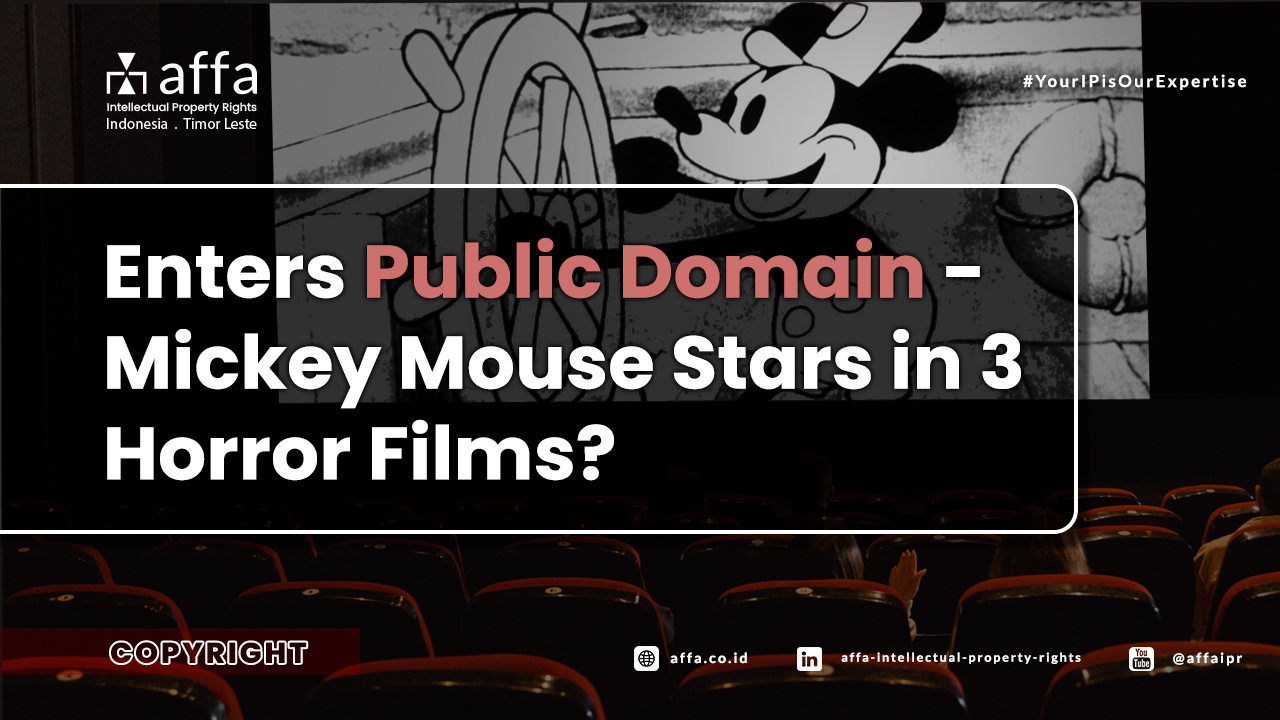
Enters Public Domain – Mickey Mouse Stars in 3 Horror Films? Mainstream news channels are busy reporting that Mickey Mouse, The Walt Disney Company’s mascot, has entered the Public Domain as of January 1, 2024. As a result, many parties are immediately looking for their fortune by presenting this black mouse in various media. Uniquely, they all have a horror theme!   1. The Vanishing of S.S. Willie Straight released on January 2, 2024, on the Night Signal Entertainment YouTube channel, this is a short film less than 10 minutes long, which assumes that the film “Steamboat Willie” published in 1928, the first film to feature the character Mickey Mouse, is an actual event.   Mickey, Minnie, and other animal characters are displayed in realistic form, covered in retro visuals, but with different names. The horror side is that their story ends tragically at the bottom of the river, contrasting with the cheerful original animated version.   2. Mickey’s Mouse Trap Also released on the same day is a 2-minute trailer for the film, which will be released in March 2024. This time, the story is about a serial killer who wears a Mickey Mouse-like mask and operates in an amusement park.   3. Steamboat Willie The third horror film to utilize Public Domain Mickey is the work of Director Steven LaMorte, who previously directed “The Mean One” (2022), a horror-comedy film inspired by “The Grinch” (2018). Steven admitted that filming of Steamboat Willie will take place this spring, and the concept remains a horror-comedy in the style of The Mean One. Steve confirmed to the media that his work would not violate the law because it would not use the name Mickey Mouse but Steamboat Willie.   4. Infestation: Origins Lastly, Mickey is in a PC game that up to four people can play. Here, you can play as a rat exterminator set in the 80s. But then, you are chased by a monster resembling Mickey Mouse! This game produced by Nightmare Forges can now be ordered on the Steam website, but the official release date has yet to be announced.   What is Public Domain? A work or Creation, including animated films, can be protected by Copyright. Then there is the Copyright Law, which regulates the validity period of Economic Rights, which is a reference for whether we still have to obtain permission from the Creator or Copyright Holder for a Work. If the validity period has passed, the work has entered the Public Domain, and the public can use it freely without asking permission from the Creator.   Why 95 Years Later? The Copyright Law in the United States stipulates that a work’s validity period is during the Creator’s life plus seventy years after the Creator dies. However, this regulation was only applied to all works published starting January 1, 1978. Meanwhile, Steamboat Willie was already present 50 years earlier. That’s why the film still has 95 years of Economic Rights and ends on December 31, 2023. Finally, Steamboat Willie only entered the Public Domain as of January 1, 2024.   Now Everyone is Free to Use Mickey Mouse? Certainly not! Because the only thing in the Public Domain is Mickey Mouse in Steamboat Willie: the Black and White Mickey without gloves. What also needs to be remembered is that as a character, two types of Intellectual Property (KI) are attached to Mickey Mouse: Copyright and Trademark.   If a copyright has an expiration validity period, then a trademark can be renewed every ten years. Mickey Mouse is a registered Trademark still owned by The Walt Disney Company. That’s why none of the works above that use Public Domain Mickey use the name “Mickey Mouse.” They consciously did not use this name to avoid legal disputes. They only dare to use “Mickey” or “Steamboat Willie,” common names not registered by anyone.   So, even though Steamboat Willie has entered the Public Domain, that doesn’t mean you are free to produce and/or sell products that contain colored versions of images or words of Mickey Mouse. The point is that Public Domain doesn’t necessarily make your own Mickey Mouse.   Mickey Mouse Still Owned by The Walt Disney Company Amid widespread news related to the Public Domain, the role of the media is needed to educate people so as not to create new problems. Because incomplete reporting can make many parties who are less aware of IP, including SMEs, subject to warning letters from Disney’s lawyers. They join in on the hype by producing products depicting colored versions of Mickey Mouse and containing the word without realizing the potential for Copyright and Trademark violations.   Remember that Walt Disney is a big company in the IP business. They understand the ins and outs of Intellectual Property law. Apart from that, they also continue to update their IP-based characters and their source of income. That is the only way the validity period of Economic Rights in Copyright can continue to be extended. Steamboat Willy is only one of tens of thousands of works featuring IP-based characters, a source of income for the Walt Disney Company. Missing one will not affect its revenue, which since 2022 will be above USD 80 billion per year.   From Walt Disney, we learn that creating original characters, if managed well, will be more profitable and provide long-term benefits. Instead of making imitation works that take advantage of the momentary hype. The public will also see it as a cheap work or a parody of no quality.   Should you need further information about Public Domain, Copyright, or other Intellectual Property management, please do not hesitate to contact us via [email protected]. Sources:  Coming Soon Variety  

Details
Unveiling-Copyright-Ownership-in-the-Film-Industry-Legal-Perspectives-affa-global

Unveiling Copyright Ownership in the Film Industry: Legal Perspectives

Unveiling Copyright Ownership in the Film Industry: Legal Perspectives There is still often a question among the public about who owns the copyright for a large-scale work, such as a movie. Because movies, especially feature films, involve many derivative works and other interrelated supporting works. Starting from scripts, background music, movie posters, and even a game specifically made to promote the movie.   So, who owns the copyright of all these works? Does the Director hold everything? Producer? Or both of them?   Definition of Copyright According to Article 1 of Law No. 28 of 2014 concerning Copyright (Copyright Law), what is meant by Copyright is the Exclusive Right of the Creator, which arises automatically based on declarative principles after a work is realized in actual form without reducing restrictions by the provisions of statutory regulations.   From the definition above, there are two essential emphases of Copyright as follows: 1. Exclusive Rights, consisting of: Economic Rights The Exclusive Right of the Creator or Copyright Holder to obtain economic benefits from the Work Moral Rights Rights that are eternally inherent in the Creator 2. Arises automatically based on Declarative Principles    No recording or registration is required to obtain protection.   Then, a Creator is a person or several people who produce a creation individually or together. Movies in the Copyright Law are referred to as Cinematography as mentioned in Article 40 Paragraph (1) letter (m), which means moving images, including documentary movies, advertising movies, reportages, or story films made with scenarios, including cartoon or animation films.   Cinematography works can be created on celluloid tape, video tape, video disc, optical disc, and/or other media that allows it to be shown in cinemas, big screens, television, or other media.   Copyright Holders of Movies/ Cinematography Works In general, 3 (three) parties are referred to as Copyright Holders, namely: Copyright Owner/Creator The party who legally receives the rights from the Creator Another party who receives further rights from the party who received the rights   However, if we talk about specific copyright holders for movie-related products, the details are as follows: Movie Related Products Types of Creation Notes Original/ raw/ in-editing process/ final movie. Copyright for Cinematographic Works Creator: Director Copyright Holder: Film Producer Script/ Story Copyright for Written Works Creator: Script/Story Writer Book – If the film is adapted from a book. Copyright for Books/Writing Works Creator: Book Author Adaptation Copyright Holder: Film Producer Book – If the film is adapted into a book. Copyright for Books/Writing Works Creator: Book Author Adaptation Copyright Holder: Book Publisher Background Music (BGM), scoring, soundtrack, sound effects, or other related music works. Copyright of Songs and/or Music Creator: Song Creator (can be assigned to Music Publisher) Related Rights: Musicians, Singers, and Record Producers Movie posters Copyright for Drawing/Painting Artworks Creator: Poster Designer Movie Exhibitions/ advertising/ promotions (photography, banners, etc.) Copyright for Photographic Works, Portraits, Databases, Video Games, Computer Programs, Appearances in the form of Written Works Creator: Photographer, Designer, and Game/Computer Programmer.   Knowing who the creator of the creations above is, if you are involved in them, especially if your position is the creator, you are entitled to Exclusive Rights to cinematographic works, valid for up to 50 (fifty) years from the first announcement.   Benefits of Copyright Recordation Also, please ensure your name is recorded in the Creation Recordation Letter issued by the Minister and in the General Register of Works, which serves as initial proof of ownership of a work and is substantial evidence in court. Even though it is not mandatory, Copyright recordation is beneficial for the following 2 (two) things: Prevent misuse of recorded works and simultaneously prevent losses arising from abuse of said works. Make it easier for Copyright owners to claim royalties for recorded Copyright licenses.   Should you have further questions regarding Copyright and its registration in Indonesia and abroad, do not hesitate to contact us via [email protected]. Sources: Law Number 28 of 2014 concerning Copyright (Copyright Law) Directorate General of Intellectual Property (DGIP)  

Details
Tips-for-Registering-Holograms-as-Trademarks-in-Indonesia-affa-global

Tips for Registering Holograms as Trademarks in Indonesia

Tips for Registering Holograms as Trademarks in Indonesia Besides Sounds and 3D objects, Holograms can be registered as Trademarks because they are equally recognized as Non-Conventional/Non-Traditional Trademarks. But what kind of Holograms can be registered as Trademarks? Do you interpret the meaning of this Hologram in the same way? Allow us to delve into the discussion.   Legal Basis For Hologram Marks In Indonesia Indonesia recognizes the existence of Hologram Marks through the elaboration of the definition of Trademark as stated in Article 1 Number 1 of Law Number 20 of 2016 concerning Marks and Geographical Indications (the Trademark Law), as follows:   A Trademark is a sign that can be displayed graphically in the form of an image, logo, name, word, letter, number, or color arrangement in 2 (two) dimensions and/or 3 (three) dimensions, sound, hologram, or a combination of 2 (two) or more of these elements to differentiate goods and/or services produced by individuals or legal entities in goods and/or services trading activities.   For a Hologram Mark to be registered, Article 4 of the Trademark Law and Article 3 of the Ministry of Law and Human Rights Regulation No.67/2016 require the attachment of a Trademark label in the form of a visual display from various sides.   This visual appearance from various sides is essential because the definition of a Hologram, according to the ‘Great Dictionary of the Indonesian Language,’ is a colored image with three dimensions on a piece of paper so that it appears as if it has arisen. So, the critical point that needs to be paid attention to for Hologram Trademarks is its embossed impression, even though it is flat, and therefore has a different color reflection effect from each side. That’s why the visual description of each side is essential and must be accurate.   Sample of Description on a Hologram Trademark For example, the Hologram Mark registered for PT. PEGADAIAN (Persero) with Application Number JID2020022485. Its appearance is only a circle, but if we look at it from various sides, an emerging effect shows the words and logos contained in it, with different effect colors appearing on each side.   So the description is, “Holograms have five image perspectives. The Front Image displays the entire hologram image (including words and logos). The Top and Right images show the words and logos in various colors. The Bottom and Left images show the words and logos in blue and purple.”   Examples of Other Hologram Marks Registered in Indonesia PT. PANCA PRATAMA INDONESIA GEN TAMEO IMAN SANTOSA Application Number: DID2022083769 Application Number: DID2022104879 Application Number: DID2020060873   From the examples of registered Hologram Marks above, it appears that words, logos, and even facial photos can be submitted as Hologram Marks, provided they do not conflict with administrative and substantive requirements. Furthermore, assuming that the application does not encounter opposition or rejection, it will only take 10-13 months from the application to obtaining the registration number.   So, have you imagined the Hologram Mark that you want to register for your business?   Should you have further questions regarding the requirements and registration of Hologram Marks in Indonesia or abroad, do not hesitate to contact us via [email protected]. Source: Directorate General of Intellectual Property

Details
Patent-Prosecution-Highway-between-Indonesia-and-South-Korea-affa

Patent Prosecution Highway between Indonesia and South Korea

Patent Prosecution Highway between Indonesia and South Korea Starting this December, the Indonesian Patent Office (DGIP) and the Korean Intellectual Property Office (KIPO) began implementing the Patent Prosecution Highway (PPH) program. This program aims to ensure that South Korean companies entering Indonesia can obtain Patent Examinations more quickly, from 40 months to just 18.4 months.   This KIPO PPH collaboration with DGIP is the 10th Bilateral PPH after previously collaborating with IMPI (Mexico – July 1, 2012), IPOPHL (Philippines – May 1, 2015), TIPO (Taiwan – July 1, 2015), EAPO (Eurasia Patent Office – January 1, 2019), IPVN (Viet Nam – June 1, 2019), SAIP (Saudi Arabia – July 1, 2019), INPI (Brazil – April 1, 2020), and MyIPO (Malaysia – December 1, 2020 ), INPI (France – September 1, 2022). It is called Bilateral PPH because it is still a pilot program, before finally becoming Global PPH, as has been implemented in IP5 countries (China, Japan, USA, & EU) and other 24 countries, such as the UK, Singapore, Australia, and Russia.   The Basic Concept PPH  Where an Office of First Filing (OFF) has assessed the patentability of a Patent Application, an Office of Second Filing (OSF) offers the Applicant accelerated examination for the corresponding Application, provided that certain conditions are met. Those conditions include sufficient correspondence in the claims of the two applications and the search and examination results of an OFF being made available to an OSF.   Under the PPH program, the examination results of an OFF are used to expedite the application process in an OSF, thereby reducing the workload and improving patent quality. If deemed patentable by an OFF, the corresponding application is filed in advance for accelerated examination in an OSF.   This PPH program is divided into two categories: PPH using the National Work Products and PPH using the PCT International Products from the KIPO. The following are the procedures for each category:   1. PPH using the National Work Products from the KIPO Applicants can request accelerated examination by a prescribed procedure including submission of relevant documents on an application filed with the DGIP and satisfies the following requirements under the DGIP-KIPO Patent Prosecution Highway (PPH) pilot program based on the KIPO application.   When filing a request for the PPH pilot program, an applicant must submit a request form to the DGIP.   The offices may terminate the PPH pilot program if the volume of participation exceeds a manageable level, or for any other reason. Ex Ante notice will be published if the PPH pilot program is terminated. The PPH pilot program will be in effect for three (3) years commencing on 8 December 2023 and will end on 8 November 2026. However, the program may be extended after a joint DGIP – KIPO review and assessment of the program implementation.   Requirements a. Both the DGIP application on which PPH is requested and the KIPO application(s) forming the basis of the PPH request shall have the same earliest date (whether a priority date or a filing date). For example, the DGIP application (including the PCT national phase application) may be either: an application that validly claims priority under the Paris Convention from the KIPO application(s) except for a complex priority. Example: A. Paris Route B. PCT Route C. PCT Route – Domestic Priority D. Paris Route – Complex Priority E. Paris Route – Divisional Application F. PCT ROUTE an application that provides the basis of a valid priority claim under the Paris Convention for the KIPO application(s) (including PCT national phase application(s)). Example: A. Paris Route   B. PCT Route a PCT national phase application where both the DGIP application and the KIPO application(s) are derived from a common PCT international application having no priority claim. Example: A. Direct PCT Route B. Direct PCT & Paris Route C. Direct PCT & PCT Route D. Direct PCT & PCT Route   b. Patent applications have been initiated in the Office of the KIPO or the DGIP. Patent applications belong to a patent family of which at least the earliest application was filed with the DGIP or the KIPO acting as a national office. The DGIP application which validly claims priority direct PCT applications is also eligible. Example: A. Paris Route BUT the First Application is from the Third Country B. PCT Route BUT the First Application is from the Third Country c. At least one corresponding application exists in the KIPO and has one or more claims that are determined to be patentable/allowable by the KIPO. The corresponding application(s) can be the application that forms the basis of the priority claim, an application derived from the KIPO application that forms the basis of the priority claim (e.g., a divisional application of the KIPO application or an application that claims domestic priority to the KIPO application, example:   or a KIPO national phase application of a PCT application.  Example: A. PCT Route B. Direct PCT Route C. Direct PCT & PCT Route D. Direct PCT & PCT Route Claims are “determined to be patentable/allowable” when the KIPO examiner identifies the claims as patentable/allowable in the latest office action, even if the application is not granted for patent. The office’s action includes: Decision to Grant a Patent Notification of Reasons for Refusal Decision of Refusal Appeal Decision For example, if the following routine expression is described in the “Notification of Reason for Refusal” of the KIPO, those claims are clearly identified to be patentable/allowable. “<Claims which has been found no reason for refusal> At present for an invention concerning Claim, no reason for refusal is found.”   d. All claims on file, as originally filed or as amended, for examination under the PPH must sufficiently correspond to one or more of those claims indicated as patentable/allowable in the KIPO. Claims are considered to “sufficiently correspond” where, accounting for differences due to translations and claim format, the claims in the DGIP are of the same or similar scope as the claims in…

Details
5-Common-Types-of-IP-Violation-in-Indonesian-E-Commerce-affa-global

5 Common Types of IP Violation in Indonesian E-Commerce

5 Common Types of IP Violation in Indonesian E-Commerce The presence of e-commerce has changed the shopping habits of Indonesians. Statista Market Insights data predicts that users by the end of this year will reach 196.47 million, or an increase of more than 22 million since 2022.  The Central Bank of the Republic of Indonesia also stated that the value of e-commerce transactions in 2022 will reach IDR 476.3 trillion. This number is predicted to continue to increase because active e-commerce users in Indonesia still account for only around 30% of transactions in cyberspace.   By now, opening an e-commerce site or app is the easiest way to compare the cheapest product we want. However, with all this convenience, you must still be aware of the potential for Intellectual Property violations in e-commerce. You need to remember that even though the platform organizers have tried to carry out sorting even with AI, it will only be helpful if you, who have self-screening capabilities, are easily tempted by the low prices of products that should be expensive.   Counterfeit goods are not the only potential for Intellectual Property (IP) violations in e-commerce; there are at least 5 (five) types of IP violations, which we can describe as follows:   1. Sale of Counterfeit Goods Even when selling fake goods, the method is more sophisticated, not blatantly using names or products with very different qualities. a. Photos taken from the official site; Suppose the seller is not an official store but uses an official photo. In that case, you should immediately be suspicious and use your right to ask for some actual photos of the product before making a transaction.   b. Preloved with invoice; If the seller uses pictures that show an invoice with the product, like pretending it was purchased from an official store, please don’t hesitate to ask for some photos of the actual product before making a transaction.   c. Normal price for a counterfeit product; If you are a collector of specific brands, you must know the shape, color, or placement of the official logo on the product. You may also know how many variants are produced for this season, including the look of the limited variants. So you won’t be deceived when you find a product with a different color, which shouldn’t be available in the market, even though it is the same price as the original product.   d. Using the word ORI or SUPER ORI or HIGH GRADE; The word “ori,” which means original, should only be used for authentic products. However, sellers of counterfeit goods have recently used this word to attract buyers. Moreover, if the inclusion of the word “ori” is coupled with the price of the item being much cheaper, you should be suspicious of its authenticity.   e. Cheap products directly from the factory. It would be best if you were also wary of this description when you find a cheaper good on e-commerce. Only official stores or distributors can do this if the product comes from Indonesia and gets wholesale price benefits. Another possibility is stolen goods that are not complete or of bad quality. Are you sure you still want to buy something like that?   2. Promoting Product Without Verification This type is the same as in the first category; the difference is that it involves the lure of a big discount, which results in the price being much lower than the market, but it is not sold by official stores or distributors (which in the same time are not providing the same promotions). Apart from the possibility that what is being sold is not a genuine product, it could also be that the product is smuggled without paying official import taxes, with questionable completeness and quality.   3. Selling Irresponsibly Through E-Commerce Sometimes, some health and beauty products are sold using a “direct selling” scheme, and sale activities via e-commerce are prohibited. Because their exclusive products are only sold through direct selling methods to downlines/registered members. So direct sales to the public (non-members) are a violation because they destroy the agreed business scheme and membership system.   4. SOPs for IP Violations in E-Commerce Are Not Yet Standardized Even though e-commerce has acted as an intermediary that will hold funds from buyers and return them if there is a problem with the goods, there are still loopholes that allow transactions to be completed even though the goods have a problem. For example, the buyer forgets to unbox with a video or only immediately checks the item’s authenticity after the deadline. If you are caught in this problem, the procedures of complaint from each e-commerce are not standardized. The absence of customer service that truly understands the situation makes this even more difficult. Especially if the customer service is entirely automated without involving humans.   5. Borderless E-Commerce Platform With the increasingly open cross-border international trade through e-commerce, you must understand the risks of purchasing goods outside Indonesia. If you find lower prices for goods, even though they are shipped from abroad, and you know that there is an official distributor in Indonesia, your vigilance needs to be increased even more. Because there could be an IP violation in the form of distribution without permission/violating the law/not paying import tax, which is not impossible, within the time frame of the order process, the police arrest the seller in the country of origin, and you will not get the goods you want.   All of the IP violation practices above harm you as a buyer and significantly impact the country. These losses include: Negative Reputation of Indonesian From the latest Priority Watch List (PWL) 2023 report, released by the United States Trade Representative (USTR), Indonesia, along with Argentina, Chile, India, Russia, China, and Venezuela, is still on the investment blocklist because it is prone to piracy practices. In particular, the Notorious Markets for Counterfeiting and Piracy 2022 report, also released by USTR, lists several local e-commerce sites…

Details
3-Crucial-Roles-of-Trademarks-in-the-Property-Business-affa-global

3 Crucial Roles of Trademarks in the Property Business

3 Crucial Roles of Trademarks in the Property Business After being hit by the COVID-19 pandemic, property growth in Indonesia has shown promising developments in recent years. Property development projects resume after investors return, thanks to lower bank interest rates and regulations more conducive to foreign property investment in Indonesia, especially for those seeking long-term profits.   As one of Indonesia’s popular tourist destinations, Bali could be the most exciting example. Data from the Central Bank of the Republic of Indonesia shows that house prices in Bali only increased by 1% in the second quarter of 2023 compared to the previous quarter. In terms of market growth, it is estimated to continue to grow in 2024, thanks to the support of tourism, infrastructure investment, and increasing foreign demand. Bali continues to attract the interest of foreign investors looking for a place to live or invest in the promising property market.   The properties in question are premium housing, hotels, resorts, and villas. Luxury properties such as villas in elite areas in Bali are sought after not only by local investors but also by foreign investors from Japan, South Korea, and Australia.   With the growth rate predicted to be increasingly rapid, it is unsurprising that new property names will emerge from this industry, whether independent/boutique or under the auspices of large groups, which are similar but different. How do we ensure that the property named “AAA” in Ubud has the same quality as the properties named “AAA” in Kuta? Could they only have the same name, but the quality is very different? Do practices like this disadvantage property entrepreneurs?   These problems can be avoided if you register your property name and/or logo as a Trademark. There are at least three main benefits that you can get from a registered property Trademark, and those three benefits are:   1. Building Image Through Trademark This is where we must start to be aware of the importance of registered Trademarks. Your property Trademark must be registered as a first step in building an image. A Trademark registered with the Directorate General of Intellectual Property of the Republic of Indonesia in Class 36 will protect the property business name and logo as Intellectual Property that you own. Thus, you are the exclusive owner of the name and logo. Only you have the right to use it, and building your image can begin. Furthermore, you can assure customers that the quality of service at every “AAA” property name you own will always be maintained. In other words, consumers can identify comfort, safety, or excellent quality with your property Trademark.   2. Registered Trademark Prevents Piracy Registration of a Trademark on the property can also prevent the criminalization of a brand used by other parties. Imagine the luxurious and comfortable image you have built suddenly damaged due to the appearance of the same property name created by someone you don’t know. A lousy property review may affect the image of your property. The property has nothing to do with you. If your property Trademark is already registered, you can take all necessary legal steps to stop the use of your Trademark by other parties. Since Trademark registration in Indonesia applies the first-to-file principle, meaning that the rights are given to the first registrant, you must register your Trademark as soon as possible before being preceded by another party. On the other hand, if you have yet to register a Trademark on your property while another party has appeared as the legal owner of the name you used, you could lose the right to use the name on the property you have built so far. Another party can ask you to pay a hefty amount due to your negligence in registering the  Trademark on your property.   3. Trademark Increases Property Value With a registered Trademark and a maintained image, your business expansion can continue to increase due to investment from within and outside the country. As an intangible asset, a Trademark becomes an added selling point for you in providing licenses to parties interested in building new properties using the name of the property you own. If your property business already has a registered Trademark, business expansion can be done as a franchise. You can read in our previous article how licensing and franchise businesses can increase the benefits of your brand.   Considering the importance of Trademark registration in the property business, you don’t need to think long about registering the property Trademark that has been the focus of your business for so long. If you have any more questions about property Trademark registration, please don’t hesitate to contact us via [email protected]. Source: Miraland.id Detik.com Directorate General of Intellectual Property

Details
Tips-for-Registering-3D-Objects-as-Trademarks-in-Indonesia-affa-global

Tips for Registering 3D Objects as Trademarks in Indonesia

Tips for Registering 3D Objects as Trademarks in Indonesia In the public mind, the meaning of a Trademark is often limited to just a name, word, or logo. As we explained in the previous article, a Trademark can also be a sound. Along with the times and increasing human creativity, Trademarks as differentiators of goods and/or services can also be registered in 3-dimensional (3D) form. If they have differentiating power, logos in 3D form, unique product shapes or packaging, and even shop layouts can be registered as Trademarks in Indonesia.   Legal Basis For 3D Marks In Indonesia Indonesia recognizes the existence of 3-Dimensional Marks through the elaboration of the definition of Trademark as stated in Article 1 Number 1 of Law Number 20 of 2016 concerning Marks and Geographical Indications (the Trademark Law), as follows:   A Trademark is a sign that can be displayed graphically in the form of an image, logo, name, word, letter, number, or color arrangement in 2 (two) dimensions and/or 3 (three) dimensions, sound, hologram, or a combination of 2 (two) or more of these elements to differentiate goods and/or services produced by individuals or legal entities in goods and/or services trading activities.   For a 3D Mark to be registered, Article 4 of the Trademark Law and Article 3 of the Ministry of Law and Human Rights Regulation No.67/2016 require the attachment of a Trademark label in the form of the characteristics of the Mark in the form of visuals and a description of the protection claim.   Types of 3D Marks A 3D Mark is a sign that has elements of length, width, and height or has volume, as in the following scope:   Product What is meant by Product here is not only the shape of the product itself, which is unique, such as Zippo lighters but the Sari Roti mobile cart is also registered as a 3D Mark.   Packaging This category is the most frequently registered 3D Mark. The most famous examples are Coca-Cola glass bottles, Toblerone chocolate, and Yakult bottles.     Character/ Mascot Currently, the presence of mascots cannot be separated from the presence of theme parks or various significant events such as the Olympics. Each event has unique characters that become symbols and represent the spirit of all contingents and the host country. Registered Mascots can then be licensed and presented in various performances and product derivatives, thus becoming a source of income for the Trademark holders.     Position Famous examples of this Position Mark are the Red label on the pocket of Levi’s jeans, the yellow thread stitching on the sole of Dr. Martens, and the Red soles on Louboutin shoes.     Layout Perhaps you still don’t know that your restaurant layout can be registered as a Trademark. With a certain uniqueness, visitors can immediately feel the difference when entering your shop just from the layout alone. Examples of layouts registered as Trademarks are the Apple Store and Kiko, a cosmetics store from Italy.   So, how do you register them as Trademarks? Here are the tips: Unique A Trademark can be registered if it has overall distinctive power, as long as these elements can be identified as product identity. So, you must ensure that the 3D shape you are registering has characteristics that distinguish it from similar products. Distinctive If your product is not distinctive enough but contains a distinctive element, it is sufficient to make it function as a whole product identity. However, it would be best if you made sure that your additional characteristics can change the impression of the overall shape, for example, in the 3-Dimensional Mark in the Position category.   Furthermore, the examination will be based on the graphical representation submitted, not the actual size. So, the image provided must display these different elements. Proportions are significant, but there are no special requirements regarding this.   How is it different from Industrial Design? The uniqueness of 3D Marks, especially for product packaging, can potentially clash with other Intellectual Property (IP) regimes, such as Industrial Designs and Patents. Therefore, you’ll need to study it before submitting the application to get maximum benefit from the protection and anticipate legal consequences that may happen in the future.   What differentiates 3D Marks from Industrial Designs is that the protection period can be extended for Trademarks, whereas Industrial Designs are only ten years and cannot be extended. Apart from that, in Industrial Design, aesthetic value and novelty are the main factors. Uniquely, one product can have two IP protections simultaneously, as a Trademark and an Industrial Design. This is possible if the product meets the terms and conditions of the Trademark and Industrial Design Law.   3D Marks can also intersect with Patents if they have technical aspects or contain functional forms. However, if an item is protected as a patent, it cannot receive protection as a trademark. This rule is based on Government Regulation in Lieu of Law No.2 of 2022 concerning Job Creation Article 20 letter (g) in number (1) in Article 108 of Law Number 11 of 2020 concerning Job Creation.   In the end, we hope you can determine whether the product you own is more appropriately registered as a 3D Mark, Industrial Design, or Patent. However, if you still have questions or need further information regarding 3D Marks, please get in touch with us via [email protected]. Source: Directorate General on Intellectual Property (DGIP)

Details