Trademark Freeriding Legal Risks and Solutions in Indonesia - AFFA IPR

Trademark Freeriding: Legal Risks & Solutions in Indonesia

According to the Indonesian Dictionary (KBBI), hitchhiking is participating (eating, riding in a vehicle, etc.) without paying. This word is used in colloquial language and is often associated with someone taking advantage of an opportunity without any contribution or cost.   Freeriding Trademarks are also often carried out to take advantage of the popularity of an existing Trademark or even a Well-known Mark to increase exposure and make it easier to sell. For example, opening a ramen shop with a logo that resembles and displays the Ultraman character, opening an amusement park called Squid Game, or opening a car rental business and naming it Gulfstream.   Is this practice justified? What are the legal consequences for the hitchhiker and the actual owner?   A Trademark is the Exclusive Right of the Trademark Holder   Exclusive Trademark Rights are rights granted to Trademark Holders who have been officially registered to use the Trademark in the trade of goods or services. These Exclusive Rights allow the holder to prohibit other parties from using the same or similar Trademark for goods and/or services in the same class without permission.   In Indonesia, Trademarks as Exclusive Rights are regulated in Article 1 of Law Number 20 of 2016 concerning Trademarks and Geographical Indications (Trademark Law), where registered Trademark Holders have Exclusive Rights for a certain period by using the Trademark themselves or granting permission to other parties to use it. Thus, Trademark Holders can prohibit other parties who, without permission, use the same Trademark on the same goods and/or services, Trademarks that are the same as their registered Trademark on the same goods and/or services, or Trademarks that are the same or basically the same as their registered trademark for similar goods and/or services.   Thus, if another party without permission utilizes the existence of a registered Trademark, it can be considered a Trademark violation.   Sanctions for Trademark Violators   For the use of a Trademark without permission, Article 100 of the Trademark Law regulates criminal sanctions of imprisonment and/or fines as follows:   Using the same Trademark: A maximum of 5 years in prison and/or a maximum fine of IDR 2 billion. Using a similar Trademark: A maximum of 4 years in prison and/or a maximum fine of IDR 2 billion.   Legal Ways to Freeriding on Registered Trademarks   Several steps can be taken to use a Registered Trademark in Indonesia legally. These steps are as follows:   Trademark License: The most common step is to obtain a license from the registered Trademark owner. This license is an agreement between the Trademark Owner (Licensor) and the Other Party (Licensee), which grants the Licensee the right to use the Trademark according to the agreed terms. To obtain it, you must contact the Trademark Owner and negotiate and sign a License Agreement determining the scope of use, duration, territorial coverage, and exclusivity. Franchise Agreement: If the registered Trademark is part of a Franchise, you can join it through the available Franchise Agreement. Through this agreement, the franchisor will grant you (the franchisee) the right to use the Trademark and its business system. Usually, a Franchise also involves transferring business knowledge, training, and operational support.You might also want to read: Similar But Not The Same – The Difference Between Franchising and Licensing in Indonesia   Co-Own of a Trademark: Sometimes, two or more parties may agree to use a Trademark together. This requires a detailed agreement and ensures that all parties understand their rights and obligations, including how the Trademark will be managed. If this joint use results in a change of ownership, you must submit the change to the Directorate General of Intellectual Property (DGIP) or through a reliable Trademark Consultant. Trademark Transfer: Another alternative is to purchase the rights to the Trademark from the current owner, the provisions of which are regulated in the Trademark Transfer. Uniquely, the Trademark can be transferred while still in the application process status, provided that the deed of transfer that the notary has legalized is recorded at the DGIP to be fully binding. The transfer must cover all classes of goods and/or services of the transferred Trademark. File a Trademark Cancelation Action: If you believe the previous owner has not used the Trademark you will use for 5 (five) consecutive years, then you can appoint an experienced Trademark Consultant to file a Trademark Cancelation Action with the Commercial Court. The Panel of Judges will then order DGIP to delete the Trademark you wish to use. However, you have also submitted a registration application for the Trademark you want to use.   You might also want to read: A Win for the “WIN” – AFFA Represents Hongyunhonghe Tobacco (Group) Co. Ltd. for a Successful Trademark Non-Use Cancellation in Indonesia Should you need more information about Trademark protection or registration in Indonesia and/or abroad, do not hesitate to contact us through email: [email protected].

Details
The Legal Risks of Selling (Unauthorized) T-Shirts with Popular Character Images - AFFA IPR

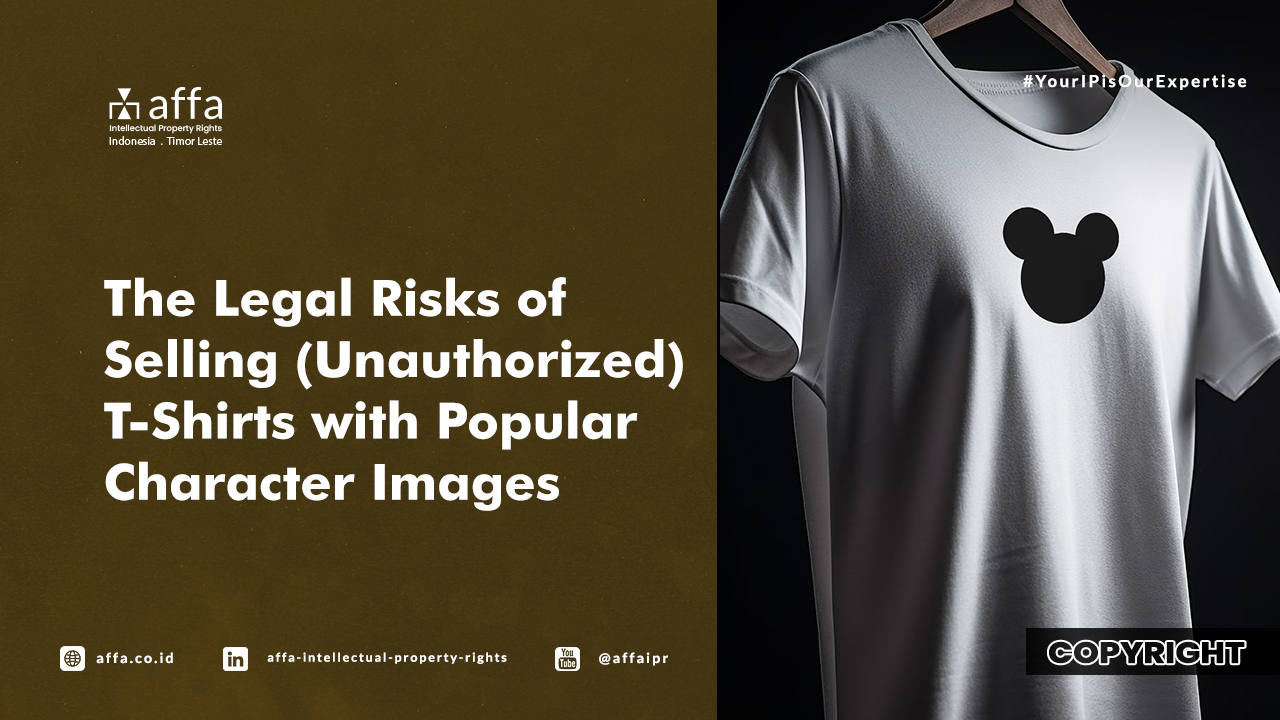
The Legal Risks of Selling (Unauthorized) T-Shirts with Popular Character Images

We can still easily find t-shirts with popular character images in small stores, shopping centers, exhibitions, and e-commerce in Indonesia. For those of you who are fans of popular culture from within and outside the country, the presence of t-shirts with characters that you like, sometimes with attractive designs, and also at low prices, is very tempting to buy.   But what if these t-shirts are not licensed or use the images without permission? Are there any legal consequences for the buyer? Here is the discussion from the Intellectual Property law perspective that applies in Indonesia.   Legal Standing   Article 40 of Law Number 28 of 2014 (Copyright Law) has recognized that works of fine art in all forms, such as paintings, drawings, carvings, calligraphy, sculptures, statues, or collages, photographic works, to cinematographic works that are closely related to popular culture, are protected creations. Therefore, the state guarantees that Exclusive Rights consisting of Moral Rights and Economic Rights are given only to the Work’s Creator, Copyright Holder, and/or Related Rights Owner.   This Copyright Law also covers all works or Creations and/or Related Rights products and users of Creations and/or Related Rights products from Indonesian Citizens and non-Indonesian citizens, non-Indonesian residents, or those who are not Indonesian legal entities, with the following provisions: Their country has a bilateral agreement with the Republic of Indonesia regarding the protection of Copyright and Related Rights; or Their country and the Republic of Indonesia are parties or participants in the same multilateral agreement regarding Copyright and Related Rights protection.   The point is that it is inevitable that all works born from popular culture originating from abroad will be recognized as copyrighted in Indonesia. Therefore, all activities of utilization, duplication, distribution, and commercialization must have the permission of the Creator, Copyright Holder, and/or Related Rights Owner. Otherwise, it will be categorized as piracy!   This piracy is regulated explicitly in Article 1 of the Copyright Law, where it is clear that what is meant by Piracy is the unauthorized duplication of Creations and/or Related Rights products and the widespread distribution of the resulting duplication goods to obtain economic benefits.   Penalties for Piracy   Article 113 Paragraph (4) of the Copyright Law states explicitly that “Any person who fulfills the elements as referred to in paragraph (3), which is carried out in the form of piracy, shall be punished with imprisonment for a maximum of 10 (ten) years and/or a maximum fine of Rp. 4,000,000,000.00 (four billion rupiah).”   Terrible sanctions, right? Unfortunately, this criminal threat has not been appropriately socialized because many still do not understand the term piracy. There is even a glorification for successful SMEs by commercializing the use of characters protected by copyright without permission. Finally, this Piracy activity continues rampant without understanding its negative impacts. In fact, Copyright is important to protect.   You might also want to read: Media Missteps: 5 Intellectual Property Blunders to Avoid   5 Reasons Why Copyright is Important Copyright protection is an important part of the legal system that supports economic justice and innovation, with the following details:   Respecting Creators: Protecting copyright ensures that creators of works receive proper recognition and compensation for their work. This provides an incentive to continue innovating and creating. Encouraging Creativity: With copyright protection, individuals and companies are more likely to invest time and resources in creating new works because they can expect a return. Regulating the Use of Works: Copyright gives owners control over how their work is used, shared, or modified, helping to prevent misuse or unauthorized use. Economic Growth: Copyright supports the creative industry, significantly contributing to economic growth through job creation and tax revenue. Consumer Protection: It helps ensure that consumers get original, high-quality products, not imitations or pirated goods.   Therefore, if piracy occurs, all of the above points will be disrupted, from a low appreciation for creators, stagnant creativity, weak distribution supervision, and low product quality to worsening Indonesia’s ranking in the International Intellectual Property Index.   Your Contribution is Needed   If you have already bought a pirated t-shirt, you don’t need to worry about legal sanctions. Because in Indonesia, criminal sanctions are mainly aimed at those who produce, distribute, or sell pirated goods, not at buyers. The Indonesian Copyright Law focuses on parties who actively violate Copyright by reproducing, producing, or distributing works without the permission of the Copyright Holder.   However, although buyers of pirated goods are generally not faced with criminal sanctions, buying pirated goods is unethical because it supports an illegal industry that harms the original Creators and the creative industry. Buying pirated goods can also harm consumers because the goods often do not meet quality and safety standards.   You must realize that choosing legitimate and licensed products is the best way to support Creators and ensure that the products received are safe and of good quality. In addition, buying original products contributes to healthy economic growth and innovation for society.   You might also want to read: Intellectual Property Infringements in Indonesia: A Closer Look at Online Hypocrisy Should you need further information regarding Copyright protection in Indonesia, you can contact us via email: [email protected].

Details
Legal Implications of Couterfeit Drugs in Indonesia - AFFA IPR

Legal Implications of Counterfeit Drugs in Indonesia

According to the World Health Organization (WHO), more than 890 million people worldwide suffer from obesity, driving high demand for weight-loss medications. One of the most popular drugs is Ozempic, produced by Novo Nordisk (NOVOb.CO), which generated nearly $19 billion in net sales last year. Ozempic’s active ingredient, semaglutide, leads to an average weight loss of 15% by reducing food cravings and slowing stomach emptying. However, this success comes with a steep price—over $1,000 for a month’s supply in the U.S.   Despite its effectiveness, the high price of Ozempic has opened the door to counterfeit versions. A fake Ozempic batch number MP5B060 has surfaced in at least 10 countries, from Azerbaijan to North Macedonia. The WHO issued a warning in July 2023 about products carrying this batch number, and Interpol also raised concerns about insulin pens being relabeled and repackaged to resemble Ozempic.   While some countries have banned the affected batch, others have not, leading to dangerous consequences. In at least four countries, fake Ozempic pens have resulted in hospitalizations. For instance, in Iraq, a man fell into a coma after using a counterfeit pen that caused his blood sugar to drop to dangerously low levels.   The Global Impact of Counterfeit Drugs   Since early last year, at least 18 different batch numbers have been found on fake Ozempic pens in 14 countries. Despite warnings, the issue persists because the solution is far from simple. Each legitimate batch of Ozempic contains 280,000 pens, and some countries are reluctant to withdraw entire batches due to the risk of exacerbating drug shortages.   Novo Nordisk has blamed international counterfeit drug syndicates, stating that they easily buy genuine products and replicate the codes to create fake ones. Rather than manufacturing packaging from scratch, these syndicates buy cheaper drugs with similar packaging and relabel them as Ozempic, making it difficult for consumers to identify the difference. This has led to severe health consequences, as unsuspecting buyers end up with insulin rather than semaglutide, leading to severe hypoglycemia.   No Packaging Change: The Ongoing Risk   Novo Nordisk has no immediate plans to change Ozempic’s packaging or register it as a new Industrial Design, stating that counterfeiters would simply find new ways to replicate the new design. This leaves consumers at risk and underscores the importance of being vigilant.   Finally, we must increase our vigilance by implementing the following steps: Only buy from authorized distributors. Always check the batch code to ensure you have a legitimate product. Don’t be tempted by low prices, especially for imported drugs.   If This Happens in Indonesia, What Are the Legal Sanctions?   This situation can be overcome with more decisive action from the supervisory authorities. In Indonesia, for example, there is Indonesia’s National Agency of Drug and Food Control (BPOM), which is proactive in conducting raids and monitoring updates related to counterfeit drug products from abroad; these drugs can be withdrawn from circulation before they harm consumers and damage the reputation of the original product.   BPOM has also been equipped with BPOM Regulation Number 16 of 2023 concerning Supervision of the Distribution of Traditional Medicines, Quasi Drugs, and Health Supplements, which gives them the authority to impose administrative sanctions in the form of cancellation/revocation of distribution permit numbers, Importer recommendations; and/or recommendations of business entities in the marketing sector if the business is proven to receive, store, and/or distribute illegal drugs including counterfeit drugs (Article 23b).   Meanwhile, if viewed from the perspective of the Trademark as regulated in Article 100 Paragraph (2) of Law Number 20 of 2016 concerning Brands and Geographical Indications, anyone who violates another person’s registered Trademark, whose type of goods causes health problems, environmental problems, and/or human death, shall be punished with a maximum imprisonment of 10 (ten) years and/or a maximum fine of IDR 5,000,000,000.00 (five billion rupiah).   Viewed from the perspective of Law Number 8 of 1999 concerning Consumer Protection as regulated in Article 8, where this article expressly prohibits business actors from producing or trading goods that do not meet or violate the required standards, including the sale of counterfeit drugs. Violation of this article can be subject to a maximum imprisonment of 5 years or a maximum fine of IDR 2 billion. Article 19 also states that the seller is responsible for all losses experienced by consumers due to the use of counterfeit products. Consumers have the right to claim compensation, which can be filed through a civil lawsuit.   No less critical, Law Number 17 of 2023 concerning Health, specifically Article 435 states that anyone who produces or distributes Pharmaceutical Preparations and/or Medical Devices that do not meet the standards and/or requirements for safety, efficacy/benefit, and quality as referred to in Article 138 paragraph (2) and paragraph (3) shall be punished with imprisonment for a maximum of 12 (twelve) years or a maximum fine of IDR 5,000,000,000.00 (five billion rupiah).   You might also want to read: Anti-Counterfeiting Methods: Choose the Right Strategy to Get Additional Protection for Your Intellectual Property   Should you need more information on protecting Intellectual Property both domestically and internationally, feel free to contact us at [email protected]. Source: Reuters  

Details
Understanding Trade Secret Laws in Indonesia: Scope and Consequences - AFFA IPR

Understanding Trade Secret Laws in Indonesia: Scope and Consequences

Trade Secrets are the recipe for business success in various fields, such as culinary, IT, pharmaceuticals, and biotechnology.   The public often seeks ways to discover or exploit these “secrets to success” through various means, including claiming and exposing these secrets on social media.   So, what exactly are the scope and consequences for disclosing Trade Secrets? We’ve summarized it for you.   Trade Secrets are governed by Law No. 30 of 2000 concerning Trade Secrets (Trade Secret Law). The definition of Trade Secrets, as outlined in Article 1, point 1, of the Trade Secret Law, is information that is not generally known to the public in the field of technology and/or business and has economic value because it is helpful in business activities, and is kept confidential by the owner of the Trade Secret.   So, what does a Trade Secret encompass?   Article 2 of the Trade Secret Law describes the scope of Trade Secret protection as follows:   Production Methods Various steps and technologies are used to convert raw materials into finished goods. Processing Methods Methods focusing on the steps necessary to alter or modify the properties of raw materials. Sales Methods Various strategies or methods to sell products or services to consumers, considering variables like target market, product type, and sales objectives. Other Information in Technology or Business This category includes product development research, customer data, agreements with third parties, and future business strategies. Economic Value Have other secrets that provide a competitive market advantage and financial potential. Not Known to the General Public The information is not a “public secret,” meaning it is known only to certain parties and not widely known by the general public.   A common dilemma for business owners is whether to file a Patent for their Trade Secret or keep it confidential indefinitely.   However, you should know that there is a criminal penalty of up to 2 (two) years imprisonment and/or a fine of up to IDR 300,000,000 (three hundred million rupiah) for parties without permission, using the Trade Secret.   To protect your Trade Secret, here are a few options to consider:   Document all methods and/or other information as thoroughly as possible. Keep the information confidential by drafting a Non-Disclosure Agreement (NDA) signed by all parties involved. Update the documentation whenever there are updates to the methods and/or other information related to the Trade Secret.   Additionally, you can implement access restrictions or encrypted technology to secure confidential documents, preventing unauthorized access.   However, you want to license your Trade Secret to a third party. In that case, you must record it with the Directorate General of Intellectual Property (DGIP) to obtain legal protection from unauthorized third-party violations. Should you need more information on Trade Secret protection in Indonesia, you can contact us via email: [email protected].

Details
Anti-Counterfeiting Methods: Choose the Right Strategy to Get Additional Protection for Your Intellectual Property - AFFA IPR

Anti-Counterfeiting Methods: Choose the Right Strategy to Get Additional Protection for Your Intellectual Property

Counterfeiting is a pervasive issue that threatens the integrity of Intellectual Property (IP) across various industries. From luxury goods to pharmaceuticals, counterfeit products not only harm brand reputation but can also endanger consumers. In this article, we will explore the most effective anti-counterfeiting methods available and guide you in choosing the right strategy based on the type of IP you seek to protect.   Before diving into anti-counterfeiting methods, it is crucial to understand what counterfeiting is and its broad impact. Counterfeiting involves the unauthorized production of goods that imitate genuine products, leading to financial losses, reputational damage, and potential legal liabilities. And that’s something you want to avoid.   Anti-Counterfeiting Methods Overview   In addition to registering and/or recording your Intellectual Property with the Directorate General of Intellectual Property (DGIP) of the Ministry of Law and Human Rights (Kemenkumham) or IP Customs Recordation, several other methods are available to strengthen the protection of your IP. But each comes with strengths and weaknesses. These methods can be categorized into physical and digital solutions, as well as legal and technological approaches.   Physical Anti-Counterfeiting Methods Holograms and Security Labels Holograms and security labels are widely used to authenticate products. These features are difficult to replicate, making them an effective deterrent against counterfeiters. This method appropriate for Trademarks, Patents, and Copyright-protected products such as luxury goods, pharmaceuticals, electronics, and official documents. Watermarks Watermarks are subtle marks embedded into materials like paper or textiles. They are invisible under normal conditions but can be seen when held against light. This method appropriate for Copyright-protected works, Industrial Designs, and legal document for Trade Secrets. Unique Serial Numbers and Barcodes Unique identifiers such as serial numbers and barcodes are used to track products throughout the supply chain. This method appropriate for Patented products, Trademarks, or hi-regulated products such as electronics, pharmaceuticals, and automotive parts.   Digital Anti-Counterfeiting Methods   RFID Tags and QR Codes Radio-frequency identification (RFID) tags and QR codes store product information that can be scanned to verify authenticity. This method appropriate for Trademarks, Patents, or products that require real-time tracking, like fashion items, electronics, and pharmaceuticals. Blockchain Technology Blockchain provides a decentralized ledger that records every transaction associated with a product. This method offers a transparent and tamper-proof way to verify product authenticity. This method appropriate for Patented products, Trademarks, or products with high levels of security, such as luxury goods, fine art, and collectibles. Digital Watermarking Digital watermarking embeds information directly into digital media, such as images, videos, or audio files, which can then be used to verify authenticity. This method appropriate for Copyright-protected digital content like music, videos, images, and software.   Selecting the Right Anti-Counterfeiting Method The best anti-counterfeiting strategy depends on the type of IP you are protecting and the specific threats you face. Here’s a brief guide:   Trademarks Consider using physical security features like holograms and security labels, along with digital solutions such as RFID tags or blockchain for high-value items.   Patents Employ unique serial numbers, barcodes, and blockchain to ensure product integrity and traceability.   Copyrights Use digital watermarking for digital media and watermarks for physical documents or packaging. In this digital era you can choose invisible watermark by using steganography.   Trade Secrets Focus on strong legal protections and technological solutions like encryption to prevent unauthorized access and copying.   Counterfeiting remains a significant challenge for IP owners, but by employing the right combination of anti-counterfeiting methods, you can effectively protect your intellectual property. Assess your specific needs, the nature of your IP, and the risks you face to determine the most appropriate strategy. Should you need more information about additional protection for your Intellectual Property, dont hesitate to contact us via email: [email protected].

Details
Key Proposed Amendments to the Indonesia's Patent Law - AFFA IPR

Key Proposed Amendments to the Indonesia’s Patent Law

The proposed amendments to Indonesia’s Patent Law, specifically the second revision of Law No. 13 of 2016 on Patents, are designed to modernize the country’s legal framework to better align with the evolving economic environment, international obligations, and the rapid pace of technological advancement. These updates aim to make Indonesia’s Patent System more adaptable and responsive to contemporary needs, while also harmonizing it with international standards.   The key focus of the proposed amendments is to align Indonesia’s Patent Regulations with global agreements, such as the TRIPS Agreement under the World Trade Organization (WTO). This alignment is crucial to ensuring that Indonesia’s Patent System meets international standards, thereby enhancing the protection of intellectual property within the country. The proposed amendments also seek to simplify the Patent Registration process, making it more efficient and accessible, which is expected to encourage greater innovation and research. By improving these processes, the government aims to boost Indonesia’s economic competitiveness and attract more investment in research and development.   The process of drafting these proposed amendments involved extensive consultation and collaboration. Internal discussions within the Ministry of Law and Human Rights (Kemenkumham), coupled with Focus Group Discussions (FGDs) with various stakeholders, played a significant role in shaping the draft. The Academic Manuscript and draft law underwent continuous refinement, ensuring the proposed changes were well-founded and thoroughly considered.   The proposed amendments introduce several critical updates to the Patent Law. One of the most significant changes is the redefinition of what constitutes an invention, particularly in light of new technologies like the Internet of Things (IoT), 5G, and Artificial Intelligence (AI). The novelty grace period has also been extended from six to twelve months, allowing inventors more time to secure their Patents after initial publication. Additionally, the proposed amendments clarify and strengthen the enforcement of Patent Rights, providing clearer guidelines on what constitutes infringement and how it can be addressed.   Other important changes include provisions that simplify the Patent Application process and allow for re-examinations, giving the applicants the much needed opportunity to correct or improve their applications post-submission. The proposed amendments also allow Patents to be used as fiduciary guarantees, thereby enhancing their value as financial instruments. Furthermore, the proposed law introduces measures to facilitate the transfer of technology, ensuring that Patents contribute to broader economic and technological growth in Indonesia.   We herewith summarize the key proposed amendments for your perusal:   Current Patent Law Proposed Amendments 1. DEFINITION OF INVENTION Article 1 (2):  Invention means an idea of an inventor embodied into a specific problem solving activity in the field of technology in the form of product or process, or refining and developing product or process. Article 1 (2) to be amended as follows:  Invention means an idea of an inventor embodied into a specific problem solving activity in the field of technology in the form of product or process, or refining and developing product and/or process, systems, methods and uses. Reasons: The rapid development of technology, Internet of Things, 5G Technology, Artificial Intelligence, has given rise to different interpretations of the category of invention claims, so that many applications related to this technology have been rejected. Also, to keep up with developments in international practice, it is necessary to change the definition of invention. Adjusting Law Number 6 of 2023 concerning the Stipulation of Government Regulation in Lieu of Law Number 2 of 2022 concerning Job Creation into Law: (1) Addition of the category of Simple Patents “Simple Methods” and (2) Implementation of Patents-methods, systems, and uses. 2. NOT INCLUDE IN INVENTIONS Article 4(c):  Inventions do not include: c. rules and methods in conducting activity of: involving mental activity; games; and business. Article 4(c) to be amended as follows:  Inventions do not include: c. methods in conducting activity of: involving mental activity; games; and Business. Reason: Rules = Methods Article 4(d):  Inventions do not include: d. rules and methods containing only computer program; Article 4(d)to be amended as follows:  Inventions do not include: d. computer program; Reasons: Computer Program is fully within the scope of the Copyright Law; Computer Program means a set of instructions that are expressed in the form of languages, codes, schemes, or in any form that is intended for a computer to perform specific functions or to achieve certain outcomes. Inventions implemented on computers, their arrangements are grouped into categories of systems, methods, and uses, in accordance with the expansion of the definition of Inventions to be regulated in the proposed amendment. Article 4(f):  Inventions do not include: f. discovery in the form of: new use of existing and/or known product; and/or new forms from existing compound which does not generate significantly enhanced efficacy and contains different relevant known chemical structures to compound. To be repealed Reasons: This article is an obstacle to the industrialization of local drugs that should be able to encourage public welfare, especially in the health sector, in addition to being an incentive award. Causing the local industry that was previously a drug producer to become an industry that only operates as a distributor, or an industry in the form of finished drugs to switch to an industry that only makes the packaging of the drug and not the elements of the drug. Article 9(c):  Inventions do not include: c. any theory and method in the field of science and mathematics; To be moved to Article 4(f) Inventions do not include: f. any theory and method in the field of science and mathematics; Reason: Theory and method in the field of science and mathematics are not inventions because they do not fit the definition of invention because they do not solve specific problems in the field of technology. 3. NOVELTY GRACE PERIOD Article 6(1):  The Invention is not deemed to have been published provided that within period of 6 (six) month prior to the Filing Date. Article 6(1) to be amended as follows:   The Invention is not deemed to have been published provided that within period of 12 (twelve) month prior…

Details
Legal Obstacles to Trademarking Indonesia's National Emblem - AFFA IPR

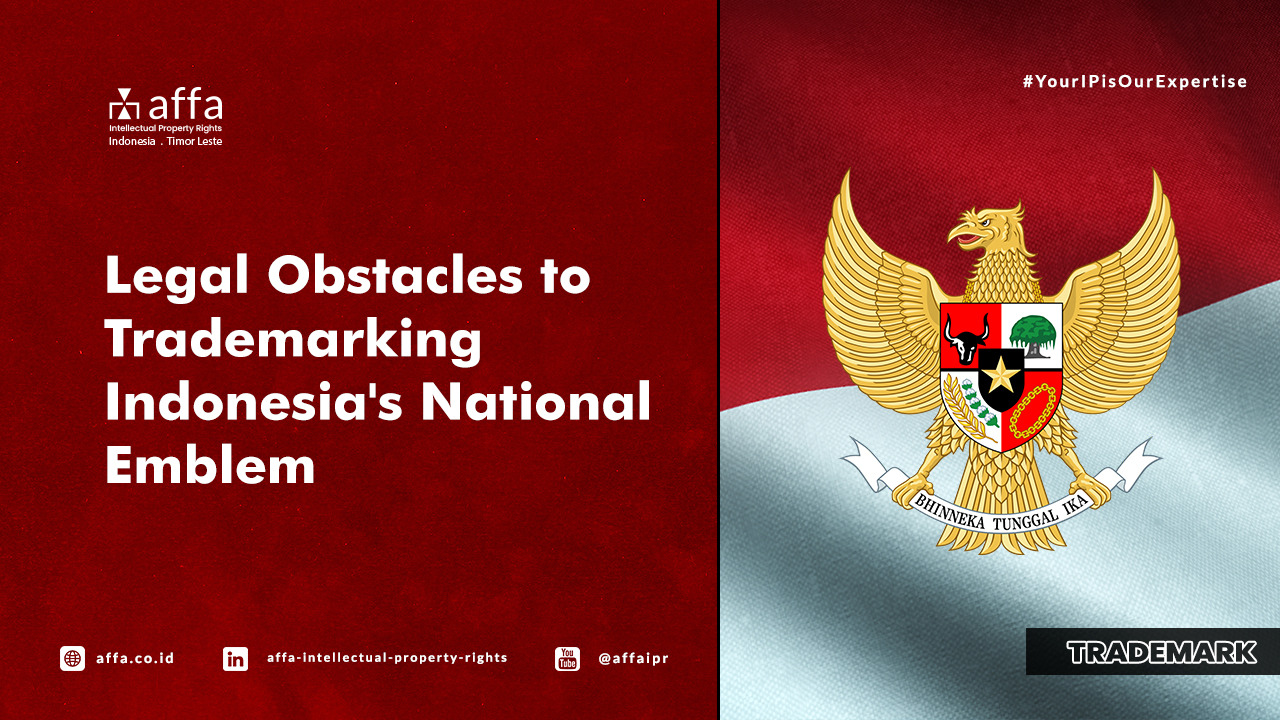
Legal Obstacles to Trademarking Indonesia’s National Emblem

The Garuda Pancasila, the National Emblem of the Republic of Indonesia, is indeed iconic. The figure of this giant bird that is said to be able to cover the sunlight has been known since the 5th century and has become a symbol of many Hindu kingdoms in the archipelago. So, since it was established and used in various national activities, its presence has always inspired people from each generation to display it in a better and better form.   But is that allowed? Modifying and/or using the Garuda Pancasila as a Trademark in Indonesia? Here is the answer from the perspective of Intellectual Property law.   This large and strong figure, containing the date of the Proclamation of Independence of the Republic of Indonesia on its feathers (17-8-1945), was already in the minds of the nation’s founders when they determined the Garuda Pancasila as the National Emblem. In early 1950, the government of the Republic of Indonesia United (RIS) created a technical committee called the National Emblem Committee under the coordination of Minister Zonder Porto Folio Sultan Hamid II, with the Chairman of the Committee, Muhammad Yamin, and Ki Hajar Dewantara, M.A. Pellaupessy, Mohammad Natsir, and R.M. Ng. Purbatjaraka as its members. President Soekarno then inaugurated it at the RIS Cabinet Meeting on February 11, 1950. Its use was then regulated in Government Regulation No. 43 of 1958 and amended by the enactment of Law of the Republic of Indonesia Number 24 of 2009 concerning the Flag, Language, National Emblem, and National Anthem to implement Article 36A of the 1945 Constitution (UUD 1945) which reads, “The National Emblem is the Garuda Pancasila with the motto Bhineka Tunggal Ika.” For those of you who need clarification as to why the 1945 Constitution already contains the Garuda Pancasila even though the draft was only made in 1950, it is because Article 36A resulted from the Second Amendment in 2000. Previously, only Article 36 contained the following: “The National Language is Indonesian.” However, after the amendment, Article 36A (national emblem), 36B (national anthem), and 36C (further provisions related to the flag, language, national emblem, and national anthem are regulated by law) were presented.   Then specifically, Article 57 of Law Number 24 of 2009 contains the following prohibitions related to the National Emblem: It is prohibited to cross out, write, draw, or damage the National Emblem with the intention of tarnishing, insulting, or degrading the honor of the National Emblem; It is prohibited to use the National Emblem that is damaged and does not match the shape, color, and size comparison; It is prohibited to create a symbol for an individual, political party, association, organization, and/or company that is the same as or resembles the national emblem; and It is prohibited to use the National Emblem for purposes other than those regulated by the Law.   A person who violates the prohibition can be punished with a maximum imprisonment of one year or a maximum fine of IDR 100 million.   Although later, the Constitutional Court, through Constitutional Court Decision Number 4/PUU-X/2012, stated the provisions of Article 57 letter d jo. Article 69 letter c of Law 24/2009 concerning the prohibition of the use of the National Emblem for other purposes and its criminal sanctions are contrary to the 1945 Constitution of the Republic of Indonesia and do not have binding legal force, which means that since then the National Emblem can be used freely to a certain extent to support the spirit of nationalism, but does not apply if it is related to Trademark registration.   So even if you can use the Garuda Pancasila in a design for a t-shirt, cap, pin, or other merchandise that is traded, you still cannot register it as a Trademark. As regulated in Article 21 Paragraph (2)b of the Trademark Law, which reads, “An application is rejected if the Trademark is an imitation or resembles the name or abbreviation of a name, flag, insignia, symbol or emblem of a country, or national or international institution, except with the written approval of the authorized party.”   Legal Problems on the Use of National Emblem in Sports Jerseys   A few months ago, there was a debate regarding the use of the National Emblem on the jersey of the Indonesian Football Team. It is common and natural for a national jersey to change its design every season or every year. When the jersey’s vendor changes, the design and logo containing the National Emblem also changes. During the last change, the latest logo was registered with the name of the owner of the jersey’s manufacturer, and this invited controversy because the public began to understand the existence of Article 21 Paragraph (2) b of the Trademark Law.   However, the public forgets the sentence “written approval from the authorized party.” This controversy ended in June 2024 when the Indonesia Football Association (PSSI), the official parent organization of football in Indonesia, took over all logos applied to the Directorate General of Intellectual Property (DGIP). So, if we open the DGIP database today, both old and new logos have listed PSSI as the Trademark owner.   Thus, PSSI has the Exclusive Right to use the logo, and anyone who wants to use it must have permission from PSSI.   Old (DID2024030570) & New (DID2024006041) Logo of PSSI   It is a bit unfortunate that the logo does not contain the initials of PSSI, so it will cause polemics if other sports organizations want to register a logo that also contains the National Emblem. This means that other parties must file and register it with a different logo, but it still has similarities in principle to the logo filed by the PSSI. Should you need further information regarding Trademark protection or registration in Indonesia and worldwide, please do not hesitate to email us at [email protected].

Details
FAQs: Trademark Enforcement in Indonesia - AFFA IPR

Frequently Asked Questions about Trademark Enforcement in Indonesia

Trademark Enforcement Proceedings Q: What types of legal or administrative proceedings are available to enforce the rights of a Trademark Owner against an alleged infringer or dilutive use of a mark, apart from previously discussed opposition and cancellation actions? Are there specialised courts or other tribunals? Is there any provision in the criminal law regarding Trademark Infringement or an equivalent offence?   A: There are several approaches that need to be considered when commencing the Trademark enforcement proceedings. It is always a prudent course of action to start with sending a cease and desist letter against the infringer to immediately cease the infringing action. Should the infringer does not comply with the requests that have been addressed in the cease and desist letter, then the Trademark Owner has the option to file a criminal action against the infringer to the civil investigator at the Directorate General of Intellectual Property (DGIP) or to the Indonesian Police.   All Intellectual Property disputes are the domain of the Court of Commerce. Apart from invalidations and cancellations of registered marks, any party with legal rights can also seek civil actions through the Court of Commerce, namely to request preliminary injunction and to seek for damages or remedies.   The penalties for infringements are covered by the Trademark Law, namely the following articles:   CHAPTER XVIII  CRIMINAL PROVISIONS Article 100 (1) Every person unlawfully uses any Mark which is identical to registered Mark of other parties for similarly produced, and/or traded goods and/or services, shall be sentenced to imprisonment of up to 5 (five) years and/or fines up to Rp2,000,000,000.00 (two billion rupiahs).   (2) Every person unlawfully uses any Mark which is substantially similar to registered Mark of another party for similarly produced and/or traded goods and/or services, shall be sentenced to imprisonment for up to 4 (four) years and/or fines up to Rp2,000,000,000.00 (two billion rupiahs).   (3) Every person violating the provisions as referred to in section (1) and section (2), whose goods cause health impairment, environment distortion, and/or human deceases, shall be sentenced to an imprisonment up to (10) ten years and/or fines up to Rp5.000.000.000,00 (five billion rupiahs).   Article 101 (1) Every person unlawfully uses any signs which are identical to Geographical Indications of other parties for similar goods and/or products or identical to registered goods and/or products, shall be sentenced to imprisonment up to 4 (four) years and/or up to Rp2.000.000.000,00 (two billion rupiahs).   (2) Every Person unlawfully uses any sign which is substantially similar to Geographical Indications of another party for similar goods and/or products or identical with registered goods and/or products, shall be sentenced with imprisonment up to 4 (four) years and/or :nes up to Rp2.000.000.000,00 (two billion rupiahs).   Article 102 Every Person who trades goods and/or services and/or product which is known or allegedly know that the goods and/or services and/or product constitute criminal acts as referred to in Article 100 and Article 101 shall be sentenced with imprisonment up to 1 (one) year or fines up to Rp200.000.000,00 (two hundred million rupiahs).   Article 103 The criminal acts as referred to in article 100 to article 102 constitute complaint delict.   Procedural Format and Timing Q: What is the format of the infringement proceeding?   A: Civil proceedings in Indonesia are conducted in writing and oral arguments. The judges will listen to the oral arguments of each party one at a time, and they rely heavily on documentary evidence. Witnesses of fact can also provide oral evidence before the court. However, a witness statement or affidavit alone will not be sufficient since it is considered merely supplementary documentary evidence. In general, the procedure of the trial is as follows: attendance at the first hearing after the court summons both plaintiff and defendant; attendance at the second hearing, when the defendant files its response to the plaintiff’s cancellation suit; preparation of the plaintiff’s reply to the defendant’s response to the suit; attendance at the third hearing to file the plaintiff’s reply; attendance at the fourth hearing when the defendant files its response to the plaintiff’s reply; preparation of the plaintiff’s evidence to be submitted to the court; attendance at the fifth hearing to submit the plaintiff’s evidence and review the defendant’s evidence; preparation and filing of the conclusion of the case based on documents and evidence filed with the court by both plaintiff and defendant; attendance at the sixth hearing on the filing of the conclusion of the case;  attendance at the seventh hearing to hear the judge’s decision; and issuance of the court’s decision.   For civil procedure, in theory a decision shall be issued within three months. However, in practice, it may take slightly longer due to the extensions requested by any of the parties involved.   Burden of Proof Q: What is the burden of proof to establish infringement or dilution?   A: In Indonesian civil procedure, the burden of proof regarding the facts on which a claim is based lies with the plaintiff. Article 1865 of the Indonesian Civil Code states that anyone who claims to have a certain right or who refers to a fact to support such a right, or who obzects to another party’s right, must prove the existence of that right or that fact. Evidence may comprise written evidence, evidence presented by witnesses, or through inference, confession or oath. In our experience, it is prudent to collect as much diverse evidential material as possible, such as purchases made by mystery shoppers, marketing materials found online and offline, and expert witnesses that may provide substantive statements pertaining to the alleged infringement. Furthermore, written evidence must be presented in the Indonesian language – translated by a sworn translator if necessary.   Standing Q: Who may seek a remedy for an alleged Trademark violation and under what conditions? Who has standing to bring a criminal complaint?   A: In accordance with article 83 of the Trademark Law, the registered mark owner and/or its licensee may file a…

Details
FAQs Licensing and Assignment of Trademark in Indonesia - AFFA IPR

Frequently Asked Questions about Licensing & Assignment of Trademark in Indonesia

Licenses Q: May a licence be recorded against a Mark in Indonesia? How? Are there any benefits to doing so or detriments to not doing so? What provisions are typically included in a licensing agreement?   A: A registered Mark can be licensed out to other parties in Indonesia. For the agreement to have binding legal effect against any third party, it will have to be recorded at the Directorate General of Intellectual Property (DGIP). In general, a licence agreement should cover the details of the licensor and the licensee, the nature of licensing (exclusive or non-exclusive), the ability to sub-license (or not), term of the licence agreement, rights and responsibilities of the parties, and the object or Trademark to be licensed.   The licensing agreement must not contain provisions that either directly or indirectly damage the Indonesian economy or limitation obstructing Indonesian capacity to acquire and develop technology.   Assignment Q: What can be assigned? Does the Trademark have to be registered first?   A: A Trademark application or registration can be assigned to another party, provided that the deed of assignment, which has been notarised, is recorded at the DGIP to be fully binding. The assignment shall cover all goods or services covered by the assigned mark. The other business assets are not generally required to be assigned to make the Trademark assignment valid, except if both parties agree otherwise.   Assignment Documentation Q: What documents are required for assignment and what form must they take? What procedures apply?   A: Both parties shall sign a deed of assignment that later will be notarised and submitted to the DGIP. A power of attorney will also need to be provided.   Validity Assignment Q: Must the assignment be recorded for purposes of its validity?   A: A signed deed of agreement must be recorded before the DGIP to be valid.   Security Interests Q: Are security interests recognised and what form must they take? Must the security interest be recorded for purposes of its validity or enforceability?   A: In theory, all kinds of IP rights can be used as security interests. But in practice, the recordal of security interests is not possible for the time being. Should you need more information regarding the Licensing & Assignment of Trademark in Indonesia, please do not hesitate to contact us via [email protected].

Details