Indonesia Extends the Trademark Non-Use Period from 3 to 5 Consecutive Years - AFFA IPR

Indonesia Extends the Trademark Non-Use Period from 3 to 5 Consecutive Years

On March 31, 2020, Indonesia officially entered the COVID-19 pandemic period with the enactment of Government Regulation Number 21 of 2020 concerning Large-Scale Social Restrictions in the Framework of Accelerating the Handling of Corona Virus Disease 2019 (Covid-I9). After facing various challenges, both for the community, the business world, and the government, the pandemic status in Indonesia was officially lifted on June 21, 2023, and changed to endemic based on the Presidential Decree of the Republic of Indonesia Number 17 of 2023 concerning the Determination of the End of the Corona Virus Disease 2019 (COVID-19) Pandemic Status in Indonesia. In post-pandemic recovery efforts, the government prioritizes economic recovery by paying attention to the needs of Small, and Medium Enterprises (SMEs).  Taking into account the specific conditions of the Indonesian economy, which hugely relies on SMEs that have limited capital and can change at any time and force majeure, through Decision Number 144/PUU-XXI/2023, which was read out at the Constitutional Court (MK) on Tuesday, July 30, 2024, an adjustment was made to the time limit for Trademark non-use period from three to five consecutive years. This case began when Ricky Thio faced a Cancellation Action for his Trademark based on Article 74 of Law Number 20 of 2016 concerning Trademarks and Geographical Indications (Trademark Law) at the Commercial Court at the Central Jakarta District Court with case number 28/Pdt.Sus HKI/Merek/2023/PN Niaga Jkt.Pst from Zhejiang Dahua Technology Co., Ltd. wanted the cancellation of the Trademark “” with registration number IDM000553432 because it was considered not to have been used for three consecutive years. According to Ricky Thio, this situation raises uncertainty in the Trademark protection provided by the government, which has the potential to make SMEs hesitate to register their Trademarks.   Timeframe for Filing a New Trademark Cancellation Action In Decision Number 144/PUU-XXI/2023, the Constitutional Court saw the importance of adjusting the non-use time limit to 5 (five) consecutive years. This is closely related to the time limit for filing a Trademark Invalidation, which is 5 (five) years from the date of Trademark registration, as stated in Article 77 paragraph (1) of the Trademark Law. Although cancellation and invalidation are different things, the regulation is placed in the Chapter “Cancellation and Invalidation of Trademarks” in the Trademark Law.   Thus, without intending to ignore the tendency of countries that adhere to the civil law system, the adjustment of the time limit for non-use of registered Trademarks to 5 (five) years is to provide justice for all registered Trademark owners so that it does not conflict with the Principle of National Treatment and is in line with the provisions contained in Trademark Invalidation. Based on all the legal considerations above, the Applicant’s argument questioning the unconstitutionality of Article 74 paragraph (1) of the Trademark Law, especially the phrase “3 (three) years” is legally justified. In Decision Number 144/PUU-XXI/2023, the Court partially granted Ricky Thio’s request so that the changes to the article related to the deletion of the Trademark due to the Decision are as follows: Before the Constitutional Court Decision After the Constitutional Court Decision Article 74 paragraph (1) Trademark Law The cancellation of a registered Mark may also be submitted by a third party who has an interest in the form of a lawsuit to the Commercial Court based on the ground that the Mark has not been used for 3 (three) consecutive years in the trade of goods and/or services from the registration date or the last use. Article 74 paragraph (1) Trademark Law The cancellation of a registered Mark may also be submitted by a third party who has an interest in the form of a lawsuit to the Commercial Court based on the ground that the Mark has not been used for 5 (five) consecutive years in the trade of goods and/or services from the registration date or the last use. Article 74 paragraph (2) Trademark Law The reasons for an non-used Mark as referred to in paragraph (1) are invalid in the event of: a. import ban; b. temporary prohibition that is related to the permit for the distribution of goods that use the relevant Mark or a decision from an authorized party; or c. other similar prohibitions that are established with Regulation of the Government. Article 74 paragraph (2) Trademark Law The reasons for an non-used Mark as referred to in paragraph (1) are invalid in the event of: a. import ban; b. temporary prohibition that is related to the permit for the distribution of goods that use the relevant Mark or a decision from an authorized party; or c. other similar prohibitions, including in conditions of force majeure that are established with Regulation of the Government.   Force Majeure can be Used for Exceptions Force Majeure can be a legitimate reason for Trademark owners who cannot use their registered Trademark or cannot run their business normally. The Constitutional Court (MK), in Decision Number 144/PUU-XXI/2023, emphasized the importance of this exception. Force Majeure generally refers to events or effects that cannot be predicted or controlled, such as natural disasters (floods, hurricanes, earthquakes) or human actions (riots, strikes, war) that prevent someone from fulfilling their obligations. In this decision, pandemic conditions such as COVID-19 are considered Force Majeure, which justifies an exception for Trademark owners who experience difficulties using and producing their Trademarks.  The consequence of Decision Number 144/PUU-XXI/2023 is that the provisions of the Trademark Law must be adjusted to the decision. This is, of course, in line with the explanation of Article 10, paragraph (1) of Law. No. 07 of 2020 Third Amendment to Law Number 24 of 2003 concerning the Constitutional Court in conjunction with the Stipulation of Government Regulation instead of Law Number 1 of 2013 concerning the Second Amendment to Law Number 24 of 2003 concerning the Constitutional Court to Become a Law in conjunction with Law No. 8 of 2011 concerning Amendments to Law Number 24 of 2003 concerning the Constitutional Court in conjunction with Law Number 24 of…

Details

FAQs: The Registration and Use of Trademark in Indonesia - AFFA IPR

Frequently Asked Questions About the Registration and Use of Trademark in Indonesia

Ownership of Marks Q: Who may apply for registration?   A: Since the Indonesian Trademark Law adopts the first to file principle, in general any individual, organisation or company can file for a Trademark Registration. However, the Trademark Law also regulates Trademark Registrations that are filed in bad faith. Article 21 paragraph (3) of the Trademark Law stipulates that an application is refused if it is submitted by an applicant in bad faith. While the implementation of this article during substantive examination holds true for some applications that have similarities with the already established and Well-known Marks, in practice it is quite challenging to determine whether an application is filed in bad faith or not. A bad-faith application that later matured to registration can always be invalidated at the Court of Commerce as regulated under article 77 paragraph (2) of the Trademark Law, which stipulates the following:   “The lawsuit for invalidation may be in unlimited time if there is bad faith and/or the relevant Mark contravenes the State ideology, laws and regulations, morality, religions, decency, and public order.”   Scope of Trademark Q: What may and may not be protected and registered as a Trademark?   A: By definition of article 1 of the Trademark Law, a Mark is any sign capable of being represented graphically in the form of drawings, logos, names, words, letters, numerals, colour arrangement, in two and;or three-dimensional shape, sounds, holograms or combination of two or more of those elements to distinguish goods or services produced by a person or legal entity in trading goods or services.   Given the definition above, then the Law acknowledges two types of trademarks, namely traditional and non-traditional marks.   Unregistered Trademarks Q: Can Trademark Rights be established without registration?   A: Indonesia is a jurisdiction that adopts the first to file principle. Hence, a prior use itself is not sufficient to establish rights in the country.   Famous Foreign Trademarks Q: Is a famous foreign Trademark afforded protection even if not used domestically? If so, must the foreign Trademark be famous domestically? What proof is required? What protection is provided?   A: A Trademark can only be protected if it is registered in Indonesia, regardless of its fame. However, the Indonesian Trademark Law has a mechanism to somewhat protect a famous foreign Trademark from bad faith registrations by other parties. Should another party try to file a malicious Trademark application that is identical or similar to a famous foreign Trademark, such application will be rejected on the basis of article 21 paragraph (1) b and c, which stipulates the following:   “An Application is refused if the Mark is substantively similar to or identical with a well-known Mark of other parties for similar goods and/or services OR a well-known Mark of other parties for different goods and/or services complying with certain requirements.”   The issue is then shifted to what constitutes as a famous Trademark. Article 18 of the Ministry of Law and Human Rights of the Republic of Indonesia Regulation No. 67 2016 concerning Trademark Registration Decree of the Directorate General of Intellectual Property in the Field of Trademarks has set out the criteria of what makes a Trademark famous, such as: the level of knowledge or public recognition against the Mark in the business field that concerned as a well-known mark; the volume of sales of goods and/or services and benefits derived from using the Mark by the owner; the market share controlled by the Mark in relation to the circulation of goods and/or services in the community; the area of use of the Mark; the period of use of the Mark; the intensity and promotion of the Mark, including value of investment used for the promotion; the number of Trademark applications and registration around the world; the success rate of law enforcement, in particular regarding the recognition of the Mark as a well-known Mark by an authorised institution; or the valuation of the Mark because of the reputation and quality assurance of goods and/or services protected by the Mark.   However, a well-known mark that is famous abroad does not always necessarily have the same level of fame in Indonesia. This raises the issue as to whether the Trademark owner should also establish its fame in Indonesia before taking any action against other parties.   The Benefits of Registration Q: What are the benefits of registration?   A: Pursuant to the Trademark Law, the right on a Mark means the Exclusive Right granted by the state to a registered Mark Owner for a definite period to use his or her mark or authorise others to do otherwise. Hence, by registering a Trademark in Indonesia, the owner can establish its legal right should there is an infringement by another party. This includes, but is not limited to, requesting an e-commerce listing takedown notice, sending a cease and desist letter, filing a police report for the criminal aspect of the infringement, seeking damages at the Court of Commerce, issuing licensing rights, filing injunctions and conducting a Customs Recordal before Indonesian Customs.   Filing Procedure and Documentation Q: What documentation is needed to file a Trademark Application? What rules govern the representation of the Mark in the application? Is electronic filing available? Are trademark searches available or required before filing? If so, what procedures and fees apply?   A: A Trademark search is strongly suggested for anyone who wishes to file a Trademark Application in Indonesia. The search report will identify potential hazards and tumbling blocks to an otherwise successful registration process. Assuming the search report gives the all-clear for continuing the application process, the applicant shall prepare the following: name of the applicant; address; list of goods and services; and the representation of the Mark to be filed, which can be in a form of wordmark, logo or non-traditional Marks.   Once the above information has been provided, then we will prepare the following documents to be signed by the client: power of attorney; and statement…

Details
AFFA Represented Guangzhou Sanwich Biology Technology, Co., Ltd. in a Succesful Trademark Invalidation Action in Indonesia - AFFA IPR

AFFA Represented Guangzhou Sanwich Biology Technology, Co., Ltd. in a Succesful Trademark Invalidation Action in Indonesia

On June 11, 2024, the Commercial Court at the Central Jakarta District Court granted AFFA IPR’s lawsuit, in this case representing Guangzhou Sanwich Biology Technology, Co., Ltd., to invalidate the SEVICH Mark with Registration Number IDM000917666, which gave a decision that the mark had similarities in essence and registered in bad faith. So, how does the “first-to-file” concept apply if there is a case like the one above? The SEVICH Trademark was first registered in China on March 21, 2016, by our client, Guangzhou Sanwich Biology Technology, Co., Ltd., in Class 3, which includes “Cleaning preparations; Abrasives; Essential oils; Toothpastes (pieces).” This Trademark has also been registered in the United States, Mexico, the United Kingdom, and the European Union. This business has expanded in Asia, and this year, SEVICH plans to be sold and distributed in Indonesia. However, before it could be applied for in Indonesia, it was discovered that the SEVICH Mark had been registered since November 2021 by another party. The Mark has the same writing, pronunciation, and logo and is registered in the same class. As a result, our client could not obtain registration in Indonesia, even though it should have had exclusive rights to use the Mark in trade. Therefore, our client filed a lawsuit for invalidation of the Trademark. The lawsuit was filed in March 2024 against Jong, Sylvia (hereinafter referred to as the Defendant), owner of the SEVICH Trademark in Indonesia with number 25/Pdt.Sus-HKI/Merek/2024/PN.Niaga.Jkt.Pst. The Defendant certainly does not easily give up the registered Mark. One of the points in their answer stated that they were the first registrants, so they are the party who has the Exclusive Right to use the SEVICH Mark in Indonesia, according to Article 1 Number 5 of Law Number 20 of 2016 concerning Marks and Geographical Indications (Trademark Law): “Right on Mark means the exclusive right granted by the State to a registered Mark owner for a definite period to use his/her Mark or authorize others to do otherwise.” Applicant in Bad Faith One of the rulings in the Decision 25/Pdt.Sus-HKI/Merek/2024/PN.Niaga.Jkt.Pst. stated that the defendant was a registrant with bad faith in registering the SEVICH mark with Registration Number IDM000917666. Applicants who have bad intentions based on the explanation of Article 21 paragraph (3) of Law Number 20 of 2016 concerning Trademarks and Geographical Indications are applicants who are reasonably suspected that in registering their Mark, they have the intention to imitate, plagiarize, or follow another party’s Mark for the benefit of their business, causing conditions unfair business competition, deceiving or misleading consumers. For example, a Trademark application takes the form of writing, a painting, a logo, or the same color arrangement as a Trademark belonging to another party or a Trademark that has been generally known to the public for many years, imitated in such a way that it has similarities in essence or its entirety to the already known Trademark. From this example, there has been bad faith on the part of the Applicant because at least it should be known that there was an element of intentionality in imitating a well-known Mark. The concept in this article is undoubtedly in line with the Permanent Decree of the Supreme Court of the Republic of Indonesia No. 39K/Pdt/1989 dated 24 November 1990 which reads, “That every act of using a Mark which is confusing and deceptive and confuses the opinion and visuals of the general public is qualified as containing elements of bad faith and unfair competition,” and Permanent Decision of the Supreme Court of the Republic of Indonesia No. 220 K/Pdt/1986 which states, “Local entrepreneurs are obliged to use marks with national identity, not plagiarize foreign names or marks, because this can mislead consumers about the origin of a good or service.” Until finally the deliberative meeting of the Commercial Court Panel of Judges at the Central Jakarta District Court ordered the Directorate General of Intellectual Property (DGIP) to invalidate the SEVICH Mark registered No. IDM000917666 on behalf of the defendant by registering the invalidation of the Mark from the General Register of Marks and announcing it in the Official Mark Gazette. Never Risk Registering Other Party’s Trademark to Begin With In a Trademark Invalidation lawsuit, if the trademark being sued is similar in essence or its entirety, and there are indications that another party registered the trademark in bad faith towards the actual owner of the trademark, and this can be proven in court, then the first to file principle can be overridden. The actual rights of the Mark owner can be restored through a court decision in Indonesia, and the Mark owner can attach proof of the decision to the Trademark Office, in this case, the DGIP, during the examination process of the Mark registration application at a later date. Should you have further questions regarding Trademark registration and protection in Indonesia and/or abroad, do not hesitate to email us at [email protected].

Details
The Indonesian Constitutional Court Ruled Article 10 of the Copyright Law Unconstitutional - AFFA IPR

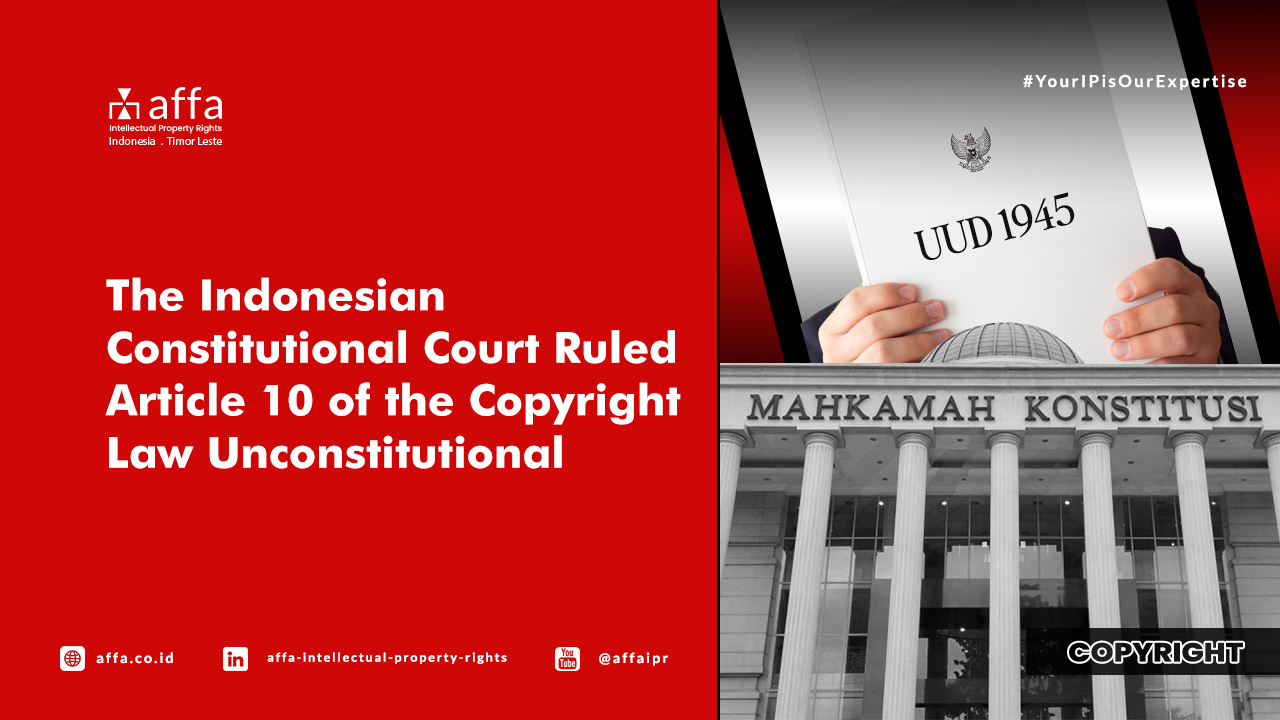
The Indonesian Constitutional Court Ruled Article 10 of the Copyright Law Unconstitutional

On February 29, 2024, the Constitutional Court of the Republic of Indonesia (MKRI) decided case Number 84/PUU-XXI/2023 concerning Material Review of Law Number 28 of 2014 concerning Copyright (Copyright Law) and declared Article 10 of the Copyright Law to be contrary to the 1945 State Constitution of the Republic of Indonesia (Constitution of Indonesia). How is this possible?   This case began when PT Aquarius Pustaka Musik, PT Aquarius Musikindo, and songwriter Melly Goeslaw (hereinafter referred to as the Petitioner) discovered that songs created and/or owned Copyright were being used by a User Generated Content (UGC)-based digital service platform. In early 2020, the Petitioner even filed a civil lawsuit against Bigo Technology Ltd. as the digital service platform ‘Likee’ manager to the Central Jakarta District Court’s Commercial Court for using songs whose Copyright is under his auspices without permission. Unfortunately, the panel of judges rejected the lawsuit because the videos shown were UCG-based, i.e., originated, created, and uploaded by application users, not by Bigo. Thus, Bigo cannot be held responsible.   The Indonesian Copyright Law Does Not Yet Regulate UGC   The rejected lawsuit to Bigo and Likee could occur because there is a vacuum in the Copyright law used for UGC-based platforms. Hence, the platform manager ignores and deliberately hides behind the Circular Letter of the Ministry of Communications and Informatics Number 5 of 2016, Chapter V-C Provisions Number 2(b), which states that the UGC Platform is not responsible for goods and/or services containing content that violates Intellectual Property Rights if it can be proven that there was an error and/or negligence on the part of the merchant or Platform user.   In fact, in Article 28-C and 28-D paragraph (1) of the Constitution of Indonesia, the state guarantees its citizens to benefit from science and technology and the arts to improve the quality of life and for the welfare of humanity, as well as to obtain fair legal certainty. Thus, the Human Rights of the Petitioners must be protected, promoted, upheld, and fulfilled by the State, in this case, the government as mandated in Article 28-I paragraph (4) which explicitly states that “Protection, promotion, enforcement and fulfillment of rights Human rights are the responsibility of the state, especially the government.”   One of the methods that the state must take in protecting and upholding the fundamental rights of the Petitioners is by establishing laws and regulations that can substantively and procedurally guarantee and ensure the implementation of these rights by the instructions of Article 28-I paragraph (5) the Constitution of Indonesia. Therefore, on the one hand, the State must create a legal norm or rule with a precise, firm formulation, without multiple interpretations, and includes or encompasses matters aimed at realizing these fundamental rights. On the other hand, the Petitioners are entitled to the certainty of the quo regulations. This is inevitable for its continuity in a rule-of-law state as required in Article 1 paragraph (3) of the Constitution of Indonesia, which states, “The state of Indonesia is a state of law.”   As stated in Indonesian Copyright Law:   Article 10 Managers of business premises are prohibited from allowing the sale and/or reproduction of goods resulted from Copyrights and/or Related Rights infringements in the location under their management.  Article 114 Every Person managing business premises in all its forms who deliberately and knowingly allows the sale and/or duplication of goods resulting from infringement of Copyright and/or Related Rights in the premises that they manage as referred to in Article 10 shall be sentenced with a maximum fine of Rp100,000,000.00 (one hundred million rupiahs). Because Articles 10 and 114 of the Copyright Law are deemed not to include protection for UGC and the state is obliged to provide legal certainty, the Petitioner also submitted a Material Review of the Copyright Law to the Constitutional Court on July 30, 2023, based on the Petitioner’s Petition Submission Deed Number 83/PUU/PAN.MK/AP3/07/2023 was recorded in the Constitutional Case Registration Book on August 3, 2023, with Number 84/PUUXXI/2023, corrected and accepted by the Registrar of the Court on September 8, 2023.   Final Verdict in Favor of the Creator Until then, the Constitutional Court’s decision stated that it had granted the Petitioners’ petition in its entirety and stated that Article 10 of the Copyright Law was contrary to the Constitution of Indonesia and did not have conditionally binding legal force as long as it was not interpreted as “Manager of trading places and/or Digital Service Platforms based on User Generated Content (UGC) is prohibited from allowing the sale, display and/or duplication of goods resulting from violations of Copyright and/or Related Rights on trading venues and/or digital services that it manages.”   In particular, the Constitutional Court stated that the Petitioners’ human rights, as outlined in the Constitution of Indonesia, were impaired due to the enactment of Article 10 and Article 114 of the Copyright Law, considering that the content of the two articles being reviewed did not or did not protect fair legal certainty, because the content was inadequate and too narrow so that it cannot reach/keep up with new phenomena that have emerged as a logical consequence of technological growth and development, where one of the consequences of technological progress, especially in the information sector, has been the violation of the constitutional rights of the Petitioners. Still, the perpetrators will easily avoid legal responsibility because the formulation of the article cannot be used as a basis for prosecuting perpetrators who violate the law.   Furthermore, the Constitutional Court stated that the material content of Article 10 and Article 114 of the Copyright Law is normatively very limited and narrow because it only emphasizes the Management of Trading Places, which are a venue for selling and/or duplicating goods resulting from violations of Copyright and/or Related Rights, despite their speed and sophistication. Information technology has created an extensive space for interaction or mass communication (between people or society) through the provision of digital service platforms, namely in the form of sharing-app, short-video creation…

Details
FAQs: The Legal Framework of Trademark Protection in Indonesia - AFFA IPR

Frequently Asked Questions about the Legal Framework of Trademark Protection in Indonesia

Prevailing Laws and Regulations Q: What is the primary legislation governing Trademarks in Indonesia?   A: Law No. 20 2016 on Marks and Geographical Indications (the Trademark Law) is the primary law concerning Trademark in Indonesia. Several provisions in the Trademark Law were then amended under the Law No. 11 Yeat 2020 in Job Creation, and then further amended under the Law No. 6 Year 2023 on the Enactment of a Replacement Government Regulation in Lieu of the Law No. 2 Year 2022 on Job Creation as Law.   Moreover, there are several by-laws that regulate more specific matters, such as, but not limited to:   Government Regulation No. 28 2019 concerning Types and Tariffs of Non-Tax State Revenues Applicable to the Ministry of Law and Human Rights. This regulation sets the official fees for various actions that can be filed before the Directorate General of Intellectual Property (DGIP) under the Ministry of Law and Human Rights of the Republic of Indonesia. Government Regulation No. 22 2018 concerning International Registration of Marks Under the Protocols Relevant to the Madrid Agreement Concerning the International Registration of Marks. This regulation covers all aspects of international registrations filed to or from Indonesia. Government Regulation No. 90 2019 concerning The Trademark Appeal Commission, which was established on 29 August 1995 concerning Procedures for Application, Examination and Settlement of Appeals at the Mark Appeal Commission. The Ministry of Law and Human Rights of the Republic of Indonesia Regulation No. 12 2021 concerning Amendments to the Ministry of Law and Human Rights of the Republic of Indonesia Regulation No. 67 of 2016 concerning Trademark Registration Decree of the Director General of Intellectual Property in the Field of Trademarks. The ministerial regulation prescribes, among others, the requirements of registration, classes of goods and services, rectification of issued certificates and recordals.   International Law Q: Which international Trademark agreements has Indonesia signed?   A: Indonesia has ratified various agreements concerning Trademarks, such as the Protocol Relating to the Madrid Agreement Concerning the International Registration of Marks, the Trademark Law Treaty and the Paris Convention.   Regulators Q: Which government bodies regulate the Trademark Law?   A: The Directorate General of Intellectual Property (DGIP) under the Ministry of Law and Human Rights of the Republic of Indonesia is the relevant body that administrates the protection of all Intellectual Properties, including Trademarks. The DGIP goes beyond regulating and implementing the law, it is also responsible for proactively disseminating the information pertaining to the importance of IP protection through various means, such as podcasts, YouTube videos, Instagram posts and seminars conducted around Indonesia. Should you need more information regarding Legal Framework of Trademark in Indonesia, please do not hesitate to contact us via [email protected].

Details
The Management of Royalties for Secondary Use Licenses for the Copyright of Books and/or other Written Works in Indonesia - A Closer Look at the Minister of Law and Human Rights Regulation Number 15 of 2024 - AFFA IPR

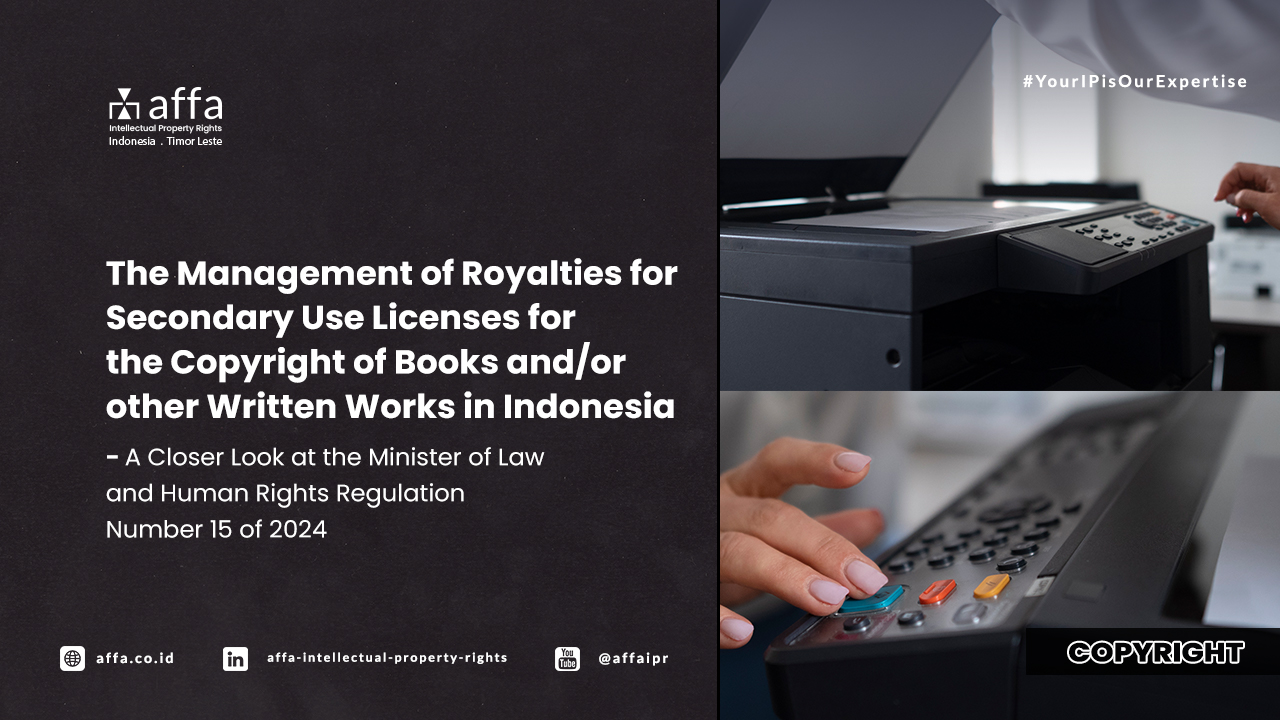
The Management of Royalties for Secondary Use Licenses for the Copyright of Books and/or other Written Works in Indonesia – A Closer Look at the Minister of Law and Human Rights Regulation Number 15 of 2024

The Minister of Law and Human Rights of the Republic of Indonesia, Yasonna Laoly, has officially ratified the Minister of Law and Human Rights Regulation (Permenkumham) Number 15 of 2024 concerning Management of Royalties for Secondary Use Licenses for the Copyright of Books and/or Other Written Works.   What is meant by Secondary Use for Book Copyright and/or other Written Works are all activities as follows: printing; photocopy; scanning; screenshot; internet downloading; emailing; posting/uploading; storing; sharing; read aloud in a form of video and/or audio; live performing; or web scraping.   This regulation, published on June 12, 2024, is expected to increase income for book creators and publishers in Indonesia. It also regulates who receives, pays, and distributes royalties for books and other written works.   More specifically, this Regulation describes the following provisions: Royalty Recipient Creator of books and/or other written works who has become a member of the Collective Management Organization (LMK) in the field of books and/or other written works. Royalty Payer Secondary Users include: education units; colleges; educational institutions; research institutions; ministries/institutions/regional governments; private businesses that carry out document duplication activities; photocopying service business; electronic system administrator; broadcasting institutions; artificial intelligence (AI) developer; other Secondary Users in accordance with statutory provisions. Imposition of Royalties The amount of Royalty for Secondary Use of Book Creations and/or Other Written Works is determined by LMK in the field of Books and/or Other Written Works, the amount of which is stated in a mutual agreement stipulated in a written agreement between LMK and Secondary Users, and ratified by the Minister.   Secondary Use rates for educational units, universities, educational institutions, and micro and small businesses can be adjusted by submitting an application letter to LMK with supporting evidence. Royalty Distribution Royalties that LMK has withdrawn will be collected and distributed only to Creators of books and/or other written works who have become members of the LMK, and this is done at least 1 (one) time in 1 (one) year. The Indonesian Publishers Association (IKAPI) acts as LMK Currently, IKAPI has been designated as the first LMK in this field, and a supervisory team formed by the Minister of Law and Human Rights will monitor its performance and finances. Requirements to Become an LMK The Ministry of Law and Human Rights is still accepting applications for operational permits as LMK in the field of Books and/or other Written Works with the following requirements: in the form of a non-profit Indonesian legal entity; obtain authority from the Creator and/or Copyright Holder to collect, gather, and distribute Royalties; have authorized persons as members of at least 200 (two hundred) people who represent the interests of the Creator and/or Copyright Holder; aims to collect, gather, and distribute Royalties; able to collect, gather, and distribute Royalties to Creators and/or Copyright Holders; member of the LMK federation organization in the field of books and/or other written works of international reproduction; And have bilateral/reciprocal agreements with LMK in the field of Books and/or other similar written works in at least 5 (five) countries, government of a country’s particular administrative region and/or certain entities.   With the existence of Minister of Law and Human Rights Regulation Number 15 of 2024, it is hoped that the welfare of authors of books and/or other written works can increase, as well as encouraging the spirit of creativity and the creation of quality works in Indonesia.   Should you have further questions regarding Royalty Management for Secondary Use Licenses for Book Copyrights and/or Other Written Works in Indonesia, please do not hesitate to email us at [email protected].   Source: Directorate General Intellectual Property

Details
Consequences of Late Payment Annuity Payment in Indonesia - AFFA IPR

Consequences of Late Patent Annuity Payment in Indonesia

Indonesian Patent Law No. 13 of 2016 outlines the process for maintaining your Patent throughout its 20-year term. This involves making timely annuity payments to the Indonesian Patent Office, hereafter called the Directorate General of Intellectual Property (DGIP). Here’s a breakdown of the key points:   First Annuity Payment This covers the period from your filing date up to one year after the grant date. It’s crucial to settle this payment within 6 months of receiving the grant notice. There’s  no grace period. Missing this deadline  invalidates your Patent, with no option for revival. No outstanding debt is created in this case.   Subsequent Annuity Payments These become due one month before the anniversary of your original filing date for each remaining year of the Patent’s lifespan.  For example, if you filed your Patent application on November 9th, all subsequent annuity payments would be due on October 9th of each year.   Late Payment Option If you anticipate missing a deadline, you can request an extension from the DGIP through a registered and reliable Patent Consultant. This request must be submitted within 7 working days before the original due date. An extension allows for a maximum 12-month grace period, but comes with a penalty – a 200% surcharge on the official fee for the missed annuity.   Consequences of Missing Payments   Failing to make timely annuity payments, including missing the initial deadline or neglecting to request an extension with a surcharge, will result in the DGIP  invalidating your Patent. This means you lose all legal protection for your invention in Indonesia.   Recommendations:   Carefully record your Patent’s filing date and grant date to ensure timely payments. Consider setting calendar reminders for upcoming annuity deadlines. Consult a registered Patent Consultant for assistance with managing these payments and navigating potential late payment scenarios.   By staying informed and adhering to the regulations, you can ensure your Patent remains valid and enforceable throughout its 20-year term in Indonesia.   Should you have any questions about Patent annuity payments in Indonesia, please do not hesitate to contact us at [email protected].   Source: Law No. 13 of 2016 on Patents (Patent Law)

Details
FAQs: Patent Office Proceedings in Indonesia - AFFA IPR

Frequently Asked Questions about Patent Office Proceedings in Indonesia

Patenting Timetable and Costs Q: How long does it typically take, and how much does it typically cost, to obtain a Patent?   A: The process of registering a patent in Indonesia involves several steps, including jling a Patent application, publication, examination and grant. The general process is as follows:   Filing a Patent Application: A Patent Application must be filed with the Indonesian Intellectual Property Office (DGIP). For PCT applications, the deadline will be 31 months from the earliest priority date. Late filing is possible with additional official fees.   Publication: The publication period in Indonesia lasts for six months. After the publication stage has been passed, the application will proceed to examination (as long as the applicant has filed for the substantive examination request).   Examination: After filing, the Patent Office will examine the Patent Application to determine if it meets the requirements for grant. This process may involve a review of the prior art and an examination of the novelty, inventiveness and industrial applicability of the invention.   Amendment: If the Patent Office finds that the Patent Application does not meet the requirements for grant, the applicant may be given an opportunity to respond to objections raised and amend the application to address any deficiencies. This can be in the form of an office action.   Grant: If the Patent Office determines that the Patent Application meets the requirements for grant, a Patent will be granted and the applicant will be issued a notice of allowance or grant and then will be followed with the issuance of a Patent Certificate, but very often the certificate is not issued for months or even years.   Maintenance: Once a patent has been granted, the applicant must take steps to maintain the Patent, including paying maintenance fees and renewing the patent as required. The first annuity payment must be paid within six months of the notice of allowance or grant.   On average, it takes approximately three to five years from filing to registration. We cannot comment on the costs given the variable conditions that affect it.   Expedited Patent Prosecution Q: Are there any procedures to expedite Patent Prosecution?   A: The DGIP, under the Ministry of Law and Human Rights of the Republic of Indonesia, has established various procedures under which the examination of a Patent Application may be accelerated. Under these procedures, the DGIP will advance an application out of turn for faster examination if the applicant files the following special requests through the ASEAN Patent Examination Co-operation (ASPEC) programme, the Indonesia – Japan Patent Prosecution Highway (PPH) programme, Indonesia – South Korea PPJ programme, or simply by providing the examiner in charge the granted corresponding claims from other patent offices (eg, the US Patent and Trademark Office (USPTO), Japan Patent Office (JPO), European Patent Office (EPO) and others).   ASPEC   ASPEC is a regional Patent work-sharing programme that involves nine ASEAN member states. The programme allows each participating Patent Office to share search and examination results to help applicants obtain corresponding Patents faster and more efficiently. The goal of ASPEC is to reduce duplication of search and examination work and produce high-quality examination reports. By obtaining examination results from other countries in the participating Patent Offices, applicants can accelerate the examination process, as long as the corresponding claims are the same.   When requesting ASPEC, the Patent Applicant is required to submit an ASPEC request form to the second Patent Office. The form must be accompanied by the following documents: a copy of the search and examination (S&E) report or the examination report (minimum documents) of a corresponding application from the first IP Office, and a copy of the claims referred to in the minimum documents submitted, with at least one claim determined by the first IP office to be allowable or patentable.   For a Patent Cooperation Treaty (PCT) ASPEC request, the Patent Applicant is required to indicate that the request is for PCT ASPEC in the ASPEC form. The completed ASPEC request form shall be submitted together with the following documents:   a copy of the written opinion international preliminary examination report (WO/ISA, WO/IPEA or IPER) established by an ASEAN International Searching Authority or International Preliminary Examining Authority (ASEAN ISA/IPEA) (‘minimum documents’) relating to a corresponding application from the first IP Office, and a copy of the claims referred to in the minimum documents submitted, with at least one claim determined by the jrst IP office to be allowable or patentable.   The request to utilise ASPEC can only be done after the application has finished the publication stage. Based on our experience, the time it takes from filing the ASPEC request until the issuance of the decision to grant will not be more than 12 months – a great improvement in lead or pendency times compared to the processing time for non-ASPEC (or PPH) Patent Applications in Indonesia.   Indonesia – Japan Patent Prosecution Highway (Indonesia-Japan PPH)   The Japan Patent Office (JPO) and the DGIP initiated a Patent Prosecution Highway Program (PPH) on 1 June 2013, and since then, the PPH has been chosen by many applicants who have previously filed their base applications in Japan as the method of accelerating the Patent Applications in Indonesia. The PPH request can be filed at any time as long as it is before the deadline to request the substantive examination stage. There will be an official fee of 5 million rupiahs incurred for requesting the PPH acceleration programme.   When it comes to the requirements, the DGIP will require the applicant to provide the following documents to start an accelerated examination process: all formality documents required to file the application have been submitted and the notice of formality documents completion issued by the DGIP; proof of payment to file a substantive examination request; the application should have passed the publication period of six months; completed PPH form; corresponding claims that should be equivalent or less compared to the claims granted by the…

Details
Indonesia Adopts International Treaty for the Protection of Intellectual Property, Genetic Resources, and Traditional Knowledge - AFFA IPR

Indonesia Adopts International Treaty for the Protection of Intellectual Property, Genetic Resources, and Traditional Knowledge

After 11 days of intensive negotiations, the International Diplomatic Conference at the World Intellectual Property Organization (WIPO) Headquarters in Geneva, Switzerland, on May 24th, agreed on and adopted the International Treaty on the Protection of Intellectual Property, Genetic Resources, and Associated Traditional Knowledge. This is the first WIPO Treaty to address the interface between Intellectual Property, Genetic Resources, and Traditional Knowledge, and it is also the first to include provisions specifically for Indigenous Peoples and Local Communities.   The final round of negotiations, attended by 193 representatives of WIPO member states, Indigenous People, and Local Communities, also agreed on a new international law on transparency and protection of the global Patent system.   By definition and scope, Genetic Resources are contained in, for example, medicinal plants, agricultural crops, and animal breeds. While Genetic Resources themselves cannot be directly protected as Intellectual Property, inventions developed using them can, most often through a Patent. Some Genetic Resources are also associated with Traditional Knowledge through their use and conservation by Indigenous Peoples as well as local communities, often over generations. This knowledge is sometimes used in scientific research and, as such, may contribute to the development of a protected invention.   With this treaty, Indonesia and countries that own Intellectual Property, Genetic Resources, and Traditional Knowledge will gain several significant benefits as follows:   Transparency The global Patent system will experience increased transparency with the obligation of each country to disclose Patents globally. The Enactment of Sanctions Mechanisms The protection of Genetic Resources and Traditional Knowledge will be enhanced by imposing adequate sanctions. The Creation of Global Standards The treaty will promote standardization and harmonization of global regulations. Protection of Local Wisdom The treaty opens up opportunities to advance other issues related to traditional knowledge and traditional cultural expression.   The Treaty itself will be signed at the 65th WIPO General Assemblies in July. After the Diplomatic Conference in May, Indonesia signed the Final Act, a non-binding document serving as a record of the proceedings. However, signing the Treaty will not immediately lead to ratification or accession to this Treaty. It would have to go through internal processes with all the stakeholders in Indonesia, such as the Directorate General of Intellectual Property (DGIP), the Ministry of Law and Human Rights, and the House of Representatives.    Should you need more information about IP protection in Indonesia or abroad, don’t hesitate to contact us at [email protected].   Source: Ministry of Foreign Affairs of the Republic of Indonesia World Intellectual Property Organization (WIPO)

Details
FAQs: Patent Licensing in Indonesia - AFFA IPR

Frequently Asked Questions about Patent Licensing in Indonesia

Voluntary Licensing Q: Are they any restrictions on the contractual terms by which a Patent Owner may license a Patent?   A: Several minimum requirements should be met. A licence agreement should contain: the date, month, year and place where the licence agreement was signed; name and address of the licensor and the licensee; the object of the licence agreement; provisions regarding the exclusivity or non-exclusivity of the licence, including sub-licensing; the term of the licence agreement; the area where the license agreement applies; and the party responsible for paying annual fees for the Patent (see Government Regulation No. 36 Year 2018 on Intellectual Property License Agreement Recordal). If either the licensor or licensee resides outside of Indonesia or are foreign nationals, the application for recording the licence agreement must be submitted through a registered IP consultant.   The licence agreement should be recorded before the Patent Office in order to have a binding legal effect to any third party.   Compulsory licences Q: Are any mechanisms available to obtain a compulsory licence to a patent? How are the terms of such a licence determined?   A: Compulsory licences can be requested if a Registered Patent has not been used or worked in Indonesia within 36 months (three years) of registration. Other conditions that allow compulsory licensing include the implementation of a Registered Patent would be in the public interest, and it is not possible to obtain a licence to implement a Patent.   Note that there are previous steps that need to be shown to obtain a compulsory licence. The applicants must show evidence that they intend to use the Patent based on their capability, and that attempts were made to contact the patent holder to obtain a licence for a maximum of 12 months but a favourable response was not received. The Ministry should also be in agreement that the patent can be performed in Indonesia on an economically feasible scale and provide benefits to society.    See Regulation of the Minister of Law and Human Rights No. 30 of 2019 on Procedures for the Granting of Compulsory Patent Licensing, which later has been replaced by the Regulation of the Minister of Law and Human Rights No. 14 Year 2021 on the Amendment to the Minister of Law and Human Rights No. 30 of 2019 on Procedures for the Granting of Compulsory Patent Licensing. Should you need more information regarding Patent Licensing in Indonesia, please do not hesitate to contact us via [email protected].

Details