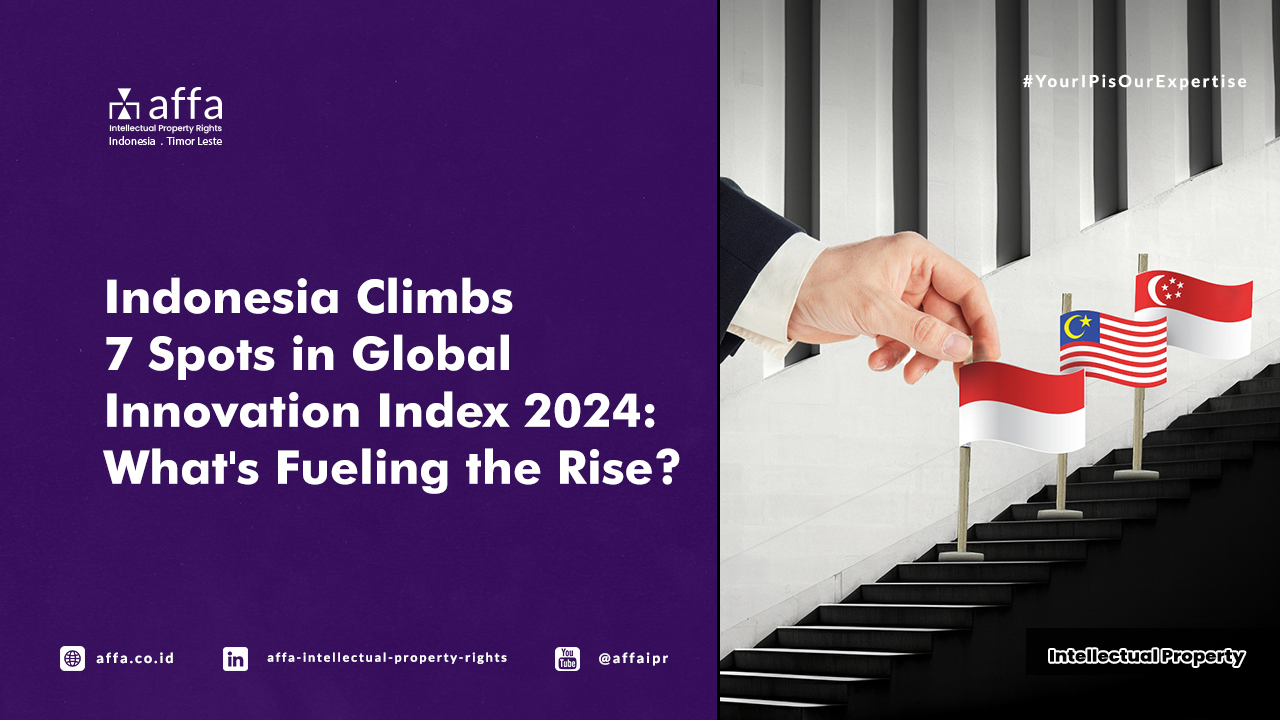
The Global Innovation Index (GII) is an annual report published by the World Intellectual Property Organization (WIPO), in collaboration with Cornell University, USA, and the Institut Européen d’Administration des Affaires (INSEAD), France. This index ranks countries based on innovation capacity and performance, using more than 80 indicators covering innovation inputs (such as institutions, human resources, and infrastructure) and outputs (such as research outcomes, technology, and creative products). This index is a crucial benchmark, as innovation is a primary driver of economic development, especially in knowledge-based economies. Intellectual Property (IP) is a critical component of this innovation ecosystem. With effective IP protection and management, countries can create new technologies, enhance competitiveness in global markets, and provide incentives for inventors and creators to continue innovating. IP ensures that innovation results are protected from easy duplication or misuse while offering economic benefits to innovators through Copyright, Patents, Trademarks, and Industrial Designs. Rising from Rank 61 to 54 This year (2024), Indonesia has experienced a significant improvement, climbing from rank 61 in 2023 to rank 54, closely trailing the Philippines at 53. Several key factors drove this rise: Policy Stability for Doing Business Measures how the government ensures a stable policy environment for business activities. This indicator is based on perceptions of policy stability measured through surveys. Entrepreneurship Policies and Culture Assesses policies that support entrepreneurship and a culture that encourages domestic entrepreneurial activity. This indicator reflects support for the establishment and growth of new ventures. Finance for Startups and Scaleups Measures the availability of financial capital for startups and business development, including access to venture capital and other financial instruments that support startup growth and business expansion. Domestic Market Scale Measures the domestic market size based on Gross Domestic Product (GDP) and National Income. This indicator highlights the domestic market’s potential for innovative products and services. University-Industry R&D Collaboration Assesses the level of research and development collaboration between universities and industries, reflecting the integration of academic and industrial sectors in generating innovation. State of Cluster Development Measures the level of development of industrial and technology clusters, including coordination between companies and institutions within clusters to enhance innovation and growth. Software Spending Measures total corporate spending on software, indicating investments in IT solutions that support operations and innovation. However, Indonesia still lags in several indicators, including: Expenditure on Education Reflects government spending on education per student, indicating the priority of education in the national budget allocation. Government Funding per Pupil Measures government funds allocated per student, reflecting the nation’s investment in human capital development through education. Tertiary Inbound Mobility Measures the number of international students enrolled in domestic higher education institutions, indicating the global attractiveness of the nation’s universities. Firms Offering Formal Training Reflects the percentage of companies providing formal employee training, indicating corporate investment in employee skill development. Scientific and Technical Articles Measures the number of scientific and technical publications, reflecting a country’s research output and innovation capacity. These factors still place Indonesia behind other ASEAN countries like Singapore (rank 4), Malaysia (33), Thailand (41), Vietnam (44), and the Philippines (53). A significant difference between Indonesia and the Philippines lies in the strength of innovation output. The Philippines excels in High-Tech Manufacturing, Production and Export Complexity, High-Tech Exports, ICT Services Exports, and Creative Goods Exports. Compared to Malaysia, they outperform Indonesia in the number of Graduates in Science and Engineering, University Rankings, and Domestic Credit to the Private Sector. Indonesia still needs to work on competing with these nations, mainly when its weaknesses lie in fundamental categories such as government spending and educational budgets, particularly at the primary level. However, Indonesia’s improved investment climate, marked by the growth of startups and solid indicators for stable government policies, reflects its commitment to creating a better business environment. Should you need further information related to innovation, Patents, or other Intellectual Property protection in Indonesia, feel free to contact us via email: [email protected].
Logo Redesign: Is a New Trademark Registration Necessary in Indonesia?
Awareness of the importance of Trademark protection in Indonesia has steadily increased. Data from the Directorate General of Intellectual Property (DGIP) shows a significant rise in Trademark registration applications, with more than 120,000 applications submitted in 2023, marking an increase compared to previous years. This demonstrates that business owners increasingly recognize the importance of legally protecting their business identity, including through the registration of logos as mandated by Law No. 20 of 2016 on Trademarks and Geographical Indications (Trademark Law). By registering a logo, you gain Exclusive Rights to use and protect it from unauthorized use by others. However, in practice, many business owners, due to budget constraints, choose to register their logo first without registering their business name. Problems arise when the business proliferates, trends shift, and the logo, considered less relevant, needs to be updated, even though its protection period has not yet expired, and it has not reached its 10-year mark. The question then arises: Does a logo change require a new Trademark registration? Legal Basis of a Logo as a Trademark In the realm of Intellectual Property (IP) law in Indonesia, a logo holds the same importance as a name in Trademark registration. As outlined in Article 1 of the Trademark Law: “A Trademark is a sign that can be graphically displayed in the form of images, logos, names, words, letters, numbers, color arrangements, in two-dimensional and/or three-dimensional forms, sounds, holograms, or combinations of two or more of these elements to distinguish goods and/or services produced by individuals or legal entities in the trade of goods and/or services.” A logo, including its colors, fonts, and other visual elements that form part of a brand’s identity, is often the most easily recognizable aspect to consumers, making its protection essential. Unregistered Logo Changes Challenges arise when you decide to change your business logo. If the changes made are significant—such as changes to the shape, colors, or even the addition of new words—and the new logo is not re-registered as a Trademark, the legal protection granted to the old logo will not automatically apply to the new one. This means your new logo will not be legally protected, allowing anyone to replicate it without legal consequences, as the new logo is no longer bound by the Exclusive Rights previously granted to the old one. Even if the old logo’s protection is still valid or hasn’t expired within 10 years, it cannot be transferred to the new version of the logo. Therefore, you must still submit a new Trademark application for the updated logo, which will be granted a separate 10-year protection period. However, it is important to note that the application for the new logo will still undergo an administrative and substantive examination process, where it will be compared with other previously registered logos. Hence, conducting a thorough search for your new logo is still a mandatory step. Solutions for Budget Constraints If your business has several unique aspects that you want consumers to recognize—such as a name, logo, three-dimensional shape, hologram, slogan, or even a jingle—the ideal approach is to register all of them as Trademarks. By doing so, you provide comprehensive protection, minimizing the possibility of others taking advantage of your brand’s popularity. You might also want to read: Trademark Freeriding: Legal Risks & Solutions in Indonesia Or if budget is an issue, at the very least, you should register your business name as the primary Trademark, followed by registering the logo as a Trademark. This way, if there is a logo change, your business name will still protect your existence from being used by others, while you prepare the budget to register your new logo. Should you need more information regarding Trademark registration for new logos in Indonesia or internationally, you can contact us via email: [email protected].
Trademark Freeriding: Legal Risks & Solutions in Indonesia
According to the Indonesian Dictionary (KBBI), hitchhiking is participating (eating, riding in a vehicle, etc.) without paying. This word is used in colloquial language and is often associated with someone taking advantage of an opportunity without any contribution or cost. Freeriding Trademarks are also often carried out to take advantage of the popularity of an existing Trademark or even a Well-known Mark to increase exposure and make it easier to sell. For example, opening a ramen shop with a logo that resembles and displays the Ultraman character, opening an amusement park called Squid Game, or opening a car rental business and naming it Gulfstream. Is this practice justified? What are the legal consequences for the hitchhiker and the actual owner? A Trademark is the Exclusive Right of the Trademark Holder Exclusive Trademark Rights are rights granted to Trademark Holders who have been officially registered to use the Trademark in the trade of goods or services. These Exclusive Rights allow the holder to prohibit other parties from using the same or similar Trademark for goods and/or services in the same class without permission. In Indonesia, Trademarks as Exclusive Rights are regulated in Article 1 of Law Number 20 of 2016 concerning Trademarks and Geographical Indications (Trademark Law), where registered Trademark Holders have Exclusive Rights for a certain period by using the Trademark themselves or granting permission to other parties to use it. Thus, Trademark Holders can prohibit other parties who, without permission, use the same Trademark on the same goods and/or services, Trademarks that are the same as their registered Trademark on the same goods and/or services, or Trademarks that are the same or basically the same as their registered trademark for similar goods and/or services. Thus, if another party without permission utilizes the existence of a registered Trademark, it can be considered a Trademark violation. Sanctions for Trademark Violators For the use of a Trademark without permission, Article 100 of the Trademark Law regulates criminal sanctions of imprisonment and/or fines as follows: Using the same Trademark: A maximum of 5 years in prison and/or a maximum fine of IDR 2 billion. Using a similar Trademark: A maximum of 4 years in prison and/or a maximum fine of IDR 2 billion. Legal Ways to Freeriding on Registered Trademarks Several steps can be taken to use a Registered Trademark in Indonesia legally. These steps are as follows: Trademark License: The most common step is to obtain a license from the registered Trademark owner. This license is an agreement between the Trademark Owner (Licensor) and the Other Party (Licensee), which grants the Licensee the right to use the Trademark according to the agreed terms. To obtain it, you must contact the Trademark Owner and negotiate and sign a License Agreement determining the scope of use, duration, territorial coverage, and exclusivity. Franchise Agreement: If the registered Trademark is part of a Franchise, you can join it through the available Franchise Agreement. Through this agreement, the franchisor will grant you (the franchisee) the right to use the Trademark and its business system. Usually, a Franchise also involves transferring business knowledge, training, and operational support.You might also want to read: Similar But Not The Same – The Difference Between Franchising and Licensing in Indonesia Co-Own of a Trademark: Sometimes, two or more parties may agree to use a Trademark together. This requires a detailed agreement and ensures that all parties understand their rights and obligations, including how the Trademark will be managed. If this joint use results in a change of ownership, you must submit the change to the Directorate General of Intellectual Property (DGIP) or through a reliable Trademark Consultant. Trademark Transfer: Another alternative is to purchase the rights to the Trademark from the current owner, the provisions of which are regulated in the Trademark Transfer. Uniquely, the Trademark can be transferred while still in the application process status, provided that the deed of transfer that the notary has legalized is recorded at the DGIP to be fully binding. The transfer must cover all classes of goods and/or services of the transferred Trademark. File a Trademark Cancelation Action: If you believe the previous owner has not used the Trademark you will use for 5 (five) consecutive years, then you can appoint an experienced Trademark Consultant to file a Trademark Cancelation Action with the Commercial Court. The Panel of Judges will then order DGIP to delete the Trademark you wish to use. However, you have also submitted a registration application for the Trademark you want to use. You might also want to read: A Win for the “WIN” – AFFA Represents Hongyunhonghe Tobacco (Group) Co. Ltd. for a Successful Trademark Non-Use Cancellation in Indonesia Should you need more information about Trademark protection or registration in Indonesia and/or abroad, do not hesitate to contact us through email: [email protected].
The Legal Risks of Selling (Unauthorized) T-Shirts with Popular Character Images
We can still easily find t-shirts with popular character images in small stores, shopping centers, exhibitions, and e-commerce in Indonesia. For those of you who are fans of popular culture from within and outside the country, the presence of t-shirts with characters that you like, sometimes with attractive designs, and also at low prices, is very tempting to buy. But what if these t-shirts are not licensed or use the images without permission? Are there any legal consequences for the buyer? Here is the discussion from the Intellectual Property law perspective that applies in Indonesia. Legal Standing Article 40 of Law Number 28 of 2014 (Copyright Law) has recognized that works of fine art in all forms, such as paintings, drawings, carvings, calligraphy, sculptures, statues, or collages, photographic works, to cinematographic works that are closely related to popular culture, are protected creations. Therefore, the state guarantees that Exclusive Rights consisting of Moral Rights and Economic Rights are given only to the Work’s Creator, Copyright Holder, and/or Related Rights Owner. This Copyright Law also covers all works or Creations and/or Related Rights products and users of Creations and/or Related Rights products from Indonesian Citizens and non-Indonesian citizens, non-Indonesian residents, or those who are not Indonesian legal entities, with the following provisions: Their country has a bilateral agreement with the Republic of Indonesia regarding the protection of Copyright and Related Rights; or Their country and the Republic of Indonesia are parties or participants in the same multilateral agreement regarding Copyright and Related Rights protection. The point is that it is inevitable that all works born from popular culture originating from abroad will be recognized as copyrighted in Indonesia. Therefore, all activities of utilization, duplication, distribution, and commercialization must have the permission of the Creator, Copyright Holder, and/or Related Rights Owner. Otherwise, it will be categorized as piracy! This piracy is regulated explicitly in Article 1 of the Copyright Law, where it is clear that what is meant by Piracy is the unauthorized duplication of Creations and/or Related Rights products and the widespread distribution of the resulting duplication goods to obtain economic benefits. Penalties for Piracy Article 113 Paragraph (4) of the Copyright Law states explicitly that “Any person who fulfills the elements as referred to in paragraph (3), which is carried out in the form of piracy, shall be punished with imprisonment for a maximum of 10 (ten) years and/or a maximum fine of Rp. 4,000,000,000.00 (four billion rupiah).” Terrible sanctions, right? Unfortunately, this criminal threat has not been appropriately socialized because many still do not understand the term piracy. There is even a glorification for successful SMEs by commercializing the use of characters protected by copyright without permission. Finally, this Piracy activity continues rampant without understanding its negative impacts. In fact, Copyright is important to protect. You might also want to read: Media Missteps: 5 Intellectual Property Blunders to Avoid 5 Reasons Why Copyright is Important Copyright protection is an important part of the legal system that supports economic justice and innovation, with the following details: Respecting Creators: Protecting copyright ensures that creators of works receive proper recognition and compensation for their work. This provides an incentive to continue innovating and creating. Encouraging Creativity: With copyright protection, individuals and companies are more likely to invest time and resources in creating new works because they can expect a return. Regulating the Use of Works: Copyright gives owners control over how their work is used, shared, or modified, helping to prevent misuse or unauthorized use. Economic Growth: Copyright supports the creative industry, significantly contributing to economic growth through job creation and tax revenue. Consumer Protection: It helps ensure that consumers get original, high-quality products, not imitations or pirated goods. Therefore, if piracy occurs, all of the above points will be disrupted, from a low appreciation for creators, stagnant creativity, weak distribution supervision, and low product quality to worsening Indonesia’s ranking in the International Intellectual Property Index. Your Contribution is Needed If you have already bought a pirated t-shirt, you don’t need to worry about legal sanctions. Because in Indonesia, criminal sanctions are mainly aimed at those who produce, distribute, or sell pirated goods, not at buyers. The Indonesian Copyright Law focuses on parties who actively violate Copyright by reproducing, producing, or distributing works without the permission of the Copyright Holder. However, although buyers of pirated goods are generally not faced with criminal sanctions, buying pirated goods is unethical because it supports an illegal industry that harms the original Creators and the creative industry. Buying pirated goods can also harm consumers because the goods often do not meet quality and safety standards. You must realize that choosing legitimate and licensed products is the best way to support Creators and ensure that the products received are safe and of good quality. In addition, buying original products contributes to healthy economic growth and innovation for society. You might also want to read: Intellectual Property Infringements in Indonesia: A Closer Look at Online Hypocrisy Should you need further information regarding Copyright protection in Indonesia, you can contact us via email: [email protected].
Legal Implications of Counterfeit Drugs in Indonesia
According to the World Health Organization (WHO), more than 890 million people worldwide suffer from obesity, driving high demand for weight-loss medications. One of the most popular drugs is Ozempic, produced by Novo Nordisk (NOVOb.CO), which generated nearly $19 billion in net sales last year. Ozempic’s active ingredient, semaglutide, leads to an average weight loss of 15% by reducing food cravings and slowing stomach emptying. However, this success comes with a steep price—over $1,000 for a month’s supply in the U.S. Despite its effectiveness, the high price of Ozempic has opened the door to counterfeit versions. A fake Ozempic batch number MP5B060 has surfaced in at least 10 countries, from Azerbaijan to North Macedonia. The WHO issued a warning in July 2023 about products carrying this batch number, and Interpol also raised concerns about insulin pens being relabeled and repackaged to resemble Ozempic. While some countries have banned the affected batch, others have not, leading to dangerous consequences. In at least four countries, fake Ozempic pens have resulted in hospitalizations. For instance, in Iraq, a man fell into a coma after using a counterfeit pen that caused his blood sugar to drop to dangerously low levels. The Global Impact of Counterfeit Drugs Since early last year, at least 18 different batch numbers have been found on fake Ozempic pens in 14 countries. Despite warnings, the issue persists because the solution is far from simple. Each legitimate batch of Ozempic contains 280,000 pens, and some countries are reluctant to withdraw entire batches due to the risk of exacerbating drug shortages. Novo Nordisk has blamed international counterfeit drug syndicates, stating that they easily buy genuine products and replicate the codes to create fake ones. Rather than manufacturing packaging from scratch, these syndicates buy cheaper drugs with similar packaging and relabel them as Ozempic, making it difficult for consumers to identify the difference. This has led to severe health consequences, as unsuspecting buyers end up with insulin rather than semaglutide, leading to severe hypoglycemia. No Packaging Change: The Ongoing Risk Novo Nordisk has no immediate plans to change Ozempic’s packaging or register it as a new Industrial Design, stating that counterfeiters would simply find new ways to replicate the new design. This leaves consumers at risk and underscores the importance of being vigilant. Finally, we must increase our vigilance by implementing the following steps: Only buy from authorized distributors. Always check the batch code to ensure you have a legitimate product. Don’t be tempted by low prices, especially for imported drugs. If This Happens in Indonesia, What Are the Legal Sanctions? This situation can be overcome with more decisive action from the supervisory authorities. In Indonesia, for example, there is Indonesia’s National Agency of Drug and Food Control (BPOM), which is proactive in conducting raids and monitoring updates related to counterfeit drug products from abroad; these drugs can be withdrawn from circulation before they harm consumers and damage the reputation of the original product. BPOM has also been equipped with BPOM Regulation Number 16 of 2023 concerning Supervision of the Distribution of Traditional Medicines, Quasi Drugs, and Health Supplements, which gives them the authority to impose administrative sanctions in the form of cancellation/revocation of distribution permit numbers, Importer recommendations; and/or recommendations of business entities in the marketing sector if the business is proven to receive, store, and/or distribute illegal drugs including counterfeit drugs (Article 23b). Meanwhile, if viewed from the perspective of the Trademark as regulated in Article 100 Paragraph (2) of Law Number 20 of 2016 concerning Brands and Geographical Indications, anyone who violates another person’s registered Trademark, whose type of goods causes health problems, environmental problems, and/or human death, shall be punished with a maximum imprisonment of 10 (ten) years and/or a maximum fine of IDR 5,000,000,000.00 (five billion rupiah). Viewed from the perspective of Law Number 8 of 1999 concerning Consumer Protection as regulated in Article 8, where this article expressly prohibits business actors from producing or trading goods that do not meet or violate the required standards, including the sale of counterfeit drugs. Violation of this article can be subject to a maximum imprisonment of 5 years or a maximum fine of IDR 2 billion. Article 19 also states that the seller is responsible for all losses experienced by consumers due to the use of counterfeit products. Consumers have the right to claim compensation, which can be filed through a civil lawsuit. No less critical, Law Number 17 of 2023 concerning Health, specifically Article 435 states that anyone who produces or distributes Pharmaceutical Preparations and/or Medical Devices that do not meet the standards and/or requirements for safety, efficacy/benefit, and quality as referred to in Article 138 paragraph (2) and paragraph (3) shall be punished with imprisonment for a maximum of 12 (twelve) years or a maximum fine of IDR 5,000,000,000.00 (five billion rupiah). You might also want to read: Anti-Counterfeiting Methods: Choose the Right Strategy to Get Additional Protection for Your Intellectual Property Should you need more information on protecting Intellectual Property both domestically and internationally, feel free to contact us at [email protected]. [dt_divider style=”thin” /] Source: Reuters
Understanding Trade Secret Laws in Indonesia: Scope and Consequences
Trade Secrets are the recipe for business success in various fields, such as culinary, IT, pharmaceuticals, and biotechnology. The public often seeks ways to discover or exploit these “secrets to success” through various means, including claiming and exposing these secrets on social media. So, what exactly are the scope and consequences for disclosing Trade Secrets? We’ve summarized it for you. Trade Secrets are governed by Law No. 30 of 2000 concerning Trade Secrets (Trade Secret Law). The definition of Trade Secrets, as outlined in Article 1, point 1, of the Trade Secret Law, is information that is not generally known to the public in the field of technology and/or business and has economic value because it is helpful in business activities, and is kept confidential by the owner of the Trade Secret. So, what does a Trade Secret encompass? Article 2 of the Trade Secret Law describes the scope of Trade Secret protection as follows: Production Methods Various steps and technologies are used to convert raw materials into finished goods. Processing Methods Methods focusing on the steps necessary to alter or modify the properties of raw materials. Sales Methods Various strategies or methods to sell products or services to consumers, considering variables like target market, product type, and sales objectives. Other Information in Technology or Business This category includes product development research, customer data, agreements with third parties, and future business strategies. Economic Value Have other secrets that provide a competitive market advantage and financial potential. Not Known to the General Public The information is not a “public secret,” meaning it is known only to certain parties and not widely known by the general public. A common dilemma for business owners is whether to file a Patent for their Trade Secret or keep it confidential indefinitely. However, you should know that there is a criminal penalty of up to 2 (two) years imprisonment and/or a fine of up to IDR 300,000,000 (three hundred million rupiah) for parties without permission, using the Trade Secret. To protect your Trade Secret, here are a few options to consider: Document all methods and/or other information as thoroughly as possible. Keep the information confidential by drafting a Non-Disclosure Agreement (NDA) signed by all parties involved. Update the documentation whenever there are updates to the methods and/or other information related to the Trade Secret. Additionally, you can implement access restrictions or encrypted technology to secure confidential documents, preventing unauthorized access. However, you want to license your Trade Secret to a third party. In that case, you must record it with the Directorate General of Intellectual Property (DGIP) to obtain legal protection from unauthorized third-party violations. Should you need more information on Trade Secret protection in Indonesia, you can contact us via email: [email protected].