The-Whitest-Paint-Innovation-for-a-Hot-Planet-affa-global

The Whitest Paint: Innovation for a Hot Planet

Scientists at Purdue University, Indiana, United States have developed a new white paint that could revolutionize the cooling industry. The paint, which is made from a combination of titanium dioxide, barium sulfate, and silica, can reflect sunlight more effectively than any other white paint on the market. This means that it can help to keep buildings cooler in hot weather, reducing the need for air conditioning.   The potential benefits of this new paint are enormous. In the United States alone, air conditioning accounts for about 15% of all electricity consumption. If this new paint could be widely adopted, it could help to reduce electricity demand and emissions significantly.     In addition to the environmental benefits, the new paint could also have significant economic implications. The cooling industry is worth billions of dollars, and this new paint could open up new markets for businesses that manufacture and sell paint.   The intellectual property implications of this new paint are also significant. Xiulin Ruan, a professor of mechanical engineering at Purdue University, and his students who developed the paint have filed for a new patent this July, and there will likely be a great deal of interest from other companies in licensing the technology.   The development of this new white paint is a breakthrough in the fight against climate change because it could be used in a variety of applications, including roofing, siding, insulation, or even cars. Intellectual property stakeholders should be paying close attention to this technology. Even though the patent application for the new paint is still pending, the scientists who developed the paint are likely to be granted a patent, which would give them exclusive rights to the technology.     The Culmination of Years of Research Back in 2020, Dr. Ruan and his students unveiled their creation: a type of white paint that can act as a reflector, bouncing 95 percent of the sun’s rays away from the Earth’s surface, up through the atmosphere, and into deep space. A few months later, they announced an even more potent formulation that increased sunlight reflection to 98 percent.     The paint’s properties are almost superheroic. It can make surfaces as much as eight degrees Fahrenheit cooler than ambient air temperatures at midday, and up to 19 degrees cooler at night, reducing temperatures inside buildings and decreasing air-conditioning needs by as much as 40 percent. “It is cool to the touch, even under a blazing sun,” Dr. Ruan said.    Unlike air-conditioners, the paint doesn’t need any energy to work, and it doesn’t warm the outside air. In 2021, Guinness declared it the whitest paint ever, and it’s since collected several awards. And in July 2023, they applied patent application for the lightweight version.   If you have some innovations that need to be protected in Indonesia, don’t hesitate to contact us via [email protected]. Source: New York Times

Details
Indonesias-IP-Odyssey-Tackling-Counterfeiters-on-Indonesian-E-Commerce-Sites-affa-global

Indonesia’s IP Odyssey: Tackling Counterfeiters on Indonesian E-Commerce Sites

According to the Priority Watch List (PWL) 2023 report, the United States Trade Representative (USTR) still places Indonesia, Argentina, Chile, India, Russia, China, and Venezuela on an investment blocklist because it is prone to piracy practices. In particular, the Notorious Markets for Counterfeiting and Piracy 2022 report, also released by USTR, listed various Indonesian sites on the watch list.   Even though in October 2021, Indonesia’s five largest e-commerce companies, namely Tokopedia, Shopee, Lazada, Bukalapak, and Blibli, signed a law enforcement cooperation agreement in the field of Intellectual Property (IP) together with the Directorate General Intellectual Property, Criminal Investigation Agency, and the Directorate General of Customs and Excise. Their target then was clear: Indonesia was released from PWL 2022.   In fact, since 2018, Indonesia is still on this list. Specifically, USTR stated that U.S. rights holders continue to face challenges in Indonesia concerning adequate and effective IP protection and enforcement. There continues to be widespread piracy and counterfeiting, and concerns regarding IP enforcement remain, including lack of enforcement against counterfeit goods, and the lack of deterrent-level penalties for IP infringement in physical markets and online.   Furthermore, USTR provides lays out the current challenges faced by and improvements made by Indonesian e-commerce that are on the watch list.   Challenges In general, right holders note a high volume of counterfeit products, with some openly labeled “replicas” of branded products. Several e-commerce sites have established notice and takedown processes and have made several improvements to their anti-counterfeiting systems, but right holders continue to push for the sites to invest more significant resources into developing proactive anti-counterfeiting protocols, as well as into increasing the speed of takedowns and transparency of takedown procedures.  Right holders have also expressed frustration with several e-commerce sites’ “repeat infringer” policy, which states that sellers with more than three infringement reports submitted by the same brand are “eligible” to be taken down, instead of “will be” taken down. Right holders state that both the site’s “repeat infringer” policy and “major infringer” policy require brands to expend significant effort and resources to report infringement, and they urge the sites to instead use proactive measures like keyword filtering to allow for automated removal of counterfeit listings.   Progresses Made by E-Commerce Sites in Indonesia Despite the challenges, the aforementioned sites have ramped up their efforts in battling against the counterfeits. In 2022, Shopee launched a pilot program for its new brand protection portal and, with a newly hired global brand protection director, increased its engagement with right holders. Whereas Tokopedia launched its new  Intellectual Property portal to increase the ease and efficiency of submitting notices of infringement and tracking the progress of the resolution of the notices.  Additionally, right holders have noted that Tokopedia has invested resources in a seller education campaign and has implemented some new technologies to increase proactive monitoring of product postings, that could detect and remove counterfeit listings before they are shown to users. Tokopedia also introduced the “penalty points” system and repeat offender system to counter the evergrowing counterfeit demands and markets.     Reporting counterfeit goods helps to protect consumers and businesses from being harmed by these illegal products. It also helps to ensure that the e-commerce platforms are fair and safe for everyone to use. But as seen from the screenshot above, for us to report counterfeit products, there is already a limit that only the owner or their authorized representatives can report. In other words, complaints for listing takedown or removal of goods from e-commerce, from ordinary users who have nothing to do with the owner of the Trademark or Copyright cannot be continued. On the other hand, this policy prevents false reporting from disturbing users.   Then if you are indeed the right holders or official representative, what documents are needed for reporting and requesting the removal of goods from e-commerce?   Documents Required for Trademark Infringement Report Proof of Trademark ownership in the form of a Trademark; Certificate that has been registered and issued by the Ministry of Law and Human Rights of the Republic of Indonesia, or similar documents; Recommended Retail Price (RRP) from Trademark Owner; This document is one of the economic evidence tools that can help e-commerce determine whether the listing to be taken down violates the Trademark. If the price of the goods sold in the listing is far below the RRP, then there is an indication that the product is counterfeit or that the seller is practicing price dumping. Proof of your legal identity; and Power of attorney from the Trademark holder/owner in accordance with the document proof of Trademark ownership that you have attached (if you are not the owner of the Trademark but are the beneficiary of the power of attorney from the Trademark owner to make a report). Documents Required for Copyright Infringement Report Proof of Copyright ownership in the form of a Copyright Recordation that has been registered and issued by the Ministry of Law and Human Rights of the Republic of Indonesia, or similar documents; Proof of your legal identity; and Power of attorney from the Copyright holder/owner in accordance with the document proof of Copyright ownership that you have attached (if you are not the owner of the Copyright but are the beneficiary of the power of attorney from the Copyright owner to make a report).   According to our experience, the average takedown listing request that we submit is accommodated by e-commerce within 2-3 weeks.   If you need further assistance in the process of reporting counterfeit products or listing takedown in e-commerce sites in Indonesia, don’t hesitate to contact us via [email protected]. Sources: 2022 Review of Notorious Markets for Counterfeiting and Piracy Priority Watch List 2023 Tokopedia IP Report Directorate General Intellectual Property

Details
How-to-Upcycle-Without-Violating-Trademark-Law

How to Upcycle Without Violating Trademark Law

Upcycling is the process of transforming waste materials into new products of higher quality or value. This trend has been growing in popularity in recent years, and it is now estimated that resale could account for 20% of a luxury company’s revenue by 2030.   According to Vogue magazine, upcycling was the biggest fashion trend of spring/summer 2021. As of June 2023, the hashtag #upcycle has over 6.2 million posts on Instagram alone.   For brand and trademark owners, upcycling can raise legal concerns. For example, if a company uses a trademarked brand name on an upcycled product without the permission of the trademark owner, this could be considered Trademark Infringement.     However, there are some exceptions to this rule. For example, in the United States, trademark owners cannot prevent the use of their trademarks on upcycled products if the use is “noncommercial and non-confusing.” This means that the use of the trademark cannot be used to sell the product or to imply that the product is endorsed by the trademark owner.   In addition, trademark owners may be able to prevent the use of their trademarks on upcycled products if the use is likely to dilute the trademark. Dilution occurs when the use of a trademark weakens the distinctiveness or reputation of the trademark.   Overall, the legal implications of upcycling for brand and trademark owners are complex. However, by understanding the law, trademark owners can protect their brands and trademarks while still supporting the upcycling movement.   Should you have any questions about Trademark Infringement in Indonesia, please contact us at [email protected]. Source ipwatchdog.com

Details
Procrastinations-Price-The-Costly-Consequence-of-Late-Trademark-Renewal-in-Indonesia-affa-global

Procrastination’s Price: The Costly Consequence of Late Trademark Renewal in Indonesia

In accordance with the Law No. 20 Year 2016 on Trademark and Geographical Indications (the Trademark Law), a Trademark owner may renew its registered Trademark within 6 months before the due date – which is calculated from 10 years from the date of application. Before the enactment of the current Trademark Law, a registered Trademark would be automatically removed from the register if the owner forgot to renew it. The only option to “revive” the Trademark back then would be to refile a new application. However, as we all are aware, in the riveting realm of intellectual property law, time is not just money – it is the undisputed king, and deadlines are not mere suggestions, they are royal commands.   While meeting renewal deadlines is of utmost importance, but what unfolds when a Trademark owner takes a memory misstep and lets the renewal lapse into the abyss of forgetfulness? Well, it is not the end of the world – the Trademark owner just has to pay more official fees – more or less double – to keep the Trademark alive. This is regulated by the Trademark Law where it allows a Trademark to still be renewed even after the deadline has passed. However, the grace period is only limited to 6 months after the deadline. Please note that it is technically impossible to renew the Trademark after the grace period has lapsed. Refiling the Trademark is the only feasible option.   When is the earliest time a Trademark can be renewed? A registered Trademark can be renewed within 6 months before the deadline.    Requirements Please note that in order to file a Trademark renewal, a Trademark owner should submit a Statement of Use of Mark. No active evidence of use will need to be submitted to the Trademark Office. All foreign Trademark owners should appoint a legal proxy to renew a registered Trademark. Therefore, a power of attorney will also need to be signed and submitted as well.   Timeline Upon the submission of a renewal application, the Trademark Office will issue a renewal application receipt. Please also note that unlike in the past, the Trademark renewal notification/certificate is issued within a day.   Should you have any questions about Trademark renewal in Indonesia, please contact us at [email protected].

Details
OC-AND-WIPO-JOIN-FORCES-TO-PROMOTE-IP-USE-AND-MANAGEMENT-IN-SPORT-affa-global

IOC & WIPO Join Forces to Promote IP Use & Management in Sport

IP rights are increasingly important in the sports industry, as they protect brands, logos, and other intellectual property assets, while the global sports industry is worth an estimated $624 billion. To ensure that IP is used responsibly and sustainably and that it benefits all stakeholders in the sports ecosystem, the International Olympic Committee (IOC) and the World Intellectual Property Organisation (WIPO) have signed a Framework Cooperation Agreement to promote the use and management of intellectual property (IP) in sports.    The agreement, which was signed on June 13, 2023, at the Olympic House in Lausanne, Switzerland, establishes a legal framework for the collaboration between the two organizations. The IOC and WIPO are both committed to the development and promotion of innovation, creativity, and the responsible management of IP in sports. By working together, they aim to foster common goals within their missions, including: Protecting the IP rights of athletes, sports organizations, and other stakeholders in the sports industry; Promoting the use of IP to drive innovation and creativity in sports; Ensuring that IP is used responsibly and sustainably.   The agreement between the IOC and WIPO will cover a wide range of activities, including: Sharing information and best practices on IP management; Collaborating on research and development projects; Organizing joint training and education programs; Providing technical assistance to sports organizations.   The IOC and WIPO believe that this agreement will help to strengthen the global sports ecosystem and ensure that IP is used to its full potential to benefit athletes, sports organizations, and fans around the world. If you need further information regarding the registration and protection of Intellectual Property in Indonesia and abroad, don’t hesitate to contact us via [email protected]. Sources: The Olympics  

Details
Indonesias-IP-Odyssey-Unraveling-the-Ins-and-Outs-of-IP-License-Agreement-Recordal-affa-global

Indonesia’s IP Odyssey: Unraveling the Ins and Outs of IP License Agreement Recordal

In Indonesia, it is a legal obligation to record all intellectual property (IP) license agreements under laws relating to trademarks, patents, designs, and copyrights to ensure they are legally enforceable and binding to all relevant third parties. By law, any IP license agreements that are not recorded will not have any legal effect against all relevant third parties. Nevertheless, the agreements will still only be binding between the contracting parties. In recent times, there have been increasing demands by IP owners to record IP license agreements, because such recorded license agreements are often requested by SNI (the Indonesian National Standardisation Body) and BPOM (Indonesian Food and Drugs Administration) to issue certain yet separate licenses.   The Directorate General of Intellectual Property (DGIP) under the Ministry of Law and Human Rights (MOLHR) is in charge of receiving the recordal applications for the license agreements. The DGIP is empowered by Government Regulation No. 36 Year 2018 on the Recordation of Intellectual Property License Agreement (Government Regulation No. 36/2018) to carry on this function. While the practice of recording IP licensing agreements has actually been done for many years before the enactment of Government Regulation No. 36/2018, we noted that the DGIP only started issuing the notifications of the recordal of license agreements after 2018 for the recordals that were filed many years before that. Until then, many who had recorded them simply held on to the “recordal filing receipts” as an evidence of recordal.   In general, Government Regulation 36/2018 regulates various requirements and procedures for recording intellectual property license agreements and specifies the following matters: License agreements Recordation procedures Recordation excerpts Changes and revocations   As a general rule of thumb, the IP holder (“Licensor”) is authorized to grant a license to another party (“Licensee”) who wishes to use the Licensor’s exclusive rights. Such a license can only be granted based on an agreement made in writing in Indonesian – hence the agreements signed in English or other languages must be sworn translated into Bahasa Indonesia. In addition, the license agreement must stipulate the following points: Place & Date of the letter signing Details of the parties including the address Object of trademark license (trademark/patent/copyright/industrial design registration number) Terms of use (exclusive, non-exclusive, sub-licensable, or not) Duration of the agreement Territory For patents, the agreement shall stipulate the party tasked with the responsibility of paying the annuity.   However, be mindful that the term of the agreement shall not be longer than the protection period of the licensed IP. The license agreement must not entertain any stipulations that might inflict harm upon Indonesia’s economic vitality or the nation’s strategic interests. Moreover, it must not cultivate an environment for unjust business competition, nor should it stand in contradiction to the existing legislative framework in Indonesia. It is equally critical that such an agreement does not breach the bounds of religious adherence, ethical conduct, or public order.   Recordation Procedure A submission of a Recordation Request must be formally made to the Minister written in the Indonesian language, accompanied by the following documents: A copy of the license agreement which has been notarized by a Notary Public in the relevant country where the parties reside; Official excerpts from the intellectual property certificate; A power of attorney letter (if applied for by proxy). It is noteworthy that the use of a proxy is mandatory if the Licensor and Licensee are foreigners or reside outside Indonesia;  Copy of the identity card/passports of the signatories; Deed of Incorporation of the parties bound to the agreement; and Proof of payment of the official fees, which will be paid by the proxy.   According to Government Regulation No. 36/2018, the submitted request will be reviewed within five business days following the receipt of a fully completed application. The applicant will be informed if the application is incomplete, and they will be given a period of 30 business days from the date of notification to perfect it. However, thanks to DGIP’s innovation – POP Merek (POP Trademark), most of the IP license agreement recordal notifications are issued within a day.    Amendment and Revocation A recorded IP license agreement can be amended and revoked. When it comes to amendments, they are limited to the name of the Licensor and/or Licensee or the subject of the license agreement, and other information (such as the address of the related parties, provisions related to the exclusivity of the license, and so forth).    A recorded IP license agreement can only be revoked under the following conditions: The agreement between the Licensor and the Licensee; The resolution of a court proceeding; or Additional elements, in accordance with Ministerial Regulation No. 8 of the year 2016 on the Procedure for Registering Conditions and Methods for the Application of Recording Intellectual Property Licensing Agreements.   Should you require further information and assistance regarding IP license agreement recordal in Indonesia, please contact us at [email protected]; [email protected]; or [email protected].

Details
5-Richest-People-Who-Live-From-Selling-Fonts-affa-global

5 Richest People Who Live From Selling Fonts

Fonts are Intellectual Property that can be sold outright or licensed. You can sell them directly from your own website or through a font foundry. The amount of income you make depends on the popularity of your fonts, the licensing terms you offer, and the sales channels you use. But before considering selling the fonts you make, you should record your fonts as Copyrights to Copyright Office, or in Indonesia called DGIP (Directorate General Intellectual Property).   If you create a successful font, you can potentially earn a significant amount of money. Here are some additional ways to get income from fonts: Create Custom Fonts for Businesses or Individuals This can be an excellent way to earn a steady stream of income, as businesses and individuals are always looking for unique fonts to use for their branding or marketing materials. Use Fonts on Social Media Being active on social media with lots of followers has many advantages. One way is to display and use your own fonts through additional applications to become the default font of your posts that many people can see. Create Fonts for Games or Apps This can be a good way to reach a specific audience and earn a commission on each sale.   If you’re interested in creating fonts as a way to make money, there are a few things you can do to increase your chances of success: Learn About the Font Industry This includes understanding the different types of fonts, the licensing terms that are available, and the marketing channels that are most effective. Create High-Quality Fonts This means paying attention to the details, such as the kerning, the hinting, and the overall appearance of the fonts. Promote Your Fonts This includes creating a website or blog for your fonts, as well as using social media and other channels to reach potential buyers.   Creating fonts can be a challenging but rewarding way to make money. If you have the skills and the dedication, you can create fonts that are both beautiful and profitable, just like these five people: Steve Matteson – Net Worth: $10 million Matteson is an American type designer and fontographer. He is best known for creating the popular fonts “Lucida Grande” and “Lucida Sans”. Matteson has also created fonts for Apple, Microsoft, and Adobe. Matthew Carter – Net Worth: $8 million Carter is an English type designer. He is best known for creating the fonts “Gill Sans” and “Times New Roman”. Carter has also created fonts for the New York Times, the BBC, and the U.S. Government. Erik Spiekermann – Net Worth: $7 million Spiekermann is a German type designer and typographer. He is best known for creating the fonts “Frutiger” and “Optima”. Spiekermann has also founded the type foundry FontShop International. Jonathan Hoefler – Net Worth: $6 million Hoefler is an American type designer and typographer. He is best known for creating the fonts “Hoefler Text” and “Gotham”. Hoefler has also founded the type foundry Hoefler & Co. Mike Abbink – Net Worth: $5 million Abbink is a Dutch type designer and typographer. He is best known for creating the fonts “Avenir” and “Univers”. Abbink has also founded the type foundry Font Bureau.   It is important to note that these estimates are based on publicly available information and may not be entirely accurate. However, they give a general idea of the wealth of some of the most successful font creators in the world. If you need further information about Copyright Recordation for fonts in Indonesia and abroad, please contact us via [email protected]. Sources: Commarts.com: Cold Cash for Hot Fonts Jonathan Hoefler: Typeface Design (2019) You are a what? Font Designer

Details
Bootleg-Toys-v-Third-Party-Which-One-is-Illegal-affa-global

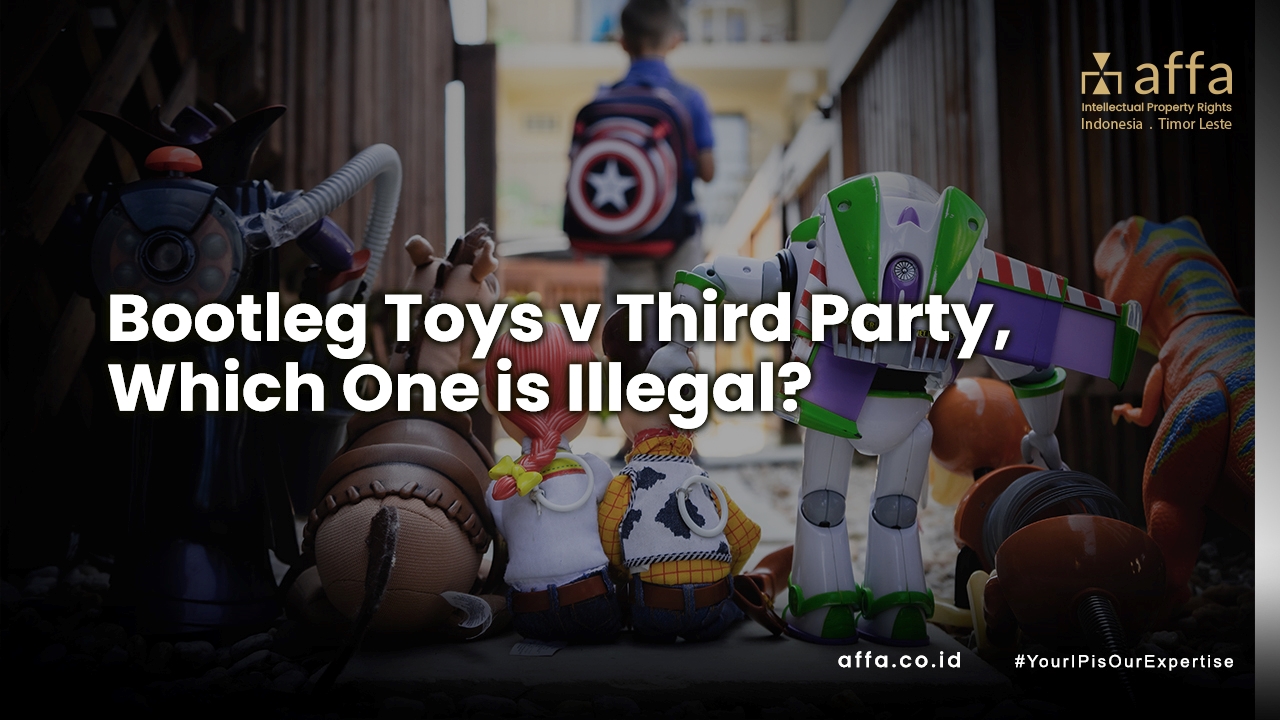
Bootleg Toys v Third Party, Which One is Illegal?

The toy industry is one of the most promising businesses for IP businesses. Of the total circulation of money, which has reached USD 107.4 billion in 2022 alone, more than 80% is Intellectual Property (IP) based toys. The best sellers were toys from IP Barbie, Disney Princess, Marvel, Star Wars, Pokemon, Minecraft, and Harry Potter.   Because basically, the buyers of these toys are not only children but also adults who collect various action figures (toy characters that can be posed because they have multiple points of articulation) and statues (toy characters that are large without articulation but have super accurate details), worth hundreds of dollar.   The large community of toy fans and collectors, with different purchasing power from a popular character, overwhelms toy manufacturers in presenting various toys that are in demand. This potential is then filled by other toy manufacturers, ranging from cheaper versions of toys to those with different designs that are not officially licensed.   Bootleg Toys Because they have official partnerships with IP owners, big toy manufacturers such as Hasbro, Bandai, Mattel, and LEGO must maintain quality by presenting products that match the original characters’ appearance— from the suitability of the color to the packaging with the official logo. With maintained quality, the selling price of these original toys is costly. But on the other hand, we can also find toys with low prices, of course with a low level of accuracy, messy paint, no official logo, and the name of the company that made it needs to be clarified.   That criterion is what is referred to as a bootleg or pirated toy. Because it is clear that its presence does not go through an official collaboration process, paying for a license, nor is there a Quality Control (QC) process that should be present to maintain the quality of an IP. Unfortunately, there is also a high interest in pirated toys, especially from low-budget collectors or collectors who deliberately buy toys to modify, repaint, or use some of the parts to replace the original toys.   Third-Party Toys As previously explained, each popular IP character has huge fans with high purchasing power. The characters Batman, Spider-Man, Iron Man, Darth Vader, Optimus Prime, and Kamen Rider are examples of popular characters whose fans always buy a new version of the toys. Seeing their enormous purchasing power, a third category of toy manufacturers emerged: toy manufacturers who make toys based on a character but with a different design, never before made by other toy companies but still attractive to the fans. These are what fans classify as “third-party” toys.   While true fans can feel guilty when they buy pirated toys, that’s not the case when they buy “third-party” toys. Because they think buying toys with new variants which have never been produced before by design is acceptable. These “third-party” toy manufacturers also do not pay royalties to IP owners. This is indicated by the absence of official logos and character names on the packaging of “third-party” toys.   Industrial Design Rights on Toys Several types of Intellectual Property are attached to a toy, namely Industrial Designs, Trademarks, and Copyrights. If the Copyright protects the packaging design, while the Mark protects the IP name and its characters, then the Industrial Design protects the core product.   According to Law Number 31 of 2000 concerning Industrial Design in Indonesia, the definition of Industrial Design is a creation of the shape, configuration, or composition of lines or colors, or lines and colors, or a combination thereof in a three-dimensional or two-dimensional form which gives an aesthetic impression and can be embodied in three-dimensional or two-dimensional patterns and can be used to produce a product, goods, industrial commodities or handicrafts.   In producing a toy, these toy manufacturers usually buy a license for a character from the IP owner, then make an attractive design and register it as an Industrial Design. However, this Industrial Design only has a protection period of 10 (ten) years from the application date and cannot be extended. This is what makes toy manufacturers have to keep creating and keep making new variants so they can continue to get the maximum benefit from the characters that have been licensed before losing the exclusive rights to the designs they made ten years later.   Penalties for Industrial Design Violators From the explanation above, it can be concluded that pirated toy manufacturers who make similar toys with the same design but lower quality have violated Industrial Design. Because according to Article 9 of the Industrial Design Law in Indonesia, “Holders of Industrial Design Rights have the exclusive right to exercise their Industrial Design Rights and to prohibit other people without their consent from making, using, selling, importing, exporting, and/or distributing goods that are given Industrial Design Rights.”   Then Article 54 of the Industrial Design Law provides for a maximum imprisonment of 4 (four) years and/or a maximum fine of Rp 300,000,000.00 (three hundred million rupiahs) for violations of Article 9 above.   Then what about “third-party” toy manufacturers? Do they not commit any violations?   Because Industrial Designs are specific according to the designs registered, “third-party” toy manufacturers may be able to escape the legal snares stipulated in the Industrial Design Law. Still, they cannot run the Copyright Law and/or Trademark Law because it is not impossible that the toy manufacturer still uses a similar name on the packaging and character design which still has similarities in principle to the character whose copyright has been recorded at the Intellectual Property Office.   Therefore, if we are true fans who support the development of our favorite IPs, we must start leaving the habit of buying toys from manufacturers who do not pay royalties because there are still forms of violation there. On the other hand, if you are interested in getting into the toy industry, it is better to start by establishing official partnerships with IP owners.   If you need further information about Industrial…

Details

Structure-of-Intellectual-Property-Trial-in-Indonesia-affa-global

Structure of Intellectual Property Trial in Indonesia

As the world becomes increasingly interconnected, the exchange of ideas, innovation, and creativity has become an essential engine of global economic growth. Intellectual Property Rights serve as the cornerstone of this new economy, safeguarding the interests of inventors and fostering an environment conducive to creative endeavor.    Within this context, Indonesia, home to a thriving marketplace of ideas, has seen a dramatic increase in the importance of Intellectual Property Rights. This article aims to demystify the unique and complex structure of the intellectual property trial process in Indonesia. From understanding the roles of various stakeholders and procedural intricacies to the legal framework that governs these trials, we’ll provide a comprehensive guide to navigating this essential, yet often confusing, aspect of Indonesia’s legal landscape.   Civil proceedings in Indonesia are conducted in writing and oral arguments. The judges will listen to the oral arguments of each party one at a time, and they rely heavily on the documentary evidence. Witnesses of fact can also provide oral evidence before the court. However, a witness statement or affidavit alone will not be sufficient since it is considered merely supplementary documentary evidence. In general, the procedure of the trial is as follows: attendance at the first hearing after the court summons both plaintiff and defendant; attendance at the second hearing, when the defendant files its response to the plaintiff’s cancellation suit; preparation of the plaintiff’s reply to the defendant’s response to the suit; attendance at the third hearing to file the plaintiff’s reply; attendance at the fourth hearing when the defendant files its response to the plaintiff’s reply; preparation of the plaintiff’s evidence to be submitted to the court; attendance at the fifth hearing to submit the plaintiff’s evidence and review the defendant’s evidence; preparation and filing of the conclusion of the case based on documents and evidence filed with the court by both plaintiff and defendant; attendance at the sixth hearing on the filing of the conclusion of the case; attendance at the seventh hearing to hear the judges’ decision; and issuance of the court’s decision.   For patent disputes, pursuant to Article 145(4) of the Patent Law, the trial can be conducted in a private manner if both parties make a request to the Court of Commerce for the trial to be private. This is to protect the secrecy of processes that would be easily manipulated or improved by a person knowledgeable in the relevant field.     For further questions regarding Intellectual Property disputes in Indonesia and the world, contact us via [email protected].  

Details
Nine-Types-of-Conduct-that-Constitute-Patent-Infringement-affa-global

Nine Types of Conduct that Constitute Patent Infringement

Patent Infringement is a serious violation that can result in legal consequences for those who violate it. Various actions carried out intentionally and without rights can be categorized as Patent Infringements. The essence of these violations is the misuse of other people’s atents for commercial interests or purposes.   Actions considered Patent Infringements are regulated in Article 160 of Law Number 13 of 2016 concerning Patents (Patent Law). As for the activities that are considered Patent Infringements, we summarize them as follows: Manufacturing products/processes without the permission of the Patent Holder. Using products/processes without the permission of the Patent Holder. Selling products/processes without the permission of the Patent Holder. Importing products without the permission of the Patent Holder. Leasing products/processes without the permission of the Patent Holder. Transferring products/processes without the permission of the Patent Holder. Providing for sale products/processes without the permission of the Patent Holder. Providing for lease products/processes without the permission of the Patent Holder. Providing for transfer products/processes without the permission of the Patent Holder.   By understanding the various types of patent infringement, you can at least avoid the legal consequences that can arise as a result of Patent Infringement. There are also very serious legal consequences. For example, Article 161 of the Patent Law states that anyone who deliberately and without rights commits an act as referred to in Article 160, shall be subject to imprisonment for a maximum of 4 (four) years and/or a fine of up to Rp. 1,000,000,000 (one billion rupiah). Meanwhile, criminal sanctions as stipulated in Article 162 of the Patent Law for violations of Simple Patents are imprisonment for a maximum of 2 (two) years and/or a fine of up to Rp. 500,000,000 (five hundred million rupiah).   If you need further information about Patent Protection and Patent Registration in Indonesia or abroad, please get in touch with us via [email protected]. Source: Articla 160, Law No. 13 of 2016 on Patents (Patent Law)

Details