Indonesia’s Patent Law Amendment: Excluded Inventions and Change in Novelty Grace Period - AFFA IPR

Indonesia’s Patent Law Amendment: Excluded Inventions and Change in Novelty Grace Period

On October 28, 2024, Indonesia introduced significant updates to its Patent System through Law No. 65 Year 2024, amending Law No. 13 Year 2016 on Patents. These changes aim to align Indonesia’s Patent System with global technological advancements while strongly emphasizing national interests. For international stakeholders and Patent applicants, this article highlights the crucial changes related to what does not constitute an invention and the updated novelty grace period.   What Is Not Included as an Invention According to Article 4 of the Patent Law, inventions do not include the following: Aesthetical creations; Schemes; Methods to conduct: – Mental activities; – Games: and – Businesses: Computer programs, except for the inventions that are implemented using computers; Presentations of information; and Theories and methods in the field of science and mathematics.    Previously, discoveries in the form of new use of existing and/or known product; and/or new forms from existing compound that do not generate significantly enhanced efficacy and contain different relevant known chemical structures to the compound, did not constitute inventions. The removal of this provision is intended to accommodate developments related to new uses for existing and/or known products that are still considered Inventions and can be granted a Patent. The Patent for such new use does not prevent the public from producing the product as long as they do not mention or indicate the patented use. Examples: Dapagliflozin: The first-use patent for diabetes has expired and has entered the public domain, so the public can use Dapagliflozin with the indication for diabetes without infringing the second-use patent. The second-use patent, which is for kidney disease, is still under patent protection. Snakehead Fish Extract: The first-use patent for cancer has expired and has entered the public domain, allowing the public to use Snakehead Fish Extract for cancer without infringing the second-use patent. The second-use patent, which is for COVID-19, is still under patent protection.   Furthermore, the term “computer program” refers to a computer program that only contains a program without technical characteristics, technical effects, or problem-solving capabilities. Problem-solving that involves a computer program, which in its implementation uses a computer, computer network, or other programmable equipment, can be considered an Invention, hereafter referred to as a computer-implemented Invention.   Examples of problem-solving involving a computer program that can be considered an Invention are: a computer program used for navigation based on the global positioning system (GPS) in motor vehicles; a computer program used to maintain a safe distance from the vehicle in front by automatically adjusting the vehicle’s speed; and a computer program used to control the electrical connectivity of household equipment.   Extended Novelty Grace Period One of the most notable updates is the extension of the novelty grace period. Previously, an invention disclosed within six months before the filing date under specific conditions would not lose its novelty. The amendment extends this period to 12 months, providing greater flexibility for inventors to publicly showcase their work without risking Patent eligibility.   Key Conditions for Grace Period: Exhibition Disclosure: Public display at recognized exhibitions in Indonesia or abroad. Experimental Use: Research and development purposes in Indonesia or abroad. Scientific Disclosure: Presentations during scientific sessions, such as thesis defenses or research discussions. Confidentiality Breaches: Unauthorized disclosure by third parties.   This extension demonstrates Indonesia’s commitment to fostering innovation by allowing inventors more time to refine and file their applications, encouraging global and domestic filings. For a deeper dive into the broader implications of the revised Patent Law, read our comprehensive guide: The Ultimate Guide to the Amendment of the Indonesian Patent Law. Should you need to know how this new definition impacts your business or invention, feel free to contact us at [email protected].

Details
Indonesia in BRICS: A Golden Opportunity for Further Trademark Protection - AFFA IPR

Indonesia in BRICS: A Golden Opportunity for Further Trademark Protection

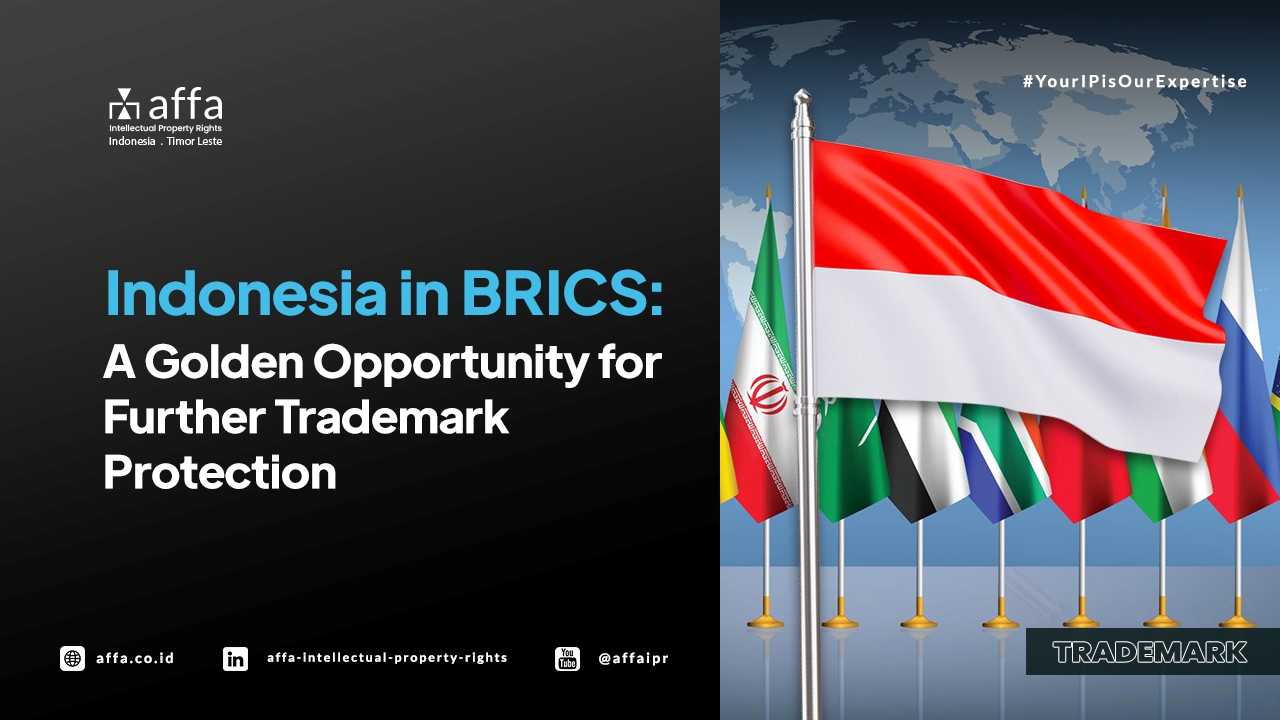
As of January 2025, Indonesia has officially joined BRICS as a full member, marking a significant milestone in its economic journey. This move is expected to enhance trade and investment among member nations, creating exciting opportunities for businesses looking to expand into the region.   BRICS, initially spearheaded by Russia, now includes Brazil, India, China, South Africa, Egypt, Ethiopia, Iran, and the United Arab Emirates. Together, these nations represent a powerful economic bloc, accounting for a substantial portion of global GDP and population. BRICS aims to strengthen the economies of its members, increase their global influence, and provide a counterbalance to Western-dominated economic institutions.   Indonesia’s entry into BRICS comes with a strong foundation. It already has robust trade relations with its fellow BRICS members, offering a dynamic market ripe for exploration. With its strategic location, abundant resources, and growing consumer market, Indonesia is poised to become a hub for international businesses.   This is the perfect time for foreign investors to tap into Indonesia’s vast potential. By registering your Trademark and establishing your business presence in Indonesia, you can gain a competitive edge in one of Southeast Asia’s most promising markets, now further amplified by its BRICS membership.   Indonesia’s Economic Potential in BRICS Countries Russia:  Main Exports to Indonesia: Wheat, fertilizers, and iron & steel products. Number of Registered Trademarks in Indonesia: 47 Most Class Category: 41 – Education; providing of training; entertainment; sporting and cultural activities. (7) 5 – Pharmaceutical and veterinary preparations; sanitary preparations for medical purposes; dietetic substances adapted for medical use, food for babies; plasters, materials for dressings; material for stopping teeth, dental wax; disinfectants; preparations for destroying vermin; fungicides, herbicides. (5) 35 – Advertising; business management; business administration; office functions. (5) 44 – Medical services; veterinary services; hygienic and beauty care for human beings or animals; agriculture, horticulture and forestry services. (5) Brazil Main Exports to Indonesia: Raw sugar, soybeans, and beef. Number of Registered Trademarks in Indonesia: 55 Most Class Category: 1 – Chemicals used in industry, science and photography, as well as in agriculture, horticulture and forestry; unprocessed artificial resins, unprocessed plastics; manures; fire extinguishing compositions; tempering and soldering preparations; chemical substances for preserving foodstuffs; tanning substances; adhesives used in industry. (16) 35 – Advertising; business management; business administration; office functions. (14) 29 – Meat, fish, poultry and game; meat extracts; preserved, frozen, dried and cooked fruits and vegetables; jellies, jams, compotes; eggs, milk and milk products; edible oils and fats. (13) India Main Exports to Indonesia: Organic chemicals, pharmaceutical products, and cotton. Number of Registered Trademarks in Indonesia: 2,308 Most Class Category: 5 – Pharmaceutical and veterinary preparations; sanitary preparations for medical purposes; dietetic substances adapted for medical use, food for babies; plasters, materials for dressings; material for stopping teeth, dental wax; disinfectants; preparations for destroying vermin; fungicides, herbicides. (404) 12 – Vehicles; apparatus for locomotion by land, air or water. (317) 9 – Scientific, nautical, surveying, photographic, cinematographic, optical, weighing, measuring, signalling, checking (supervision), life-saving and teaching apparatus and instruments; apparatus and instruments for conducting, switching, transforming, accumulating, regulating or controlling electricity; apparatus for recording, transmission or reproduction of sound or images; magnetic data carriers, recording discs; automatic vending machines and mechanisms for coin-operated apparatus; cash registers, calculating machines, data processing equipment and computers; fire-extinguishing apparatus. (229) 35 – Advertising; business management; business administration; office functions. (205) China Main Exports to Indonesia: Electronics, machinery, and textiles. Number of Registered Trademarks in Indonesia: 44,992 Most Class Category: 9 – Scientific, nautical, surveying, photographic, cinematographic, optical, weighing, measuring, signalling, checking (supervision), life-saving and teaching apparatus and instruments; apparatus and instruments for conducting, switching, transforming, accumulating, regulating or controlling electricity; apparatus for recording, transmission or reproduction of sound or images; magnetic data carriers, recording discs; automatic vending machines and mechanisms for coin-operated apparatus; cash registers, calculating machines, data processing equipment and computers; fire-extinguishing apparatus. (8,044) 7 – Machines and machine tools; motors and engines (except for land vehicles); machine coupling and transmission components (except for land vehicles); agricultural implements other than hand-operated; incubators for eggs. (3,439) 35 – Advertising; business management; business administration; office functions. (3,060) South Africa Main Exports to Indonesia: Coal, iron, and steel. Number of Registered Trademarks in Indonesia: 227 Most Class Category: 13 – Firearms; ammunition and projectiles; explosives; fireworks. (58) 9 – Scientific, nautical, surveying, photographic, cinematographic, optical, weighing, measuring, signalling, checking (supervision), life-saving and teaching apparatus and instruments; apparatus and instruments for conducting, switching, transforming, accumulating, regulating or controlling electricity; apparatus for recording, transmission or reproduction of sound or images; magnetic data carriers, recording discs; automatic vending machines and mechanisms for coin-operated apparatus; cash registers, calculating machines, data processing equipment and computers; fire-extinguishing apparatus. (50) 42 – Scientific and technological services and research and design relating thereto; industrial analysis and research services; design and development of computer hardware and software. (31) Egypt Main Exports to Indonesia: Cotton, dates, and other agricultural products. Number of Registered Trademarks in Indonesia: 80 Most Class Category: 35 – Advertising; business management; business administration; office functions. (21) 34 – Tobacco; smokers’ articles; matches. (20) 30 – Coffee, tea, cocoa, sugar, rice, tapioca, sago, artificial coffee; flour and preparations made from cereals, bread, pastry and confectionery, ices; honey, treacle; yeast, baking-powder; salt, mustard; vinegar, sauces (condiments); spices; ice. (14) 41 – Education; providing of training; entertainment; sporting and cultural activities. (14) 42 – Scientific and technological services and research and design relating thereto; industrial analysis and research services; design and development of computer hardware and software. (13) Ethiopia Main Exports to Indonesia: Coffee, oilseeds, and raw hides. Number of Registered Trademarks in Indonesia: N/A Most Class Category: N/A Iran Main Exports to Indonesia: Crude oil, petrochemical products, and nuts. Number of Registered Trademarks in Indonesia: 135 Most Class Category:  30 – Coffee, tea, cocoa, sugar, rice, tapioca, sago, artificial coffee; flour and preparations made from cereals, bread, pastry and confectionery, ices; honey, treacle; yeast, baking-powder; salt, mustard; vinegar, sauces (condiments); spices; ice. (36) 29 – Meat, fish, poultry and game; meat…

Details
Amended Definition of Patent under the Revised Indonesian Patent Law - AFFA IPR

Amended Definition of Patent under the Revised Indonesian Patent Law

The landscape of Intellectual Property in Indonesia continues to evolve, reflecting the dynamic nature of technology and innovation. One of the most significant updates in Law No. 65 of 2024, which is the third amendment to Law No. 13 of 2016 on Patents, lies in the revised definition of “Invention.”   The Old Definition Under Law No. 13 of 2016, Article 1(2) defined an invention as: “An idea of an inventor embodied into a specific problem-solving activity in the field of technology in the form of product or process, or refining and developing product or process.”   While this definition provided a foundation for Patent protection, it was deemed limited in addressing the broader advancements in technology and innovation across various industries.   The New Definition With the enactment of Law No. 65 of 2024, Article 1(2) now defines an invention as: “An idea of an inventor embodied into a specific problem-solving activity in the field of technology in the form of product and/or process, refinement, and/or development of a product and/or process, as well as systems, methods, and uses.”   Key Changes and Implications   Broader Scope: The inclusion of “systems, methods, and uses” significantly broadens the scope of what can be patented. This change acknowledges the importance of protecting technological advancements that may not fit neatly into the previous categories of “product or process.” Clarity and Flexibility: By adding “and/or” between product, process, refinement, and development, the law ensures greater flexibility in interpretation, making it more inclusive for different types of innovations. Alignment with Global Standards: The new definition aligns more closely with international Patent laws, making Indonesia a more attractive jurisdiction for inventors and businesses seeking to protect their Intellectual Property globally.   Why the Change Matters   This amendment reflects Indonesia’s commitment to adapting its Intellectual Property framework to keep pace with the rapid evolution of technology. From AI-driven systems to innovative methods in healthcare, the revised definition ensures that inventors in Indonesia have a robust legal foundation to protect and commercialize their ideas.   The revision is not only a response to domestic technological advancements but also a move to foster innovation and competitiveness in the international market. By expanding the definition, Indonesia signals its readiness to embrace emerging industries and future innovations.   For a deeper dive into the broader implications of the revised Patent Law, read our comprehensive guide: The Ultimate Guide to the Amendment of the Indonesian Patent Law. Should you need to know how this new definition impacts your business or invention, feel free to contact us at [email protected].

Details
2025 Resolution: Wealth Through IP - Make It Happen! - AFFA IPR

2025 Resolution: Wealth through IP – Make It Happen!

As we enter a new year, many of us aim for ambitious resolutions, including achieving financial success. One often-overlooked but highly effective way to achieve this is through Intellectual Property (IP) ownership—be it Trademarks, Patents, Industrial Designs, or Copyrights. Hard to imagine? Let’s look at some inspiring examples of how IP has made others wealthy.   Trademarks: David Beckham Earned USD 36 Million in 2024  By licensing his name to major companies like Adidas, Nespresso, and Stella Artois, the English football icon significantly boosted his income from the previous year, which was “just” USD 16.2 million. This is remarkable, considering he retired more than a decade ago.  Moreover, the entire Beckham family, from his wife Victoria to his children Brooklyn, Romeo, Cruz, and Harper, have also registered their names as Trademarks with the UK Intellectual Property Office (UKIPO). So, if you have a unique name with notable achievements, don’t hesitate to register it and use it as your business identity.   Patents: Dyson’s Innovations Generated GBP 1.4 Billion in 2023  Founded by Sir James Dyson in 1991, Dyson started with the revolutionary bagless vacuum cleaner. Today, its innovations extend to other technologies used in household appliances such as hand dryers, bladeless fans, air purifiers, and hair styling tools.  Although the company invests heavily in R&D for AI, robotics, and cutting-edge battery technologies, its tens of thousands of registered patents have been licensed to numerous companies worldwide, providing additional revenue beyond the sales of finished products. In 2023, Dyson’s total revenue reached GBP 7.1 billion!   Copyrights: Mariah Carey’s Royalties Reach USD 3 Million Annually  In the entertainment world, Copyright is an invaluable asset. For instance, Mariah Carey’s timeless hit, “All I Want for Christmas Is You,” has generated annual royalties of around IDR 48 billion despite being released in 1994. These royalties come from frequent airplay on radio, streaming platforms, and usage in films and commercials every holiday season.  If you create a song or movie with a holiday theme, its popularity and playback could grow yearly, allowing you to earn passive income through royalties.   Industrial Designs: Bandai’s 20 Billion Yen Annual Revenue from “Henshin Belt”  It’s no secret that the Kamen Rider series serves as a year-long advertisement for toys. Each year, a new Kamen Rider series is introduced, complete with a new Henshin Belt—more sophisticated and unique, following current trends.In the story, the Henshin Belt is a high-tech device enabling the protagonist to transform into a superhero. To captivate children, the toy version incorporates engaging “gimmicks.” For example, in the latest series, Kamen Rider GAVV, the gimmick involves inserting small monster-shaped collectibles into the belt to unlock various powers. Bandai registers the Industrial Design for the belt and its collectible monsters to ensure exclusivity and economic rights. With this protection, no other party can legally use the unique design without permission. The result? Annual toy sales of approximately USD 134 million!   These examples show that Intellectual Property isn’t just a foreign concept—it’s also applicable in Indonesia or everywhere. You can use your name as a Trademark for a restaurant franchise or create a unique product design registered as an Industrial Design. As long as your IP is protected, it will continue to generate opportunities to build wealth in the future. If you’re an innovator, business owner, athlete, musician, or creator from any background, IP-based business opportunities can be a promising source of future income. To learn more about securing legal protection for your Intellectual Property, reach out to us at [email protected].

Details
Indonesian IP Office Declares 2025 the Year of Copyright and Industrial Design - What Are the Benefits? - AFFA IPR

Indonesian IP Office Declares 2025 the Year of Copyright and Industrial Design – What Are the Benefits?

The Indonesian IP Office (DGIP) has reaffirmed its commitment to supporting the protection and development of Intellectual Property (IP) in Indonesia. 2025 has been declared the Year of Copyright and Industrial Design, marking a new strategic initiative to strengthen Indonesia’s IP ecosystem. This policy not only aims to raise awareness of the importance of Copyrights and Industrial Designs but also to create a more conducive environment for businesses and investors, both domestic and international.   This declaration is based on several initiatives and policies implemented by DGIP over recent years. After the 2024 Year of Geographical Indications, DGIP recorded a significant increase in IP applications, demonstrating heightened public awareness of the importance of IP protection. With the declaration of the Year of Copyright and Industrial Design, DGIP aims to continue this positive trend, particularly by increasing the registration of Copyrights and Industrial Designs.   DGIP has set ambitious targets, with the Director General of Intellectual Property aiming for increased Non-Tax State Revenue (PNBP) for 2026: IDR 28,156,750,000 from Copyrights, IDR 354,753,680,000 from Trademarks, and IDR 529,167,083,000 from Patents and Trade Secrets.   DGIP’s Achievements in 2024 As a foundation for 2025, DGIP achieved several milestones during 2024:   Increase in Intellectual Property Applications DGIP recorded a significant increase in IP applications, including Copyrights, Industrial Designs, and Geographical Indications. In 2024, more than 15,000 Copyright applications were recorded, a 20% increase compared to the previous year. DGIP also received approximately 5,000 Industrial Design applications, reflecting a 15% growth. Furthermore, 50 new Geographical Indication applications were filed, indicating rising public awareness of protecting local wealth-based products. Launch of the 2025-2029 National Geographical Indications Roadmap This strategy aims to strengthen the management and preservation of Geographical Indication-based products, providing direct economic benefits to local communities. Enhanced Services and Transparency Through various initiatives, including the 2024 IP Program Financial Coordination Meeting, DGIP improved service efficiency, especially by expediting IP registration processes to enhance user experience. International Collaboration DGIP successfully established partnerships with international organizations to strengthen IP protection in Indonesia. These collaborations included training, capacity-building for human resources, and promoting Indonesian IP products in global markets. Key IP-Based Regional Programs This initiative encourages the development of IP-based regions to support sustainable economies, enhancing the competitiveness of local products in international markets. These programs range from the Development of Geographical Indications-Based Local Products, Creative Economy Zones Based on IP, to IP-Based SME Assistance.   Strategic Policies Supporting the Year of Copyright and Industrial Design To ensure the success of this initiative, DGIP has formulated several strategic policies and measures:   Updating the 2024-2029 Strategic Plan During the Strategic Plan Update meeting in Bogor in December 2024, DGIP designed data-driven programs to anticipate future needs and challenges. This step ensures that policies related to Copyrights and Industrial Designs align with global dynamics. Strengthening Services and Financial Management Through the 2024 IP Program Financial Coordination Meeting, DGIP focused on improving services and the potential for Non-Tax State Revenue (PNBP). Efficient financial management has become a priority to support optimal operations, particularly in expediting the registration and protection of Copyrights and Industrial Designs. IP-Based Regional Programs DGIP launched flagship programs that utilize IP-based regions to support sustainable economies. This approach aims to enhance the competitiveness of local products with IP value in global markets, providing direct economic benefits to communities and businesses. 2025-2029 National Geographical Indications Roadmap While focusing on Geographical Indications, this roadmap serves as an example of how DGIP designs comprehensive strategies for IP management. Similar approaches are expected to be applied to Copyrights and Industrial Designs, emphasizing preservation and innovation.   Positive Impacts for Businesses and Investors Through these policies, DGIP not only strengthens Indonesia’s IP ecosystem but also sends positive signals to international businesses and investors. These conducive conditions include:   Faster Services: Improved speed and transparency in IP recordation, registration, and protection processes.   Legal Certainty: Structured policies provide better protection for rights holders.   Global Competitiveness: Strengthened IP-based regions allow local products to compete more effectively in international markets.   You might also want to read: Fighting IP Crimes: Indonesia’s IP Office Task Force Destroys IDR 5.35 Billion Worth of Counterfeit Goods!   Despite the many initiatives launched, challenges remain, such as low public awareness of the importance of IP protection and the need for adequate infrastructure. However, with DGIP’s commitment, 2025 is expected to be a monumental year for strengthening Copyright and Industrial Design protection in Indonesia.   The declaration of the 2025 Year of Copyright and Industrial Design is DGIP’s tangible step in solidifying Indonesia’s position as a country that supports Intellectual Property protection. This policy aims to raise awareness of the importance of Copyrights and Industrial Designs and create a more conducive environment for businesses and investors, both domestic and international. Should you need more information on Copyright and Industrial Design protection in Indonesia, please contact us at [email protected].

Details
IP Licensing for Restaurants & Theme Parks: An Investment or a Burden? - AFFA IPR

IP Licensing for Restaurants & Theme Parks: An Investment or a Burden?

Indonesian laws regulate the granting of Exclusive Rights over Trademarks, Industrial Designs, or Copyrights, where only the owner and/or creator have the right to derive economic benefits from the Intellectual Property (IP). Therefore, it can be concluded that any restaurant, venue, or theme park wishing to utilize such IP must obtain permission. But how does it work in practice?   However, it is still common to find restaurants and venues utilizing well-known IP elements such as characters from popular animations, superheroes, or movie themes without official permission from the owner. For example, themed restaurants inspired by popular movies or series that use their names and menu concepts, or amusement parks displaying statues of characters without a license. While these may appear attractive and draw visitors, such actions violate the Exclusive Rights of IP owners and may lead to legal lawsuits.   The Importance of Licensing IP Usage   Such violations harm IP owners and create an unhealthy business environment. Entrepreneurs who disregard Intellectual Property Rights neglect the significant investments made by IP owners in creating their works, from the creative process to marketing efforts.   So, what’s the solution? It’s as simple as contacting the IP owner and obtaining usage rights formalized in a Licensing Agreement. This ensures legal usage of the IP and helps determine if another party in Indonesia has already been granted a license, potentially allowing further collaboration for authorization.   You might also want to read: Indonesia’s IP Odyssey: Unraveling the Ins and Outs of IP License Agreement Recordal   By obtaining a license, you can get the following three key benefits:   Avoiding Legal Risks Licensing protects businesses from lawsuits that may result in hefty fines or even closure. Enhancing Credibility Official licensing demonstrates a commitment to ethical business practices and respect for others’ rights. Building Long-Term Partnerships IP owners often support the marketing of licensed businesses, providing strategic advantages for expanding into international markets. You could even become the trusted partner for operating this business in Indonesia.   The Public’s Role in Respecting IP   Besides business operators, the public also plays a crucial role in safeguarding Intellectual Property Rights. As consumers, we should be more critical when choosing places to visit. If you encounter a restaurant, venue, or theme park using a well-known IP without authorization, consider the following:   Avoid Visiting Supporting businesses that violate IP rights only worsens the problem. Report Violations You can report violations to the relevant authorities or directly to the IP owner to initiate legal action.   The easiest way to verify whether a venue has a formal collaboration with the IP owner is by checking for the © “IP Owner’s Name” label on its publication. Because obtaining such authorization often involves significant effort and cost, businesses are likely to display this label. Not only does it reflect official usage, but it also serves as a badge of pride that their business has earned the trust of a major IP name. Licensed businesses also freely promote such partnerships without fear of secrecy.   Criminal Sanctions for Unauthorized IP Usage   Running a business that uses IP without permission in Indonesia may result in criminal penalties, depending on the type of violation:   Trademark Infringement Anyone who unlawfully uses a trademark identical to a registered one belonging to another party for similar goods and/or services may be subject to: Imprisonment: Up to 5 years. Fine: Up to IDR 2 billion. Copyright Infringement Anyone who unlawfully and/or without permission from the creator or copyright holder distributes a work or its copies for commercial purposes may be subject to: Imprisonment: Up to 4 years. Fine: Up to IDR 1 billion.   For more severe violations, such as piracy, penalties may include imprisonment of up to 10 years and/or fines of up to IDR 4 billion. Furthermore, should you need help obtaining a license for well-known IPs, including drafting proper licensing agreements, feel free to contact us via email at [email protected].

Details
The Billion-Stream Christmas Song: Mariah Carey's Seasonal Success - AFFA IPR

The Billion-Stream Christmas Song: Mariah Carey’s Seasonal Success

As December begins and the holiday season approaches, Mariah Carey’s iconic song, “All I Want for Christmas Is You,” can be heard almost everywhere. The festive atmosphere, from radios, cafes, hotels, offices, and shopping malls, seems incomplete without this song. If you’re a musician, songwriter, or singer, you might wonder how much royalty Mariah Carey earns annually from this song. But is it as massive as we imagine?   “All I Want for Christmas Is You” was first released in 1994 as part of Mariah Carey’s Christmas album, Merry Christmas. The song was co-written by Mariah and Walter Afanasieff, a seasoned musician, songwriter, and producer who collaborated with top artists of the era, such as Celine Dion, Boyz II Men, and Natalie Cole. However, the song initially only peaked at number twelve on the Billboard US Hot 100 Airplay chart.   The Journey to Becoming a $100 Million Royalty Song   Although it didn’t perform exceptionally well in the United States, the song skyrocketed in popularity in Europe, Japan, Singapore, Australia, and New Zealand, becoming the most-played holiday song annually. In 2001, Mariah released a remix of her Greatest Hits album. From then on, the demand for the song surged, with the original version consistently topping the charts every December from 2005 to 2008, 2019, and beyond.   According to the Associated Press, since 1994, the song has generated an estimated $100 million in royalties. This is primarily thanks to the surge in plays from streaming platforms like Spotify and YouTube, making it more accessible to listeners worldwide.   Passive Income of Up to $3 Million Per Year   As the songwriter and singer, it’s no surprise that Mariah is one of the biggest royalty earners from this song. However, she’s not the only one receiving royalties. The song has sold over 3.6 million digital copies in the United States since its release. It’s the most popular Christmas song in Europe, mainly the UK, with over 1.2 million downloads and 100 million streams. In Asia, the song ranks top on karaoke platforms and remains one of the most frequently sung Western songs.   Radio airplay and physical record sales also continue to generate royalties for the parties involved with the song. They include:   Songwriters Walter Afanasieff, the song’s co-writer, is entitled to a share of the songwriting royalties.  Record Label The song is under Columbia Records, part of Sony Music Entertainment. As the company that produces, markets, and protects the master recording, the label receives royalties from distribution and licensing agreements.  Music Producers In addition to Mariah Carey, Walter Afanasieff also acted as the song’s producer, earning royalties for the master recording.  Related Rights Supporting musicians like Dan Shea and backing vocalists (Kelly Price, Melonie Daniels, and Shanrae Price) who contributed to the recording are also entitled to royalties, as stipulated in their recording contracts.     “All I Want for Christmas Is You,” celebrating its 30th anniversary this year, shows how a single song can provide extraordinary long-term income for singers, songwriters, and other musicians. However, such income sources would not be well-managed without proper licensing agreements that regulate royalty distribution.   Thus, ensure that all your creations are appropriately documented and managed with solid licensing agreements to maximize their benefits—not just now but for decades to come. Should you need more information on Copyright recordation and licensing agreements domestically and internationally, please contact us at [email protected].

Details
Fighting IP Crimes: Indonesia's IP Office Task Force Destroys IDR 5.35 Billion Worth of Counterfeit Goods! - AFFA IPR

Fighting IP Crimes: Indonesia’s IP Office Task Force Destroys IDR 5.35 Billion Worth of Counterfeit Goods!

The Indonesian Intellectual Property (IP) Task Force, a cross-ministerial special task force of the Republic of Indonesia, consists of the Directorate General of Intellectual Property (DGIP), the Directorate General of Customs and Excise (DGCE), the National Agency of Drug and Food Control (BPOM), the Ministry of Communication and Digital (Komdigi), the Criminal Investigation Department (Bareskrim) of the National Police, and the National Cyber and Crypto Agency (BSSN). On December 12, 2024, the task force symbolically destroyed a number of products associated with violations of 12 Trademarks and Industrial Designs.   During a press conference, the Director General of Intellectual Property, Razilu, stated: “This destruction serves as a strong message from the DGIP that there is no room for Intellectual Property violations in Indonesia.”   At least three key messages were conveyed through the destruction of these products: Deterrence: To provide a deterrent effect on offenders, ensuring they refrain from committing further violations. Both civil and criminal legal actions can be enforced against them. Creator and Owner Protection: To assure creators and IP owners that their works are protected, fostering an environment where they can continue innovating. Public Awareness: To urge the public never to buy counterfeit or fake goods at low prices, as these products can adversely affect health, employment, and the environment.   The destroyed products, valued at IDR 5.35 billion, included the following: LEGO (toys): Worth over IDR 1 billion, from 110 items. Comotomo (baby bottles): Worth over IDR 500 million, from 888 items. Mimi White (hand and body lotion): 216 items. MT NG Shan (drill bits): 2,000 pieces. Louis Vuitton (women’s bags, wallets, and belts): 10 items. Christian Louboutin (women’s shoes): 2 pairs. Tokai (lighters): 5 boxes. Orion Choco Pie (snack/biscuits): 50 boxes. Honda (spare parts): 30 boxes. Honda (generators): 30 units. Harley Davidson (apparel accessories, umbrellas, and wallets): 600 items. Food Packaging (Industrial Design): 30 boxes.   It is important to note that the products classified as IP violations are not limited to counterfeit goods but also include goods illegally entering the Indonesian market. Under the law, smuggled goods that bypass official channels, fail to adhere to applicable import procedures, and are subject to objections by the official license holders of the relevant trademarks are subject to enforcement actions.   Given the complex and extensive scope of IP  violations, cross-sector enforcement is required. The specific roles of the involved institutions are as follows: DGIP: Monitoring, supervision, preventive measures, mitigation strategies, and enforcement of IP laws. DGCE: Addressing the importation of goods suspected of infringing IP rights. BPOM: Managing the distribution of food and pharmaceutical products that are suspected of infringing IP rights and endangering public health and the environment. Komdigi: Handling complaints and requests for blocking websites related to goods and/or services deemed to violate IP rights. Bareskrim Polri: Coordinating communication and collaboration for law enforcement from the central office to its units across Indonesia. BSSN: Monitoring IP violations in cyberspace and assisting in handling IP infringements that occur in the digital realm.   You might also want to read: Unraveling the Global Complexity of IP Crime: Money Laundering and More!   Each year, the average number of reports on IP violations is around 50 cases, with the majority involving Trademark, Industrial Design, and Copyright infringements. The active role of Komdigi has also significantly contributed to blocking 414 websites infringing Copyrights based on 16 requests. However, considering that the IDR 5 billion in damages mentioned earlier came from only 12 cases, this can be seen as just the beginning or the tip of the iceberg in the enforcement of IP laws in Indonesia.   Therefore, the participation of the five key components of the nation—Government, Academics, Private Sector, Society, and Media—is expected to continue supporting efforts to create a better Intellectual Property climate in Indonesia.   With increasing public awareness of the importance of Intellectual Property, there will also be positive impacts on the national economy and Indonesia’s investment climate in the global arena.   Should you need more information regarding Trademark protection and other Intellectual Property matters in Indonesia and abroad, feel free to contact us via email at [email protected].

Details
IP Character Collaborations with Airlines - Which One is Your Favorite? AFFA IPR

IP Character Collaborations with Airlines – Which One is Your Favorite?

Collaborations involving Intellectual Property (IP) or well-known characters aren’t limited to clothing or merchandise; they extend to restaurants, theme parks, and even airlines. Thanks to the immense popularity of these characters, fans are willing to travel, buy tickets, and spend more to enjoy a unique experience connected to their favorite icons. As the holiday season approaches, traveling with a trusted airline featuring your favorite IP characters can be an exciting option for you and your family. These collaborations often offer in-flight branding, including themed headrests, paper cups, meal boxes, in-flight entertainment, and exclusive merchandise to take home. Does your favorite character make the list? Etihad Airways x Warner Bros Boeing 787-10 Dreamliner  Since: July 2024 Characters: Batman, Superman, Wonder Woman, Looney Tunes, etc. Routes: Abu Dhabi, London, Dublin, Amsterdam, Vienna, Bangkok, and Manila AirAsia x Sonic the Hedgehog Airbus A330 Since: October 2024 Characters: Sonic, Tails, & Shadow Routes: Kuala Lumpur – Bangkok All Nippon Airways (ANA) x Demon Slayer: Kimetsu no Yaiba Bombardier DHC 8-400 Since: July 2023 Characters: Tanjiro, Nezuko, Zenitsu, Inosuke, Kyojuro, etc. Routes: Osaka – Fukuoka Southwest Airlines x Walt Disney World Boeing 737-700 Since: September 2021 Characters: Mickey, Minnie, etc. Routes: United States Domestic Garuda Indonesia x Pokemon Boeing B737-800 NG (Pikachu Jet GA-1), since February 2024 Airbus A330-300 (Pikachu Jet GA-2), from March 2025 Characters: Pikachu, Squirtle, Aipom, Oddish, etc. Routes: Jakarta, Denpasar, Jogja, Lombok, Batam, Surabaya, Malang, Semarang, Makassar, Tokyo, Sydney, Melbourne, Hong Kong, China, Jeddah, Bangkok, etc. With this collaboration, Garuda Indonesia has joined the elites of the “Pikachu Jets” fleet, alongside other airlines that collaborated earlier, such as ANA and Skymark Airlines (Japan), China Airlines, Scoot (Singapore), and T’way Air (South Korea). For Garuda Indonesia, IP collaborations are not new, as the airline previously partnered with Star Wars and Marvel Studios from The Walt Disney Company in 2022.   Should you need further information about IP collaborations, licensing agreements, or the protection of Trademarks and other IPs domestically or internationally, contact us at [email protected].

Details

Patent Translation Submission Requirement in Indonesia - AFFA IPR

Patent Translation Submission Requirement in Indonesia

In accordance with the latest amendment of the Indonesian Patent Law, all foreign applicants who wish to file patent applications in Indonesia have to provide the Indonesian IP Office (DGIP) with the following:   ⁠If the description is written in foreign languages other than English, the description shall be complemented with the English and Indonesian translations; or If the description is written in English, it shall be complemented by an Indonesian translation.   This new policy is aimed to enable the examiners to examine the applications more thoroughly, since in the past some applicants from non-English speaking countries only provided the description, claims, and figures in their languages and then in Indonesia.    Please be mindful of the deadline to submit the above within 30 working days from the filing date. Should you require any assistance for patent translation in Indonesia, please do not hesitate to contact us at [email protected].

Details