


Protecting intellectual property (IP) is crucial for businesses to maintain their competitive edge and avoid significant financial losses. Missteps in IP management can lead to costly legal battles, loss of market exclusivity, and reputational damage. At AFFA Intellectual Property Rights, we have observed how certain oversights can jeopardize a company’s assets. This article highlights common IP mistakes that have cost companies millions and offers guidance on how to avoid them. Delaying Trademark Registration, Losing Momentum Real Case: A major phone company lost its momentum to secure its Mark easily in Indonesia because its former distributor managed to file it first in Indonesia. The company had to challenge the ownership of the Mark before the Court of Commerce. How to Avoid It: File early — before launching products or entering new markets. Have an agreement with potential distributors on IP ownership Neglecting International Trademark Protection: Locked Out of Your Brand Real Case: A fast-growing electric vehicle company faced a legal dispute in East Asia when a local businessman had already registered the company’s brand name. The company had to settle the matter through costly negotiations to enter the market under its own name. How to Avoid It: Create a global Trademark filing strategy — especially for key growth markets. Use the Madrid Protocol or local filings, depending on your market. Rely on local IP experts who understand the nuances of national systems. Failing to Record a Trademark License: Legal and Commercial Setbacks Real Case: Some overseas companies faced delays in distributing certified products because the Trademark they were using, although legally licensed, was not officially recorded with the authorities. Without this, certification bodies could not process mandatory approvals and licenses to be able to operate in Indonesia. How to Avoid It: Record all Trademark licenses at the national IP office. Work with consultants who understand licensing formalities and draft enforceable agreements. Do not assume a signed appointment contract is enough — a specific license agreement will be required. Not Using a Patent Locally: Risk of Revocation Real Case: In several jurisdictions, companies have had their Patents challenged or revoked because the inventions were not “worked” or implemented within the country. This has opened the door to compulsory licensing by third parties. How to Avoid It: Prepare a local implementation or commercialization strategy. Consider partnerships with local entities to meet legal requirements. Monitor “working” obligations in each country where you hold Patents. Conclusion: Proactive IP Management is Essential Many companies only realize the importance of IP when it is too late, especially when it comes to Indonesia as a growing market. Indonesia is a challenging country when it comes to IP, but with proper planning, it does not have to be so challenging! AFFA Intellectual Property Rights has helped businesses across the globe secure and protect their Trademarks, Patents, Industrial Designs, and licenses — both in Indonesia and internationally. From strategic filings to enforcement and compliance, we offer practical solutions that prevent losses before they happen. Should you need assistance securing or defending your IP in Indonesia or globally, contact AFFA Intellectual Property Rights today at [email protected].
Why Filing First is Not Enough — The Rise of Bad Faith Trademark Applications in Indonesia
Indonesia’s Trademark landscape has become increasingly challenging for legitimate brand owners in recent years. Filing your Trademark first is no longer a guaranteed safeguard against opportunists. A concerning trend has emerged: the surge of bad faith Trademark applications, commonly called Trademark squatting. At AFFA Intellectual Property Rights, we have witnessed — and successfully countered — this rise firsthand. The Growing Threat of Bad Faith Filings According to data from the Directorate General of Intellectual Property (DGIP) in Indonesia, Trademark applications have steadily increased annually. However, not all of these filings are genuine. Opportunistic parties, both local and international, are taking advantage of Indonesia’s first-to-file system by registering Trademarks identical to or confusingly similar to well-known brands without any legitimate intent to use them. These bad actors aim to profit by either selling the Trademark rights back to the rightful brand owners or using them to confuse consumers. Real Examples: How AFFA Wins Against Squatters At AFFA, we have led multiple successful cases challenging bad faith registrations. Two notable victories highlight how vigilant defense and a strong legal approach can protect your brand: Guangzhou Sanwich Biology Technology Co., Ltd. In 2024, our client, the owner of the well-known hair care brand SEVICH, faced a situation in which a third party registered their Trademark in Indonesia without authorization. We filed a Trademark invalidation action, presenting strong evidence of prior use and global brand recognition. The Commercial Court at the Central Jakarta District Court ruled in favor of our client, affirming that the third-party registration was made in bad faith. Inner Mongolia Kunming Cigarette Limited Liability Company Similarly, this client, known globally for its DONGCHONGXIACAO brand of cigarettes, encountered unauthorized parties attempting to capitalize on its brand by filing Trademark applications in Indonesia. We secured a favorable decision invalidating the bad faith Trademark registration by leveraging thorough documentation, the client’s international reputation, and a well-structured legal argument. Why Filing First Alone is Not Enough Indonesia operates on a first-to-file system, but: Squatters may file before you, especially if you have not entered the market yet. Even after filing, vigilance is required to monitor for similar or identical marks. The law provides avenues to invalidate bad faith registrations, but only if the rightful owner is proactive. Our Approach to Defending Brands At AFFA, we go beyond simple filings: Trademark Monitoring: We routinely monitor new filings to detect possible bad-faith applications. Evidence Gathering: In invalidation actions, we compile comprehensive evidence — proving prior use, reputation, and lack of good faith from the applicant. Swift Legal Action: We quickly file oppositions or invalidations to block squatters before they gain leverage. Strategic Negotiation: When necessary, we negotiate favorable outcomes without lengthy litigation. Conclusion: Protect Your Brand, Act Proactively The rise of bad faith Trademark filings in Indonesia is real, and serious players must be ready to defend their brand. Filing your Trademark early is necessary, but not sufficient. Active monitoring, quick response, and expert legal support are key. AFFA is committed to helping businesses navigate these challenges and win the fight against Trademark squatters. Should you need assistance securing or defending your Trademark in Indonesia? Contact our team at AFFA Intellectual Property Rights today at [email protected].

Extension of Time to Complete Patent Application Formality Documents
Indonesia’s Patent regulation has undergone significant changes following the enactment of Law No. 65 Year 2024, which amends Law No. 13 Year 2016 on Patents. One of the key amendments is the extension of time to complete the formalities in a Patent application. Previous Regulation (Law No. 13 Year 2016) Under the previous version of Article 35: Applicants who received a notification to complete formal requirements had 3 months from the date of notification to comply. If needed, applicants could request two extensions: First extension: Up to 2 months. Second extension: Up to 1 additional month, subject to a fee. However, the second extension (one month with a fee) was rarely utilized in practice. Many applicants who requested extensions still failed to complete the requirements, resulting in their applications being considered withdrawn. Current Regulation (Law No. 65 Year 2024) The amended Article 35 introduces more stringent provisions: Applicants still have 3 months to complete formal requirements after receiving notification. Only one extension of up to 2 months is now permitted. Additional extension beyond the two months is only possible under emergency circumstances and requires strong supporting evidence. Key Takeaways: The second extension option (1 month with a fee) has been repealed. The new law limits the extension to a one-time request, making compliance more challenging but streamlining the overall process. Practical Steps for Applicants To meet the formality requirements within the given timeframe, applicants are advised to prepare the following key documents promptly: Power of Attorney (PoA) Statement of Assignment or Deed of Assignment Failing to submit these documents within the prescribed period, including the extension, will result in the Patent application being considered withdrawn. Comparison Table Aspect Before Amendment (Law No. 13/2016) After Amendment (Law No. 65/2024) Initial Period to Complete Requirements 3 months from the date of the Minister’s notification 3 months from the date of the Minister’s notification First Extension Up to 2 months Up to 2 months Second Extension Additional 1 month, subject to fee Abolished Additional Extension in Emergency Cases Not explicitly regulated Allowed only in emergencies, up to 6 months, with strong supporting evidence Total Possible Duration 3 months + 2 months + 1 month (total 6 months), with the possibility of paying the fee for the final month 3 months + 2 months (total 5 months), emergency extension possible up to 6 months, but requires justification Ease for Applicants More lenient with more extension options Stricter, only one regular extension allowed Impact on Examination Timeframe Potentially longer due to multiple extensions Shorter, as fewer extensions are permitted The recent amendment emphasizes the importance of timely compliance. Applicants are now only allowed one extension of two months, with no further routine extensions available. While this makes the process more demanding, it significantly shortens the formality examination period, enhancing efficiency in Indonesia’s Patent system. Applicants must prepare their formal documents meticulously and avoid delays to ensure the smooth processing of their applications. You might also want to read: Steps to Take When a Patent Application is Deemed Withdrawn in Indonesia Should you need more information regarding the extension of time to complete Patent application formality documents in Indonesia, feel free to contact us via email at [email protected].

Patent Implementation in Indonesia and Its Consequences if the Patent is Not Used According to the Latest Patent Law
A registered Patent not only grants the Exclusive Right to its owner to prohibit others from using the invention but also imposes an additional obligation to implement the Patent. This obligation is regulated under Law Number 13 of 2016 concerning Patents, as well as Law Number 65 of 2024 concerning the Third Amendment to Law Number 13 of 2016, which has been in effect since October 28, 2024. How is the obligation to implement a Patent regulated, and what are the legal consequences if a Patent is not used under the latest Patent Law? Here’s the summary! Previously—and still applicable—Article 20 of the Patent Law has regulated the obligation to implement Patents in Indonesia as follows: Product Patent: Obligated to manufacture, import, or license the product. Process Patent: Obligated to manufacture, license, or import the product resulting from the patented process. Method, System, & Use Patents: Obligated to manufacture, import, or license the product resulting from the method, system, or use. Obligation to Implement Patents in Indonesia In this third amendment, Article 20A has been added to the Patent Law, stipulating that every Patent holder is required to submit a declaration of Patent use in Indonesia and report it to the Minister through Directorate General Intellectual Property (DGIP) at the end of each year, accompanied by proof of implementation. The implementation of the Patent may be carried out either by the Patent holder or by a third party under license from the Patent holder. The objective of this provision is to encourage technology transfer, investment, job creation, and tangible economic growth for Indonesia. Forms of Patent implementation may include: Manufacturing goods or utilizing processes protected by the Patent in Indonesia. Transferring technology to third parties in Indonesia. Collaborating in manufacturing with local companies. Consequences of Non-Implementation of Patents In this latest amendment, provisions regarding consequences such as compulsory licensing or Patent revocation, which were previously regulated under Articles 82 and 130 of the Patent Law, have been removed. Instead, the annual reporting obligation as stipulated in Article 20A serves as an instrument for the government to monitor Patent utilization in Indonesia. Although administrative sanctions for non-compliance with the reporting obligation are not explicitly regulated yet, this obligation opens the possibility for the government to issue further implementing regulations or administrative policies in the future. Acceptable Reasons for Delayed Implementation Previously, the Patent Law allowed Patent holders to provide legitimate reasons for not yet implementing their Patent, such as: Force majeure circumstances. Regulatory or licensing obstacles to production. Production still in preparation stages. In the amended Patent Law, although these reasons are no longer explicitly listed, Patent holders may still include such reasons in their annual reports as part of the explanation or justification in cases where implementation has not been optimal. You might also want to read: 5 Stages of Patent Registration Process in Indonesia Should you need further information regarding the Patent implementation in Indonesia and Its consequences if the Patent is not used, feel free to contact us at [email protected].
2 Clubs, 1 Logo – Expansion, Imitation, or Pure Coincidence?
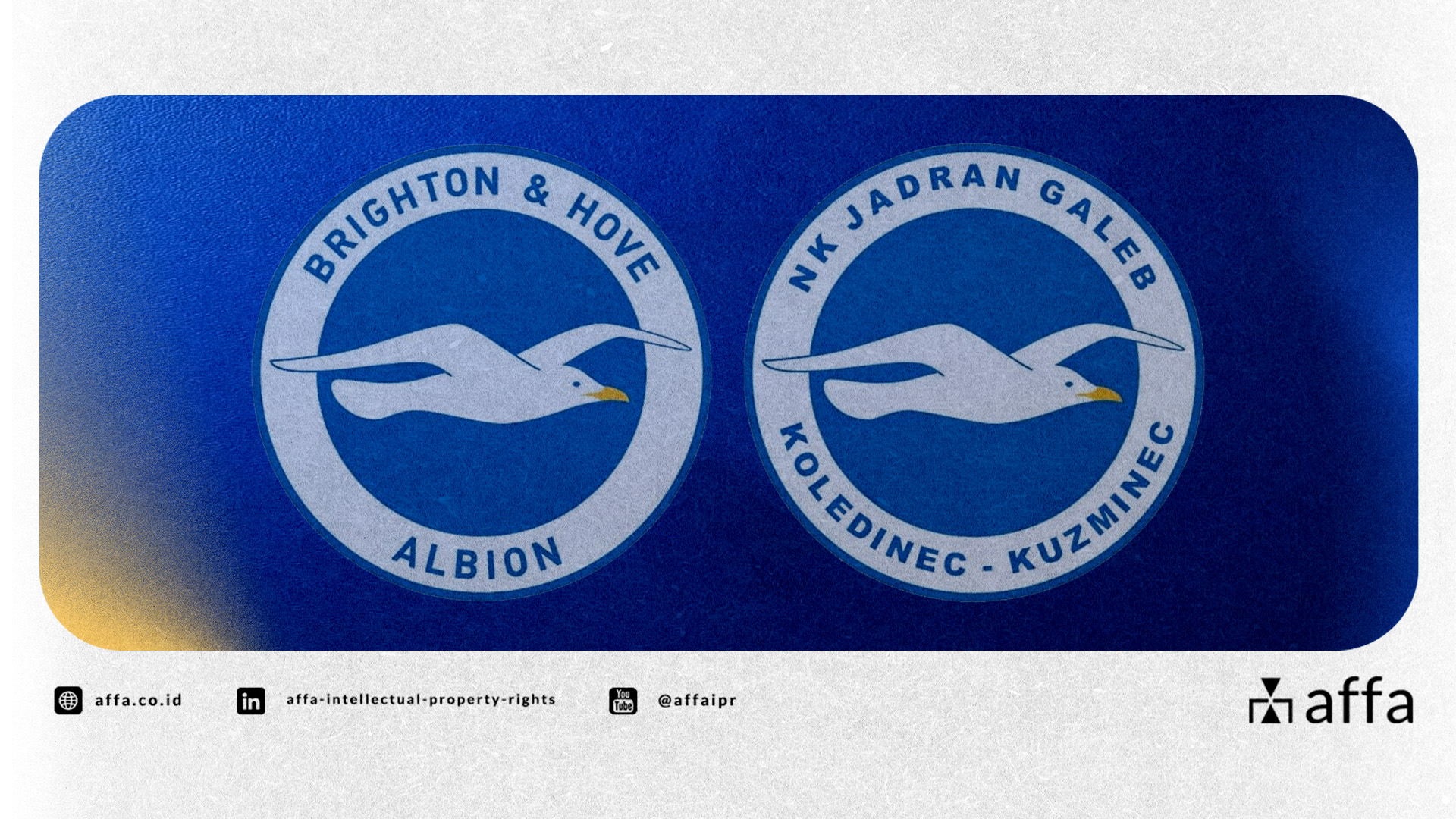
In football, a club’s visual identity, including its logo, is crucial in reflecting its history, values, and pride. But what happens when two clubs from different countries, separated by more than 1,300 kilometers, share the same logo? The case between Brighton & Hove Albion FC from England and NK Jadran-Galeb from Croatia is an intriguing example that highlights the importance of respecting logo originality and avoiding the impression of riding on another club’s popularity. The History of Brighton & Hove Albion’s Logo Brighton & Hove Albion FC was founded in 1901 and has undergone several logo changes since then. In 1977, the club adopted a logo featuring a seagull flying to the left and its nickname, “The Seagulls.” However, in 2011, the logo was updated to show the seagull flying to the right, enclosed in a blue circle with the words “BRIGHTON & HOVE ALBION.” This design remains in use today. As a corporation, The Brighton and Hove Albion Football Club Limited registered this logo as a Trademark with the UK Intellectual Property Office (UKIPO), covering Nice Classes 6, 9, 14, 16, 18, 21, 24, 25, 28, 35, 36, 38, 41, and 43, officially registered since October 28, 2011. The Evolution of Brighton & Hove Albion’s Logo The Emergence of NK Jadran-Galeb’s Seagull Logo NK Jadran-Galeb is a football club based in Croatia. In 2001, two local clubs, NK Jadran (founded in 1947) and NK Galeb (founded in 1963), merged to form NK Jadran-Galeb. As a small club playing in the lowest tier of Croatian football, there is little information on when exactly the club started using a logo strikingly similar to Brighton & Hove Albion’s—featuring a seagull and nearly identical color schemes. The only visible difference was the club name on the logo. Coincidence or Deliberate Inspiration? The resemblance between the two logos raises the question: Did Brighton & Hove Albion’s logo directly inspire NK Jadran-Galeb, or was it purely coincidental? Given the level of similarity, many believe NK Jadran-Galeb intentionally took inspiration from Brighton’s design. Adding to the speculation, Jadran-Galeb is not a coastal city where seagulls are a prominent symbol. The similarity came to public attention in late 2024, when NK Jadran-Galeb representatives visited Brighton & Hove Albion’s office in England and pointed out the resemblance between their logos. Strangely enough, instead of raising concerns, the Jadran-Galeb representatives requested donations of sports equipment, claiming they shared the same logo. However, rather than receiving donations, they were handed a cease-and-desist letter. NK Jadran-Galeb Squad 2024 Actions Taken by Both Parties Upon realizing the striking similarity, Brighton & Hove Albion sent an official letter to NK Jadran-Galeb, requesting them to change their club logo and stop using it across all forms of public media, including their official website and promotional materials. Although there were no legal threats in the letter, Brighton’s firm request demonstrated their commitment to protecting their Trademark. In response, NK Jadran-Galeb agreed to change their logo. The Croatian Football Federation also removed NK Jadran-Galeb’s old logo from its official website as a sign of respect for Brighton & Hove Albion’s Trademark rights. As of January 30, 2025, NK Jadran-Galeb unveiled a new logo, still featuring a seagull, but now facing forward. NK Jadran-Galeb’s New Logo The case between Brighton & Hove Albion and NK Jadran-Galeb underscores the importance of respecting originality in logo design. A logo as a Trademark (not copyright) is more than just a visual symbol; it represents a club’s identity and values. Using a similar or copied design without permission can create the impression of exploiting another club’s popularity and may lead to legal disputes. Therefore, every club must ensure that its visual identity is unique and does not infringe upon another’s Trademark rights. You might also want to read: Various Intellectual Properties in Football Should you need more information on Trademark protection in Indonesia and abroad, you can contact us via email at [email protected].

Complete Guide to Drafting a Patent Description in Indonesia
Drafting a well-structured and accurate Patent description is a crucial step in the Patent application process. This description serves to provide a detailed explanation of the invention to be patented, including its advantages and working principles. Here is a comprehensive guide on the essential elements that must be included in a Patent description, along with examples! Title of the Invention The title of the invention must be concise, clear, and reflect the essence of the innovation being submitted. This title will serve as the identity of the registered invention.Example: “Nano-Technology-Based Air Filtering Device” Technical Field of the Invention This section explains the field of technology related to the invention.Example: “This invention relates to air filtration technology, more specifically to an air filtration system using nano-based materials to enhance micro-particle filtration efficiency.” Background of the Invention This section must describe the problems present in previous technologies and how the proposed invention provides a solution.Example: “Current air filtration technology still has several drawbacks, such as limitations in filtering ultra-fine particles and high production costs. Patent Number XXXX has disclosed filtration technology using activated carbon, but this method is still ineffective in capturing particles smaller than 0.3 microns. This invention aims to overcome these issues by developing a nano-material-based filter that is more efficient.” Brief Description of the Invention This section should explain the main objectives of the invention and its key components.Example: “This invention aims to improve the effectiveness of air filtration systems by using nano-based materials with smaller pores compared to previous technology. The filter consists of (a) a nano-fiber layer, (b) a polymer-based support structure, and (c) a multi-stage filtration system characterized by an increased filtration efficiency of up to 99.9%.” Brief Description of the Drawings If the invention requires illustrations to explain its components, this section must provide a concise description of the included figures.Example: Figure 1: A perspective view of the air filtering device. Figure 2: A block diagram of the filtration system. Figure 3: A flowchart of the air filtration process. Detailed Description of the Invention This section explains in detail how the invention works, including its technical specifications.Example: “Referring to Figure 1, the air filtering device consists of three main layers: a nano-filtering layer (101), a polymer-based support structure (102), and an air ventilation system (103). The nano-filtering layer functions to capture ultra-fine particles with high efficiency. The polymer-based support structure allows installation flexibility and increases product durability. The air ventilation system ensures optimal airflow distribution within the room.” Claims Claims are the most critical part of the Patent document as they define the boundaries of Patent protection.Example: An air filtering device comprising: A nano-fiber layer for capturing micro-particles, A polymer-based support structure, An optimized air ventilation system, characterized by an increased filtration efficiency of up to 99.9%.An air filtering device comprising: The air filtering device according to claim 1, wherein the nano-fiber layer has pore sizes ranging between 10-50 nanometers. Abstract The abstract provides a concise overview of the invention and its function.Example: “This invention relates to a nano-technology-based air filtering device that enhances the efficiency of ultra-fine particle filtration. The device consists of a nano-fiber layer, a polymer-based support structure, and an air ventilation system designed to optimize airflow distribution. This technology enables high-efficiency air filtration with lower production costs.” You might also want to read: 5 Stages of Patent Registration Process in Indonesia All the information above is included in a document titled “Description.” By drafting a Patent description according to this guide, applicants can ensure that their invention is clearly documented while also facilitating the examination process. Ultimately, this leads to faster and more optimal legal protection. You can also find examples of international Patent descriptions on patents.google.com. Should you need more information on Patent registration and/or protection in Indonesia or abroad, you can contact us directly via email: [email protected].