

AFFA Wins Two Categories at the Indonesia Law Firm Awards 2025 - AFFA IPR

AFFA Wins Two Categories at the Indonesia Law Firm Awards 2025

Jakarta, 18 September 2025 – We are pleased to share that AFFA has been recognized with two awards at the Indonesia Law Firm Awards 2025, organised by Asia Business Law Journal.   We received recognition as: Best Boutique Law Firm in Indonesia IP Enforcement Firm   About the Awards   The Indonesia Law Firm Awards 2025 highlight outstanding law firms across various practice areas. The winners were selected based on votes and feedback from in-house counsel and industry professionals, combined with editorial research by Asia Business Law Journal.   Our Recognition   Being named Best Boutique Law Firm reflects our focus and dedication as a specialized firm in Intellectual Property law. From Trademarks and Patents to Industrial Designs, Copyrights, and Geographical Indications, we have consistently worked to support both Indonesian and international clients in securing and managing their IP rights.   Our recognition in IP Enforcement further underlines our role in protecting clients’ rights in practice — ensuring that Intellectual Property is not only registered but also effectively defended.    Moving Forward   These acknowledgments encourage us to continue strengthening our services and staying committed to delivering clear, practical, and reliable IP solutions. While we are grateful for this recognition, our focus remains on supporting businesses, innovators, and creators in protecting and growing your Intellectual assets in Indonesia, globally, and beyond.   Need help protecting your IP in Indonesia? Book a free 15-minute call with a registered IP consultant and ensure your IP meets all local requirements:   ? E-Mail : [email protected] ? Book a Call : +62 21 83793812 ? WhatsApp : +62 812 87000 889

Fighting IP Crimes: Indonesia's IP Office Task Force Destroys IDR 5.35 Billion Worth of Counterfeit Goods! - AFFA IPR

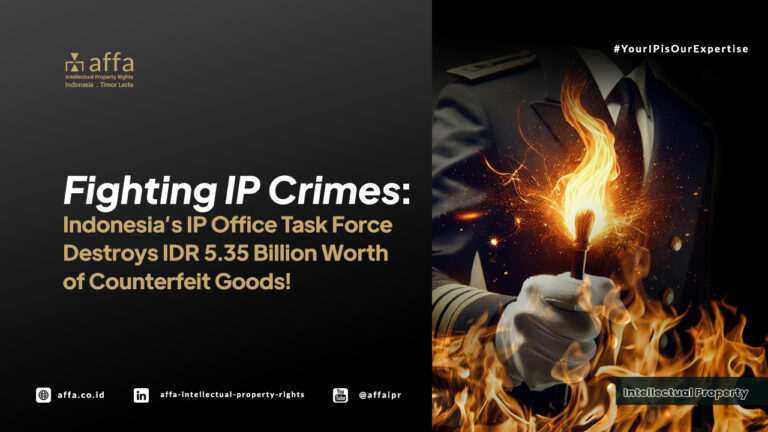
Fighting IP Crimes: Indonesia’s IP Office Task Force Destroys IDR 5.35 Billion Worth of Counterfeit Goods!

The Indonesian Intellectual Property (IP) Task Force, a cross-ministerial special task force of the Republic of Indonesia, consists of the Directorate General of Intellectual Property (DGIP), the Directorate General of Customs and Excise (DGCE), the National Agency of Drug and Food Control (BPOM), the Ministry of Communication and Digital (Komdigi), the Criminal Investigation Department (Bareskrim) of the National Police, and the National Cyber and Crypto Agency (BSSN). On December 12, 2024, the task force symbolically destroyed a number of products associated with violations of 12 Trademarks and Industrial Designs.   During a press conference, the Director General of Intellectual Property, Razilu, stated: “This destruction serves as a strong message from the DGIP that there is no room for Intellectual Property violations in Indonesia.”   At least three key messages were conveyed through the destruction of these products: Deterrence: To provide a deterrent effect on offenders, ensuring they refrain from committing further violations. Both civil and criminal legal actions can be enforced against them. Creator and Owner Protection: To assure creators and IP owners that their works are protected, fostering an environment where they can continue innovating. Public Awareness: To urge the public never to buy counterfeit or fake goods at low prices, as these products can adversely affect health, employment, and the environment.   The destroyed products, valued at IDR 5.35 billion, included the following: LEGO (toys): Worth over IDR 1 billion, from 110 items. Comotomo (baby bottles): Worth over IDR 500 million, from 888 items. Mimi White (hand and body lotion): 216 items. MT NG Shan (drill bits): 2,000 pieces. Louis Vuitton (women’s bags, wallets, and belts): 10 items. Christian Louboutin (women’s shoes): 2 pairs. Tokai (lighters): 5 boxes. Orion Choco Pie (snack/biscuits): 50 boxes. Honda (spare parts): 30 boxes. Honda (generators): 30 units. Harley Davidson (apparel accessories, umbrellas, and wallets): 600 items. Food Packaging (Industrial Design): 30 boxes.   It is important to note that the products classified as IP violations are not limited to counterfeit goods but also include goods illegally entering the Indonesian market. Under the law, smuggled goods that bypass official channels, fail to adhere to applicable import procedures, and are subject to objections by the official license holders of the relevant trademarks are subject to enforcement actions.   Given the complex and extensive scope of IP  violations, cross-sector enforcement is required. The specific roles of the involved institutions are as follows: DGIP: Monitoring, supervision, preventive measures, mitigation strategies, and enforcement of IP laws. DGCE: Addressing the importation of goods suspected of infringing IP rights. BPOM: Managing the distribution of food and pharmaceutical products that are suspected of infringing IP rights and endangering public health and the environment. Komdigi: Handling complaints and requests for blocking websites related to goods and/or services deemed to violate IP rights. Bareskrim Polri: Coordinating communication and collaboration for law enforcement from the central office to its units across Indonesia. BSSN: Monitoring IP violations in cyberspace and assisting in handling IP infringements that occur in the digital realm.   You might also want to read: Unraveling the Global Complexity of IP Crime: Money Laundering and More!   Each year, the average number of reports on IP violations is around 50 cases, with the majority involving Trademark, Industrial Design, and Copyright infringements. The active role of Komdigi has also significantly contributed to blocking 414 websites infringing Copyrights based on 16 requests. However, considering that the IDR 5 billion in damages mentioned earlier came from only 12 cases, this can be seen as just the beginning or the tip of the iceberg in the enforcement of IP laws in Indonesia.   Therefore, the participation of the five key components of the nation—Government, Academics, Private Sector, Society, and Media—is expected to continue supporting efforts to create a better Intellectual Property climate in Indonesia.   With increasing public awareness of the importance of Intellectual Property, there will also be positive impacts on the national economy and Indonesia’s investment climate in the global arena.   Should you need more information regarding Trademark protection and other Intellectual Property matters in Indonesia and abroad, feel free to contact us via email at [email protected].

A Win for the WIN - AFFA Represents Hongyunhonghe Tobacco for a Successful Trademark Non-Use Cancellation in Indonesia

A Win for the “WIN” – AFFA Represents Hongyunhonghe Tobacco (Group) Co. Ltd. for a Successful Trademark Non-Use Cancellation in Indonesia

When your Trademark Registration application is rejected in Indonesia, it is often due to the existence of another prior Trademark with the same elements that have been registered in the same class with the Directorate General of Intellectual Property (DGIP). Since Indonesia applies the first-to-file principle, if you register the same Trademark after another Trademark that has been filed or registered earlier, you must consider alternative options to prevent a potential rejection by the DGIP.   The dilemma usually arises when there is an identical prior Trademark that gets in the way of a successful registration, but you have no other option but to still keep using the identical Trademark for business purposes in Indonesia. At times, rebranding exercise costs more than any potential legal action that may be required to cancel a prior Mark due to non-use. In this scenario, the latter should be considered.   As stated in Article 74 of the Trademark and Geographical Indications Law (Trademark Law), an interested third party can apply for cancellation of a registered Trademark in the form of attack legally on the grounds of non-use to the Court of Commerce if the Mark has not been used for trade in goods and/or services for 3 (three) consecutive years from the date of registration or last use.   Therefore, if we can prove that the Trademark is genuinely not in use after a thorough investigation, the Court of Commer can cancel a registered Trademark upon request of an interested third party.   Since 2022, AFFA has been trusted by Hongyunhonghe Tobacco (Group) Co. Ltd., which originates from the People’s Republic of China to manage its Intellectual Property in Indonesia, one of which is the WIN Trademark in class 34 which includes types of cigarette filters, filters for cigarettes, lighters, liquid solutions for use in electronic cigarettes, lighters for smokers, flavorings other than oil essentials for tobacco, cigarettes, electronic cigarettes, snuff and hand-rolling tobacco.   However, based on initial searches, there is already a WIN Trademark under registration no. IDM000030697 in the same class owned by PT Sumatra Tobacco Trading Company (STTC)  of North Sumatra, Indonesia. Under normal conditions, of course, the client’s chance to register WIN is low because it will be rejected as regulated in Article 21 paragraph (1) letter (a) of the Trademark Law, which states that a Trademark application is rejected if the Trademark has similarities in essence or its entirety with the registered Trademark owned by the other party for similar goods and/or services.   Previously, the WIN Trademark of Hongyunhonghe Tobacco had been registered in China, the European Union, Australia, Brazil, Mexico, South Korea, Cambodia, Vietnam, and even Singapore since 2009. This fact alone already constitutes the definition of “an interested party” as regulated by Article 74 of the Trademark Law.   After the investigation process was carried out, it was found that STTC had not used the Trademark for 3 consecutive years from the date of registration or from the date of last use. Consequently, the petition for cancellation was filed to the Commercial Court – Central Jakarta District Court on September 14, 2023, as regulated in Article 76 paragraph (1) of the Trademark Law. Unfortunately, the Court of Commerce decided to reject the petition. Therefore, the next step was to file a cassation to the Supreme Court on September 27, 2023.   The Supreme Court of the Republic of Indonesia finally decided that the Central Jakarta District Court had misapplied the law, granted our cassation request on January 25, 2024, while canceling the Commercial Court’s decision, and asked DGIP to register the cancellation of the WIN Trademark registration from the General Register of Trademarks and announce it in the Official Trademark Gazette.    You might also want to read: AFFA Represents Trek Bicycle to Win a Trademark Non-Use Cancellation Action in Indonesia This success story is a testament that with thorough preparation and investigation, a non-use cancellation action is possible in Indonesia. Should you need more information about Trademark registration and protection in Indonesia or abroad, please email us at [email protected].

AFFA Represents Trek Bicycle to Win a Trademark Non-Use Cancellation Action in Indonesia

AFFA Represents Trek Bicycle to Win a Trademark Non-Use Cancellation Action in Indonesia

Since mid-2023, AFFA has been entrusted with handling disputes over the Marlin, Trademark owned by Trek Bicycle Corporation, headquartered in Waterloo, United States. Marlin is Trek’s Trademark for its flagship mountain bike frame.    In its home country, Marlin has been used since 1994 and was registered in 1998 at the United States Patent and Trademark Office (USPTO). However, when it was submitted for registration in 2021 via the Madrid Protocol addressed to Indonesia, this Mark was rejected by the Directorate General Intellectual Property (DGIP) as the Trademark Office in Indonesia because it was deemed to have similarities in its essence or its entirety with the registered identical Prior Mark owned by PT Astra Honda Motor since November 2006, and the protection period would have ended in November 2026.   Based on research conducted by independent investigators, it turned out that PT Astra Honda Motor had never used this Trademark for 3 (three) consecutive years from the date of registration or from the date of last use. Due to this fact, a petition to cancel the Marlin Trademark due to non-use was filed as regulated in Article 74 paragraph (1) of the Trademark and Geographical Indications Law (Trademark Law).   Despite an unfavorable decision at the Court of Commerce level, the team at AFFA filed a cassation to the Supreme Court on December 6 and submitted a cassation memo on December 19, 2023. It was finally decided in a deliberation meeting of the Panel of Judges on Tuesday, March 19, 2024, that the Commercial Court at the Central Jakarta District Court had misapplied the law and ordered the DGIP to remove the Marlin Trademark under the name of PT Astra Honda Motor.   The most important factor is that the Trademark has not been used in the last 3 (three) years based on the non-use investigation report submitted to the Court of Commerce. Apart from that, the similarity in essence or its entirety, an element of Trademark cancellation, does not need to be explained in the petition. Moreover, it is supported by the fact that the Cassation Respondent/Defendant never appeared at the hearings, even though they had been summoned 3 (three) times. Another helpful point that enhanced the chance of obtaining a favorable decision is the fact that Trek Bicycle Corporation also has registrations for the same Mark in various countries, such as Costa Rica, Guatemala, Nicaragua, Panama, Honduras and others.    Contrary to the popular belief that non-use cancellations in Indonesia are impossible, this decision by the Supreme Court is a proof that non-use cancellations are possible, provided that the plaintiff comes prepared with non-use investigation report and ample additional evidence which suggest legitimate interests in the same Mark. Should you need more information about registering your Trademark in Indonesia or abroad, do not hesitate to email us at [email protected].

Looking forward to meeting you at the 2024 INTA Annual Meeting - AFFA IPR

See You At The Upcoming INTA 2024 Annual Meeting In Atlanta, May 18-22 | 2024

AFFA Intellectual Property Rights—Indonesia & Timor Leste are delighted to announce that our Managing Partner, Emirsyah Dinar, will attend the highly anticipated International Trademark Association (INTA)’s 146th Annual Meeting in Atlanta, USA, this May. As a leading global association of Trademark owners and professionals, INTA’s annual meeting is a must-attend event for IP practitioners worldwide. We look forward to meeting you during the course of the Annual Meeting. For meeting inquiries, please email [email protected].

ASEAN IP 2024: Addressing Intellectual Property Issues by AI by Maximizing the Use of AI - AFFA IPR

ASEAN IPA 2024: Addressing Intellectual Property Issues by AI by Maximizing the Use of AI

This article is a continuation of the previous article, which discussed the Challenges of Intellectual Property Protection in the Digital Era for countries in Southeast Asia, as presented at the 2024 ASEAN Intellectual Property Association (IPA) Annual General Meeting & Conference, which took place on March 1-2 ago in Jakarta, Indonesia. As previously explained, the Digital Economy presents challenges in protecting Intellectual Property (IP) in the ASEAN region. However, what has not been revealed in the article is the contribution of Artificial Intelligence (AI) to the growth of the digital economy and its impact on IP law enforcement, even though AI’s contribution to regional GDP in 2030 will reach USD 1 trillion.   The growth of the Digital Economy in the ASEAN region cannot be denied, generated by many start-up companies in various fields, such as Techinasia in the media sector, Grab in the transportation sector, and Traveloka in the tourism sector. Of the USD 100 billion growth in the region in 2023, around 13% will be supported by investment in the AI sectors, with 6 (six) main uses as follows:   Computer Vision This market focuses on technology that helps computers make sense of digital images and videos. Machine Learning Algorithms teach computer systems to learn from data. Natural Language Processing Deals with technology enabling computers to understand and generate human language. AI Robotics Combining AI, machine learning, and engineering, to create intelligent machines capable of independent tasks. Autonomous & Sensor Technology Machines and systems equipped with sensors and AI operate independently, responding to changes in their environment. Generative AI Involving the creation of models that produce new content like images and text, often indistinguishable from human-created content.   With those various implementations, IP stakeholders must anticipate AI developments because they impact administration, practice, protection, and law enforcement. In particular, AI will confuse IP owners, consultants, and government officials if the laws on Copyright, Trade Secrets, Industrial Designs, Patents, and Trademarks are not changed.   Because AI, on the one hand, is very promising but also dangerous, depending on who uses it. In the UK and the US, there have been more than 10 cases of lawsuits against Generative AI-based companies. For example, OpenAI, the company that created ChatGPT, was deemed to have violated Copyright because it used many well-known works and media news as learning material for its AI system without permission.   Utilization of AI for IP Violations   If ChatGPT argues that the use of the work is for learning and can be settled with royalty payments, in practice, many other uses of AI can be categorized as legal violations, namely: Fabricate, forge, falsify images, certificates, documents, and create deepfakes videos; Create/manufacture realistic counterfeit labels and packaging; Clean up language, grammar, misspellings, and awkward phrasing on labels, packaging, advertising, websites; spam/phishing emails, which were often dead giveaways of counterfeit goods made in a foreign country; and Allow hackers to break into networks through emails that trick recipients into sharing personal info or accessing them illegally.   Benefits of AI in the IP Landscape However, AI is of great benefit to IP law enforcement. Starting from maximizing IP Consultants’ work and the border enforcement process to law enforcement officers.   Maximizing the Work of IP Consultants: Conducting searches and analysis of prior art and IP registration databases more efficiently and accurately; Streamlining contract analysis by extracting and categorizing relevant information, saving time and allowing attorneys to focus on negotiating and drafting contracts; Enabling faster identification of potential conflicts, enhancing due diligence, assisting in determining protection or infringement issues; and application drafting to improve productivity/reduce costs.   Benefits of AI for IP Law Enforcement: Monitor online platforms, websites, and social media for unauthorized use of IP, enabling proactive enforcement by owners; Identify instances of infringement on digital platforms by comparing content or marks against databases of brands, designs, or works; and Assist IP research and litigation by analyzing legal texts, court decisions and precedents, case strategy development, and outcome predictions from historical data. AI is being integrated into the criminal justice process, from crime prevention to evidence analysis. It can assist courts in making sentencing decisions and assess the likelihood of future criminal behavior, thereby informing parole, probation, or release decisions. It can enhance efficiency, accuracy and fairness, but bias, transparency, and ethics concerns have been raised and will continue to be raised as AI technologies become more pervasive and invasive. Benefits of AI for Border Enforcement: Drawing insights and patterns from customs databases, market reports, trade statistics, and IP owner-provided product identification materials; Automatically identifying objects in streaming video and imagery; and Providing real-time alerts to operators when an anomaly is detected, enhances the ability to stop illicit and illegal goods from entering the country.   In the end, new regulations are needed to adapt to AI developments. These regulations should start with rules related to ownership of rights involving AI, rules governing coordination between stakeholders, competition, and privacy, and rules governing resolution and legal enforcement of any disputes that may occur. Only with clear rules can conducive growth be created before the next technological wave finally emerges.   If you require further information regarding the impact of AI on Intellectual Property, please do not hesitate to contact us via email at [email protected].

ASEAN IPA 2024 Challenges of IP Protection in the Digital Era

ASEAN IPA 2024: Challenges of IP Protection in the Digital Era

The 2024 ASEAN Intellectual Property Association (IPA) Annual General Meeting & Conference took place successfully on March 1-2 in Jakarta, Indonesia. Held at the Mandarin Oriental – Hotel, this event provided new insight to Intellectual Property (IP) Southeast Asian stakeholders regarding the challenges faced in the digital era.   There was plenty of knowledge shared by competent speakers presented, including Bambang Brodjonegoro (Former Minister of Finance of the Republic of Indonesia), Thang Van Luong (Assistant Director of IPR Division of ASEAN), Kozo Takeuchi (President-Elect of APAA Headquarters, Japan), Peter Fowler (Senior Counsel for Enforcement, Office of Policy and International Affairs of USPTO – USA), Peter Sungjin Chun (Senior Vice President of APAA Korean Group – ROK), Jesse Zhang (AIPPI China Group), and Kukuh TW (Lecturer, Entrepreneur and IT Consultant ). For this reason, we will divide it into several articles, from the conditions and challenges facing ASEAN in the digital era to specific obstacles related to Artificial Intelligence (AI). Below is the summary:   The Growth of Intellectual Property in ASEAN   In 2022, the ASEAN economy grew 5.7% compared to the previous year, achieving a Gross Domestic Product (GDP) of USD 3.6 trillion and placing this region in the 3rd most prominent position in Asia or the 5th largest globally. With this performance, ASEAN succeeded in attracting Foreign Direct Investment (FDI) of USD 224.2 billion, most of which came from the United States (16.3%), Japan (11.9%), the European Union (10.7%), and China (6.9%). This investment is mainly aimed at the service sector at 68.3% and manufacturing at 27.5%.   ASEAN’s population is dominated by people under 30, making this region dynamic and challenging in the digital era. There were 460 million internet users in 2022, of which 80% were actively shopping online. The Gross Merchandise Value (GMV) contribution will reach USD 200 billion and is predicted to exceed USD 330 billion in 2025.   This change in lifestyle in the digital era makes the ASEAN region seem to have entered the Digital Decade, where the potential for the digital economy will reach USD 1 trillion GMV in 2030. However, this great potential will only be achieved with the right strategy and collaboration. This aligned strategy is essential, considering that ASEAN countries have quite a significant gap in the Global Innovation Index (GII) ranking released by the World Intellectual Property Organization (WIPO) in 2023.   Of the top 50 in the GII ranking, only Singapore (rank 5), Malaysia (30), Vietnam (40), Thailand (43), and the Philippines (50) are in the top 50. Meanwhile, half of the other ASEAN countries, such as Indonesia, Brunei, Cambodia, Myanmar, and Laos, still need to be higher. For this reason, a blueprint for the “ASEAN Economic Community 2025” has been created, prioritizing Intellectual Property cooperation with several strategic goals and indicators.   Cooperation on Strengthening Intellectual Property in the ASEAN Region   To strengthen this collaboration, the following Strategic Objectives have been prepared: Provide a firm basis for economic progress, support economic development, and produce wealth & prosperity. Promote trade & flow of investment; stimulate tech transfer & technological innovation; competitiveness. Expedite the realization of ASEA FTAs, and contribute to the growth of regional and global trade liberation. Contribute to regional dynamism, synergy & the enhancement of ASEAN solidarity.   Meanwhile, the Strategic Indicators are as follows: Strengthening IP offices and building IP infrastructure. Enhancing regional mechanisms to promote asset creation & commercialization. Developing regional IP platforms and infrastructure. Expanding the ASEAN IP ecosystem.   This strategic indicator has been planned since 2016 but is still being pursued to realize everything by 2025.   ASEAN Filing Trends 2016-2022 Source: WIPO Source: WIPO Source: WIPO   Even though it is quite volatile, especially after the Covid-19 pandemic, overall, whether for Patents, Trademarks or Industrial Design, achievements in 2022 are among the highest in the last 6 (six) years.   Intellectual Property Opportunities in the Digital Economy   ASEAN has mapped several IP opportunities in the Digital Economy because it plays a role as a catalyst and empowerer with 5 (five) main roles as follows:   IP Service Delivery Quality Digitalization of IP service delivery processes improves efficiency and accessibility. DE facilitates remote access to expertise and can improve the quality and reach of IP services in the region. IP Enforcement With the rise of digital transactions & online activities, IP protection will be more prioritized. DE provides tools for data analytics and monitoring and promotes info sharing, and cross-border cooperation among authorities in strengthening regional combat against IP violation, infringement, and piracy. IP Commercialization DE speeds up the innovation process leading to the creation of new tech and IP assets, and fast IP commercialization, hence fostering TT and Tech innovation. Global market extension, digital technologies, and digital marketplaces/platforms empower ASEAN creators, innovators, IP owners, and SMEs to capitalize on IP assets. IP Education & Culture DE provides opportunities to create and disseminate IP education (documents, virtual simulations, open educational resources). DE offers powerful tools for conducting digital outreach and awareness campaigns. IP for Inclusive & Sustainable Growth IP be more beneficial to inclusive and sustainable growth since DE could help unlock local creativity, inclusive innovation, and financial inclusion. Local communities GRTKCE can be protected and commercialized through IP mechanisms. DE can improve digital accessibility & inclusion for all.   Intellectual Property Challenges in the Digital Economy On the other hand, the same 5 (five) factors also have inhibiting elements that cause the growth of the IP climate in the ASEAN region to remain stagnant. The following is the explanation:   IP Service Delivery Quality Digital Divide & Cybersecurity Risks hinder. Disparities in access to technology and online services across ASEAN member states may hinder the delivery of high-quality IP services. Whereas data breaches, cyberattacks, and IP theft disrupt IP delivery. IP Enforcement DE blurs traditional jurisdictional boundaries and complicates cross-border IP enforcement. Enforcement agencies are disrupted in coordinating investigations, collecting evidence, and prosecuting offenders across different legal jurisdictions, let alone anonymous & pseudonymous actors in…

inta-2023-singapore

See you at the upcoming INTA 2023 Annual Meeting in Singapore, May 16-20 | 2023

AFFA Intellectual Property Rights – Indonesia & Timor Leste are delighted to announce that our team members, Emirsyah Dinar (Managing Partner), Fariz Syah Alam (Partner – Trademark), and Amelia Zafin (Associate – Trademark), will be attending the highly anticipated International Trademark Association (INTA)’s 145th Annual Meeting in Singapore this May.  As a leading global association of trademark owners and professionals, INTA’s annual meeting is a must-attend event for IP practitioners around the world. Our team members’ attendance provides a unique opportunity to network with other professionals in the industry, gain insights into the latest trends and best practices, and showcase our firm’s expertise. We look forward to meeting you during the course of the Annual Meeting.

Highest-IP-Filings

Indonesia Listed as One of the Countries with the Highest IP Filings in the World

Indonesia has made its way to be recognised among the top 10 countries in the world with the most Trademark filings. According to WIPO’s report in 2022, Indonesia recorded 127,142 Trademark filings – the number is higher than Vietnam (113,079), Argentina (85,844), the Philippines (64,946), and South Africa (39,863). This accomplishment is also complemented with a statistic which shows Indonesia as one of the countries with the highest number of Simple Patent filing with a total number of 3,249 applications. However, this number is significantly lower than China (2,852,219), Germany (10,576), Japan  (5,238), and just below Thailand by a slight margin (3,762). This achievement is made possible by the continuous digital improvement strategized and implemented by the Directorate General of Intellectual Property of the Republic of Indonesia (DGIP).  The DGIP also has other notable improvements that are worth mentioning, such as the automatic Trademark renewal certificate issuance, automatic Copyright recordation certificate issuance, automatic license notification issuance, and automatic Trademark registration excerpt issuance. These improvements are hoped to be in full operation from 2023 and we certainly hope these improvements will be extended to other important features of IP filings in Indonesia. For more information about how you can protect your IP in Indonesia, please contact us at [email protected].