
PERLINDUNGAN HUKUM DESAIN INDUSTRI DI INDONESIA

Desain industri termasuk dalam ruang lingkup hak kekayaan intelektual. Berdasarkan pengertian yang diberikan oleh Pasal 1 angka 1 UU Desain Industri, desain industri dapat dipakai lebih lanjut guna menghasilkan suatu produk, barang, komoditas industri, atau kerajinan tangan. Sebagai hasil kreasi manusia dan sebagai bagian dari hak kekayaan intelektual, desain industri diberikan perlindungan secara hukum. Perlindungan ini penting dengan tujuan untuk menciptakan iklim yang mendorong kreasi dan inovasi masyarakat di bidang desain industi sebagai bagian dari sistem hak kekayaan intelektual. Terkait hal tersebut, ruang lingkup perlindungan desain industry adalah sebagai berikut: Kreasi tentang bentuk, konfigurasi, atau komposisi Tampilannya baru dan memiliki nilai esteis yang sangat unik Diterapkan pada barang yang diproduksi secara massal (mass product) Desain industri dapat dibuat oleh pendesain, yang merupakan sesorang atau beberapa orang yang menghasilkan desain industri. Atas desain industri yang dibuat, pendesain dapat mengajukan pendaftaran desain industri kepada Direktorat Jenderal Kekayaan Intelektual yang berada di bawah naungan Kementrian Hukum dan HAM Republik Inodnesia. Apabila permohonan tersebut dikabulkan, pendesain memiliki hak desain industri, yaitu hak eksklusif yang diberikan kepada Negara Republik Indonesia kepada pendesain atas hasil kreasinya untuk selama beberapa waktu tertentu melaksanakan sendiri, atau memberi persetujuannya kepada pihak lain untuk melaksanakan hak tersebut. Pada prinsipnya, hak desain industri diberikan dengan memperhatikan 2 determinants, yakni kebaruan dan pengajuan pendaftaran pertama (first to file). Kedua asas tersebut dijelaskan sebagai berikut. Asas kebaruan, di mana dalam desain industri dibedakan dari asas orisinal yang berlaku dalam hak cipta. Pengertian “baru” atau “kebaruan” ditetapkan dengan suatu pendaftaran yang pertama kali diajukan dan pada saat pendaftaran itu diajukan, tidak ada pihak lain yang dapat membuktikan bahwa pendaftaran tersebut tidak baru atau terlah ada pengungkapan/ publikasi sebelumnya, baik tertulis atau tidak tertulis. “Orisinal” berarti sesuatu yang langsung berasal dari sumber asal orang yang membuat atau yang mencipta atau sesuatu yang langsung dikemukakan oleh orang yang dapat membuktikan sumber aslinya. Asas pendaftaran pertama, berarti bahwa orang yang pertama mengajukan permohonan hak atas desain industri yang akan mendapatkan perlindungan hukum dan bukan berdasar atas asas orang yang pertama mendesain.   Hak desain industri diberikan untuk desain industri yang baru. Desain industri dianggap baru apabila pada tanggal penerimaan, desain industri tersebut tidak sama deangan pengungkapan (pengungkapan melalui media cetak atau elektronik, termasuk juga keikutsertaan dalam suatu pameran)) yang telah ada sebelumnya.   Pengungkapan sebelumnya yang dimaksud disini adalah pengungkapan desain industri yang sebelum: Tanggal penerimaan; atau Tanggal prioritas apabila permohonan dengan hak prioritas Telah diumumkan atau digunakan di Indonesia atau di luar Indonesia   Suatu desain industri tidak dianggap telah diumumkan apabila dalam jangka waktu paling lama 6 (enam) bulan sebelum tanggal penerimaannya, desain industri tersebut: Telah dipertunjukkan dalam suatu pameran nasional ataupun internasional di Indonesia atau di luar negeri yang resmi atau diakui sebagai resmi; atau Telah digunakan di Indonesia oleh pendesain dalam rangka percobaan dengan tujuan pendidikan, penelitian, atau pengembangan. Pada dasarnya desain industri tidak dapat diberikan atau ditolak oeleh pemerika di Direktorat Jenderal Kekayaan Intelektual apabila: Bertentangan dengan peraturan perundang-undangan yang berlaku, ketertiban umum, agama, atau kesusilaan. Syarat ini merupakan syarat absolut yang selalu tercantum dalam setiap UU Desain Industri suatu Negara. Yang dimaksud dengan syarat tersebut di atas dalam pelaksanaan, misalnya, desain industri suatu barang berupa gelas dengan bantuk wanita telanjang atau alat tulis yang menggambarkan tubuh manusia tanpa busana. Hal ini jelas merupakan pelanggaran kesusilaan, ketertiban umum, atau bertentangan dengan agama tertentu. Tidak memiliki kebaruan; artinya, desain industri itu telah pernah diumumkan atau digunakan sebelum permohonan industri itu diajukan permohonan pendaftarannya. Syarat ini merupakan syarat absolut karena selalu tercantum dalam UU Desain Industri suatu Negara. Namum penerapan terhadap makna ‘kebaruan’ ini bisa saja menimbulkan penafsiran berbeda bagi pemeriksa desain industri di suatu Negara dengan Negara lain karena subjektivitas masing-masing pemeriksa desain industri kemungkinan besar akan berbeda. Ruang lingkup hak desain industri dijelaskan melalui pasal 9 ayat (1) UU Desain Industri, yang dinyatakan bahwa Pemegang Desain Industri memiliki hak eksklusif untuk melaksanakan hak desain industri yang dimilikinya dan untuk melarang orang lain yang tanpa persetujuannya membuat, memakai, menjual, mengimpor, mengeskspor, dan/atau mengedarkan barang yang diberi hak desain industri. Hak eksklusif adalah hak yang hanya diberikan kepada pemegang desain industri untuk dalam jangka waktu tertentu melaksanakan sendiri atau memberikan izin kepada pihak lain. Dengan demikian, pihak lain dilarang melaksanakan hak desain industri tersebut tanpa persetujuan pemegangnya. Pemberian hak kepada pihak lain dapat dilakukan melalui pewarisan, hibah, wasiat, perjanjian, atau sebab-sebab lain. Hak desain industri sebagaimana Pasal 9 ayat (1) UU Desain Industri di atas dikecualikan bagi pemakaian desain industri untuk kepentingan penelitian dan pendidikan sepanjang tidak merugikan kepentingan yang wajar dari pemegang hak Desain Industri. Pemakaian yang dimaksud di sini adalah pemakaian hanya untuk kepentingan penelitian dan pendidikan, termasuk di dalamnya uji penelitian pengembangan. Namun, pemakaian itu tidak boleh merugikan kepentingan yang wajar dari Pendesain, sedangkan yang dimaksud dengan “kepentingan yang wajar” adalah penggunaan untuk kepentingan pendidikan dan penelitian itu secara tidak umum tidak termasuk dalam penggunaan hak Desain Industri sebagaimana dimaksud dalam pasal 9 ayat (1) UU Desain Industri. Dalam bidang pendidikan, misalnya, kepentingan yang wajar dari Pendesain akan dirugikan apabila desain industri tersebut digunakan untuk seluruh lembaga pendidikan yang ada di kita tersebut. Kriteria kepentingan tidak semata-mata diukur dari ada tidaknya unsur komersial, tetapi juga dari kuantitas penggunaan.

Indonesia – The Final Goodbye to the Patent Performance Postponement Request

The Government of the Republic of Indonesia has issued the Ministry of Law and Human Rights of the Republic of Indonesia Regulation No. 14 Year 2021 on the Changes of the Ministry of Law and Human Rights of the Republic of Indonesia Regulation No. 30 Year 2019 on Patent Compulsory Licensing Granting Procedure. The amended regulation highlights several changes, including the grounds of granting of a patent compulsory license and most importantly the removal of the opportunity for patent holders to postpone the working of their registered patents.   Grounds to grant a compulsory license based on request: The Patent Holder does not perform its obligations to perform the patent as per Article 107 point 2 of the Law No. 11 Year 2020 on Job Creations within 36 months after the patent has been granted. For your information, Article 107 point 2 of the Law No. 11 Year 2020 on Job Creations stipulates the conditions of use/performance of Patent in Indonesia as the following:   The patent performance as referred to in (1) is as under: The use/performance of a Patented product by manufacturing, importing, or licensing the patented product; The use/performance of a Patented process by manufacturing, importing, or licensing the product which has been resulted from a patented process; or The use/performance of a Patented method, system, and use by manufacturing, importing or licensing a product which has been resulted from a method, system, and use which has been patented.   The patent is performed by the patent holder of the licensee in a way that is detrimental to the public interest. The patent that is resulted from the development of a prior registered patent cannot be performed without using the patent of the other party which is still registered.   In addition, the regulation also stipulates the following:   The Minister via the Director General of Intellectual Property can send a notification letter to the Patent Holder regarding the obligation to perform the patent if the patent holder has not performed its patent within 36 months from the grant date. The notification letter will be done for the patent which is requested to be licensed in compulsory manner. The notification above will be announced electronically to the public to inform that the Patent Holder has not performed the patent in Indonesia.   The regulation also abolishes Article 39 to 44 of the Ministerial Regulation No. 30 Year 2019 on the Procedure to Grant Patent Compulsory License. The abolished articles are as under:   Article 39 (1) Patent holders are required to make products or using processes in Indonesia. (2) Creating a product or using a process as referred to in paragraph (1) must support technology transfer, investment absorption, and / or provision of employment.     Article 40 In the event that the Patent Holder has not been able to do so Patents in Indonesia as referred to in Article 39, the Patent Holder can delay the implementation of the manufacture products or use of a Patent process in Indonesia.   Article 41 A suspension of application for patents in Indonesia may be granted within a maximum period of 5 (five) years with submit a request to the Minister accompanied by any reason.   Article 42 Postponement of Use of Patents as referred to in Article 41 it is submitted within a maximum period of 3 (three) years from the date the Patent was granted.   Article 43 In the event that the Minister approves the request for postponement of Use of Patents in Indonesia as referred to in Article 42, the Minister notifies the Patent Holder.   Article 44 Postponement of Use of Patents in Indonesia as referred to referred to in Article 43 is granted   Patent Performance Postponement No Longer Valid   In accordance with the Law No. 13 Year 2016 on Patents, patent holders shall perform or work their registered patents within 36 months from the date of grant. Otherwise, they may be susceptible to compulsory-license request by any third party. In addition, the failure to perform or work a registered patent as per Article 20 of the Law No. 13 Year 2016 on Patents (as well as Article 107 Para (2) of the law No. 11 year 2020 on Job Creations) may also pose a revocation risk at the Court of Commerce. The work-around to overcome these limitations used to be available, namely by requesting a working postponement of a registered patent.   However, as regulated by the new regulation, it is no longer possible for the holders of registered patents in Indonesia to request for the postponement of their registered patents. The removal is in line with the spirit of the Indonesian Patent Law to ensure that all patents that are registered in Indonesia should be performed either through direct performance by the holders or through licensing.   Should you require further information, please do not hesitate to contact us at [email protected].

[URGENT UPDATE] Key Changes to the Indonesian Patent and Trademark Laws after the Enactment of the Law No. 11 Year 2020 on Job Creations

The Law No. 11 Year 2020 on Job Creations (hereinafter referred to as “the Omnibus Law”) was finally signed by the President of the Republic of Indonesia, Joko Widodo, on November 2, 2020. The Omnibus Law is 1,187 pages long and it consists of numerous revisions to the existing laws that are aimed to spur job creations in Indonesia. While it puts a stronger emphasis on the Employment Law, the Omnibus Law – after several amendments – also impacted key provisions in the Law No. 13 Year 2016 on Patents (hereinafter referred to as “the Patent Law”) and the Law No. 20 Year 2016 on Marks and Geographical Indications (hereinafter referred to as “the Trademark Law”). We herewith list the changes and revisions for your perusal: Changes to the Patent Law Simple Patent Article 3 of the Patent law has been revised to the following: (1) A Patent is granted for a novel invention, which has inventive steps and can be applied industrially. (2) Whereas a Simple Patent for a novel invention, which is the development of a product or a process that already exists and can be applied industrially. (3) The development of an existing product or process can cover: Simple products: Simple processes; or Simple methods. In addition, Article 122 of the Patent Law also regulates the following requirements regarding the Substantive Examination Request for a Simple Patent: (1) A Simple Patent is only granted for one Invention. (2) The Request for the Substantive Examination for a Simple Patent shall be done at the same time as the time of the filing of the application with official fees. (3) If the Substantive Examination Request is not filed at the time of filing of the Simple Patent application or if the Official Fees are not paid, then the Simple Patent application is considered withdrawn. Whereas Article 123 of the Patent Law which regulates the publication period is amended as under: (1) The publication of a Simple Patent shall be done no later than 14 days from the date of filing of the Simple Patent Application. (2) The publication as referred to (1) shall be done for 14 working days. (3) The Substantive Examination is conducted after the publication has ended. (4) Except for the provisions in Article 48 Para (3) and (4), an opposition against a Simple Patent application is used as a determining factor during the Substantive Examination Stage. Article 124 of the Patent Law is also amended so that the Substantive Examination period is cut by half: (1) The Minister shall issue a decision to grant/reject a Simple Patent no later than 6 months from the date of the application date of the Simple Patent. (2) A Simple Patent which is granted by the Minister shall be recorded and published via electronic or non-electronic media. (3) The Minister issues a Simple Patent certificate to the Patent Owner as the proof of ownership. Use Requirements in Indonesia remain in place despite the initial plan and proposal to scrap it altogether The initial plan to scrap Article 20 of the Patent Law was scrapped at the very last minute. Nevertheless, the Use Requirements have become “more accommodating” since it lists importation and licensing as the definition of use. Article 20 has been reworded as under: (1) A Patent shall be used/performed in Indonesia. (2) The patent performance as referred to in (1) is as under: The use/performance of a Patented product by manufacturing, importing, or licensing the patented product; The use/performance of a Patented process by manufacturing, importing, or licensing the product which has been resulted from a patented process; or The use/performance of a Patented method, system, and use by manufacturing, importing or licensing a product which has been resulted from a method, system, and use which has been patented. Changes to the Compulsory-Licensing Article 82 which regulates Compulsory-Licensing has been reworded as under: (1) A Compulsory-License is a License to use/perform a Patent which has been granted by a Ministerial Decree or based on a request under the following conditions: A Patent has not been used/performed in Indonesia as per Article 20 for 36 months after it was granted; A Patent which has been used/performed by a Patent Holder or by the Licensee in a way that is detrimental to the public interest or A Patent resulting from the development of the existing Patents granted earlier could not be implemented without using the other party’s Patents which are still under protection. (2) The Compulsory-License request will be subject to the payment of official fees. Changes to the Trademark Law Some provisions in the Trademark Law have also been revised in the Omnibus Law. The most notable changes are as under: Functional 3D Mark is no longer registrable in Indonesia According to the revised Article 20 of the Trademark Law, a Mark cannot be registered if: It is contrary to the state ideology, prevailing laws, and regulations, religious values, decency, or public order: It is the same, related to, or simply states the goods and/or services covered in the application; It contains a misleading element concerning the origin, quality, type, size, option, the purpose of use of the goods and/or services covered in the application or if the application is a name of a plant variety that is registered for the same goods and/or services; It contains inaccurate information regarding the quality, benefit, or efficacy of the goods and/or services that are produced; It lacks distinguishing elements; It is a common name and/or public symbol; and/or It contains a shape that is functional. Shorter Substantive Examination period Article 23 of the Trademark Law circumvents the Substantive Examination period from 150 working days to 30 days if there is no opposition or 90 days if there is an opposition. The amended provision is as under: (1) A Substantive Examination is an examination that is conducted by an Examiner for every Trademark Application. (2) All oppositions and/or objections are considered in the Substantive Examination. (3) If there is no opposition filed…

Indonesia ranks 85th in the Global Innovation Index 2020 – remains unmoved for 3 years in a row

The 13th edition of the Global Innovation Index (GII) has just been released by Cornell University, INSEAD, and the World Intellectual Property Organization (WIPO). The GII looks at the state of innovation among the 131 economies around the world and the factors that contribute to the ranks, such as institutional environment, business sophistication, knowledge & technology outputs, creative outputs, market sophistication, infrastructure, and human capital & research. Indonesia has high scores in four out of the seven GII pillars: Infrastructure, market sophistication, Knowledge & technology outputs and creative outputs, which are above average for the lower middle-income group. Conversely, Indonesia scores below average for its income group in three pillars: Institutions, Human capital & research, and business sophistication. Indonesia, which is still ranked 85th this year – remain unmoved for 3 years in a row, falls under the Lower middle-income group and its performance is still in line with the level of development, albeit it falls short compared to its lower middle income-group neighbors in ASEAN, such as Viet Nam (42nd), and the Philippines (50th). Nevertheless, Indonesia is ranked in 9th within the lower middle-income economies, just above Kenya (86th), and it sits in the14th place among 17 economies in South East Asia, East Asia, and Oceania. Unfortunately, the statistics suggest that compared to other economies in the regions, Indonesia performs below average. The report reports the strengths and weaknesses of Indonesia as the contributing factors to the innovation index when it comes to innovations. The notable strengths, among many, include domestic market scale, trade & competition, ease of resolving insolvency, QS university ranking, and gross capital information. Whereas the contributing weaknesses, among many, include the regulatory environment, government funding, PISA scales in reading, math & science, global R&D companies, knowledge workers, scientific & technical articles/bn, tertiary inbound mobility, and FDI net outflows. Will Indonesia move up the rank next year given the current situation? #innovation #inovasi #trademark #patent #copyright #industrialdesign #Indonesia

Episode 2 – What to prepare and what to expect when it comes to a Trademark Application in Indonesia

Filing a Trademark in Indonesia can be tricky, but it also comes down to the preparation and research you do beforehand and manage your expectations. Please make sure you watch our guide on the following link before you file your Trademark in Indonesia:   #trademarklaw #Merek #Trademark #KekayaanIntelektual #KI #IP #DGIP #bisnisindonesia #intellectualproperty #indonesia

AFFA IP Education Series on Youtube

AFFA Intellectual Property Rights – Indonesia & Timor Leste presents: AFFA IP Eduction: Episode 1 – Hal-hal yang harus diperhatikan sebelum mengajukan permohonan pendaftaran merek di Indonesia. Please see our video on the following link on Youtube – https://www.youtube.com/watch?v=pNjgpfWKYc8 We will be uploading more contents about Intellectual Property in Indonesia. Please subscribe and stay tuned!  #trademarklaw #Merek #Trademark #KekayaanIntelektual #KI #IP

Jangan Lupa Daftar Merek - Sebelum Jual Barang ke Luar Negeri - AFFA IPR

Jangan Lupa Daftar Merek – Sebelum Jual Barang ke Luar Negeri

Seiring dengan berkembangnya bisnis Anda di Indonesia, permintaan barang dan/atau jasa dari luar negeri yang berasal dari relasi dan kerabat pun pastinya mulai bermunculan.   Dari satu pesanan, akhirnya tumbuh seribu, bahkan jutaan pesanan dengan nilai transaksi yang bisa jadi sangat fantastis. Produk atau jasa Anda pun akhirnya semakin dikenal di luar negeri. Namun hal yang paling menakutkan, akhirnya terjadi:   “Merek saya sudah didaftarkan oleh orang lain di luar negeri?!”   Ketika Merek Anda didfatarkan di luar negeri oleh pihak lain, maka Anda dapat menderita kerugian yang tidak sedikit, baik itu secaran moral maupun finansial. Sebelum hal tersebut terjadi, kami sangat menyarankan Anda untuk mendaftarkan Merek di luar negeri. Berikut adalah empat poin yang harus Anda pertimbangkan sebelum melakukan pendaftaran Merek di luar negeri:   Cek Budget dan Skala Prioritas Usaha Pendaftaran Merek di luar negeri tidak selalu mahal, namun Anda juga harus mengetahui biaya yang diperlukan untuk melakukan penelusuran dan permohonan pendaftaran Merek di luar negeri. Anda mungkin tidak harus mengajukan di seluruh dunia, tapi bisa diprioritaskan untuk negara-negara tertentu terlebih dahulu. Lakukan Penelusuran Merek Terlebih Dahulu Penelusuran Merek di negara tujuan akan memudahkan Anda untuk menilai besarnya peluang Merek Anda dapat didaftarkan di negara tersebut. Hal ini dapat meminimalisir over spending saat melakukan permohonan pendaftaran Merek di luar negeri. Gunakan Data Prioritas Permohonan Pendaftaran Merek di Indonesia Sebagai Dasar Permohonan Di mayoritas negara anggota Konvensi Paris, Anda dapat mengajukan permohonan pendaftaran Merek menggunakan data prioritas permohonan Merek di Indonesia, asalkan tidak lebih dari 6 (enam) bulan semenjak tanggal permohonan pendaftaran Merek di Indonesia. Selalu Simpan Bukti Permohonan Merek di Luar Negeri untuk Monitoring Lebih Lanjut Setelah mengajukan Merek di luar negeri, Anda akan mendapatkan bukti permohonan pendaftaran Merek di negara masing-masing, dan pastikan Anda menyimpan dokumennya dengan baik. Karena dokumen tersebut memiliki nomor permohonan yang dapat dijadikan patokan untuk monitoring progres Merek Anda di luar negeri.   Baca juga:
 9 Tips Daftar Merek di Malaysia – Pebisnis Indonesia Wajib Baca Jika Anda membutuhkan informasi lebih lanjut terkait pendaftaran dan perlindungan Merek di Luar Negeri, Anda dapat langsung menghubungi kami melalui email: [email protected].

The Indonesian IP Office will remain closed until May 29, 2020

The Indonesian Intellectual Property Office will remain closed until May 29, 2020 due to the spread of the Coronavirus which has not been fully contained. As previously predicted by top health officials in the country, we are expecting to see the peak of the spread by the end of May or June. Therefore, it is very likely that the closure of the Indonesian Intellectual Property Office will be extended. Nevertheless, all online-based services are working and the closure only affects the services that are normally done face to face.   If you have any questions, please do not hesitate to contact us at [email protected].

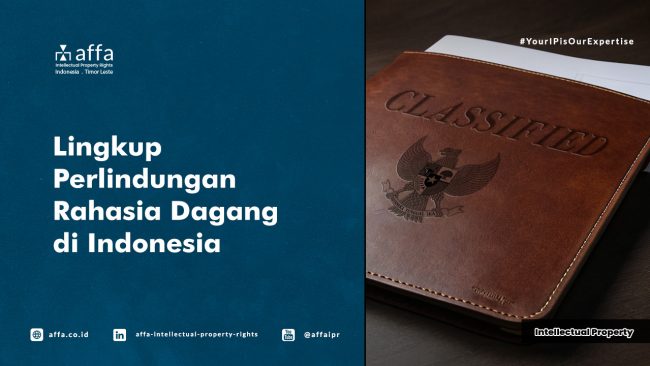
Lingkup Perlindungan Rahasia Dagang di Indonesia - AFFA IPR

Lingkup Perlindungan Rahasia Dagang di Indonesia

Rahasia Dagang merupakan resep kesuksesan bisnis dalam berbagai bidang, baik itu kuliner, IT, farmasi, maupun bioteknologi.  Tidak jarang publik selalu mencari tahu atau bahkan celah untuk mendapatkan “rahasia sukses” tersebut dengan berbagai macam cara. Atau bahkan mengklaim dan mengekspos, serta membagikan rahasia tersebut ke media sosial. Sebenarnya apa saja cakupan dan konsekuensi bagi pembocor Rahasia Dagang? Kami sudah merangkumnya untuk Anda. Rahasia Dagang sendiri diatur di dalam Undang-undang Nomor 30 Tahun 2000 tentang Rahasia Dagang (UU Rahasia Dagang). Definisi Rahasia Dagang berdasarkan pasal 1 angka 1 UU Rahasia Dagang adalah suatu informasi yang tidak diketahui oleh umum di bidang teknologi dan/atau bisnis, mempunyai nilai ekonomi karena berguna dalam kegiatan usaha, dan dijaga kerahasiaannya oleh pemilik Rahasia Dagang.   Lalu, apa saja cakupan dari Rahasia Dagang? Pasal 2 UU Rahasia Dagang menjabarkan ruang lingkup perlindungan Rahasia Dagang adalah sebagai berikut: Metode Produksi Berbagai langkah dan teknologi yang digunakan untuk mengubah bahan mentah menjadi barang jadi. Misalnya produksi   Metode Pengolahan Metode yang fokusnya pada langkah-langkah yang diperlukan untuk mengubah atau memodifikasi sifat bahan mentah.  Metode Penjualan Mencakup berbagai strategi atau cara yang digunakan untuk menjual produk atau jasa kepada konsumen, dengan variabel yang mempertimbangkan target pasar, jenis produk, hingga tujuan penjualan.  Informasi Lain di Bidang Teknologi atau Bisnis Hasil riset pengembangan produk, data pelanggan, perjanjian dengan pihak ketiga, hingga strategi bisnis kedepan masuk dalam kategori ini.  Memiliki Nilai Ekonomi Rahasia lainnya yang memberikan keunggulan kompetitif di pasar dan memiliki potensi nilai finansial.  Tidak Diketahui oleh Masyarakat Umum Bukan merupakan “rahasia umum,” dimana informasi tersebut memang hanya diketahui oleh pihak-pihak yang tertentu saja, bukan kebanyakan orang.   Yang kerap menjadi dilema bagi pelaku usaha adalah keputusan untuk mengajukan permohonan Paten atas Rahasia Dagang atau tetap menjadikannya rahasia agar tidak diketahui oleh umum selamanya. Namun yang perlu Anda ketahui adalah sanksi pidana penjara paling lama 2 (dua) tahun dan/atau denda paling banyak Rp.300.000.000,00 (tiga ratus juta rupiah) bagi pihak lain yang tanpa hak, menggunakan Rahasia Dagang tersebut.   Untuk mencegahnya, beberapa opsi ini dapat menjadi pertimbangan Anda: Dokumentasikan seluruh metode dan/atau informasi lainnya sedetail mungkin; Tetap rahasiakan dengan membuat Perjanjian Kerahasiaan atau Non-Disclosure Agreement (NDA) yang ditandatangani oleh seluruh pihak yang terlibat; dan Perbaharui dokumentasi jika ada perbaruan metode dan/atau informasi lain terkait Rahasia Dagang tersebut.   Selain itu, Anda juga dapat menerapkan pembatasan akses, hingga penerapan teknologi yang terenkripsi untuk mengakses dokumen-dokumen rahasia, agar tidak terjadi akses dari pihak yang tidak berwenang.   Namun, jika Anda ingin melinsensikan Rahasia Dagang Anda ke pihak lain (Pihak Kedua), Anda harus mencatatkannya ke Direktorat Jenderal Kekayaan Intelektual (DJKI) agar memiliki payung hukum dari pelanggaran pihak lain (Pihak Ketiga) yang tidak bertanggung jawab.   Untuk informasi lebih lanjut perihal perlindungan Rahasia Dagang di Indonesia, Anda dapat menghubungi kami melalui email: [email protected].

Renewal of Patent Implementation Postponement Request in Indonesia

Dear friends and colleagues,   Since the enactment of the Ministry of Law and Human Rights of the Republic of Indonesia Regulation No. 15 Year 2018 on the Postponement of Patent Implementation by the Patent Holder, we estimated that thousands of patent holders may have lodged in the requests to postpone the implementation of their patent registrations in Indonesia. This is seen as an important action given the limitation that exists in Article 20 of the Patent Law which states that a registered patent product/process has to be used/implemented in Indonesia. The Ministry of Law and Human Rights of the Republic of Indonesia Regulation No. 15 Year 2018 on the Postponement of Patent Implementation by the Patent Holder allows the postponement of 5 years from the registration date and it can be renewed for another 5 years as long as the patent holder provides strong reasons as to why another postponement is required. Once the request to postpone the implementation has been granted by the Indonesian Patent Office, the Patent Office will issue a notification that states the deadline for the postponement. Should you require any assistance with patent protection in Indonesia, please do not hesitate to email us at [email protected]; [email protected]; [email protected].