Asia-Business-Law-Journal-Names-AFFA-IPR-as-The-Top-Law-Firm-in-Indonesia-for-IP-Enforcement-affa

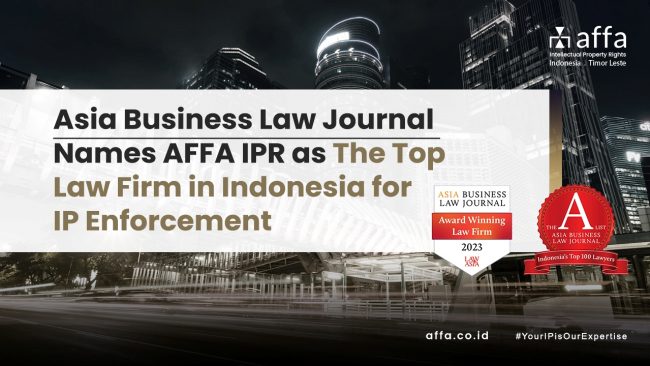
Asia Business Law Journal Names AFFA IPR as The Top Law Firm in Indonesia for IP Enforcement

Asia Business Law Journal Names AFFA IPR as The Top Law Firm in Indonesia for IP Enforcement AFFA Intellectual Property Rights has been the fortress guarding our clients’ invaluable IP assets for over two decades. Our journey, which commenced in 1999 under the visionary leadership of our founder, the late Achmad Fatchy, has now found its course under the capable guidance of Emirsyah Dinar as Managing Partner and Fariz Syah Alam as Trademark Partner. With a formidable team of over 70 IP experts, we have consistently delivered unwavering support to our clients.   We proudly serve a diverse clientele, ranging from esteemed government entities and state-owned enterprises to industry giants within Indonesia, extending our reach to East Timor and beyond. The faith bestowed upon us by our clients fuels our commitment to excellence.   Winning an award from Asia Business Law Journal is a testament to your trust in us as your legal partner. This accolade is not just a token of recognition; it represents our unwavering dedication to delivering the best legal solutions to our valued clients like you. Asia Law Business Journal is highly regarded for its rigorous evaluation process, ensuring that only the most deserving firms and practitioners receive these honors.  This award reaffirms our commitment to excellence and innovation in the legal field. We are truly grateful for your continued support and trust, and we look forward to achieving even more significant milestones together in the future.  

形容词能否注册为商标?affa

形容词能否注册为商标?

形容词能否注册为商标? 为了独树一帜并拥有高卖点,有时企业主希望添加形容词为商品或服务打上品牌。因此, “美丽的裙子”、“热咖啡”、“吃得美味”、“楼梯下”、“天空屋顶”、“独立成功”或“永恒的荣耀”等作为企业名称如此常见。但这些名称可注册为商标吗? 根据《印尼语大词典》(KBBI),形容词是描述名词的词,一般用 “更”和 “非常”等连词连接。除上述词语外,形容词的其他例子包括甜-咸、少-多、老-少、富-穷、大-小、悲-喜、近-远等等。 若参考2016年第20条法律《商标和地理标志法》以及由2023年第6条法律关于将2022年第2号《创业法》修改为政府规定的法律》进一步修改的法律,这些法律没有明确规定禁止在商标中使用形容词,只要形容词能够以图形方式显示并与之前注册商标有区别。然而,还需查看该形容词的使用是否唯一,或仅仅是第二个相关词。若是如此,这将违反《商标法》第二十条至第二十一条关于商标不可注册(绝对驳回理由)和驳回(相对驳回理由)的规定,具体如下:   绝对拒绝注册的理由(商标法第20条) 若以下情况之一成立,商标将无法注册或不符合商标资格: a. 违背国家意识形态、法律法规、道德、宗教、礼仪或公共秩序。例子:带有种族攻击性或粗俗的品牌,如 “烧死马卡萨”。 b. 与申请注册的商品和/或服务相似、相关或仅提及申请注册的商品和/或服务。例子:“黑巧克力” 不可注册,因为它只描述巧克力的质量或类型。知识产权总局关于仅与商品种类有关的词语,或仅与商品有关的一个词语(在本案中为 “巧克力” 的规定仍然必须为公众所使用。 c. 包含可能在申请注册的商品和/或服务的原产地、质量、类型、大小、品种、用途等方面误导公众的内容,或者是类似商品和/或服务的受保护植物品种的名称。例子:“巴布亚肉串”由加鲁特羊制成,非巴布亚人制作,使用马都拉斯食谱,在万丹地区出售。 d. 包含与所生产的商品和/或服务的质量、效益或功效不符的信息。例子:“美味鹅卵石” e. 缺乏区分力例子:缺乏独特性或过于简单的品牌,如“鸡肉粥”。 f. 是公共财产的公共名称和/或标志。例子:禁止使用“P Coret” (禁止停车)标志,因为此标志表示公共使用的禁止停车,禁止使用“餐厅”一词指餐馆,“咖啡店” 用于咖啡馆,而“骷髅符号”则用于危险标志。 g. 包含功能性的形式。例子:餐厅使用的“勺-叉”标志。   驳回的理由(《商标法》第21条) 在商标视为合格后,将进入下一个分拣过程,并符合以下标准: 1. 与其他方拥有或其他方为类似商品和/或服务预申请的注册商标在原则上或整体上有相似之处。 2. 与其他方拥有或其他方为类似商品和/或服务预申请的注册商标在原则上或整体上有完全相似之处。 3. 与其他方拥有的类似商品和/或服务的驰名商标在原则上或整体上有相似之处。 4. 与已注册的地理标志在原则上或整体上有相似之处。 5. 代表或类似名人的姓名或缩写、照片或他人拥有的法律实体的名称,除非获得合法所有者的书面同意。 6. 代表或类似于一个国家、国家或国际机构的名称、旗帜、徽章或标志或徽章的名称或缩写,但经主管当局书面同意的情况除外。 7. 代表或类似于国家或政府机构使用的官方标志或印章,除非获得授权方的书面同意。 8. 若申请人存有恶意提交申请,该申请将被拒绝。   若您的商标与另一方的注册商标实质上或完全相似,要查明您的商标是否可以逃脱相对拒绝理由,必须进行“追踪”只有通过这一过程,您才能看到真实的可比性,并深入了解您的商标被知识产权总局(DJKI)接受的可能性。   包含形容词并已在DJKI注册的商标示例如下: 第 30 类中的 “Makmur”(繁荣),自 2009 年起列名。 第 41 类中的 “Kisah Bawah Tanah”(地下故事),自 2019 年起注册 第 5类中的“Madu Enak”(美味蜂蜜),自 2019 年起注册。 第 25 类中的 “Atas Bawah”(自上而下),自 2022 年起注册。 第 17 类中的 “Cantik”(美丽),自 2022 年起注册。   如果在追溯过程中,发现其在原则上或整体上与其他方拥有的类似商品和/或服务的注册商标相似,建议进行语音开发。例子: –   将形容词“Makmur”(繁荣)改为“Makmoor”或“Makmore”。 –   将形容词“Enak”(美味)改为“Enyaak”或“En@@k”。   如需进一步咨询有关商标注册和命名以避免驳回的问题,请随时通过 [email protected] 与我们联系。 来源: –   印度尼西亚共和国法 2016年第20号商标和地理标志法 –   2023年第6条法律关于将2022年第2号《创业法》修改为政府规定的法律》 –   DJKI的知识产权讲座: 商标注册对企业的重要性

COSPLAY-and-Intellectual-Property-Navigating-the-Legal-Landscape-affa-global

COSPLAY and Intellectual Property: Navigating the Legal Landscape

COSPLAY and Intellectual Property: Navigating the Legal Landscape Cosplay has become popular again as a form of pop culture activity since the COVID-19 pandemic restrictions ended. Malls in all corners compete to host various events featuring Cosplayers to increase visitors. But not many people know that Cosplay is an activity on the “edge of the cliff” when viewed from an Intellectual Property (IP) perspective. How come?   Definition of Cosplay Taken from the words “Costume & Play,” Cosplay is the activity of playing using character costumes, whether from films, TV series, video games, comics, or characters from other popular culture. People who carry out Cosplay activities are called Cosplayers. We can easily find them at pop culture-based events, such as “Comic Conventions,” dominated by IP from America, or “Anime Conventions,” dominated by IP from Japan.   Cosplayers proudly wore their favorite character costumes at these events, socialized with fellow fans, or participated in competitions. Yes, Cosplay is also regularly contested with quite big prizes. This is one of the factors why the number of Cosplayers continues to increase. Because Cosplay has become a place to earn money, increase popularity, and expand friendships. The rise of Cosplay activities has also given rise to various derivative professions. Starting from Costume Makers with their respective specifications, whether for costumes made from cloth, foam, resin, or leather. Then, the Prop Makers make costume-supporting equipment such as armor, swords, or other weapons. Also, trained Performers with acrobatic or martial arts skills are specifically hired to play certain characters. Then we have Cosplay Judges who are staffed by “seniors” with high-flying hours and have won many competitions at home and abroad. Unfortunately, all of these professions receive payment for using characters without the permission of the creator or owner of the character. This factor causes Cosplay to become an activity on the edge of Intellectual Property violations.   Every Popular Character is Copyrighted Every character, realized in various media, whether considered popular or only known to a few people, is included in the “Creation.” According to Article 1 of the Copyright Law, this Creation is a creative work in science, art, and literature produced based on inspiration, ability, thought, imagination, talent, skill, or expertise expressed in concrete form.   The Creator is given exclusive Economic Rights, so only the Creator has the right to obtain financial benefits, including commercial use of his Creation. It is also important to remember that the Exclusive Right to Copyright arises automatically based on the Declarative Principle after a work is realized in actual form, without the need to go through a registration process as with Trademarks, Patents, or other Intellectual Property.   In other words, if another party wants to use or utilize a Creation commercially, they must first obtain permission from the Creator, as regulated in Article 9, Paragraphs 2 and 3 of the Copyright Law.   Sanctions for Violations Unfortunately, the various professions derived from the Cosplay activities above can specifically be categorized as forms of Copyright Infringement. For Costume and Prop Makers violating Article 9 Paragraph 1 letters (b) and (d) regarding the Duplication of Works in all their forms, as well as Adaptation and Transformation of Works; Meanwhile, Event Organizers who invite costumed Performers or Cosplay Judges may be deemed to have violated Article 9 Paragraph 1 letter (f) regarding Creation Performances. Criminal sanctions regulated in Article 113 of the Copyright Law as follows: Costume & Prop Maker: Prison max. 4 years and/or fine max. one billion rupiah. Cosplay Event Organization: Prison max. 3 years and/or fine max. 500 million rupiah.   The sanctions given to costume makers could be more severe if they deliberately sell themselves as sellers of costumes made from characters with registered Trademarks and/or parts of their costumes take designs from products with registered Industrial Designs. So he could be subject to sanctions from the Trademark and Industrial Design Law simultaneously!   Copyright Restrictions But fellow Cosplayers or all related derivative workers don’t need to worry because there are restrictions or exceptions for actions that are still not considered Copyright Violations. Namely, if the duplication and/or performance is free of charge, provided that it does not harm the reasonable interests of the Creator.   In other words, if the Cosplay activity is designed as a paid show where the audience must buy tickets, or Brand X pays a Cosplayer complete with the costume to promote a product from Brand X, then it is inevitable that there has been a Copyright Violation.   However, because the criminal provisions on Intellectual Property are a complaint offense, there must be a direct objection from the Creator to all activities carried out by the Cosplayer and any derivative work thereof. What can happen is, even in a free Cosplay show or free costume making, if the Creator finds out, objects, and does not give permission for whatever reason, a lawsuit can still be filed.   Cosplay Practice in the USA and Japan Even though it is considered a fun activity without limits and upholding freedom of expression, Cosplay still has to comply with several pretty strict rules. For example, if done privately, Cosplayers must abide by the norms of decency; neither their costumes nor their behavior must disturb public order. In this personal activity, Japan has stricter rules than America. In Japan, it is impossible to find people busking in character costumes in the middle of the street. Apart from disturbing public order, it could be considered to damage the image of the character he presents.   Street Performers In America, Cosplayers are categorized as Street Performers. They are free to express themselves even if there is no event, but the area is minimal if they take to the streets or public spaces for activities. A famous example of this restriction is the streets painted Light Blue around New York’s Times Square. If they act outside that area, they can be immediately arrested by the police. Indonesia also has regional regulations that prohibit busking or…

Adjectives-on-the-Trademark-Frontier-Whats-Allowed-in-Indonesia-affa

Adjectives on the Trademark Frontier What’s Allowed in Indonesia?

Adjectives on the Trademark Frontier What’s Allowed in Indonesia? To be unique and have high selling value, sometimes business owners want to add adjectives to the trademark of their goods or services. That’s why we often see names like “Beautiful Dress,” “Hot Coffee,” “Delicious Foods,” “Under Table,” “Above Sky,” “Self Success,” or “Eternal Win” as business names. But can these names be registered as trademarks?   According to the Indonesian Dictionary (KBBI), adjectives are words that can describe nouns, which can generally be combined with the words “more” and “very.” Apart from the words mentioned above, other examples of adjectives are sweet-salty, little-a lot, young-old, rich-poor, big-small, sad-happy, far-close, and many more.   If we refer to Law (UU) Number 20 of 2016 concerning Marks and Geographical Indications which was subsequently amended by Law Number 6 of 2023 concerning the Determination of Government Regulations in Lieu of Law Number 2 of 2022 concerning Job Creation into Law,   Suppose we refer to Law Number 20 of 2016 concerning Marks and Geographical Indications which was subsequently amended by Law Number 6 of 2023 concerning the Determination of Government Regulations in Lieu of Law Number 2 of 2022 concerning Job Creation into Law. In that case, no special provisions prohibit the use of adjectives in a trademark as long as they can be displayed graphically and have distinguishing power from previously registered trademarks. However, it is also necessary to see whether this adjective is the only word used or only the second related word. If this is true, it will conflict with Articles 20 to 21 of the Trademark Law, which make the mark unable to be registered (Absolute Grounds for Refusal) and rejected (Relative Grounds for Refusal), as follows:   Absolute Grounds for Refusal (Article 20 of the Trademark Law) A trademark cannot be registered or is not eligible to be a trademark if: a. Contrary to state ideology, laws and regulations, morality, religion, decency, or public order. Example: Trademarks that offend ethnicity, religion, ancestry, and group of people or are vulgar, such as “Burn Java.”   b. Relates to, or only mentions, the goods and/or services for which registration is requested. Example: “Dark Chocolate” cannot be registered because it only describes the quality or type of chocolate. The Indonesian Trademark Office (DGIP) rules regarding words that only relate to the kind of item or the thing in one word; in this case, “Chocolate” can not be registered and must still be used by the public.   c. Contains elements that can mislead the public about the origin, quality, type, size, type, intended use of goods and/or services for which registration is requested or is the name of a protected plant variety for similar goods and/or services. Example: “Papuan Satay” but not made by Papuans, using a Madurese recipe with Garut Lamb, and sold in the Banten region.   d. Contains information inconsistent with the quality, benefits, or efficacy of the goods and/or services produced. Example: “Tasty Pebbles.”   e. It has no distinguishing power. Example: Brands with nothing unique or too simple, such as “Chicken Porridge.”   f. Common name and/or symbol of public property. Example: The “P Strikethrough” logo means No Parking.   g. Contains functional image forms. Example: “Fork & Spoon” logo for a restaurant.   Relative Grounds for Refusal (Article 21 of the Trademark Law) Once your Trademark is deemed worthy, they will proceed to the following sorting process, with the following criteria: Having similarities in principle or its entirety with a registered Trademark belonging to another party or previously applied for by another party for similar goods and/or services. Has similarities in essence or its entirety with a well-known Trademark belonging to another party for similar goods and/or services. Having similarities in principle or its entirety with a well-known mark belonging to another party for dissimilar goods and/or services that meet specific requirements. Has similarities in essence or its entirety with registered Geographical Indications. Represents or resembles the name or abbreviation of the name of a famous person, photo, or a legal entity owned by another person, unless with written approval from the person entitled to it. An imitation or resembles the name or abbreviation of a country or national and international institution’s name, flag, symbol, or emblem, unless with written approval from the authorized party. Imitation or resembles an official mark, stamp, or seal used by a state or government institution unless with written approval from the authorized party. The application is only accepted if it is submitted by an applicant with good intentions.   To determine whether your Mark can pass the Basis of Relative Rejection, where it is substantially or entirely similar to a registered Trademark belonging to another party, you must conduct a “search” process. Only by carrying out this process can you see real comparisons and gain insight into how likely your Brand will be accepted by the Indonesian Trademark Office: Directorate General Intellectual Property (DGIP).   Some examples of Trademarks that contain adjectives and have been registered with DGIP are: “BEAUTIFUL” registered in class 9, since 2003 “HAPPY” registered in class 35, since 2003 “BIG” registered in class 19, since 2013 “HOT&COOL” registered in class 21, since 2015 “RICH” registered in class 11, since 2015   Suppose during the search process you find similarities in essence or their entirety with a registered Trademark belonging to another party for similar goods and/or services. In that case, you can carry out phonetic development as one of the tips. Example: Replacing the adjective “Beautiful” to “Beuteeful” or “Beautivul”. Replacing the adjective “Delicious” to “Delizzious” or “Delicyus”.   Should you require further consultation regarding Trademark registration and its naming to avoid rejection, please contact us at [email protected]. Sources: Law Number 20 of 2016 concerning Trademarks and Geographical Indications Law Number 6 of 2023 concerning the Determination of Government Regulations in Lieu of Law Number 2 of 2022 concerning Job Creation into Law IP Talks DGIP: The Importance of Trademark Registration for Business  

Media-Missteps-5-Intellectual-Property-Blunders-to-Avoid-affa-global

Media Missteps: 5 Intellectual Property Blunders to Avoid

Media Missteps: 5 Intellectual Property Blunders to Avoid The government’s efforts to remove Indonesia from the US investment blocklist published by the United States Trade Representative (USTR) through the 2023 Priority Watch List (PWL) are heavy. Apart from improving regulations and law enforcement efforts, education regarding the importance of Intellectual Property must continue to be carried out on a massive scale.   Unfortunately, the big media, which should take that role, often become part of the piracy. Finally, the media is the party that must be educated earlier so that this education can resonate more with society.   The following are five major media sins that we often encounter in their reporting: 1.    Using the Word “Patent” for Every Intellectual Property Regime Because the Indonesian Dictionary (KBBI) still describes Patent as “a right given by the government to someone for an invention for their use and to protect it from imitation (piracy),” this word is still often used as a substitute for Intellectual Property. Patents are only one of the various types of intellectual property; that means the description from the KBBI is different from what is stated in Law No. 14 of 2001 concerning Patents. This misconception has resulted in the narrative of “patenting a trademark” or “patenting various food recipes,” which we commonly hear in large or small media coverage. Previously, we published a short article regarding the differences between Patents and other Intellectual Property here: Patented Trademark? Registering Copyright? What Are The Correct Terms?   2.    Reporting Piracy, but Showing the Source Several media already have good intentions in warning the public not to access materials such as films or music that we should only be able to enjoy in cinemas or official streaming channels through illegal sites. However, in its reporting, the media displayed a screenshot containing the address of the illicit site. This is a blunder because it lures more of the public into accessing it. Such coverage can also be considered as dissemination of illegal material and can be subject to criminal sanctions as regulated in Article 113 of the Copyright Law. Therefore, keep good intentions from ending up causing problems.   3.    Unauthorized Use of Material Dozens of years ago, when YouTube became increasingly popular and became a source of information with attractive visuals, TV media competed to use it as material for new programs, which they thought were unique for their loyal viewers: People live in remote areas and still have difficulty accessing the internet. The media’s opinion then was, “Everything on the internet means the public can access it so that it can be used commercially for free.” This contradicts Article 8 of the Copyright Law, which states that only the creator or, in this case, the creator/ photographer/ original video maker has the right to Economic Rights over his creation. In other words, if the media wants to make a TV program based on these works, let alone get advertising from their broadcast, they must obtain permission from the creator. Even platforms like YouTube are subject to Copyright Laws. The Terms of Service state that any violations can be followed up with applicable legal processes. Assuming that each work can still be used freely under “fair use” will not apply if the creator objects. Currently, although the media is more aware of copyright issues by including the address of the original material, this is only a justification for publishing it with permission. So, to avoid lawsuits in the future, please make sure to first ask permission from the owner of the material you want to use as coverage/program material.   4.    Overclaim on YouTube When mainstream media began to use YouTube as an additional source of income, they also uploaded all their programs and coverage on that streaming channel so that viewers could watch the material anytime, anywhere. Based on legality and high viewership, YouTube also indirectly gives confidence that every material uploaded by them is considered to have “strong copyright protections.” This becomes dangerous when the media uploads material that does not belong to them. For example, when making a report or interviewing a content creator. To make the visuals attractive, the media will display a few minutes of video insert made by the creator. The creator had long published the video on YouTube. Still, after the media uploaded its coverage program containing part of the video, the creator’s video was deemed to have violated copyright. This has happened several times and has gone viral on social media. Luckily, cases like this do not result in criminal charges because they can be resolved by turning off copyright protection on videos uploaded by the media.   5.    Glorification of Intellectual Property Violations This last sin can be said to be the one we encounter most often, which indirectly maintains violation activities to continue to occur in Indonesia. In the name of “Good News,” media reports often feature success stories from Small and Medium Enterprises (SMEs) in rural areas. However, the problem is the business activities carried out by these SMEs violate Intellectual Property. For example, making handicraft products, fabrics, or clothing that utilize popular characters from abroad without permission. The media proudly described their huge income as an “inspirational success story.” For those of us who understand this condition, it will undoubtedly be uncomfortable because the media reporters who cover these activities should be able to spearhead efforts to educate the public regarding Intellectual Property awareness. Please don’t use other people’s protected characters again when their production numbers are already high. It’s time to produce original characters, which are not impossible to provide added value for SMEs. By ignoring it, the media endangers these SMEs by positioning them as open shooting targets for the actual IP owners. With the news of the enormous income generated, the original owner will file a lawsuit at the highest level, and whose fault is that?   That’s all the five significant media sins we see frequently today. Hopefully,…

Building-ASEAN-Competence-in-the-World-Through-Geographical-Indications-affa-global

Building ASEAN Competence in the World Through Geographical Indications

Building ASEAN Competence in the World Through Geographical Indications Geographical indications (GIs) are vital in identifying products from specific regions known for their unique quality and characteristics. These indications are increasingly crucial to consumers who seek authenticity and quality in their purchases.    GIs apply to various sectors, including industry, agriculture, and handicrafts, promoting diversity within these domains. GIs guarantee product quality for consumers, offering protection against misleading origin descriptions. Furthermore, they foster trade on national, regional, and international scales, support rural development by creating jobs and higher incomes, and promote regions as tourism destinations. GIs also significantly preserve traditional knowledge and local biodiversity, often rooted in community-driven, traditional processes. Since the inception of the World Trade Organization (WTO) Agreement on Trade-Related Aspects of Intellectual Property Rights (TRIPS Agreement) in 1994, GI protection systems have expanded globally, notably in Asia. The Association of Southeast Asian Nations (ASEAN) countries have actively embraced GI identification and registration as a strategic tool for domestic and international market presence. As of January 2019, ASEAN countries have registered an impressive 346 GIs. This includes 37 foreign GIs, illustrating ASEAN nations’ remarkable interest in GI protection.   Thailand, Malaysia, & Indonesia Lead the Awareness These registrations vary among countries. Thailand leads with 115, followed by Malaysia at 84, Indonesia at 74, Vietnam at 69, Cambodia at 3, and Lao PDR at 1. Eight GIs have been registered in the European Union market, such as Kampot Pepper from Cambodia and Nuoc Nam Phu Quoc from Vietnam. The EU-Singapore Free Trade Agreement is poised to introduce EU GIs to Singapore, further underscoring the global significance of GIs in trade and commerce.     As with other Intellectual Property Rights, there is no common legal framework for protecting GIs at the ASEAN regional level. Each country has its own GI legal framework. Due to their relationship with the EU, most ASEAN member states (8 out of 10) have followed the sui-generis approach for protecting GIs, where the application includes a “book of specifications” or “description document” comprising the descriptions of the product, geographical area, method of production, and the link between the product and its geographical origin. The exceptions are the Philippines and Brunei Darussalam, which protects GIs through its Trademark systems.   Geographical Indications Increase Various Product Prices In the EU, the price of a GI product has been estimated at 2.23 times the price of a comparable non-GI product (on average, 1.5 times more for agro-food products).  Another worldwide study estimates that the GI premiums lead to prices 20% to 50% higher than comparable non-GI products. In the ASEAN region, GIs show a positive impact in terms of volumes, prices, and local development. For example, for all the GIs for pepper, there has been an increase in prices during a period where the international price of pepper was relatively stable. The price of Kampot White Pepper (Cambodia) increased by a factor of 2.6 between 2009 and 2018, the price of Muntok White Pepper (Indonesia) increased by a factor of 6 between 2009 and 2015, while the price of Sarawak Pepper (Malaysia) increased by a factor of 4.32 from 2003 (before GI registration) to 2016 (after GI registration) for sales in bulk.     Other successful GIs are in the area of coffee, with the farm gate price of Flores Bajawa Arabica Coffee Red Berries (Indonesia) increasing by a factor of 2.2 between 2005 and 2015, although such price increase remains unstable. For Doi Chaang Coffee (Thailand), the price of coffee berries evolved by a factor of 2. Buon Ma Thuot Coffee (Vietnam) benefits from an added value of 2–3% compared with the standard comparable coffee. Fruits also primarily benefit from GI protection, with the Koh Trung Pomelo (Cambodia) farm gate price increasing by a factor of 1.33 and the price of Pakpanang Tabtimsiam Pomelo (Thailand) rising by a factor of 1.75.     Finally, handicraft goods such as the Lamphun Brocade Thai Silk have seen some higher revenues following GI registration, with an increase in price by a factor of 1.5.  Other vital benefits of GIs are the development of the GI product value chain structure and the creation of a collective organization of producers and processors for the management of the GI, such as the Community for the Protection of Geographical Indication of Amed Bali Salt (Indonesia). Agro-tourism, another key benefit, was developed in the Sarawak Pepper (Malaysia) area, coffee festivals have been organized in Buon Ma Thuot (Vietnam), and the preservation of traditional rice varieties is carried out with the GI Khao Kai Noi (Laos).   Protecting GIs in the European Union and International Markets Like other forms of Intellectual Property, GIs need to be protected in each country where protection is sought, according to the legal framework of that particular country. For non-EU products to be registered in the EU market, producers send their applications directly or via national authorities to the European Commission.  For spirit drinks and agri-food products, the European Commission has a maximum of 12 and 6 months to examine the application. Foreign GIs will be registered as GIs in the EU market if they fulfill the conditions of the EU system, which are a link between the product and its place of origin and the presence of a control mechanism. Foreign GIs can be protected as a Protected Designation of Origin (PDO) or a Protected Geographical Indication (PGI), the two systems in place in the EU.   PDO or PGI? Product names registered as a PDO have the most vital links to the place they are made, with every part of the production, processing, and preparation process taking place in the specific region. For wines, this means that the grapes have to come exclusively from the geographical area where the wine is made.   PGI emphasizes the relationship between the specific geographic region and the product’s name, where a particular quality, reputation, or other characteristic is essentially attributable to its geographical origin. For PGI, for most products, at least…

印度尼西亚专利维持费实用指南-affa-global

印度尼西亚专利维持费实用指南

何时在印度尼西亚支付专利维护费? 本文提供正确的指南,可确保您不错过最后期限并维持专利权。   时间至关重要: 何时付款最合适?   印尼关于计算专利延期到期日的规定非常简单。 本文不仅涉及首次续保,还包括每年要注意的所有延期到期日。   您需要记住的第一件重要事情是: 在专利申请过程中,无需支付专利维持费(年费)。 您需要在专利正式注册 6 个月后支付新的维持费(该日期指专利注册日期,可在知识产权总局发布的专利申请公告函上查看)。 该维护费包括自申请之日起至专利授予之年的第一年应支付的年费,以及下一年的年费。   例如,如果专利从2023年2月1日起注册,您必须在2023年8月1日前直接向知识产权总局(DJKI)支付第一笔专利维护费。 请注意,如果您未能在该日期前付款,注册专利将被撤回或删除。   专利年度续费 付清专利维持费后,下一笔付款是年费,顾名思义,您必须每年支付年费。 下一年度的年费最迟应在下一年度保障期的同一申请之日前 1(一)个月支付。   换言之,如果专利申请日期是11月9日,即每年的10月9日是年度续期的到期日。   如果您对印尼专利维持费/续展费仍有疑问,请随时通过电子邮件与我们联系:[email protected]。 来源: 《印度尼西亚共和国法律 2016年第13号专利法》

A-No-Nonsense-Guide-to-Patent-Annuity-Payment-in-Indonesia-affa-global

A No-Nonsense Guide to Patent Annuity Payment in Indonesia

Are you wondering when to pay those critical Patent Renewal fees in Indonesia? Please read the following to learn the important deadlines.   Timing is Everything: When Do Those Renewal Fees Kick In? Indonesia’s calculation of renewal due dates is actually pretty straightforward. We are not just talking about the inaugural renewal due date but all future ones as well.   Here’s the kicker: No annuities are due while your Patent is still in the application process. Your first payment becomes due 6 (six) months after the Patent grant date (you can always refer to the Notice of Allowance issued by the Indonesian Patent Office). And that payment isn’t just a one-off; it covers all the annuities that would have been due while your application was still pending – it’s a back-payment of sorts.   For instance, if your Patent was granted on February 1, 2023, you must settle the first annuity payment by August 1, 2023, to the Directorate General of Intellectual Property (DGIP). Please note that the granted Patent will be deemed withdrawn/invalidated if the payment deadline is missed.    Yearly Renewals Explained Once you have settled that first payment, let’s keep the ball rolling. Every year, one month before the anniversary of your original filing date, another annuity will knock on your door.   To paint a clearer picture: If you initially filed your Patent on November 9, mark your calendar because all subsequent renewals must be settled by October 9 each year.   Should you have any questions about Patent annuity payments in Indonesia, please do not hesitate to contact us at [email protected].   Source: Law No. 13 of 2016 on Patents (Patent Law)

A-Comprehensive-Trademark-Registration-Guide-for-Indonesian-Companies-in-Thailand-affa

A Comprehensive Trademark Registration Guide for Indonesian Companies in Thailand

Thailand is a crucial partner for Indonesian businesses, with bilateral trade between the two nations exceeding $18 billion in 2020. As the second-largest economy in Southeast Asia, Thailand offers Indonesian companies access to a sizable consumer market of over 69 million people. Its strategic location within the ASEAN region provides a gateway for Indonesian exports, making Thailand a pivotal trade partner.   Moreover, Thailand’s investor-friendly policies have attracted over 600 Indonesian companies, highlighting its appeal as a destination for Indonesian investments. This economic synergy, along with trade agreements and a well-established infrastructure, underscores Thailand’s significance for Indonesian businesses aiming to expand their reach in Southeast Asia and beyond.   Why Register Your Trademark in Thailand? Registering a Trademark is one of the first things to be done to establish effective protection in Thailand or internationally. An unregistered sign, logo, or name will not receive the same rights and status as a registered mark. Since Thailand adopted a first-to-file Trademark system, a Trademark may be at risk of being taken by other competitors if not registered in time.   Trademark According to Trademark Act B.E. 2534 in Thailand A Trademark is a mark that identifies the origin of the goods or services and can be distinguished from other Trademark owners. The mark may be a name, drawing, logo, word, letter, combination of colors, or a combination of several of these elements.   A Trademark is a mark used for a product and it is an indication that the product with such a Trademark is different from products of other Trademarks. A Service Trademark is a mark used for a service and is an indication the service with such a service mark is different from services of other service marks. A Certificate Mark is a mark used by the owner to certify the origin, composition, method of production or characteristics of the goods or services of another person. A Collective Mark is a Trademark or service mark used by companies or enterprises of the same group or by members of an association, cooperative, union, state, or private organization.   Trademarks consisting of certain characteristics are forbidden under the Trademark Act. These characteristics include: Any mark contrary to public order, moral, or public policy; Marks that are identical to marks prescribed by Ministerial notifications; National flags or emblems of Thailand, royal standard flags, national flags and emblems of foreign states or international organizations; Royal names or monograms; or Marks that are similar to medals, diplomas, or certificates issued by the Thai government or Thai government agency.   How do you register a Trademark in Thailand? Trademarks are registered with the Department of Intellectual Property (DIP). Applicants must have a fixed address in Thailand. Non-residents can only register by appointing a legal representative with a fixed address in Thailand.   Filing an Application An application must be submitted to DIP. The registrar will notify the applicant or its representative of the result of the Trademark Examination within 12 to 18 months. If the application is deemed by the registrar to be registerable, the Trademark will be published for a 60-day period to make sure there is no third-party opposition. If the registrar deems the Trademark unregistrable, a rejection notification will be provided along with a reason for the basis of that rejection.   Trademark Application Timeline The entire process takes about 1 year from the date of filing to obtaining the certificate, presuming there is no office action or request for amendment of the application. However, the Trademark protection period begins on the days of submission of the application for 10 years and may be renewed.   Priority Claim A priority claim is when an application is filed for the first time in one country, and the applicant would like to retain a right of priority to the date of first filing applications for other countries. To claim priority, an application must be filed in Thailand within 6 months from the first foreign filing date (priority date).   Required Documents for Priority Claim The original certified copy of the foreign application (issued by the foreign Trademark Office); The statement asserts that the former application has not been abandoned or withdrawn (original required).    A priority claim application must be submitted in Thai language at the time of the filing. Late filing of these documents is possible upon request, and 60 days from the date of filing is allowed for late submission of documents.   Renewals A registered Trademark may be renewed. A request for renewal can be filed 3 months before the expiration date of that Trademark. Late renewal is possible within the 6 months from the expiration date. The late renewal period of 6 months is also known as the grace period, and a penalty of 20% of the official fees must be paid.   Fast-Track Applications Thailand Department of Intellectual Property introduced a new fast-track system for Trademark renewals and registration while the official fees remain the same. Fast-Track Renewal can be shortened from 60 days to 60 minutes, applicable for renewal requests for Trademarks of no more than 30 items of goods and services, and under the condition that there are no changes to those items. For Fast-Track Registration, the Trademark Examination period can be shortened from around 12 months to around 6 months. Two conditions must be fulfilled to accelerate Trademark examination under this system: The application is filed for no more than 10 items of goods and services and the items must be obtained from DIP’s list.  The application must not be amended after filing.   Trademark Assignment Assigning or inheriting a Trademark must be registered with the registrar of the DIP. It may be an assignment of a Trademark Application or a Registered Trademark, or an assignment of specific classes or items.   Required Documents for Trademark Assignment Copy of the assignor and assignee’s national ID card or other ID card issued by a governmental agency. Copy of the assignor and assignee’s passport in case of a…

特许人在印度尼西亚开展业务前应满足的7个条件-affa

特许人在印度尼西亚开展业务前应满足的7个条件

知识产权在特许经营业务中发挥着重要作用,在印度尼西亚,特许经营称为 “Waralaba”。“该特许经营商标注册了吗?”这个问题对授予特许者(特许人)非常重要,它是检验商标有效性的首要问题。   从投资者(加盟商)的角度来看,在印尼经营特许经营业务似乎很有前景。因为我们得到了快速投资回报率的“自动经营” 业务的承诺!   只需投入一些资金,收入就会源源不断,这归功于我们获得的特许经营权。 特许经营的提议如雨后春笋般涌现,在各种特许经营展览会上,很容易就能找到诱人的商业提案,包括由知名艺术家支持的新公司的提案。   但要考虑的是,我们所关注的公司所提供的业务值得称为特许经营吗?   假冒特许经营商会有什么法律后果吗?   特许经营的定义 根据《印度尼西亚共和国政府条例》(2007 年第 42 号,关于特许经营)第 1 条和《印度尼西亚共和国贸易部长条例》(2019 年第 71 号,关于实施特许经营)第 1 条,特许经营是指个人或企业实体对具有商业特征的商业系统所拥有的特殊权利,目的是销售成功的商品和/或服务,其他各方可根据特许经营协议利用和/或使用这些商品和/或服务。   特许经营必须满足的 7 项标准 《政府条例》第 3 条 2017年底42号关于特许经营以及《贸易部长条例》第 10 条 2019年第71号关于实施特许经营规定了具有特许经营概念的企业必须满足的明确标准,具体如下:   1.      具有商业特色 鲜明特点的企业,是指与其他同类企业相比,具有不易被模仿的优势或差异,并使消费者青睐这些特点的企业。例如,特许经营人(特许人)特有的管理系统、销售和服务方法,或结构或分销方法。 2.      盈利证明 该证明指特许人在经营过程中积累大约 5 年的经验,并掌握了克服困难的经营诀窍,从而实现继续生存和发展,并实现盈利。   3.      以书面形式制定所提供商品和/或服务的服务标准 这项规定要求特许经营公司制定 SOP(Standard Operational Procedure标准操作程序),以便加盟商在统一框架内开展业务。 因此,若不具备 SOP,就不能称之为特许经营。   4.      易于教学和应用 特许经营业务的好处在于,没有类似业务经验或知识的加盟商可以根据特许人提供的持续经营和管理指导很好地开展业务   5.      持续支持 此外,特许人不应袖手旁观,因为它有义务不断向加盟商提供经营指导、培训和宣传。   6.      已注册的知识产权 确保您审查的特许经营公司已注册与业务相关的知识产权,如商标、版权、专利和商业秘密,并提供证书所有权证明,或正在授权机构进行注册,具体指印度尼西亚共和国法律和人权部知识产权总局(DJKI)。   7.      拥有STPW(特许经营注册证书) 《贸易部长条例》第 10 条第 71号2019年要求特许人机加盟商拥有 STPW。 要获得本STPW,特许人必须有特许经营招股说明书,否则特许人加盟商之间不得签订特许经营协议。 注意,若将来特许人的知识产权(IPR)注册未获批准或过期,STPW 将失效。   因此,鉴于知识产权在特许经营业务中的重要性,必须一开始就提出“您的企业是否已在知识产权总局(DJKI)注册商标?”的问题。   在辨别假冒特许经营权时,注意以下一些重要事项:   真正的特许经营不会承诺自动经营 印度尼西亚特许经营协会(AFI)主席阿南–苏坎达尔(Anang Sukandar)在组织国际特许经营展览会时警告说:“我们不应被敷衍了事的方法所迷惑。在生意场上,不会自动经营。自动驾驶只存在于航空领域,在商业领域不存在。” 因此,千万不要以为特许经营企业就像投资黄金一样,不按照经营流程就能持续上涨。 因为你可能被当作猎物,这样特许人就可以在将来亏损时逃脱惩罚。 例如,说明你所处的位置并不有利。   印度尼西亚特许经营支持国内生产 不要被以销售进口原材料为主要吸引力的特许经营店所诱惑。 因为《特许经营条例》第 9 条规定,只要符合特许人书面规定的商品和/或服务质量标准,特许人和加盟商应优先使用国产商品和/或服务。                                                                                                     通过更好地了解特许经营业务的复杂性,在选择特许经营业务时就会更多选项。 看似非常诱人的商业提议可能只是合伙提议,并不符合印度尼西亚共和国政府的《特许经营条例》。   注意,使用不符合上述标准的 “特许经营 “可能会受到行政处罚,应根据法律法规的规定,推荐发证官员吊销营业执照和/或经营/商业执照。 换句话说,您付出的巨额投资最终可能会亏损,不是因为缺少买家,而是因为忽略了对特许经营强制要求的检测。   如需更多有关印度尼西亚或全球特许经营的信息和帮助,请通过以下方式联系我们[email protected]. 来源: 政府条例 2007 年第 42 号关于特许经营 贸易部长条例 2019年第71号关于实施特许经营