


More than one million active Trademarks, yet fewer than three in ten Patents granted. What WIPO’s latest global scorecard means for brand owners and innovators doing business in Indonesia.
Every year, the World Intellectual Property Organization (WIPO) publishes the world’s most comprehensive scorecard of intellectual property activity. The new edition, World Intellectual Property Indicators 2026, covers filings and registrations made during 2025. For Indonesia, it tells two very different stories.
The first is a “Brand Boom.” Trademark filings at Indonesia’s Directorate General of Intellectual Property (DGIP) grew by 20% in 2025, roughly five times the global growth rate of 4.1%. The number of Trademark registrations in force in Indonesia now exceeds one million.
The second is a “Patent Squeeze.” Patent filings fell, Indonesia slipped out of the world’s top 20 Patent offices, and the DGIP granted a smaller share of the applications it examined than any other major office that reported data.
Here is what the numbers say, and what they mean for your IP strategy in Indonesia.
Indonesia at a Glance
| IP right (2025) | Indonesia | Change vs 2024 | Where Indonesia stands |
|---|---|---|---|
| Trademark filings at DGIP | 199,340 classes | +20.0% | 15th largest office; 3rd-fastest growth in the top 20 |
| Trademark registrations | 202,945 classes | +31.1% | 10th largest; 3rd-fastest growth in the top 20 |
| Trademarks in force | 1,016,864 | +13.3% | 13th; on par with Russia and Germany |
| Design filings at DGIP | 8,563 designs | +8.0% | 18th largest office |
| Design registrations | 7,418 designs | +59.2% | 3rd-fastest growth in the top 20 |
| Designs in force | 36,811 | +30.3% | Fastest growth in the top 20 |
| Patent filings at DGIP | 10,366 | –4.9% | Slipped from the top 20 to 21st |
| Patent grant share | 29% | n/a | Lowest of the top 10 reporting offices |
| Utility model filings | 4,830 | –1.8% | 5th largest utility model office worldwide |
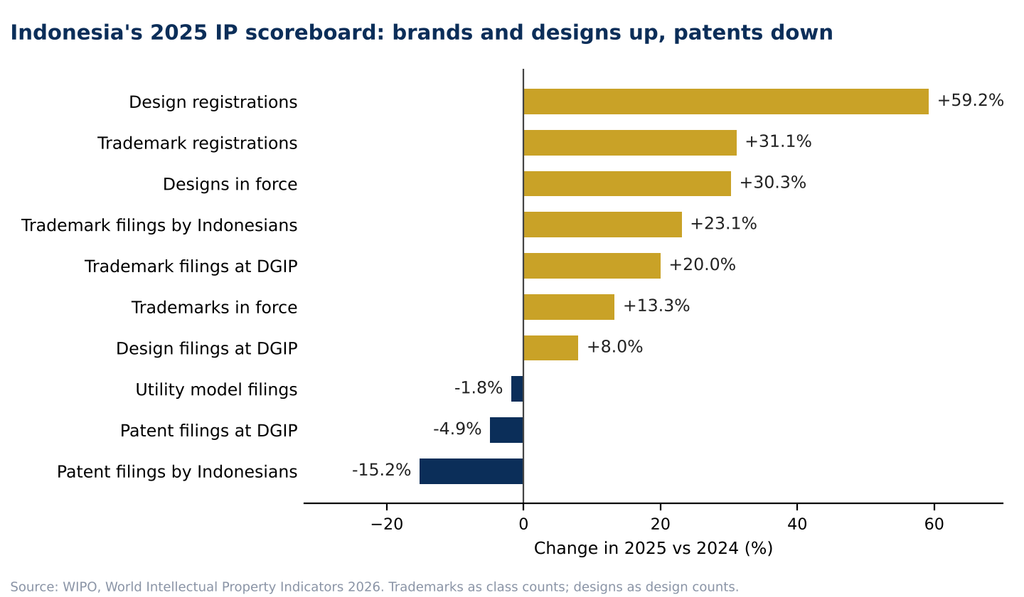
Figure 1. Indonesia’s 2025 performance across IP rights. Source: WIPO, World Intellectual Property Indicators 2026.
- The Brand Boom: Indonesia Joins The Million-Mark Club
Indonesia was one of 2025’s standout Trademark markets. Filing at the DGIP rose by 20% to 199,340 classes, the third-fastest growth among the world’s top 20 Trademark offices, behind only Argentina (+50.8%) and India (+20.5%).
The growth is homegrown. Filing by Indonesian applicants rose by 23.1% to 161,686 classes, making Indonesia one of only three top-20 origins to grow by more than 20%. In its executive summary, WIPO names Indonesia among the world’s fastest-growing sources of Trademark filing. Local applicants now account for 78.8% of all Trademark filing at the DGIP and contributed around 17.6 percentage points of the office’s 20% growth. Indonesian entrepreneurs are increasingly treating their brands as business assets worth protecting.
The office has kept pace. Trademark registrations rose by 31.1% to 202,945 classes, making Indonesia the world’s 10th largest registering office. Active registrations climbed 13.3% to 1,016,864, putting Indonesia level with Russia (1,014,647) and Germany (1,014,471). According to WIPO, the DGIP took an average of 197 days from filing to final decision, compared with 508 days in the Republic of Korea, 558 in Brazil and 1,057 in Canada. That matches AFFA’s day-to-day experience: registration in Indonesia now typically takes about five to eight months.
A register of more than one million active marks is a crowded register. Of the Trademark applications the DGIP processed in 2025, 11.6% were rejected and 18.5% were withdrawn or abandoned, so almost three in ten never reached registration.
The lesson is that speed and volume cut both ways. Faster registration is good news for well-prepared applicants, but the busier the register, the higher the risk of conflicts, refusals and oppositions. Clearance searching before filing is no longer optional.
- China Leads Foreign Demand for Indonesian Trademarks
Foreign applicants filed 42,338 Trademark classes at the DGIP in 2025. China was by far the largest source, with 8,807 classes, or about one in every five foreign filings. It was followed by Japan (5,429), the United States (4,311), the Republic of Korea (3,106) and Germany (3,084). China, Japan and Korea together accounted for around 41% of all foreign Trademark demand.
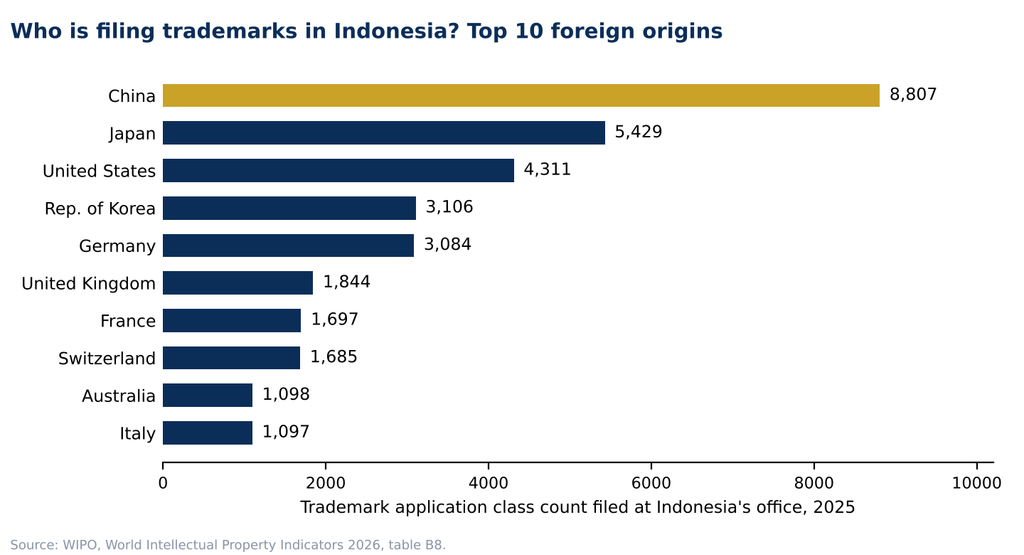
Figure 2. Top 10 foreign origins of Trademark filing at Indonesia’s office, 2025 (class count). Source: WIPO, table B8.
For foreign brand owners, the message is that competitors are already filing. Indonesia is a first-to-file jurisdiction, so the first applicant generally takes the mark. Brands that wait until they launch risk finding their name already registered by a distributor, a competitor or a bad-faith filer.
WIPO’s data reveal one more gap. Indonesia, together with China, India and Viet Nam, has among the lowest shares of services classes in Trademark filing, at about 31% to 34%, against 64.2% in Brazil. Businesses in services such as retail, hospitality, logistics, technology platforms and franchising should check that their filings cover the services they actually provide, not only their goods.
- The Patent Squeeze: Fewer Filings, Tougher Examination
Patent filing at the DGIP fell by 4.9% to 10,366 applications. Iran overtook Indonesia, which now ranks 21st worldwide. Indonesia is still the largest Patent office among the low- and middle-income economies WIPO highlights, ahead of South Africa (9,208) and Thailand (9,087). Its Patent system, however, depends heavily on foreign applicants: 83.6% of applications came from abroad, and 7,898 (about three-quarters) entered through the PCT international route.
The more striking figure is what happened at examination. The DGIP processed 19,936 applications in 2025, almost double the year’s new filings, which points to an office working hard through its backlog. Of those applications:
- 29% were granted, the lowest grant share among the top 10 reporting offices (compared with 81.4% in Viet Nam, 77.7% in India and 75.5% in Japan);
- 43.4% were rejected, the second-highest rejection share after the United States (47%); and
- 27.7% were withdrawn or abandoned.
In 2025, an applicant entering examination in Indonesia had fewer than a one-in-three chance of a grant. Patent quality, not Patent quantity, now decides the outcome.
Patent grants were flat at 5,778 (–0.6%), and 52,194 Patents were in force at the end of the year. For applicants, this is the clearest signal in the report. The quality of the Indonesian specification and translation, the timing of examination requests, and the substance of responses to office actions now matter more than ever. Some withdrawals are strategic, but every application lost to a missed deadline or an unpaid fee is avoidable.
Fast-track routes remain underused. WIPO records 184 Patent Prosecution Highway (PPH) requests reaching Indonesia from Japan-first filings in 2025, while the other first-filing offices shown in its table made only a handful. Where an eligible PPH arrangement exists, it is an underused way to speed up and strengthen examination.
- Homegrown Innovation Needs a Boost, and Utility Models Show the Way
Patent filing by Indonesian applicants, at home and abroad, fell by 15.2% to 1,836, allowing Viet Nam (1,924, +38.2%) to overtake Indonesia. Indonesian residents received just 620 of the 5,778 Patents granted by the DGIP (10.7%) and made only 72 PCT national phase entries abroad. On WIPO’s chart comparing R&D spending with resident patenting per person, Indonesia sits among the lower-ranked economies.
Yet the report also reveals a strength that is easy to miss. Indonesia is the world’s fifth-largest Utility Model (Paten Sederhana) office, with 4,830 applications, and Indonesian applicants are the world’s fifth-largest users of utility models. Almost all of this activity (97.8%) is domestic: foreign applicants filed just 107 utility model applications in Indonesia in 2025.
For foreign companies, that is an overlooked opportunity. Utility Models offer a quicker, simpler route to protect incremental, practical improvements, with a shorter 10-year term. They can sit alongside a standard Patent strategy or replace it where a full Patent is unlikely to succeed.
- Industrial Designs: Indonesia’s Sleeper Asset
Design filing at the DGIP rose by 8.0% to 8,563 designs, making Indonesia the 18th largest design office in the world. The more dramatic story is in registrations. Design registrations surged by 59.2% to 7,418, the third-fastest growth among the top 20 offices after Brazil (+70.9%) and Viet Nam (+67%). Designs in force rose by 30.3% to 36,811, the fastest growth of any top-20 office.
Design examination in Indonesia is also applicant-friendly. Of the design applications processed in 2025, 89.5% were registered, with an average of 239 days from filing to final decision.
There is still plenty of room to grow. Indonesia records 147 resident design applications per USD 100 billion of GDP, against 2,076 in China and 1,783 in the Republic of Korea. Foreign applicants account for only about a quarter (25.9%) of design filing. Companies selling consumer products, packaging or distinctive product shapes in Indonesia should consider registering designs as well as Trademarks and Patents.
- The Missing Piece: Indonesian Brands Going Global
Indonesian businesses are filing Trademarks at home in record numbers, but very few protect their brands abroad. Only 2.9% of Indonesian Trademark filing went overseas in 2025. Brazil (2.2%), India (3.3%) and Argentina (3.6%) were similarly low, while Swiss applicants directed 69.5% of their filing abroad.
The trend is moving in the right direction, since Indonesian filing abroad grew by double digits in 2025. Among the world’s top 20 offices, the leading destinations were China (965 classes), Viet Nam (254), the United States (152), the Republic of Korea (129), Japan (126) and the European Union (110). For Indonesian brands planning to export, franchise or sell online across borders, protection should come before market entry, not after a dispute.
What This Means For You
For Foreign Brand Owners:
- File early. Indonesia is first-to-file, and competitors, including many from China, Japan, the US and Korea, are already active.
- Search before you file. With more than one million active marks, conflicts are increasingly likely.
- Cover your services, not just your goods, and monitor the register so you can oppose conflicting applications in time.
For Patent Applicants:
- Invest in quality in drafting, translation and office-action responses. With a 29% grant share, the quality of the application largely decides the result.
- Manage deadlines and fees carefully to avoid unnecessary abandonment.
- Use every tool available: the PPH where eligible, utility models for incremental innovations, and design registrations for product appearance.
For Indonesian Businesses
- Build an IP portfolio, not just a Trademark. Patents, utility models and designs protect the innovation behind the brand.
- Protect your brand abroad before you expand, using the Madrid System or direct national filings in your target markets.
Key takeaways
- Indonesia’s brand economy is booming. Trademark filing rose 20%, filing by Indonesian applicants rose 23.1%, and active registrations now exceed one million.
- The Patent system is under pressure. Filings fell 4.9%, Indonesia dropped to 21st worldwide, and only 29% of examined applications were granted.
- China leads foreign demand, filing about one in five of all foreign Trademark classes in Indonesia.
- Designs and utility models are rising assets. Design registrations jumped 59.2%, and Indonesia is the world’s fifth-largest utility model office.
- Indonesian brands have yet to go global. Only 2.9% of their Trademark filing goes abroad.
Taken together, WIPO’s 2026 indicators describe a market that is more active and more demanding than ever. Indonesia rewards those who plan their IP strategy early and execute it carefully, and it is increasingly unforgiving to those who do not.
About AFFA Intellectual Property Rights
AFFA Intellectual Property Rights is a Jakarta-based IP firm of more than 70 professionals, serving foreign counsel and clients in Indonesia and Timor-Leste. AFFA is recognised every year by Indonesia’s Ministry of Law as a top filer of Trademarks, patents and industrial designs. From clearance searches and filing to prosecution, oppositions and enforcement, AFFA helps clients turn Indonesia’s fast-moving IP landscape into a competitive advantage.
Graha Pratama Building, Level 15, Jl. MT Haryono Kav. 15, Jakarta Selatan, DKI Jakarta 12810, Indonesia
Tel: +62 812 8700 0889 | WeChat: AFFAIPR | www.affa.co.id
Notes on the data:
All figures come from WIPO, World Intellectual Property Indicators 2026 (November 2026), and refer to activity in 2025. Trademark filing and registration figures are class counts, and design figures are design counts, unless stated otherwise. Rankings refer to WIPO’s top-20 lists. Key sources: figures 1.11, A5, A13, A15, B5, B8, B14, B15, B32, B35, C5, C15, C29 and C32, and statistical tables A62–A65, B44–B46 and C39–C41. “DGIP” refers to Indonesia’s Directorate General of Intellectual Property.
This article is for general information only and does not constitute legal advice.