
AFFA Represents APRIL International Enterprise Pte. Ltd. to Win a Trademark Non-Use Cancellation Action in Indonesia - AFFA IPR

AFFA Represents APRIL International Enterprise Pte. Ltd. to Win a Trademark Non-Use Cancellation Action in Indonesia

In today’s increasingly competitive business environment, Trademark protection is a key factor in maintaining a company’s identity and competitive advantage. However, Trademark registration often faces obstacles due to the existence of previously registered Trademarks that, in reality, are not being used. This was the case with PRINT ONE, where AFFA successfully represented APRIL International Enterprise Pte. Ltd., the owner of the well-known brand PAPER ONE, in winning a Trademark non-use cancellation action against PRINT ONE, which had long been unused in Indonesia, based on prior investigation results.   The case began when APRIL International Enterprise Pte. Ltd. filed a Trademark application for “PRINT ONE” under Application Number DID2021062992 with the Directorate General of Intellectual Property (DGIP) in 2021. However, the application was rejected by DGIP because it was considered similar to the “PRINT ONE,” which had been registered under PT Daksa Sinergi since May 12, 2020.   An independent investigation revealed that the PRINT ONE Trademark had never been used in commerce for over three years since its registration. Based on these findings, AFFA filed a trademark non-use cancellation action with the Central Jakarta Commercial Court in April 2024.   Legal Basis for Trademark Non-Use Cancellation Action   This action was filed under Article 74, Paragraph (1) of Law No. 20 of 2016 on Trademarks and Geographical Indications, which states that a Trademark that has not been used for three consecutive years from the date of registration may be canceled upon request by an interested party.   During the trial, PT Daksa Sinergi failed to appear, despite being legally summoned. This further strengthened the evidence that the Trademark was not actively used in the market.   Court Decision   After a series of hearings, in October 2024, the Central Jakarta Commercial Court finally granted the lawsuit filed by AFFA. In its ruling, the court declared that:   The plaintiff has a legal interest in filing the Trademark non-use cancellation action. The PRINT ONE Trademark owned by PT Daksa Sinergi is officially removed from the General Register of Trademarks. DGIP is ordered to revoke the Trademark and announce its removal in the Official Trademark Gazette. PT Daksa Sinergi is required to pay court fees amounting to IDR 8,820,000.   This decision marks a significant victory for APRIL International Enterprise Pte. Ltd., which can now reapply for its Trademark registration in Indonesia without any obstacles.   Lessons from the PRINT ONE Trademark Cancellation Case in Indonesia   This case is a clear example that a non-use Trademark can be canceled, even if it is still officially registered. Therefore, Trademark owners should take note of these three key factors:   Ensure that your registered Trademark is actively used in Indonesia. If not, other parties may file for cancellation. If an unused Trademark blocks your Trademark, legal solutions are available. Trademark cancellation is one of the strategies to pave the way for a new Trademark registration. Entrust your Trademark registration to an experienced Intellectual Property Consultant to ensure your brand is properly protected in Indonesia.   Current Trademark Cancellation Practice in Indonesia   However, it is important to note that following the Constitutional Court Decision No. 144/PUU-XXI/2023, a Trademark can now only be canceled if it has not been used for five consecutive years from the date of registration.   Additionally, a Trademark cannot be canceled if: There is a ban on importing goods or services that use the Trademark. There are licensing restrictions related to the goods or services associated with the Trademark. The Trademark cannot be used due to a force majeure situation.   You might also want to read: AFFA Represents Trek Bicycle to Win a Trademark Non-Use Cancellation Action in Indonesia This success story is a testament that with thorough preparation and investigation, a non-use cancellation action is possible in Indonesia. Should you need more information about Trademark registration and protection in Indonesia or abroad, please email us at [email protected].

Indonesia Extends the Trademark Non-Use Period from 3 to 5 Consecutive Years - AFFA IPR

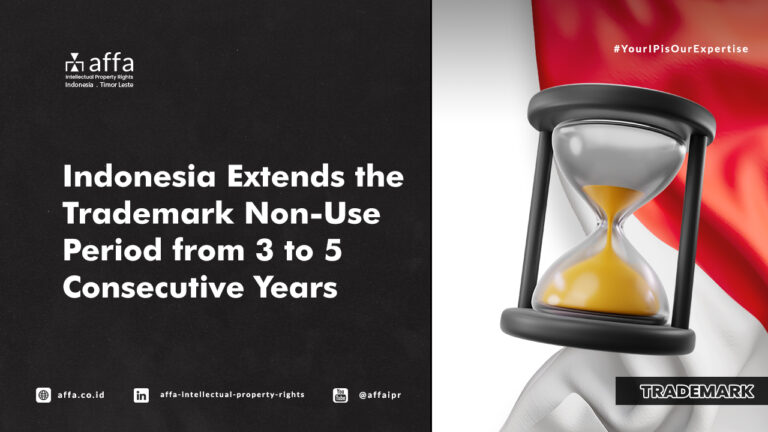
Indonesia Extends the Trademark Non-Use Period from 3 to 5 Consecutive Years

On March 31, 2020, Indonesia officially entered the COVID-19 pandemic period with the enactment of Government Regulation Number 21 of 2020 concerning Large-Scale Social Restrictions in the Framework of Accelerating the Handling of Corona Virus Disease 2019 (Covid-I9). After facing various challenges, both for the community, the business world, and the government, the pandemic status in Indonesia was officially lifted on June 21, 2023, and changed to endemic based on the Presidential Decree of the Republic of Indonesia Number 17 of 2023 concerning the Determination of the End of the Corona Virus Disease 2019 (COVID-19) Pandemic Status in Indonesia. In post-pandemic recovery efforts, the government prioritizes economic recovery by paying attention to the needs of Small, and Medium Enterprises (SMEs).  Taking into account the specific conditions of the Indonesian economy, which hugely relies on SMEs that have limited capital and can change at any time and force majeure, through Decision Number 144/PUU-XXI/2023, which was read out at the Constitutional Court (MK) on Tuesday, July 30, 2024, an adjustment was made to the time limit for Trademark non-use period from three to five consecutive years. This case began when Ricky Thio faced a Cancellation Action for his Trademark based on Article 74 of Law Number 20 of 2016 concerning Trademarks and Geographical Indications (Trademark Law) at the Commercial Court at the Central Jakarta District Court with case number 28/Pdt.Sus HKI/Merek/2023/PN Niaga Jkt.Pst from Zhejiang Dahua Technology Co., Ltd. wanted the cancellation of the Trademark “” with registration number IDM000553432 because it was considered not to have been used for three consecutive years. According to Ricky Thio, this situation raises uncertainty in the Trademark protection provided by the government, which has the potential to make SMEs hesitate to register their Trademarks.   Timeframe for Filing a New Trademark Cancellation Action In Decision Number 144/PUU-XXI/2023, the Constitutional Court saw the importance of adjusting the non-use time limit to 5 (five) consecutive years. This is closely related to the time limit for filing a Trademark Invalidation, which is 5 (five) years from the date of Trademark registration, as stated in Article 77 paragraph (1) of the Trademark Law. Although cancellation and invalidation are different things, the regulation is placed in the Chapter “Cancellation and Invalidation of Trademarks” in the Trademark Law.   Thus, without intending to ignore the tendency of countries that adhere to the civil law system, the adjustment of the time limit for non-use of registered Trademarks to 5 (five) years is to provide justice for all registered Trademark owners so that it does not conflict with the Principle of National Treatment and is in line with the provisions contained in Trademark Invalidation. Based on all the legal considerations above, the Applicant’s argument questioning the unconstitutionality of Article 74 paragraph (1) of the Trademark Law, especially the phrase “3 (three) years” is legally justified. In Decision Number 144/PUU-XXI/2023, the Court partially granted Ricky Thio’s request so that the changes to the article related to the deletion of the Trademark due to the Decision are as follows: Before the Constitutional Court Decision After the Constitutional Court Decision Article 74 paragraph (1) Trademark Law The cancellation of a registered Mark may also be submitted by a third party who has an interest in the form of a lawsuit to the Commercial Court based on the ground that the Mark has not been used for 3 (three) consecutive years in the trade of goods and/or services from the registration date or the last use. Article 74 paragraph (1) Trademark Law The cancellation of a registered Mark may also be submitted by a third party who has an interest in the form of a lawsuit to the Commercial Court based on the ground that the Mark has not been used for 5 (five) consecutive years in the trade of goods and/or services from the registration date or the last use. Article 74 paragraph (2) Trademark Law The reasons for an non-used Mark as referred to in paragraph (1) are invalid in the event of: a. import ban; b. temporary prohibition that is related to the permit for the distribution of goods that use the relevant Mark or a decision from an authorized party; or c. other similar prohibitions that are established with Regulation of the Government. Article 74 paragraph (2) Trademark Law The reasons for an non-used Mark as referred to in paragraph (1) are invalid in the event of: a. import ban; b. temporary prohibition that is related to the permit for the distribution of goods that use the relevant Mark or a decision from an authorized party; or c. other similar prohibitions, including in conditions of force majeure that are established with Regulation of the Government.   Force Majeure can be Used for Exceptions Force Majeure can be a legitimate reason for Trademark owners who cannot use their registered Trademark or cannot run their business normally. The Constitutional Court (MK), in Decision Number 144/PUU-XXI/2023, emphasized the importance of this exception. Force Majeure generally refers to events or effects that cannot be predicted or controlled, such as natural disasters (floods, hurricanes, earthquakes) or human actions (riots, strikes, war) that prevent someone from fulfilling their obligations. In this decision, pandemic conditions such as COVID-19 are considered Force Majeure, which justifies an exception for Trademark owners who experience difficulties using and producing their Trademarks.  The consequence of Decision Number 144/PUU-XXI/2023 is that the provisions of the Trademark Law must be adjusted to the decision. This is, of course, in line with the explanation of Article 10, paragraph (1) of Law. No. 07 of 2020 Third Amendment to Law Number 24 of 2003 concerning the Constitutional Court in conjunction with the Stipulation of Government Regulation instead of Law Number 1 of 2013 concerning the Second Amendment to Law Number 24 of 2003 concerning the Constitutional Court to Become a Law in conjunction with Law No. 8 of 2011 concerning Amendments to Law Number 24 of 2003 concerning the Constitutional Court in conjunction with Law Number 24 of…