

Indonesia Fosters a Thriving IP Ecosystem: Domestic and International Filings Soar Over the Past Decade - AFFA IPR

Indonesia Fosters a Thriving IP Ecosystem: Domestic and International Filings Soar Over the Past Decade

Indonesia’s Directorate General of Intellectual Property (DGIP) has achieved a remarkable milestone over the past decade. According to a report delivered by the Director General of Intellectual Property, Razilu, a total of 1,738,573 Intellectual Property (IP) applications were filed between 2015 and 2024. “This is a monumental figure that reflects the extraordinary enthusiasm of the Indonesian public in protecting their intellectual creations,” Razilu stated during the “Ten-Year Performance Exposé and IP Appreciation” event, held in celebration of World Intellectual Property Day 2025 at Graha Pengayoman, Jakarta, on Wednesday, June 4, 2025. The data show that IP filings have grown at an average annual rate of 18.5%. According to Razilu, this growth is more than just numbers — it reflects increasing awareness of the importance of IP as a national economic and cultural asset. Razilu emphasized that this performance exposé is not merely an evaluation, but also a strategic platform to shape future IP policies. The goal is to ensure that every innovation and creative work by Indonesians is not only protected by law but also fully empowered. Of the total filings, approximately 86.76% originated from within the country. Domestic applicants contributed nearly 99.8% of Copyright filings, 85.2% of Trademark filings, and 68.76% of Industrial Design filings. However, domestic contributions to Patent filings remain relatively low, standing at just 32.05%, highlighting an area for improvement. “These figures demonstrate the strong dominance of local IP filings across all categories. It’s a testament to the thriving innovation and creativity among individuals, entrepreneurs, and inventors across Indonesia,” Razilu added. Over the same period, micro, small, and medium enterprises (MSMEs) were significant contributors to Trademark filings. The most registered classes included: Culinary products (Classes 30 and 29) Fashion (Class 25) Hospitality services (Class 43) Cosmetics and personal care (Class 3) In the Industrial Design category, top applications were concentrated in: Other printed matter (Class 19-08) Chairs (Class 06-01) Garments (Class 02-02) Travel bags, handbags, key holders (Class 03-01) Bags, containers, tubes, capsules (Class 09-05)  Meanwhile, the most recorded Copyright works were books, written articles, computer programs, video recordings, and posters. For Geographical Indications, the top five products over the past decade were coffee, woven textiles, rice, batik, and traditional salt. In the domestic Patent category, top filings involved food chemistry, pharmaceuticals, chemical engineering, special machinery, and basic chemistry. On the other hand, foreign Patent applications were dominated by sectors such as pharmaceuticals, digital communications, transportation, basic chemistry, and metallurgy. At AFFA Intellectual Property Rights, we welcome this growing momentum in Indonesia’s IP landscape. Our team of experienced IP consultants stands ready to support businesses, creators, and innovators—not only in Indonesia but also around the world—in securing and maximizing the value of their Intellectual Property. Let us help you navigate your IP journey with confidence.   Need help filing your IP in Indonesia? Book a free 15-minute call with a registered IP consultant and ensure your IP meets all local requirements:   ? E-Mail : [email protected] ? Book a Call : +62 21 83793812 ? WhatsApp : +62 812 87000 889   Source: Directorate General of Intellectual Property

Guide to the Recordation of Communal Intellectual Property in Indonesia - AFFA IPR

Guide to the Recordation of Communal Intellectual Property in Indonesia

Communal Intellectual Property (CIP) in Indonesia includes Traditional Cultural Expressions, Traditional Knowledge, Genetic Resources, Potential Geographical Indications, and Indications of Origin, which are collectively owned. CIP holds economic value that communities can commercially benefit from while still respecting the nation’s moral, social, and cultural values.   But what are the definitions of Traditional Cultural Expressions, Traditional Knowledge, Genetic Resources, Geographical Indications, and Communal Indications of Origin according to Indonesian law? How does the recordation process work?   This article summarizes it for you!   Definition Traditional Cultural Expressions All forms of creative expressions, whether tangible, intangible, or a combination of both, that represent the existence of a traditional culture held communally and passed down through generations. Examples: Hula Dance Hawaii, Aboriginal Dot Painting, Betawi Pangsi Clothing, North Kalimantan Dragon Motif Necklace, and many more. Traditional Knowledge Intellectual works in the field of knowledge and technology that contain traditional heritage characteristics, developed, maintained, and preserved by a particular community or society. Examples: Ayurveda from India & Nepal, Kuna Healing Practices from Panama, Mencalok Lingga from Riau Islands, Kalakan from Pacitan, and many more. Genetic Resources Plants, animals, microorganisms, or their parts that have actual or potential value.Examples: Peruvian Maca from Peru, Rooibos Tea from South Africa, Lengkir from Bangka Belitung, Alocasia Talambai from West Sulawesi, and many more. Potential Geographical Indications A sign that indicates the origin of a product due to geographical environmental factors, including natural factors, human factors, or a combination of both, which provide specific reputation, quality, and characteristics to the produced goods or products. Examples: Kobe Beef from Japan, Manuka Honey from New Zealand, Pacitan Chalcedony Agate, Sambu Mamasa Weaving, Majene Crystal Salt, and many more. Indications of Origin Identifies the place where a product is produced without linking it to environmental or human factors that influence its quality or characteristics. For example, a “Made in China” label on a product indicates that it was produced in China but does not imply that its quality or characteristics are influenced by specific geographical factors.Indications of Origin rights arise automatically upon the existence of the object and, like other forms of CIP, do not require special registration. However, they should be recorded with the Directorate General of Intellectual Property (DGIP) for legal protection. Examples: Jakarta Ginger Coffee, Pacitan Tuna Tofu, Fakfak Lontar Cake, Meulaboh Khop Coffee, Ngawi Mata Gareng Crackers, and many more.   Legal Basis for CIP Protection in Indonesia At least five regulations serve as the legal foundation for protecting Communal Intellectual Property (CIP) in Indonesia:   Government Regulation No. 56 of 2022 on Communal Intellectual Property This regulation emphasizes the importance of inventorying, preserving, developing, and utilizing CIP as a fundamental national development asset. Law No. 28 of 2014 on Copyright This law states that the state holds the copyright over Traditional Cultural Expressions whose creators are unknown and provides perpetual protection. Law No. 13 of 2016 on Patents It regulates the disclosure of genetic resources and/or traditional knowledge in patent descriptions and mandates the formulation of technical regulations regarding benefit-sharing from the utilization of Traditional Knowledge or Genetic Resources. Law No. 20 of 2016 on Trademarks and Geographical Indications This law governs the registration of Geographical Indications as part of Communal Intellectual Property. Law No. 11 of 2013 on the Ratification of the Nagoya Protocol This law reinforces the importance of inventorying genetic resources and traditional knowledge and developing regulations related to benefit-sharing from their utilization.   To protect CIP, the government has established the National Communal Intellectual Property Database (PDN KIK) as an information portal and economic map for CIP, accessible via the DGIP website. This database integrates data related to Traditional Cultural Expressions, Traditional Knowledge, Genetic Resources, and Potential Geographical Indications. As of January 2025, according to PDN KIK data, the following records have been documented: 1,823 Traditional Cultural Expressions 491 Traditional Knowledge entries 8,483 Genetic Resources 125 Potential Geographical Indications 59 Indications of Origin   Your community can also be part of this if you meet the following registration requirements.   Communal Intellectual Property Recordation Procedure To protect Communal Intellectual Property (CIP) in Indonesia, DJKI has provided various inventory forms for each category: EBT Form for Traditional Cultural Expressions PT Form for Traditional Knowledge PIG Form for Potential Geographical Indications SDG Form for Genetic Resources Alternatively, you can hire a trusted Intellectual Property Consultant to help formulate the contents of the forms, which generally include: Detailed description of the CIP Origin and history Community or society that preserves and develops it Cultural function and significance Supporting documentation (photos, videos, or audio recordings showing skills or production techniques) Declaration Letter stating that the information provided is accurate and that the CIP belongs to the relevant community Written statement of support for protection, preservation, development, and utilization signed by local governments, traditional community organizations, or cultural associations Once the forms and necessary documents are submitted to DJKI, they undergo verification to ensure the completeness and authenticity of the provided data. If they meet the criteria, the CIP will be recorded in the National Database for legal protection.   Unfortunately, DGIP does not specify the estimated time required for the overall CIP recordation process. The duration may vary depending on the complexity of the CIP and the completeness of the submitted documents.   By legally protecting Traditional Cultural Expressions, Traditional Knowledge, Genetic Resources, Potential Geographical Indications, and Indications of Origin, your community can prevent unauthorized claims or misuse by third parties, preserve traditional culture for future generations, and increase economic value through the commercialization of its economic rights. Should you need more information about the recordation of Communal Intellectual Property in Indonesia, feel free to contact us via email: [email protected].

Geographical Indications for Indonesian Cuisine: Untapped Potential - AFFA IPR

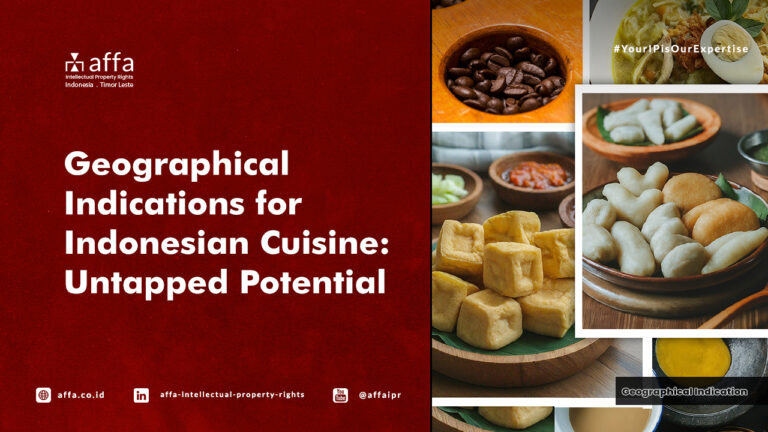
Geographical Indications for Indonesian Cuisine: Untapped Potential

According to data from the Ministry of Tourism and Creative Economy of the Republic of Indonesia, Culinary tourism accounts for about 30-40% of tourists’ total spending during their visit across the country. Names such as Kopi Gayo (Gayo Coffee), Kripik Sanjay (Sanjay Hot Chips), Sate Padang (Padang Satay), Pempek Palembang, Dodol Garut, Tahu Sumedang (Sumedang Tofu), Lumpia Semarang, Soto Madura, Bali Peanuts, and many more have become signature souvenirs that must be purchased when visiting these destinations.   These popular culinary products also bolster the local economy, as most originate from Small and Medium Enterprises (SMEs) that play a vital role in job creation and increasing local income. However, one untapped potential for these regional-based culinary items is their registration as Intellectual Property, specifically as Geographical Indications.   So, why have people yet to do this? What are the obstacles? And what’s the difference between a Trademark and a Geographical Indication in Indonesia? Here’s the explanation…   Legal Basis for Geographical Indications in Indonesia   Geographical Indications, along with Trademarks, are regulated by Indonesian Law No. 20 of 2016 on Trademarks and Geographical Indications (Trademark and GI Law). The law defines:   “A Geographical Indication is a sign indicating the origin of goods and/or products from a certain area that, due to geographical factors such as natural elements, human factors, or a combination of both, gives the goods and/or products a specific reputation, quality, and characteristics.”   Article 53 of the Trademark and GI Law:  The applicant can be the provincial or district/city government or an organization representing the community in a specific geographical area involved in producing goods and/or products such as:   natural resources; handicrafts; or industrial goods.   Thus, if a natural product like coffee, cloves, nutmeg, shrimp, pearls, woven goods, batik, or traditional cuisine comes from a specific geographic area, as long as it doesn’t conflict with national ideology, laws, morality, religion, decency, and public order, isn’t misleading, and is not the name of a plant variety (unless paired with a geographic indication term), it can be registered as a Geographical Indication.   Benefits of Geographical Indications   Registering a product as a Geographical Indication (GI) offers many benefits, particularly for local producers and communities involved in the production. Here are some of the main benefits of GI registration:   Legal Protection for Name Usage One of the most significant benefits of registering a product as a GI is legal protection over using the product’s name. GI registration ensures that only producers from the specified geographic area and those who meet specific production standards can use the name. This prevents others outside the area or those not adhering to the standards from using the GI name indiscriminately.For example, only producers from Garut who meet the standards can use the name “Dodol Garut.” This helps maintain the product’s reputation and quality in the market, ensuring it meets consumer expectations for taste. Increases Product Value and CompetitivenessProducts registered as GIs usually have higher market value due to their reputation associated with a particular area and recognized quality. Consumers are often willing to pay more for products known for their specific geographic origin, associating them with quality, uniqueness, and tradition. This enhances the product’s competitiveness in both domestic and international markets.For instance, Gayo Arabica Coffee, registered as a GI in 2018 by the Directorate General of Intellectual Property (DGIP), has a premium quality reputation in international markets, boosting demand and selling prices.   Preserves Tradition and Local KnowledgeGI registration helps preserve traditional knowledge and production techniques passed down through generations. The standards set in GI registration often include conventional production methods, ensuring producers adhere to established practices, thereby preserving the tradition.For example, “Tenun Ikat Sikka” (Sikka Traditional Weaving) from East Nusa Tenggara, registered in 2018 by DGIP, guarantees that every weaving product is crafted by local communities who consistently maintain their unique production techniques and cultural identity. Boosts Local EconomyRegistering a product as a GI can drive the local economy, from increasing product demand to making it a tourist destination. With GI recognition, local producers can better market their products domestically and internationally. Ultimately, communities’ incomes dependent on the product can increase, especially if they manage the production center as a tourist destination that offers added value for visitors.For example, Kintamani Arabica Coffee from Bali registered as a GI, has significantly boosted the economic standing of coffee farmers in the area. Builds International Reputation and BrandingProducts registered as GIs are typically easier to promote in international markets due to their reputation linked to a specific geographic area. GIs help products gain global recognition and become stronger brands. Moreover, GI registration protects products from unauthorized use in international markets.Today, Indonesia is recognized as a high-quality coffee producer. Over 50 coffee-related Geographical Indications are registered with DGIP, making it the dominant GI category. Prevents Counterfeiting and FraudThe legal protection a Geographical Indication provides prevents the growth of counterfeit or lower-quality products using the same name to exploit the registered product’s reputation. This safeguards the original product’s quality and integrity in the eyes of consumers, protects the original producers from losses, and prevents consumers from being deceived.For example, if “Sumedang Tofu” were registered as a GI, it could prevent parties outside Sumedang from using the name without permission or failing to meet production standards. Strengthens Consumer RelationshipsConsumers tend to trust GI-registered products because they know the product is made to specific standards and has unique characteristics tied to its geographic origin. This helps build trust between producers and consumers, which is key for long-term success.Why Have Many Local Culinary Products Not Been Registered as GIs?   There are several reasons why culinary delights like Padang Satay, Sumedang Tofu, and Madura Soto have not been registered as Geographical Indications (GI) despite their significant potential as distinct regional products:   Lack of Awareness or Knowledge About Geographical IndicationsMany local producers, organizations, or even local governments may need to fully realize the potential benefits of Geographic Indication protection. Coordination Required for RegistrationGI registration requires…