AFFA Represents Trek Bicycle to Win a Trademark Non-Use Cancellation Action in Indonesia

AFFA Represents Trek Bicycle to Win a Trademark Non-Use Cancellation Action in Indonesia

Since mid-2023, AFFA has been entrusted with handling disputes over the Marlin, Trademark owned by Trek Bicycle Corporation, headquartered in Waterloo, United States. Marlin is Trek’s Trademark for its flagship mountain bike frame.    In its home country, Marlin has been used since 1994 and was registered in 1998 at the United States Patent and Trademark Office (USPTO). However, when it was submitted for registration in 2021 via the Madrid Protocol addressed to Indonesia, this Mark was rejected by the Directorate General Intellectual Property (DGIP) as the Trademark Office in Indonesia because it was deemed to have similarities in its essence or its entirety with the registered identical Prior Mark owned by PT Astra Honda Motor since November 2006, and the protection period would have ended in November 2026.   Based on research conducted by independent investigators, it turned out that PT Astra Honda Motor had never used this Trademark for 3 (three) consecutive years from the date of registration or from the date of last use. Due to this fact, a petition to cancel the Marlin Trademark due to non-use was filed as regulated in Article 74 paragraph (1) of the Trademark and Geographical Indications Law (Trademark Law).   Despite an unfavorable decision at the Court of Commerce level, the team at AFFA filed a cassation to the Supreme Court on December 6 and submitted a cassation memo on December 19, 2023. It was finally decided in a deliberation meeting of the Panel of Judges on Tuesday, March 19, 2024, that the Commercial Court at the Central Jakarta District Court had misapplied the law and ordered the DGIP to remove the Marlin Trademark under the name of PT Astra Honda Motor.   The most important factor is that the Trademark has not been used in the last 3 (three) years based on the non-use investigation report submitted to the Court of Commerce. Apart from that, the similarity in essence or its entirety, an element of Trademark cancellation, does not need to be explained in the petition. Moreover, it is supported by the fact that the Cassation Respondent/Defendant never appeared at the hearings, even though they had been summoned 3 (three) times. Another helpful point that enhanced the chance of obtaining a favorable decision is the fact that Trek Bicycle Corporation also has registrations for the same Mark in various countries, such as Costa Rica, Guatemala, Nicaragua, Panama, Honduras and others.    Contrary to the popular belief that non-use cancellations in Indonesia are impossible, this decision by the Supreme Court is a proof that non-use cancellations are possible, provided that the plaintiff comes prepared with non-use investigation report and ample additional evidence which suggest legitimate interests in the same Mark. Should you need more information about registering your Trademark in Indonesia or abroad, do not hesitate to email us at [email protected].
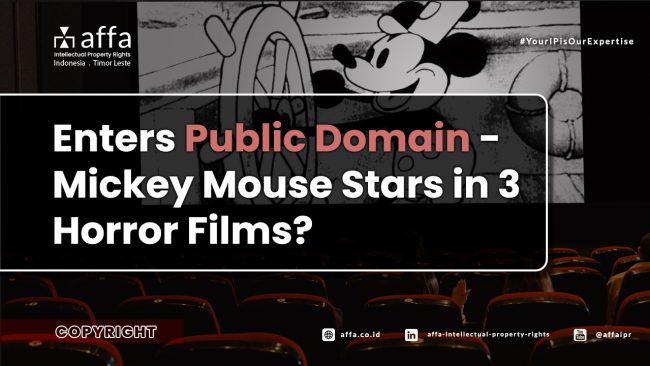
Enters-Public-Domain-Mickey-Mouse-Stars-in-3-Horror-Films-affa-global

Enters Public Domain – Mickey Mouse Stars in 3 Horror Films?

Enters Public Domain – Mickey Mouse Stars in 3 Horror Films? Mainstream news channels are busy reporting that Mickey Mouse, The Walt Disney Company’s mascot, has entered the Public Domain as of January 1, 2024. As a result, many parties are immediately looking for their fortune by presenting this black mouse in various media. Uniquely, they all have a horror theme!   1. The Vanishing of S.S. Willie Straight released on January 2, 2024, on the Night Signal Entertainment YouTube channel, this is a short film less than 10 minutes long, which assumes that the film “Steamboat Willie” published in 1928, the first film to feature the character Mickey Mouse, is an actual event.   Mickey, Minnie, and other animal characters are displayed in realistic form, covered in retro visuals, but with different names. The horror side is that their story ends tragically at the bottom of the river, contrasting with the cheerful original animated version.   2. Mickey’s Mouse Trap Also released on the same day is a 2-minute trailer for the film, which will be released in March 2024. This time, the story is about a serial killer who wears a Mickey Mouse-like mask and operates in an amusement park.   3. Steamboat Willie The third horror film to utilize Public Domain Mickey is the work of Director Steven LaMorte, who previously directed “The Mean One” (2022), a horror-comedy film inspired by “The Grinch” (2018). Steven admitted that filming of Steamboat Willie will take place this spring, and the concept remains a horror-comedy in the style of The Mean One. Steve confirmed to the media that his work would not violate the law because it would not use the name Mickey Mouse but Steamboat Willie.   4. Infestation: Origins Lastly, Mickey is in a PC game that up to four people can play. Here, you can play as a rat exterminator set in the 80s. But then, you are chased by a monster resembling Mickey Mouse! This game produced by Nightmare Forges can now be ordered on the Steam website, but the official release date has yet to be announced.   What is Public Domain? A work or Creation, including animated films, can be protected by Copyright. Then there is the Copyright Law, which regulates the validity period of Economic Rights, which is a reference for whether we still have to obtain permission from the Creator or Copyright Holder for a Work. If the validity period has passed, the work has entered the Public Domain, and the public can use it freely without asking permission from the Creator.   Why 95 Years Later? The Copyright Law in the United States stipulates that a work’s validity period is during the Creator’s life plus seventy years after the Creator dies. However, this regulation was only applied to all works published starting January 1, 1978. Meanwhile, Steamboat Willie was already present 50 years earlier. That’s why the film still has 95 years of Economic Rights and ends on December 31, 2023. Finally, Steamboat Willie only entered the Public Domain as of January 1, 2024.   Now Everyone is Free to Use Mickey Mouse? Certainly not! Because the only thing in the Public Domain is Mickey Mouse in Steamboat Willie: the Black and White Mickey without gloves. What also needs to be remembered is that as a character, two types of Intellectual Property (KI) are attached to Mickey Mouse: Copyright and Trademark.   If a copyright has an expiration validity period, then a trademark can be renewed every ten years. Mickey Mouse is a registered Trademark still owned by The Walt Disney Company. That’s why none of the works above that use Public Domain Mickey use the name “Mickey Mouse.” They consciously did not use this name to avoid legal disputes. They only dare to use “Mickey” or “Steamboat Willie,” common names not registered by anyone.   So, even though Steamboat Willie has entered the Public Domain, that doesn’t mean you are free to produce and/or sell products that contain colored versions of images or words of Mickey Mouse. The point is that Public Domain doesn’t necessarily make your own Mickey Mouse.   Mickey Mouse Still Owned by The Walt Disney Company Amid widespread news related to the Public Domain, the role of the media is needed to educate people so as not to create new problems. Because incomplete reporting can make many parties who are less aware of IP, including SMEs, subject to warning letters from Disney’s lawyers. They join in on the hype by producing products depicting colored versions of Mickey Mouse and containing the word without realizing the potential for Copyright and Trademark violations.   Remember that Walt Disney is a big company in the IP business. They understand the ins and outs of Intellectual Property law. Apart from that, they also continue to update their IP-based characters and their source of income. That is the only way the validity period of Economic Rights in Copyright can continue to be extended. Steamboat Willy is only one of tens of thousands of works featuring IP-based characters, a source of income for the Walt Disney Company. Missing one will not affect its revenue, which since 2022 will be above USD 80 billion per year.   From Walt Disney, we learn that creating original characters, if managed well, will be more profitable and provide long-term benefits. Instead of making imitation works that take advantage of the momentary hype. The public will also see it as a cheap work or a parody of no quality.   Should you need further information about Public Domain, Copyright, or other Intellectual Property management, please do not hesitate to contact us via [email protected]. Sources:  Coming Soon Variety  

Unveiling-Copyright-Ownership-in-the-Film-Industry-Legal-Perspectives-affa-global

Unveiling Copyright Ownership in the Film Industry: Legal Perspectives

Unveiling Copyright Ownership in the Film Industry: Legal Perspectives There is still often a question among the public about who owns the copyright for a large-scale work, such as a movie. Because movies, especially feature films, involve many derivative works and other interrelated supporting works. Starting from scripts, background music, movie posters, and even a game specifically made to promote the movie.   So, who owns the copyright of all these works? Does the Director hold everything? Producer? Or both of them?   Definition of Copyright According to Article 1 of Law No. 28 of 2014 concerning Copyright (Copyright Law), what is meant by Copyright is the Exclusive Right of the Creator, which arises automatically based on declarative principles after a work is realized in actual form without reducing restrictions by the provisions of statutory regulations.   From the definition above, there are two essential emphases of Copyright as follows: 1. Exclusive Rights, consisting of: Economic Rights The Exclusive Right of the Creator or Copyright Holder to obtain economic benefits from the Work Moral Rights Rights that are eternally inherent in the Creator 2. Arises automatically based on Declarative Principles    No recording or registration is required to obtain protection.   Then, a Creator is a person or several people who produce a creation individually or together. Movies in the Copyright Law are referred to as Cinematography as mentioned in Article 40 Paragraph (1) letter (m), which means moving images, including documentary movies, advertising movies, reportages, or story films made with scenarios, including cartoon or animation films.   Cinematography works can be created on celluloid tape, video tape, video disc, optical disc, and/or other media that allows it to be shown in cinemas, big screens, television, or other media.   Copyright Holders of Movies/ Cinematography Works In general, 3 (three) parties are referred to as Copyright Holders, namely: Copyright Owner/Creator The party who legally receives the rights from the Creator Another party who receives further rights from the party who received the rights   However, if we talk about specific copyright holders for movie-related products, the details are as follows: Movie Related Products Types of Creation Notes Original/ raw/ in-editing process/ final movie. Copyright for Cinematographic Works Creator: Director Copyright Holder: Film Producer Script/ Story Copyright for Written Works Creator: Script/Story Writer Book – If the film is adapted from a book. Copyright for Books/Writing Works Creator: Book Author Adaptation Copyright Holder: Film Producer Book – If the film is adapted into a book. Copyright for Books/Writing Works Creator: Book Author Adaptation Copyright Holder: Book Publisher Background Music (BGM), scoring, soundtrack, sound effects, or other related music works. Copyright of Songs and/or Music Creator: Song Creator (can be assigned to Music Publisher) Related Rights: Musicians, Singers, and Record Producers Movie posters Copyright for Drawing/Painting Artworks Creator: Poster Designer Movie Exhibitions/ advertising/ promotions (photography, banners, etc.) Copyright for Photographic Works, Portraits, Databases, Video Games, Computer Programs, Appearances in the form of Written Works Creator: Photographer, Designer, and Game/Computer Programmer.   Knowing who the creator of the creations above is, if you are involved in them, especially if your position is the creator, you are entitled to Exclusive Rights to cinematographic works, valid for up to 50 (fifty) years from the first announcement.   Benefits of Copyright Recordation Also, please ensure your name is recorded in the Creation Recordation Letter issued by the Minister and in the General Register of Works, which serves as initial proof of ownership of a work and is substantial evidence in court. Even though it is not mandatory, Copyright recordation is beneficial for the following 2 (two) things: Prevent misuse of recorded works and simultaneously prevent losses arising from abuse of said works. Make it easier for Copyright owners to claim royalties for recorded Copyright licenses.   Should you have further questions regarding Copyright and its registration in Indonesia and abroad, do not hesitate to contact us via [email protected]. Sources: Law Number 28 of 2014 concerning Copyright (Copyright Law) Directorate General of Intellectual Property (DGIP)  

Tips-for-Registering-Holograms-as-Trademarks-in-Indonesia-affa-global

Tips for Registering Holograms as Trademarks in Indonesia

Tips for Registering Holograms as Trademarks in Indonesia Besides Sounds and 3D objects, Holograms can be registered as Trademarks because they are equally recognized as Non-Conventional/Non-Traditional Trademarks. But what kind of Holograms can be registered as Trademarks? Do you interpret the meaning of this Hologram in the same way? Allow us to delve into the discussion.   Legal Basis For Hologram Marks In Indonesia Indonesia recognizes the existence of Hologram Marks through the elaboration of the definition of Trademark as stated in Article 1 Number 1 of Law Number 20 of 2016 concerning Marks and Geographical Indications (the Trademark Law), as follows:   A Trademark is a sign that can be displayed graphically in the form of an image, logo, name, word, letter, number, or color arrangement in 2 (two) dimensions and/or 3 (three) dimensions, sound, hologram, or a combination of 2 (two) or more of these elements to differentiate goods and/or services produced by individuals or legal entities in goods and/or services trading activities.   For a Hologram Mark to be registered, Article 4 of the Trademark Law and Article 3 of the Ministry of Law and Human Rights Regulation No.67/2016 require the attachment of a Trademark label in the form of a visual display from various sides.   This visual appearance from various sides is essential because the definition of a Hologram, according to the ‘Great Dictionary of the Indonesian Language,’ is a colored image with three dimensions on a piece of paper so that it appears as if it has arisen. So, the critical point that needs to be paid attention to for Hologram Trademarks is its embossed impression, even though it is flat, and therefore has a different color reflection effect from each side. That’s why the visual description of each side is essential and must be accurate.   Sample of Description on a Hologram Trademark For example, the Hologram Mark registered for PT. PEGADAIAN (Persero) with Application Number JID2020022485. Its appearance is only a circle, but if we look at it from various sides, an emerging effect shows the words and logos contained in it, with different effect colors appearing on each side.   So the description is, “Holograms have five image perspectives. The Front Image displays the entire hologram image (including words and logos). The Top and Right images show the words and logos in various colors. The Bottom and Left images show the words and logos in blue and purple.”   Examples of Other Hologram Marks Registered in Indonesia PT. PANCA PRATAMA INDONESIA GEN TAMEO IMAN SANTOSA Application Number: DID2022083769 Application Number: DID2022104879 Application Number: DID2020060873   From the examples of registered Hologram Marks above, it appears that words, logos, and even facial photos can be submitted as Hologram Marks, provided they do not conflict with administrative and substantive requirements. Furthermore, assuming that the application does not encounter opposition or rejection, it will only take 10-13 months from the application to obtaining the registration number.   So, have you imagined the Hologram Mark that you want to register for your business?   Should you have further questions regarding the requirements and registration of Hologram Marks in Indonesia or abroad, do not hesitate to contact us via [email protected]. Source: Directorate General of Intellectual Property

5-Common-Types-of-IP-Violation-in-Indonesian-E-Commerce-affa-global

5 Common Types of IP Violation in Indonesian E-Commerce

5 Common Types of IP Violation in Indonesian E-Commerce The presence of e-commerce has changed the shopping habits of Indonesians. Statista Market Insights data predicts that users by the end of this year will reach 196.47 million, or an increase of more than 22 million since 2022.  The Central Bank of the Republic of Indonesia also stated that the value of e-commerce transactions in 2022 will reach IDR 476.3 trillion. This number is predicted to continue to increase because active e-commerce users in Indonesia still account for only around 30% of transactions in cyberspace.   By now, opening an e-commerce site or app is the easiest way to compare the cheapest product we want. However, with all this convenience, you must still be aware of the potential for Intellectual Property violations in e-commerce. You need to remember that even though the platform organizers have tried to carry out sorting even with AI, it will only be helpful if you, who have self-screening capabilities, are easily tempted by the low prices of products that should be expensive.   Counterfeit goods are not the only potential for Intellectual Property (IP) violations in e-commerce; there are at least 5 (five) types of IP violations, which we can describe as follows:   1. Sale of Counterfeit Goods Even when selling fake goods, the method is more sophisticated, not blatantly using names or products with very different qualities. a. Photos taken from the official site; Suppose the seller is not an official store but uses an official photo. In that case, you should immediately be suspicious and use your right to ask for some actual photos of the product before making a transaction.   b. Preloved with invoice; If the seller uses pictures that show an invoice with the product, like pretending it was purchased from an official store, please don’t hesitate to ask for some photos of the actual product before making a transaction.   c. Normal price for a counterfeit product; If you are a collector of specific brands, you must know the shape, color, or placement of the official logo on the product. You may also know how many variants are produced for this season, including the look of the limited variants. So you won’t be deceived when you find a product with a different color, which shouldn’t be available in the market, even though it is the same price as the original product.   d. Using the word ORI or SUPER ORI or HIGH GRADE; The word “ori,” which means original, should only be used for authentic products. However, sellers of counterfeit goods have recently used this word to attract buyers. Moreover, if the inclusion of the word “ori” is coupled with the price of the item being much cheaper, you should be suspicious of its authenticity.   e. Cheap products directly from the factory. It would be best if you were also wary of this description when you find a cheaper good on e-commerce. Only official stores or distributors can do this if the product comes from Indonesia and gets wholesale price benefits. Another possibility is stolen goods that are not complete or of bad quality. Are you sure you still want to buy something like that?   2. Promoting Product Without Verification This type is the same as in the first category; the difference is that it involves the lure of a big discount, which results in the price being much lower than the market, but it is not sold by official stores or distributors (which in the same time are not providing the same promotions). Apart from the possibility that what is being sold is not a genuine product, it could also be that the product is smuggled without paying official import taxes, with questionable completeness and quality.   3. Selling Irresponsibly Through E-Commerce Sometimes, some health and beauty products are sold using a “direct selling” scheme, and sale activities via e-commerce are prohibited. Because their exclusive products are only sold through direct selling methods to downlines/registered members. So direct sales to the public (non-members) are a violation because they destroy the agreed business scheme and membership system.   4. SOPs for IP Violations in E-Commerce Are Not Yet Standardized Even though e-commerce has acted as an intermediary that will hold funds from buyers and return them if there is a problem with the goods, there are still loopholes that allow transactions to be completed even though the goods have a problem. For example, the buyer forgets to unbox with a video or only immediately checks the item’s authenticity after the deadline. If you are caught in this problem, the procedures of complaint from each e-commerce are not standardized. The absence of customer service that truly understands the situation makes this even more difficult. Especially if the customer service is entirely automated without involving humans.   5. Borderless E-Commerce Platform With the increasingly open cross-border international trade through e-commerce, you must understand the risks of purchasing goods outside Indonesia. If you find lower prices for goods, even though they are shipped from abroad, and you know that there is an official distributor in Indonesia, your vigilance needs to be increased even more. Because there could be an IP violation in the form of distribution without permission/violating the law/not paying import tax, which is not impossible, within the time frame of the order process, the police arrest the seller in the country of origin, and you will not get the goods you want.   All of the IP violation practices above harm you as a buyer and significantly impact the country. These losses include: Negative Reputation of Indonesian From the latest Priority Watch List (PWL) 2023 report, released by the United States Trade Representative (USTR), Indonesia, along with Argentina, Chile, India, Russia, China, and Venezuela, is still on the investment blocklist because it is prone to piracy practices. In particular, the Notorious Markets for Counterfeiting and Piracy 2022 report, also released by USTR, lists several local e-commerce sites…

3-Crucial-Roles-of-Trademarks-in-the-Property-Business-affa-global

3 Crucial Roles of Trademarks in the Property Business

3 Crucial Roles of Trademarks in the Property Business After being hit by the COVID-19 pandemic, property growth in Indonesia has shown promising developments in recent years. Property development projects resume after investors return, thanks to lower bank interest rates and regulations more conducive to foreign property investment in Indonesia, especially for those seeking long-term profits.   As one of Indonesia’s popular tourist destinations, Bali could be the most exciting example. Data from the Central Bank of the Republic of Indonesia shows that house prices in Bali only increased by 1% in the second quarter of 2023 compared to the previous quarter. In terms of market growth, it is estimated to continue to grow in 2024, thanks to the support of tourism, infrastructure investment, and increasing foreign demand. Bali continues to attract the interest of foreign investors looking for a place to live or invest in the promising property market.   The properties in question are premium housing, hotels, resorts, and villas. Luxury properties such as villas in elite areas in Bali are sought after not only by local investors but also by foreign investors from Japan, South Korea, and Australia.   With the growth rate predicted to be increasingly rapid, it is unsurprising that new property names will emerge from this industry, whether independent/boutique or under the auspices of large groups, which are similar but different. How do we ensure that the property named “AAA” in Ubud has the same quality as the properties named “AAA” in Kuta? Could they only have the same name, but the quality is very different? Do practices like this disadvantage property entrepreneurs?   These problems can be avoided if you register your property name and/or logo as a Trademark. There are at least three main benefits that you can get from a registered property Trademark, and those three benefits are:   1. Building Image Through Trademark This is where we must start to be aware of the importance of registered Trademarks. Your property Trademark must be registered as a first step in building an image. A Trademark registered with the Directorate General of Intellectual Property of the Republic of Indonesia in Class 36 will protect the property business name and logo as Intellectual Property that you own. Thus, you are the exclusive owner of the name and logo. Only you have the right to use it, and building your image can begin. Furthermore, you can assure customers that the quality of service at every “AAA” property name you own will always be maintained. In other words, consumers can identify comfort, safety, or excellent quality with your property Trademark.   2. Registered Trademark Prevents Piracy Registration of a Trademark on the property can also prevent the criminalization of a brand used by other parties. Imagine the luxurious and comfortable image you have built suddenly damaged due to the appearance of the same property name created by someone you don’t know. A lousy property review may affect the image of your property. The property has nothing to do with you. If your property Trademark is already registered, you can take all necessary legal steps to stop the use of your Trademark by other parties. Since Trademark registration in Indonesia applies the first-to-file principle, meaning that the rights are given to the first registrant, you must register your Trademark as soon as possible before being preceded by another party. On the other hand, if you have yet to register a Trademark on your property while another party has appeared as the legal owner of the name you used, you could lose the right to use the name on the property you have built so far. Another party can ask you to pay a hefty amount due to your negligence in registering the  Trademark on your property.   3. Trademark Increases Property Value With a registered Trademark and a maintained image, your business expansion can continue to increase due to investment from within and outside the country. As an intangible asset, a Trademark becomes an added selling point for you in providing licenses to parties interested in building new properties using the name of the property you own. If your property business already has a registered Trademark, business expansion can be done as a franchise. You can read in our previous article how licensing and franchise businesses can increase the benefits of your brand.   Considering the importance of Trademark registration in the property business, you don’t need to think long about registering the property Trademark that has been the focus of your business for so long. If you have any more questions about property Trademark registration, please don’t hesitate to contact us via [email protected]. Source: Miraland.id Detik.com Directorate General of Intellectual Property

Tips-for-Registering-3D-Objects-as-Trademarks-in-Indonesia-affa-global

Tips for Registering 3D Objects as Trademarks in Indonesia

Tips for Registering 3D Objects as Trademarks in Indonesia In the public mind, the meaning of a Trademark is often limited to just a name, word, or logo. As we explained in the previous article, a Trademark can also be a sound. Along with the times and increasing human creativity, Trademarks as differentiators of goods and/or services can also be registered in 3-dimensional (3D) form. If they have differentiating power, logos in 3D form, unique product shapes or packaging, and even shop layouts can be registered as Trademarks in Indonesia.   Legal Basis For 3D Marks In Indonesia Indonesia recognizes the existence of 3-Dimensional Marks through the elaboration of the definition of Trademark as stated in Article 1 Number 1 of Law Number 20 of 2016 concerning Marks and Geographical Indications (the Trademark Law), as follows:   A Trademark is a sign that can be displayed graphically in the form of an image, logo, name, word, letter, number, or color arrangement in 2 (two) dimensions and/or 3 (three) dimensions, sound, hologram, or a combination of 2 (two) or more of these elements to differentiate goods and/or services produced by individuals or legal entities in goods and/or services trading activities.   For a 3D Mark to be registered, Article 4 of the Trademark Law and Article 3 of the Ministry of Law and Human Rights Regulation No.67/2016 require the attachment of a Trademark label in the form of the characteristics of the Mark in the form of visuals and a description of the protection claim.   Types of 3D Marks A 3D Mark is a sign that has elements of length, width, and height or has volume, as in the following scope:   Product What is meant by Product here is not only the shape of the product itself, which is unique, such as Zippo lighters but the Sari Roti mobile cart is also registered as a 3D Mark.   Packaging This category is the most frequently registered 3D Mark. The most famous examples are Coca-Cola glass bottles, Toblerone chocolate, and Yakult bottles.     Character/ Mascot Currently, the presence of mascots cannot be separated from the presence of theme parks or various significant events such as the Olympics. Each event has unique characters that become symbols and represent the spirit of all contingents and the host country. Registered Mascots can then be licensed and presented in various performances and product derivatives, thus becoming a source of income for the Trademark holders.     Position Famous examples of this Position Mark are the Red label on the pocket of Levi’s jeans, the yellow thread stitching on the sole of Dr. Martens, and the Red soles on Louboutin shoes.     Layout Perhaps you still don’t know that your restaurant layout can be registered as a Trademark. With a certain uniqueness, visitors can immediately feel the difference when entering your shop just from the layout alone. Examples of layouts registered as Trademarks are the Apple Store and Kiko, a cosmetics store from Italy.   So, how do you register them as Trademarks? Here are the tips: Unique A Trademark can be registered if it has overall distinctive power, as long as these elements can be identified as product identity. So, you must ensure that the 3D shape you are registering has characteristics that distinguish it from similar products. Distinctive If your product is not distinctive enough but contains a distinctive element, it is sufficient to make it function as a whole product identity. However, it would be best if you made sure that your additional characteristics can change the impression of the overall shape, for example, in the 3-Dimensional Mark in the Position category.   Furthermore, the examination will be based on the graphical representation submitted, not the actual size. So, the image provided must display these different elements. Proportions are significant, but there are no special requirements regarding this.   How is it different from Industrial Design? The uniqueness of 3D Marks, especially for product packaging, can potentially clash with other Intellectual Property (IP) regimes, such as Industrial Designs and Patents. Therefore, you’ll need to study it before submitting the application to get maximum benefit from the protection and anticipate legal consequences that may happen in the future.   What differentiates 3D Marks from Industrial Designs is that the protection period can be extended for Trademarks, whereas Industrial Designs are only ten years and cannot be extended. Apart from that, in Industrial Design, aesthetic value and novelty are the main factors. Uniquely, one product can have two IP protections simultaneously, as a Trademark and an Industrial Design. This is possible if the product meets the terms and conditions of the Trademark and Industrial Design Law.   3D Marks can also intersect with Patents if they have technical aspects or contain functional forms. However, if an item is protected as a patent, it cannot receive protection as a trademark. This rule is based on Government Regulation in Lieu of Law No.2 of 2022 concerning Job Creation Article 20 letter (g) in number (1) in Article 108 of Law Number 11 of 2020 concerning Job Creation.   In the end, we hope you can determine whether the product you own is more appropriately registered as a 3D Mark, Industrial Design, or Patent. However, if you still have questions or need further information regarding 3D Marks, please get in touch with us via [email protected]. Source: Directorate General on Intellectual Property (DGIP)

关于在印度尼西亚将声音和音乐注册为商标的提示-affa-global

关于在印度尼西亚将声音和音乐注册为商标的提示

关于在印度尼西亚将声音和音乐注册为商标的提示 随着全权贸易和技术进步快速发展,商标保护的需求也在不断增加。自2008年以来,世界知识产权组织(WIPO)成员国已经承认“新型标志”的存在,这导致商标分为两种类型,即可见商标和不可见商标。   可见商标包括三维标志、颜色标志、全息图、标语、电影和书籍标题、运动或多媒体标志、位置标志和手势标志。 同时,不可见商标可通过眼睛以外的感官感知。例如,耳朵听到的声音标志,鼻子闻到的嗅觉标志,舌头尝到的味觉标志,皮肤感觉到的质地或感觉标志。   声音标志在印度尼西亚的法律依据 印度尼西亚通过阐述关于商标和地理标志的2016年第20号法律(《商标法》)第1条第1款所述的商标定义,承认了非传统商标的存在,具体如下:   商标是一种标识,可用图像、徽标、名称、单词、字母、数字或2(二)维和/或3(三)维的颜色排列、声音、全息图或2(二)个或以上这些元素的组合进行图形展示,以区分个人或法律实体在商品和/或服务贸易活动中生产的商品和/或提供的服务。   对于要注册的声音标志,《商标法》第4条和法律和人权部第67/2016号条例第3条要求附上显示标志特征的附件;对于声音标志,需要附上符号和录音。但是,如果声音标志不能以符号形式显示,则附件应是声谱图。   声音标志的类型: 1. 唱出/说出的语言元素 例如,“Auo-uo”这个声音就是人猿泰山喊出来的。   2. 音乐元素 例如,每次打开装有Windows操作系统的PC/笔记本电脑时出现的音乐。   3. 逼真的声音 例如,影片开始前,在米高梅标志出现时,狮子咆哮的声音。   4. 其他声音 例如,刚刚启动的哈雷戴维森摩托车发动机发出的轰鸣声。   那么,如何将它们注册为商标呢? 提示如下: 1. 附上您的图形表示 以视觉方式显示的符号和声谱图可区分不同的声音标志。 声音标志的符号示例 声音标志的声谱图示例 2. 附上带清晰说明的符号 不含语言元素的声音标志符号 说明: “该声音标志由C调的五音旋律组成。该旋律由八分之一C音、八分之一E音、八分之一D音、十六分之一B音、十六分之一C音和一个半C音组成。”   含语言元素的声音标志符号 说明: ”该声音标志由单词“HISAMITSU”和四个音符 (E、A、E和F)的声音组成。前三个音符是八分音符,后一个音符是八分半音符”   3. 对于唱出/说出的标志,语言元素对检验有较大影响 语言元素是指说出的声音,类似上述HISAMITSU标志的示例。 如果说出的单词有很大差别,声音就具有很强的区分能力。假设两个不同的语言元素(HISAMITSU和WECANSEEYOU)以相同方式标注。在这种情况下,HI-SA-MIT-SU的发声就像是WE-CAN-SEE-YOU;因此不是不同的声音标志。 如果语言元素相同,但伴有非语言元素(例如不同的音乐声),区分值将仍然存在,但要弱于语言元素完全不同时的情况。   4. 对于含音乐元素的声音标志,不同的旋律对检验有较大影响 如果申请注册的声音标志只包含音乐元素,将不同的旋律作为区分值。 与仅在其他乐器、节奏和旋律方面存在差异相比,越多样化越好。   5. 对于逼真的声音,可通过不同的类型、节奏和旋律来检验区分力度。 如果声音标志是逼真的声音,例如米高梅的狮子咆哮声,为了区分,另一只狮子的咆哮声必须具有不同的节奏和旋律和声级。 例如,狮子的嗓音(例如,尖叫或哭泣的节奏较慢)也具有区分力度。   您希望注册哪种声音标志来支持您的企业,让它在市场上更加引人注目、更有区分力呢?请确保您满足以上所有标准。 如果您对印度尼西亚或国外的语音标志有任何疑问或需要其他信息,包括查询要注册的标志是否已被其他方注册,请随时通过[email protected]联系我们。 来源: 印度尼西亚知识产权局

Tips-for-Registering-Sound-and-Music-as-a-Trademark-in-Indonesia-affa-global

Tips for Registering Sound and Music as a Trademark in Indonesia

Tips for Registering Sound and Music as a Trademark in Indonesia In line with the development of the need for Trademark protection following the increasingly rapid dynamics of the world of trade and technological advances, since 2008, member countries of the World Intellectual Property Organization (WIPO) have recognized the existence of ‘New Types of Marks,’ which has resulted in the division Trademarks are divided into two types, namely Visible and Non-Visible Trademarks.   Visible Trademarks include 3-dimensional Marks, Color Marks, Holograms, Slogans, Film and Book Titles, Motion or Multimedia Signs, Position Marks, and Gesture Marks. Meanwhile, Non-Visible Trademarks can be perceived through senses other than the eyes. For example, Sound Marks that the ear can recognize, Olfactory Marks that the nose can smell, Taste Marks that the tongue can taste, and Texture or Feel Marks that the skin can feel.   Legal Basis for Sound Marks in Indonesia Indonesia recognizes the existence of Non-Traditional Marks through the elaboration of the definition of Trademarks as stated in Article 1 Number 1 of Law Number 20 of 2016 concerning Marks and Geographical Indications (Trademark Law), as follows:   A Trademark is a sign that can be displayed graphically in the form of an image, logo, name, word, letter, number, or color arrangement in 2 (two) dimensions and/or 3 (three) dimensions, sound, hologram, or a combination of 2 (two) or more of these elements to differentiate goods and/or services produced by individuals or legal entities in goods and/or services trading activities.   For a Sound Mark to be registered, Article 4 Trademark Law and Article 3 of the Ministry of Law and Human Rights Regulation No. 67/2016 require an attachment that shows the characteristics of the Mark, and for Sound Marks, what needs to be attached is a notation and sound recording. However, if the Sound Mark cannot be displayed in the notational form, the attachment should be a sonogram.   Types of Sound Marks: 1. Sung/ Spoken Verbal Elements  For example, the sound “Auo-uo” was shouted by Tarzan.   2. Musical Elements For example, the music that appears every time we turn on the PC/Laptop with the Windows operating system.   3. True-to-life Sounds  For example, the sound of a lion roaring at the same time as the Metro Goldwyn Mayer logo appears before the film starts.   4. Other Sounds  For example, the roar of a Harley Davidson motorbike engine that has just been started.   So, how do we register them as Trademarks? Here are the tips: 1. Attach Your Graphic Representation Notations and sonograms displayed visually can differentiate between one Sound Mark and another. Example of Notation of a Sound Mark Example of Sonogram of a Sound Mark 2. Attach a Notation with a Clear Description Notation of a Sound Mark without Verbal Element Description: “The Sound Mark consists of a five-note melody in the key of C. This melody consists of one-eighth C notes, one-eighth E notes, one-eighth D notes, one-sixteenth B notes, one-sixteenth C notes joined by one and a half C notes.”   Notation of a Sound Mark with Verbal Element Description: “The Sound Mark consists of the word “HISAMITSU” and the sound of four musical notes: E, A, E, and F. The first three notes are eighth, and the last are eighth and half.”   3. For Sung/Spoken Marks, Verbal Elements Have a Big Influence on Examination What is meant by Verbal Elements is the voice that is uttered, as in the example of the HISAMITSU Mark above. If the words spoken are very different, then the sound can be considered to have great differentiating power. However, suppose two different Verbal Elements (HISAMITSU vs WECANSEEYOU) are notated the same. In that case, HI-SA-MIT-SU is performed like WE-CAN-SEE-YOU; it is not considered a different Sound Mark. If the Verbal Elements are the same but accompanied by Non-Verbal Elements, such as different musical sounds, then the differentiating value is still there, but not as big as if the Verbal Elements are entirely different.   4. For Sound Marks with Musical Elements, Different Melodies Have a Big Influence on Examination If the Sound Mark application for registration only contains Musical Elements, the distinguishing value is the different melody. The more diverse, the better, compared with the differences only being other musical instruments, tempos, and rhythms.   5. For True-to-life Sounds, Differentiating Power is Examined by Different Types, Tempos, and Rhythms. If the Sound Mark is a true-to-life sound, such as Metro Goldwyn Mayer’s lion roar, then to differentiate it, the sound of another lion’s roar must have a different tempo, rhythm, and sound level. For example, a lion’s voice, such as screaming or crying at a slower tempo, can have differentiating power.   So, what kind of Sound Mark do you want to register to support your business so that it becomes more visible and has differentiating power in the market? Make sure you can fulfill all the criteria above.   If you have questions or need other information about the Voice Mark in Indonesia or abroad, including checking whether the Mark you want to register has been previously registered by another party, please don’t hesitate to contact us via [email protected]. Source: Directorate General of Intellectual Property

Comprehensive-Trademark-Protection-Post-Registration-Best-Practices-affa-global

Comprehensive Trademark Protection: Post-Registration Best Practices

Comprehensive Trademark Protection: Post-Registration Best Practices Even though it has offensive and defensive functions, owning a Trademark Certificate does not necessarily prevent your Trademark from being counterfeited. Moreover, if you are a market leader, there will always be irresponsible parties who want to take advantage of profits badly.   According to data from the Indonesian Anti-Counterfeiting Society (MIAP), losses suffered by producers in 2020 from counterfeit goods have reached IDR 290 trillion. Most counterfeiting comes from software and cosmetic products, resulting in state tax losses of up to hundreds of billions of Rupiah. This high rate of counterfeiting is expected in developing countries because of the “impulsive consumerism” nature of the people who want to own branded goods but are not supported by an adequate budget. And then, buying fake goods is an option, and the important thing is that they are similar and can be worn stylishly.   With a registered Trademark, you can take legal enforcement efforts by issuing a direct warning or sending a legal notice with the help of a trusted Trademark Consultant. Suppose there is still no response from the violator. In that case, you can escalate it to the police for further efforts by including initial evidence (where the counterfeit product was sold and who the reported party is). The police will then ask for an expert opinion (Trademark Examiner from Trademark Office/ DGIP). After a follow-up from the expert, the action can be continued with the prosecution, namely confiscation, as well as criminal sanctions of fines and/or imprisonment of 4-5 years. However, most of these Trademark Infringement cases can be resolved outside court, where the guilty party pays compensation and withdraws the product from the market.   However, you must ensure that you have protected your Trademark by carrying out the following comprehensive protection:   1. Apply Registration in All Relevant Classes If you have registered your coffee shop in the restaurant class and you also sell coffee drinks or coffee beans that can be purchased separately, you must also register your Trademark in the class that can protect these products. Because you want to avoid that in the future, there will be other parties who are famous for selling coffee drink products that should only be purchased at your coffee shop, right?   2. Register Your Logo as a Trademark If your business has a logo that can make it more unique and well-known in the market, then there is no need to delay its registration as a Trademark. If necessary, also register it with the colors you use so you can carry out subsequent protection strategies.   3. Increase Your Consumer Awareness In the era of social media, marketing your products and making consumers aware of your product’s presence has become more accessible. For this reason, you can carry out a series of education. Start by explaining what your logo looks like and its meaning, including the consequences if someone fakes it and branding efforts by telling how your products and/or services prioritize quality and can only be obtained through official/specific distribution channels. In this way, consumers will buy the original one for the sake of quality rather than buying a fake one, which will cause many future losses.   Should you have questions or need other information regarding Trademark registration in Indonesia and abroad, please get in touch with us via [email protected] Source: IP Talks Directorate General Intellectual Property