
Fighting IP Crimes: Indonesia's IP Office Task Force Destroys IDR 5.35 Billion Worth of Counterfeit Goods! - AFFA IPR

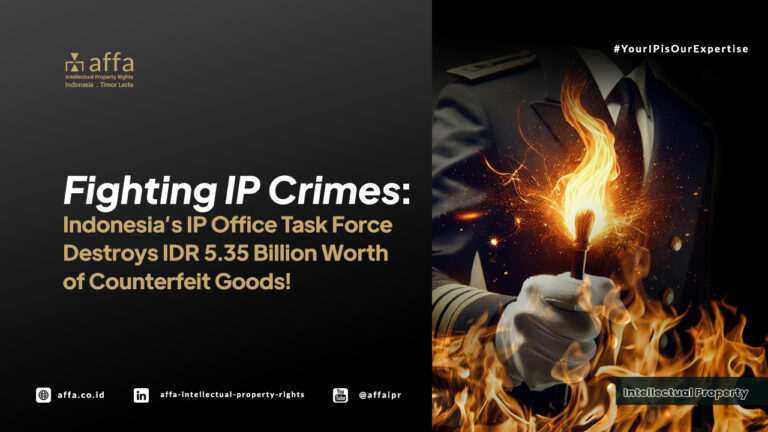
Fighting IP Crimes: Indonesia’s IP Office Task Force Destroys IDR 5.35 Billion Worth of Counterfeit Goods!

The Indonesian Intellectual Property (IP) Task Force, a cross-ministerial special task force of the Republic of Indonesia, consists of the Directorate General of Intellectual Property (DGIP), the Directorate General of Customs and Excise (DGCE), the National Agency of Drug and Food Control (BPOM), the Ministry of Communication and Digital (Komdigi), the Criminal Investigation Department (Bareskrim) of the National Police, and the National Cyber and Crypto Agency (BSSN). On December 12, 2024, the task force symbolically destroyed a number of products associated with violations of 12 Trademarks and Industrial Designs.   During a press conference, the Director General of Intellectual Property, Razilu, stated: “This destruction serves as a strong message from the DGIP that there is no room for Intellectual Property violations in Indonesia.”   At least three key messages were conveyed through the destruction of these products: Deterrence: To provide a deterrent effect on offenders, ensuring they refrain from committing further violations. Both civil and criminal legal actions can be enforced against them. Creator and Owner Protection: To assure creators and IP owners that their works are protected, fostering an environment where they can continue innovating. Public Awareness: To urge the public never to buy counterfeit or fake goods at low prices, as these products can adversely affect health, employment, and the environment.   The destroyed products, valued at IDR 5.35 billion, included the following: LEGO (toys): Worth over IDR 1 billion, from 110 items. Comotomo (baby bottles): Worth over IDR 500 million, from 888 items. Mimi White (hand and body lotion): 216 items. MT NG Shan (drill bits): 2,000 pieces. Louis Vuitton (women’s bags, wallets, and belts): 10 items. Christian Louboutin (women’s shoes): 2 pairs. Tokai (lighters): 5 boxes. Orion Choco Pie (snack/biscuits): 50 boxes. Honda (spare parts): 30 boxes. Honda (generators): 30 units. Harley Davidson (apparel accessories, umbrellas, and wallets): 600 items. Food Packaging (Industrial Design): 30 boxes.   It is important to note that the products classified as IP violations are not limited to counterfeit goods but also include goods illegally entering the Indonesian market. Under the law, smuggled goods that bypass official channels, fail to adhere to applicable import procedures, and are subject to objections by the official license holders of the relevant trademarks are subject to enforcement actions.   Given the complex and extensive scope of IP  violations, cross-sector enforcement is required. The specific roles of the involved institutions are as follows: DGIP: Monitoring, supervision, preventive measures, mitigation strategies, and enforcement of IP laws. DGCE: Addressing the importation of goods suspected of infringing IP rights. BPOM: Managing the distribution of food and pharmaceutical products that are suspected of infringing IP rights and endangering public health and the environment. Komdigi: Handling complaints and requests for blocking websites related to goods and/or services deemed to violate IP rights. Bareskrim Polri: Coordinating communication and collaboration for law enforcement from the central office to its units across Indonesia. BSSN: Monitoring IP violations in cyberspace and assisting in handling IP infringements that occur in the digital realm.   You might also want to read: Unraveling the Global Complexity of IP Crime: Money Laundering and More!   Each year, the average number of reports on IP violations is around 50 cases, with the majority involving Trademark, Industrial Design, and Copyright infringements. The active role of Komdigi has also significantly contributed to blocking 414 websites infringing Copyrights based on 16 requests. However, considering that the IDR 5 billion in damages mentioned earlier came from only 12 cases, this can be seen as just the beginning or the tip of the iceberg in the enforcement of IP laws in Indonesia.   Therefore, the participation of the five key components of the nation—Government, Academics, Private Sector, Society, and Media—is expected to continue supporting efforts to create a better Intellectual Property climate in Indonesia.   With increasing public awareness of the importance of Intellectual Property, there will also be positive impacts on the national economy and Indonesia’s investment climate in the global arena.   Should you need more information regarding Trademark protection and other Intellectual Property matters in Indonesia and abroad, feel free to contact us via email at [email protected].

FAQs: The Legal Framework of Trademark Protection in Indonesia - AFFA IPR

Frequently Asked Questions about the Legal Framework of Trademark Protection in Indonesia

Prevailing Laws and Regulations Q: What is the primary legislation governing Trademarks in Indonesia?   A: Law No. 20 2016 on Marks and Geographical Indications (the Trademark Law) is the primary law concerning Trademark in Indonesia. Several provisions in the Trademark Law were then amended under the Law No. 11 Yeat 2020 in Job Creation, and then further amended under the Law No. 6 Year 2023 on the Enactment of a Replacement Government Regulation in Lieu of the Law No. 2 Year 2022 on Job Creation as Law.   Moreover, there are several by-laws that regulate more specific matters, such as, but not limited to:   Government Regulation No. 28 2019 concerning Types and Tariffs of Non-Tax State Revenues Applicable to the Ministry of Law and Human Rights. This regulation sets the official fees for various actions that can be filed before the Directorate General of Intellectual Property (DGIP) under the Ministry of Law and Human Rights of the Republic of Indonesia. Government Regulation No. 22 2018 concerning International Registration of Marks Under the Protocols Relevant to the Madrid Agreement Concerning the International Registration of Marks. This regulation covers all aspects of international registrations filed to or from Indonesia. Government Regulation No. 90 2019 concerning The Trademark Appeal Commission, which was established on 29 August 1995 concerning Procedures for Application, Examination and Settlement of Appeals at the Mark Appeal Commission. The Ministry of Law and Human Rights of the Republic of Indonesia Regulation No. 12 2021 concerning Amendments to the Ministry of Law and Human Rights of the Republic of Indonesia Regulation No. 67 of 2016 concerning Trademark Registration Decree of the Director General of Intellectual Property in the Field of Trademarks. The ministerial regulation prescribes, among others, the requirements of registration, classes of goods and services, rectification of issued certificates and recordals.   International Law Q: Which international Trademark agreements has Indonesia signed?   A: Indonesia has ratified various agreements concerning Trademarks, such as the Protocol Relating to the Madrid Agreement Concerning the International Registration of Marks, the Trademark Law Treaty and the Paris Convention.   Regulators Q: Which government bodies regulate the Trademark Law?   A: The Directorate General of Intellectual Property (DGIP) under the Ministry of Law and Human Rights of the Republic of Indonesia is the relevant body that administrates the protection of all Intellectual Properties, including Trademarks. The DGIP goes beyond regulating and implementing the law, it is also responsible for proactively disseminating the information pertaining to the importance of IP protection through various means, such as podcasts, YouTube videos, Instagram posts and seminars conducted around Indonesia. Should you need more information regarding Legal Framework of Trademark in Indonesia, please do not hesitate to contact us via [email protected].

FAQs: Patent Office Proceedings in Indonesia - AFFA IPR

Frequently Asked Questions about Patent Office Proceedings in Indonesia

Patenting Timetable and Costs Q: How long does it typically take, and how much does it typically cost, to obtain a Patent?   A: The process of registering a patent in Indonesia involves several steps, including jling a Patent application, publication, examination and grant. The general process is as follows:   Filing a Patent Application: A Patent Application must be filed with the Indonesian Intellectual Property Office (DGIP). For PCT applications, the deadline will be 31 months from the earliest priority date. Late filing is possible with additional official fees.   Publication: The publication period in Indonesia lasts for six months. After the publication stage has been passed, the application will proceed to examination (as long as the applicant has filed for the substantive examination request).   Examination: After filing, the Patent Office will examine the Patent Application to determine if it meets the requirements for grant. This process may involve a review of the prior art and an examination of the novelty, inventiveness and industrial applicability of the invention.   Amendment: If the Patent Office finds that the Patent Application does not meet the requirements for grant, the applicant may be given an opportunity to respond to objections raised and amend the application to address any deficiencies. This can be in the form of an office action.   Grant: If the Patent Office determines that the Patent Application meets the requirements for grant, a Patent will be granted and the applicant will be issued a notice of allowance or grant and then will be followed with the issuance of a Patent Certificate, but very often the certificate is not issued for months or even years.   Maintenance: Once a patent has been granted, the applicant must take steps to maintain the Patent, including paying maintenance fees and renewing the patent as required. The first annuity payment must be paid within six months of the notice of allowance or grant.   On average, it takes approximately three to five years from filing to registration. We cannot comment on the costs given the variable conditions that affect it.   Expedited Patent Prosecution Q: Are there any procedures to expedite Patent Prosecution?   A: The DGIP, under the Ministry of Law and Human Rights of the Republic of Indonesia, has established various procedures under which the examination of a Patent Application may be accelerated. Under these procedures, the DGIP will advance an application out of turn for faster examination if the applicant files the following special requests through the ASEAN Patent Examination Co-operation (ASPEC) programme, the Indonesia – Japan Patent Prosecution Highway (PPH) programme, Indonesia – South Korea PPJ programme, or simply by providing the examiner in charge the granted corresponding claims from other patent offices (eg, the US Patent and Trademark Office (USPTO), Japan Patent Office (JPO), European Patent Office (EPO) and others).   ASPEC   ASPEC is a regional Patent work-sharing programme that involves nine ASEAN member states. The programme allows each participating Patent Office to share search and examination results to help applicants obtain corresponding Patents faster and more efficiently. The goal of ASPEC is to reduce duplication of search and examination work and produce high-quality examination reports. By obtaining examination results from other countries in the participating Patent Offices, applicants can accelerate the examination process, as long as the corresponding claims are the same.   When requesting ASPEC, the Patent Applicant is required to submit an ASPEC request form to the second Patent Office. The form must be accompanied by the following documents: a copy of the search and examination (S&E) report or the examination report (minimum documents) of a corresponding application from the first IP Office, and a copy of the claims referred to in the minimum documents submitted, with at least one claim determined by the first IP office to be allowable or patentable.   For a Patent Cooperation Treaty (PCT) ASPEC request, the Patent Applicant is required to indicate that the request is for PCT ASPEC in the ASPEC form. The completed ASPEC request form shall be submitted together with the following documents:   a copy of the written opinion international preliminary examination report (WO/ISA, WO/IPEA or IPER) established by an ASEAN International Searching Authority or International Preliminary Examining Authority (ASEAN ISA/IPEA) (‘minimum documents’) relating to a corresponding application from the first IP Office, and a copy of the claims referred to in the minimum documents submitted, with at least one claim determined by the jrst IP office to be allowable or patentable.   The request to utilise ASPEC can only be done after the application has finished the publication stage. Based on our experience, the time it takes from filing the ASPEC request until the issuance of the decision to grant will not be more than 12 months – a great improvement in lead or pendency times compared to the processing time for non-ASPEC (or PPH) Patent Applications in Indonesia.   Indonesia – Japan Patent Prosecution Highway (Indonesia-Japan PPH)   The Japan Patent Office (JPO) and the DGIP initiated a Patent Prosecution Highway Program (PPH) on 1 June 2013, and since then, the PPH has been chosen by many applicants who have previously filed their base applications in Japan as the method of accelerating the Patent Applications in Indonesia. The PPH request can be filed at any time as long as it is before the deadline to request the substantive examination stage. There will be an official fee of 5 million rupiahs incurred for requesting the PPH acceleration programme.   When it comes to the requirements, the DGIP will require the applicant to provide the following documents to start an accelerated examination process: all formality documents required to file the application have been submitted and the notice of formality documents completion issued by the DGIP; proof of payment to file a substantive examination request; the application should have passed the publication period of six months; completed PPH form; corresponding claims that should be equivalent or less compared to the claims granted by the…

AFFA Represents Inner Mongolia Kunming Cigarette Limited Liability Company for a Successful Bad-Faith Trademark Invalidation in Indonesia - AFFA IPR

AFFA Represents Inner Mongolia Kunming Cigarette Limited Liability Company for a Successful Bad-Faith Trademark Invalidation in Indonesia

On April 25 2024, the Panel of Judges at the Central Jakarta District Court issued a favourable decision for Inner Mongolia Kunming Cigarette Limited Liability Company to invalidate the “DONGCHONGXIACAO” Trademark under registration number IDM000791780 which had been registered in bad faith since May 2018 in Indonesia.   “DONGCHONGXIACAO” is a Trademark that has been registered and made famous by Inner Mongolia Kunming Cigarette Limited Liability Company (hereinafter referred to as the “company”) in China since 2017, as well as in several other countries including Pakistan, Brazil, Saudi Arabia, Qatar, and the United Kingdom. In 2021, the company decided to apply for Trademark registration with application number DID2021069519 in Indonesia. However, the application was rejected by Trademark Office (DGIP) in 2022 on the grounds that there were substantial similarities with the prior Trademark “DONGCHONGXIACAO” which was registered with number IDM000791780 in the same class, namely class 34.   In response to this rejection, Inner Mongolia Kunming Cigarette Limited Liability Company, which appointed AFFA Intellectual Property Rights, decided to file an act for invalidation of this Trademark. This is done considering that the company believed that the prior Mark “DONGCHONGXIACAO” with registration number IDM000791780 was applied for and registered by a party who did not have the rights to the Trademark nor any legitimate reason to own it, considering that the company has earlier registrations of the same Trademark in other countries which were  submitted before the date of the Trademark application of the prior Mark.   Apart from being registered and marketed in various countries around the world, the arguments in this action were based on the following 4 (four) points::   Similarities in visual elements   Notes Plaintiff’s Trademark Defendant’s Trademark Similarities in Words DONG CHONG XIA CAO DONGCHONGXIACAO Similarities in Writing Dong Chong Xia Cao DONGCHONGXIACAO Similarities in Word Order D-o-n-g-C-h-o-n-g-X-i-a-C-a-o D-O-N-G-C-H-O-N-G-X-I-A-C-A-O Conclusion The Defendant’s Trademark can create an impression that confuses the public, so the Trademark market can think that the Trademark is the Client’s Mark.   Similarities in pronunciation   Notes Plaintiff’s Trademark Defendant’s Trademark Similarities in essence in Trademark Pronunciation dong-chong-xia-cao dong-chong-xia-cao   Similarities in the goods covered in Class 34 They have similarities and close relationships, starting from the function, intended use, and origin of the goods, as well as similarities in marketing channels/target markets, so it is feared that they have the potential to confuse consumers.   Plaintiff’s Trademark Defendant’s Trademark DONGCHONGXIACAO Application Number DID2023116953 – Class 34 Registered Number IDM000791780 – Class 34 Type of Goods: “Tobacco powder; shredded tobacco; cigar; small cigars; cigarette; electronic cigarettes; cigarettes containing tobacco substitutes, not for medical purposes; tobacco; chewing tobacco; tobacco to snort.” Type of Goods: “Tobacco and processed tobacco products, including smoking tobacco, tobacco pipes, cigars and cigarettes, smokers’ goods, including smoking pipes and lighters, electronic cigarettes, non-metal cigarette ash containers, cigarette boxes, gas cylinders for cigar lighters, cigarillos (small cigars), tobacco for self-rolling cigarettes, chewing tobacco, snuff tobacco, kretek, betel tobacco, heated tobacco products, devices electronics and parts thereof for heating cigarettes or tobacco to release nicotine-containing aerosols for inhalation, liquid nicotine solutions for use in electronic cigarettes, cigarette paper, cigarette tubes, cigarette filters, tobacco containers, pouch equipment for rolling cigarettes.”   The trademark invalidation action that was officially filed was registered on December 18, 2024, at the Registrar’s Office of the Commercial Court at the Central Jakarta District Court, with the Trademark Office/Directorate General of Intellectual Property (DGIP) was also included as a co-defendant. Through a series of hearings,, the Panel of Judges at the Commercial Court at the Central Jakarta District Court finally issued a favourable decision for the plaintiff. The decision was based on the following considerations:   “The owner of an unregistered Trademark can file an action as intended in paragraph (1) after submitting an Application to the Minister,” as regulated in Article 76 paragraph (2) of Law Number 20 of 2016 concerning Marks and Geographical Indications (Trademark Law) and the Plaintiff has done this prior to the submission of the suit to the Court of Commerce. The Trademark Invalidation Action has been appropriately and properly filed through the Commercial Court at the Central Jakarta District Court, as regulated in Article 85 paragraph (2) of the Trademark Law; The Panel of Judges has carefully examined that the Defendant’s Trademark is substantially similar to the Client’s Trademark, which was previously registered in China on 28 August 2017. Both the sound of the speech, the arrangement of the letters, and the words used in the word DONGCHONGXIACAO Trademarks, according to the panel of judges, have very close similarities, so it is appropriate that the type of goods owned by the Plaintiff’s mark and the Defendant’s mark can be considered as a Trademark which is substantially similar in the type of goods applied for and also registered; Defendant should not use and/or apply for registration of a Trademark which is similar in essence to Plaintiff’s Trademark because there are many other words or arrangements of words that the Defendant can create and use as a Trademark without having to imitate and/or plagiarize the Plaintiff’s Trademark; The application for registration of the Trademark submitted by the Defendant is not an application that can be registered as intended in Article 21 paragraph 3 of the Trademark Law, or other words, the application for registration of the DONGCHONGXIACAO Trademark should be rejected by the Co-Defendant (DGIP) because the Trademark registered by the Defendant is the result of imitation and/or plagiarism of the Plaintiff’s Trademark which already existed and was previously registered in China; Defendant never appeared at the trial, even though they had been summoned legally and properly; this also proves that the Defendant did not refute the Plaintiff’s arguments, which were that the registered Trademark was substantially similar to the Plaintiff’s mark, which had previously existed and was registered earlier in China, and that the Defendant registered the Trademark in bad faith.   You might also want to read: A Win for the “WIN” – AFFA Represents Hongyunhonghe Tobacco (Group) Co. Ltd. for…

Indonesias-IP-Odyssey-Unraveling-the-Ins-and-Outs-of-IP-License-Agreement-Recordal-affa-global

Indonesia’s IP Odyssey: Unraveling the Ins and Outs of IP License Agreement Recordal

In Indonesia, it is a legal obligation to record all intellectual property (IP) license agreements under laws relating to trademarks, patents, designs, and copyrights to ensure they are legally enforceable and binding to all relevant third parties. By law, any IP license agreements that are not recorded will not have any legal effect against all relevant third parties. Nevertheless, the agreements will still only be binding between the contracting parties. In recent times, there have been increasing demands by IP owners to record IP license agreements, because such recorded license agreements are often requested by SNI (the Indonesian National Standardisation Body) and BPOM (Indonesian Food and Drugs Administration) to issue certain yet separate licenses.   The Directorate General of Intellectual Property (DGIP) under the Ministry of Law and Human Rights (MOLHR) is in charge of receiving the recordal applications for the license agreements. The DGIP is empowered by Government Regulation No. 36 Year 2018 on the Recordation of Intellectual Property License Agreement (Government Regulation No. 36/2018) to carry on this function. While the practice of recording IP licensing agreements has actually been done for many years before the enactment of Government Regulation No. 36/2018, we noted that the DGIP only started issuing the notifications of the recordal of license agreements after 2018 for the recordals that were filed many years before that. Until then, many who had recorded them simply held on to the “recordal filing receipts” as an evidence of recordal.   In general, Government Regulation 36/2018 regulates various requirements and procedures for recording intellectual property license agreements and specifies the following matters: License agreements Recordation procedures Recordation excerpts Changes and revocations   As a general rule of thumb, the IP holder (“Licensor”) is authorized to grant a license to another party (“Licensee”) who wishes to use the Licensor’s exclusive rights. Such a license can only be granted based on an agreement made in writing in Indonesian – hence the agreements signed in English or other languages must be sworn translated into Bahasa Indonesia. In addition, the license agreement must stipulate the following points: Place & Date of the letter signing Details of the parties including the address Object of trademark license (trademark/patent/copyright/industrial design registration number) Terms of use (exclusive, non-exclusive, sub-licensable, or not) Duration of the agreement Territory For patents, the agreement shall stipulate the party tasked with the responsibility of paying the annuity.   However, be mindful that the term of the agreement shall not be longer than the protection period of the licensed IP. The license agreement must not entertain any stipulations that might inflict harm upon Indonesia’s economic vitality or the nation’s strategic interests. Moreover, it must not cultivate an environment for unjust business competition, nor should it stand in contradiction to the existing legislative framework in Indonesia. It is equally critical that such an agreement does not breach the bounds of religious adherence, ethical conduct, or public order.   Recordation Procedure A submission of a Recordation Request must be formally made to the Minister written in the Indonesian language, accompanied by the following documents: A copy of the license agreement which has been notarized by a Notary Public in the relevant country where the parties reside; Official excerpts from the intellectual property certificate; A power of attorney letter (if applied for by proxy). It is noteworthy that the use of a proxy is mandatory if the Licensor and Licensee are foreigners or reside outside Indonesia;  Copy of the identity card/passports of the signatories; Deed of Incorporation of the parties bound to the agreement; and Proof of payment of the official fees, which will be paid by the proxy.   According to Government Regulation No. 36/2018, the submitted request will be reviewed within five business days following the receipt of a fully completed application. The applicant will be informed if the application is incomplete, and they will be given a period of 30 business days from the date of notification to perfect it. However, thanks to DGIP’s innovation – POP Merek (POP Trademark), most of the IP license agreement recordal notifications are issued within a day.    Amendment and Revocation A recorded IP license agreement can be amended and revoked. When it comes to amendments, they are limited to the name of the Licensor and/or Licensee or the subject of the license agreement, and other information (such as the address of the related parties, provisions related to the exclusivity of the license, and so forth).    A recorded IP license agreement can only be revoked under the following conditions: The agreement between the Licensor and the Licensee; The resolution of a court proceeding; or Additional elements, in accordance with Ministerial Regulation No. 8 of the year 2016 on the Procedure for Registering Conditions and Methods for the Application of Recording Intellectual Property Licensing Agreements.   Should you require further information and assistance regarding IP license agreement recordal in Indonesia, please contact us at [email protected]; [email protected]; or [email protected].