Racing-Ahead-A-Comprehensive-Guide-to-IP-in-MotoGP-affa-global

Racing Ahead: A Comprehensive Guide to IP in MotoGP

Racing Ahead: A Comprehensive Guide to IP in MotoGP   The 2023 Mandalika MotoGP in Indonesia on October 15 again brought Ducati racer Francesco Bagnaia to the top of the standings with 346 points. The event, officially called “Pertamina Grand Prix of Indonesia 2023”, is the 15th race of the 20 MotoGP World Championship series, which is in a year generating a turnover of around 500 million Euros or about 8.3 trillion Rupiah.   Dorna Sports S.L., a company from Spain that has held MotoGP Commercial Rights from the Fédération Internationale de Motocyclisme (FIM) since 1992. In Dorna’s hands, the fastest motorbike racing event on land has become the most expensive in the world with its Intellectual Property business. In 2021, Dorna Sports successfully recorded 137 million Euros just from selling Broadcast Rights to various TV and streaming platforms to broadcast each competition live. Income from Broadcasting Rights is said to reach 66% of the total income from all Intellectual Property (IP) businesses carried out. So, what other IPs are related to the implementation of MotoGP?   Trademark The first is, of course, MotoGP’s unique naming and logo. Dorna has registered MotoGP in 22 existing Trademark classes, whose protection extends to 53 countries worldwide. Of the 22 Trademark classes, it includes class 25 (clothing, shoes, hats), 28 (toys), and 30 (tea & coffee), apart from, of course, class 41 (sports activities), which is the core of its business. In Indonesia, the “MotoGP” Trademark is still protected until 2027 and can be extended every ten years.   Apart from that, Dorna also registered Trademarks for various derivative businesses related to MotoGP, such as MotoGP Kids, MotoGP VIP Village, and MotoGP Legends. By registering all the Trademarks, Dorna has become the owner of the Exclusive Rights to MotoGP and prevents the possibility of other parties registering identical or similar names in the future.   Copyright Race materials, images, promotions, and other content related to MotoGP are included in the Copyright category. As the holder of Commercial Rights to MotoGP, Dorna also owns the Copyright to MotoGP. Thus, it has the right to regulate and control the use of all Copyrights related to MotoGP, including Broadcast Rights, to broadcast the race live on various platforms worldwide. The granting of Broadcasting Rights licenses is the most significant income for Dorna. It has been recorded that from 2015 to 2021, except for 2020, there has always been an increase in revenue from Broadcasting Rights. It started from 105, 115, 125, 135, 130, and 137 million Euros (around 2.3 trillion Rupiah) in 2021. For the 2023 MotoGP World Championship, there are more than 90 channels that are official broadcasters, representing 63 countries in the world. In Indonesia, MotoGP broadcast rights are held by Trans7, MNC Vision, KVision, UseeTV, and Maxstream-SpoTV.   Patent A large-scale sports competition, especially one related to the automotive industry, indeed cannot be separated from technological inventions, whether closely related to engine construction and speed or safety equipment, which are objects that can be patented. MotoGP has also become a place for innovation competition between motorbike manufacturers and safety equipment to get maximum exposure before the technology is applied to commercial products sold to the public.   Industrial Design Suppose the design of a motorbike, riding equipment, safety equipment, and other racing equipment does not contain elements of inventions but still has an aesthetic novelty design. In that case, it can be registered and receive Industrial Design protection. The most straightforward example is the commercialization of helmets used by MotoGP racers.   Trade Secret Specific racing strategies are Trade Secrets, including technical details and other confidential information. These secrets give MotoGP teams a competitive advantage by not disclosing certain important information to competitors, and all team members involved are bound by a Non-Disclosure Agreement (NDA).   Domain Name Domain names related to MotoGP are significant for maintaining online presence and marketing. Dorna has registered “motogp.com” to prevent cybersquatting and brand misuse. This domain is also available in many languages, including Indonesian, to facilitate the marketing and disseminating of official information to all media and MotoGP fans worldwide.   Licensing Agreement Apart from the Copyright previously mentioned, the License Agreement can also cover other Intellectual Property regimes, such as Brand Licenses to produce and sell merchandise, mobile phone applications, video games, and many more. Because if we talk about business, a robust Intellectual Property License Agreement can mutually benefit all parties involved.   From Dorna Sports’ financial report in 2021, more than 100 million Euros were spent on organizing MotoGP. However, they managed to record a profit of 46 million from revenue of 207 million Euros. This figure is undoubtedly quite fantastic for sporting activities supported by solid IPs.   Because a successful sports business is also an Intellectual Property business, would you be serious about getting into it? In that case, you can start on the most miniature scale, from events that are local but have the potential for a broad audience, and continue to present exciting and competitive matches so that more and more parties are interested in joining in getting a license.   If you need further information about Licensing Agreements, Trademark registration, Patent protection, or anything related to Intellectual Property, please do not hesitate to contact us via [email protected].

The-Coffee-Business-and-Intellectual-Property-A-Perfect-Blend-affa-global

The Coffee Business and Intellectual Property: A Perfect Blend

The Coffee Business and Intellectual Property: A Perfect Blend The world of coffee is a flavorful fusion of tradition and innovation. From unique blends to cutting-edge brewing methods, the coffee industry is rich with Intellectual Property opportunities. In this article, we’ll explore the various aspects of Intellectual Property, from Trademarks to Patents, Copyrights, and more, and how they’re intertwined with the coffee business. Whether you’re a coffee connoisseur or a seasoned roaster, here’s a breakdown of the fundamental Intellectual Properties related to the coffee industry:   Trademarks Coffee Brand Names Trademarks protect the unique names and logos of coffee brands. Think of iconic brands like “Starbucks” or “Kapal Api.” Coffee Shop Names Trademarks also apply to coffee shop names, creating brand recognition for businesses like “The Coffee Bean & Tea Leaf” or “Kenangan Coffee.”   Patents Coffee Brewing Technology Patents protect innovative coffee brewing methods and machines—for instance, the invention of the espresso machine in 1884 by an Italian inventor, Angelo Moriondo. Coffee Roasting Equipment Patents can cover advancements in coffee roasting technology, ensuring that unique processes are protected.   Copyrights Coffee Art and Labels Coffee packaging often includes artistic designs and labels. Copyrights safeguard these creative elements. Coffee Literature Copyrights can apply to books, articles, or marketing materials related to coffee, including coffee history, brewing guides, and more.   Trade Secrets Coffee Blends Coffee companies may have closely guarded trade secrets related to their unique coffee blends and recipes. Roasting Profiles The specific roasting profiles for different coffee beans can also be considered Trade Secrets.   Geographical Indications Origin-Based Labels Some coffee regions, like Arabica Gayo coffee or Jamaican Blue Mountain coffee, are known for their distinct flavors. Geographical Indications protect these regional characteristics.   Industrial Designs Coffee Machine Aesthetics The design of coffee machines, from espresso makers to grinders, can be protected by Industrial Design rights. Unique Packaging The distinctive packaging of coffee products, making them easily recognizable on store shelves, can also be registered as Industrial Design.   Plant Variety Protection Unique Coffee Varieties: Specific coffee plant varieties may sometimes be protected to ensure that only authorized growers can cultivate them. For example, Gayo Arabica coffee has several varieties registered as Plant Variety Protection in Indonesia.   Licensing & Franchising Agreements Distribution Rights To distribute a specific brand of coffee, you must obtain official approval from the owner, stating several details, such as distribution scope, licensing validity period, and how much royalties can be given. Franchising Coffee businesses with networked shops usually have a franchise agreement, where the franchisee has obtained permission from the franchisor with a registered Trademark to open a coffee shop based on a predetermined business model.   From a coffee business, there are many additional opportunities to increase income from various existing Intellectual Property, and it would be a shame if they were not maximized. If you need further information about Trademark registration, Patent protection, or anything related to Intellectual Property, please do not hesitate to contact us via [email protected].

COSPLAY-and-Intellectual-Property-Navigating-the-Legal-Landscape-affa-global

COSPLAY and Intellectual Property: Navigating the Legal Landscape

COSPLAY and Intellectual Property: Navigating the Legal Landscape Cosplay has become popular again as a form of pop culture activity since the COVID-19 pandemic restrictions ended. Malls in all corners compete to host various events featuring Cosplayers to increase visitors. But not many people know that Cosplay is an activity on the “edge of the cliff” when viewed from an Intellectual Property (IP) perspective. How come?   Definition of Cosplay Taken from the words “Costume & Play,” Cosplay is the activity of playing using character costumes, whether from films, TV series, video games, comics, or characters from other popular culture. People who carry out Cosplay activities are called Cosplayers. We can easily find them at pop culture-based events, such as “Comic Conventions,” dominated by IP from America, or “Anime Conventions,” dominated by IP from Japan.   Cosplayers proudly wore their favorite character costumes at these events, socialized with fellow fans, or participated in competitions. Yes, Cosplay is also regularly contested with quite big prizes. This is one of the factors why the number of Cosplayers continues to increase. Because Cosplay has become a place to earn money, increase popularity, and expand friendships. The rise of Cosplay activities has also given rise to various derivative professions. Starting from Costume Makers with their respective specifications, whether for costumes made from cloth, foam, resin, or leather. Then, the Prop Makers make costume-supporting equipment such as armor, swords, or other weapons. Also, trained Performers with acrobatic or martial arts skills are specifically hired to play certain characters. Then we have Cosplay Judges who are staffed by “seniors” with high-flying hours and have won many competitions at home and abroad. Unfortunately, all of these professions receive payment for using characters without the permission of the creator or owner of the character. This factor causes Cosplay to become an activity on the edge of Intellectual Property violations.   Every Popular Character is Copyrighted Every character, realized in various media, whether considered popular or only known to a few people, is included in the “Creation.” According to Article 1 of the Copyright Law, this Creation is a creative work in science, art, and literature produced based on inspiration, ability, thought, imagination, talent, skill, or expertise expressed in concrete form.   The Creator is given exclusive Economic Rights, so only the Creator has the right to obtain financial benefits, including commercial use of his Creation. It is also important to remember that the Exclusive Right to Copyright arises automatically based on the Declarative Principle after a work is realized in actual form, without the need to go through a registration process as with Trademarks, Patents, or other Intellectual Property.   In other words, if another party wants to use or utilize a Creation commercially, they must first obtain permission from the Creator, as regulated in Article 9, Paragraphs 2 and 3 of the Copyright Law.   Sanctions for Violations Unfortunately, the various professions derived from the Cosplay activities above can specifically be categorized as forms of Copyright Infringement. For Costume and Prop Makers violating Article 9 Paragraph 1 letters (b) and (d) regarding the Duplication of Works in all their forms, as well as Adaptation and Transformation of Works; Meanwhile, Event Organizers who invite costumed Performers or Cosplay Judges may be deemed to have violated Article 9 Paragraph 1 letter (f) regarding Creation Performances. Criminal sanctions regulated in Article 113 of the Copyright Law as follows: Costume & Prop Maker: Prison max. 4 years and/or fine max. one billion rupiah. Cosplay Event Organization: Prison max. 3 years and/or fine max. 500 million rupiah.   The sanctions given to costume makers could be more severe if they deliberately sell themselves as sellers of costumes made from characters with registered Trademarks and/or parts of their costumes take designs from products with registered Industrial Designs. So he could be subject to sanctions from the Trademark and Industrial Design Law simultaneously!   Copyright Restrictions But fellow Cosplayers or all related derivative workers don’t need to worry because there are restrictions or exceptions for actions that are still not considered Copyright Violations. Namely, if the duplication and/or performance is free of charge, provided that it does not harm the reasonable interests of the Creator.   In other words, if the Cosplay activity is designed as a paid show where the audience must buy tickets, or Brand X pays a Cosplayer complete with the costume to promote a product from Brand X, then it is inevitable that there has been a Copyright Violation.   However, because the criminal provisions on Intellectual Property are a complaint offense, there must be a direct objection from the Creator to all activities carried out by the Cosplayer and any derivative work thereof. What can happen is, even in a free Cosplay show or free costume making, if the Creator finds out, objects, and does not give permission for whatever reason, a lawsuit can still be filed.   Cosplay Practice in the USA and Japan Even though it is considered a fun activity without limits and upholding freedom of expression, Cosplay still has to comply with several pretty strict rules. For example, if done privately, Cosplayers must abide by the norms of decency; neither their costumes nor their behavior must disturb public order. In this personal activity, Japan has stricter rules than America. In Japan, it is impossible to find people busking in character costumes in the middle of the street. Apart from disturbing public order, it could be considered to damage the image of the character he presents.   Street Performers In America, Cosplayers are categorized as Street Performers. They are free to express themselves even if there is no event, but the area is minimal if they take to the streets or public spaces for activities. A famous example of this restriction is the streets painted Light Blue around New York’s Times Square. If they act outside that area, they can be immediately arrested by the police. Indonesia also has regional regulations that prohibit busking or…

Media-Missteps-5-Intellectual-Property-Blunders-to-Avoid-affa-global

Media Missteps: 5 Intellectual Property Blunders to Avoid

Media Missteps: 5 Intellectual Property Blunders to Avoid The government’s efforts to remove Indonesia from the US investment blocklist published by the United States Trade Representative (USTR) through the 2023 Priority Watch List (PWL) are heavy. Apart from improving regulations and law enforcement efforts, education regarding the importance of Intellectual Property must continue to be carried out on a massive scale.   Unfortunately, the big media, which should take that role, often become part of the piracy. Finally, the media is the party that must be educated earlier so that this education can resonate more with society.   The following are five major media sins that we often encounter in their reporting: 1.    Using the Word “Patent” for Every Intellectual Property Regime Because the Indonesian Dictionary (KBBI) still describes Patent as “a right given by the government to someone for an invention for their use and to protect it from imitation (piracy),” this word is still often used as a substitute for Intellectual Property. Patents are only one of the various types of intellectual property; that means the description from the KBBI is different from what is stated in Law No. 14 of 2001 concerning Patents. This misconception has resulted in the narrative of “patenting a trademark” or “patenting various food recipes,” which we commonly hear in large or small media coverage. Previously, we published a short article regarding the differences between Patents and other Intellectual Property here: Patented Trademark? Registering Copyright? What Are The Correct Terms?   2.    Reporting Piracy, but Showing the Source Several media already have good intentions in warning the public not to access materials such as films or music that we should only be able to enjoy in cinemas or official streaming channels through illegal sites. However, in its reporting, the media displayed a screenshot containing the address of the illicit site. This is a blunder because it lures more of the public into accessing it. Such coverage can also be considered as dissemination of illegal material and can be subject to criminal sanctions as regulated in Article 113 of the Copyright Law. Therefore, keep good intentions from ending up causing problems.   3.    Unauthorized Use of Material Dozens of years ago, when YouTube became increasingly popular and became a source of information with attractive visuals, TV media competed to use it as material for new programs, which they thought were unique for their loyal viewers: People live in remote areas and still have difficulty accessing the internet. The media’s opinion then was, “Everything on the internet means the public can access it so that it can be used commercially for free.” This contradicts Article 8 of the Copyright Law, which states that only the creator or, in this case, the creator/ photographer/ original video maker has the right to Economic Rights over his creation. In other words, if the media wants to make a TV program based on these works, let alone get advertising from their broadcast, they must obtain permission from the creator. Even platforms like YouTube are subject to Copyright Laws. The Terms of Service state that any violations can be followed up with applicable legal processes. Assuming that each work can still be used freely under “fair use” will not apply if the creator objects. Currently, although the media is more aware of copyright issues by including the address of the original material, this is only a justification for publishing it with permission. So, to avoid lawsuits in the future, please make sure to first ask permission from the owner of the material you want to use as coverage/program material.   4.    Overclaim on YouTube When mainstream media began to use YouTube as an additional source of income, they also uploaded all their programs and coverage on that streaming channel so that viewers could watch the material anytime, anywhere. Based on legality and high viewership, YouTube also indirectly gives confidence that every material uploaded by them is considered to have “strong copyright protections.” This becomes dangerous when the media uploads material that does not belong to them. For example, when making a report or interviewing a content creator. To make the visuals attractive, the media will display a few minutes of video insert made by the creator. The creator had long published the video on YouTube. Still, after the media uploaded its coverage program containing part of the video, the creator’s video was deemed to have violated copyright. This has happened several times and has gone viral on social media. Luckily, cases like this do not result in criminal charges because they can be resolved by turning off copyright protection on videos uploaded by the media.   5.    Glorification of Intellectual Property Violations This last sin can be said to be the one we encounter most often, which indirectly maintains violation activities to continue to occur in Indonesia. In the name of “Good News,” media reports often feature success stories from Small and Medium Enterprises (SMEs) in rural areas. However, the problem is the business activities carried out by these SMEs violate Intellectual Property. For example, making handicraft products, fabrics, or clothing that utilize popular characters from abroad without permission. The media proudly described their huge income as an “inspirational success story.” For those of us who understand this condition, it will undoubtedly be uncomfortable because the media reporters who cover these activities should be able to spearhead efforts to educate the public regarding Intellectual Property awareness. Please don’t use other people’s protected characters again when their production numbers are already high. It’s time to produce original characters, which are not impossible to provide added value for SMEs. By ignoring it, the media endangers these SMEs by positioning them as open shooting targets for the actual IP owners. With the news of the enormous income generated, the original owner will file a lawsuit at the highest level, and whose fault is that?   That’s all the five significant media sins we see frequently today. Hopefully,…

Indonesian-Discord-Users-Could-Face-1-Billion-Rupiah-Fine-for-Streaming-Anime-Illegally-affa

Indonesian Discord Users Could Face 1 Billion Rupiah Fine for Streaming Anime Illegally

“Every person who unlawfully and/or without permission of the Author or Copyright holder distributes Works or their copies for Commercial Use shall be sentenced to imprisonment for up to 4 years and/or fine up to Rp 1,000,000,000.00!”   As connoisseurs of the entertainment industry, whether in music, feature films, or animated series, we certainly understand that all forms of entertainment are works protected by Copyright.   Article 3 of Law No. 28 of 2014 concerning Copyright states that Works mean any scientific, artistic, and literary works resulted from inspiration, ability, thought, imagination, dexterity, skill or expertise expressed in a tangible form.   Furthermore, Article 4 of the Indonesian Copyright Law states that Copyright Holder means an Author as the Copyright owner, the party acquiring a lawful right from the Author, or other parties who acquire subsequent rights from the party such acquiring lawful rights.   Suppose other parties wish to use the Work, they must obtain written permission from the Copyright Holder or Related Rights Owner in the form of a License Agreement, which may include details of the distribution of Royalty as compensation for using the Work. In other words, if there is no license agreement moreover and there is an attempt to take advantage of a work without permission, it can be said that there has been a Copyright Infringement.   What is meant by taking advantage of this can be something other than a paid activity. For example, as has recently been done by several influencers who want to take advantage of the hype of anime “One Piece” to increase their followers on the Discord platform. They openly hold a viewing event in their group, also promoted on their social media accounts. Even though it is not paid, the watching together event can be considered Copyright Infringement.   Because watching together activities via unauthorized streaming activities on an authorized platform, if carried out without permission, has violated the exclusive rights of the Author or Copyright Holder to obtain economic benefits for their work. One of them is the distribution of Works or their copies, as stipulated in Article 9 Paragraph (1) letter e of the Copyright Law, with the threat of punishment as stated in the first paragraph of this article.   Apart from illegal distribution activities for unauthorized watching events, the Discord application itself has provided strict rules:   “You may not use Discord to stream, upload, or share any content that infringes on the copyrights or other Intellectual Property rights of others. This includes, but is not limited to, streaming movies, TV shows, music, or other copyrighted content without the permission of the copyright holder.”   The rules regarding Copyright on Discord can be accessed via https://discord.com/terms, and each violator can receive the following sanctions: Having your account suspended or terminated Being sued by the copyright holder for copyright infringement Having to pay damages to the copyright holder   Suppose we specifically discuss the latest One Piece episodes that are currently being talked about. In that case, we can watch them for free and legally in Indonesia via the iQIYI and Bstation/Bilibili platforms, complete with Indonesian subtitles. However, if you want to watch it with a higher image resolution, the Bstation platform provides a Premium (paid) option. Remember, whether it’s free or paid, whatever shows we get on the platform, we have no right to distribute or broadcast them again without permission. As regulated in the following Bstation/Bilibili User Agreement:   “Unless otherwise authorized by Bstation/Bilibili in writing, you shall not (and shall not allow, encourage or facilitate any third party to) modify, copy, adapt, maliciously spread, lease, lend, sell or translate the Services or any part thereof, or create derivative works related to them, and shall not obtain their source code through reverse engineering, decompilation, disassembly or other similar acts..”   Furthermore, suppose it is proven that there has been a violation of the law and user agreement. In that case, Bstation has the right to suspend or stop providing part or all of the services to you unilaterally without notice and would like to ask you to compensate for any losses to the extent permitted by law.   Thus, it can be concluded that the activity of watching together (via illegal, unauthorized streaming) on legal platforms whose sources come from legal platforms has become illegal if done without permission. Apart from exposing you to imprisonment for up to four years and/or a maximum fine of one billion Rupiah, you will also lose all access to the accounts you have worked so hard to build.   This illegal watching together activity (on any platform) is no different from moviegoers who are still legally illiterate, and recording or distributing it live via Instagram is an act against the law.   If you have committed a Copyright Infringement or need further consultation regarding organizing a legal watching together activity according to Copyright Law in Indonesia, please don’t hesitate to contact us via [email protected].

Brushstrokes-Trademarks-Indonesias-Copyright-Quirk-affa

Brushstrokes & Trademarks Indonesia’s Copyright Quirk

Article 65 of the Indonesian Copyright Law crafts a vibrant patchwork in the legal tapestry of intellectual property rights. It explicitly prohibits the registration of a work of art, specifically a painting, as a copyright when it is used as a logo or distinguishing mark for a trade of goods or services or represents a symbol for an organization, business entity, or legal entity. This law paints a clear boundary line in the diverse field of intellectual property rights, where copyrights and trademarks often play tug-of-war.   However, an intriguing paradox has emerged in practice. Many parties try to draw double protection by registering the exact artistic representation as both a Trademark and Copyright – in other words, trying to overdo it by “double kill.” This practice takes advantage of a perceived grey area between the two distinct protections, aiming to arm the creator with an extra layer of legal armor. By doing so, they attempt to circumvent the spirit of Article 65, setting up a fascinating legal conundrum and an escalating tug-of-war between the copyright and trademark protection regimes in Indonesia.   In the past, there have been some warnings by the Indonesian Copyright Office to unilaterally withdraw the recorded copyrights if they are found to have breached Article 65 of the Copyright Law. A solution to this discrepancy lies in tightening the enforcement by the Indonesian IP Office, ensuring that the lines dividing trademarks and copyrights remain as sharp and clear as the brushstrokes of a master artist. Thus, Article 65 of the Indonesian Copyright Law continues to challenge the art and business words, forcing them to think outside the frame without doubling down on the protection for the same object illegally.   Should you have any questions about Copyright Recordation in Indonesia or abroad, please get in touch with us via [email protected].

Toei-Strategy-Using-IP-to-Increase-Global-Sales-affa-global

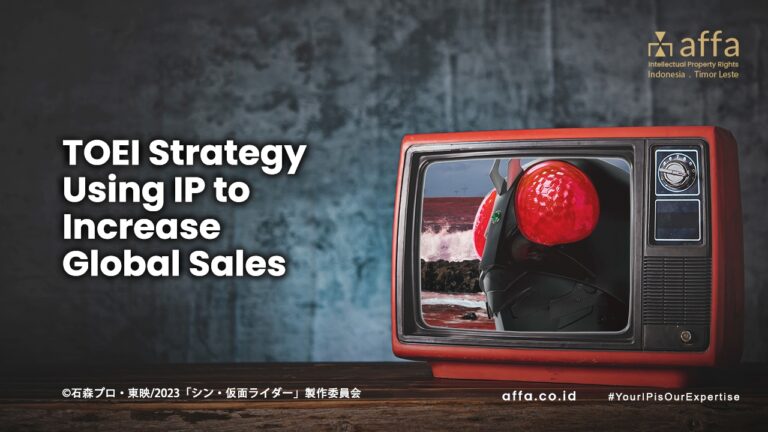
TOEI Strategy: Using IP to Increase Global Sales

The IP (Intellectual Property) business in the entertainment industry is up-and-coming. We can see how the Walt Disney Company became a giant by producing its own animated series and feature films and continuing to buy well-known IPs such as Marvel Heroes, Star Wars, and many more. The valuation of the company founded by Walter Elias Disney 100 years ago has reached USD 171.49 billion and is ranked 63rd company with the largest market capitalization in the world.   Meanwhile, from Japan, Toei Company, Co. Ltd., or simply Toei, is known as a producer of popular films and animations such as Dragon Ball, Saint Seiya, One Piece, Digimon, Sailor Moon, Super Sentai, and Kamen Rider. Classic series such as Gaban (Uchu Keiji Gavan), Voltus (Chodenji Machine Voltes V), and Goggle Five, which were popular in the 80s, were also produced by Toei.   However, unlike Disney, like most other Japanese companies, especially in the entertainment industry, they prioritize the local market and only make the global market a secondary target. According to Nora Mediana, Managing Director of Moxienotion, who has several times been entrusted with distributing Japanese-produced films to Indonesia, this policy applies the principle of embracing enthusiasts and succeeding in the local market before advancing in the global market.   “You have to speak to your local audience, and be relevant to them first before reaching out to a wider audience,” she explained.   This strategy of strengthening IP foundations in the country has to deal with a population growth crisis that is difficult to overcome. The continued reduction in the number of children and adolescents, the main target of this IP business, has reduced the income in the local market.   Even though Toei has produced more than 4,400 feature films and 38,000 TV series, income from licenses for using trademarks and copyrights of their works will decrease unless they make the global market their primary target. Efforts to get out of this crisis were marked by the launch of a long-term vision called “Toei New Wave 2033”, which targets to increase global sales by 170%, or from the composition of the local to the global market, which was 70:30 to 50:50 in 2033.   So what strategy is done by Toei? The first, as has been and is commonly done by IP practitioners in the entertainment industry, is to extend the life of the IP itself, namely by recycling an IP so that it can continue to be known and loved from generation to generation.   One of the IPs that Toei relies on to carry out this mission is Kamen Rider, known in Indonesia as Ksatria Baja Hitam. In Japan, Kamen Rider, which first aired in 1971, has become a popular series that continues to be updated yearly. There are always new Kamen Riders with new transformation tools (called Henshin Belt), new bikes, new enemies, and other new uniqueness that are sold. Not only in the form of a TV series that airs in many countries but also in the form of a wide-screen film adaptation, besides the various toys and merchandise that fans are always hunting for.   The growing development of digital platforms also opens vast opportunities for this series to have more touch points to a broader market. If previously it was only available on TV screens, now it can be watched on cross-country streaming channels. Whether it was published via Toei’s official YouTube channel or the license was taken by a paid streaming platform that can be accessed worldwide. Of course, guarding the legality of granting cross-country licenses is a challenge. Because the protection of Intellectual Property is territorial, a limited license agreement must be paid close attention to so that it does not leak or fall into the hands of pirates.   Two Kamen Rider movies have screening dates in Indonesian cinemas in the last two months. The first is “Kamen Rider Geats × Revice: Movie Battle Royale”, screened on 31 May 2023, then “Shin Kamen Rider”, which will be screened in the last week of June 2023. These two films have regional licenses held by Neofilms Southeast Asia, and Moxienotion, aka PT Mitra Media Layar Lebar, hold the right in Indonesia.   IP Kamen Rider fans also enthusiastically welcomed the screening of these two films, especially since the screening of Shin Kamen Rider in Indonesia will be one of the earlier than neighboring countries. Shin Kamen Rider itself is a 121-minute remake of the first Kamen Rider series (1971) and was directed by Hideaki Anno, the director, and animator who gave birth to the IP Neon Genesis Evangelion, which became a phenomenon in the mid-90s.   Hopefully, this fan support will be converted into satisfactory ticket sales so that a mutually beneficial relationship between producers, distributors and fans can be maintained for other films in the future. Distributors are happy, fans are satisfied, and producers can meet their global sales targets.   In addition to intensifying the sale of its works globally, Toei is also opening itself up to foreign production houses to adapt its IP to suit the tastes of its audience. The latest project currently airing is “Voltes V: Legacy”, an entirely CGI robot series produced by GMA Entertainment for audiences in the Philippines. Voltes V was originally a robot animation series produced by Toei in 1977-1978, which was very popular in the Philippines because the story inspired the people to overthrow the Marcos regime in 1986. Because the popularity of this series is still immense, the fans who used to be children are now established, and current skills are also trying to bring back the Voltes robot with more sophisticated visual technology.   Toei’s support for the production house from the Philippines is a strategy to increase the value of IP through a cycle: “Creation – Export – Reboot – Reimportation.” From the same IP, the value can continue to grow because the license is purchased by outsiders, becoming new works that can be resold to the…

Super-Mario-Bros-Huge-Success-affa-global

Super Mario Bros, Huge Success of a Video Game IP on the Big Screen

The Super Mario Bros. Movie is a 2023 American computer-animated comedy film produced by Illumination Entertainment and distributed by Universal Pictures. Based on a video game franchise of the same name that was first released in 1985. The film was directed by Aaron Horvath and Michael Jelenic, and stars Chris Pratt as Mario, Charlie Day as Luigi, Anya Taylor-Joy as Princess Peach, and Jack Black as Bowser. In the film, Mario and his brother Luigi team up to rescue Princess Peach from Bowser. The film was released in the United States on April 7, 2023. It received mixed reviews from critics, but was a true box office success, grossing over $1.21 billion worldwide while the budget was only $100 million. The film became the highest-grossing film of 2023, the highest-grossing film based on a video game, and the highest-grossing animated film of 2023. With those records, this movie has beaten ‘John Wick: Chapter 4,’ ‘Ant-Man and the Wasp: Quantumania,’ ‘Guardians of the Galaxy Vol. 3,’ and all ‘Toy Story’ movies that are owned by Disney-Pixar. Since its first release, the Super Mario Bros franchise designed by Shigeru Miyamoto and Takashi Tezuka has become a cultural icon and a household name around the world. The Italian plumber Mario and Luigi have entertained gamers for over three decades, appearing in more than 200 games and generating billions of dollars in revenue, with more than 58 million copies sold worldwide. The decision to bring Super Mario Bros to the big screen once again is a smart move for Nintendo, the company behind the franchise. In recent years, the company has made a concerted effort to expand the reach of its IP beyond video games, with successful ventures into mobile games, merchandise, and theme parks. The upcoming park would be in Singapore and it is scheduled to open in 2025. With the popularity of the franchise showing no signs of waning, it seems that Mario and his friends will continue to be a beloved part of popular culture for years to come. In conclusion, having an established IP can provide a promising future for any individual or company in the entertainment industry. It offers a recognized brand and loyal fanbase that can increase revenue through various streams of merchandise, licensing, and media adaptations. With the rise of new technologies and platforms, the potential for growth and success is only expanding. However, do not forget to protect and manage the IP to maintain its value and integrity. With proper management and strategic planning, an established IP can continue to thrive and bring joy to audiences for years to come.   If you need more information about how to protect your IP(s) in Indonesia and other countries, please do not hesitate to contact us at [email protected]. Source: Boxofficemojo.com    

Patent-x-Trademark-x-Industrial-Design-x-Copyright-affa-global

Patent, Trademark, Industrial Design, Copyright: Sorting Out Your Intellectual Property

Intellectual Property (IP) is a term used to describe a variety of intangible assets or creations of the mind that are given legal protection. The three main objects of Intellectual Property are Patents, Trademarks, and Copyrights. Here’s a brief explanation of each: 1. Patents Patents are legal protections for inventions. A patent gives the owner the exclusive right to make, use, and sell the invention for a certain period of time, typically 20 years from the date of filing the patent application. 2. Trademarks Trademarks are distinctive signs that are used to identify and distinguish the goods or services of one business from those of another. Trademarks can be in the form of words, logos, symbols, or a combination of these, and they are used to build brand recognition and goodwill. In general, a trademark registration provides protection for 10 years. However, trademark protection can be renewed indefinitely as long as the trademark owner continues to use the mark and pays the necessary renewal fees. 3. Industrial Design Industrial Design is a creation of shape, configuration, or composition of lines or colors, or lines and colors, or a combination thereof in a three-dimensional or two-dimensional form which gives an aesthetic impression and can be realized in a three-dimensional or two-dimensional pattern and can be used to produce products, goods, industrial commodities or handicrafts. 4. Copyrights Copyrights protect original works of authorship, such as books, music, art, and software. Copyright gives the owner the exclusive right to reproduce, distribute, and display the work for a certain period of time, typically the life of the creator plus 70 years.   In addition to these three main objects, there are also other forms of Intellectual Property, such as Trade Secrets and Industrial Designs, which provide protection for confidential information and the aesthetic design of products, respectively. Understanding the different categories of Intellectual Property can be crucial for protecting your intangible assets and creations of the mind. Patents provide protection for inventions or discoveries, Trademarks protect distinctive signs that identify and distinguish goods or services, and Copyrights safeguard original works of authorship. By understanding and utilizing these legal protections, individuals and businesses can ensure that their intellectual property is protected and secure. If you need more advice for protecting your IPs in Indonesia and other countries, please do not hesitate to contact us at [email protected]. Sources: Law No. 13 of 2016 on Patents (Patent Law); Law No. 20 of 2016 on Trademarks and Geographical Indications (Trademark Law) Law No. 28 of 2014 on Copyrights (Copyright Law);

Perlindungan Hak Cipta dalam NFT (Non-Fungible Token)

Non-Fungible Token atau NFT merupakan sebuah aset digital yang mewakili objek di dunia nyata seperti seni, musik, item dalam game, dan video. NFT dijumpai dalam blockchain, yang merupakan buku kas publik terditribusi yang mencatat transaksi dan menyediakan informasi tentang apa yang dijual, oleh siapa dan berapa harga yang dibayarkan. Berbeda dengan Cryptocurrencies, yang merupakan fungible tokens (token yang dapat dipertukarkan), artinya setiap cryptocurrency sama dengan yang lainnya, setiap unit NFT unik dan dapat diidentifikasi dengan jelas. NFT merupakan versi digital dari sertifikat kepemilikan atau keaslian yang secara aman tercatat dalam buku kas blockchain. Pada awalnya NFT hanyalah rekreasi digital dari karya yang ada, sekarang tidak lagi. Saat ini, NFT dibuat dari bentuk yang telah ada seperti seni digital atau bahkan meme. Perlindungan Hak Cipta ada dalam karya asli dari pencipta yang terwujud dalam media ekspresi apapun yang nyata, yang sekarang dikenal, atau kemudian dikembangkan, dimana karya tersebut bisa dirasakan, direproduksi, atau dikomunikasian, baik secara langsung atau dengan bantuan sebuah perangkat. Dengan demikian, karya asli yang diwakili oleh NFT dapat dilindungi oleh Undang-Undang Hak Cipta di sebagian besar yurisdiksi, termasuk di Indonesia. Di Indonesia sendiri Undang-Undang yang mengatur tentang perlindungan Hak Cipta adalah Undang-Undang Nomor 28 Tahun 2014 tentang Hak Cipta. Kepemilikan dari NFT belum tentu berarti kepemilikan atas karya yang diwakili oleh NFT. Seperti lukisan, ketika sudah terjual, hanya ada satu pemilik dari lukisan asli, tetapi, pencipta lukisan tersebut memiliki hak kekayaan intelektual yang mengizinkan mereka untuk membuat salinan, cetakan, atau karya turunan dari lukisan tersebut. Hak cipta dipertahankan oleh pencipta asli dari lukisan tersebut. Kecuali jika ada perjanjian pengalihan hak antara pencipta dan pembeli, berkas dan dokumen hak cipta untuk NFT masih menjadi milik pencipta aslinya. “Pembeli NFT tidak memiliki apapun kecuali hash unik di blockchain dengan catatan transaksional dan hyperlink ke file karya seni”. Pencetakan dan penjualan NFT rentan terhadap penipuan hak cipta dan pelanggaran atas karya yang mendasarinya. Hal tersebut terjadi ketika seseorang mencetak NFT dari sebuah karya, dan secara keliru mengklaim dirinya memiliki hak cipta atas karya tersebut. Singkat cerita, karya yang diwakili oleh NFT dapat dilindungi oleh Undang-Undang Hak Cipta, tetapi NFT itu sendiri tidak bisa. Untuk informasi lebih lanjut tentang perlindungan Hak Cipta NFT, silakan hubungi [email protected].