Can You Protect Checkered Sarong Designs Under Indonesian IP Law? - AFFA IPR

Can You Protect Checkered Sarong Designs Under Indonesian IP Law?

Sarong fabrics featuring checkered patterns and distinctive color combinations often serve as a unique identity of a particular region or brand. Due to their visual appeal and strong market demand, these designs are frequently commercialized. This raises an important question: can such patterns be protected as exclusive rights in Indonesia, and if so, under which type of Intellectual Property protection?   Available Forms of Protection in Indonesia   Checkered patterns and color combinations on sarongs can be protected under Indonesian Intellectual Property law, depending on how they are created and used. The two most relevant forms of protection are Copyright and Industrial Design.   Protection as Copyright   Under Law No. 28 of 2014 on Copyright, protection is granted to artistic works, including motifs or designs with artistic value.   A sarong pattern may qualify for Copyright protection if it: Is created as an original artistic work; Demonstrates creativity and uniqueness; and Is not merely a common or repetitive pattern widely available in the market.   Examples include: A sarong motif specifically designed by a designer; A pattern with a distinctive composition of lines and colors that reflects strong artistic character.   In this case, the protection applies to the artistic motif itself, not the sarong product.   Protection as Industrial Design   If the pattern is applied to sarongs that are mass-produced and sold commercially, serving as part of the product’s visual appearance and market appeal, then Industrial Design protection is more appropriate.   Under Law No. 31 of 2000 on Industrial Design, the aesthetic appearance of a product—such as compositions of lines and color combinations—can be protected as an Industrial Design.   In this context, the protection covers the appearance of the sarong as a commercial product.   Which Protection Is More Appropriate? Both forms of protection are available, and the choice depends on the intended strategy: Aspect Copyright Industrial Design Object Artistic Work (Motif) Product Appearance Protection Automatic (registration optional but recommended) Must be Registered Requirement Originality Novelty Term Life of the author + 70 years 10 years Business Value More Abstract More Specific & Practical   Can Both Protections Be Used?   Yes. A combined strategy is often the most effective. For example: The original motif created by a designer can be protected under Copyright; Once applied to sarongs and commercialized, the design can also be registered as an Industrial Design.   This approach ensures long-term protection of the artistic work, while also securing strong commercial protection for the product.   However, it is important to ensure that the design is actively used in business, so that the investment in registration or recordation provides real value.   Do you have a unique motif you want to protect? Contact us through the following channels and get a FREE 15-minute consultation:   📩 E-Mail : [email protected] 📞 Book a Call : +62 21 83793812 💬 WhatsApp : +62 812 87000 889   About AFFA:  Established in 1999, AFFA Intellectual Property Rights is an Indonesia-based boutique IP law firm serving international brands and innovators, offering full-service support—from prosecution and licensing to enforcement and commercialization—in Indonesia’s dynamic IP landscape. Our firm is widely recognized for its excellence, with accolades including “Best Boutique Law Firm in Indonesia” and “IP Enforcement Firm” at the Indonesia Law Firm Awards 2025 by Asia Business Law Journal, as well as being listed as a “Recommended Firm 2024 — Indonesia” by WTR 1000: The World’s Leading Trademark Professionals. For more information, please visit: www.affa.co.id.

Indonesia and China Forge Strategic Copyright Alliance to Strengthen Global IP Protection - AFFA IPR

Indonesia and China Forge Strategic Copyright Alliance to Strengthen Global IP Protection

In a major step toward deeper international IP collaboration, the Government of Indonesia and the People’s Republic of China have signed a Memorandum of Understanding (MoU) to enhance cooperation in the field of Copyright and related rights. The agreement was formalized during the sidelines of the World Intellectual Property Organization (WIPO) General Assembly in Geneva, Switzerland, on July 8, 2025.   This landmark MoU, signed between Indonesia’s Ministry of Law and Human Rights and China’s National Copyright Administration, marks a pivotal moment in the bilateral IP relationship between two of Asia’s largest creative economies.   Responding to the Challenges of a Digital World   “This MoU represents a new chapter in our countries’ commitment to protect creativity in an increasingly borderless digital era,” said Minister of Law Supratman Andi Agtas. “It is more than an agreement—it’s a framework for resilience, cooperation, and innovation.”   At its core, the agreement focuses on strengthening Copyright enforcement, building institutional capacity, and fostering mutual promotion of the creative and cultural industries. Both countries have recognized the need for joint responses to transnational Copyright infringement, especially amid the rise of digital piracy and the development of generative AI.   Key Areas of Cooperation   Under the MoU, Indonesia and China will collaborate in the following areas: Exchange of legal and technical information on Copyright and related rights. Joint training programs for staff and professionals. Promotion of cross-border creative and cultural exchange. Facilitation of relations between Collective Management Organizations (CMOs). Public awareness campaigns to elevate IP education   Crucially, both parties agreed to develop annual work plans, appoint official contact points, and organize practical engagements—ranging from seminars and workshops to policy dialogues on emerging Copyright issues.   A Strategic – Soft Power Approach   While the MoU is non-binding, its strategic impact is significant. It reinforces Indonesia’s broader vision of positioning Intellectual Property as a tool of cultural diplomacy, especially within the fast-evolving global IP landscape.   The MoU will remain in effect for five years, with an option to renew for another term. Both countries may revise the agreement through mutual written consent, ensuring flexibility in addressing future challenges and opportunities.   As global stakeholders watch with growing interest, this Indonesia-China partnership sends a clear message: International Copyright cooperation is no longer optional—it is essential!   At AFFA Intellectual Property Rights, we support stronger international IP cooperation like the Indonesia–China partnership. Whether you’re expanding into Indonesia or managing IP across Asia, our consultants are ready to guide you.   Need help protecting your Copyright in Indonesia? Book a free 15-minute call with our professional consultant:   ? E-Mail : [email protected] ? Book a Call : +62 21 83793812 ? WhatsApp : +62 812 87000 889   Source: Directorate General of Intellectual Property

Indonesia Fosters a Thriving IP Ecosystem: Domestic and International Filings Soar Over the Past Decade - AFFA IPR

Indonesia Fosters a Thriving IP Ecosystem: Domestic and International Filings Soar Over the Past Decade

Indonesia’s Directorate General of Intellectual Property (DGIP) has achieved a remarkable milestone over the past decade. According to a report delivered by the Director General of Intellectual Property, Razilu, a total of 1,738,573 Intellectual Property (IP) applications were filed between 2015 and 2024. “This is a monumental figure that reflects the extraordinary enthusiasm of the Indonesian public in protecting their intellectual creations,” Razilu stated during the “Ten-Year Performance Exposé and IP Appreciation” event, held in celebration of World Intellectual Property Day 2025 at Graha Pengayoman, Jakarta, on Wednesday, June 4, 2025. The data show that IP filings have grown at an average annual rate of 18.5%. According to Razilu, this growth is more than just numbers — it reflects increasing awareness of the importance of IP as a national economic and cultural asset. Razilu emphasized that this performance exposé is not merely an evaluation, but also a strategic platform to shape future IP policies. The goal is to ensure that every innovation and creative work by Indonesians is not only protected by law but also fully empowered. Of the total filings, approximately 86.76% originated from within the country. Domestic applicants contributed nearly 99.8% of Copyright filings, 85.2% of Trademark filings, and 68.76% of Industrial Design filings. However, domestic contributions to Patent filings remain relatively low, standing at just 32.05%, highlighting an area for improvement. “These figures demonstrate the strong dominance of local IP filings across all categories. It’s a testament to the thriving innovation and creativity among individuals, entrepreneurs, and inventors across Indonesia,” Razilu added. Over the same period, micro, small, and medium enterprises (MSMEs) were significant contributors to Trademark filings. The most registered classes included: Culinary products (Classes 30 and 29) Fashion (Class 25) Hospitality services (Class 43) Cosmetics and personal care (Class 3) In the Industrial Design category, top applications were concentrated in: Other printed matter (Class 19-08) Chairs (Class 06-01) Garments (Class 02-02) Travel bags, handbags, key holders (Class 03-01) Bags, containers, tubes, capsules (Class 09-05)  Meanwhile, the most recorded Copyright works were books, written articles, computer programs, video recordings, and posters. For Geographical Indications, the top five products over the past decade were coffee, woven textiles, rice, batik, and traditional salt. In the domestic Patent category, top filings involved food chemistry, pharmaceuticals, chemical engineering, special machinery, and basic chemistry. On the other hand, foreign Patent applications were dominated by sectors such as pharmaceuticals, digital communications, transportation, basic chemistry, and metallurgy. At AFFA Intellectual Property Rights, we welcome this growing momentum in Indonesia’s IP landscape. Our team of experienced IP consultants stands ready to support businesses, creators, and innovators—not only in Indonesia but also around the world—in securing and maximizing the value of their Intellectual Property. Let us help you navigate your IP journey with confidence.   Need help filing your IP in Indonesia? Book a free 15-minute call with a registered IP consultant and ensure your IP meets all local requirements:   ? E-Mail : [email protected] ? Book a Call : +62 21 83793812 ? WhatsApp : +62 812 87000 889   Source: Directorate General of Intellectual Property

5 Steps to Avoid Copyright Issues for Your Product Illustrations - AFFA IPR

5 Steps to Avoid Copyright Issues for Your Product Illustrations

Being inspired by, imitating, modifying, or even duplicating someone else’s work without permission—whether it’s well-known or not—can lead to serious legal consequences, including up to 4 years in prison or a fine of 1 billion Rupiah!   This is because Copyright Law grants Exclusive Rights only to the Original Creator, ensuring that they alone can claim economic benefits from their work.   In other words, if you profit from someone else’s creation without permission, the rightful owner can file an objection, send a legal notice (cease-and-desist), or take further legal action against you.   However, exceptions exist if your use of the work is non-commercial, educational, for criticism, or news reporting, provided it is done fairly and does not harm the creator.   But what if you genuinely didn’t know that a design submitted by your designer or illustrator infringed on someone else’s work?   Here are 5 essential steps you can take to review and evaluate whether a work violates copyright or not.   Does the Work Resemble a Popular Character?  A popular character isn’t just limited to animated movie figures or superheroes like Batman, Superman, or Ultraman. Even public figures or athletes with recognizable faces and signature poses cannot be used without permission.  To avoid issues, ask your designer about the initial sketches and the creative process behind the work. Use Reverse Image Search  Utilize tools like Google Reverse Image Search, TinEye, or Yandex Image Search to check if similar images already exist online.  If you find the design in stock image websites, art platforms, or other media, ensure that your illustrator didn’t just copy or slightly edit the image without significant modification. Avoid Copying the Style of Famous Illustrators  Some illustrators have highly distinctive and well-known styles, such as Loish, Kim Jung Gi, Greg Rutkowski, Hajime Sorayama, and others whose works frequently appear on book covers, games, or movies.  If the submitted artwork strongly resembles their style without permission, it could be considered Copyright Infringement or a Trade Dress violation (protection against copying distinctive design elements). Ensure All Design Elements Have Proper Licenses  Certain fonts or typefaces require a paid license. If your designer uses a premium font without a valid license, you could face legal action.Similarly, elements like brushes, textures, or patterns may also have specific usage rights. Always verify that all components in the design are legally licensed. Create a Written Agreement with Your Illustrator  Draft a contract stating that the work is 100% original and not derived or modified from another source without permission.This ensures that the illustrator is legally accountable if copyright infringement issues arise due to their work.   Remember, a work is automatically protected by copyright the moment it is published. You cannot claim that your use is valid simply because the work was never officially registered or originates from a different country with a separate market.   If you must or want to use an existing work for commercial purposes, the only legal solution is to contact the original creator and negotiate a licensing agreement.   This agreement would require you to pay royalties to the rightful owner. By obtaining proper licensing, you can legally collaborate with the original creator and promote the work openly—without fear of legal consequences.   You might also want to read: Indonesia’s Copyright Dilemma: When Good Intentions Pave the Way to (Unintended) Infringement Should you need more information regarding Copyright protection both domestically and internationally, you can contact us directly via email at [email protected].

2025 Resolution: Wealth Through IP - Make It Happen! - AFFA IPR

2025 Resolution: Wealth through IP – Make It Happen!

As we enter a new year, many of us aim for ambitious resolutions, including achieving financial success. One often-overlooked but highly effective way to achieve this is through Intellectual Property (IP) ownership—be it Trademarks, Patents, Industrial Designs, or Copyrights. Hard to imagine? Let’s look at some inspiring examples of how IP has made others wealthy.   Trademarks: David Beckham Earned USD 36 Million in 2024  By licensing his name to major companies like Adidas, Nespresso, and Stella Artois, the English football icon significantly boosted his income from the previous year, which was “just” USD 16.2 million. This is remarkable, considering he retired more than a decade ago.  Moreover, the entire Beckham family, from his wife Victoria to his children Brooklyn, Romeo, Cruz, and Harper, have also registered their names as Trademarks with the UK Intellectual Property Office (UKIPO). So, if you have a unique name with notable achievements, don’t hesitate to register it and use it as your business identity.   Patents: Dyson’s Innovations Generated GBP 1.4 Billion in 2023  Founded by Sir James Dyson in 1991, Dyson started with the revolutionary bagless vacuum cleaner. Today, its innovations extend to other technologies used in household appliances such as hand dryers, bladeless fans, air purifiers, and hair styling tools.  Although the company invests heavily in R&D for AI, robotics, and cutting-edge battery technologies, its tens of thousands of registered patents have been licensed to numerous companies worldwide, providing additional revenue beyond the sales of finished products. In 2023, Dyson’s total revenue reached GBP 7.1 billion!   Copyrights: Mariah Carey’s Royalties Reach USD 3 Million Annually  In the entertainment world, Copyright is an invaluable asset. For instance, Mariah Carey’s timeless hit, “All I Want for Christmas Is You,” has generated annual royalties of around IDR 48 billion despite being released in 1994. These royalties come from frequent airplay on radio, streaming platforms, and usage in films and commercials every holiday season.  If you create a song or movie with a holiday theme, its popularity and playback could grow yearly, allowing you to earn passive income through royalties.   Industrial Designs: Bandai’s 20 Billion Yen Annual Revenue from “Henshin Belt”  It’s no secret that the Kamen Rider series serves as a year-long advertisement for toys. Each year, a new Kamen Rider series is introduced, complete with a new Henshin Belt—more sophisticated and unique, following current trends.In the story, the Henshin Belt is a high-tech device enabling the protagonist to transform into a superhero. To captivate children, the toy version incorporates engaging “gimmicks.” For example, in the latest series, Kamen Rider GAVV, the gimmick involves inserting small monster-shaped collectibles into the belt to unlock various powers. Bandai registers the Industrial Design for the belt and its collectible monsters to ensure exclusivity and economic rights. With this protection, no other party can legally use the unique design without permission. The result? Annual toy sales of approximately USD 134 million!   These examples show that Intellectual Property isn’t just a foreign concept—it’s also applicable in Indonesia or everywhere. You can use your name as a Trademark for a restaurant franchise or create a unique product design registered as an Industrial Design. As long as your IP is protected, it will continue to generate opportunities to build wealth in the future. If you’re an innovator, business owner, athlete, musician, or creator from any background, IP-based business opportunities can be a promising source of future income. To learn more about securing legal protection for your Intellectual Property, reach out to us at [email protected].

Indonesian IP Office Declares 2025 the Year of Copyright and Industrial Design - What Are the Benefits? - AFFA IPR

Indonesian IP Office Declares 2025 the Year of Copyright and Industrial Design – What Are the Benefits?

The Indonesian IP Office (DGIP) has reaffirmed its commitment to supporting the protection and development of Intellectual Property (IP) in Indonesia. 2025 has been declared the Year of Copyright and Industrial Design, marking a new strategic initiative to strengthen Indonesia’s IP ecosystem. This policy not only aims to raise awareness of the importance of Copyrights and Industrial Designs but also to create a more conducive environment for businesses and investors, both domestic and international.   This declaration is based on several initiatives and policies implemented by DGIP over recent years. After the 2024 Year of Geographical Indications, DGIP recorded a significant increase in IP applications, demonstrating heightened public awareness of the importance of IP protection. With the declaration of the Year of Copyright and Industrial Design, DGIP aims to continue this positive trend, particularly by increasing the registration of Copyrights and Industrial Designs.   DGIP has set ambitious targets, with the Director General of Intellectual Property aiming for increased Non-Tax State Revenue (PNBP) for 2026: IDR 28,156,750,000 from Copyrights, IDR 354,753,680,000 from Trademarks, and IDR 529,167,083,000 from Patents and Trade Secrets.   DGIP’s Achievements in 2024 As a foundation for 2025, DGIP achieved several milestones during 2024:   Increase in Intellectual Property Applications DGIP recorded a significant increase in IP applications, including Copyrights, Industrial Designs, and Geographical Indications. In 2024, more than 15,000 Copyright applications were recorded, a 20% increase compared to the previous year. DGIP also received approximately 5,000 Industrial Design applications, reflecting a 15% growth. Furthermore, 50 new Geographical Indication applications were filed, indicating rising public awareness of protecting local wealth-based products. Launch of the 2025-2029 National Geographical Indications Roadmap This strategy aims to strengthen the management and preservation of Geographical Indication-based products, providing direct economic benefits to local communities. Enhanced Services and Transparency Through various initiatives, including the 2024 IP Program Financial Coordination Meeting, DGIP improved service efficiency, especially by expediting IP registration processes to enhance user experience. International Collaboration DGIP successfully established partnerships with international organizations to strengthen IP protection in Indonesia. These collaborations included training, capacity-building for human resources, and promoting Indonesian IP products in global markets. Key IP-Based Regional Programs This initiative encourages the development of IP-based regions to support sustainable economies, enhancing the competitiveness of local products in international markets. These programs range from the Development of Geographical Indications-Based Local Products, Creative Economy Zones Based on IP, to IP-Based SME Assistance.   Strategic Policies Supporting the Year of Copyright and Industrial Design To ensure the success of this initiative, DGIP has formulated several strategic policies and measures:   Updating the 2024-2029 Strategic Plan During the Strategic Plan Update meeting in Bogor in December 2024, DGIP designed data-driven programs to anticipate future needs and challenges. This step ensures that policies related to Copyrights and Industrial Designs align with global dynamics. Strengthening Services and Financial Management Through the 2024 IP Program Financial Coordination Meeting, DGIP focused on improving services and the potential for Non-Tax State Revenue (PNBP). Efficient financial management has become a priority to support optimal operations, particularly in expediting the registration and protection of Copyrights and Industrial Designs. IP-Based Regional Programs DGIP launched flagship programs that utilize IP-based regions to support sustainable economies. This approach aims to enhance the competitiveness of local products with IP value in global markets, providing direct economic benefits to communities and businesses. 2025-2029 National Geographical Indications Roadmap While focusing on Geographical Indications, this roadmap serves as an example of how DGIP designs comprehensive strategies for IP management. Similar approaches are expected to be applied to Copyrights and Industrial Designs, emphasizing preservation and innovation.   Positive Impacts for Businesses and Investors Through these policies, DGIP not only strengthens Indonesia’s IP ecosystem but also sends positive signals to international businesses and investors. These conducive conditions include:   Faster Services: Improved speed and transparency in IP recordation, registration, and protection processes.   Legal Certainty: Structured policies provide better protection for rights holders.   Global Competitiveness: Strengthened IP-based regions allow local products to compete more effectively in international markets.   You might also want to read: Fighting IP Crimes: Indonesia’s IP Office Task Force Destroys IDR 5.35 Billion Worth of Counterfeit Goods!   Despite the many initiatives launched, challenges remain, such as low public awareness of the importance of IP protection and the need for adequate infrastructure. However, with DGIP’s commitment, 2025 is expected to be a monumental year for strengthening Copyright and Industrial Design protection in Indonesia.   The declaration of the 2025 Year of Copyright and Industrial Design is DGIP’s tangible step in solidifying Indonesia’s position as a country that supports Intellectual Property protection. This policy aims to raise awareness of the importance of Copyrights and Industrial Designs and create a more conducive environment for businesses and investors, both domestic and international. Should you need more information on Copyright and Industrial Design protection in Indonesia, please contact us at [email protected].

IP Licensing for Restaurants & Theme Parks: An Investment or a Burden? - AFFA IPR

IP Licensing for Restaurants & Theme Parks: An Investment or a Burden?

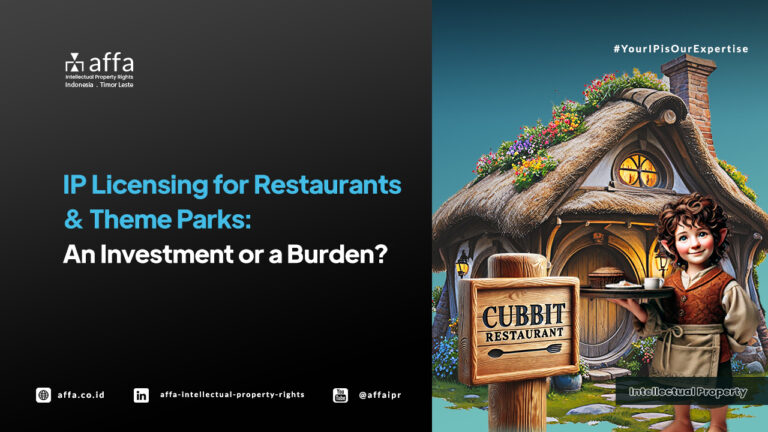
Indonesian laws regulate the granting of Exclusive Rights over Trademarks, Industrial Designs, or Copyrights, where only the owner and/or creator have the right to derive economic benefits from the Intellectual Property (IP). Therefore, it can be concluded that any restaurant, venue, or theme park wishing to utilize such IP must obtain permission. But how does it work in practice?   However, it is still common to find restaurants and venues utilizing well-known IP elements such as characters from popular animations, superheroes, or movie themes without official permission from the owner. For example, themed restaurants inspired by popular movies or series that use their names and menu concepts, or amusement parks displaying statues of characters without a license. While these may appear attractive and draw visitors, such actions violate the Exclusive Rights of IP owners and may lead to legal lawsuits.   The Importance of Licensing IP Usage   Such violations harm IP owners and create an unhealthy business environment. Entrepreneurs who disregard Intellectual Property Rights neglect the significant investments made by IP owners in creating their works, from the creative process to marketing efforts.   So, what’s the solution? It’s as simple as contacting the IP owner and obtaining usage rights formalized in a Licensing Agreement. This ensures legal usage of the IP and helps determine if another party in Indonesia has already been granted a license, potentially allowing further collaboration for authorization.   You might also want to read: Indonesia’s IP Odyssey: Unraveling the Ins and Outs of IP License Agreement Recordal   By obtaining a license, you can get the following three key benefits:   Avoiding Legal Risks Licensing protects businesses from lawsuits that may result in hefty fines or even closure. Enhancing Credibility Official licensing demonstrates a commitment to ethical business practices and respect for others’ rights. Building Long-Term Partnerships IP owners often support the marketing of licensed businesses, providing strategic advantages for expanding into international markets. You could even become the trusted partner for operating this business in Indonesia.   The Public’s Role in Respecting IP   Besides business operators, the public also plays a crucial role in safeguarding Intellectual Property Rights. As consumers, we should be more critical when choosing places to visit. If you encounter a restaurant, venue, or theme park using a well-known IP without authorization, consider the following:   Avoid Visiting Supporting businesses that violate IP rights only worsens the problem. Report Violations You can report violations to the relevant authorities or directly to the IP owner to initiate legal action.   The easiest way to verify whether a venue has a formal collaboration with the IP owner is by checking for the © “IP Owner’s Name” label on its publication. Because obtaining such authorization often involves significant effort and cost, businesses are likely to display this label. Not only does it reflect official usage, but it also serves as a badge of pride that their business has earned the trust of a major IP name. Licensed businesses also freely promote such partnerships without fear of secrecy.   Criminal Sanctions for Unauthorized IP Usage   Running a business that uses IP without permission in Indonesia may result in criminal penalties, depending on the type of violation:   Trademark Infringement Anyone who unlawfully uses a trademark identical to a registered one belonging to another party for similar goods and/or services may be subject to: Imprisonment: Up to 5 years. Fine: Up to IDR 2 billion. Copyright Infringement Anyone who unlawfully and/or without permission from the creator or copyright holder distributes a work or its copies for commercial purposes may be subject to: Imprisonment: Up to 4 years. Fine: Up to IDR 1 billion.   For more severe violations, such as piracy, penalties may include imprisonment of up to 10 years and/or fines of up to IDR 4 billion. Furthermore, should you need help obtaining a license for well-known IPs, including drafting proper licensing agreements, feel free to contact us via email at [email protected].

The Billion-Stream Christmas Song: Mariah Carey's Seasonal Success - AFFA IPR

The Billion-Stream Christmas Song: Mariah Carey’s Seasonal Success

As December begins and the holiday season approaches, Mariah Carey’s iconic song, “All I Want for Christmas Is You,” can be heard almost everywhere. The festive atmosphere, from radios, cafes, hotels, offices, and shopping malls, seems incomplete without this song. If you’re a musician, songwriter, or singer, you might wonder how much royalty Mariah Carey earns annually from this song. But is it as massive as we imagine?   “All I Want for Christmas Is You” was first released in 1994 as part of Mariah Carey’s Christmas album, Merry Christmas. The song was co-written by Mariah and Walter Afanasieff, a seasoned musician, songwriter, and producer who collaborated with top artists of the era, such as Celine Dion, Boyz II Men, and Natalie Cole. However, the song initially only peaked at number twelve on the Billboard US Hot 100 Airplay chart.   The Journey to Becoming a $100 Million Royalty Song   Although it didn’t perform exceptionally well in the United States, the song skyrocketed in popularity in Europe, Japan, Singapore, Australia, and New Zealand, becoming the most-played holiday song annually. In 2001, Mariah released a remix of her Greatest Hits album. From then on, the demand for the song surged, with the original version consistently topping the charts every December from 2005 to 2008, 2019, and beyond.   According to the Associated Press, since 1994, the song has generated an estimated $100 million in royalties. This is primarily thanks to the surge in plays from streaming platforms like Spotify and YouTube, making it more accessible to listeners worldwide.   Passive Income of Up to $3 Million Per Year   As the songwriter and singer, it’s no surprise that Mariah is one of the biggest royalty earners from this song. However, she’s not the only one receiving royalties. The song has sold over 3.6 million digital copies in the United States since its release. It’s the most popular Christmas song in Europe, mainly the UK, with over 1.2 million downloads and 100 million streams. In Asia, the song ranks top on karaoke platforms and remains one of the most frequently sung Western songs.   Radio airplay and physical record sales also continue to generate royalties for the parties involved with the song. They include:   Songwriters Walter Afanasieff, the song’s co-writer, is entitled to a share of the songwriting royalties.  Record Label The song is under Columbia Records, part of Sony Music Entertainment. As the company that produces, markets, and protects the master recording, the label receives royalties from distribution and licensing agreements.  Music Producers In addition to Mariah Carey, Walter Afanasieff also acted as the song’s producer, earning royalties for the master recording.  Related Rights Supporting musicians like Dan Shea and backing vocalists (Kelly Price, Melonie Daniels, and Shanrae Price) who contributed to the recording are also entitled to royalties, as stipulated in their recording contracts.     “All I Want for Christmas Is You,” celebrating its 30th anniversary this year, shows how a single song can provide extraordinary long-term income for singers, songwriters, and other musicians. However, such income sources would not be well-managed without proper licensing agreements that regulate royalty distribution.   Thus, ensure that all your creations are appropriately documented and managed with solid licensing agreements to maximize their benefits—not just now but for decades to come. Should you need more information on Copyright recordation and licensing agreements domestically and internationally, please contact us at [email protected].

Fighting IP Crimes: Indonesia's IP Office Task Force Destroys IDR 5.35 Billion Worth of Counterfeit Goods! - AFFA IPR

Fighting IP Crimes: Indonesia’s IP Office Task Force Destroys IDR 5.35 Billion Worth of Counterfeit Goods!

The Indonesian Intellectual Property (IP) Task Force, a cross-ministerial special task force of the Republic of Indonesia, consists of the Directorate General of Intellectual Property (DGIP), the Directorate General of Customs and Excise (DGCE), the National Agency of Drug and Food Control (BPOM), the Ministry of Communication and Digital (Komdigi), the Criminal Investigation Department (Bareskrim) of the National Police, and the National Cyber and Crypto Agency (BSSN). On December 12, 2024, the task force symbolically destroyed a number of products associated with violations of 12 Trademarks and Industrial Designs.   During a press conference, the Director General of Intellectual Property, Razilu, stated: “This destruction serves as a strong message from the DGIP that there is no room for Intellectual Property violations in Indonesia.”   At least three key messages were conveyed through the destruction of these products: Deterrence: To provide a deterrent effect on offenders, ensuring they refrain from committing further violations. Both civil and criminal legal actions can be enforced against them. Creator and Owner Protection: To assure creators and IP owners that their works are protected, fostering an environment where they can continue innovating. Public Awareness: To urge the public never to buy counterfeit or fake goods at low prices, as these products can adversely affect health, employment, and the environment.   The destroyed products, valued at IDR 5.35 billion, included the following: LEGO (toys): Worth over IDR 1 billion, from 110 items. Comotomo (baby bottles): Worth over IDR 500 million, from 888 items. Mimi White (hand and body lotion): 216 items. MT NG Shan (drill bits): 2,000 pieces. Louis Vuitton (women’s bags, wallets, and belts): 10 items. Christian Louboutin (women’s shoes): 2 pairs. Tokai (lighters): 5 boxes. Orion Choco Pie (snack/biscuits): 50 boxes. Honda (spare parts): 30 boxes. Honda (generators): 30 units. Harley Davidson (apparel accessories, umbrellas, and wallets): 600 items. Food Packaging (Industrial Design): 30 boxes.   It is important to note that the products classified as IP violations are not limited to counterfeit goods but also include goods illegally entering the Indonesian market. Under the law, smuggled goods that bypass official channels, fail to adhere to applicable import procedures, and are subject to objections by the official license holders of the relevant trademarks are subject to enforcement actions.   Given the complex and extensive scope of IP  violations, cross-sector enforcement is required. The specific roles of the involved institutions are as follows: DGIP: Monitoring, supervision, preventive measures, mitigation strategies, and enforcement of IP laws. DGCE: Addressing the importation of goods suspected of infringing IP rights. BPOM: Managing the distribution of food and pharmaceutical products that are suspected of infringing IP rights and endangering public health and the environment. Komdigi: Handling complaints and requests for blocking websites related to goods and/or services deemed to violate IP rights. Bareskrim Polri: Coordinating communication and collaboration for law enforcement from the central office to its units across Indonesia. BSSN: Monitoring IP violations in cyberspace and assisting in handling IP infringements that occur in the digital realm.   You might also want to read: Unraveling the Global Complexity of IP Crime: Money Laundering and More!   Each year, the average number of reports on IP violations is around 50 cases, with the majority involving Trademark, Industrial Design, and Copyright infringements. The active role of Komdigi has also significantly contributed to blocking 414 websites infringing Copyrights based on 16 requests. However, considering that the IDR 5 billion in damages mentioned earlier came from only 12 cases, this can be seen as just the beginning or the tip of the iceberg in the enforcement of IP laws in Indonesia.   Therefore, the participation of the five key components of the nation—Government, Academics, Private Sector, Society, and Media—is expected to continue supporting efforts to create a better Intellectual Property climate in Indonesia.   With increasing public awareness of the importance of Intellectual Property, there will also be positive impacts on the national economy and Indonesia’s investment climate in the global arena.   Should you need more information regarding Trademark protection and other Intellectual Property matters in Indonesia and abroad, feel free to contact us via email at [email protected].

IP Character Collaborations with Airlines - Which One is Your Favorite? AFFA IPR

IP Character Collaborations with Airlines – Which One is Your Favorite?

Collaborations involving Intellectual Property (IP) or well-known characters aren’t limited to clothing or merchandise; they extend to restaurants, theme parks, and even airlines. Thanks to the immense popularity of these characters, fans are willing to travel, buy tickets, and spend more to enjoy a unique experience connected to their favorite icons. As the holiday season approaches, traveling with a trusted airline featuring your favorite IP characters can be an exciting option for you and your family. These collaborations often offer in-flight branding, including themed headrests, paper cups, meal boxes, in-flight entertainment, and exclusive merchandise to take home. Does your favorite character make the list? Etihad Airways x Warner Bros Boeing 787-10 Dreamliner  Since: July 2024 Characters: Batman, Superman, Wonder Woman, Looney Tunes, etc. Routes: Abu Dhabi, London, Dublin, Amsterdam, Vienna, Bangkok, and Manila AirAsia x Sonic the Hedgehog Airbus A330 Since: October 2024 Characters: Sonic, Tails, & Shadow Routes: Kuala Lumpur – Bangkok All Nippon Airways (ANA) x Demon Slayer: Kimetsu no Yaiba Bombardier DHC 8-400 Since: July 2023 Characters: Tanjiro, Nezuko, Zenitsu, Inosuke, Kyojuro, etc. Routes: Osaka – Fukuoka Southwest Airlines x Walt Disney World Boeing 737-700 Since: September 2021 Characters: Mickey, Minnie, etc. Routes: United States Domestic Garuda Indonesia x Pokemon Boeing B737-800 NG (Pikachu Jet GA-1), since February 2024 Airbus A330-300 (Pikachu Jet GA-2), from March 2025 Characters: Pikachu, Squirtle, Aipom, Oddish, etc. Routes: Jakarta, Denpasar, Jogja, Lombok, Batam, Surabaya, Malang, Semarang, Makassar, Tokyo, Sydney, Melbourne, Hong Kong, China, Jeddah, Bangkok, etc. With this collaboration, Garuda Indonesia has joined the elites of the “Pikachu Jets” fleet, alongside other airlines that collaborated earlier, such as ANA and Skymark Airlines (Japan), China Airlines, Scoot (Singapore), and T’way Air (South Korea). For Garuda Indonesia, IP collaborations are not new, as the airline previously partnered with Star Wars and Marvel Studios from The Walt Disney Company in 2022.   Should you need further information about IP collaborations, licensing agreements, or the protection of Trademarks and other IPs domestically or internationally, contact us at [email protected].