Are You Breaking the Law? The Truth About Region Lock - AFFA IPR

Are You Breaking the Law? The Truth About Region Lock

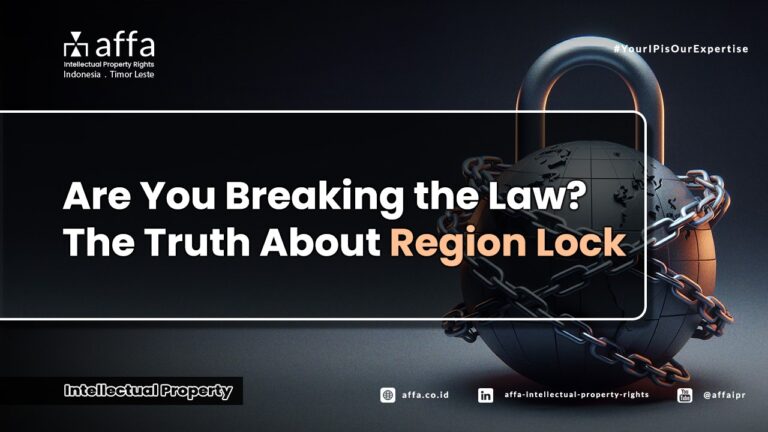
Region lock is a Digital Rights Management (DRM) restriction placed on content or devices. It restricts their use to a specific geographical region. You might know that Netflix Japan has a different movie catalog than Netflix Indonesia. That’s the basic idea, but why?   Before we delve into discussion about the “why,” let’s first learn about the two types of region locking: Content Locking This restricts access to digital content, like movies, games, or even streaming services, based on your location. For instance, a movie available on a streaming service in the US might be blocked for viewers in Indonesia due to licensing agreements. Device Locking This restricts the functionality of a physical device, like a phone or game console, depending on the region it’s purchased in. For example, a phone bought from abroad might not be able to be used in Indonesia.   There are 5 (five) reasons why region locking exists: Content Regulation Copyright laws and regulations that rule contents can vary worldwide. Region locking allows companies to control what content is available in each region, comply with local laws, and avoid any issues.A simple example is that content considered normal in one country will be sensitive if seen in another. Plus, the age limit of 13+ in one country may be 18+ in another. Therefore, creators tend to apply region lock to their work to limit responsibility to the public outside their jurisdiction. Licensing Agreements Sometimes, companies sell the rights to distribute their products (like movies or games) to different companies in different regions. Region locking ensures that people use the product only in the region it’s licensed for.Because Licensing Agreements are a form of IP utilization, a leak from the distribution channel will cause losses for both parties. The licensor will lose potential buyers from other countries/regions, while the licensee will lose exclusivity in their region. Price Discrimination This is another big problem. Because not all countries have the same purchasing power and Licensees are given the authority to determine prices according to the market, differences in selling prices are very likely to occur. For example, an iPhone might be much cheaper in one country compared to another. Region locking stops people from buying the cheaper version and using it or even selling it in the more expensive region. Staged Releases Sometimes, companies might want to release a product in one region before another. Region locking can help them control when and where the product is available.This strategy is usually taken to determine the response from a specific market in a region so any improvements can be made before being released to the wider market. If there is a leak in this stagging release, the research data received will be biased, and the product may be disappointing when it is actually released to the wider market. Technical Reasons In some cases, region locking might be used for technical reasons, like ensuring compatibility with local infrastructure or preventing lag in online games.A clear example is if an application requires a very fast connection, it will not be possible to release it in a country where the internet connection is far below average. If it is forced to be released or accessed outside the region, it will not give a good impression; it will actually bring a lot of complaints, which will make the product look bad in the eyes of the public.   That’s why the region locking can be frustrating for consumers, but it does serve some purposes for companies. So it would be best if you did not force yourself to break it because you might suffer losses such as the following: For You Warranty Voiding Tampering with region locks might be considered a violation of the device’s warranty terms, potentially voiding your warranty and leaving you without coverage for repairs. Technical Issues Bypassing region locks often involves unofficial methods or software. These can be unstable and lead to unexpected glitches or malfunctions with your device or content. Legal Issues Region locking often hinges on copyright or licensing agreements. Breaking these locks might be illegal depending on your location and the specific content or device. For Your Device/Content Limited Functionality Bypassing a lock might disable certain features intended for the original region. For example, a console game might lack online functionality if the region lock is broken. Content Incompatibility Region locking can sometimes be tied to format or encoding differences. Bypassing the lock might lead to compatibility issues, such as the content not playing properly on your device. Other Factors Safety and Security Using unofficial methods to break region locks such as using a Virtual Private Network (VPN) can introduce security risks. Malicious software might be bundled with these tools, putting your device and data at risk.   In the end, it’s important to weigh the potential benefits against the risks before attempting to bypass region locking. Sometimes, waiting for a regional release from the official licensee in the region or considering alternatives like region-free versions might be a safer option.   If you require further information regarding the region lock issue, licensing problem, or want to protect your Intellectual Property in a broader market, please do not hesitate to contact us via email at [email protected].

The Benefits of IP Customs Recordation for Your IPs in Indonesia - AFFA IPR

The Benefits of IP Customs Recordation for Your IPs in Indonesia

Recently, the Directorate General of Customs and Excise of the Republic of Indonesia (DGCE) has taken widespread action against tons of illegal food to protect consumers and the Indonesian food industry. Because the ingredients of food imported illegally are unknown, it can endanger residents and disrupt the distribution of local food producers. But did you know that Customs and Excise can also deter illegal goods that violate Intellectual Property abroad or within the country? Because DGCE is part of the Task Force together with the Criminal Investigation Agency of the Republic of Indonesia Police (Bareskrim Polri), the Indonesian Food and Drug Authority (BPOM), and the Directorate General of Informatics Applications (Ditjen Aptika), which supports the performance of the Directorate General of Intellectual Property (DGIP) in enforcing Intellectual Property Law in Indonesia. Enforcing this law is a collective homework because Indonesia is still on the list of world countries with serious Intellectual Property violations (along with Argentina, Chile, China, India, Indonesia, Russia, and Venezuela), as released by the United States Trade Representative (USTR) in the 2023 Priority Watch List Special 301 Report. A few weeks ago, DGCE conducted outreach to the public so that the wider community, especially Intellectual Property (IP) owners, could take advantage of this service. So, if illegal products are found crossing state borders, IP owners, especially copyright and trademark owners, will be assisted in the deterrence process. But before that, you must first carry out the recordation process on the DGCE website. For those of you who are still unfamiliar with the term “deterrence”, this word has 2 (two) meanings, namely: Delaying the release, loading, or transportation of excisable goods and/or other goods related to excisable goods; Prevent the departure of means of transport.   The Benefits of IP Customs Recordation in DGCE The recordation process is an activity to enter your IP information into the DGCE customs database, with the following benefits: Action at Ports or Borders; Especially if the quantity of goods smuggled is very significant. Effective and efficient deterring before goods that violate IPR are distributed to the domestic market. Protecting IP Owners’ Business Processes; Products are protected from counterfeiting or infringement attempts. Maintain consumer confidence in products on the market. Maintaining brand reputation from low-quality counterfeit products. Macro Aspects; Increasing investor confidence, both domestic and foreign. The government can restore international trust in the seriousness of eradicating counterfeit products in Indonesia.   The Authority of DGCE DGCE has two schemes for the enforcement of Intellectual Property Law: Judicial Scheme that applies to all IP regimes: DGCE may impose a temporary suspension until a physical examination. However, DGCE’s position here is passive because it must wait for a temporary suspension order from the Commercial Court, where the Rights owner must carry out the initiative without any prior obligation to record it on the DGCE site. Ex-Officio Scheme for Trademarks and Copyrights: After the rights owner carries out the recordation process with the DGCE, the process of deterrence, temporary suspension, and physical examination can be carried out proactively by the DGCE.   Conditions for IP Customs Recordation at DGCE As the owner or right holder, you must submit a written application accompanied by the required documents by Minister of Finance Regulation (MFR) Number 40/pmk.04/2018 concerning Recording, Deterrence, Guarantee, Temporary Suspension, Monitoring and Evaluation in the Context of Controlling the Import or Export of Suspected Goods Constituting or Originating from the results of Violations of Intellectual Property Rights, to the Director of Action and Investigation at the DGCE Head Office and submitted electronically via the CEISA IPR application which can be accessed on the user portal.   Then you are required to prepare the following documents as attachments: Copy of Company Deed of Establishment and Latest Amendments Copy of Taxpayer Identification Number (NPWP) Copy of Trading Business License (SIUP) or Company Registration Certificate (TDP) Copy of Domicile Letter Copy of Trademark Certificate/ Registration or Copyright Recordation Letter issued by DGIP Information regarding product authenticity characteristics (mark, product appearance, packaging, distribution route, etc.) Statement letter as regulated in Appendix B – MFR No. 40/PMK.04/2018 Proof of transfer of rights (if rights are transferred) Information on parties granted the right to import/export Other information(s) required by DGCE   Involve Internal or External Examinator Apart from that, you must appoint one or more examiners who are experts on the product, who can come from within or outside the company, and who understand the Trademark or Copyright of the item to be recorded. If the goods recorded are related to the Trademark, the appointed Examiner(s) must understand the characteristics of product authenticity, such as the mark, goods, logo, product appearance, packaging, distribution, and marketing routes, as well as the number of products marketed in that area. However, suppose the item being recorded is related to Copyright. In that case, the examiner must understand the characteristics or specifications of the copyrighted work in the fields of science, art, literature, or related rights being created.   DGCE Research Procedure Approximately 30 Days All requirements will then undergo formal and material research by DGCE, including validating the data with DGIP. If this recordation is approved, it will be valid for 1 (one) year and can be extended. The entire recordation process is free of charge and only takes approximately 30 days. However, if you are a Trademark Owner or Copyright Holder who is a foreign company and domiciled abroad, you must have a business entity domiciled in Indonesia. DGCE has successfully disposed of more than one million pens, three million razors, 72 thousand more cosmetics, up to 160 rolls, and 890 cartons of sandpaper in the last four years. This number is not much because not many Trademark Owners and Copyright Holders take advantage of this feature. Therefore, if you own a product with a high cross-border risk, we recommend immediately recording it at DGCE.   If you still have questions or need further information regarding Intellectual Property Customs Recordation at the Directorate General of Customs and Excise, do not hesitate to…

AFFA IPR Si Juki Team Up to Raise IP Awareness in Indonesia

AFFA IPR x Si Juki Team Up to Raise IP Awareness in Indonesia!

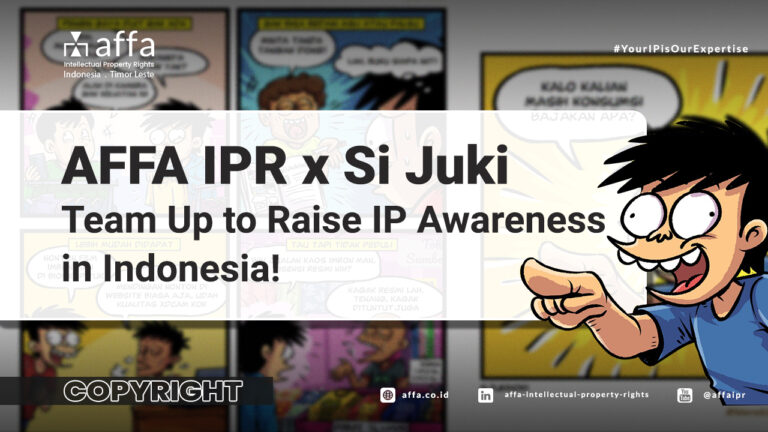
Check out AFFA IPR’s first collaboration with Indonesia’s iconic Si Juki character in a comic raising awareness about IP. With more than 771K followers on Instagram, Si Juki is the work of Faza Meonk, one of Indonesia’s most influential IP creators, who has collaborated several times with various international IPs, such as Garfield and SpongeBob SquarePants. Not only in comic form, Si Juki has also appeared in big-screen animated films. Stay tuned for more exciting collaborations from AFFA IPR!

Remixed-Music-from-the-Indonesian-Intellectual-Property-Perspective-AFFA-Copyright

Remixed Music from the Indonesian Intellectual Property Perspective

Remixed Music from the Indonesian Intellectual Property Perspective The weekend is just around the corner. Which club will you go to to spend the night? The club with the most comfortable atmosphere? In the middle of the city? On the beach? Club with makes the best drink? Or the one with the most popular live music?   Live music has become a form of entertainment that is inseparable from nightlife. With the mix of popular and new songs sung, we can be hypnotized for a moment and forget all our problems. But for those of you who are on the side of event organizers, venue managers, or artists who perform this music/song, don’t let yourself get into trouble.   Because music/songs with or without text (lyrics), in Article 40 of the Law of the Republic of Indonesia Number 28 of 2014 concerning Copyright, is stated as a form of protected work. For these creations, there are Exclusive Rights (moral and economic) holders entitled to royalties from every music/song performed. If done without paying royalties, performing music/songs without permission for commercial purposes can be categorized as a Copyright violation.   However, Who Should Pay the Royalties? In Article 3 of the Republic of Indonesia Government Regulation Number 56 of 2021 concerning the Management of Song and/or Music Copyright Royalties, it is regulated that every person can make commercial use of songs and/or music in the form of commercial public services by paying royalties to the Creator, Copyright Holders, and/or Related Rights Owners through the National Collective Management Organization (LMKN).   Commercial public services include commercial seminars and conferences; restaurants, cafes, pubs, bars, lounges, nightclubs, and discotheques; music concerts; airplanes, buses, trains, and ships; exhibitions and fairs; cinema; telephone waiting tone; banks and offices; shops; recreation center; television broadcasting institutions; radio broadcasting institutions; hotels, hotel rooms, and hotel facilities; and karaoke business.   Regarding Music Mix performed in restaurants, cafes, pubs, bars, discotheques, or nightclubs, Article 3 GR No. 56 of 2021 concerning the Management of Song and/or Music Copyright Royalties has specifically regulated the rates as follows:   Restaurants and Cafes Royalties are determined per seat per year, with the provisions of the Creator royalty being IDR 60,000 per seat per year and the Related Rights royalty being IDR 60,000 per seat per year.  Pubs, Bars, and Lounges Royalties are determined per square meter per year. The royalty rate for the Author’s Rights is IDR 180,000 per square meter per year, and the royalty rate for Related Rights is IDR 180,000 per square meter per year.  Discotheques and Nightclubs Royalties are determined per square meter per year. The royalty rate for the Author’s Rights is IDR 250,000 per square meter per year, and the royalty rate for Related Rights is IDR 180,000 per square meter per year.   Note: Author’s Rights are royalties given to the Creator, while Related Rights are royalties given to musicians, original singers (performers), and producers of the song/music.   Because Creators or recipients of Related Rights do not always know when and where their songs are performed, the government has given authority to LMKN to collect royalties and distribute them to Creators and recipients of Related Rights. Therefore, if you are a restaurant and cafe, pub, bar and lounge, discotheque, and nightclub manager, you will be the one who will be charged royalties for the songs/music held inside your business, not the artist or performer who performs the music.   Before LMKN inspects your business, it would be a good idea for you first to carry out the following procedures: Submit a license application to the Copyright holder or Related Rights owner through LMKN; The license agreement is recorded by the Minister of Law and Human Rights by statutory provisions; Provide reports on the use of songs and/or music to LMKN via the Song and/or Music Information System (“SILM” Platform); Pay royalties to Creators, Copyright holders, and/or Related Rights owners through LMKN;   Based on the rules above, royalty payments are not explicitly charged per song but are based on the number of seats or the size of your commercial area. But you must know what song and/or music is being performed so that you can accurately report it through SILM, and the creator and/or recipient of related rights can obtain their rights properly. You can then hold proof of royalty payments to LMKN if, in the future, there is a lawsuit from the creator who objects to the use of their work in your place.   What if the Music Mix is commercialized? Sometimes, DJs also record and distribute their favorite remixes, even selling them on a limited basis to their fans. Is this an unlawful act?   Returning to the rules regarding the Exclusive Rights of a music/song, where Article 9 of the Copyright Law states that only the Copyright Holder has the Economic Rights to adapt, arrange, and transform the work, as well as copy and use commercially, so to be able to do this, these DJs must obtain permission by submitting a license application to the Copyright holder or Related Rights owner. Otherwise, as regulated in Article 113 concerning Criminal Provisions for Copyright Infringement, “Every person who fulfills the elements as stated in as intended in paragraph (3), which is committed in the form of piracy, shall be punished with imprisonment for a maximum of 10 (ten) years and/or a fine of a maximum of IDR 4,000,000,000.00 (four billion rupiah).”   After understanding the risks, if you are a DJ or musician and a live music organizer, you have to be more aware of implementing your business by applicable regulations. If you have further questions regarding commercial use of music/songs, Copyright, or other Intellectual Property, don’t hesitate to contact us via [email protected].

Enters-Public-Domain-Mickey-Mouse-Stars-in-3-Horror-Films-affa-global

Enters Public Domain – Mickey Mouse Stars in 3 Horror Films?

Enters Public Domain – Mickey Mouse Stars in 3 Horror Films? Mainstream news channels are busy reporting that Mickey Mouse, The Walt Disney Company’s mascot, has entered the Public Domain as of January 1, 2024. As a result, many parties are immediately looking for their fortune by presenting this black mouse in various media. Uniquely, they all have a horror theme!   1. The Vanishing of S.S. Willie Straight released on January 2, 2024, on the Night Signal Entertainment YouTube channel, this is a short film less than 10 minutes long, which assumes that the film “Steamboat Willie” published in 1928, the first film to feature the character Mickey Mouse, is an actual event.   Mickey, Minnie, and other animal characters are displayed in realistic form, covered in retro visuals, but with different names. The horror side is that their story ends tragically at the bottom of the river, contrasting with the cheerful original animated version.   2. Mickey’s Mouse Trap Also released on the same day is a 2-minute trailer for the film, which will be released in March 2024. This time, the story is about a serial killer who wears a Mickey Mouse-like mask and operates in an amusement park.   3. Steamboat Willie The third horror film to utilize Public Domain Mickey is the work of Director Steven LaMorte, who previously directed “The Mean One” (2022), a horror-comedy film inspired by “The Grinch” (2018). Steven admitted that filming of Steamboat Willie will take place this spring, and the concept remains a horror-comedy in the style of The Mean One. Steve confirmed to the media that his work would not violate the law because it would not use the name Mickey Mouse but Steamboat Willie.   4. Infestation: Origins Lastly, Mickey is in a PC game that up to four people can play. Here, you can play as a rat exterminator set in the 80s. But then, you are chased by a monster resembling Mickey Mouse! This game produced by Nightmare Forges can now be ordered on the Steam website, but the official release date has yet to be announced.   What is Public Domain? A work or Creation, including animated films, can be protected by Copyright. Then there is the Copyright Law, which regulates the validity period of Economic Rights, which is a reference for whether we still have to obtain permission from the Creator or Copyright Holder for a Work. If the validity period has passed, the work has entered the Public Domain, and the public can use it freely without asking permission from the Creator.   Why 95 Years Later? The Copyright Law in the United States stipulates that a work’s validity period is during the Creator’s life plus seventy years after the Creator dies. However, this regulation was only applied to all works published starting January 1, 1978. Meanwhile, Steamboat Willie was already present 50 years earlier. That’s why the film still has 95 years of Economic Rights and ends on December 31, 2023. Finally, Steamboat Willie only entered the Public Domain as of January 1, 2024.   Now Everyone is Free to Use Mickey Mouse? Certainly not! Because the only thing in the Public Domain is Mickey Mouse in Steamboat Willie: the Black and White Mickey without gloves. What also needs to be remembered is that as a character, two types of Intellectual Property (KI) are attached to Mickey Mouse: Copyright and Trademark.   If a copyright has an expiration validity period, then a trademark can be renewed every ten years. Mickey Mouse is a registered Trademark still owned by The Walt Disney Company. That’s why none of the works above that use Public Domain Mickey use the name “Mickey Mouse.” They consciously did not use this name to avoid legal disputes. They only dare to use “Mickey” or “Steamboat Willie,” common names not registered by anyone.   So, even though Steamboat Willie has entered the Public Domain, that doesn’t mean you are free to produce and/or sell products that contain colored versions of images or words of Mickey Mouse. The point is that Public Domain doesn’t necessarily make your own Mickey Mouse.   Mickey Mouse Still Owned by The Walt Disney Company Amid widespread news related to the Public Domain, the role of the media is needed to educate people so as not to create new problems. Because incomplete reporting can make many parties who are less aware of IP, including SMEs, subject to warning letters from Disney’s lawyers. They join in on the hype by producing products depicting colored versions of Mickey Mouse and containing the word without realizing the potential for Copyright and Trademark violations.   Remember that Walt Disney is a big company in the IP business. They understand the ins and outs of Intellectual Property law. Apart from that, they also continue to update their IP-based characters and their source of income. That is the only way the validity period of Economic Rights in Copyright can continue to be extended. Steamboat Willy is only one of tens of thousands of works featuring IP-based characters, a source of income for the Walt Disney Company. Missing one will not affect its revenue, which since 2022 will be above USD 80 billion per year.   From Walt Disney, we learn that creating original characters, if managed well, will be more profitable and provide long-term benefits. Instead of making imitation works that take advantage of the momentary hype. The public will also see it as a cheap work or a parody of no quality.   Should you need further information about Public Domain, Copyright, or other Intellectual Property management, please do not hesitate to contact us via [email protected]. Sources:  Coming Soon Variety  

Unveiling-Copyright-Ownership-in-the-Film-Industry-Legal-Perspectives-affa-global

Unveiling Copyright Ownership in the Film Industry: Legal Perspectives

Unveiling Copyright Ownership in the Film Industry: Legal Perspectives There is still often a question among the public about who owns the copyright for a large-scale work, such as a movie. Because movies, especially feature films, involve many derivative works and other interrelated supporting works. Starting from scripts, background music, movie posters, and even a game specifically made to promote the movie.   So, who owns the copyright of all these works? Does the Director hold everything? Producer? Or both of them?   Definition of Copyright According to Article 1 of Law No. 28 of 2014 concerning Copyright (Copyright Law), what is meant by Copyright is the Exclusive Right of the Creator, which arises automatically based on declarative principles after a work is realized in actual form without reducing restrictions by the provisions of statutory regulations.   From the definition above, there are two essential emphases of Copyright as follows: 1. Exclusive Rights, consisting of: Economic Rights The Exclusive Right of the Creator or Copyright Holder to obtain economic benefits from the Work Moral Rights Rights that are eternally inherent in the Creator 2. Arises automatically based on Declarative Principles    No recording or registration is required to obtain protection.   Then, a Creator is a person or several people who produce a creation individually or together. Movies in the Copyright Law are referred to as Cinematography as mentioned in Article 40 Paragraph (1) letter (m), which means moving images, including documentary movies, advertising movies, reportages, or story films made with scenarios, including cartoon or animation films.   Cinematography works can be created on celluloid tape, video tape, video disc, optical disc, and/or other media that allows it to be shown in cinemas, big screens, television, or other media.   Copyright Holders of Movies/ Cinematography Works In general, 3 (three) parties are referred to as Copyright Holders, namely: Copyright Owner/Creator The party who legally receives the rights from the Creator Another party who receives further rights from the party who received the rights   However, if we talk about specific copyright holders for movie-related products, the details are as follows: Movie Related Products Types of Creation Notes Original/ raw/ in-editing process/ final movie. Copyright for Cinematographic Works Creator: Director Copyright Holder: Film Producer Script/ Story Copyright for Written Works Creator: Script/Story Writer Book – If the film is adapted from a book. Copyright for Books/Writing Works Creator: Book Author Adaptation Copyright Holder: Film Producer Book – If the film is adapted into a book. Copyright for Books/Writing Works Creator: Book Author Adaptation Copyright Holder: Book Publisher Background Music (BGM), scoring, soundtrack, sound effects, or other related music works. Copyright of Songs and/or Music Creator: Song Creator (can be assigned to Music Publisher) Related Rights: Musicians, Singers, and Record Producers Movie posters Copyright for Drawing/Painting Artworks Creator: Poster Designer Movie Exhibitions/ advertising/ promotions (photography, banners, etc.) Copyright for Photographic Works, Portraits, Databases, Video Games, Computer Programs, Appearances in the form of Written Works Creator: Photographer, Designer, and Game/Computer Programmer.   Knowing who the creator of the creations above is, if you are involved in them, especially if your position is the creator, you are entitled to Exclusive Rights to cinematographic works, valid for up to 50 (fifty) years from the first announcement.   Benefits of Copyright Recordation Also, please ensure your name is recorded in the Creation Recordation Letter issued by the Minister and in the General Register of Works, which serves as initial proof of ownership of a work and is substantial evidence in court. Even though it is not mandatory, Copyright recordation is beneficial for the following 2 (two) things: Prevent misuse of recorded works and simultaneously prevent losses arising from abuse of said works. Make it easier for Copyright owners to claim royalties for recorded Copyright licenses.   Should you have further questions regarding Copyright and its registration in Indonesia and abroad, do not hesitate to contact us via [email protected]. Sources: Law Number 28 of 2014 concerning Copyright (Copyright Law) Directorate General of Intellectual Property (DGIP)  

5-Common-Types-of-IP-Violation-in-Indonesian-E-Commerce-affa-global

5 Common Types of IP Violation in Indonesian E-Commerce

5 Common Types of IP Violation in Indonesian E-Commerce The presence of e-commerce has changed the shopping habits of Indonesians. Statista Market Insights data predicts that users by the end of this year will reach 196.47 million, or an increase of more than 22 million since 2022.  The Central Bank of the Republic of Indonesia also stated that the value of e-commerce transactions in 2022 will reach IDR 476.3 trillion. This number is predicted to continue to increase because active e-commerce users in Indonesia still account for only around 30% of transactions in cyberspace.   By now, opening an e-commerce site or app is the easiest way to compare the cheapest product we want. However, with all this convenience, you must still be aware of the potential for Intellectual Property violations in e-commerce. You need to remember that even though the platform organizers have tried to carry out sorting even with AI, it will only be helpful if you, who have self-screening capabilities, are easily tempted by the low prices of products that should be expensive.   Counterfeit goods are not the only potential for Intellectual Property (IP) violations in e-commerce; there are at least 5 (five) types of IP violations, which we can describe as follows:   1. Sale of Counterfeit Goods Even when selling fake goods, the method is more sophisticated, not blatantly using names or products with very different qualities. a. Photos taken from the official site; Suppose the seller is not an official store but uses an official photo. In that case, you should immediately be suspicious and use your right to ask for some actual photos of the product before making a transaction.   b. Preloved with invoice; If the seller uses pictures that show an invoice with the product, like pretending it was purchased from an official store, please don’t hesitate to ask for some photos of the actual product before making a transaction.   c. Normal price for a counterfeit product; If you are a collector of specific brands, you must know the shape, color, or placement of the official logo on the product. You may also know how many variants are produced for this season, including the look of the limited variants. So you won’t be deceived when you find a product with a different color, which shouldn’t be available in the market, even though it is the same price as the original product.   d. Using the word ORI or SUPER ORI or HIGH GRADE; The word “ori,” which means original, should only be used for authentic products. However, sellers of counterfeit goods have recently used this word to attract buyers. Moreover, if the inclusion of the word “ori” is coupled with the price of the item being much cheaper, you should be suspicious of its authenticity.   e. Cheap products directly from the factory. It would be best if you were also wary of this description when you find a cheaper good on e-commerce. Only official stores or distributors can do this if the product comes from Indonesia and gets wholesale price benefits. Another possibility is stolen goods that are not complete or of bad quality. Are you sure you still want to buy something like that?   2. Promoting Product Without Verification This type is the same as in the first category; the difference is that it involves the lure of a big discount, which results in the price being much lower than the market, but it is not sold by official stores or distributors (which in the same time are not providing the same promotions). Apart from the possibility that what is being sold is not a genuine product, it could also be that the product is smuggled without paying official import taxes, with questionable completeness and quality.   3. Selling Irresponsibly Through E-Commerce Sometimes, some health and beauty products are sold using a “direct selling” scheme, and sale activities via e-commerce are prohibited. Because their exclusive products are only sold through direct selling methods to downlines/registered members. So direct sales to the public (non-members) are a violation because they destroy the agreed business scheme and membership system.   4. SOPs for IP Violations in E-Commerce Are Not Yet Standardized Even though e-commerce has acted as an intermediary that will hold funds from buyers and return them if there is a problem with the goods, there are still loopholes that allow transactions to be completed even though the goods have a problem. For example, the buyer forgets to unbox with a video or only immediately checks the item’s authenticity after the deadline. If you are caught in this problem, the procedures of complaint from each e-commerce are not standardized. The absence of customer service that truly understands the situation makes this even more difficult. Especially if the customer service is entirely automated without involving humans.   5. Borderless E-Commerce Platform With the increasingly open cross-border international trade through e-commerce, you must understand the risks of purchasing goods outside Indonesia. If you find lower prices for goods, even though they are shipped from abroad, and you know that there is an official distributor in Indonesia, your vigilance needs to be increased even more. Because there could be an IP violation in the form of distribution without permission/violating the law/not paying import tax, which is not impossible, within the time frame of the order process, the police arrest the seller in the country of origin, and you will not get the goods you want.   All of the IP violation practices above harm you as a buyer and significantly impact the country. These losses include: Negative Reputation of Indonesian From the latest Priority Watch List (PWL) 2023 report, released by the United States Trade Representative (USTR), Indonesia, along with Argentina, Chile, India, Russia, China, and Venezuela, is still on the investment blocklist because it is prone to piracy practices. In particular, the Notorious Markets for Counterfeiting and Piracy 2022 report, also released by USTR, lists several local e-commerce sites…

Demystifying-the-Public-Domain-Permissions-and-Limitations-affa-global

Demystifying the Public Domain: Permissions and Limitations

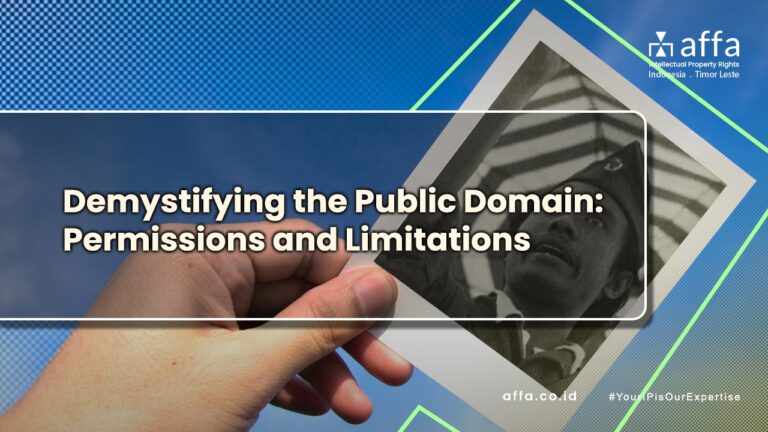
Demystifying the Public Domain: Permissions and Limitations We can almost always see this iconic portrait of Bung Tomo‘s enthusiastic speech every November 10th, as Indonesia celebrates National Heroes’ Day. In fact, according to Tempo Magazine‘s journalistic investigation, this photo was not taken on that date but later in 1947 by Frans Mendur, when Bung Tomo chaired a meeting in Malang, East Java.   As a Work, this iconic portrait was first published in 1949, together with other historical photos of the Indonesian struggle, including photographs of the Proclamation, taken by Alex Mendur, Frans Mendur, and Abdoel Wahab Saleh, in a photo album “Revolutionary Paintings” courtesy of the Indonesia Press Photo Service (IPPHOS). The first two names are the brothers who founded IPPHOS. Because the portrait of Bung Tomo in Malang is more in line with the public’s imagination about the war spirit of November 10, rather than the actual conditions, where orations were only given in radio studios, this portrait is widely used to support Heroes’ Day.   However, a portrait is still a Work that has copyright protection. Articles 1 and 9 of the Indonesian Copyright Law specifically state that a portrait is a photographic Work with human objects, and only the Creator has Economic Rights to publish, reproduce in all forms, adapt, transform, and distribute a Work. If another party wants to use it, they must obtain permission from the Creator or Copyright Holder.   What if the Creator or Copyright Holder no longer exists? The Copyright Law regulates the validity period of Economic Rights, a reference for whether we still have to obtain permission from the Creator or Copyright Holder for a Work. If the validity period has passed, the Work has entered the Public Domain, and the public can use it freely without asking anyone for permission.   The Copyright Law in Indonesia divides the validity period of Economic Rights over Work into three different periods:   1. 25 years since the first publication; Applies to Works of Applied Art in the form of fine art created by using art to a product so that it has an aesthetic impression to meet practical needs, including images, motifs, or ornaments on a product.   2. 25 years since the first publication; This applies to the following three categories: Photographic works; portrait; cinematographic; video games; computer program; the appearance of written work; translations, interpretations, adaptations, anthologies, databases, adaptations, arrangements, modifications, and other works resulting from transformation; translation, adaption, arrangement, transformation or modification of traditional cultural expressions; compilation of works or data, either in a format that computer programs or other media can read; and the compilation of traditional cultural expressions as long as the compilation is an original work. Works Made for Hire; Anonymous Works and Pseudonymous Works.   3. During the life of the creator and 70 years after the creator’s death; Books, pamphlets, and all other written works; lectures, lectures, speeches, and other similar works; demonstration materials created for educational and scientific purposes; songs or music with or without text; drama, musical drama, dance, choreography, puppetry, and pantomime; works of fine art in all forms such as paintings, drawings, carvings, calligraphy, sculpture, statues or collages; architectural works; map; and batik artwork or other motif art.   4. Limitless Time Applies to held Traditional Cultural Expressions by government, which includes the following six categories: a. textual verbal, both spoken and written, in the form of prose or poetry, in various themes and message content, which can be in the form of literary works or informative narratives; b. music, including, among other things, vocal, instrumental, or a combination thereof; c. movement, including, among other things, dance; d. theater, including, among other things, puppet shows and folk plays; e. fine arts, both in two-dimensional and three-dimensional form, made from various materials such as leather, wood, bamboo, metal, stone, ceramics, paper, textiles, etc., or a combination thereof; and f. traditional ceremonies.   From the four categories above, it can be concluded that all works, if not included in Traditional Cultural Expressions, will ultimately fall into the Public Domain. Therefore, the portrait of Bung Tomo, first published in 1949, has been in the Public Domain since 1999.   In addition, there are regulations in Article 43 (e) of the Copyright Law regarding Copyright Restrictions, which states that duplication, announcement, and/or distribution of portraits of the President, Vice President, Former President, Former Vice President, National Heroes, heads of state institutions, leaders ministries/non-ministerial government agencies, and/or regional authorities with due regard for dignity and fairness by the provisions of laws and regulations are not considered a Copyright Infringement. Since 2008, Bung Tomo has been designated as a National Hero, so the public’s use of this iconic portrait is not Copyright infringement.   However, it would be best to remember that the legal basis governing Copyright varies in each country. So, the rules that apply in Indonesia may be different from other countries.   Comparison of Public Domains Abroad Duration of Copyright in the United States The Copyright Law in the United States divides the duration of Copyright as follows:      1. During the life of the creator and 70 years after the creator’s death; The creator’s identity is known for all works created after January 1, 1978.      2. 95 years from the year of its first publication, or a term of 120 years from the year of its creation, whichever expires first; For Anonymous Works, Pseudonymous Works, and Works Made for Hire      3. 45 years after the creation; Works created before January 1, 1978, but expired before December 31, 2002; and, if the work is published on or before December 31, 2002      4. 28 years after the publication. Any Posthumous Work or of any periodical, cyclopedic, or other composite work upon which the copyright was originally secured by the proprietor thereof, or any Work copyrighted by a corporate body (otherwise than as assignee or licensee of the individual author) or by an employer for whom…

The-Impact-Of-Intellectual-Property-On-The-Quality-Of-Life-For-People-With-Disabilities-affa-global

The Impact of Intellectual Property on the Quality of Life for People with Disabilities

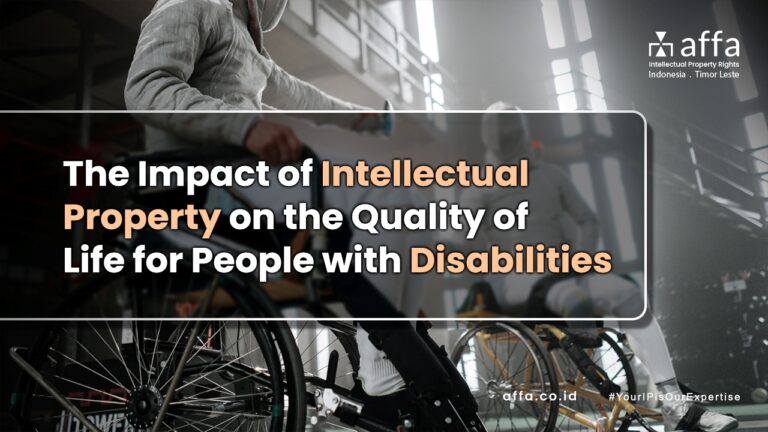
The Impact of Intellectual Property on the Quality of Life for People with Disabilities   The 2022* Asian Para Games, which ended yesterday in Hangzhou, China, showcased human civilization’s sportsmanship, high fighting spirit, and demonstrated the impact of Intellectual Property (IP) on the quality of life of people with disabilities in many ways. For example, the Games featured a wide range of patented assistive technologies used by athletes with disabilities to compete at the highest level. These patented assistive technologies included:   Running Prosthetics:  Losing a leg (or both) is not an obstacle for paralympic athletes to run; they no longer use prosthetic legs in the form of legs but unique legs in the form of carbon fiber plates, which are lighter and enable them to run like Olympic athletes. One of the Running Prosthetic manufacturers whose products are widely used is Ottobock, which currently has more than 1,800 patents.   Racing Wheelchairs: There are three sports where wheelchair use is permitted at the 2022 Asian Para Games: basketball, fencing, and tennis. Of course, they don’t compete with ordinary wheelchairs, but wheelchairs with innovative technology that makes them lighter but more robust, which allows them to act more quickly and safely.   Swim Fins: Swimming athletes who don’t have legs can use artificial fins made from silicon worn on their hands to swim faster and more efficiently.   Blindfolds: Because not all Paralympic athletes are entirely blind, for the competition to be fair, they are required to use unique cloth coverings, for example, when competing in athletics. These blindfolds are also made with an innovative design to be worn comfortably throughout the competition.   At the 2022 Asian Para Games, Indonesia achieved the highest achievement by reaching 6th place, under China, the Islamic Republic of Iran, Japan, the Republic of Korea, and India. The economic benefits obtained certainly do not only come to people with disabilities. The sporting event, which took place from October 22nd to 28th, 2023, generated billions of dollars in economic activity and created thousands of jobs from its implementation and innovative products protected by Intellectual Property.   Intellectual Property continues to play an essential role in improving the quality of life of people with disabilities in various ways, including: Encourage innovation in assistive technologies to help people with disabilities live more independent and fulfilling lives. For example, IP rights have been instrumental in developing technologies such as screen readers, speech-to-text software, and prosthetic limbs. Make assistive technologies more affordable and accessible to people with disabilities. For example, IP rights can establish licensing agreements allowing manufacturers to produce and sell assistive technologies at lower prices. Promote the inclusion of people with disabilities in the workplace and society. For example, IP rights can be used to protect the intellectual property of businesses that employ people with disabilities. This can help to create jobs for people with disabilities and reduce the stigma associated with disability.   Overall, the 2022 Asian Para Games were a powerful reminder of the positive impact that IP can have on the quality of life for people with disabilities. IP-protected assistive technologies can help people with disabilities live more independent and fulfilling lives, participate in the workplace and society, and achieve their full potential.    If you need more information about IP protection in Indonesia or abroad, please feel free to contact us via email at [email protected] Source: WIPO Magazines 2022 Asian Para Games   *) Dated 2022, as it originally marked the event scheduled for 2022, which was subsequently rescheduled to 2023 due to the COVID-19 Pandemic.

The-Intellectual-Property-Landscape-of-Tokusatsu-A-Comprehensive-Overview-affa

The Intellectual Property Landscape of Tokusatsu: A Comprehensive Overview

The Intellectual Property Landscape of Tokusatsu: A Comprehensive Overview Tokusatsu (特撮) is a Japanese term for live-action (non-anime) films or television programs that heavily use practical special effects. However, in its development, this genre in Japan is mainly used in movies or series with superhero themes. From giant monsters (Kaiju) such as Godzilla and Gamera, humans who turn into giant Ultraman, masked heroes riding a bike (Kamen Rider), colorful Super Sentai heroes, metallic heroes like Gavan, and many more.   In Japan, Tokusatsu has become an enormous industry. Every year, there are at least 3 (three) new series, 2 (films) on the big screen, and dozens of OTT content, with some toys that consistently record best-selling toy sales. The BANDAI toy company, as the Master Licensee of Kamen Rider, Ultraman, and Super Sentai, records revenues of around 60 billion Yen per year from the above Intellectual Properties. Of course, this is apart from the income from broadcasting rights received by Production Houses from broadcasting throughout the world.   Then, what other Intellectual Properties are related to Tokusatsu? Here is the explanation:   1.      Copyright Copyright is Intellectual Property in science, art, and literature resulting from inspiration, ability, thoughts, imagination, dexterity, skills, or expertise expressed in real form. According to the Copyright Law, the work is called Creation, and the creator is for sure called the Creator. Because one individual does not make Tokusatsu but is a joint work of several companies, the Creator can be the designer or production leader with the title of Producer, but these companies own the Copyright Holder. For example, the late Shotaro Ishinomori is recognized as the creator of the Kamen Rider series. Still, the Copyright Holder is listed as jointly owned by Ishimori Pro (Shotaro’s company), TV Asahi (the broadcasting TV station), and TOEI (the production house). Companies registered as Copyright Holders can also be seen from writing such as “(C) 2023 石森プロ・テレビ朝日・東映” in various published materials. Tokusatsu’s works related to Copyright are not only the series or films but also the songs, scripts, characterizations, illustrations, and books related to them. Copyright is protected as long as the creator is alive, plus 70 years after that, and cannot be extended. Protected here means that only the Copyright Holder has Economic Rights and Moral Rights, so that no other party may publish, duplicate, translate, adapt/arrange/transform, distribute, announce, communicate, or rent it without the permission of the Copyright Holder.   2.      Trademark Trademark in Tokusatsu is not the additional protection but the primary Intellectual Property, which makes the name unique, along with the logo, which makes it different from other works already on the market. In contrast to Copyright, which does not need to be registered, Trademarks must be registered to obtain protection. When applying for a Trademark, it is necessary to provide information about the appropriate protection classes according to its products and/or services. The number of classes registered for the Tokusatsu series, which airs throughout the year, usually reaches 22 classes, but for films, it is only around 6 (six) to a dozen. This significant difference in numbers is because broadcasts present throughout the year will also have more derivative products and services that can be produced, and all of them must be protected from the possibility of being exploited by other irresponsible parties. Some of the trademark classes that are usually registered for the Tokusatsu series that air throughout the year are classes 32 (beverages), 30 (processed food), 28 (toys), 25 (clothing), 16 (paper), and 9 (electronic equipment). Uniquely, the Trademark Registration process is open from the start of the application process, which can be accessed by the public via the Japanese Patent Information site, providing a means for fans to get a sneak peek at the name of the new Tokusatsu series, several months before the official announcement.   3.      Industrial Design In the world of Tokusatsu, there is a unique symbiotic mutualistic relationship between toy manufacturers and Copyright Holders. It is so unique that it is common knowledge that the Tokusatsu series is called a toy advertisement that airs throughout the year. As a toy manufacturer and shareholder of the Tokusatsu producers, BANDAI also provides other support, namely making character designs, so that they can be immediately ready to be produced in various kinds of toys liked by fans of various ages from abroad. The Industrial Designs for Tokusatsu toys registered by BANDAI can also be seen on the Japanese Patent Information site. Uniquely, even though the Industrial Design is registered and owned by BANDAI, all names involved in the creative process, including representatives from the production house, are still registered as the Designer. Registration of Industrial Designs for these toys is essential so that no other party makes imitation products. Because the practice of pirating Tokusatsu toys is usually done by producing the same toys but with different Trademarks. So by registering, even if these pirates escape the trap of Trademark violations, they will not escape Industrial Design violations.   4.      Patent Patents are one type of Intellectual Property that needs to be understood in Indonesia. It is as if the patent is Intellectual Property, even though it is only one type. Patents are Intellectual Property directly related to innovation and technology with novelty value. If associated with Tokusatsu, the patent protection could be in the thin but strong action figure joint technology, toy sensors that can be activated by finger movements or inserting a coded card, and BANDAI owns all the patents.   5.      Trade Secret The formula used to make a hero’s costume that is strong but light, to the right amount of chemicals to cause a significant but safe explosion, as well as other secret formulas, can be kept as Trade Secrets. These secrets make Tokusatsu a spectacle that continues to amaze fans, and all team members involved are bound by a Non-Disclosure Agreement (NDA).   6.      License Agreement After having a recorded Copyright…