Indonesia - Adjustment to the IP Services Official Fees Under the Government Regulation No.24 Year 2024 - AFFA IPR

Indonesia – Adjustment to the Intellectual Property Services Official Fees Under the Government Regulation No. 45 Year 2024

The Government of the Republic of Indonesia has issued the latest update on the Non-Tax State Revenue for the Ministry of Law and Human Rights under the Government Regulation No. 45 Year 2024. The adjustments cover IP services pertaining Trademark, Geographical Indication Patent, Industrial Design, and Copyright. We herewith provide you the summary of the changes for your perusal and please bear in mind that anything not listed here is not affected.   Trademark and Geographical Indication The items that have been adjusted are as follows:   Type of Action Old Fees New Fees International Registration designating Indonesia CHF 144 CHF 125 International Registration renewal in Indonesia CHF 180 CHF 156 International Registration renewal in Indonesia (within 6-month grace period) CHF 360 CHF 313 Requesting substantive examination for a Geographical Indication application N/A IDR 1,000,000.00   Patent The items that have been adjusted are as follows:   Type of Action Old Fees New Fees Accelerated publication IDR 400,000.00 IDR 500,000.00 Patent substantive examination request IDR 3,000,000.00 IDR 3,500,000.00 Simple patent substantive examination request IDR 500,000.00 iDR 750,000.00 Priority rights document request IDR 300,000.00 IDR 500,000.00 Patent decision appeal request IDR 3,000,000.00 IDR 4,000,000.00 Post-grant correction of description, claim, and/or figures after the patent is granted IDR 3,000,000.00 IDR 4,000,000.00 Post-grant appeal against the decision to grant a patent IDR 3,000,000.00 IDR 4,000,000.00 Patent Board of Appeal decision request N/A IDR 20,000.00 per page   Industrial Design No changes or adjustments were introduced for Industrial Design matters.   Copyright The items that have been adjusted are as follows:   Type of Action Old Fees New Fees Application IDR 400,000.00 OR  IDR 600,000.00 (if software) per creation IDR 200,000.00   Should you have any further questions and queries about the adjustment of official fees, please do not hesitate to contact us at [email protected].  

Unraveling the Global Complexity of IP Crime: Money Laundering and More! AFFA IPR

Unraveling the Global Complexity of IP Crime: Money Laundering and More!

Intellectual Property (IP) Crime negatively impacts the economy and consumer safety and has become structurally more complex, posing a worldwide threat to economic and social security.   According to the recently released report “Uncovering the Ecosystem of Intellectual Property Crime,” published this October by the European Union Agency for Law Enforcement Cooperation (Europol) and the European Union Intellectual Property Office (EUIPO), it is revealed that 6% of imported products entering the European Union are counterfeit, with a value exceeding 2 billion euros) annually. This figure represents only the seized products, mainly packaging materials, toys, cigarettes, and CDs/DVDs. Imagine if we could account for the undetected counterfeit goods distributed worldwide.   So, why is tackling IP crime so challenging? The report highlights that this form of crime is highly networked and involves corrupt officials, money laundering, and even tax officers. EUIPO labels these facilitators as IP Crime Enablers!   How significant is their role, and how do they perpetuate Intellectual Property crime? Here are the details.   Intellectual Property Crime – The Definition   In the document, “IP Crime” refers to illegal activities involving the theft, infringement, or unauthorized use of Intellectual Property (IP) rights, which include Copyrights, Industrial Designs, Trademarks, Patents, Geographical Indications, and Trade Secrets. The document categorizes IP crime primarily as:   Counterfeiting Manufacturing, importing, distributing, storing, or selling goods that bear the Trademark of a genuine brand without permission. Examples: Counterfeit Pharmaceuticals: Production and distribution of fake pharmaceutical products that can pose severe health risks to consumers. For instance, counterfeit Semaglutide injection pens falsely labeled as containing the active ingredient were found to contain other substances, leading to serious health incidents​. Counterfeit Automotive Parts: The production and distribution of fake automotive parts, like brake pads and wheel rims, infringe Trademarks and pose serious safety risks. Piracy Unauthorized copying, use, reproduction, and distribution of materials protected by IP rights, such as digital media, software, and entertainment. Example: Digital Piracy: Illicit streaming services that distribute copyrighted content (like movies and sports events) without authorization. In one case, a streaming service was operating across multiple countries, generating significant revenue through illegal broadcasts​.   The Mechanics of IP Crime   IP criminals exploit weaknesses in the global supply chain, legal loopholes, and infrastructure to operate with resilience and evade law enforcement efforts. This structured approach allows them to profit significantly while remaining difficult to prosecute due to their operations’ multi-jurisdictional and often hidden nature. The structured process criminal networks use to conduct IP crimes ranges from obtaining infringing items to laundering the proceeds. Here are the key phases:   Infringing IP Rights (Acquisition Phase) This is the initial stage where IP rights are intentionally violated. Criminals produce counterfeit goods by replicating brand logos, labels, or pirated content. This phase may involve either manufacturing counterfeit products directly or diverting legitimate products from the supply chain. Common sources for counterfeit goods include China, Hong Kong, and Türkiye. Transportation and Distribution Phase After acquiring the counterfeit items, networks transport them globally, often abusing the legal logistical and shipping sectors to move goods across borders. Criminals use sophisticated smuggling techniques, including splitting shipments and hiding counterfeit items within legitimate products to avoid detection. Marketing and Retail Phase Criminals use both online and offline methods to market and sell counterfeit products. Online marketplaces, social media platforms, and even the dark web provide anonymity and access to large audiences. Offline, counterfeit goods may also be sold through physical retail outlets or open markets. Dealing with Profits and Risks (Money-Laundering Phase) The final stage involves managing the profits from these illegal sales. Criminal networks employ money laundering techniques to disguise the origins of their profits. This includes investing in legal businesses, conducting physical cash transfers, or using complex digital financial systems to reintegrate funds into the economy.   Parties Also Involved in Intellectual Property Crimes In addition to the 4 (four) phases of crime above, Europol and EUIPO mapped the parties involved in IP crimes, making these crimes complex and challenging to eradicate.   Criminal Enablers These are illegal activities or crimes that help facilitate IP crime: Corruption: Bribery or manipulation within organizations to ease illegal processes. Forced Labour: Exploitation of labor, often under inhumane conditions, to produce counterfeit goods. Cybercrime: Digital crimes that support IP crime, such as phishing, malware, or data theft. Money Laundering: Concealing the profits from IP crime by converting illegal earnings into legitimate assets. Document Fraud: Creating fake documents to disguise the origin or legitimacy of counterfeit goods. Environmental Crime (Envicrime): Illegal activities that harm the environment, often associated with the improper disposal of waste from counterfeit production. Non-Criminal Enablers These are lawful activities or structures that criminals misuse to facilitate IP crime: Professional Expertise: Use of skills from professionals (e.g., lawyers, technicians) to support illegal IP activities. Use of Legal Business Structures (LBS): Legal businesses that provide a front for illegal IP activities, such as follows: Trading Companies or Factories These legitimate businesses can be set up or inserted into the supply chain to disguise the production or distribution of counterfeit goods. Factories or production sites can be used to produce counterfeit goods under the guise of legitimate products. Warehouses or Logistics Service Providers Legitimate warehouses or logistics companies can be used to store or transport counterfeit goods without raising suspicion. For example, counterfeit goods can be hidden among legitimate products in international shipments. Physical Retail Stores Appearing legitimate stores can be used to sell counterfeit goods to consumers without their knowledge. Counterfeit goods can be sold alongside legitimate products, making it difficult for consumers to tell the difference. Online Stores or Marketplace Platforms Many IP criminals use e-commerce websites or accounts on platforms like Amazon, eBay, or social media to sell counterfeit products. These platforms often give the impression of a legitimate business, making it easier for criminals to reach consumers at a wide range. Front or Shell Companies These companies are technically legitimate but serve only as a front for illegal activity. They are often used to launder money…

The Legal Risks of Selling (Unauthorized) T-Shirts with Popular Character Images - AFFA IPR

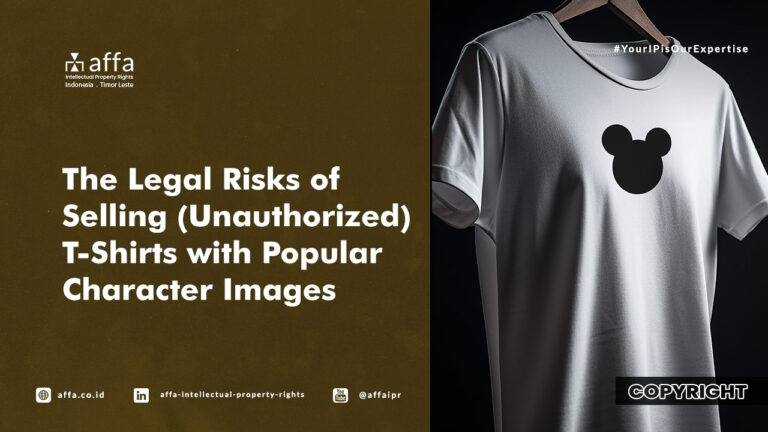
The Legal Risks of Selling (Unauthorized) T-Shirts with Popular Character Images

We can still easily find t-shirts with popular character images in small stores, shopping centers, exhibitions, and e-commerce in Indonesia. For those of you who are fans of popular culture from within and outside the country, the presence of t-shirts with characters that you like, sometimes with attractive designs, and also at low prices, is very tempting to buy.   But what if these t-shirts are not licensed or use the images without permission? Are there any legal consequences for the buyer? Here is the discussion from the Intellectual Property law perspective that applies in Indonesia.   Legal Standing   Article 40 of Law Number 28 of 2014 (Copyright Law) has recognized that works of fine art in all forms, such as paintings, drawings, carvings, calligraphy, sculptures, statues, or collages, photographic works, to cinematographic works that are closely related to popular culture, are protected creations. Therefore, the state guarantees that Exclusive Rights consisting of Moral Rights and Economic Rights are given only to the Work’s Creator, Copyright Holder, and/or Related Rights Owner.   This Copyright Law also covers all works or Creations and/or Related Rights products and users of Creations and/or Related Rights products from Indonesian Citizens and non-Indonesian citizens, non-Indonesian residents, or those who are not Indonesian legal entities, with the following provisions: Their country has a bilateral agreement with the Republic of Indonesia regarding the protection of Copyright and Related Rights; or Their country and the Republic of Indonesia are parties or participants in the same multilateral agreement regarding Copyright and Related Rights protection.   The point is that it is inevitable that all works born from popular culture originating from abroad will be recognized as copyrighted in Indonesia. Therefore, all activities of utilization, duplication, distribution, and commercialization must have the permission of the Creator, Copyright Holder, and/or Related Rights Owner. Otherwise, it will be categorized as piracy!   This piracy is regulated explicitly in Article 1 of the Copyright Law, where it is clear that what is meant by Piracy is the unauthorized duplication of Creations and/or Related Rights products and the widespread distribution of the resulting duplication goods to obtain economic benefits.   Penalties for Piracy   Article 113 Paragraph (4) of the Copyright Law states explicitly that “Any person who fulfills the elements as referred to in paragraph (3), which is carried out in the form of piracy, shall be punished with imprisonment for a maximum of 10 (ten) years and/or a maximum fine of Rp. 4,000,000,000.00 (four billion rupiah).”   Terrible sanctions, right? Unfortunately, this criminal threat has not been appropriately socialized because many still do not understand the term piracy. There is even a glorification for successful SMEs by commercializing the use of characters protected by copyright without permission. Finally, this Piracy activity continues rampant without understanding its negative impacts. In fact, Copyright is important to protect.   You might also want to read: Media Missteps: 5 Intellectual Property Blunders to Avoid   5 Reasons Why Copyright is Important Copyright protection is an important part of the legal system that supports economic justice and innovation, with the following details:   Respecting Creators: Protecting copyright ensures that creators of works receive proper recognition and compensation for their work. This provides an incentive to continue innovating and creating. Encouraging Creativity: With copyright protection, individuals and companies are more likely to invest time and resources in creating new works because they can expect a return. Regulating the Use of Works: Copyright gives owners control over how their work is used, shared, or modified, helping to prevent misuse or unauthorized use. Economic Growth: Copyright supports the creative industry, significantly contributing to economic growth through job creation and tax revenue. Consumer Protection: It helps ensure that consumers get original, high-quality products, not imitations or pirated goods.   Therefore, if piracy occurs, all of the above points will be disrupted, from a low appreciation for creators, stagnant creativity, weak distribution supervision, and low product quality to worsening Indonesia’s ranking in the International Intellectual Property Index.   Your Contribution is Needed   If you have already bought a pirated t-shirt, you don’t need to worry about legal sanctions. Because in Indonesia, criminal sanctions are mainly aimed at those who produce, distribute, or sell pirated goods, not at buyers. The Indonesian Copyright Law focuses on parties who actively violate Copyright by reproducing, producing, or distributing works without the permission of the Copyright Holder.   However, although buyers of pirated goods are generally not faced with criminal sanctions, buying pirated goods is unethical because it supports an illegal industry that harms the original Creators and the creative industry. Buying pirated goods can also harm consumers because the goods often do not meet quality and safety standards.   You must realize that choosing legitimate and licensed products is the best way to support Creators and ensure that the products received are safe and of good quality. In addition, buying original products contributes to healthy economic growth and innovation for society.   You might also want to read: Intellectual Property Infringements in Indonesia: A Closer Look at Online Hypocrisy Should you need further information regarding Copyright protection in Indonesia, you can contact us via email: [email protected].

The Indonesian Constitutional Court Ruled Article 10 of the Copyright Law Unconstitutional - AFFA IPR

The Indonesian Constitutional Court Ruled Article 10 of the Copyright Law Unconstitutional

On February 29, 2024, the Constitutional Court of the Republic of Indonesia (MKRI) decided case Number 84/PUU-XXI/2023 concerning Material Review of Law Number 28 of 2014 concerning Copyright (Copyright Law) and declared Article 10 of the Copyright Law to be contrary to the 1945 State Constitution of the Republic of Indonesia (Constitution of Indonesia). How is this possible?   This case began when PT Aquarius Pustaka Musik, PT Aquarius Musikindo, and songwriter Melly Goeslaw (hereinafter referred to as the Petitioner) discovered that songs created and/or owned Copyright were being used by a User Generated Content (UGC)-based digital service platform. In early 2020, the Petitioner even filed a civil lawsuit against Bigo Technology Ltd. as the digital service platform ‘Likee’ manager to the Central Jakarta District Court’s Commercial Court for using songs whose Copyright is under his auspices without permission. Unfortunately, the panel of judges rejected the lawsuit because the videos shown were UCG-based, i.e., originated, created, and uploaded by application users, not by Bigo. Thus, Bigo cannot be held responsible.   The Indonesian Copyright Law Does Not Yet Regulate UGC   The rejected lawsuit to Bigo and Likee could occur because there is a vacuum in the Copyright law used for UGC-based platforms. Hence, the platform manager ignores and deliberately hides behind the Circular Letter of the Ministry of Communications and Informatics Number 5 of 2016, Chapter V-C Provisions Number 2(b), which states that the UGC Platform is not responsible for goods and/or services containing content that violates Intellectual Property Rights if it can be proven that there was an error and/or negligence on the part of the merchant or Platform user.   In fact, in Article 28-C and 28-D paragraph (1) of the Constitution of Indonesia, the state guarantees its citizens to benefit from science and technology and the arts to improve the quality of life and for the welfare of humanity, as well as to obtain fair legal certainty. Thus, the Human Rights of the Petitioners must be protected, promoted, upheld, and fulfilled by the State, in this case, the government as mandated in Article 28-I paragraph (4) which explicitly states that “Protection, promotion, enforcement and fulfillment of rights Human rights are the responsibility of the state, especially the government.”   One of the methods that the state must take in protecting and upholding the fundamental rights of the Petitioners is by establishing laws and regulations that can substantively and procedurally guarantee and ensure the implementation of these rights by the instructions of Article 28-I paragraph (5) the Constitution of Indonesia. Therefore, on the one hand, the State must create a legal norm or rule with a precise, firm formulation, without multiple interpretations, and includes or encompasses matters aimed at realizing these fundamental rights. On the other hand, the Petitioners are entitled to the certainty of the quo regulations. This is inevitable for its continuity in a rule-of-law state as required in Article 1 paragraph (3) of the Constitution of Indonesia, which states, “The state of Indonesia is a state of law.”   As stated in Indonesian Copyright Law:   Article 10 Managers of business premises are prohibited from allowing the sale and/or reproduction of goods resulted from Copyrights and/or Related Rights infringements in the location under their management.  Article 114 Every Person managing business premises in all its forms who deliberately and knowingly allows the sale and/or duplication of goods resulting from infringement of Copyright and/or Related Rights in the premises that they manage as referred to in Article 10 shall be sentenced with a maximum fine of Rp100,000,000.00 (one hundred million rupiahs). Because Articles 10 and 114 of the Copyright Law are deemed not to include protection for UGC and the state is obliged to provide legal certainty, the Petitioner also submitted a Material Review of the Copyright Law to the Constitutional Court on July 30, 2023, based on the Petitioner’s Petition Submission Deed Number 83/PUU/PAN.MK/AP3/07/2023 was recorded in the Constitutional Case Registration Book on August 3, 2023, with Number 84/PUUXXI/2023, corrected and accepted by the Registrar of the Court on September 8, 2023.   Final Verdict in Favor of the Creator Until then, the Constitutional Court’s decision stated that it had granted the Petitioners’ petition in its entirety and stated that Article 10 of the Copyright Law was contrary to the Constitution of Indonesia and did not have conditionally binding legal force as long as it was not interpreted as “Manager of trading places and/or Digital Service Platforms based on User Generated Content (UGC) is prohibited from allowing the sale, display and/or duplication of goods resulting from violations of Copyright and/or Related Rights on trading venues and/or digital services that it manages.”   In particular, the Constitutional Court stated that the Petitioners’ human rights, as outlined in the Constitution of Indonesia, were impaired due to the enactment of Article 10 and Article 114 of the Copyright Law, considering that the content of the two articles being reviewed did not or did not protect fair legal certainty, because the content was inadequate and too narrow so that it cannot reach/keep up with new phenomena that have emerged as a logical consequence of technological growth and development, where one of the consequences of technological progress, especially in the information sector, has been the violation of the constitutional rights of the Petitioners. Still, the perpetrators will easily avoid legal responsibility because the formulation of the article cannot be used as a basis for prosecuting perpetrators who violate the law.   Furthermore, the Constitutional Court stated that the material content of Article 10 and Article 114 of the Copyright Law is normatively very limited and narrow because it only emphasizes the Management of Trading Places, which are a venue for selling and/or duplicating goods resulting from violations of Copyright and/or Related Rights, despite their speed and sophistication. Information technology has created an extensive space for interaction or mass communication (between people or society) through the provision of digital service platforms, namely in the form of sharing-app, short-video creation…

The Management of Royalties for Secondary Use Licenses for the Copyright of Books and/or other Written Works in Indonesia - A Closer Look at the Minister of Law and Human Rights Regulation Number 15 of 2024 - AFFA IPR

The Management of Royalties for Secondary Use Licenses for the Copyright of Books and/or other Written Works in Indonesia – A Closer Look at the Minister of Law and Human Rights Regulation Number 15 of 2024

The Minister of Law and Human Rights of the Republic of Indonesia, Yasonna Laoly, has officially ratified the Minister of Law and Human Rights Regulation (Permenkumham) Number 15 of 2024 concerning Management of Royalties for Secondary Use Licenses for the Copyright of Books and/or Other Written Works.   What is meant by Secondary Use for Book Copyright and/or other Written Works are all activities as follows: printing; photocopy; scanning; screenshot; internet downloading; emailing; posting/uploading; storing; sharing; read aloud in a form of video and/or audio; live performing; or web scraping.   This regulation, published on June 12, 2024, is expected to increase income for book creators and publishers in Indonesia. It also regulates who receives, pays, and distributes royalties for books and other written works.   More specifically, this Regulation describes the following provisions: Royalty Recipient Creator of books and/or other written works who has become a member of the Collective Management Organization (LMK) in the field of books and/or other written works. Royalty Payer Secondary Users include: education units; colleges; educational institutions; research institutions; ministries/institutions/regional governments; private businesses that carry out document duplication activities; photocopying service business; electronic system administrator; broadcasting institutions; artificial intelligence (AI) developer; other Secondary Users in accordance with statutory provisions. Imposition of Royalties The amount of Royalty for Secondary Use of Book Creations and/or Other Written Works is determined by LMK in the field of Books and/or Other Written Works, the amount of which is stated in a mutual agreement stipulated in a written agreement between LMK and Secondary Users, and ratified by the Minister.   Secondary Use rates for educational units, universities, educational institutions, and micro and small businesses can be adjusted by submitting an application letter to LMK with supporting evidence. Royalty Distribution Royalties that LMK has withdrawn will be collected and distributed only to Creators of books and/or other written works who have become members of the LMK, and this is done at least 1 (one) time in 1 (one) year. The Indonesian Publishers Association (IKAPI) acts as LMK Currently, IKAPI has been designated as the first LMK in this field, and a supervisory team formed by the Minister of Law and Human Rights will monitor its performance and finances. Requirements to Become an LMK The Ministry of Law and Human Rights is still accepting applications for operational permits as LMK in the field of Books and/or other Written Works with the following requirements: in the form of a non-profit Indonesian legal entity; obtain authority from the Creator and/or Copyright Holder to collect, gather, and distribute Royalties; have authorized persons as members of at least 200 (two hundred) people who represent the interests of the Creator and/or Copyright Holder; aims to collect, gather, and distribute Royalties; able to collect, gather, and distribute Royalties to Creators and/or Copyright Holders; member of the LMK federation organization in the field of books and/or other written works of international reproduction; And have bilateral/reciprocal agreements with LMK in the field of Books and/or other similar written works in at least 5 (five) countries, government of a country’s particular administrative region and/or certain entities.   With the existence of Minister of Law and Human Rights Regulation Number 15 of 2024, it is hoped that the welfare of authors of books and/or other written works can increase, as well as encouraging the spirit of creativity and the creation of quality works in Indonesia.   Should you have further questions regarding Royalty Management for Secondary Use Licenses for Book Copyrights and/or Other Written Works in Indonesia, please do not hesitate to email us at [email protected].   Source: Directorate General Intellectual Property

Indonesia's Copyright Dilemma: When Good Intentions Pave the Way to (Unintended) Infringement - AFFA IPR

Indonesia’s Copyright Dilemma: When Good Intentions Pave the Way to (Unintended) Infringement

Viral on Social Media about how the family of the late proclaimer of the Republic of Indonesia, Bung Hatta, objected to his speeches, which had been released in book form, being digitized and distributed free to the public by a public official for educational reasons and not for commercial purposes. Why might the family raise objections? Were any laws violated?   Suppose you have several classic books published before 1960, which contain a collection of speeches by Bung Hatta (who died on March 14, 1980), and you have done research that the publisher is no longer there. Then, it doesn’t mean you can transform the creation; in this case, make a digital version and share it for free without permission from the heirs.   Article 40 of the Copyright Law recognizes a book and a lecture/speech as protected works. Most of these books contain Bung Hatta’s speeches, not as the first Vice President of the Republic of Indonesia but as a person who gave speeches on various occasions. So, the assumption that the speech is not protected by Copyright falls.   Specifically, the Copyright Law regulates Moral and Economic Rights, which are creators’ Exclusive Rights. In this case, Bung Hatta gets Moral Rights without time limits and Economic Rights for up to 70 years after his death. If we calculate that Bung Hatta died in 1980, his Economic Rights will still be valid for 70 years starting January 1 of the following year (1981) and will only end in December 2050.   Sanctions for Transformation & Distribution of Works Without Permission   Transforming activities are considered a different Copyright violation than the distribution of works. So parties who create a digital version of a book and share the link without permission can be subject to two articles at once, namely the Copyright Law Article 113 Paragraphs (2) and (3): a maximum imprisonment of 3 (three) years and/or a maximum fine of IDR 500,000,000.00 (five hundred million rupiah) for transforming without permission; And a maximum prison sentence of 4 (four) years and/or a maximum fine of IDR 1,000,000,000.00 (one billion rupiah) for distribution without permission.   But what if you argue that you’re doing it for free?   For educational reasons and not charging fees by distributing it for free, you could say that this activity does not harm the reasonable interests of the Creator, known as the term “Fair Use.” However, it would be best to remember that Fair Use does not look at elements of commercialization. As long as the Copyright holder objects, you can be considered violating Copyright.   The basis is stated in the Explanation of Article 44 paragraph (1) letter a of the Copyright Law, which states “Reasonable Interests of the Creator or Copyright Holder” are interests based on balance in enjoying the economic benefits of a Creation, and it is proven that Bung Hatta’s family has submitted object.   Reasons for Bung Hatta’s Family to Object   In their statement via social media X (Twitter) on June 9, 2024, the family of Halida Hatta, Bung Hatta’s youngest daughter, expressed disappointment from Bung Hatta’s heirs over the piracy of Bung Hatta’s writing, which was shared on social media X. In another statement, the heir reminded us that even though the post was taken down, it can still be prosecuted legally.   The heirs stated that since 1988, Meutia Farida Hatta, the first daughter of Bung Hatta, together with the publisher LP3ES, have collected his works, up to 9 (nine) volumes, so that his writings do not disappear and can be accessed by the public, both by purchasing the physical book in a bookstore or online, or accessing it for free at the National Library.   In their follow-up statement, the heir stated that Bung Hatta’s family had followed the Copyright Memoir, which were published in 1978 by the publisher Tinta Mas before being republished by the publisher Gramedia and then collected and republished by LP3ES. The family does not intend to share or publish it themselves because they are paying respect to the Economic Rights of each publisher. And for now, all of Bung Hatta’s works can be purchased officially at the LP3ES Book Gallery.   Therefore, if you have good intentions to share educational information from a book, especially if you want to share the entire contents of the book for free, the most important thing you have to do is contact the heirs of the Creator. This is because you will get legal information about a work. For example, who is also the Copyright holder for the work, whether it can still be obtained legally, or when the Copyright protection period ends?   So don’t assume that non-commercial actions you carry out without permission will not have legal consequences. The Copyright Law guarantees that Moral and Economic rights are the Exclusive Rights of the Creator and his heirs until the work falls into the Public Domain.   You might also want to read: Demystifying the Public Domain: Permissions and Limitations Should you need further information regarding Copyright and Intellectual Property protection in Indonesia or abroad, do not hesitate to contact us via email: [email protected].

Steps to Consider if Your Copyright is Infringed in Indonesia - AFFA IPR

Steps to Consider if Your Copyright is Infringed in Indonesia

To date, Indonesia is still considered as a “hot bed” for Copyright infringements. Many infringements vary from petty ones to the heavily industrialised ones. Copyrights are protected under the Law No. 28 Year 2014 on Copyrights and by definition, a (Copyright) Creation is any creative work in the fields of science, art, and literature that is produced based on inspiration, ability, thought, imagination, dexterity, skill or expertise expressed in tangible form. A Creator is a person or several people who produce a Creation. Meanwhile, the Copyright Holder is the Creator or other party, including a company that is also given the right by the Creator to obtain Exclusive Rights and economic benefits from a Creation.   Therefore, if another party benefits from a work without permission from the Copyright Holder, it can be categorized as a Copyright infringement. In particular, piracy activities also have the meaning clearly stated in Article 1 of the Copyright Law, namely the illegal duplication of works and/or related rights products and the widespread distribution of goods resulting from such duplication to obtain economic benefits.   Because economic benefits are the Copyright Holder’s exclusive right and infringement is still widespread in the modern era, if you are a Creator or Copyright Holder, you need to understand your rights and know what you can do when your work is pirated in Indonesia.   Record Your Creation before the Copyright Office under the DIrectorate General of Intellectual Property (DGIP)   Copyright protection is granted automatically from the time the copyrighted work is produced. This is different from other Intellectual Property, such as Trademarks and Patents, which must be registered first to obtain protection. Therefore, the term used to register copyright with the Directorate General of Intellectual Property (DGIP)—Ministry of Law and Human Rights (Kemenkumham) is “recordation.”   Hence, no recordation is required to prosecute or file a lawsuit against a party deemed to have violated Copyright. However, suppose there is a dispute regarding Copyright ownership of a work. In that case, a work recordation letter issued by the Minister, in this case the DGIP, and recorded in the General Register of Works is initial proof of ownership of a work and is substantial evidence in court.   Prioritize Mediation, Amicable Settlements, Before Pursuing Criminal Charges   Article 95 Paragraph (4) of the Copyright Law stipulates that Copyright violations, including piracy, must take mediation before making criminal charges.   So if you find that your work has been pirated, you can give an informal warning first, followed by a warning letter, if you don’t get a response.   Contents of the Warning Letter: In general, there are no standard rules governing the contents of a warning letter, but it must clearly describe the following 5 (five) things: Intended party; The problem being addressed; The demands of the sender, which the recipient must implement; Legal basis and legal standing of the sender; and The period for demands must be met.   Violations in Social Media/E-Commerce   Piracy is rampant on various social media and e-commerce platforms in the internet era. Technically, each platform also provides a complaint service if pirated goods are found. If you find Trademarks or Copyrights being bought and sold there without permission, you can start from the self-report system or go to the particular page provided.   In general, you need to prepare the following 3 (three) things if your report is to be followed up: Proof of ownership of the work in the form of a work recordation letter issued by the Ministry of Law and Human Rights, a statement of work ownership signed by you, or a similar document; Proof of your identity (ID card, driving license, passport, or similar); and Power of attorney from the Copyright Holder by the document proving ownership of the work you attached (if you are not the owner of the Copyright but are the recipient of the power of attorney from the Copyright owner to make a report).   You might also want to read: Tackling Counterfeiters on Indonesian E-Commerce Sites   Suppose pirates or platforms ignore your warning. In that case, you need to engage an experienced Intellectual Property Consultant who can provide further advice so that piracy activities from other parties can be stopped immediately or proceed with criminal prosecution at the Commercial Court.   Violations By Fellow Creators   A problem that also often occurs in Copyright disputes is disputes between Creators who claim they have the right to get more than others. For example, a comic was created jointly by an illustrator, a colorist, and a writer. If, in the future, the writer feels that his share is smaller, he might claim his rights. There was also a case that went viral in which a band was subpoenaed and prohibited from performing songs by writers who had left the band.   That is where the critical role of copyright recording with DGIP is to avoid disputes that may arise in the future between creators. In the Copyright Recordation, which is then included in the DGIP General Register of Creations, you can consist of all existing Creators. But again, mediation is still the most recommended route before trial.   Furthermore, you can also register a License Agreement for the work you own because it is possible for you, as the Creator of a character, to need vendors or other parties interested in getting economic benefits from your creation. For example, suppose a t-shirt or toy manufacturer is interested in commercializing your work in massive quantities and distributing it throughout Indonesia. In that case, you need to make a clear License Agreement that details how much royalties or profit sharing scheme you will get and register the agreement with DGIP as a firm grip in case of default or dispute in the future.   You might also want to read: Unveiling Copyright Ownership in the Film Industry: Legal Perspectives Should you need more information about Copyright protection in Indonesia, don’t hesitate to contact us at…

Various Intellectual Properties in Football - AFFA IPR

Various Intellectual Properties in Football

At the beginning of May 2024, the United Nations (UN) General Assembly declared May 25 as the World Football Day. This date was chosen to commemorate the 100th anniversary of the first football competition at the 1924 Olympics held in Paris, France. The UN hopes this day will always be celebrated as a day of world unity, which can unite cultural differences and socio-economic barriers.   As the most widely played sport, Football also involves a lot of Intellectual Property, with a turnover of up to trillions of dollars. This includes Trademarks, Patents, Industrial Designs, Copyrights, Trade Secrets, Domain Names, and License Agreements. Below, we describe some of the Intellectual Property we most often encounter in Football.   Trademark   Every competition and tournament certainly has a name. We know the FIFA World Cup, UEFA Champions League, English Premier League (EPL), and Asian Football Confederation (AFC). These names are synonymous with quality and entertaining games. Most importantly, they are all registered Trademarks that unauthorized parties cannot use arbitrarily. You cannot just produce and sell t-shirts with the UEFA Champions League logo without permission from the Union des Associations Européennes de Football.    Trademarks in football are not only related to competition; several names of top players have also been registered as Trademarks. For example, “CR7” belongs to Cristiano Ronaldo, “Leo Messi” belongs to Lionel Messi, and even Mbappe’s celebration pose. You might also want to read: Kylian Mbappé Has Trademarked His Iconic Goal Celebration – Why Is It Possible?   Patent An innovation that cannot be separated from modern football is the Video Assistant Referee (VAR). With this technology, referee decisions on the field can be more accurate, not controversial. VAR, whose patent is owned by Hawk-Eye Innovations (part of Sony), was first used at the 2018 FIFA World Cup in Russia. With VAR, the referee can quickly check whether a goal is legal, a player is caught offside, or cameras from many sides cover other violations.   As a Patent, FIFA pays royalties to Hawk-Eye Innovations for its use. Hawk-Eye also maximizes its income by marketing this technology to 90 countries worldwide. However, with a cost per season of around USD 6.2 million, not all leagues worldwide can afford to use it.   The Patent for football also includes the ball itself. In almost every World Cup event, the ball is presented with more sophisticated technology than before, which is expected to increase the accuracy of the players’ shots.   Industrial Design   Like the ball in football, the shoes players use may contain patent-protected innovations. But if not, the shoes and all the clothes we see are registered as Industrial Design.   Football jerseys or costumes are one of a football club or team’s biggest sources of income. For diehard fans, wearing a jersey when watching a match or even going to the mall is a matter of pride and proof of their support for their favorite team.   However, jerseys are also among the Intellectual Property most often pirated. As true fans, of course, we can choose to only buy the original because only then is the money we spend commensurate with the quality we get, and most importantly, the income will go to the club we support.   Copyright   League and match materials, images, promotions, or other content related to football broadcasts fall into the Copyright category. Each match is owned by a different owner, who also sells broadcast rights to TV stations in each region.   These Copyright holders even opened a bidding scheme to give the highest buyers the opportunity to obtain the Broadcasting Rights. Because it costs a lot of money to get the rights, it is understandable that the Broadcasting Rights holders are very protective of the material they own. They don’t let other parties broadcast it in the regions they already cover, or prosecution will be carried out.   Trade Secret   Playing strategies, including technical details of formations and other confidential information, can be categorized as Trade Secrets. These secrets give each team a competitive advantage by not revealing certain important information to the public or rival teams. All team members, including the technical and health trainers, are bound by a Non-Disclosure Agreement (NDA).   Domain Name   The Domain Name associated with each league and competition is very important in maintaining its online presence and marketing. Fifa.com, uefa.com, and the-afc.com have been registered to prevent cybersquatting and Trademark misuse. The fifa.com domain, for example, is available in various languages to make it easier to access and search for the latest information and to disseminate official information to all media and football fans throughout the world.   License Agreement   Licensing Agreements may include Trademark Licenses to produce and sell merchandise, mobile phone applications, video games, and more. Game developers who want to present a team with the appropriate club name or accurate appearance of the players have to pay significant royalties to FIFA.   Finally, in organizing football, we must be aware of and involve all related Intellectual Properties (IPs). In fact, IP is the financial generator in every activity. Therefore, don’t forget to involve IPs in every tournament you run and reap the benefits. Should you need further information regarding Licensing Agreements, Trademark registration, Patents, Industrial Designs, Copyrights, or other Intellectual Property, please do not hesitate to contact us at [email protected].

International IP Index 2024: Indonesia to catch up on IP Commercialization - AFFA IPR

International IP Index 2024: Indonesia to Catch Up on IP Commercialization

Every year, the United States Chamber of Commerce releases the “International Intellectual Property Index,” which ranks countries worldwide based on their growth in Intellectual Property, commercialization of Intellectual Property assets, law enforcement, system efficiency, and membership and ratification of international treaties. This year, Indonesia is ranked 49th out of 55 countries, or 7th from the bottom. What caused it?   The International Intellectual Property (IP) Index is a comprehensive assessment of the intellectual property framework of countries worldwide. It indirectly shows a country’s policies in encouraging innovation, creativity, economic growth, and wider investment opportunities.   Intellectual Property Becomes an Important Decision for Investment   Intellectual Property as an asset must be recognized. Today’s large companies are at the forefront thanks to their Intellectual Property assets. Technology companies such as Tesla, Apple, Microsoft, and even Walt Disney became rich thanks to the Copyrights, Patents, Trademarks, Industrial Designs, and Trade Secrets they owned. Therefore, when a country cannot provide a climate conducive to protecting Intellectual Property (IP), it is considered to have failed to protect the wealth of its citizens and its business ecosystem. If this is the case, it makes sense that investment in the lowest-rank countries will be smaller than in the upper-rank countries.   The International IP Index published by the United States Chamber of Commerce was first published in 2012. At that time, it only described the performance of 11 countries: the United States, Australia, Brazil, Chile, China, India, England, Canada, Malaysia, Mexico, and Russia. The 12th edition, released in February 2024, has experienced an increase from the previous year, covering 53 countries. This year’s 55 countries have covered over 90% of the world economy’s Gross Domestic Product (GDP), so it is hoped to represent the condition of world IP.   From Southeast Asian countries, the IP Index maps the performance of Singapore, Malaysia, the Philippines, Brunei, Vietnam, Thailand, and Indonesia as samples. Unfortunately, Indonesia is indeed the lowest in Southeast Asia.   The following is the overall ranking of the 2024 International IP Index:   1 United States 95,48% 29 Peru 49,82% 2 United Kingdom 94,12% 30 Chile 49,72% 3 France 93,12% 31 Colombia 48,84% 4 Germany 92,46% 32 Saudi Arabia 48,42% 5 Sweden 92,12% 33 Brazil 46,52% 6 Japan 91,26% 34 United Arab Emirates 46,00% 7 The Netherlands 91,24% 35 Jordan 44,70%  8 Ireland 89,38% 36 Honduras 42,16% 9 Spainl 86,44% 37 Philippines 41,58%  10 Switzerland 85,98% 38 Brunei 41,08%  11 South Korea 84,94% 39 Ghana 40,88%  12 Singapore 84,92%  40 Vietnam 40,76% 13 Italy 83,90% 41 Ukraine 40,30%  14 Australia 80,70% 42 India 38,64% 15 Hungary 76,90% 43 Thailand 38,28%  16 Canada 76,22% 44 Kenya 37,88% 17 Israel 72,74% 45 South Africa 37,28%  18 Greece 71,42% 46 Argentina 37,00% 19 Poland 70,74% 47 Nigeria 36,34%  20 New Zealand 69,36% 48 Egypt 33,86% 21 Taiwan 67,34% 49 Indonesia 30,40% 22 Morocco 62,76% 50 Ecuador 29,58% 23 Mexico 59,98% 51 Kuwait 28,42% 24 China 57,86% 52 Pakistan 27,42% 25 Dominican Republic 55,30% 53 Algeria 26,36% 26 Costa Rika 55,04% 54 Russia 25,00% 27 Malaysia 53,44% 55 Venezuela 14,10% 28 Turkiye 51,04%   Why is Indonesia’s Ranking Low?   Indonesia’s performance in the index fell 0.02% from the previous year but remained at the same rank.   Indonesia’s Performance based on Indicators Source: 2024 International IP Index – U.S. Chamber of Commerce   From the graph above, it can be seen that the number of Patents owned by Indonesia still needs to be stronger, unable to keep up with the growth of Copyrights, Trademarks, and Industrial Designs. Among all the IPs used as indicators, only Copyright is closest to the Asian average performance.   For other indicators, Indonesia is quite good regarding system efficiency but very low in IP asset commercialization. It is the country with the lowest score for this indicator, recorded at only 4.17%. It is below Ecuador, Venezuela, Ghana, Kenya, Russia, and even Vietnam.   Indonesia’s ranking based on the Commercialization of IP Asset Indicator Source: 2024 International IP Index – U.S. Chamber of Commerce   The commercialization of IP Assets is an indicator that measures the presence of barriers and incentives for the commercialization and licensing of IP assets. In more detail, this indicator includes barriers to technology transfer, registration and disclosure requirements of licensing agreements, direct government intervention in setting licensing terms, and the existence of tax incentives for the creation and commercialization of IP assets.   In particular, the United States Chamber of Commerce assesses that Presidential Regulation of the Republic of Indonesia Number 77 of 2020 concerning Procedures for Implementing Patents by the Government has gone far beyond the stated goals and circumstances for the issuing of compulsory licenses under the Trade-Related Aspects of Intellectual Property Rights (TRIPS) Agreement, minimum standards for the regulation by national governments of different forms of IP as applied to nationals of other World Trade Organization (WTO) member nations. This presidential regulation is considered to hinder the transfer of technology on Patents, and Biopharmaceutical patentability standards are outside international norms.   However, Indonesia is generally at the bottom of the ranking because its commercialization foundation still needs to be stronger. Public awareness of IP still needs to improve; the knowledge of IP as an asset is minimal. There are still many people who do not appreciate IPs, not because they cannot afford to buy, but because the tendency to enjoy the IPs without paying still exists. Copyright growth is high, but the market hopes these works can be enjoyed for free. As a result, creators scream, and their productivity decreases. This also causes the innovation climate in Indonesia is not good. Because the public still needs to consider innovation to be something that can be commercialized, the growth of Patents from Indonesia is low. dapat dikomersialisasikan, pertumbuhan Paten dari Indonesia pun rendah. To change this mentality, more than education is needed; concrete steps from the government and private sectors are needed to give the highest appreciation to every existing IPs from within and outside the…

7 Reasons to Not Use Pirated Software - the Indonesian Context - AFFA IPR

7 Reasons to Not Use Pirated Software – the Indonesian Context

Knowing that the original price of “Windows 11 Home” on the Microsoft website is sold for IDR 2,999,999, but on the well-known e-commerce in Indonesia, it can be found for only IDR 20,000, complete with the promise of an activation key that is valid forever. What’s even crazier is that this high price disparity opens up opportunities for other fraudsters to sell pirated software at various prices, from hundreds of thousands of rupiah to millions, which, of course, can deceive buyers who intend to buy genuine products but are constrained by a limited budget.   However, if you are used to buying original or branded products with a large price difference from the original, you will understand that something is wrong. Yes, of course, it can be suspected that the product being sold cheaper is not genuine, used, or even stolen.   Just like using pirated or stolen products, there are several big risks if we continue to use pirated software. Want to know more?   Here are 7 disadvantages of using pirated software:   Fostering Illegal Activities Software piracy is a violation of Copyright Law and can lead to hefty fines or even jail time, primarily if you use it for commercial purposes without permission or reproduce and distribute it unlawfully. There have been many instances where software companies go after those who use the software illegally for commercial purposes. Security Risks Pirated software often comes from untrusted sources and may contain malware or viruses that can harm your computer and steal your data. Lack of Updates You won’t receive security updates or bug fixes for pirated software, leaving your system vulnerable to attacks. No Technical Support If you encounter problems with pirated software, you won’t have access to customer support from the software developer. Harms Software Development Software piracy reduces software developers’ revenue, making investing harder in research and development of new and improved software. This condition will undoubtedly worsen the growth of innovation in our country. Damaging Your Image Imagine if you are in the middle of an important presentation and, while sharing the screen, a notification appears that your laptop’s operating system needs to be revised. Of course, this would create a wrong impression for you and your company. Clients would also judge that you do not uphold Intellectual Property. Inhibiting Foreign Investment It is common knowledge that Indonesia is still on the list of world countries with serious Intellectual Property violations (along with Argentina, Chile, China, India, Indonesia, Russia, and Venezuela), as released by the United States Trade Representative (USTR) in the 2023 Priority Watch List Special 301 Report.   Overall, the bads of software piracy far outweigh the goods. There are many affordable and legal software options available, and the risks associated with piracy are simply not worth it. If you require further information regarding the software protection, Copyright recordation or Patent registration in Indonesia and abroad, please do not hesitate to contact us via email at [email protected].