Are You Breaking the Law? The Truth About Region Lock - AFFA IPR

Are You Breaking the Law? The Truth About Region Lock

Region lock is a Digital Rights Management (DRM) restriction placed on content or devices. It restricts their use to a specific geographical region. You might know that Netflix Japan has a different movie catalog than Netflix Indonesia. That’s the basic idea, but why?   Before we delve into discussion about the “why,” let’s first learn about the two types of region locking: Content Locking This restricts access to digital content, like movies, games, or even streaming services, based on your location. For instance, a movie available on a streaming service in the US might be blocked for viewers in Indonesia due to licensing agreements. Device Locking This restricts the functionality of a physical device, like a phone or game console, depending on the region it’s purchased in. For example, a phone bought from abroad might not be able to be used in Indonesia.   There are 5 (five) reasons why region locking exists: Content Regulation Copyright laws and regulations that rule contents can vary worldwide. Region locking allows companies to control what content is available in each region, comply with local laws, and avoid any issues.A simple example is that content considered normal in one country will be sensitive if seen in another. Plus, the age limit of 13+ in one country may be 18+ in another. Therefore, creators tend to apply region lock to their work to limit responsibility to the public outside their jurisdiction. Licensing Agreements Sometimes, companies sell the rights to distribute their products (like movies or games) to different companies in different regions. Region locking ensures that people use the product only in the region it’s licensed for.Because Licensing Agreements are a form of IP utilization, a leak from the distribution channel will cause losses for both parties. The licensor will lose potential buyers from other countries/regions, while the licensee will lose exclusivity in their region. Price Discrimination This is another big problem. Because not all countries have the same purchasing power and Licensees are given the authority to determine prices according to the market, differences in selling prices are very likely to occur. For example, an iPhone might be much cheaper in one country compared to another. Region locking stops people from buying the cheaper version and using it or even selling it in the more expensive region. Staged Releases Sometimes, companies might want to release a product in one region before another. Region locking can help them control when and where the product is available.This strategy is usually taken to determine the response from a specific market in a region so any improvements can be made before being released to the wider market. If there is a leak in this stagging release, the research data received will be biased, and the product may be disappointing when it is actually released to the wider market. Technical Reasons In some cases, region locking might be used for technical reasons, like ensuring compatibility with local infrastructure or preventing lag in online games.A clear example is if an application requires a very fast connection, it will not be possible to release it in a country where the internet connection is far below average. If it is forced to be released or accessed outside the region, it will not give a good impression; it will actually bring a lot of complaints, which will make the product look bad in the eyes of the public.   That’s why the region locking can be frustrating for consumers, but it does serve some purposes for companies. So it would be best if you did not force yourself to break it because you might suffer losses such as the following: For You Warranty Voiding Tampering with region locks might be considered a violation of the device’s warranty terms, potentially voiding your warranty and leaving you without coverage for repairs. Technical Issues Bypassing region locks often involves unofficial methods or software. These can be unstable and lead to unexpected glitches or malfunctions with your device or content. Legal Issues Region locking often hinges on copyright or licensing agreements. Breaking these locks might be illegal depending on your location and the specific content or device. For Your Device/Content Limited Functionality Bypassing a lock might disable certain features intended for the original region. For example, a console game might lack online functionality if the region lock is broken. Content Incompatibility Region locking can sometimes be tied to format or encoding differences. Bypassing the lock might lead to compatibility issues, such as the content not playing properly on your device. Other Factors Safety and Security Using unofficial methods to break region locks such as using a Virtual Private Network (VPN) can introduce security risks. Malicious software might be bundled with these tools, putting your device and data at risk.   In the end, it’s important to weigh the potential benefits against the risks before attempting to bypass region locking. Sometimes, waiting for a regional release from the official licensee in the region or considering alternatives like region-free versions might be a safer option.   If you require further information regarding the region lock issue, licensing problem, or want to protect your Intellectual Property in a broader market, please do not hesitate to contact us via email at [email protected].
ASEAN IP 2024: Addressing Intellectual Property Issues by AI by Maximizing the Use of AI - AFFA IPR

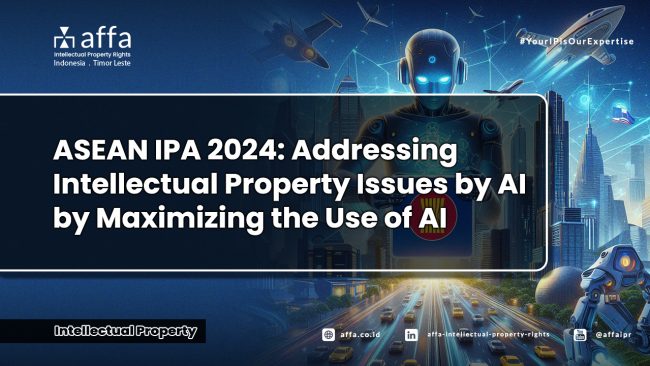
ASEAN IPA 2024: Addressing Intellectual Property Issues by AI by Maximizing the Use of AI

This article is a continuation of the previous article, which discussed the Challenges of Intellectual Property Protection in the Digital Era for countries in Southeast Asia, as presented at the 2024 ASEAN Intellectual Property Association (IPA) Annual General Meeting & Conference, which took place on March 1-2 ago in Jakarta, Indonesia. As previously explained, the Digital Economy presents challenges in protecting Intellectual Property (IP) in the ASEAN region. However, what has not been revealed in the article is the contribution of Artificial Intelligence (AI) to the growth of the digital economy and its impact on IP law enforcement, even though AI’s contribution to regional GDP in 2030 will reach USD 1 trillion.   The growth of the Digital Economy in the ASEAN region cannot be denied, generated by many start-up companies in various fields, such as Techinasia in the media sector, Grab in the transportation sector, and Traveloka in the tourism sector. Of the USD 100 billion growth in the region in 2023, around 13% will be supported by investment in the AI sectors, with 6 (six) main uses as follows:   Computer Vision This market focuses on technology that helps computers make sense of digital images and videos. Machine Learning Algorithms teach computer systems to learn from data. Natural Language Processing Deals with technology enabling computers to understand and generate human language. AI Robotics Combining AI, machine learning, and engineering, to create intelligent machines capable of independent tasks. Autonomous & Sensor Technology Machines and systems equipped with sensors and AI operate independently, responding to changes in their environment. Generative AI Involving the creation of models that produce new content like images and text, often indistinguishable from human-created content.   With those various implementations, IP stakeholders must anticipate AI developments because they impact administration, practice, protection, and law enforcement. In particular, AI will confuse IP owners, consultants, and government officials if the laws on Copyright, Trade Secrets, Industrial Designs, Patents, and Trademarks are not changed.   Because AI, on the one hand, is very promising but also dangerous, depending on who uses it. In the UK and the US, there have been more than 10 cases of lawsuits against Generative AI-based companies. For example, OpenAI, the company that created ChatGPT, was deemed to have violated Copyright because it used many well-known works and media news as learning material for its AI system without permission.   Utilization of AI for IP Violations   If ChatGPT argues that the use of the work is for learning and can be settled with royalty payments, in practice, many other uses of AI can be categorized as legal violations, namely: Fabricate, forge, falsify images, certificates, documents, and create deepfakes videos; Create/manufacture realistic counterfeit labels and packaging; Clean up language, grammar, misspellings, and awkward phrasing on labels, packaging, advertising, websites; spam/phishing emails, which were often dead giveaways of counterfeit goods made in a foreign country; and Allow hackers to break into networks through emails that trick recipients into sharing personal info or accessing them illegally.   Benefits of AI in the IP Landscape However, AI is of great benefit to IP law enforcement. Starting from maximizing IP Consultants’ work and the border enforcement process to law enforcement officers.   Maximizing the Work of IP Consultants: Conducting searches and analysis of prior art and IP registration databases more efficiently and accurately; Streamlining contract analysis by extracting and categorizing relevant information, saving time and allowing attorneys to focus on negotiating and drafting contracts; Enabling faster identification of potential conflicts, enhancing due diligence, assisting in determining protection or infringement issues; and application drafting to improve productivity/reduce costs.   Benefits of AI for IP Law Enforcement: Monitor online platforms, websites, and social media for unauthorized use of IP, enabling proactive enforcement by owners; Identify instances of infringement on digital platforms by comparing content or marks against databases of brands, designs, or works; and Assist IP research and litigation by analyzing legal texts, court decisions and precedents, case strategy development, and outcome predictions from historical data. AI is being integrated into the criminal justice process, from crime prevention to evidence analysis. It can assist courts in making sentencing decisions and assess the likelihood of future criminal behavior, thereby informing parole, probation, or release decisions. It can enhance efficiency, accuracy and fairness, but bias, transparency, and ethics concerns have been raised and will continue to be raised as AI technologies become more pervasive and invasive. Benefits of AI for Border Enforcement: Drawing insights and patterns from customs databases, market reports, trade statistics, and IP owner-provided product identification materials; Automatically identifying objects in streaming video and imagery; and Providing real-time alerts to operators when an anomaly is detected, enhances the ability to stop illicit and illegal goods from entering the country.   In the end, new regulations are needed to adapt to AI developments. These regulations should start with rules related to ownership of rights involving AI, rules governing coordination between stakeholders, competition, and privacy, and rules governing resolution and legal enforcement of any disputes that may occur. Only with clear rules can conducive growth be created before the next technological wave finally emerges.   If you require further information regarding the impact of AI on Intellectual Property, please do not hesitate to contact us via email at [email protected].
The Benefits of IP Customs Recordation for Your IPs in Indonesia - AFFA IPR

The Benefits of IP Customs Recordation for Your IPs in Indonesia

Recently, the Directorate General of Customs and Excise of the Republic of Indonesia (DGCE) has taken widespread action against tons of illegal food to protect consumers and the Indonesian food industry. Because the ingredients of food imported illegally are unknown, it can endanger residents and disrupt the distribution of local food producers. But did you know that Customs and Excise can also deter illegal goods that violate Intellectual Property abroad or within the country? Because DGCE is part of the Task Force together with the Criminal Investigation Agency of the Republic of Indonesia Police (Bareskrim Polri), the Indonesian Food and Drug Authority (BPOM), and the Directorate General of Informatics Applications (Ditjen Aptika), which supports the performance of the Directorate General of Intellectual Property (DGIP) in enforcing Intellectual Property Law in Indonesia. Enforcing this law is a collective homework because Indonesia is still on the list of world countries with serious Intellectual Property violations (along with Argentina, Chile, China, India, Indonesia, Russia, and Venezuela), as released by the United States Trade Representative (USTR) in the 2023 Priority Watch List Special 301 Report. A few weeks ago, DGCE conducted outreach to the public so that the wider community, especially Intellectual Property (IP) owners, could take advantage of this service. So, if illegal products are found crossing state borders, IP owners, especially copyright and trademark owners, will be assisted in the deterrence process. But before that, you must first carry out the recordation process on the DGCE website. For those of you who are still unfamiliar with the term “deterrence”, this word has 2 (two) meanings, namely: Delaying the release, loading, or transportation of excisable goods and/or other goods related to excisable goods; Prevent the departure of means of transport.   The Benefits of IP Customs Recordation in DGCE The recordation process is an activity to enter your IP information into the DGCE customs database, with the following benefits: Action at Ports or Borders; Especially if the quantity of goods smuggled is very significant. Effective and efficient deterring before goods that violate IPR are distributed to the domestic market. Protecting IP Owners’ Business Processes; Products are protected from counterfeiting or infringement attempts. Maintain consumer confidence in products on the market. Maintaining brand reputation from low-quality counterfeit products. Macro Aspects; Increasing investor confidence, both domestic and foreign. The government can restore international trust in the seriousness of eradicating counterfeit products in Indonesia.   The Authority of DGCE DGCE has two schemes for the enforcement of Intellectual Property Law: Judicial Scheme that applies to all IP regimes: DGCE may impose a temporary suspension until a physical examination. However, DGCE’s position here is passive because it must wait for a temporary suspension order from the Commercial Court, where the Rights owner must carry out the initiative without any prior obligation to record it on the DGCE site. Ex-Officio Scheme for Trademarks and Copyrights: After the rights owner carries out the recordation process with the DGCE, the process of deterrence, temporary suspension, and physical examination can be carried out proactively by the DGCE.   Conditions for IP Customs Recordation at DGCE As the owner or right holder, you must submit a written application accompanied by the required documents by Minister of Finance Regulation (MFR) Number 40/pmk.04/2018 concerning Recording, Deterrence, Guarantee, Temporary Suspension, Monitoring and Evaluation in the Context of Controlling the Import or Export of Suspected Goods Constituting or Originating from the results of Violations of Intellectual Property Rights, to the Director of Action and Investigation at the DGCE Head Office and submitted electronically via the CEISA IPR application which can be accessed on the user portal.   Then you are required to prepare the following documents as attachments: Copy of Company Deed of Establishment and Latest Amendments Copy of Taxpayer Identification Number (NPWP) Copy of Trading Business License (SIUP) or Company Registration Certificate (TDP) Copy of Domicile Letter Copy of Trademark Certificate/ Registration or Copyright Recordation Letter issued by DGIP Information regarding product authenticity characteristics (mark, product appearance, packaging, distribution route, etc.) Statement letter as regulated in Appendix B – MFR No. 40/PMK.04/2018 Proof of transfer of rights (if rights are transferred) Information on parties granted the right to import/export Other information(s) required by DGCE   Involve Internal or External Examinator Apart from that, you must appoint one or more examiners who are experts on the product, who can come from within or outside the company, and who understand the Trademark or Copyright of the item to be recorded. If the goods recorded are related to the Trademark, the appointed Examiner(s) must understand the characteristics of product authenticity, such as the mark, goods, logo, product appearance, packaging, distribution, and marketing routes, as well as the number of products marketed in that area. However, suppose the item being recorded is related to Copyright. In that case, the examiner must understand the characteristics or specifications of the copyrighted work in the fields of science, art, literature, or related rights being created.   DGCE Research Procedure Approximately 30 Days All requirements will then undergo formal and material research by DGCE, including validating the data with DGIP. If this recordation is approved, it will be valid for 1 (one) year and can be extended. The entire recordation process is free of charge and only takes approximately 30 days. However, if you are a Trademark Owner or Copyright Holder who is a foreign company and domiciled abroad, you must have a business entity domiciled in Indonesia. DGCE has successfully disposed of more than one million pens, three million razors, 72 thousand more cosmetics, up to 160 rolls, and 890 cartons of sandpaper in the last four years. This number is not much because not many Trademark Owners and Copyright Holders take advantage of this feature. Therefore, if you own a product with a high cross-border risk, we recommend immediately recording it at DGCE.   If you still have questions or need further information regarding Intellectual Property Customs Recordation at the Directorate General of Customs and Excise, do not hesitate to…

ASEAN IPA 2024 Challenges of IP Protection in the Digital Era

ASEAN IPA 2024: Challenges of IP Protection in the Digital Era

The 2024 ASEAN Intellectual Property Association (IPA) Annual General Meeting & Conference took place successfully on March 1-2 in Jakarta, Indonesia. Held at the Mandarin Oriental – Hotel, this event provided new insight to Intellectual Property (IP) Southeast Asian stakeholders regarding the challenges faced in the digital era.   There was plenty of knowledge shared by competent speakers presented, including Bambang Brodjonegoro (Former Minister of Finance of the Republic of Indonesia), Thang Van Luong (Assistant Director of IPR Division of ASEAN), Kozo Takeuchi (President-Elect of APAA Headquarters, Japan), Peter Fowler (Senior Counsel for Enforcement, Office of Policy and International Affairs of USPTO – USA), Peter Sungjin Chun (Senior Vice President of APAA Korean Group – ROK), Jesse Zhang (AIPPI China Group), and Kukuh TW (Lecturer, Entrepreneur and IT Consultant ). For this reason, we will divide it into several articles, from the conditions and challenges facing ASEAN in the digital era to specific obstacles related to Artificial Intelligence (AI). Below is the summary:   The Growth of Intellectual Property in ASEAN   In 2022, the ASEAN economy grew 5.7% compared to the previous year, achieving a Gross Domestic Product (GDP) of USD 3.6 trillion and placing this region in the 3rd most prominent position in Asia or the 5th largest globally. With this performance, ASEAN succeeded in attracting Foreign Direct Investment (FDI) of USD 224.2 billion, most of which came from the United States (16.3%), Japan (11.9%), the European Union (10.7%), and China (6.9%). This investment is mainly aimed at the service sector at 68.3% and manufacturing at 27.5%.   ASEAN’s population is dominated by people under 30, making this region dynamic and challenging in the digital era. There were 460 million internet users in 2022, of which 80% were actively shopping online. The Gross Merchandise Value (GMV) contribution will reach USD 200 billion and is predicted to exceed USD 330 billion in 2025.   This change in lifestyle in the digital era makes the ASEAN region seem to have entered the Digital Decade, where the potential for the digital economy will reach USD 1 trillion GMV in 2030. However, this great potential will only be achieved with the right strategy and collaboration. This aligned strategy is essential, considering that ASEAN countries have quite a significant gap in the Global Innovation Index (GII) ranking released by the World Intellectual Property Organization (WIPO) in 2023.   Of the top 50 in the GII ranking, only Singapore (rank 5), Malaysia (30), Vietnam (40), Thailand (43), and the Philippines (50) are in the top 50. Meanwhile, half of the other ASEAN countries, such as Indonesia, Brunei, Cambodia, Myanmar, and Laos, still need to be higher. For this reason, a blueprint for the “ASEAN Economic Community 2025” has been created, prioritizing Intellectual Property cooperation with several strategic goals and indicators.   Cooperation on Strengthening Intellectual Property in the ASEAN Region   To strengthen this collaboration, the following Strategic Objectives have been prepared: Provide a firm basis for economic progress, support economic development, and produce wealth & prosperity. Promote trade & flow of investment; stimulate tech transfer & technological innovation; competitiveness. Expedite the realization of ASEA FTAs, and contribute to the growth of regional and global trade liberation. Contribute to regional dynamism, synergy & the enhancement of ASEAN solidarity.   Meanwhile, the Strategic Indicators are as follows: Strengthening IP offices and building IP infrastructure. Enhancing regional mechanisms to promote asset creation & commercialization. Developing regional IP platforms and infrastructure. Expanding the ASEAN IP ecosystem.   This strategic indicator has been planned since 2016 but is still being pursued to realize everything by 2025.   ASEAN Filing Trends 2016-2022 Source: WIPO Source: WIPO Source: WIPO   Even though it is quite volatile, especially after the Covid-19 pandemic, overall, whether for Patents, Trademarks or Industrial Design, achievements in 2022 are among the highest in the last 6 (six) years.   Intellectual Property Opportunities in the Digital Economy   ASEAN has mapped several IP opportunities in the Digital Economy because it plays a role as a catalyst and empowerer with 5 (five) main roles as follows:   IP Service Delivery Quality Digitalization of IP service delivery processes improves efficiency and accessibility. DE facilitates remote access to expertise and can improve the quality and reach of IP services in the region. IP Enforcement With the rise of digital transactions & online activities, IP protection will be more prioritized. DE provides tools for data analytics and monitoring and promotes info sharing, and cross-border cooperation among authorities in strengthening regional combat against IP violation, infringement, and piracy. IP Commercialization DE speeds up the innovation process leading to the creation of new tech and IP assets, and fast IP commercialization, hence fostering TT and Tech innovation. Global market extension, digital technologies, and digital marketplaces/platforms empower ASEAN creators, innovators, IP owners, and SMEs to capitalize on IP assets. IP Education & Culture DE provides opportunities to create and disseminate IP education (documents, virtual simulations, open educational resources). DE offers powerful tools for conducting digital outreach and awareness campaigns. IP for Inclusive & Sustainable Growth IP be more beneficial to inclusive and sustainable growth since DE could help unlock local creativity, inclusive innovation, and financial inclusion. Local communities GRTKCE can be protected and commercialized through IP mechanisms. DE can improve digital accessibility & inclusion for all.   Intellectual Property Challenges in the Digital Economy On the other hand, the same 5 (five) factors also have inhibiting elements that cause the growth of the IP climate in the ASEAN region to remain stagnant. The following is the explanation:   IP Service Delivery Quality Digital Divide & Cybersecurity Risks hinder. Disparities in access to technology and online services across ASEAN member states may hinder the delivery of high-quality IP services. Whereas data breaches, cyberattacks, and IP theft disrupt IP delivery. IP Enforcement DE blurs traditional jurisdictional boundaries and complicates cross-border IP enforcement. Enforcement agencies are disrupted in coordinating investigations, collecting evidence, and prosecuting offenders across different legal jurisdictions, let alone anonymous & pseudonymous actors in…

Indonesia-Issues-Publisher-Rights-Google-and-Social-Media-Must-Collaborate-with-Local-Media-affa-global

Indonesia Issues Publisher Rights: Google and Social Media Must Collaborate with Local Media

Indonesia Issues Publisher Rights: Google and Social Media Must Collaborate with Local Media The President of the Republic of Indonesia, Joko Widodo, on February 20, 2024, signed the Presidential Regulation Number 32 of 2024 concerning the Responsibility of Digital Platform Companies to Support Quality Journalism. One of the provisions in that regulation, which President Joko calls the Publisher Rights Regulation, requires digital platforms such as Google, Facebook, and X (Twitter) to collaborate with local media companies.   The Presidential Regulation on Publisher Rights consists of 6 (six) chapters and 19 articles, with a summary as follows:   Chapter I: General Provisions This chapter regulates the responsibilities of digital platform companies, such as Google, Facebook, or X (Twitter), to maintain a healthy news business ecosystem and support quality journalism.   Chapter II: Digital Platform Companies Digital platform companies are determined based on service presence in Indonesia. They are obliged to support quality journalism by: Not facilitating the dissemination and/or commercialization of news content that is not by the law regarding the press after receiving reports through reporting facilities provided by digital platform companies; Provide best efforts to prioritize the facilitation and commercialization of news produced by press companies; Provide fair treatment to all press companies in offering services; Carrying out training and programs aimed at supporting quality and responsible journalism; Providing the best effort in designing news distribution algorithms that support the realization of quality journalism by democratic values, diversity, and statutory regulations; Collaborate with press companies that the Press Council has verified in four ways, namely: Paid license Profit sharing Sharing aggregate data of news users Other agreed forms   Chapter III: Cooperation and Dispute Resolution Apart from regulating the forms of cooperation as mentioned above, this chapter discusses how to resolve disputes between digital platform companies and the press, namely: The parties, individually or collectively, can submit legal remedies outside the general court through arbitration or alternative dispute resolution. Dispute resolution is carried out independently by statutory provisions.   Chapter IV: Committee The committee was formed and determined by the Press Council. Duties and functions are as follows: Ensuring the fulfillment of digital platform company obligations. Supervise and facilitate the fulfillment of company obligations related to digital platforms. Provide recommendations to the Minister regarding the results of supervision. Facilitate arbitration or alternative dispute resolution between digital platform companies and the press.   Matters relating to the committee are: Every committee decision-making is carried out in a collegial collective manner and is accountable to the public. If a consensus deliberation agreement is not reached, the majority vote decides. Each committee agreement must: Through a consideration process that considers input in the form of opinions and thoughts that develop in society. Guarantee transparency, guarantee independence, and fulfill a sense of justice. The committee must regularly report to the public on implementing its duties and functions at least once a year. This report is uploaded to the Press Council information system and must be easily accessible to the public. The committee consists of representatives from: The Press Council does not represent press companies. Ministry. Experts in Digital Platform Services who are not affiliated with digital platform companies or the press. The committee members have an odd number of at most 11 people, consisting of: Representatives from elements of the Press Council, a maximum of five people; Representatives from elements of the Ministry are one person; Representatives from expert elements, as a maximum of five people, and appointed by the minister who coordinates government affairs in politics, law, and security. The composition of the committee membership consists of: One committee chairman is also a committee member. One deputy chairman of the committee is also a member of the committee. Committee members can be appointed for a term of three years and can be re-elected for another term. The Committee is assisted by a secretariat, held ex officio by the Secretary of the Press Council.   Chapter V: Funding Sourced from press organizations and companies, assistance from the state and/or others by statutory provisions.   Chapter VI: Conclusion Regulates the implementation of the Presidential Regulation on Publisher Rights, namely six months from the date of promulgation or August 20, 2024.   With this Publisher Rights Regulation, the government of the Republic of Indonesia is trying to organize the ecosystem of digital platform companies with press companies to support quality journalism to realize a democratic life as a nation, state, and society.   If you need more information about the Presidential Regulation on Publisher Rights and its implementation in Indonesia, please contact us via [email protected]. Source: Presidential Regulation Number 32 of 2024 concerning the Responsibility of Digital Platform Companies to Support Quality Journalism

AFFA-Listed-as-a-WTR-1000-Recommended-Firm-2024-in-Indonesia-affa-global

AFFA Listed as a WTR 1000 Recommended Firm 2024 in Indonesia

AFFA Listed as a WTR 1000 Recommended Firm 2024 in Indonesia AFFA Intellectual Property Rights proudly announces its consecutive inclusion in the WTR 1000: The World’s Leading Trademark Professionals. This prestigious recognition underscores our unwavering dedication to providing exceptional trademark services and reaffirms our position as a trustworthy partner for safeguarding your valuable Intellectual Property.   As one of Indonesia’s most comprehensive IP service providers, AFFA IPR offers a sophisticated and streamlined Trademark filing and licensing platform. Our team of renowned experts leverages their extensive experience and local market knowledge to navigate the complexities of Trademark protection and licensing services, ensuring your brand receives the utmost legal and strategic protection.   Whether you are a multinational corporation or a rising entrepreneur, choosing AFFA IPR for your Trademark management signifies: Unparalleled Expertise Our seasoned professionals provide proactive counsel and comprehensive strategies tailored to your unique brand identity and business goals. Streamlined Efficiency We employ proven methodologies and robust systems to achieve successful and timely trademark registration in Indonesia and internationally. Maximized Value Our skilled negotiators help you unlock the full potential of your trademark assets through strategically crafted licensing agreements. Unwavering Commitment We are dedicated to serving as your reliable partner throughout every step of your trademark journey, providing ongoing support and guidance.   Entrusting AFFA IPR with your Trademark protection signifies your commitment to brand integrity and market success. Contact us today via [email protected]  to discuss your specific needs and experience the distinctive level of service and security that sets AFFA IPR apart.

인도네시아의-상표-불사용취소심판

인도네시아의 상표 불사용취소심판

인도네시아의 상표 불사용취소심판 상표 및 지리적 표시에 관한 법률 2016년 제20호(이하 “상표법“이라 칭함)는 상표가 보호되는 방법 및 미사용 등 다양한 이유로 상표를 상실하는 방법을 규정합니다. 상표법 제74조 제1항은 등록상표의 취소는 상표가 등록일 또는 마지막 사용일로부터 상품 및/또는 서비스 거래에서 3년 연속 사용되지 않았음을 근거로 이해관계가 있는 제삼자에 의해 상사법원에 소의 형태로 제기될 수도 있다고 명시합니다. 그러나 여기에는 다음과 같은 몇 가지 예외가 있습니다. 취소 대상 상표가 부착된 상품에 대한 수입 제한 조치가 있는 경우, 해당 상표를 사용한 상품의 유통 허가와 관련된 금지 규정, 또는 수권자의 임시 결정이 시행되고 있는 경우, 또는 정부 규정에 의해 확립된 기타 유사한 금지 규정이 있는 경우.   당사는 이에 인도네시아의 상표 불사용취소심판에 관해 가장 자주 묻는 질문 3가지를 제시합니다.   1. 취소 대상 상표가 아직 등록되지 않았습니다. 상표청에 상표 취소 청원서를 제출할 수 있나요? 상표법은 오직 등록상표만이 미사용을 근거로 취소될 수 있으며 심판은 상사법원에만 제기될 수 있다고 명시합니다. 이러한 관행은 상표청이나 상표심판원에 불사용취소심판을 제기할 수 있는 일부 국가에서는 다릅니다.   2. 피고가 입증책임을 부담하나요? 입증책임은 원고에게 있습니다. 따라서, 원고는 상표가 실제로 등록일 또는 마지막 사용일로부터 3년 연속 사용되지 않았음을 입증하는 데 필요한 모든 증거를 가지고 있어야 합니다.   3. 원고는 미사용 조사 보고서를 제공해야 하나요? 상표법은 상표의 사용 여부를 입증하기 위해 제공되어야 하는 증거 목록을 명시하지 않습니다. 그러나, 당사는 실무에서 (설문조사와 함께) 광범위한 온라인 및 오프라인 연구가 수행되었음을 입증하기 위해 일반적으로 항상 완전한 조사 보고서를 제공합니다. 이런 유형의 조사 보고서에 자주 제기되는 문제는 지리적 다양성으로, 이에 따라 높은 보고서 관련 비용이 발생하게 됩니다.   좀 더 명확하게 말하자면, 인도네시아에는 18,000개가 넘는 섬이 있습니다. 당사의 경험에 따르면, 조사 보고서가 주요 도시에서 수행된 후일지라도, 피고인은 종종 국가의 외딴 지역에서 이루어진 판매 증거를 여전히 제시할 수 있습니다.  그러나, 상사법원이 단일 사용을 충분한 사용 증거로 항상 간주하는 것은 아니라는 점을 명심하십시오.   가능한 경우, 당사는 일반적으로 고객에게 불사용취소심판을 제기하기 전에 우호적 해결 및 악의의 무효심판 등의 선택 사항을 조언합니다. 두 심판 모두 불사용취소심판에 비해 성공률이 더 높은 경향이 있기 때문입니다.   인도네시아의 상표 불사용취소심판에 대한 추가 정보가 필요한 경우언제든지[email protected]로 문의하시기를 바랍니다  

印度尼西亚商标不使用撤销诉讼

印度尼西亚商标不使用撤销诉讼

印度尼西亚商标不使用撤销诉讼 2016年第20号法《商标和地理标志法》(以下简称“《商标法》”)对商标保护方式以及失去商标保护的各种原因(不使用是其中之一)进行规范。《商标法》第74条第(1)款规定,有利害关系的第三方也可以出于下述理由向商事法院提起注册商标撤销诉讼:自注册或最后一次使用之日起,该商标已连续3年未在商品和/或服务贸易中使用。但是,也有一些例外情况,即: 印有拟撤销商标的商品受到进口限制; 与使用相关商标的商品分销许可有关的禁令或授权方的临时决定已生效;或 存在政府法规规定的其他类似禁令。   我们在此为您提供3(三)个关于印度尼西亚商标不使用撤销诉讼的常见问题: 1. 拟撤销的商标尚未注册,我可以向商标局提出撤销申请吗? 《商标法》明确规定,只有以不使用为由才能撤销已注册的商标,并且只能向商事法院提起诉讼。一些国家有与此不同的做法,即可以向商标局或商标上诉委员会提起不使用撤销诉讼。   2. 被告是否承担举证责任? 举证责任由原告承担。因此,原告必须提供所有必要的证据,以证明自商标注册或最后一次使用之日起,被告确实已连续3年未使用该商标。   3. 原告是否必须提供不使用调查报告? 《商标法》并未明确规定为证明商标是否已被使用而应提供的证据清单。但在实践中,我们一般都会提供完整的调查报告,以证明已完成深入细致的线上和线下调研(以及调查)。经常伴随此类调查报告出现的问题是地域差异性。这种地域差异性将导致与报告相关的费用居高不下。   从更明确的视角来看,印度尼西亚有1.8万多个岛屿。根据我们的经验,即便在主要城市完成调查报告,被告往往仍有可能提出关于他们在我国偏远地区进行的销售中使用了商标的证据。但是,请记住,商事法院并不总是将单次使用视为充分的使用证据。   我们一般会尽可能建议客户在提起不使用撤销诉讼前选择其他诉讼方式,如友好和解和提起恶意无效诉讼,因为这两种诉讼的胜诉率往往高于不使用撤销诉讼。   若需要更多有关印度尼西亚不使用撤销诉讼的信息,请随时通过[email protected]与我们联系。

Trademark-Non-Use-Cancellation-Action-in-Indonesia-affa-global

Trademark Non-Use Cancellation Action in Indonesia

Trademark Non-Use Cancellation Action in Indonesia The Law No. 20 Year 2016 on Marks and Geographical Indications (hereinafter referred to as the “Trademark Law”) regulates how a Mark shall be protected, and how one can lose it due to various reasons – and non-use is one of them. Article 74 Para (1) of the Trademark Law state states that the cancellation of a registered trademark can also be filed by an interested third party in the form of a lawsuit to the Commercial Court on the grounds that the Trademark has not been used for 3 (three) consecutive years in the trade of goods and/or services since the date of registration or last use. However, there are some exceptions to that, namely: If there is an import restriction on the goods bearing the Trademark to be cancelled; The prohibitions related to the permission for the distribution of goods using the concerned Trademark, or a temporary decision from the authorized party are in place; or There are other similar prohibitions established by Government Regulation.   We herewith provide you with 3 (three) most Frequently Asked Questions about the Trademark Non-Use Cancellation Actions in Indonesia: 1. The Trademark to be cancelled is yet to be registered. Can I file the petition to cancel it at the Trademark Office? The Trademark Law explicitly states that only a registered Trademark can be cancelled based on non-use and the action can only be filed before the Court of Commerce. This practice is different in some countries where non-use cancellation action can be filed before the Trademark Office or the Trademark Board of Appeal.   2. Will the Defendant Bear the Burden of Proof? The burden of proof lies on the plaintiff. Hence, the plaintiff must have all the required evidence to prove that the Trademark has indeed been not used for 3 consecutive years from the date of registration or the date of last use.    3. Will the Plaintiff be Required to Provide a Non-Use Investigation Report? The Trademark Law does not explicitly state the list of evidence to be provided to show if the Trademark has been used or not. However, in our practice, we generally always provide a complete investigation report to show that extensive online and offline research has been conducted (along with surveys). The issue that often comes up with this kind of investigation report is the geographical variability, which will contribute to the high costs associated with the report.    Just to put it into a clearer perspective, Indonesia has more than 18 thousand islands. From our experience, it is possible that even after an investigation report has been done in major cities has been conducted, the defendant often still comes up with evidence of use for their sales that were done in remote parts of the country. However, please bear in mind that the Court of Commerce will not always deem a single use as sufficient evidence of use.   When possible, we generally advise our clients with other options before filing a non-use cancellation action, such as amicable settlement and bad-faith invalidation action, since both actions tend to have a higher degree of success compared to non-use cancellation action. Should you require further information about non-use cancellation action in Indonesia, please do not hesitate to contact us at [email protected].

Building-Blocks-of-Creativity-A-Celebration-of-International-Lego-Day-affa-global

Building Blocks of Creativity: A Celebration of International Lego Day

Building Blocks of Creativity: A Celebration of International Lego Day Every January 28, the global Lego community celebrates it as “Lego Day.” On this date, for the first time, Godtfred Kirk Christiansen, the son of a carpenter from Denmark, registered a Patent for his brick toy in 1958. From a brick toy with unique connectors, Lego has developed into a fun educational toy for all ages, collaborating with many Intellectual Properties (IPs), present in some animated films and series, and has 11 amusement parks worldwide. The word Lego comes from the Danish “leg godt,” which means to play well. It was first introduced in 1932 by Ole Kirk Christiansen, father of Godfred. Initially, Lego was a wooden brick toy with unique protrusions and holes to connect and arrange the bricks. However, for economic reasons, since 1947, Lego switched to plastic materials and registered its first Patent in Denmark and other countries in 1958.     Because they understand the importance of Patents as valuable assets but have a limited protection period (only 20 years), Lego as a company continues to innovate so that the products produced can grow and develop not only from the sale of toys but also from royalty income and license.   Apart from Patents, Lego also has other Intellectual Properties such as Trademarks, Industrial Designs, and Copyrights. As a toy company, there are still Trademarks that must be protected, product designs that continue to develop, and unique characters that continue to be created to stay ahead of competitors.   Staying ahead is an important keyword. Based on Patents and Designs, the original form of Lego has become public domain, meaning it is no longer protected. So, since the 90s, many companies have emerged that use Lego’s outdated technology and design to make various kinds of similar toys.   However, Lego did not remain silent. Its legal team attempted to shut down competitors’ operations by using Trademark law and suing those who use “brick” and/or “block.” However, these efforts fail due to regulations where there is a provision that states, “Trademark law should not be used to perpetuate monopoly rights enjoyed under now-expired Patents.”   Finally, to continue to exist, Lego continues to present many new characters and Lego sets, with Patents, Industrial Designs, and Copyright protection. Should you need further information about Patent protection, Industrial Designs, Copyright, or other Intellectual Property management, please do not hesitate to contact us via [email protected].