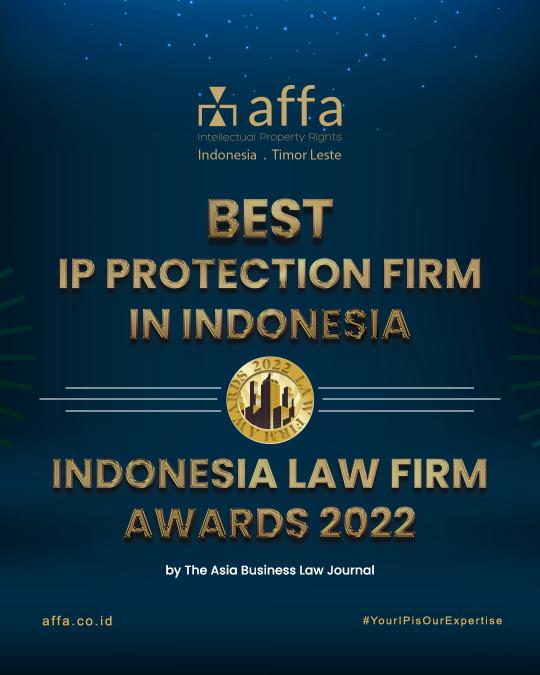
AFFA Recognized in the Asia Business Law Journal: Indonesia Law Firm Awards 2021

Our firm has received a rather flattering award by the Asia Business Law Journal, the definitive guide to Asia’s leading law firms and lawyers, as the winning firm in the IP Protection category in Indonesia. This is a testament to our desire to keep improving and to give the best solutions to our clients around the world. The list can be seen below:   The full list can be viewed at https://law.asia/indonesia-law-firm-awards-2021/. For further information when it comes to IP protection in Indonesia, please do not hesitate to contact us at [email protected]; [email protected].

Perlindungan Hak Cipta dalam NFT (Non-Fungible Token)

Non-Fungible Token atau NFT merupakan sebuah aset digital yang mewakili objek di dunia nyata seperti seni, musik, item dalam game, dan video. NFT dijumpai dalam blockchain, yang merupakan buku kas publik terditribusi yang mencatat transaksi dan menyediakan informasi tentang apa yang dijual, oleh siapa dan berapa harga yang dibayarkan. Berbeda dengan Cryptocurrencies, yang merupakan fungible tokens (token yang dapat dipertukarkan), artinya setiap cryptocurrency sama dengan yang lainnya, setiap unit NFT unik dan dapat diidentifikasi dengan jelas. NFT merupakan versi digital dari sertifikat kepemilikan atau keaslian yang secara aman tercatat dalam buku kas blockchain. Pada awalnya NFT hanyalah rekreasi digital dari karya yang ada, sekarang tidak lagi. Saat ini, NFT dibuat dari bentuk yang telah ada seperti seni digital atau bahkan meme. Perlindungan Hak Cipta ada dalam karya asli dari pencipta yang terwujud dalam media ekspresi apapun yang nyata, yang sekarang dikenal, atau kemudian dikembangkan, dimana karya tersebut bisa dirasakan, direproduksi, atau dikomunikasian, baik secara langsung atau dengan bantuan sebuah perangkat. Dengan demikian, karya asli yang diwakili oleh NFT dapat dilindungi oleh Undang-Undang Hak Cipta di sebagian besar yurisdiksi, termasuk di Indonesia. Di Indonesia sendiri Undang-Undang yang mengatur tentang perlindungan Hak Cipta adalah Undang-Undang Nomor 28 Tahun 2014 tentang Hak Cipta. Kepemilikan dari NFT belum tentu berarti kepemilikan atas karya yang diwakili oleh NFT. Seperti lukisan, ketika sudah terjual, hanya ada satu pemilik dari lukisan asli, tetapi, pencipta lukisan tersebut memiliki hak kekayaan intelektual yang mengizinkan mereka untuk membuat salinan, cetakan, atau karya turunan dari lukisan tersebut. Hak cipta dipertahankan oleh pencipta asli dari lukisan tersebut. Kecuali jika ada perjanjian pengalihan hak antara pencipta dan pembeli, berkas dan dokumen hak cipta untuk NFT masih menjadi milik pencipta aslinya. “Pembeli NFT tidak memiliki apapun kecuali hash unik di blockchain dengan catatan transaksional dan hyperlink ke file karya seni”. Pencetakan dan penjualan NFT rentan terhadap penipuan hak cipta dan pelanggaran atas karya yang mendasarinya. Hal tersebut terjadi ketika seseorang mencetak NFT dari sebuah karya, dan secara keliru mengklaim dirinya memiliki hak cipta atas karya tersebut. Singkat cerita, karya yang diwakili oleh NFT dapat dilindungi oleh Undang-Undang Hak Cipta, tetapi NFT itu sendiri tidak bisa. Untuk informasi lebih lanjut tentang perlindungan Hak Cipta NFT, silakan hubungi [email protected].

Apakah yang dimaksud dengan Kelas Barang dan Jasa dalam Merek?

Dalam pengajuan suatu Merek para pemohon kerap dipusingkan dengan klasifikasi atau jenis kelas yang sesuai dengan barang atau jasa yang ingin dilindungi dalam suatu permohonan Merek. Pertanyaan yang palings ering muncul adalah:   “Yang dimaksud dengan kelas barang atau jasa apa, ya?”   Singkat cerita, ketika pemohon mengajukansuatu  permohonan Merek, pemohon juga harus mencantumkan jenis barang dan/atau jasa yang ingin dilindungi. Kelas-kelas ini diatur dalam The NICE Classification  atau kerap disebut sebagai NICE Class. Nah, di dalam NICE Class ini ada 45 kelas barang dan jasa yang berbeda-beda. Pengelompokannya adalah sebagai berikut:   Kelas 1-34: Barang Kelas 35-45: Jasa   Klasifikasi ini sudah diikuti oleh hampir semua negara di dunia yang memiliki sistem hukum Merek. Untuk mengetahui suatu barang dan/atau jasa masuk dalam kelas tertentu, silakan cek http://skm.dgip.go.id/. Tautan tersebut memiliki informasi detil perihal jenis barang dan jasa di dalam setiap kelasnya yang dapat diajukan dalam suatu permohonan Merek di Indonesia.   Untuk informasi dan bantuan perihal permohonan pendaftaran Merek di Indonesia dan mancanegara, silakan hubungi [email protected].  

Indonesia – The World’s First NFT Resort by LABS Group Begins Auction on July 15

Congratulations to both LABS Group and Gravity Hotel Indonesia for the signing of a remarkable agreement involving a land and building acquisition in the beautiful Banyuwangi, Indonesia. The project is remarked as the world’s first-ever community-owned resort! The project will be developed as a luxury glamping resort that will be opened by the end of 2021. AFFA Intellectual Property Rights – Indonesia & Timor Leste, representing and advising both parties relating to the structuring, compliances, due diligence, drafting, as well as negotiation of the transaction documents. We sincerely hope that this transaction will contribute to the development of Indonesia’s tourism sector. It is in all of our best interest to see the industry grow and we hope this is the much-needed catalyst to reignite the spirit that we all need during this pandemic. The deal has attracted media coverage, among others: https://lnkd.in/gutmf8p #NFT #internationalrealestate #indonesia #tourism #intellectualproperty

Indonesia – The Final Goodbye to the Patent Performance Postponement Request

The Government of the Republic of Indonesia has issued the Ministry of Law and Human Rights of the Republic of Indonesia Regulation No. 14 Year 2021 on the Changes of the Ministry of Law and Human Rights of the Republic of Indonesia Regulation No. 30 Year 2019 on Patent Compulsory Licensing Granting Procedure. The amended regulation highlights several changes, including the grounds of granting of a patent compulsory license and most importantly the removal of the opportunity for patent holders to postpone the working of their registered patents.   Grounds to grant a compulsory license based on request: The Patent Holder does not perform its obligations to perform the patent as per Article 107 point 2 of the Law No. 11 Year 2020 on Job Creations within 36 months after the patent has been granted. For your information, Article 107 point 2 of the Law No. 11 Year 2020 on Job Creations stipulates the conditions of use/performance of Patent in Indonesia as the following:   The patent performance as referred to in (1) is as under: The use/performance of a Patented product by manufacturing, importing, or licensing the patented product; The use/performance of a Patented process by manufacturing, importing, or licensing the product which has been resulted from a patented process; or The use/performance of a Patented method, system, and use by manufacturing, importing or licensing a product which has been resulted from a method, system, and use which has been patented.   The patent is performed by the patent holder of the licensee in a way that is detrimental to the public interest. The patent that is resulted from the development of a prior registered patent cannot be performed without using the patent of the other party which is still registered.   In addition, the regulation also stipulates the following:   The Minister via the Director General of Intellectual Property can send a notification letter to the Patent Holder regarding the obligation to perform the patent if the patent holder has not performed its patent within 36 months from the grant date. The notification letter will be done for the patent which is requested to be licensed in compulsory manner. The notification above will be announced electronically to the public to inform that the Patent Holder has not performed the patent in Indonesia.   The regulation also abolishes Article 39 to 44 of the Ministerial Regulation No. 30 Year 2019 on the Procedure to Grant Patent Compulsory License. The abolished articles are as under:   Article 39 (1) Patent holders are required to make products or using processes in Indonesia. (2) Creating a product or using a process as referred to in paragraph (1) must support technology transfer, investment absorption, and / or provision of employment.     Article 40 In the event that the Patent Holder has not been able to do so Patents in Indonesia as referred to in Article 39, the Patent Holder can delay the implementation of the manufacture products or use of a Patent process in Indonesia.   Article 41 A suspension of application for patents in Indonesia may be granted within a maximum period of 5 (five) years with submit a request to the Minister accompanied by any reason.   Article 42 Postponement of Use of Patents as referred to in Article 41 it is submitted within a maximum period of 3 (three) years from the date the Patent was granted.   Article 43 In the event that the Minister approves the request for postponement of Use of Patents in Indonesia as referred to in Article 42, the Minister notifies the Patent Holder.   Article 44 Postponement of Use of Patents in Indonesia as referred to referred to in Article 43 is granted   Patent Performance Postponement No Longer Valid   In accordance with the Law No. 13 Year 2016 on Patents, patent holders shall perform or work their registered patents within 36 months from the date of grant. Otherwise, they may be susceptible to compulsory-license request by any third party. In addition, the failure to perform or work a registered patent as per Article 20 of the Law No. 13 Year 2016 on Patents (as well as Article 107 Para (2) of the law No. 11 year 2020 on Job Creations) may also pose a revocation risk at the Court of Commerce. The work-around to overcome these limitations used to be available, namely by requesting a working postponement of a registered patent.   However, as regulated by the new regulation, it is no longer possible for the holders of registered patents in Indonesia to request for the postponement of their registered patents. The removal is in line with the spirit of the Indonesian Patent Law to ensure that all patents that are registered in Indonesia should be performed either through direct performance by the holders or through licensing.   Should you require further information, please do not hesitate to contact us at [email protected].

[URGENT UPDATE] Key Changes to the Indonesian Patent and Trademark Laws after the Enactment of the Law No. 11 Year 2020 on Job Creations

The Law No. 11 Year 2020 on Job Creations (hereinafter referred to as “the Omnibus Law”) was finally signed by the President of the Republic of Indonesia, Joko Widodo, on November 2, 2020. The Omnibus Law is 1,187 pages long and it consists of numerous revisions to the existing laws that are aimed to spur job creations in Indonesia. While it puts a stronger emphasis on the Employment Law, the Omnibus Law – after several amendments – also impacted key provisions in the Law No. 13 Year 2016 on Patents (hereinafter referred to as “the Patent Law”) and the Law No. 20 Year 2016 on Marks and Geographical Indications (hereinafter referred to as “the Trademark Law”). We herewith list the changes and revisions for your perusal: Changes to the Patent Law Simple Patent Article 3 of the Patent law has been revised to the following: (1) A Patent is granted for a novel invention, which has inventive steps and can be applied industrially. (2) Whereas a Simple Patent for a novel invention, which is the development of a product or a process that already exists and can be applied industrially. (3) The development of an existing product or process can cover: Simple products: Simple processes; or Simple methods. In addition, Article 122 of the Patent Law also regulates the following requirements regarding the Substantive Examination Request for a Simple Patent: (1) A Simple Patent is only granted for one Invention. (2) The Request for the Substantive Examination for a Simple Patent shall be done at the same time as the time of the filing of the application with official fees. (3) If the Substantive Examination Request is not filed at the time of filing of the Simple Patent application or if the Official Fees are not paid, then the Simple Patent application is considered withdrawn. Whereas Article 123 of the Patent Law which regulates the publication period is amended as under: (1) The publication of a Simple Patent shall be done no later than 14 days from the date of filing of the Simple Patent Application. (2) The publication as referred to (1) shall be done for 14 working days. (3) The Substantive Examination is conducted after the publication has ended. (4) Except for the provisions in Article 48 Para (3) and (4), an opposition against a Simple Patent application is used as a determining factor during the Substantive Examination Stage. Article 124 of the Patent Law is also amended so that the Substantive Examination period is cut by half: (1) The Minister shall issue a decision to grant/reject a Simple Patent no later than 6 months from the date of the application date of the Simple Patent. (2) A Simple Patent which is granted by the Minister shall be recorded and published via electronic or non-electronic media. (3) The Minister issues a Simple Patent certificate to the Patent Owner as the proof of ownership. Use Requirements in Indonesia remain in place despite the initial plan and proposal to scrap it altogether The initial plan to scrap Article 20 of the Patent Law was scrapped at the very last minute. Nevertheless, the Use Requirements have become “more accommodating” since it lists importation and licensing as the definition of use. Article 20 has been reworded as under: (1) A Patent shall be used/performed in Indonesia. (2) The patent performance as referred to in (1) is as under: The use/performance of a Patented product by manufacturing, importing, or licensing the patented product; The use/performance of a Patented process by manufacturing, importing, or licensing the product which has been resulted from a patented process; or The use/performance of a Patented method, system, and use by manufacturing, importing or licensing a product which has been resulted from a method, system, and use which has been patented. Changes to the Compulsory-Licensing Article 82 which regulates Compulsory-Licensing has been reworded as under: (1) A Compulsory-License is a License to use/perform a Patent which has been granted by a Ministerial Decree or based on a request under the following conditions: A Patent has not been used/performed in Indonesia as per Article 20 for 36 months after it was granted; A Patent which has been used/performed by a Patent Holder or by the Licensee in a way that is detrimental to the public interest or A Patent resulting from the development of the existing Patents granted earlier could not be implemented without using the other party’s Patents which are still under protection. (2) The Compulsory-License request will be subject to the payment of official fees. Changes to the Trademark Law Some provisions in the Trademark Law have also been revised in the Omnibus Law. The most notable changes are as under: Functional 3D Mark is no longer registrable in Indonesia According to the revised Article 20 of the Trademark Law, a Mark cannot be registered if: It is contrary to the state ideology, prevailing laws, and regulations, religious values, decency, or public order: It is the same, related to, or simply states the goods and/or services covered in the application; It contains a misleading element concerning the origin, quality, type, size, option, the purpose of use of the goods and/or services covered in the application or if the application is a name of a plant variety that is registered for the same goods and/or services; It contains inaccurate information regarding the quality, benefit, or efficacy of the goods and/or services that are produced; It lacks distinguishing elements; It is a common name and/or public symbol; and/or It contains a shape that is functional. Shorter Substantive Examination period Article 23 of the Trademark Law circumvents the Substantive Examination period from 150 working days to 30 days if there is no opposition or 90 days if there is an opposition. The amended provision is as under: (1) A Substantive Examination is an examination that is conducted by an Examiner for every Trademark Application. (2) All oppositions and/or objections are considered in the Substantive Examination. (3) If there is no opposition filed…

Indonesia ranks 85th in the Global Innovation Index 2020 – remains unmoved for 3 years in a row

The 13th edition of the Global Innovation Index (GII) has just been released by Cornell University, INSEAD, and the World Intellectual Property Organization (WIPO). The GII looks at the state of innovation among the 131 economies around the world and the factors that contribute to the ranks, such as institutional environment, business sophistication, knowledge & technology outputs, creative outputs, market sophistication, infrastructure, and human capital & research. Indonesia has high scores in four out of the seven GII pillars: Infrastructure, market sophistication, Knowledge & technology outputs and creative outputs, which are above average for the lower middle-income group. Conversely, Indonesia scores below average for its income group in three pillars: Institutions, Human capital & research, and business sophistication. Indonesia, which is still ranked 85th this year – remain unmoved for 3 years in a row, falls under the Lower middle-income group and its performance is still in line with the level of development, albeit it falls short compared to its lower middle income-group neighbors in ASEAN, such as Viet Nam (42nd), and the Philippines (50th). Nevertheless, Indonesia is ranked in 9th within the lower middle-income economies, just above Kenya (86th), and it sits in the14th place among 17 economies in South East Asia, East Asia, and Oceania. Unfortunately, the statistics suggest that compared to other economies in the regions, Indonesia performs below average. The report reports the strengths and weaknesses of Indonesia as the contributing factors to the innovation index when it comes to innovations. The notable strengths, among many, include domestic market scale, trade & competition, ease of resolving insolvency, QS university ranking, and gross capital information. Whereas the contributing weaknesses, among many, include the regulatory environment, government funding, PISA scales in reading, math & science, global R&D companies, knowledge workers, scientific & technical articles/bn, tertiary inbound mobility, and FDI net outflows. Will Indonesia move up the rank next year given the current situation? #innovation #inovasi #trademark #patent #copyright #industrialdesign #Indonesia

Episode 2 – What to prepare and what to expect when it comes to a Trademark Application in Indonesia

Filing a Trademark in Indonesia can be tricky, but it also comes down to the preparation and research you do beforehand and manage your expectations. Please make sure you watch our guide on the following link before you file your Trademark in Indonesia:   #trademarklaw #Merek #Trademark #KekayaanIntelektual #KI #IP #DGIP #bisnisindonesia #intellectualproperty #indonesia

3 Top Ways to Accelerate Your Patent Application Process in Indonesia

The Directorate General of Intellectual Property of the Republic of Indonesia under the Ministry of Law and Human Rights of the Republic of Indonesia (hereinafter referred to as “DGIP”) has established various procedures under which the examination of a patent application may be accelerated. Under these procedures, DGIP will advance an application out of turn for faster examination if the applicant files the following special requests through the ASPEC program, Indonesia-Japan PPH  program, or simply by providing the examiner in charge the granted corresponding claims from other Patent Offices, such as the USPTO, JPO, EPO, and others. We herewith summarize the options that may suit your need, depending on where you file your patent applications in other jurisdictions: 1. ASPEC The ASEAN Patent Examination Co-operation ( hereinafter referred to as “ASPEC”) was launched on 15 June 2009 and it is the first regional patent work-sharing program which involves nine participating ASEAN Member States (AMS) IP Offices of Brunei Darussalam, Cambodia, Indonesia, Lao PDR, Malaysia, the Philippines, Singapore, Thailand, and Viet Nam. The program aims to accelerate the patent examination process by encouraging each of the participating Patent Offices to share search and examination results to allow applicants in the participating countries to obtain corresponding patents faster and more efficiently. Since ASPEC aims to reduce duplication on the search and examination work done, it is hoped that the search and examination work done on a corresponding application can be used as a useful reference in producing high-quality examination reports. Hence, if you can obtain the examination result from other countries in the participating Patent Offices, then the examination results or reports can be used as the basis of examination acceleration, as long as the corresponding claims are the same. When requesting ASPEC, the patent applicant is required to submit an ASPEC Request Form in the second Patent Office. The ASPEC Request Form shall be accompanied by the following documents: 1. a copy of the Search and Examination (S&E) report or the Examination report (“minimum documents”) of a corresponding application from the first IP Office; and 2. a copy of the claims referred to in the minimum documents submitted, with at least one claim determined by the first IP Office to be allowable/patentable. For PCT ASPEC request, the patent applicant is required to indicate that the request is for PCT ASPEC in the ASPEC form. The completed ASPEC request form shall be submitted together with the following documents: 1. a copy of the written opinion/international preliminary examination report (“WO/ISA, WO/IPEA or IPER”) established by an ASEAN International Searching Authority/International Preliminary Examining Authority (ASEAN ISA/IPEA) (“minimum documents”) relating to a corresponding application from the first IP Office; and 2. a copy of the claims referred to in the minimum documents submitted, with at least one claim determined by the first IP Office to be allowable/patentable. Please be mindful that the request to utilize ASPEC can only be done after the application has finished the publication stage. Based on our experience, the time it takes from filing the ASPEC request until the issuance of the decision to grant will not be more than 12 months – a great improvement in lead or pendency times compared to the processing time for non-ASPEC (or PPH) patent applications in Indonesia.   2. Japan-Indonesia Patent Prosecution Highway (Indonesia-Japan PPH) The Japan Patent Office (hereinafter referred to as the “JPO”) and the DGIP have initiated a Patent Prosecution Highway Program (hereinafter referred to as the “PPH”) back on June 1, 2013, and since then, the PPH has been chosen by many applicants who have previously filed their base applications in Japan as the method of accelerating the patent applications in Indonesia. The PPH request can be filed at any time as long as it is before the deadline to request the substantive examination stage. Please also be mindful that there will be an official fee of Rp 5.000.000,00 incurred for requesting the PPH acceleration program. When it comes to the requirements, the DGIP will require the applicant to provide the following documents in order to start the accelerate examination process: All formality documents required to file the application have been submitted and the DGIP will issue the notice of formality documents completion, which should also be provided by the applicant; Proof of payment to file a substantive examination request; The application should have passed the Publication of Period of 6 months; PPH Form (filled in); Corresponding claims  which should be equivalent or less compared to the claims granted by the JPO; OEE ad OLE examination results; and OEE/OLE in English and/or in Bahasa Indonesia. Based on our experience, the time it takes from filing the ASPEC request until the issuance of the decision to grant will not be more than 7 to 12 months – a great improvement in lead or pendency times compared to the processing time for non-ASPEC (or PPH) patent applications in Indonesia. 3. Providing Corresponding Registered Claims In case none of the options above apply to you, you mal also provide the examiners at the DGIP with the corresponding granted claims from other well-established Patent Offices, such as the USPTO, UKIP, EP, AUIPO, SIPO, JPO, etc. The provision of the corresponding granted claims from the aforementioned Patent Offices will make it easier for the examiners at the DGIP to expedite the examination. Please note that the documents should be provided with equivalent English translation. For any questions related to patent application in Indonesia, please do not hesitate to contact us at [email protected].

AFFA IP EDUCATION SERIES ON YOUTUBE

AFFA Intellectual Property Rights – Indonesia & Timor Leste presents: AFFA IP Eduction: Episode 1 – Hal-hal yang harus diperhatikan sebelum mengajukan permohonan pendaftaran merek di Indonesia. Please see our video on the following link on Youtube – https://www.youtube.com/watch?v=pNjgpfWKYc8 We will be uploading more contents about Intellectual Property in Indonesia. Please subscribe and stay tuned!  #trademarklaw #Merek #Trademark #KekayaanIntelektual #KI #IP