Trademark Freeriding Legal Risks and Solutions in Indonesia - AFFA IPR

Trademark Freeriding: Legal Risks & Solutions in Indonesia

According to the Indonesian Dictionary (KBBI), hitchhiking is participating (eating, riding in a vehicle, etc.) without paying. This word is used in colloquial language and is often associated with someone taking advantage of an opportunity without any contribution or cost.   Freeriding Trademarks are also often carried out to take advantage of the popularity of an existing Trademark or even a Well-known Mark to increase exposure and make it easier to sell. For example, opening a ramen shop with a logo that resembles and displays the Ultraman character, opening an amusement park called Squid Game, or opening a car rental business and naming it Gulfstream.   Is this practice justified? What are the legal consequences for the hitchhiker and the actual owner?   A Trademark is the Exclusive Right of the Trademark Holder   Exclusive Trademark Rights are rights granted to Trademark Holders who have been officially registered to use the Trademark in the trade of goods or services. These Exclusive Rights allow the holder to prohibit other parties from using the same or similar Trademark for goods and/or services in the same class without permission.   In Indonesia, Trademarks as Exclusive Rights are regulated in Article 1 of Law Number 20 of 2016 concerning Trademarks and Geographical Indications (Trademark Law), where registered Trademark Holders have Exclusive Rights for a certain period by using the Trademark themselves or granting permission to other parties to use it. Thus, Trademark Holders can prohibit other parties who, without permission, use the same Trademark on the same goods and/or services, Trademarks that are the same as their registered Trademark on the same goods and/or services, or Trademarks that are the same or basically the same as their registered trademark for similar goods and/or services.   Thus, if another party without permission utilizes the existence of a registered Trademark, it can be considered a Trademark violation.   Sanctions for Trademark Violators   For the use of a Trademark without permission, Article 100 of the Trademark Law regulates criminal sanctions of imprisonment and/or fines as follows:   Using the same Trademark: A maximum of 5 years in prison and/or a maximum fine of IDR 2 billion. Using a similar Trademark: A maximum of 4 years in prison and/or a maximum fine of IDR 2 billion.   Legal Ways to Freeriding on Registered Trademarks   Several steps can be taken to use a Registered Trademark in Indonesia legally. These steps are as follows:   Trademark License: The most common step is to obtain a license from the registered Trademark owner. This license is an agreement between the Trademark Owner (Licensor) and the Other Party (Licensee), which grants the Licensee the right to use the Trademark according to the agreed terms. To obtain it, you must contact the Trademark Owner and negotiate and sign a License Agreement determining the scope of use, duration, territorial coverage, and exclusivity. Franchise Agreement: If the registered Trademark is part of a Franchise, you can join it through the available Franchise Agreement. Through this agreement, the franchisor will grant you (the franchisee) the right to use the Trademark and its business system. Usually, a Franchise also involves transferring business knowledge, training, and operational support.You might also want to read: Similar But Not The Same – The Difference Between Franchising and Licensing in Indonesia   Co-Own of a Trademark: Sometimes, two or more parties may agree to use a Trademark together. This requires a detailed agreement and ensures that all parties understand their rights and obligations, including how the Trademark will be managed. If this joint use results in a change of ownership, you must submit the change to the Directorate General of Intellectual Property (DGIP) or through a reliable Trademark Consultant. Trademark Transfer: Another alternative is to purchase the rights to the Trademark from the current owner, the provisions of which are regulated in the Trademark Transfer. Uniquely, the Trademark can be transferred while still in the application process status, provided that the deed of transfer that the notary has legalized is recorded at the DGIP to be fully binding. The transfer must cover all classes of goods and/or services of the transferred Trademark. File a Trademark Cancelation Action: If you believe the previous owner has not used the Trademark you will use for 5 (five) consecutive years, then you can appoint an experienced Trademark Consultant to file a Trademark Cancelation Action with the Commercial Court. The Panel of Judges will then order DGIP to delete the Trademark you wish to use. However, you have also submitted a registration application for the Trademark you want to use.   You might also want to read: A Win for the “WIN” – AFFA Represents Hongyunhonghe Tobacco (Group) Co. Ltd. for a Successful Trademark Non-Use Cancellation in Indonesia Should you need more information about Trademark protection or registration in Indonesia and/or abroad, do not hesitate to contact us through email: [email protected].
The Legal Risks of Selling (Unauthorized) T-Shirts with Popular Character Images - AFFA IPR

The Legal Risks of Selling (Unauthorized) T-Shirts with Popular Character Images

We can still easily find t-shirts with popular character images in small stores, shopping centers, exhibitions, and e-commerce in Indonesia. For those of you who are fans of popular culture from within and outside the country, the presence of t-shirts with characters that you like, sometimes with attractive designs, and also at low prices, is very tempting to buy.   But what if these t-shirts are not licensed or use the images without permission? Are there any legal consequences for the buyer? Here is the discussion from the Intellectual Property law perspective that applies in Indonesia.   Legal Standing   Article 40 of Law Number 28 of 2014 (Copyright Law) has recognized that works of fine art in all forms, such as paintings, drawings, carvings, calligraphy, sculptures, statues, or collages, photographic works, to cinematographic works that are closely related to popular culture, are protected creations. Therefore, the state guarantees that Exclusive Rights consisting of Moral Rights and Economic Rights are given only to the Work’s Creator, Copyright Holder, and/or Related Rights Owner.   This Copyright Law also covers all works or Creations and/or Related Rights products and users of Creations and/or Related Rights products from Indonesian Citizens and non-Indonesian citizens, non-Indonesian residents, or those who are not Indonesian legal entities, with the following provisions: Their country has a bilateral agreement with the Republic of Indonesia regarding the protection of Copyright and Related Rights; or Their country and the Republic of Indonesia are parties or participants in the same multilateral agreement regarding Copyright and Related Rights protection.   The point is that it is inevitable that all works born from popular culture originating from abroad will be recognized as copyrighted in Indonesia. Therefore, all activities of utilization, duplication, distribution, and commercialization must have the permission of the Creator, Copyright Holder, and/or Related Rights Owner. Otherwise, it will be categorized as piracy!   This piracy is regulated explicitly in Article 1 of the Copyright Law, where it is clear that what is meant by Piracy is the unauthorized duplication of Creations and/or Related Rights products and the widespread distribution of the resulting duplication goods to obtain economic benefits.   Penalties for Piracy   Article 113 Paragraph (4) of the Copyright Law states explicitly that “Any person who fulfills the elements as referred to in paragraph (3), which is carried out in the form of piracy, shall be punished with imprisonment for a maximum of 10 (ten) years and/or a maximum fine of Rp. 4,000,000,000.00 (four billion rupiah).”   Terrible sanctions, right? Unfortunately, this criminal threat has not been appropriately socialized because many still do not understand the term piracy. There is even a glorification for successful SMEs by commercializing the use of characters protected by copyright without permission. Finally, this Piracy activity continues rampant without understanding its negative impacts. In fact, Copyright is important to protect.   You might also want to read: Media Missteps: 5 Intellectual Property Blunders to Avoid   5 Reasons Why Copyright is Important Copyright protection is an important part of the legal system that supports economic justice and innovation, with the following details:   Respecting Creators: Protecting copyright ensures that creators of works receive proper recognition and compensation for their work. This provides an incentive to continue innovating and creating. Encouraging Creativity: With copyright protection, individuals and companies are more likely to invest time and resources in creating new works because they can expect a return. Regulating the Use of Works: Copyright gives owners control over how their work is used, shared, or modified, helping to prevent misuse or unauthorized use. Economic Growth: Copyright supports the creative industry, significantly contributing to economic growth through job creation and tax revenue. Consumer Protection: It helps ensure that consumers get original, high-quality products, not imitations or pirated goods.   Therefore, if piracy occurs, all of the above points will be disrupted, from a low appreciation for creators, stagnant creativity, weak distribution supervision, and low product quality to worsening Indonesia’s ranking in the International Intellectual Property Index.   Your Contribution is Needed   If you have already bought a pirated t-shirt, you don’t need to worry about legal sanctions. Because in Indonesia, criminal sanctions are mainly aimed at those who produce, distribute, or sell pirated goods, not at buyers. The Indonesian Copyright Law focuses on parties who actively violate Copyright by reproducing, producing, or distributing works without the permission of the Copyright Holder.   However, although buyers of pirated goods are generally not faced with criminal sanctions, buying pirated goods is unethical because it supports an illegal industry that harms the original Creators and the creative industry. Buying pirated goods can also harm consumers because the goods often do not meet quality and safety standards.   You must realize that choosing legitimate and licensed products is the best way to support Creators and ensure that the products received are safe and of good quality. In addition, buying original products contributes to healthy economic growth and innovation for society.   You might also want to read: Intellectual Property Infringements in Indonesia: A Closer Look at Online Hypocrisy Should you need further information regarding Copyright protection in Indonesia, you can contact us via email: [email protected].

Legal Obstacles to Trademarking Indonesia's National Emblem - AFFA IPR

Legal Obstacles to Trademarking Indonesia’s National Emblem

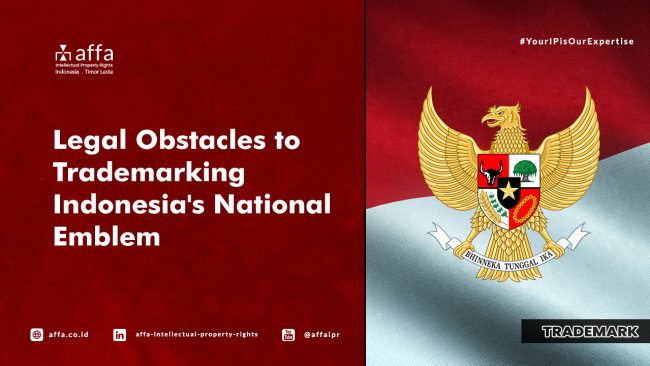
The Garuda Pancasila, the National Emblem of the Republic of Indonesia, is indeed iconic. The figure of this giant bird that is said to be able to cover the sunlight has been known since the 5th century and has become a symbol of many Hindu kingdoms in the archipelago. So, since it was established and used in various national activities, its presence has always inspired people from each generation to display it in a better and better form.   But is that allowed? Modifying and/or using the Garuda Pancasila as a Trademark in Indonesia? Here is the answer from the perspective of Intellectual Property law.   This large and strong figure, containing the date of the Proclamation of Independence of the Republic of Indonesia on its feathers (17-8-1945), was already in the minds of the nation’s founders when they determined the Garuda Pancasila as the National Emblem. In early 1950, the government of the Republic of Indonesia United (RIS) created a technical committee called the National Emblem Committee under the coordination of Minister Zonder Porto Folio Sultan Hamid II, with the Chairman of the Committee, Muhammad Yamin, and Ki Hajar Dewantara, M.A. Pellaupessy, Mohammad Natsir, and R.M. Ng. Purbatjaraka as its members. President Soekarno then inaugurated it at the RIS Cabinet Meeting on February 11, 1950. Its use was then regulated in Government Regulation No. 43 of 1958 and amended by the enactment of Law of the Republic of Indonesia Number 24 of 2009 concerning the Flag, Language, National Emblem, and National Anthem to implement Article 36A of the 1945 Constitution (UUD 1945) which reads, “The National Emblem is the Garuda Pancasila with the motto Bhineka Tunggal Ika.” For those of you who need clarification as to why the 1945 Constitution already contains the Garuda Pancasila even though the draft was only made in 1950, it is because Article 36A resulted from the Second Amendment in 2000. Previously, only Article 36 contained the following: “The National Language is Indonesian.” However, after the amendment, Article 36A (national emblem), 36B (national anthem), and 36C (further provisions related to the flag, language, national emblem, and national anthem are regulated by law) were presented.   Then specifically, Article 57 of Law Number 24 of 2009 contains the following prohibitions related to the National Emblem: It is prohibited to cross out, write, draw, or damage the National Emblem with the intention of tarnishing, insulting, or degrading the honor of the National Emblem; It is prohibited to use the National Emblem that is damaged and does not match the shape, color, and size comparison; It is prohibited to create a symbol for an individual, political party, association, organization, and/or company that is the same as or resembles the national emblem; and It is prohibited to use the National Emblem for purposes other than those regulated by the Law.   A person who violates the prohibition can be punished with a maximum imprisonment of one year or a maximum fine of IDR 100 million.   Although later, the Constitutional Court, through Constitutional Court Decision Number 4/PUU-X/2012, stated the provisions of Article 57 letter d jo. Article 69 letter c of Law 24/2009 concerning the prohibition of the use of the National Emblem for other purposes and its criminal sanctions are contrary to the 1945 Constitution of the Republic of Indonesia and do not have binding legal force, which means that since then the National Emblem can be used freely to a certain extent to support the spirit of nationalism, but does not apply if it is related to Trademark registration.   So even if you can use the Garuda Pancasila in a design for a t-shirt, cap, pin, or other merchandise that is traded, you still cannot register it as a Trademark. As regulated in Article 21 Paragraph (2)b of the Trademark Law, which reads, “An application is rejected if the Trademark is an imitation or resembles the name or abbreviation of a name, flag, insignia, symbol or emblem of a country, or national or international institution, except with the written approval of the authorized party.”   Legal Problems on the Use of National Emblem in Sports Jerseys   A few months ago, there was a debate regarding the use of the National Emblem on the jersey of the Indonesian Football Team. It is common and natural for a national jersey to change its design every season or every year. When the jersey’s vendor changes, the design and logo containing the National Emblem also changes. During the last change, the latest logo was registered with the name of the owner of the jersey’s manufacturer, and this invited controversy because the public began to understand the existence of Article 21 Paragraph (2) b of the Trademark Law.   However, the public forgets the sentence “written approval from the authorized party.” This controversy ended in June 2024 when the Indonesia Football Association (PSSI), the official parent organization of football in Indonesia, took over all logos applied to the Directorate General of Intellectual Property (DGIP). So, if we open the DGIP database today, both old and new logos have listed PSSI as the Trademark owner.   Thus, PSSI has the Exclusive Right to use the logo, and anyone who wants to use it must have permission from PSSI.   Old (DID2024030570) & New (DID2024006041) Logo of PSSI   It is a bit unfortunate that the logo does not contain the initials of PSSI, so it will cause polemics if other sports organizations want to register a logo that also contains the National Emblem. This means that other parties must file and register it with a different logo, but it still has similarities in principle to the logo filed by the PSSI. Should you need further information regarding Trademark protection or registration in Indonesia and worldwide, please do not hesitate to email us at [email protected].

FAQs: Trademark Enforcement in Indonesia - AFFA IPR

Frequently Asked Questions about Trademark Enforcement in Indonesia

Trademark Enforcement Proceedings Q: What types of legal or administrative proceedings are available to enforce the rights of a Trademark Owner against an alleged infringer or dilutive use of a mark, apart from previously discussed opposition and cancellation actions? Are there specialised courts or other tribunals? Is there any provision in the criminal law regarding Trademark Infringement or an equivalent offence?   A: There are several approaches that need to be considered when commencing the Trademark enforcement proceedings. It is always a prudent course of action to start with sending a cease and desist letter against the infringer to immediately cease the infringing action. Should the infringer does not comply with the requests that have been addressed in the cease and desist letter, then the Trademark Owner has the option to file a criminal action against the infringer to the civil investigator at the Directorate General of Intellectual Property (DGIP) or to the Indonesian Police.   All Intellectual Property disputes are the domain of the Court of Commerce. Apart from invalidations and cancellations of registered marks, any party with legal rights can also seek civil actions through the Court of Commerce, namely to request preliminary injunction and to seek for damages or remedies.   The penalties for infringements are covered by the Trademark Law, namely the following articles:   CHAPTER XVIII  CRIMINAL PROVISIONS Article 100 (1) Every person unlawfully uses any Mark which is identical to registered Mark of other parties for similarly produced, and/or traded goods and/or services, shall be sentenced to imprisonment of up to 5 (five) years and/or fines up to Rp2,000,000,000.00 (two billion rupiahs).   (2) Every person unlawfully uses any Mark which is substantially similar to registered Mark of another party for similarly produced and/or traded goods and/or services, shall be sentenced to imprisonment for up to 4 (four) years and/or fines up to Rp2,000,000,000.00 (two billion rupiahs).   (3) Every person violating the provisions as referred to in section (1) and section (2), whose goods cause health impairment, environment distortion, and/or human deceases, shall be sentenced to an imprisonment up to (10) ten years and/or fines up to Rp5.000.000.000,00 (five billion rupiahs).   Article 101 (1) Every person unlawfully uses any signs which are identical to Geographical Indications of other parties for similar goods and/or products or identical to registered goods and/or products, shall be sentenced to imprisonment up to 4 (four) years and/or up to Rp2.000.000.000,00 (two billion rupiahs).   (2) Every Person unlawfully uses any sign which is substantially similar to Geographical Indications of another party for similar goods and/or products or identical with registered goods and/or products, shall be sentenced with imprisonment up to 4 (four) years and/or :nes up to Rp2.000.000.000,00 (two billion rupiahs).   Article 102 Every Person who trades goods and/or services and/or product which is known or allegedly know that the goods and/or services and/or product constitute criminal acts as referred to in Article 100 and Article 101 shall be sentenced with imprisonment up to 1 (one) year or fines up to Rp200.000.000,00 (two hundred million rupiahs).   Article 103 The criminal acts as referred to in article 100 to article 102 constitute complaint delict.   Procedural Format and Timing Q: What is the format of the infringement proceeding?   A: Civil proceedings in Indonesia are conducted in writing and oral arguments. The judges will listen to the oral arguments of each party one at a time, and they rely heavily on documentary evidence. Witnesses of fact can also provide oral evidence before the court. However, a witness statement or affidavit alone will not be sufficient since it is considered merely supplementary documentary evidence. In general, the procedure of the trial is as follows: attendance at the first hearing after the court summons both plaintiff and defendant; attendance at the second hearing, when the defendant files its response to the plaintiff’s cancellation suit; preparation of the plaintiff’s reply to the defendant’s response to the suit; attendance at the third hearing to file the plaintiff’s reply; attendance at the fourth hearing when the defendant files its response to the plaintiff’s reply; preparation of the plaintiff’s evidence to be submitted to the court; attendance at the fifth hearing to submit the plaintiff’s evidence and review the defendant’s evidence; preparation and filing of the conclusion of the case based on documents and evidence filed with the court by both plaintiff and defendant; attendance at the sixth hearing on the filing of the conclusion of the case;  attendance at the seventh hearing to hear the judge’s decision; and issuance of the court’s decision.   For civil procedure, in theory a decision shall be issued within three months. However, in practice, it may take slightly longer due to the extensions requested by any of the parties involved.   Burden of Proof Q: What is the burden of proof to establish infringement or dilution?   A: In Indonesian civil procedure, the burden of proof regarding the facts on which a claim is based lies with the plaintiff. Article 1865 of the Indonesian Civil Code states that anyone who claims to have a certain right or who refers to a fact to support such a right, or who obzects to another party’s right, must prove the existence of that right or that fact. Evidence may comprise written evidence, evidence presented by witnesses, or through inference, confession or oath. In our experience, it is prudent to collect as much diverse evidential material as possible, such as purchases made by mystery shoppers, marketing materials found online and offline, and expert witnesses that may provide substantive statements pertaining to the alleged infringement. Furthermore, written evidence must be presented in the Indonesian language – translated by a sworn translator if necessary.   Standing Q: Who may seek a remedy for an alleged Trademark violation and under what conditions? Who has standing to bring a criminal complaint?   A: In accordance with article 83 of the Trademark Law, the registered mark owner and/or its licensee may file a…

Indonesia Extends the Trademark Non-Use Period from 3 to 5 Consecutive Years - AFFA IPR

Indonesia Extends the Trademark Non-Use Period from 3 to 5 Consecutive Years

On March 31, 2020, Indonesia officially entered the COVID-19 pandemic period with the enactment of Government Regulation Number 21 of 2020 concerning Large-Scale Social Restrictions in the Framework of Accelerating the Handling of Corona Virus Disease 2019 (Covid-I9). After facing various challenges, both for the community, the business world, and the government, the pandemic status in Indonesia was officially lifted on June 21, 2023, and changed to endemic based on the Presidential Decree of the Republic of Indonesia Number 17 of 2023 concerning the Determination of the End of the Corona Virus Disease 2019 (COVID-19) Pandemic Status in Indonesia. In post-pandemic recovery efforts, the government prioritizes economic recovery by paying attention to the needs of Small, and Medium Enterprises (SMEs).  Taking into account the specific conditions of the Indonesian economy, which hugely relies on SMEs that have limited capital and can change at any time and force majeure, through Decision Number 144/PUU-XXI/2023, which was read out at the Constitutional Court (MK) on Tuesday, July 30, 2024, an adjustment was made to the time limit for Trademark non-use period from three to five consecutive years. This case began when Ricky Thio faced a Cancellation Action for his Trademark based on Article 74 of Law Number 20 of 2016 concerning Trademarks and Geographical Indications (Trademark Law) at the Commercial Court at the Central Jakarta District Court with case number 28/Pdt.Sus HKI/Merek/2023/PN Niaga Jkt.Pst from Zhejiang Dahua Technology Co., Ltd. wanted the cancellation of the Trademark “” with registration number IDM000553432 because it was considered not to have been used for three consecutive years. According to Ricky Thio, this situation raises uncertainty in the Trademark protection provided by the government, which has the potential to make SMEs hesitate to register their Trademarks.   Timeframe for Filing a New Trademark Cancellation Action In Decision Number 144/PUU-XXI/2023, the Constitutional Court saw the importance of adjusting the non-use time limit to 5 (five) consecutive years. This is closely related to the time limit for filing a Trademark Invalidation, which is 5 (five) years from the date of Trademark registration, as stated in Article 77 paragraph (1) of the Trademark Law. Although cancellation and invalidation are different things, the regulation is placed in the Chapter “Cancellation and Invalidation of Trademarks” in the Trademark Law.   Thus, without intending to ignore the tendency of countries that adhere to the civil law system, the adjustment of the time limit for non-use of registered Trademarks to 5 (five) years is to provide justice for all registered Trademark owners so that it does not conflict with the Principle of National Treatment and is in line with the provisions contained in Trademark Invalidation. Based on all the legal considerations above, the Applicant’s argument questioning the unconstitutionality of Article 74 paragraph (1) of the Trademark Law, especially the phrase “3 (three) years” is legally justified. In Decision Number 144/PUU-XXI/2023, the Court partially granted Ricky Thio’s request so that the changes to the article related to the deletion of the Trademark due to the Decision are as follows: Before the Constitutional Court Decision After the Constitutional Court Decision Article 74 paragraph (1) Trademark Law The cancellation of a registered Mark may also be submitted by a third party who has an interest in the form of a lawsuit to the Commercial Court based on the ground that the Mark has not been used for 3 (three) consecutive years in the trade of goods and/or services from the registration date or the last use. Article 74 paragraph (1) Trademark Law The cancellation of a registered Mark may also be submitted by a third party who has an interest in the form of a lawsuit to the Commercial Court based on the ground that the Mark has not been used for 5 (five) consecutive years in the trade of goods and/or services from the registration date or the last use. Article 74 paragraph (2) Trademark Law The reasons for an non-used Mark as referred to in paragraph (1) are invalid in the event of: a. import ban; b. temporary prohibition that is related to the permit for the distribution of goods that use the relevant Mark or a decision from an authorized party; or c. other similar prohibitions that are established with Regulation of the Government. Article 74 paragraph (2) Trademark Law The reasons for an non-used Mark as referred to in paragraph (1) are invalid in the event of: a. import ban; b. temporary prohibition that is related to the permit for the distribution of goods that use the relevant Mark or a decision from an authorized party; or c. other similar prohibitions, including in conditions of force majeure that are established with Regulation of the Government.   Force Majeure can be Used for Exceptions Force Majeure can be a legitimate reason for Trademark owners who cannot use their registered Trademark or cannot run their business normally. The Constitutional Court (MK), in Decision Number 144/PUU-XXI/2023, emphasized the importance of this exception. Force Majeure generally refers to events or effects that cannot be predicted or controlled, such as natural disasters (floods, hurricanes, earthquakes) or human actions (riots, strikes, war) that prevent someone from fulfilling their obligations. In this decision, pandemic conditions such as COVID-19 are considered Force Majeure, which justifies an exception for Trademark owners who experience difficulties using and producing their Trademarks.  The consequence of Decision Number 144/PUU-XXI/2023 is that the provisions of the Trademark Law must be adjusted to the decision. This is, of course, in line with the explanation of Article 10, paragraph (1) of Law. No. 07 of 2020 Third Amendment to Law Number 24 of 2003 concerning the Constitutional Court in conjunction with the Stipulation of Government Regulation instead of Law Number 1 of 2013 concerning the Second Amendment to Law Number 24 of 2003 concerning the Constitutional Court to Become a Law in conjunction with Law No. 8 of 2011 concerning Amendments to Law Number 24 of 2003 concerning the Constitutional Court in conjunction with Law Number 24 of…

FAQs: The Registration and Use of Trademark in Indonesia - AFFA IPR

Frequently Asked Questions About the Registration and Use of Trademark in Indonesia

Ownership of Marks Q: Who may apply for registration?   A: Since the Indonesian Trademark Law adopts the first to file principle, in general any individual, organisation or company can file for a Trademark Registration. However, the Trademark Law also regulates Trademark Registrations that are filed in bad faith. Article 21 paragraph (3) of the Trademark Law stipulates that an application is refused if it is submitted by an applicant in bad faith. While the implementation of this article during substantive examination holds true for some applications that have similarities with the already established and Well-known Marks, in practice it is quite challenging to determine whether an application is filed in bad faith or not. A bad-faith application that later matured to registration can always be invalidated at the Court of Commerce as regulated under article 77 paragraph (2) of the Trademark Law, which stipulates the following:   “The lawsuit for invalidation may be in unlimited time if there is bad faith and/or the relevant Mark contravenes the State ideology, laws and regulations, morality, religions, decency, and public order.”   Scope of Trademark Q: What may and may not be protected and registered as a Trademark?   A: By definition of article 1 of the Trademark Law, a Mark is any sign capable of being represented graphically in the form of drawings, logos, names, words, letters, numerals, colour arrangement, in two and;or three-dimensional shape, sounds, holograms or combination of two or more of those elements to distinguish goods or services produced by a person or legal entity in trading goods or services.   Given the definition above, then the Law acknowledges two types of trademarks, namely traditional and non-traditional marks.   Unregistered Trademarks Q: Can Trademark Rights be established without registration?   A: Indonesia is a jurisdiction that adopts the first to file principle. Hence, a prior use itself is not sufficient to establish rights in the country.   Famous Foreign Trademarks Q: Is a famous foreign Trademark afforded protection even if not used domestically? If so, must the foreign Trademark be famous domestically? What proof is required? What protection is provided?   A: A Trademark can only be protected if it is registered in Indonesia, regardless of its fame. However, the Indonesian Trademark Law has a mechanism to somewhat protect a famous foreign Trademark from bad faith registrations by other parties. Should another party try to file a malicious Trademark application that is identical or similar to a famous foreign Trademark, such application will be rejected on the basis of article 21 paragraph (1) b and c, which stipulates the following:   “An Application is refused if the Mark is substantively similar to or identical with a well-known Mark of other parties for similar goods and/or services OR a well-known Mark of other parties for different goods and/or services complying with certain requirements.”   The issue is then shifted to what constitutes as a famous Trademark. Article 18 of the Ministry of Law and Human Rights of the Republic of Indonesia Regulation No. 67 2016 concerning Trademark Registration Decree of the Directorate General of Intellectual Property in the Field of Trademarks has set out the criteria of what makes a Trademark famous, such as: the level of knowledge or public recognition against the Mark in the business field that concerned as a well-known mark; the volume of sales of goods and/or services and benefits derived from using the Mark by the owner; the market share controlled by the Mark in relation to the circulation of goods and/or services in the community; the area of use of the Mark; the period of use of the Mark; the intensity and promotion of the Mark, including value of investment used for the promotion; the number of Trademark applications and registration around the world; the success rate of law enforcement, in particular regarding the recognition of the Mark as a well-known Mark by an authorised institution; or the valuation of the Mark because of the reputation and quality assurance of goods and/or services protected by the Mark.   However, a well-known mark that is famous abroad does not always necessarily have the same level of fame in Indonesia. This raises the issue as to whether the Trademark owner should also establish its fame in Indonesia before taking any action against other parties.   The Benefits of Registration Q: What are the benefits of registration?   A: Pursuant to the Trademark Law, the right on a Mark means the Exclusive Right granted by the state to a registered Mark Owner for a definite period to use his or her mark or authorise others to do otherwise. Hence, by registering a Trademark in Indonesia, the owner can establish its legal right should there is an infringement by another party. This includes, but is not limited to, requesting an e-commerce listing takedown notice, sending a cease and desist letter, filing a police report for the criminal aspect of the infringement, seeking damages at the Court of Commerce, issuing licensing rights, filing injunctions and conducting a Customs Recordal before Indonesian Customs.   Filing Procedure and Documentation Q: What documentation is needed to file a Trademark Application? What rules govern the representation of the Mark in the application? Is electronic filing available? Are trademark searches available or required before filing? If so, what procedures and fees apply?   A: A Trademark search is strongly suggested for anyone who wishes to file a Trademark Application in Indonesia. The search report will identify potential hazards and tumbling blocks to an otherwise successful registration process. Assuming the search report gives the all-clear for continuing the application process, the applicant shall prepare the following: name of the applicant; address; list of goods and services; and the representation of the Mark to be filed, which can be in a form of wordmark, logo or non-traditional Marks.   Once the above information has been provided, then we will prepare the following documents to be signed by the client: power of attorney; and statement…

FAQs: The Legal Framework of Trademark Protection in Indonesia - AFFA IPR

Frequently Asked Questions about the Legal Framework of Trademark Protection in Indonesia

Prevailing Laws and Regulations Q: What is the primary legislation governing Trademarks in Indonesia?   A: Law No. 20 2016 on Marks and Geographical Indications (the Trademark Law) is the primary law concerning Trademark in Indonesia. Several provisions in the Trademark Law were then amended under the Law No. 11 Yeat 2020 in Job Creation, and then further amended under the Law No. 6 Year 2023 on the Enactment of a Replacement Government Regulation in Lieu of the Law No. 2 Year 2022 on Job Creation as Law.   Moreover, there are several by-laws that regulate more specific matters, such as, but not limited to:   Government Regulation No. 28 2019 concerning Types and Tariffs of Non-Tax State Revenues Applicable to the Ministry of Law and Human Rights. This regulation sets the official fees for various actions that can be filed before the Directorate General of Intellectual Property (DGIP) under the Ministry of Law and Human Rights of the Republic of Indonesia. Government Regulation No. 22 2018 concerning International Registration of Marks Under the Protocols Relevant to the Madrid Agreement Concerning the International Registration of Marks. This regulation covers all aspects of international registrations filed to or from Indonesia. Government Regulation No. 90 2019 concerning The Trademark Appeal Commission, which was established on 29 August 1995 concerning Procedures for Application, Examination and Settlement of Appeals at the Mark Appeal Commission. The Ministry of Law and Human Rights of the Republic of Indonesia Regulation No. 12 2021 concerning Amendments to the Ministry of Law and Human Rights of the Republic of Indonesia Regulation No. 67 of 2016 concerning Trademark Registration Decree of the Director General of Intellectual Property in the Field of Trademarks. The ministerial regulation prescribes, among others, the requirements of registration, classes of goods and services, rectification of issued certificates and recordals.   International Law Q: Which international Trademark agreements has Indonesia signed?   A: Indonesia has ratified various agreements concerning Trademarks, such as the Protocol Relating to the Madrid Agreement Concerning the International Registration of Marks, the Trademark Law Treaty and the Paris Convention.   Regulators Q: Which government bodies regulate the Trademark Law?   A: The Directorate General of Intellectual Property (DGIP) under the Ministry of Law and Human Rights of the Republic of Indonesia is the relevant body that administrates the protection of all Intellectual Properties, including Trademarks. The DGIP goes beyond regulating and implementing the law, it is also responsible for proactively disseminating the information pertaining to the importance of IP protection through various means, such as podcasts, YouTube videos, Instagram posts and seminars conducted around Indonesia. Should you need more information regarding Legal Framework of Trademark in Indonesia, please do not hesitate to contact us via [email protected].

International IP Index 2024: Indonesia to catch up on IP Commercialization - AFFA IPR

International IP Index 2024: Indonesia to Catch Up on IP Commercialization

Every year, the United States Chamber of Commerce releases the “International Intellectual Property Index,” which ranks countries worldwide based on their growth in Intellectual Property, commercialization of Intellectual Property assets, law enforcement, system efficiency, and membership and ratification of international treaties. This year, Indonesia is ranked 49th out of 55 countries, or 7th from the bottom. What caused it?   The International Intellectual Property (IP) Index is a comprehensive assessment of the intellectual property framework of countries worldwide. It indirectly shows a country’s policies in encouraging innovation, creativity, economic growth, and wider investment opportunities.   Intellectual Property Becomes an Important Decision for Investment   Intellectual Property as an asset must be recognized. Today’s large companies are at the forefront thanks to their Intellectual Property assets. Technology companies such as Tesla, Apple, Microsoft, and even Walt Disney became rich thanks to the Copyrights, Patents, Trademarks, Industrial Designs, and Trade Secrets they owned. Therefore, when a country cannot provide a climate conducive to protecting Intellectual Property (IP), it is considered to have failed to protect the wealth of its citizens and its business ecosystem. If this is the case, it makes sense that investment in the lowest-rank countries will be smaller than in the upper-rank countries.   The International IP Index published by the United States Chamber of Commerce was first published in 2012. At that time, it only described the performance of 11 countries: the United States, Australia, Brazil, Chile, China, India, England, Canada, Malaysia, Mexico, and Russia. The 12th edition, released in February 2024, has experienced an increase from the previous year, covering 53 countries. This year’s 55 countries have covered over 90% of the world economy’s Gross Domestic Product (GDP), so it is hoped to represent the condition of world IP.   From Southeast Asian countries, the IP Index maps the performance of Singapore, Malaysia, the Philippines, Brunei, Vietnam, Thailand, and Indonesia as samples. Unfortunately, Indonesia is indeed the lowest in Southeast Asia.   The following is the overall ranking of the 2024 International IP Index:   1 United States 95,48% 29 Peru 49,82% 2 United Kingdom 94,12% 30 Chile 49,72% 3 France 93,12% 31 Colombia 48,84% 4 Germany 92,46% 32 Saudi Arabia 48,42% 5 Sweden 92,12% 33 Brazil 46,52% 6 Japan 91,26% 34 United Arab Emirates 46,00% 7 The Netherlands 91,24% 35 Jordan 44,70%  8 Ireland 89,38% 36 Honduras 42,16% 9 Spainl 86,44% 37 Philippines 41,58%  10 Switzerland 85,98% 38 Brunei 41,08%  11 South Korea 84,94% 39 Ghana 40,88%  12 Singapore 84,92%  40 Vietnam 40,76% 13 Italy 83,90% 41 Ukraine 40,30%  14 Australia 80,70% 42 India 38,64% 15 Hungary 76,90% 43 Thailand 38,28%  16 Canada 76,22% 44 Kenya 37,88% 17 Israel 72,74% 45 South Africa 37,28%  18 Greece 71,42% 46 Argentina 37,00% 19 Poland 70,74% 47 Nigeria 36,34%  20 New Zealand 69,36% 48 Egypt 33,86% 21 Taiwan 67,34% 49 Indonesia 30,40% 22 Morocco 62,76% 50 Ecuador 29,58% 23 Mexico 59,98% 51 Kuwait 28,42% 24 China 57,86% 52 Pakistan 27,42% 25 Dominican Republic 55,30% 53 Algeria 26,36% 26 Costa Rika 55,04% 54 Russia 25,00% 27 Malaysia 53,44% 55 Venezuela 14,10% 28 Turkiye 51,04%   Why is Indonesia’s Ranking Low?   Indonesia’s performance in the index fell 0.02% from the previous year but remained at the same rank.   Indonesia’s Performance based on Indicators Source: 2024 International IP Index – U.S. Chamber of Commerce   From the graph above, it can be seen that the number of Patents owned by Indonesia still needs to be stronger, unable to keep up with the growth of Copyrights, Trademarks, and Industrial Designs. Among all the IPs used as indicators, only Copyright is closest to the Asian average performance.   For other indicators, Indonesia is quite good regarding system efficiency but very low in IP asset commercialization. It is the country with the lowest score for this indicator, recorded at only 4.17%. It is below Ecuador, Venezuela, Ghana, Kenya, Russia, and even Vietnam.   Indonesia’s ranking based on the Commercialization of IP Asset Indicator Source: 2024 International IP Index – U.S. Chamber of Commerce   The commercialization of IP Assets is an indicator that measures the presence of barriers and incentives for the commercialization and licensing of IP assets. In more detail, this indicator includes barriers to technology transfer, registration and disclosure requirements of licensing agreements, direct government intervention in setting licensing terms, and the existence of tax incentives for the creation and commercialization of IP assets.   In particular, the United States Chamber of Commerce assesses that Presidential Regulation of the Republic of Indonesia Number 77 of 2020 concerning Procedures for Implementing Patents by the Government has gone far beyond the stated goals and circumstances for the issuing of compulsory licenses under the Trade-Related Aspects of Intellectual Property Rights (TRIPS) Agreement, minimum standards for the regulation by national governments of different forms of IP as applied to nationals of other World Trade Organization (WTO) member nations. This presidential regulation is considered to hinder the transfer of technology on Patents, and Biopharmaceutical patentability standards are outside international norms.   However, Indonesia is generally at the bottom of the ranking because its commercialization foundation still needs to be stronger. Public awareness of IP still needs to improve; the knowledge of IP as an asset is minimal. There are still many people who do not appreciate IPs, not because they cannot afford to buy, but because the tendency to enjoy the IPs without paying still exists. Copyright growth is high, but the market hopes these works can be enjoyed for free. As a result, creators scream, and their productivity decreases. This also causes the innovation climate in Indonesia is not good. Because the public still needs to consider innovation to be something that can be commercialized, the growth of Patents from Indonesia is low. dapat dikomersialisasikan, pertumbuhan Paten dari Indonesia pun rendah. To change this mentality, more than education is needed; concrete steps from the government and private sectors are needed to give the highest appreciation to every existing IPs from within and outside the…

A Win for the WIN - AFFA Represents Hongyunhonghe Tobacco for a Successful Trademark Non-Use Cancellation in Indonesia

A Win for the “WIN” – AFFA Represents Hongyunhonghe Tobacco (Group) Co. Ltd. for a Successful Trademark Non-Use Cancellation in Indonesia

When your Trademark Registration application is rejected in Indonesia, it is often due to the existence of another prior Trademark with the same elements that have been registered in the same class with the Directorate General of Intellectual Property (DGIP). Since Indonesia applies the first-to-file principle, if you register the same Trademark after another Trademark that has been filed or registered earlier, you must consider alternative options to prevent a potential rejection by the DGIP.   The dilemma usually arises when there is an identical prior Trademark that gets in the way of a successful registration, but you have no other option but to still keep using the identical Trademark for business purposes in Indonesia. At times, rebranding exercise costs more than any potential legal action that may be required to cancel a prior Mark due to non-use. In this scenario, the latter should be considered.   As stated in Article 74 of the Trademark and Geographical Indications Law (Trademark Law), an interested third party can apply for cancellation of a registered Trademark in the form of attack legally on the grounds of non-use to the Court of Commerce if the Mark has not been used for trade in goods and/or services for 3 (three) consecutive years from the date of registration or last use.   Therefore, if we can prove that the Trademark is genuinely not in use after a thorough investigation, the Court of Commer can cancel a registered Trademark upon request of an interested third party.   Since 2022, AFFA has been trusted by Hongyunhonghe Tobacco (Group) Co. Ltd., which originates from the People’s Republic of China to manage its Intellectual Property in Indonesia, one of which is the WIN Trademark in class 34 which includes types of cigarette filters, filters for cigarettes, lighters, liquid solutions for use in electronic cigarettes, lighters for smokers, flavorings other than oil essentials for tobacco, cigarettes, electronic cigarettes, snuff and hand-rolling tobacco.   However, based on initial searches, there is already a WIN Trademark under registration no. IDM000030697 in the same class owned by PT Sumatra Tobacco Trading Company (STTC)  of North Sumatra, Indonesia. Under normal conditions, of course, the client’s chance to register WIN is low because it will be rejected as regulated in Article 21 paragraph (1) letter (a) of the Trademark Law, which states that a Trademark application is rejected if the Trademark has similarities in essence or its entirety with the registered Trademark owned by the other party for similar goods and/or services.   Previously, the WIN Trademark of Hongyunhonghe Tobacco had been registered in China, the European Union, Australia, Brazil, Mexico, South Korea, Cambodia, Vietnam, and even Singapore since 2009. This fact alone already constitutes the definition of “an interested party” as regulated by Article 74 of the Trademark Law.   After the investigation process was carried out, it was found that STTC had not used the Trademark for 3 consecutive years from the date of registration or from the date of last use. Consequently, the petition for cancellation was filed to the Commercial Court – Central Jakarta District Court on September 14, 2023, as regulated in Article 76 paragraph (1) of the Trademark Law. Unfortunately, the Court of Commerce decided to reject the petition. Therefore, the next step was to file a cassation to the Supreme Court on September 27, 2023.   The Supreme Court of the Republic of Indonesia finally decided that the Central Jakarta District Court had misapplied the law, granted our cassation request on January 25, 2024, while canceling the Commercial Court’s decision, and asked DGIP to register the cancellation of the WIN Trademark registration from the General Register of Trademarks and announce it in the Official Trademark Gazette.    You might also want to read: AFFA Represents Trek Bicycle to Win a Trademark Non-Use Cancellation Action in Indonesia This success story is a testament that with thorough preparation and investigation, a non-use cancellation action is possible in Indonesia. Should you need more information about Trademark registration and protection in Indonesia or abroad, please email us at [email protected].

AFFA Represents Trek Bicycle to Win a Trademark Non-Use Cancellation Action in Indonesia

AFFA Represents Trek Bicycle to Win a Trademark Non-Use Cancellation Action in Indonesia

Since mid-2023, AFFA has been entrusted with handling disputes over the Marlin, Trademark owned by Trek Bicycle Corporation, headquartered in Waterloo, United States. Marlin is Trek’s Trademark for its flagship mountain bike frame.    In its home country, Marlin has been used since 1994 and was registered in 1998 at the United States Patent and Trademark Office (USPTO). However, when it was submitted for registration in 2021 via the Madrid Protocol addressed to Indonesia, this Mark was rejected by the Directorate General Intellectual Property (DGIP) as the Trademark Office in Indonesia because it was deemed to have similarities in its essence or its entirety with the registered identical Prior Mark owned by PT Astra Honda Motor since November 2006, and the protection period would have ended in November 2026.   Based on research conducted by independent investigators, it turned out that PT Astra Honda Motor had never used this Trademark for 3 (three) consecutive years from the date of registration or from the date of last use. Due to this fact, a petition to cancel the Marlin Trademark due to non-use was filed as regulated in Article 74 paragraph (1) of the Trademark and Geographical Indications Law (Trademark Law).   Despite an unfavorable decision at the Court of Commerce level, the team at AFFA filed a cassation to the Supreme Court on December 6 and submitted a cassation memo on December 19, 2023. It was finally decided in a deliberation meeting of the Panel of Judges on Tuesday, March 19, 2024, that the Commercial Court at the Central Jakarta District Court had misapplied the law and ordered the DGIP to remove the Marlin Trademark under the name of PT Astra Honda Motor.   The most important factor is that the Trademark has not been used in the last 3 (three) years based on the non-use investigation report submitted to the Court of Commerce. Apart from that, the similarity in essence or its entirety, an element of Trademark cancellation, does not need to be explained in the petition. Moreover, it is supported by the fact that the Cassation Respondent/Defendant never appeared at the hearings, even though they had been summoned 3 (three) times. Another helpful point that enhanced the chance of obtaining a favorable decision is the fact that Trek Bicycle Corporation also has registrations for the same Mark in various countries, such as Costa Rica, Guatemala, Nicaragua, Panama, Honduras and others.    Contrary to the popular belief that non-use cancellations in Indonesia are impossible, this decision by the Supreme Court is a proof that non-use cancellations are possible, provided that the plaintiff comes prepared with non-use investigation report and ample additional evidence which suggest legitimate interests in the same Mark. Should you need more information about registering your Trademark in Indonesia or abroad, do not hesitate to email us at [email protected].