FAQs: Patent Remedies in Indonesia - AFFA IPR

Frequently Asked Questions about Patent Remedies in Indonesia

Monetary Remedies for Infringement Q: What monetary remedies are available against a Patent infringer? When do damages start to accrue? Do damage awards tend to be nominal, provide fair compensation, or be punitive? How are royalties calculated?   A: All laws about Intellectual Property assets allow the infringed to seek damages through the Court of Commerce. However, there is no known formula for determining the damages to be awarded. When seeking damages, the plaintiff considers the combination of material loss and immaterial loss. The latter often has a significantly higher amount. Still, we have not seen any landmark cases where the Court of Commerce awards the plaintiff with the total sought damages based on material and immaterial loss.   The compensation shall be given based on a final and binding decision of a civil or criminal court.   Injunctions Against Infringement Q: To what extent can a temporary injunction or a final injunction against future infringement be obtained? Is an injunction effective against the infringer’s suppliers or customers?   A: Regarding injunctions, the Patent Law allows the rights holder to request a provisional injunction to stop the entry and circulation of infringing items, secure or confine them, and avoid greater losses.   The injunction petition shall be filed before the Court of Commerce.   Banning Importation of Infringing Products Q: To what extent is it possible to block the importation of infringing products into the country? Is there a specific tribunal or proceeding available to accomplish this?   A: Banning the importation of infringing products is only practically possible if it is related to Trademark or Copyright infringement, which can be done by filing a Customs IP Recordal Application before the Indonesian Customs and Excise. Even then, it is only possible if the rights holder is an Indonesian individual or holds a share in an Indonesian company.   Attorneys’ Fees Q: Under what conditions can a successful litigant recover costs and attorneys’ fees?   A: Attorney’s fees shall be borne by the party that receives legal services from the entrusted attorney. Hence, seeking compensation from the other party for the legal fees already incurred by the claimant or plaintiff will not be possible.   Wilful Infringement Q: Are additional remedies available against a deliberate or wilful infringer? If so, what is the test or standard to determine whether the infringement is deliberate? Are opinions of counsel used as a defense to a charge of wilful infringement?   A: There are no additional remedies available against deliberate or wilful infringement. The Patent Law does not specify the threshold level that constitutes wilful or intentional infringement. The Patent Law only states that without a patent holder’s permission, it is prohibited to make, use, sell, import, rent, deliver, or provide any patented product for sale or rent. Additionally, using a patented process to make a product or taking other actions, as mentioned above, is prohibited without the patent holder’s permission. In summary, this provision sets out the exclusive rights of a patent holder. It prohibits others from using, selling, or making the patented product or process without permission (see Article 160 of the Patent Law).   The Limits for Lawsuits Q: What is the time limit for seeking a remedy for Patent infringement?   A: The Patent Law does not regulate any specific time limit for filing a Patent infringement or compensation claim. As long as the Patent is still registered, the holder has the right to enforce it.   Patent Marking Q: Must a Patent holder mark its patented products? If so, how must the marking be made? What are the consequences of failure to mark? What are the implications of false Patent marking?   A: The Patent Law does not regulate the obligation concerning Patent marking.   Should you need more information regarding Patent Remedies in Indonesia, please do not hesitate to contact us via [email protected].

IP Infringement Risks - Is Building Replicas of Classic Cars One of Them? AFFA IPR

IP Infringement Risks – Is Building Replicas of Classic Cars One of Them?

Owning a rare classic car, even at a high price, can be a source of pride. What’s unique is that several classic cars, such as the Porsche 911, Shelby Cobra 427, and Ford Mustang GT500, which are widely used by Indonesian celebrities, are local manufacturers, aka custom or modified results from different cars. How is this practice viewed from an Intellectual Property law perspective?   In the production of vehicles, or in this case specifically four-wheeled cars, there are at least three categories of Intellectual Property (IP) related to it, namely Trademarks, Industrial Designs, and Patents. Let’s describe the details one by one.   Car Name & Logo are the Exclusive Rights of the Trademark Owner   According to the Trademark Law, a Trademark is a sign in the form of an image, name, word, letters, numbers, color arrangement, or a combination of these elements, which has distinguishing power and is used in trading activities for goods or services. The names and logos of well-known cars such as Porche, Shelby Cobra, and Ford Mustang are the property of Porche AG, Carroll Hall Shelby Trust, and Ford Motor Company, respectively. These Trademarks have been registered and recognized as well-known marks and are protected in many countries, including Indonesia.   The trademark’s ownership and protection are valid for ten years and can be extended. Therefore, there is very little chance for you to own or commercialize this Trademark in Indonesia without establishing official cooperation with the Trademark owner or its official distributor in Indonesia.   Regarding the use of Trademarks without permission, Article 100, paragraphs (1) and (2) of the Trademark Law clearly states, “Every person who without right uses a Trademark which is completely the same as a registered Trademark belonging to another party for similar goods and/or services which produced and/or traded, shall be punished with imprisonment for a maximum of 5 years and/or a fine of a maximum of IDR 2 billion.”   Industrial Design – Aesthetic External Appearance Protection   Another IP that is closely related to cars is Industrial Design. According to its definition, Industrial Design is the creation of a form of configuration, or composition of lines or colors, or lines and colors, or a combination thereof in a three-dimensional or two-dimensional form which gives an aesthetic impression and can be realized in three-dimensional or two-dimensional patterns and can be used to produce a product, industrial commodity, or handicraft.   Industrial Design protects the appearance of the car’s external design, whether as a whole or just in part, such as the design of the front bumper, rear bumper, rim shape, or even the threads of the tires. Industrial design can also protect the appearance of the dashboard, steering wheel, chair shape, and even the design of the pedal brake clutch, as well as the gear shift lever. Several Industrial Designs registered by Porche AG Source: Word Intellectual Property Office (WIPO)   As an Intellectual Property, Industrial Designs have a protection period of 10 years and cannot be extended. So, legally, you can use an expired design without getting approval from the owner. However, suppose you use a design that is still protected. In that case, Article 54 of the Industrial Design Law states that a maximum prison sentence of four years and/or a maximum fine of IDR 300,000,000.00 (three hundred million rupiah) awaits you.   Patent & Cars Innovations   Patents are another category of IP that can be contained in a car. If Industrial Design concerns an aesthetic external appearance, then a Patent only covers certain parts that include innovations in the field of technology. For example, braking sensor systems, light automation, or airbag systems are all protected Patents, and anyone who wants to use them must pay royalties to the Patent owner.   And if there is a violation or use of a Patent without permission, Article 161 of the Patent Law states that each person can be punished with imprisonment for a maximum of four years and/or a fine of a maximum of IDR 1,000,000,000 (one billion rupiah). Meanwhile, criminal sanctions, as regulated in Article 162 of the Patent Law for violations of Simple Patents, are imprisonment for a maximum of 2 (two) years and/or a fine of a maximum of IDR 500,000,000 (five hundred million rupiah).   If we are talking about modified cars, most of the technology contained in the original car will not be available. Firstly, because it is technically incapable of adopting the technology; secondly, it does not obtain a license for the Patent. That’s where modified cars become technically unsafe products because of a technological imbalance in their manufacture.   Legal Solution: Original Car Modification   Although since 25 September 2023, the Minister of Transportation of the Republic of Indonesia has promulgated Ministerial Regulation Number PM-45 of 2023 concerning Vehicles Customization, this regulation only regulates technical requirements regarding how modifications can and cannot be carried out so that the car is roadworthy, and provides a sense of security to users, as well as the requirements for a modification workshop to apply for a certificate, without touching on the Intellectual Property side.   Article 1 of Ministerial Regulation No. PM-45 of 2023 clearly states that modification or customization of motorized vehicles includes changes to the axle distance, construction, and/or materials, as well as changing the engine brand and engine type of a motorized vehicle for one’s benefit or individual.   However, it should be noted that customization by order by a custom workshop for one’s own or individual interests, if there is an Intellectual Property violation in it, is still at risk of receiving a complaint from the owner of the Trademark, Industrial Design and/or Patent, and may be subject to criminal sanctions as stated in each article of Intellectual Property law applicable in Indonesia.   For this reason, several legal practices widely implemented worldwide focus on making their own modified cars. An example of this is done by Mitsuoka Motor, a Japanese modification company that changes Japanese-manufactured…

Various Intellectual Properties in Football - AFFA IPR

Various Intellectual Properties in Football

At the beginning of May 2024, the United Nations (UN) General Assembly declared May 25 as the World Football Day. This date was chosen to commemorate the 100th anniversary of the first football competition at the 1924 Olympics held in Paris, France. The UN hopes this day will always be celebrated as a day of world unity, which can unite cultural differences and socio-economic barriers.   As the most widely played sport, Football also involves a lot of Intellectual Property, with a turnover of up to trillions of dollars. This includes Trademarks, Patents, Industrial Designs, Copyrights, Trade Secrets, Domain Names, and License Agreements. Below, we describe some of the Intellectual Property we most often encounter in Football.   Trademark   Every competition and tournament certainly has a name. We know the FIFA World Cup, UEFA Champions League, English Premier League (EPL), and Asian Football Confederation (AFC). These names are synonymous with quality and entertaining games. Most importantly, they are all registered Trademarks that unauthorized parties cannot use arbitrarily. You cannot just produce and sell t-shirts with the UEFA Champions League logo without permission from the Union des Associations Européennes de Football.    Trademarks in football are not only related to competition; several names of top players have also been registered as Trademarks. For example, “CR7” belongs to Cristiano Ronaldo, “Leo Messi” belongs to Lionel Messi, and even Mbappe’s celebration pose. You might also want to read: Kylian Mbappé Has Trademarked His Iconic Goal Celebration – Why Is It Possible?   Patent An innovation that cannot be separated from modern football is the Video Assistant Referee (VAR). With this technology, referee decisions on the field can be more accurate, not controversial. VAR, whose patent is owned by Hawk-Eye Innovations (part of Sony), was first used at the 2018 FIFA World Cup in Russia. With VAR, the referee can quickly check whether a goal is legal, a player is caught offside, or cameras from many sides cover other violations.   As a Patent, FIFA pays royalties to Hawk-Eye Innovations for its use. Hawk-Eye also maximizes its income by marketing this technology to 90 countries worldwide. However, with a cost per season of around USD 6.2 million, not all leagues worldwide can afford to use it.   The Patent for football also includes the ball itself. In almost every World Cup event, the ball is presented with more sophisticated technology than before, which is expected to increase the accuracy of the players’ shots.   Industrial Design   Like the ball in football, the shoes players use may contain patent-protected innovations. But if not, the shoes and all the clothes we see are registered as Industrial Design.   Football jerseys or costumes are one of a football club or team’s biggest sources of income. For diehard fans, wearing a jersey when watching a match or even going to the mall is a matter of pride and proof of their support for their favorite team.   However, jerseys are also among the Intellectual Property most often pirated. As true fans, of course, we can choose to only buy the original because only then is the money we spend commensurate with the quality we get, and most importantly, the income will go to the club we support.   Copyright   League and match materials, images, promotions, or other content related to football broadcasts fall into the Copyright category. Each match is owned by a different owner, who also sells broadcast rights to TV stations in each region.   These Copyright holders even opened a bidding scheme to give the highest buyers the opportunity to obtain the Broadcasting Rights. Because it costs a lot of money to get the rights, it is understandable that the Broadcasting Rights holders are very protective of the material they own. They don’t let other parties broadcast it in the regions they already cover, or prosecution will be carried out.   Trade Secret   Playing strategies, including technical details of formations and other confidential information, can be categorized as Trade Secrets. These secrets give each team a competitive advantage by not revealing certain important information to the public or rival teams. All team members, including the technical and health trainers, are bound by a Non-Disclosure Agreement (NDA).   Domain Name   The Domain Name associated with each league and competition is very important in maintaining its online presence and marketing. Fifa.com, uefa.com, and the-afc.com have been registered to prevent cybersquatting and Trademark misuse. The fifa.com domain, for example, is available in various languages to make it easier to access and search for the latest information and to disseminate official information to all media and football fans throughout the world.   License Agreement   Licensing Agreements may include Trademark Licenses to produce and sell merchandise, mobile phone applications, video games, and more. Game developers who want to present a team with the appropriate club name or accurate appearance of the players have to pay significant royalties to FIFA.   Finally, in organizing football, we must be aware of and involve all related Intellectual Properties (IPs). In fact, IP is the financial generator in every activity. Therefore, don’t forget to involve IPs in every tournament you run and reap the benefits. Should you need further information regarding Licensing Agreements, Trademark registration, Patents, Industrial Designs, Copyrights, or other Intellectual Property, please do not hesitate to contact us at [email protected].

International IP Index 2024: Indonesia to catch up on IP Commercialization - AFFA IPR

International IP Index 2024: Indonesia to Catch Up on IP Commercialization

Every year, the United States Chamber of Commerce releases the “International Intellectual Property Index,” which ranks countries worldwide based on their growth in Intellectual Property, commercialization of Intellectual Property assets, law enforcement, system efficiency, and membership and ratification of international treaties. This year, Indonesia is ranked 49th out of 55 countries, or 7th from the bottom. What caused it?   The International Intellectual Property (IP) Index is a comprehensive assessment of the intellectual property framework of countries worldwide. It indirectly shows a country’s policies in encouraging innovation, creativity, economic growth, and wider investment opportunities.   Intellectual Property Becomes an Important Decision for Investment   Intellectual Property as an asset must be recognized. Today’s large companies are at the forefront thanks to their Intellectual Property assets. Technology companies such as Tesla, Apple, Microsoft, and even Walt Disney became rich thanks to the Copyrights, Patents, Trademarks, Industrial Designs, and Trade Secrets they owned. Therefore, when a country cannot provide a climate conducive to protecting Intellectual Property (IP), it is considered to have failed to protect the wealth of its citizens and its business ecosystem. If this is the case, it makes sense that investment in the lowest-rank countries will be smaller than in the upper-rank countries.   The International IP Index published by the United States Chamber of Commerce was first published in 2012. At that time, it only described the performance of 11 countries: the United States, Australia, Brazil, Chile, China, India, England, Canada, Malaysia, Mexico, and Russia. The 12th edition, released in February 2024, has experienced an increase from the previous year, covering 53 countries. This year’s 55 countries have covered over 90% of the world economy’s Gross Domestic Product (GDP), so it is hoped to represent the condition of world IP.   From Southeast Asian countries, the IP Index maps the performance of Singapore, Malaysia, the Philippines, Brunei, Vietnam, Thailand, and Indonesia as samples. Unfortunately, Indonesia is indeed the lowest in Southeast Asia.   The following is the overall ranking of the 2024 International IP Index:   1 United States 95,48% 29 Peru 49,82% 2 United Kingdom 94,12% 30 Chile 49,72% 3 France 93,12% 31 Colombia 48,84% 4 Germany 92,46% 32 Saudi Arabia 48,42% 5 Sweden 92,12% 33 Brazil 46,52% 6 Japan 91,26% 34 United Arab Emirates 46,00% 7 The Netherlands 91,24% 35 Jordan 44,70%  8 Ireland 89,38% 36 Honduras 42,16% 9 Spainl 86,44% 37 Philippines 41,58%  10 Switzerland 85,98% 38 Brunei 41,08%  11 South Korea 84,94% 39 Ghana 40,88%  12 Singapore 84,92%  40 Vietnam 40,76% 13 Italy 83,90% 41 Ukraine 40,30%  14 Australia 80,70% 42 India 38,64% 15 Hungary 76,90% 43 Thailand 38,28%  16 Canada 76,22% 44 Kenya 37,88% 17 Israel 72,74% 45 South Africa 37,28%  18 Greece 71,42% 46 Argentina 37,00% 19 Poland 70,74% 47 Nigeria 36,34%  20 New Zealand 69,36% 48 Egypt 33,86% 21 Taiwan 67,34% 49 Indonesia 30,40% 22 Morocco 62,76% 50 Ecuador 29,58% 23 Mexico 59,98% 51 Kuwait 28,42% 24 China 57,86% 52 Pakistan 27,42% 25 Dominican Republic 55,30% 53 Algeria 26,36% 26 Costa Rika 55,04% 54 Russia 25,00% 27 Malaysia 53,44% 55 Venezuela 14,10% 28 Turkiye 51,04%   Why is Indonesia’s Ranking Low?   Indonesia’s performance in the index fell 0.02% from the previous year but remained at the same rank.   Indonesia’s Performance based on Indicators Source: 2024 International IP Index – U.S. Chamber of Commerce   From the graph above, it can be seen that the number of Patents owned by Indonesia still needs to be stronger, unable to keep up with the growth of Copyrights, Trademarks, and Industrial Designs. Among all the IPs used as indicators, only Copyright is closest to the Asian average performance.   For other indicators, Indonesia is quite good regarding system efficiency but very low in IP asset commercialization. It is the country with the lowest score for this indicator, recorded at only 4.17%. It is below Ecuador, Venezuela, Ghana, Kenya, Russia, and even Vietnam.   Indonesia’s ranking based on the Commercialization of IP Asset Indicator Source: 2024 International IP Index – U.S. Chamber of Commerce   The commercialization of IP Assets is an indicator that measures the presence of barriers and incentives for the commercialization and licensing of IP assets. In more detail, this indicator includes barriers to technology transfer, registration and disclosure requirements of licensing agreements, direct government intervention in setting licensing terms, and the existence of tax incentives for the creation and commercialization of IP assets.   In particular, the United States Chamber of Commerce assesses that Presidential Regulation of the Republic of Indonesia Number 77 of 2020 concerning Procedures for Implementing Patents by the Government has gone far beyond the stated goals and circumstances for the issuing of compulsory licenses under the Trade-Related Aspects of Intellectual Property Rights (TRIPS) Agreement, minimum standards for the regulation by national governments of different forms of IP as applied to nationals of other World Trade Organization (WTO) member nations. This presidential regulation is considered to hinder the transfer of technology on Patents, and Biopharmaceutical patentability standards are outside international norms.   However, Indonesia is generally at the bottom of the ranking because its commercialization foundation still needs to be stronger. Public awareness of IP still needs to improve; the knowledge of IP as an asset is minimal. There are still many people who do not appreciate IPs, not because they cannot afford to buy, but because the tendency to enjoy the IPs without paying still exists. Copyright growth is high, but the market hopes these works can be enjoyed for free. As a result, creators scream, and their productivity decreases. This also causes the innovation climate in Indonesia is not good. Because the public still needs to consider innovation to be something that can be commercialized, the growth of Patents from Indonesia is low. dapat dikomersialisasikan, pertumbuhan Paten dari Indonesia pun rendah. To change this mentality, more than education is needed; concrete steps from the government and private sectors are needed to give the highest appreciation to every existing IPs from within and outside the…

A Win for the WIN - AFFA Represents Hongyunhonghe Tobacco for a Successful Trademark Non-Use Cancellation in Indonesia

A Win for the “WIN” – AFFA Represents Hongyunhonghe Tobacco (Group) Co. Ltd. for a Successful Trademark Non-Use Cancellation in Indonesia

When your Trademark Registration application is rejected in Indonesia, it is often due to the existence of another prior Trademark with the same elements that have been registered in the same class with the Directorate General of Intellectual Property (DGIP). Since Indonesia applies the first-to-file principle, if you register the same Trademark after another Trademark that has been filed or registered earlier, you must consider alternative options to prevent a potential rejection by the DGIP.   The dilemma usually arises when there is an identical prior Trademark that gets in the way of a successful registration, but you have no other option but to still keep using the identical Trademark for business purposes in Indonesia. At times, rebranding exercise costs more than any potential legal action that may be required to cancel a prior Mark due to non-use. In this scenario, the latter should be considered.   As stated in Article 74 of the Trademark and Geographical Indications Law (Trademark Law), an interested third party can apply for cancellation of a registered Trademark in the form of attack legally on the grounds of non-use to the Court of Commerce if the Mark has not been used for trade in goods and/or services for 3 (three) consecutive years from the date of registration or last use.   Therefore, if we can prove that the Trademark is genuinely not in use after a thorough investigation, the Court of Commer can cancel a registered Trademark upon request of an interested third party.   Since 2022, AFFA has been trusted by Hongyunhonghe Tobacco (Group) Co. Ltd., which originates from the People’s Republic of China to manage its Intellectual Property in Indonesia, one of which is the WIN Trademark in class 34 which includes types of cigarette filters, filters for cigarettes, lighters, liquid solutions for use in electronic cigarettes, lighters for smokers, flavorings other than oil essentials for tobacco, cigarettes, electronic cigarettes, snuff and hand-rolling tobacco.   However, based on initial searches, there is already a WIN Trademark under registration no. IDM000030697 in the same class owned by PT Sumatra Tobacco Trading Company (STTC)  of North Sumatra, Indonesia. Under normal conditions, of course, the client’s chance to register WIN is low because it will be rejected as regulated in Article 21 paragraph (1) letter (a) of the Trademark Law, which states that a Trademark application is rejected if the Trademark has similarities in essence or its entirety with the registered Trademark owned by the other party for similar goods and/or services.   Previously, the WIN Trademark of Hongyunhonghe Tobacco had been registered in China, the European Union, Australia, Brazil, Mexico, South Korea, Cambodia, Vietnam, and even Singapore since 2009. This fact alone already constitutes the definition of “an interested party” as regulated by Article 74 of the Trademark Law.   After the investigation process was carried out, it was found that STTC had not used the Trademark for 3 consecutive years from the date of registration or from the date of last use. Consequently, the petition for cancellation was filed to the Commercial Court – Central Jakarta District Court on September 14, 2023, as regulated in Article 76 paragraph (1) of the Trademark Law. Unfortunately, the Court of Commerce decided to reject the petition. Therefore, the next step was to file a cassation to the Supreme Court on September 27, 2023.   The Supreme Court of the Republic of Indonesia finally decided that the Central Jakarta District Court had misapplied the law, granted our cassation request on January 25, 2024, while canceling the Commercial Court’s decision, and asked DGIP to register the cancellation of the WIN Trademark registration from the General Register of Trademarks and announce it in the Official Trademark Gazette.    You might also want to read: AFFA Represents Trek Bicycle to Win a Trademark Non-Use Cancellation Action in Indonesia This success story is a testament that with thorough preparation and investigation, a non-use cancellation action is possible in Indonesia. Should you need more information about Trademark registration and protection in Indonesia or abroad, please email us at [email protected].

Athlete and Inventor at Once - Why Not? - AFFA IPR

Athlete and Inventor at Once – Why Not?

Professional athletes often understand what needs to be done to improve their performance, whether modifying existing equipment or creating something new. So, their position is not just to use the latest technology created by sponsors but to create their own technology according to their needs. This is also useful for athletes and other sportsmen, including fans who want to experience the sensation.   In the history of sports technology development, dozens of athletes have been involved in the innovation process and registered as inventors in various countries. The following five names could be an inspiration for you: Tony Finau This 6 PGA Tour winner has a unique habit when using his putter. He often uses the back of the club to hit the ball from close range. He even provides an arrow with a certain tilt angle on his Ping PLD Anser 2D putter, making his aim more accurate. Seeing this inappropriate use certainly made the Ping producer feel the need to “talk” with Tony to get feedback. The results led to the creation of a putter prototype that provides the sensation of being hit from behind but still has an attractive design that does not violate the rules.   “Compact Putter Head” (U.S. #11.911.670 B2) Finally, since February 2024, Tony Finau’s name was officially included as the inventor of the Patent Utility for Ping’s “Compact Putter Head” (U.S. #11,911,670 B2), along with Tony Serrano (Ping Design Engineer) and John A. Solheim (Ping President). George Grant A century and a half ago, the sport of golf did not yet know the term “golf tee” or a tool for placing the ball at the starting point of the shot. Uneven sand or grass conditions were harsh and interfered with hitting accuracy until the first African-American avid golfer from Harvard registered the first “Golf-Tee” (U.S. #638,920 A) in America in 1899. “Golf-Tee” (U.S. #638.920 A) Unfortunately, Grant’s wooden tee is not commercialized, so only a few people know about it and use it. Until decades later, William Lowell, who also worked as a dentist, appeared, collaborating with Spalding to produce and promote the “Reddy Tee,” a wooden tee like Grant’s but painted red. Stanley Honey As a Sailing sports navigator since 1992, he has mastered various classes, from Yacht to Catamaran, complete with several fastest finish records, including winning the Newport Bermuda Race in 2022. Stanley, who has a Master of Science in Electrical Engineering from Stanford University, uses the knowledge gained on campus to maximize his sporting activities. Since 2003, he has had a Patent for “Locating an Object Using GPS with Additional Data” (U.S. #657,584 B2). “Electromagnetic Transmitting Hockey Puck” (U.S. #5.564.698 A) He also became acquainted with officials from this sport from leading technology and media companies, including Atari, News Corp, and Fox Corporation. Until 1998, Stanley was trusted to lead Sportvision, a technology company tasked with improving the audience’s experience watching various sports broadcasts on News Corp and Fox. “Electromagnetic Transmitting Hockey Puck” (U.S. #5,564,698 A), which allows TV viewers at home to see more clearly the hockey puck in play, “System for Determining Information about a Golf Club and/or a Golf Ball” (U.S. #6,456 .232 B1) which can show the speed of the ball on the viewer’s screen, and the “System for Enhancing the Television Presentation of an Object at a Sporting Event” (U.S. 5,912,700 A) which allows the viewer to receive real-time information from changes in the sequence of vehicles on racing. Of his total of 30 Patents, eight are related to navigation design systems, while the rest are related to improving the experience of watching sporting events. Charles Smith After retiring, the former National Basketball Association (NBA) player from 1988-1988 was active in the National Basketball Players Association (NBPA) Foundation, advising retired basketball players who wanted to change professions to other fields. In 1998, Smith founded New Media Technology Corp., the first company to develop and patent a customizable video ingest application. “System and Method for Computer-Assisted Manual and Automatic Logging of Time-Based Media” (U.S. #8.060.515 B2) This invention, called “System and Method for Computer-Assisted Manual and Automatic Logging of Time-Based Media” (U.S. #8,060,515 B2), makes it easier to provide virtual consultations to everyone who needs them, with limited bandwidth. Smith said that his experience as a player and coach is beneficial in giving these virtual consultations, especially in the post-pandemic era, when people trust the input of a “coach” more than their boss. Van Phillips Phillips lost both legs at the age of 21 in a 1976 water skiing accident. However, he became even more enthusiastic about completing his studies as a Biomedical Design Engineer at the Utah University, United States, and founded his own company, Flex-Foot Incorporated, in 1984. “Prosthetic Energy Storing and Releasing Apparatus and Methods” (U.S. #20.210.259.857 A1) From there, several vital inventions were born, one of which was a light and flexible artificial leg made from carbon fiber, which foreign athletes widely used to excel in the prestigious Summer Paralympics. This Patent, called “Attachment Construction for Prosthesis” (WO #9,318,723 A1), was then developed to give birth to dozens of other Patent derivatives that brought him royalty income.   Whatever job you are in now, you may find a better way to make it easier. If it turns out to be unique, has never existed before, and can also be helpful for many people, immediately register it as a Patent to get more protection and benefits!   Should you need further information about Patent registration in Indonesia and abroad, don’t hesitate to email us at [email protected].

Kylian Mbappe has Trademarked His Iconic Goal Celebration - Why is it Possible? - AFFA IPR

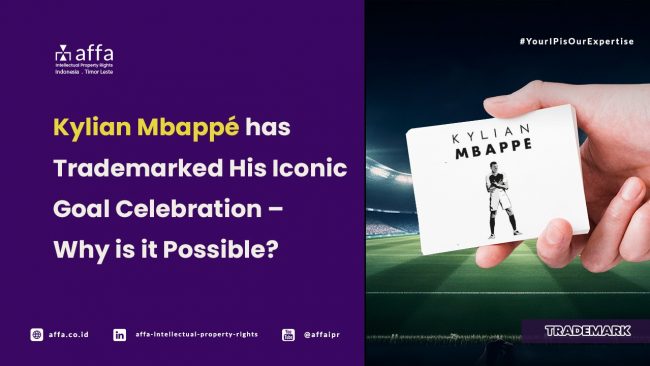
Kylian Mbappé has Trademarked His Iconic Goal Celebration – Why is it Possible?

Since 2017, Kylian Mbappé has contributed 170+ goals for the Paris Saint-Germain football club. Since then, Mbappé has introduced a celebration pose with crossed arms clamped in his armpits after he scores. Apparently, the pose was registered as a Trademark in the same year and will be protected at least until August 2027.   In theory, since 2008, the World Intellectual Property Organization (WIPO) has recognized the existence of ‘New Types of Marks,’ which divides Trademarks into two types, namely Visible and Non-Visible. For Visible Marks, apart from the various commonly recognized Marks such as names, logos, and holograms, Motion or Multimedia Signs, Position Marks, and Gesture Marks are also recognized. Therefore, this celebratory pose, which includes gestures, can indeed be registered as a Trademark. Source: World Intellectual Property Organization (WIPO)   As a logo, there is a classification system that regulates it to make applications more accessible, as well as providing ample opportunity for each person or company logo to be registered in various appropriate class categories, thereby minimizing monopolistic practices. The classification system is the Vienna Class, which divides logos into 29 categories, 144 divisions, 775 main sections, and 1,112 auxiliary sections. Mbappé’s celebration pose is included in Vienna Class 2.1.8 which includes logos for “Acrobats, athletes, dancers, jugglers, nude men, men practising sports (except those already included in Vienna Classes 2.1.2, 2.1.12, 2.1.14, 2.1.20 and 2.1.21).”   It should be noted that the Indonesian Trademark Office (DGIP) has not adopted the Vienna Class for Figurative Mark, but this does not mean that the Mark cannot be registered in Indonesia. Please take a look at the explanation at the end of this article.   Why Does It Need to be Trademarked?   From the start, Mbappé understood that his unique pose could be registered as a Trademark. Dozens of years earlier, David Beckham, the legendary wing midfielder from Manchester United, had registered his cross-passing pose as a Trademark. The difference is that the logo registered by Beckham is a figure that resembles a human (Vienna Class 4.5.5), not a black-and-white photo of himself as registered by Mbappé. Source: World Intellectual Property Organization (WIPO)   However, just like Beckham, Mbappé also hopes that this Trademark can be used commercially for various goods and/or services of his own. With global achievements and 113 million Instagram followers from all over the world, it is not difficult to imagine that whatever Mbappé sells, especially those with his unique celebration logo, will make a profit. Of course, this profit does not only come to Mbappé but also to manufacturers of clothes, textiles, toys, video games, umbrellas, bags, jewelry, perfume, cosmetics, and even toothbrushes who are interested in getting the license.   Negative Impact on the Athlete’s Image?   If a Trademark is already registered, commercial use of the mark becomes the exclusive right of the mark owner or another party who has officially obtained permission. So, suppose another party uses it without permission. In that case, a civil lawsuit can be filed in Indonesia, or criminal liability can be demanded, with a maximum fine of 2 (two) billion Rupiah or a maximum imprisonment of 5 (five) years.   From the perspective of the fan community, the size of this fine can be scary because a logo that was previously very proud, used as wallpaper on a cellphone, laptop, sticker on a vehicle, or poster in the work space could become incriminating evidence. Will Mbappé’s lawyers or legal team sue and imprison the Fans?   The answer is, of course, no. Because they will mainly pursue pirates who produce, distribute, or sell counterfeit products without permission, this effort is undoubtedly very positive for fans who are truly present to provide support to their athletes. Because the money spent will actually be income for the athletes, not put into the pockets of the pirates, it’s more expensive but legal, you get quality goods, and you’re prouder.   Other Athletes Who Have Done It, Too.   The practice of commercializing athletes’ profiles as Trademarks has been going on for a long time; for example, basketball player Michael Jordan, golfer Jack Nicklaus, and sprinter Usain Bolt are still loved by their fans. With the ownership of this celebration logo, Mbappé is recorded as having 7 registered Trademark variants at the European Union Intellectual Property Office (EUIPO), of which 1 is a Trademark bearing his name, 2 Trademarks contain his favorite slogan, 2 are his logo, and 2 more are a combination of logo and Mbappé’s name.   Lionel Messi (6 Marks) and Cristiano Ronaldo (5 Marks) are other footballers with many active registered Trademarks. However, when David Beckham was still active, he had more Trademarks. Namely, he had 8 registered Trademarks for the logo, name, and several variants of his name with a combination of his back numbers for various products and foundations that he owns. Unfortunately, currently, only one Trademark is still active: BECKHAM.   Can this Trademark be Registered in Indonesia? Referring to Article 1 point 1 of Law Number 20 of 2016 on Trademarks and Geographical Indications (the Trademark Law), a Trademark is a sign that can be displayed graphically in the form of an image, logo, name, word, letter, number, color arrangement, in the form of 2 (two) dimensions and/or 3 (three) dimensions, sound, hologram, or a combination of 2 (two) or more of these elements to differentiate goods and/or services produced by individuals or legal entities in goods and/or services trading activities.   Referring to the Trademark definition, the Trademark submitted by Kylian Mbappé can also be registered in Indonesia as long as no identical or similar Mark has been previously submitted by another party, as regulated in Article 21 of the Trademark Law. Are you interested in registering your name or favorite pose as a Trademark in Indonesia or abroad? Contact us directly via email: [email protected].

[Important Update] Trademark Certificate Required for Textile, Bag, & Footwear Imports in Indonesia - AFFA IPR

[Important Update] Trademark Certificate Required for Textile, Bag, & Footwear Imports in Indonesia

Effective March 10, 2024, in order to increase Trademark protection and control product quality on the market, Indonesian Ministry of Industry (MOI) has implemented a new regulation significantly impacting importers of textiles, textile products, bags, and footwear. This revision to MOI Regulation No. 5 of 2024 Article 23(3) concerns the procedures for issuing technical considerations for these imports.   Significant changes have occurred, including the addition of the following documents, which are mandatory when an importer submits a General Import Permit for Consumption (API-U).   Trademark Certificates issued by DGIP under the Ministry of Law and Human Rights of the Republic of Indonesia; Proof of recordation the License Agreement, Sublicense, and/or Letter of Appointment from the Trademark Owner to the Authorized Representative; and Letter of Appointment to Import from the Trademark Owner or Authorized Representative.   Affected Products Textiles: Fibers, threads, and fabrics; Textile Products: Carpets, other textile floor coverings, clothing, ready-made clothing accessories, and other finished textile goods; Bags: Suitcases, wallets, school bags, sports bags, handbags, and other bags; Footwear: Shoes, sandals, and moccasins.   The general import permit process remains in place, where the General Import Permit for Consumption (API-U) applies to businesses importing for trading purposes. The application process involves a General Importer Verification (VIU) followed by the MOI’s Technical Consideration (Pertek). Obtaining the API-U permit requires submitting the VIU report and Pertek results to the MOT.   Impact on Importers This new requirement poses a challenge for importers who haven’t secured Trademark registration in Indonesia. The lengthy Trademark registration process, typically taking 1-2 years, necessitates immediate discussions with Trademark owners to obtain the necessary certificates and avoid delays in obtaining import permits. Should you need further information regarding this regulation, including how to register a trademark in Indonesia, please contact us via email [email protected].

Looking forward to meeting you at the 2024 INTA Annual Meeting - AFFA IPR

See You At The Upcoming INTA 2024 Annual Meeting In Atlanta, May 18-22 | 2024

AFFA Intellectual Property Rights—Indonesia & Timor Leste are delighted to announce that our Managing Partner, Emirsyah Dinar, will attend the highly anticipated International Trademark Association (INTA)’s 146th Annual Meeting in Atlanta, USA, this May. As a leading global association of Trademark owners and professionals, INTA’s annual meeting is a must-attend event for IP practitioners worldwide. We look forward to meeting you during the course of the Annual Meeting. For meeting inquiries, please email [email protected].

7 Reasons to Not Use Pirated Software - the Indonesian Context - AFFA IPR

7 Reasons to Not Use Pirated Software – the Indonesian Context

Knowing that the original price of “Windows 11 Home” on the Microsoft website is sold for IDR 2,999,999, but on the well-known e-commerce in Indonesia, it can be found for only IDR 20,000, complete with the promise of an activation key that is valid forever. What’s even crazier is that this high price disparity opens up opportunities for other fraudsters to sell pirated software at various prices, from hundreds of thousands of rupiah to millions, which, of course, can deceive buyers who intend to buy genuine products but are constrained by a limited budget.   However, if you are used to buying original or branded products with a large price difference from the original, you will understand that something is wrong. Yes, of course, it can be suspected that the product being sold cheaper is not genuine, used, or even stolen.   Just like using pirated or stolen products, there are several big risks if we continue to use pirated software. Want to know more?   Here are 7 disadvantages of using pirated software:   Fostering Illegal Activities Software piracy is a violation of Copyright Law and can lead to hefty fines or even jail time, primarily if you use it for commercial purposes without permission or reproduce and distribute it unlawfully. There have been many instances where software companies go after those who use the software illegally for commercial purposes. Security Risks Pirated software often comes from untrusted sources and may contain malware or viruses that can harm your computer and steal your data. Lack of Updates You won’t receive security updates or bug fixes for pirated software, leaving your system vulnerable to attacks. No Technical Support If you encounter problems with pirated software, you won’t have access to customer support from the software developer. Harms Software Development Software piracy reduces software developers’ revenue, making investing harder in research and development of new and improved software. This condition will undoubtedly worsen the growth of innovation in our country. Damaging Your Image Imagine if you are in the middle of an important presentation and, while sharing the screen, a notification appears that your laptop’s operating system needs to be revised. Of course, this would create a wrong impression for you and your company. Clients would also judge that you do not uphold Intellectual Property. Inhibiting Foreign Investment It is common knowledge that Indonesia is still on the list of world countries with serious Intellectual Property violations (along with Argentina, Chile, China, India, Indonesia, Russia, and Venezuela), as released by the United States Trade Representative (USTR) in the 2023 Priority Watch List Special 301 Report.   Overall, the bads of software piracy far outweigh the goods. There are many affordable and legal software options available, and the risks associated with piracy are simply not worth it. If you require further information regarding the software protection, Copyright recordation or Patent registration in Indonesia and abroad, please do not hesitate to contact us via email at [email protected].