

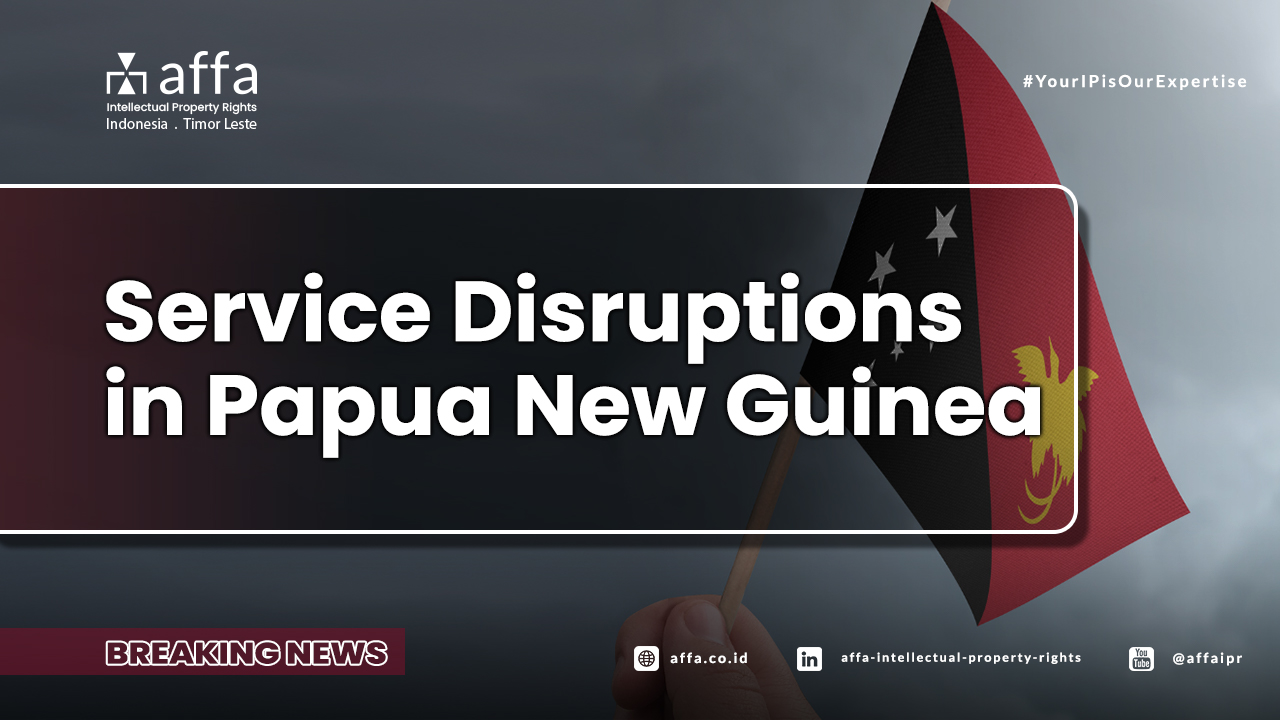
Dear friends and colleagues, Due to massive riots in parts of Papua New Guinea, we regret to inform you that we are experiencing disruptions for the time being. There will be some delays in providing you with the filing receipts and updates, but we will do our best to provide you with our responses as soon as possible. Should you require further information, please contact [email protected]
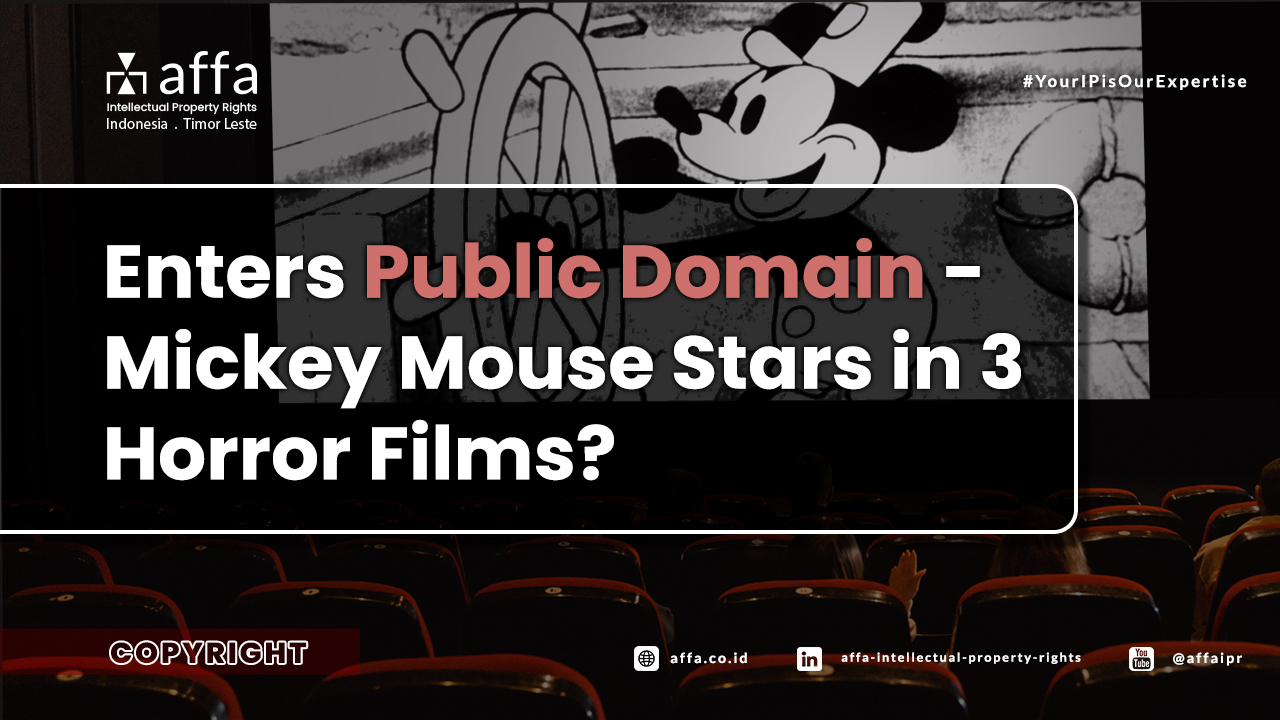
Enters Public Domain – Mickey Mouse Stars in 3 Horror Films?
Enters Public Domain – Mickey Mouse Stars in 3 Horror Films? Mainstream news channels are busy reporting that Mickey Mouse, The Walt Disney Company’s mascot, has entered the Public Domain as of January 1, 2024. As a result, many parties are immediately looking for their fortune by presenting this black mouse in various media. Uniquely, they all have a horror theme! 1. The Vanishing of S.S. Willie Straight released on January 2, 2024, on the Night Signal Entertainment YouTube channel, this is a short film less than 10 minutes long, which assumes that the film “Steamboat Willie” published in 1928, the first film to feature the character Mickey Mouse, is an actual event. Mickey, Minnie, and other animal characters are displayed in realistic form, covered in retro visuals, but with different names. The horror side is that their story ends tragically at the bottom of the river, contrasting with the cheerful original animated version. 2. Mickey’s Mouse Trap Also released on the same day is a 2-minute trailer for the film, which will be released in March 2024. This time, the story is about a serial killer who wears a Mickey Mouse-like mask and operates in an amusement park. 3. Steamboat Willie The third horror film to utilize Public Domain Mickey is the work of Director Steven LaMorte, who previously directed “The Mean One” (2022), a horror-comedy film inspired by “The Grinch” (2018). Steven admitted that filming of Steamboat Willie will take place this spring, and the concept remains a horror-comedy in the style of The Mean One. Steve confirmed to the media that his work would not violate the law because it would not use the name Mickey Mouse but Steamboat Willie. 4. Infestation: Origins Lastly, Mickey is in a PC game that up to four people can play. Here, you can play as a rat exterminator set in the 80s. But then, you are chased by a monster resembling Mickey Mouse! This game produced by Nightmare Forges can now be ordered on the Steam website, but the official release date has yet to be announced. What is Public Domain? A work or Creation, including animated films, can be protected by Copyright. Then there is the Copyright Law, which regulates the validity period of Economic Rights, which is a reference for whether we still have to obtain permission from the Creator or Copyright Holder for a Work. If the validity period has passed, the work has entered the Public Domain, and the public can use it freely without asking permission from the Creator. Why 95 Years Later? The Copyright Law in the United States stipulates that a work’s validity period is during the Creator’s life plus seventy years after the Creator dies. However, this regulation was only applied to all works published starting January 1, 1978. Meanwhile, Steamboat Willie was already present 50 years earlier. That’s why the film still has 95 years of Economic Rights and ends on December 31, 2023. Finally, Steamboat Willie only entered the Public Domain as of January 1, 2024. Now Everyone is Free to Use Mickey Mouse? Certainly not! Because the only thing in the Public Domain is Mickey Mouse in Steamboat Willie: the Black and White Mickey without gloves. What also needs to be remembered is that as a character, two types of Intellectual Property (KI) are attached to Mickey Mouse: Copyright and Trademark. If a copyright has an expiration validity period, then a trademark can be renewed every ten years. Mickey Mouse is a registered Trademark still owned by The Walt Disney Company. That’s why none of the works above that use Public Domain Mickey use the name “Mickey Mouse.” They consciously did not use this name to avoid legal disputes. They only dare to use “Mickey” or “Steamboat Willie,” common names not registered by anyone. So, even though Steamboat Willie has entered the Public Domain, that doesn’t mean you are free to produce and/or sell products that contain colored versions of images or words of Mickey Mouse. The point is that Public Domain doesn’t necessarily make your own Mickey Mouse. Mickey Mouse Still Owned by The Walt Disney Company Amid widespread news related to the Public Domain, the role of the media is needed to educate people so as not to create new problems. Because incomplete reporting can make many parties who are less aware of IP, including SMEs, subject to warning letters from Disney’s lawyers. They join in on the hype by producing products depicting colored versions of Mickey Mouse and containing the word without realizing the potential for Copyright and Trademark violations. Remember that Walt Disney is a big company in the IP business. They understand the ins and outs of Intellectual Property law. Apart from that, they also continue to update their IP-based characters and their source of income. That is the only way the validity period of Economic Rights in Copyright can continue to be extended. Steamboat Willy is only one of tens of thousands of works featuring IP-based characters, a source of income for the Walt Disney Company. Missing one will not affect its revenue, which since 2022 will be above USD 80 billion per year. From Walt Disney, we learn that creating original characters, if managed well, will be more profitable and provide long-term benefits. Instead of making imitation works that take advantage of the momentary hype. The public will also see it as a cheap work or a parody of no quality. Should you need further information about Public Domain, Copyright, or other Intellectual Property management, please do not hesitate to contact us via [email protected]. Sources: Coming Soon Variety
3 Top Ways to Accelerate Your Patent Application in Indonesia
The Directorate General of Intellectual Property of the Republic of Indonesia under the Ministry of Law and Human Rights of the Republic of Indonesia (hereinafter referred to as “DGIP”) has established various procedures under which the examination of a patent application may be accelerated. Under these procedures, DGIP will advance an application out of turn for faster examination if the applicant files the following special requests through the ASPEC program, Indonesia-Japan PPH program, or simply by providing the examiner in charge the granted corresponding claims from other Patent Offices, such as the USPTO, JPO, EPO, and others. We herewith summarize the options that may suit your need, depending on where you file your patent applications in other jurisdictions: 1. ASPEC The ASEAN Patent Examination Co-operation ( hereinafter referred to as “ASPEC”) was launched on 15 June 2009 and it is the first regional patent work-sharing program which involves nine participating ASEAN Member States (AMS) IP Offices of Brunei Darussalam, Cambodia, Indonesia, Lao PDR, Malaysia, the Philippines, Singapore, Thailand, and Viet Nam. The program aims to accelerate the patent examination process by encouraging each of the participating Patent Offices to share search and examination results to allow applicants in the participating countries to obtain corresponding patents faster and more efficiently. Since ASPEC aims to reduce duplication on the search and examination work done, it is hoped that the search and examination work done on a corresponding application can be used as a useful reference in producing high-quality examination reports. Hence, if you can obtain the examination result from other countries in the participating Patent Offices, then the examination results or reports can be used as the basis of examination acceleration, as long as the corresponding claims are the same. When requesting ASPEC, the patent applicant is required to submit an ASPEC Request Form in the second Patent Office. The ASPEC Request Form shall be accompanied by the following documents: 1. a copy of the Search and Examination (S&E) report or the Examination report (“minimum documents”) of a corresponding application from the first IP Office; and 2. a copy of the claims referred to in the minimum documents submitted, with at least one claim determined by the first IP Office to be allowable/patentable. For PCT ASPEC request, the patent applicant is required to indicate that the request is for PCT ASPEC in the ASPEC form. The completed ASPEC request form shall be submitted together with the following documents: 1. a copy of the written opinion/international preliminary examination report (“WO/ISA, WO/IPEA or IPER”) established by an ASEAN International Searching Authority/International Preliminary Examining Authority (ASEAN ISA/IPEA) (“minimum documents”) relating to a corresponding application from the first IP Office; and 2. a copy of the claims referred to in the minimum documents submitted, with at least one claim determined by the first IP Office to be allowable/patentable. Please be mindful that the request to utilize ASPEC can only be done after the application has finished the publication stage. Based on our experience, the time it takes from filing the ASPEC request until the issuance of the decision to grant will not be more than 12 months – a great improvement in lead or pendency times compared to the processing time for non-ASPEC (or PPH) patent applications in Indonesia. 2. Japan-Indonesia Patent Prosecution Highway (Indonesia-Japan PPH) The Japan Patent Office (hereinafter referred to as the “JPO”) and the DGIP have initiated a Patent Prosecution Highway Program (hereinafter referred to as the “PPH”) back on June 1, 2013, and since then, the PPH has been chosen by many applicants who have previously filed their base applications in Japan as the method of accelerating the patent applications in Indonesia. The PPH request can be filed at any time as long as it is before the deadline to request the substantive examination stage. Please also be mindful that there will be an official fee of Rp 5.000.000,00 incurred for requesting the PPH acceleration program. When it comes to the requirements, the DGIP will require the applicant to provide the following documents in order to start the accelerate examination process: All formality documents required to file the application have been submitted and the DGIP will issue the notice of formality documents completion, which should also be provided by the applicant; Proof of payment to file a substantive examination request; The application should have passed the Publication of Period of 6 months; PPH Form (filled in); Corresponding claims which should be equivalent or less compared to the claims granted by the JPO; OEE ad OLE examination results; and OEE/OLE in English and/or in Bahasa Indonesia. Based on our experience, the time it takes from filing the ASPEC request until the issuance of the decision to grant will not be more than 7 to 12 months – a great improvement in lead or pendency times compared to the processing time for non-ASPEC (or PPH) patent applications in Indonesia. 3. Providing Corresponding Registered Claims In case none of the options above apply to you, you mal also provide the examiners at the DGIP with the corresponding granted claims from other well-established Patent Offices, such as the USPTO, UKIP, EP, AUIPO, SIPO, JPO, etc. The provision of the corresponding granted claims from the aforementioned Patent Offices will make it easier for the examiners at the DGIP to expedite the examination. Please note that the documents should be provided with the equivalent English translation. For any questions related to patent application in Indonesia, please do not hesitate to contact us at [email protected].
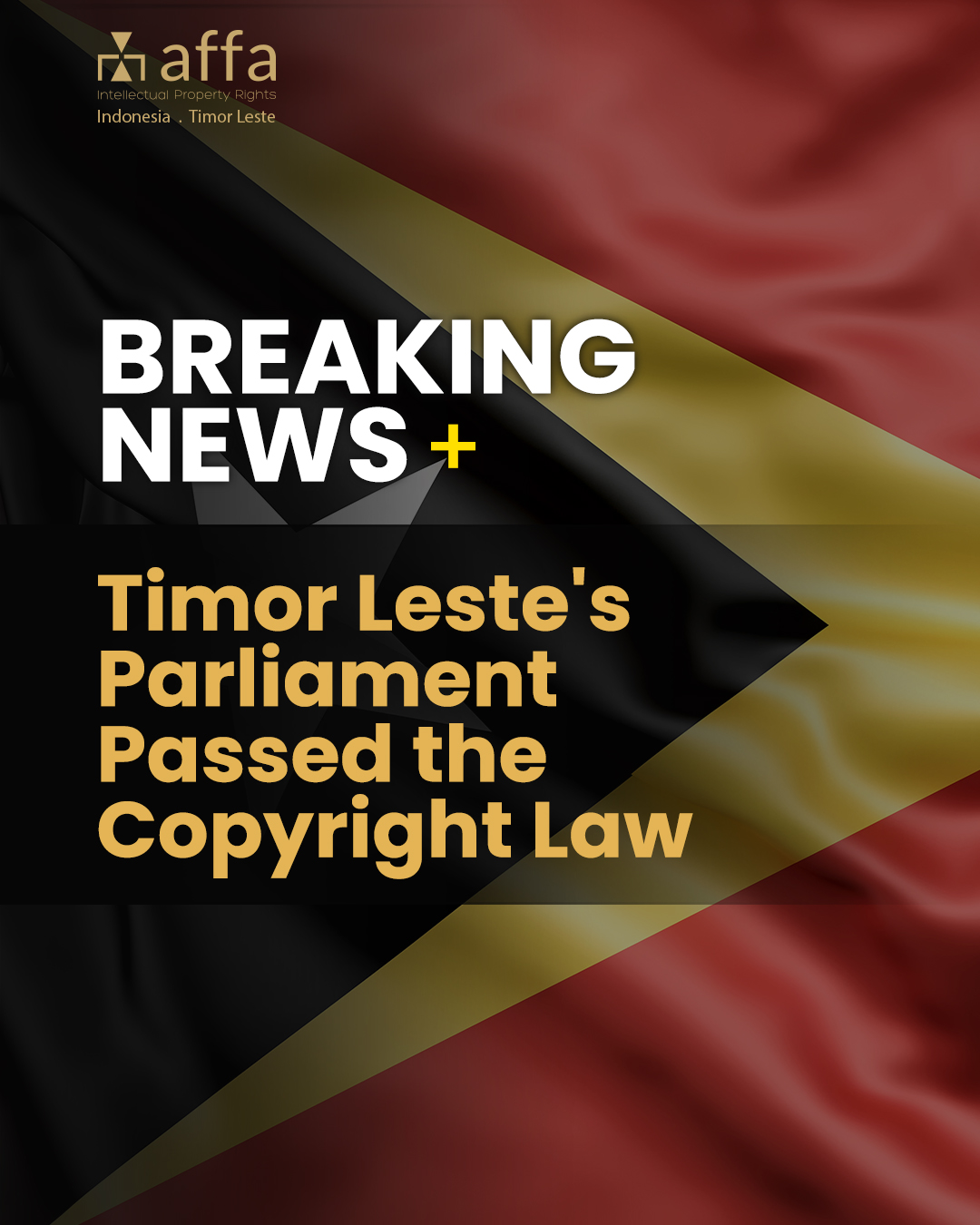
Timor Leste’s Parliament Passed The Copyright Law
The most awaited update from Timor Leste is finally here – the Copyright Law was passed by the Parliament with 48 votes in favor, zero against, and one abstention. However, the Law may still be amended/corrected further before it is presented to the President of Timor Leste before its promulgation. The Copyright Law consists of 224 Articles which may still be subject to further correction.
Intellectual Property Protection in Indonesia
I FORMS OF INTELLECTUAL PROPERTY PROTECTION Intellectual property protection and enforcement in Indonesia have already existed in Indonesia since the Dutch Colonial Government era, where it enacted the Auteurswet Stb. No. 600 Year 1912 (Copyright), Ooctroi Wet No. 313 Year 1910 (Patent), and Reglement Industriele Eigendom No. 545 Year 1912 (Trademark). Even after the independence of Indonesia in 1945, these laws were still relevant and in force until 1961, where the government of the Republic of Indonesia enacted the Law No. 21 Year 1961 on Marks, Law No. 6 Year 1982 on Copyrights, and Law No. 6 Year 1989 on Patents. As time went by, Indonesia further ratified various international agreements concerning Intellectual Property Rights. Now, Indonesia is a party to the Trade-Related Aspects of Intellectual Property Rights (TRIPS), Madrid Protocol, Beijing Treaty on Audiovisual Performances, Berne Convention, Paris Convention, Patent Cooperation Treaty, and WIPO Copyright Treaty. Furthermore, Indonesia is also a party to several bilateral and/or regional agreements/treaties, such as the ASEAN Patent Examination Cooperation (ASPEC) and the Japan-Indonesia Patent Prosecution Highway (PPH). Currently, the grouping of Intellectual Property Rights in Indonesia is as under: Intellectual Property Protection Grouping in Indonesia Copyrights Industrial Rights Copyrights Related rights Trademarks and Geographical Indications Industrial Designs Patents – covers conventional patents and utility models/simple patents Plant Varieties Trade Secrets Integrated Circuit Layout Designs Whereas the legal basis of the protection of the above are as under: The Law No. 29 Year 2000 on Plant Varieties The Law No. 30 Year 2000 on Trade Secrets The Law No. 31 Year 2000 on Industrial Designs The Law No. 32 Year 2000 on Integrated Circuit Layout Designs The Law No. 28 Year 2014 on Copyrights The Law No. 13 Year 2016 on Patents The Law No. 20 Year 2016 on Trademarks and Geographical Indications The Law No. 11 Year 2020 on Job Creation (the Omnibus Law) i. Simple Patents/Utility Models Simple patents/utility models are governed by the Law No. 13 Year 2016 on Patents (the Patent Law) and the Law No. 11 Year 2020 on Job Creation (the Omnibus Law). Subject to registration, simple patents allow for obtaining exclusive rights if they can fulfil the following criteria: Novelty Development of known products or processes Possess practical uses Applicable commercially¹ The development of the above cover simple products, simple processes, or simple methods. Once registered, simple patents/utility models are valid for 10 years from the filing date. ii. Patents Unlike simple patents/utility models, conventional patents are not affected by the Omnibus Law and the Patent Law is the only law which governs the protection of conventional patents. Subject to registration, simple patents allow for obtaining exclusive rights if they can fulfil the following criteria: Novelty Inventive steps Applicable commercially. Conventional patents can cover both product and process patents. Once registered, conventional patents are valid for 20 years from the filing date. It is also worth mentioning that there are inventions that cannot be filed, such as aesthetical creations, schemes, business methods, computer programs per se, presentation of information, and discoveries that are considered as new uses for known products and/or new forms of existing compounds that do not result in significant increase in efficacy and there are differences in related chemical structures that have been known from the compounds.² iii. Trademarks Trademarks (as well as Geographical Indications) are regulated under the Law No. 20 Year 2016 on Marks and Geographical Indications (the Trademark Law). The basis of registration adopts the “first to file” approach and registered Trademarks are valid for 10 years – effective from the filing date. While no prior use requirement is essential for the purpose of application and registration, it is always advised to use the registered Trademarks to avoid non-use cancellation action filed by any ¹Previously, a simple patent/utility model only needs to be novel and can be applied commercially. The Omnibus Law changed the criteria in 2020. ²Article 4 of the Law No. 13 Year 2016 on Patents highlights several inventions that are not protectable in Indonesia. It is important to highlight that such limitations mean second medical use claims are no longer allowed. third parties. Furthermore, Indonesia adopts strict classification system on its e-filing platform. Any goods or services that do not exist in the system may not be filed – hence prior checking is advised. iv. Copyrights Copyrights are governed under the Law No. 28 Year 2014 on Copyrights (the Copyright Law). The Copyright protests various in the realms of art, science, and literature. The protection period starts from the first date of publication and depending on the nature of the protectable work. For instance, Softwares and other computer programs are protected for 50 years form the first publication date. Whereas songs and books are protected up to 70 years from the passing of the creator(s). II RECENT DEVELOPMENTS The Omnibus Law adjusted several provisions in both Patent and Trademark Laws in 2020. The changes focused on several aspects of patents and simple patents. The most significant change is the obligation to use or perform registered patents in Indonesia, otherwise they are prone to be invalidated or subject to compulsory licensing. This marked the end of the prior practice where it was feasible to postpone the use of registered patents by submitting written requests to the Indonesian Patent Office. The compulsory licensing can be requested if a registered patent has not been used or performed in Indonesia within 36 months. Furthermore, during COVID-19 Indonesia has pushed for the use of registered patents that deemed necessary to mitigate the virus. For instance, the President issued the Presidential Regulation No. 100 Year 2021 on Patent Use by the Government for Remdesivir. Under the regulation, the government may appoint a pharmaceutical industry to perform the patent if the nature of the use remains non-commercial. Furthermore, the patent holder will receive 1% from the nett sales of Remdesivir. Furthermore, the President also issued Presidential Regulation No. 101 Year 2021 on Patent Use by the Government for Favipiravir.
事务所简介 的 AFFA 印尼 & 东帝汶
AFFA知识产权事务所,是一家印尼和东帝汶企业,由资深知识产权专业人士于1999年7月创立,后由Achmad Fatchy担任负责人,其认为事务所在实务领域的主要目标是确保提供给客户的服务质量。事务所当前负责人Emirsyah Dinar 和Fariz Syah Alam也持相同观点,使事务所的团队技术能力和丰富经验能够满足国内和国际市场的客户要求。此外,AFFA在全球几乎所有国家都建立了业务网,使其能够保护当地客户以及在印尼的外国客户的知识产权。AFFA的成员与INTA、欧洲共同体商标协会、东南亚国家联盟知识产权协会和国际许可贸易工作者协会建立了业务往来。 除了知识产权业务,AFFA也提供与普通商法相关的服务、印尼食品和药品管理局的登记业务、有限责任公司(本地或外资)的成立、域名注册、许可证颁发和审核以及特许权协议和知识产权调查业务。 为什么是AFFA? AFFA自1999年以来就向印尼、东帝汶和太平洋各岛国的广大客户提供知识产权服务。我们的信誉是建立在我们的专业能力、经验和我们在所涉及的相关司法辖区内处理复杂知识产权问题的本地化专有技术上。我们致力于向客户提供与其目标一致的解决方案和成果。 在过去的21年当中,我们一直致力于向客户提供全方位优质服务。我们持续拜访客户以解决其面临的复杂问题并提供可行的解决方案,无论客户在何处。我们也在客户的办公场所内举办培训,使其了解印尼、东帝汶和太平洋各岛国的知识产权保护方面的重要信息。 我们的团队 我们在印尼和东帝汶有60名以上的专家,我们能向您提供知识产权保护方面的服务。我们的专家有广泛的业务背景,包括法律、经济学、信息技术、生物学、生物技术、机械工程、化学工程和药学,我们的成员分布在雅加达、万隆、巴厘岛和帝力(东帝汶)。 我们的客户 我们的客户包括本地和外国政府机构、全球知名公司以及新兴公司和非赢利组织、教育机构、外国公司及律师事务所、企业和发明人。我们的客户范围从一人公司到几乎在全球每一国家都设有分支机构的公司。我们的大多数客户自我们1999年创立之后就与我们有业务关系,作为对他们长久合作的真诚感谢,我们向他们提供定制化的解决方案。 我们98%左右的客户是非印尼个人或实体,自1999年以来这个比例就一直如此。 若您有需求,请通过电子邮件:[email protected]或微信@AFFAIPR与我们联系。
Intellectual Property Protection in Indonesia During the Covid-19 Pandemic
Since the start of the Covid-19 Pandemic, the Indonesian Intellectual Property Office has taken appropriate measure to curb the spread of the virus by ceasing all face to face services since March 23, 2020 until May 13, 2020. However, there is a high likelihood that the face to face services will remain postponed after May 13, 2020 since there is little evidence which suggests that the spread of the virus has slowed down in Indonesia. However, worry not – since 2017 most of the Intellectual Property related services (i.e. new filings, renewals, filing oppositions, responding to office actions, etc) can be filed online. The availability of the online services have, in a way, prepped us for the pandemic since there are only minor disruptions that we have experienced in the past 2 months (i.e. not being able to pay the patent annual maintenance fees is the only problem that we have for now). Therefore, it is business as usual! Apart from the general prosecution, the Indonesian Intellectual Property Office has also made it possible for the right holders to report Intellectual Property related infringements online, which can be done at pengaduan.dgip.go.id. The right holders can also check the latest status of the actions that have been taken by the Indonesian Intellectual Property Office Once the complaint has been lodged. Should you have any questions, please let us know at [email protected].
COVID-19, Indonesian IP Office Closure, and Work from Home Arrangements
Dear friends and colleagues, We hope you and your family are doing well. Due to the spread of COVID-19 in Jakarta, Indonesia, the Indonesian IP Office has suspended all physical services until the end of March. All deadlines in March have also been postponed until March 31st, 2020. However, depending on the situation, the Indonesian IP Office closure and the deadline may be extended until further notice. However, all E-Filing services are still in operation and we therefore still can file new applications/renewals if required. All of our staff members are currently working from home until the situation gets better. We nevertheless will respond to your queries as soon as possible. The decision had to be taken since the safety and wellbeing of all of our staff members are of paramount importance. Thank you for your kind attention and we remain at your services for Indonesia, Timor Leste, and Papua New Guinea IP matters. Best regards, Emirsyah Dinar/Achmad Fatchy
Important Changes Concerning Trademark Application Process in Indonesia
Since the introduction of the new E-Filing system by the Directorate General of Intellectual Property of Indonesia (DGIP) on 17 August 2019, there have been several radical changes that have impacted the process of a Trademark application in Indonesia. We herewith summarize the 3 most important changes: 1. The prepaid payment voucher system Under the previous system, the official fees were only payable once the application form (online or paper-based) had been filled in. Under the current system, the applicant/proxy should purchase the official fees voucher before filling in the form online. 2. Goodbye, paper-based manual filing! The DGIP finally axed the paper-based manual filing option in as an attempt to digitize and smoothen its business process. The reason why this was a necessary action to do is to reduce the potential backlog that may affect the time it takes from filing to registration. This applies to all 3. Madrid Goods and Services Manager Trademark applicants will need to ensure that the goods and/or services they file for exist in the Madrid Goods and Services Manager. Should they attempt to file non-standard items, the E-Filing system will not able to process the filing request. You may check the full Madrid Goods and Services Manager list at https://webaccess.wipo.int/mgs/. Should you require further assistance regarding Trademarks in Indonesia, Timor Leste, and the Pacific Islands, please do not hesitate to contact us at [email protected].
REMINDER: The Deadline of Payment of Unpaid Patent Annuity Fees in Indonesia Is Due Soon
Dear colleagues, As a follow up on the Directorate General of Intellectual Property of the Republic of Indonesia’s Circular No. HKI.KI.05.04-04 titled “EXTENSION OF TIME TO FULFILL THE OBLIGATION FOR UNPAID PATENT ANNUAL FEE FOR PATENT HOLDERS” which was issued on 17 February 2019, we herewith remind you that the deadline to pay the unpaid patent annuity fees will fall on 16 August 2019. Failure to settle the unpaid patent annuity fees may result in the decision by the Directorate General of Intellectual Property of the Republic of Indonesia to reject new patent applications. We will appreciate your instruction to settle the debts as soon as possible. Should you require further assistance, please email us at [email protected] and [email protected].