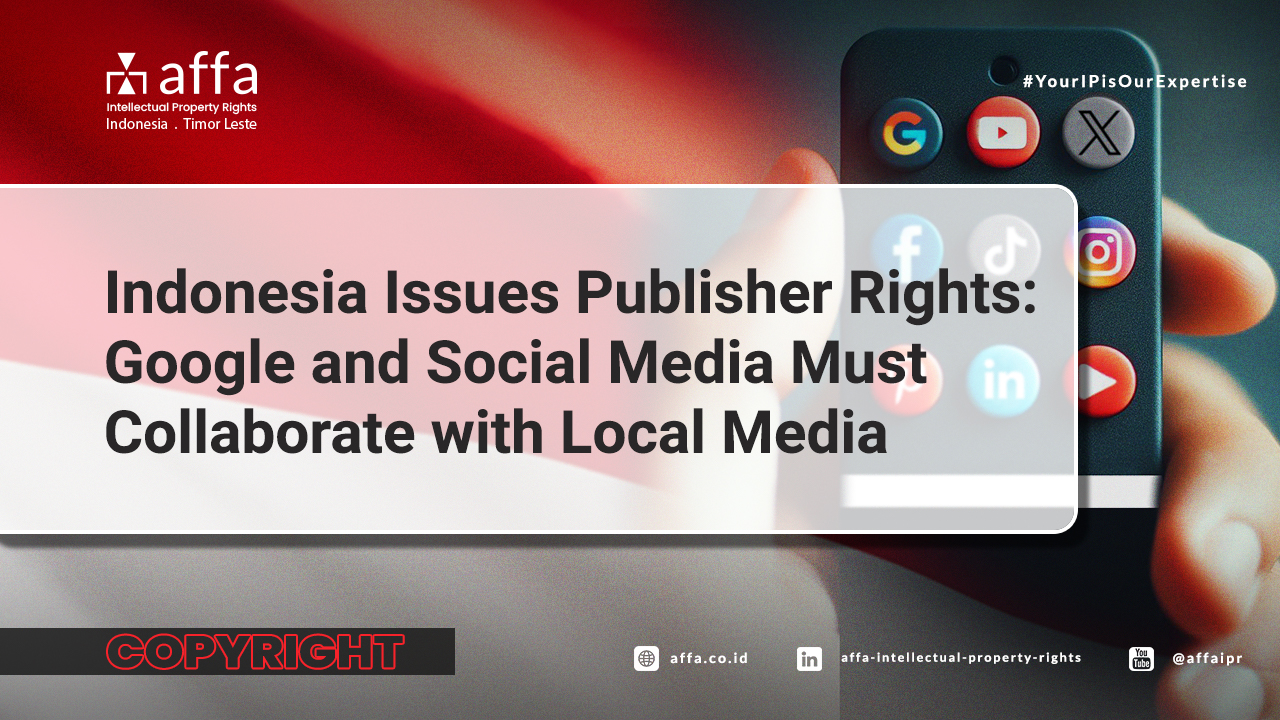
Indonesia Issues Publisher Rights: Google and Social Media Must Collaborate with Local Media The President of the Republic of Indonesia, Joko Widodo, on February 20, 2024, signed the Presidential Regulation Number 32 of 2024 concerning the Responsibility of Digital Platform Companies to Support Quality Journalism. One of the provisions in that regulation, which President Joko calls the Publisher Rights Regulation, requires digital platforms such as Google, Facebook, and X (Twitter) to collaborate with local media companies. The Presidential Regulation on Publisher Rights consists of 6 (six) chapters and 19 articles, with a summary as follows: Chapter I: General Provisions This chapter regulates the responsibilities of digital platform companies, such as Google, Facebook, or X (Twitter), to maintain a healthy news business ecosystem and support quality journalism. Chapter II: Digital Platform Companies Digital platform companies are determined based on service presence in Indonesia. They are obliged to support quality journalism by: Not facilitating the dissemination and/or commercialization of news content that is not by the law regarding the press after receiving reports through reporting facilities provided by digital platform companies; Provide best efforts to prioritize the facilitation and commercialization of news produced by press companies; Provide fair treatment to all press companies in offering services; Carrying out training and programs aimed at supporting quality and responsible journalism; Providing the best effort in designing news distribution algorithms that support the realization of quality journalism by democratic values, diversity, and statutory regulations; Collaborate with press companies that the Press Council has verified in four ways, namely: Paid license Profit sharing Sharing aggregate data of news users Other agreed forms Chapter III: Cooperation and Dispute Resolution Apart from regulating the forms of cooperation as mentioned above, this chapter discusses how to resolve disputes between digital platform companies and the press, namely: The parties, individually or collectively, can submit legal remedies outside the general court through arbitration or alternative dispute resolution. Dispute resolution is carried out independently by statutory provisions. Chapter IV: Committee The committee was formed and determined by the Press Council. Duties and functions are as follows: Ensuring the fulfillment of digital platform company obligations. Supervise and facilitate the fulfillment of company obligations related to digital platforms. Provide recommendations to the Minister regarding the results of supervision. Facilitate arbitration or alternative dispute resolution between digital platform companies and the press. Matters relating to the committee are: Every committee decision-making is carried out in a collegial collective manner and is accountable to the public. If a consensus deliberation agreement is not reached, the majority vote decides. Each committee agreement must: Through a consideration process that considers input in the form of opinions and thoughts that develop in society. Guarantee transparency, guarantee independence, and fulfill a sense of justice. The committee must regularly report to the public on implementing its duties and functions at least once a year. This report is uploaded to the Press Council information system and must be easily accessible to the public. The committee consists of representatives from: The Press Council does not represent press companies. Ministry. Experts in Digital Platform Services who are not affiliated with digital platform companies or the press. The committee members have an odd number of at most 11 people, consisting of: Representatives from elements of the Press Council, a maximum of five people; Representatives from elements of the Ministry are one person; Representatives from expert elements, as a maximum of five people, and appointed by the minister who coordinates government affairs in politics, law, and security. The composition of the committee membership consists of: One committee chairman is also a committee member. One deputy chairman of the committee is also a member of the committee. Committee members can be appointed for a term of three years and can be re-elected for another term. The Committee is assisted by a secretariat, held ex officio by the Secretary of the Press Council. Chapter V: Funding Sourced from press organizations and companies, assistance from the state and/or others by statutory provisions. Chapter VI: Conclusion Regulates the implementation of the Presidential Regulation on Publisher Rights, namely six months from the date of promulgation or August 20, 2024. With this Publisher Rights Regulation, the government of the Republic of Indonesia is trying to organize the ecosystem of digital platform companies with press companies to support quality journalism to realize a democratic life as a nation, state, and society. If you need more information about the Presidential Regulation on Publisher Rights and its implementation in Indonesia, please contact us via [email protected]. Source: Presidential Regulation Number 32 of 2024 concerning the Responsibility of Digital Platform Companies to Support Quality Journalism
Remixed Music from the Indonesian Intellectual Property Perspective
Remixed Music from the Indonesian Intellectual Property Perspective The weekend is just around the corner. Which club will you go to to spend the night? The club with the most comfortable atmosphere? In the middle of the city? On the beach? Club with makes the best drink? Or the one with the most popular live music? Live music has become a form of entertainment that is inseparable from nightlife. With the mix of popular and new songs sung, we can be hypnotized for a moment and forget all our problems. But for those of you who are on the side of event organizers, venue managers, or artists who perform this music/song, don’t let yourself get into trouble. Because music/songs with or without text (lyrics), in Article 40 of the Law of the Republic of Indonesia Number 28 of 2014 concerning Copyright, is stated as a form of protected work. For these creations, there are Exclusive Rights (moral and economic) holders entitled to royalties from every music/song performed. If done without paying royalties, performing music/songs without permission for commercial purposes can be categorized as a Copyright violation. However, Who Should Pay the Royalties? In Article 3 of the Republic of Indonesia Government Regulation Number 56 of 2021 concerning the Management of Song and/or Music Copyright Royalties, it is regulated that every person can make commercial use of songs and/or music in the form of commercial public services by paying royalties to the Creator, Copyright Holders, and/or Related Rights Owners through the National Collective Management Organization (LMKN). Commercial public services include commercial seminars and conferences; restaurants, cafes, pubs, bars, lounges, nightclubs, and discotheques; music concerts; airplanes, buses, trains, and ships; exhibitions and fairs; cinema; telephone waiting tone; banks and offices; shops; recreation center; television broadcasting institutions; radio broadcasting institutions; hotels, hotel rooms, and hotel facilities; and karaoke business. Regarding Music Mix performed in restaurants, cafes, pubs, bars, discotheques, or nightclubs, Article 3 GR No. 56 of 2021 concerning the Management of Song and/or Music Copyright Royalties has specifically regulated the rates as follows: Restaurants and Cafes Royalties are determined per seat per year, with the provisions of the Creator royalty being IDR 60,000 per seat per year and the Related Rights royalty being IDR 60,000 per seat per year. Pubs, Bars, and Lounges Royalties are determined per square meter per year. The royalty rate for the Author’s Rights is IDR 180,000 per square meter per year, and the royalty rate for Related Rights is IDR 180,000 per square meter per year. Discotheques and Nightclubs Royalties are determined per square meter per year. The royalty rate for the Author’s Rights is IDR 250,000 per square meter per year, and the royalty rate for Related Rights is IDR 180,000 per square meter per year. Note: Author’s Rights are royalties given to the Creator, while Related Rights are royalties given to musicians, original singers (performers), and producers of the song/music. Because Creators or recipients of Related Rights do not always know when and where their songs are performed, the government has given authority to LMKN to collect royalties and distribute them to Creators and recipients of Related Rights. Therefore, if you are a restaurant and cafe, pub, bar and lounge, discotheque, and nightclub manager, you will be the one who will be charged royalties for the songs/music held inside your business, not the artist or performer who performs the music. Before LMKN inspects your business, it would be a good idea for you first to carry out the following procedures: Submit a license application to the Copyright holder or Related Rights owner through LMKN; The license agreement is recorded by the Minister of Law and Human Rights by statutory provisions; Provide reports on the use of songs and/or music to LMKN via the Song and/or Music Information System (“SILM” Platform); Pay royalties to Creators, Copyright holders, and/or Related Rights owners through LMKN; Based on the rules above, royalty payments are not explicitly charged per song but are based on the number of seats or the size of your commercial area. But you must know what song and/or music is being performed so that you can accurately report it through SILM, and the creator and/or recipient of related rights can obtain their rights properly. You can then hold proof of royalty payments to LMKN if, in the future, there is a lawsuit from the creator who objects to the use of their work in your place. What if the Music Mix is commercialized? Sometimes, DJs also record and distribute their favorite remixes, even selling them on a limited basis to their fans. Is this an unlawful act? Returning to the rules regarding the Exclusive Rights of a music/song, where Article 9 of the Copyright Law states that only the Copyright Holder has the Economic Rights to adapt, arrange, and transform the work, as well as copy and use commercially, so to be able to do this, these DJs must obtain permission by submitting a license application to the Copyright holder or Related Rights owner. Otherwise, as regulated in Article 113 concerning Criminal Provisions for Copyright Infringement, “Every person who fulfills the elements as stated in as intended in paragraph (3), which is committed in the form of piracy, shall be punished with imprisonment for a maximum of 10 (ten) years and/or a fine of a maximum of IDR 4,000,000,000.00 (four billion rupiah).” After understanding the risks, if you are a DJ or musician and a live music organizer, you have to be more aware of implementing your business by applicable regulations. If you have further questions regarding commercial use of music/songs, Copyright, or other Intellectual Property, don’t hesitate to contact us via [email protected].
AFFA Listed as a WTR 1000 Recommended Firm 2024 in Indonesia
AFFA Listed as a WTR 1000 Recommended Firm 2024 in Indonesia AFFA Intellectual Property Rights proudly announces its consecutive inclusion in the WTR 1000: The World’s Leading Trademark Professionals. This prestigious recognition underscores our unwavering dedication to providing exceptional trademark services and reaffirms our position as a trustworthy partner for safeguarding your valuable Intellectual Property. As one of Indonesia’s most comprehensive IP service providers, AFFA IPR offers a sophisticated and streamlined Trademark filing and licensing platform. Our team of renowned experts leverages their extensive experience and local market knowledge to navigate the complexities of Trademark protection and licensing services, ensuring your brand receives the utmost legal and strategic protection. Whether you are a multinational corporation or a rising entrepreneur, choosing AFFA IPR for your Trademark management signifies: Unparalleled Expertise Our seasoned professionals provide proactive counsel and comprehensive strategies tailored to your unique brand identity and business goals. Streamlined Efficiency We employ proven methodologies and robust systems to achieve successful and timely trademark registration in Indonesia and internationally. Maximized Value Our skilled negotiators help you unlock the full potential of your trademark assets through strategically crafted licensing agreements. Unwavering Commitment We are dedicated to serving as your reliable partner throughout every step of your trademark journey, providing ongoing support and guidance. Entrusting AFFA IPR with your Trademark protection signifies your commitment to brand integrity and market success. Contact us today via [email protected] to discuss your specific needs and experience the distinctive level of service and security that sets AFFA IPR apart.
인도네시아의 상표 불사용취소심판
인도네시아의 상표 불사용취소심판 상표 및 지리적 표시에 관한 법률 2016년 제20호(이하 “상표법“이라 칭함)는 상표가 보호되는 방법 및 미사용 등 다양한 이유로 상표를 상실하는 방법을 규정합니다. 상표법 제74조 제1항은 등록상표의 취소는 상표가 등록일 또는 마지막 사용일로부터 상품 및/또는 서비스 거래에서 3년 연속 사용되지 않았음을 근거로 이해관계가 있는 제삼자에 의해 상사법원에 소의 형태로 제기될 수도 있다고 명시합니다. 그러나 여기에는 다음과 같은 몇 가지 예외가 있습니다. 취소 대상 상표가 부착된 상품에 대한 수입 제한 조치가 있는 경우, 해당 상표를 사용한 상품의 유통 허가와 관련된 금지 규정, 또는 수권자의 임시 결정이 시행되고 있는 경우, 또는 정부 규정에 의해 확립된 기타 유사한 금지 규정이 있는 경우. 당사는 이에 인도네시아의 상표 불사용취소심판에 관해 가장 자주 묻는 질문 3가지를 제시합니다. 1. 취소 대상 상표가 아직 등록되지 않았습니다. 상표청에 상표 취소 청원서를 제출할 수 있나요? 상표법은 오직 등록상표만이 미사용을 근거로 취소될 수 있으며 심판은 상사법원에만 제기될 수 있다고 명시합니다. 이러한 관행은 상표청이나 상표심판원에 불사용취소심판을 제기할 수 있는 일부 국가에서는 다릅니다. 2. 피고가 입증책임을 부담하나요? 입증책임은 원고에게 있습니다. 따라서, 원고는 상표가 실제로 등록일 또는 마지막 사용일로부터 3년 연속 사용되지 않았음을 입증하는 데 필요한 모든 증거를 가지고 있어야 합니다. 3. 원고는 미사용 조사 보고서를 제공해야 하나요? 상표법은 상표의 사용 여부를 입증하기 위해 제공되어야 하는 증거 목록을 명시하지 않습니다. 그러나, 당사는 실무에서 (설문조사와 함께) 광범위한 온라인 및 오프라인 연구가 수행되었음을 입증하기 위해 일반적으로 항상 완전한 조사 보고서를 제공합니다. 이런 유형의 조사 보고서에 자주 제기되는 문제는 지리적 다양성으로, 이에 따라 높은 보고서 관련 비용이 발생하게 됩니다. 좀 더 명확하게 말하자면, 인도네시아에는 18,000개가 넘는 섬이 있습니다. 당사의 경험에 따르면, 조사 보고서가 주요 도시에서 수행된 후일지라도, 피고인은 종종 국가의 외딴 지역에서 이루어진 판매 증거를 여전히 제시할 수 있습니다. 그러나, 상사법원이 단일 사용을 충분한 사용 증거로 항상 간주하는 것은 아니라는 점을 명심하십시오. 가능한 경우, 당사는 일반적으로 고객에게 불사용취소심판을 제기하기 전에 우호적 해결 및 악의의 무효심판 등의 선택 사항을 조언합니다. 두 심판 모두 불사용취소심판에 비해 성공률이 더 높은 경향이 있기 때문입니다. 인도네시아의 상표 불사용취소심판에 대한 추가 정보가 필요한 경우언제든지[email protected]로 문의하시기를 바랍니다
印度尼西亚商标不使用撤销诉讼
印度尼西亚商标不使用撤销诉讼 2016年第20号法《商标和地理标志法》(以下简称“《商标法》”)对商标保护方式以及失去商标保护的各种原因(不使用是其中之一)进行规范。《商标法》第74条第(1)款规定,有利害关系的第三方也可以出于下述理由向商事法院提起注册商标撤销诉讼:自注册或最后一次使用之日起,该商标已连续3年未在商品和/或服务贸易中使用。但是,也有一些例外情况,即: 印有拟撤销商标的商品受到进口限制; 与使用相关商标的商品分销许可有关的禁令或授权方的临时决定已生效;或 存在政府法规规定的其他类似禁令。 我们在此为您提供3(三)个关于印度尼西亚商标不使用撤销诉讼的常见问题: 1. 拟撤销的商标尚未注册,我可以向商标局提出撤销申请吗? 《商标法》明确规定,只有以不使用为由才能撤销已注册的商标,并且只能向商事法院提起诉讼。一些国家有与此不同的做法,即可以向商标局或商标上诉委员会提起不使用撤销诉讼。 2. 被告是否承担举证责任? 举证责任由原告承担。因此,原告必须提供所有必要的证据,以证明自商标注册或最后一次使用之日起,被告确实已连续3年未使用该商标。 3. 原告是否必须提供不使用调查报告? 《商标法》并未明确规定为证明商标是否已被使用而应提供的证据清单。但在实践中,我们一般都会提供完整的调查报告,以证明已完成深入细致的线上和线下调研(以及调查)。经常伴随此类调查报告出现的问题是地域差异性。这种地域差异性将导致与报告相关的费用居高不下。 从更明确的视角来看,印度尼西亚有1.8万多个岛屿。根据我们的经验,即便在主要城市完成调查报告,被告往往仍有可能提出关于他们在我国偏远地区进行的销售中使用了商标的证据。但是,请记住,商事法院并不总是将单次使用视为充分的使用证据。 我们一般会尽可能建议客户在提起不使用撤销诉讼前选择其他诉讼方式,如友好和解和提起恶意无效诉讼,因为这两种诉讼的胜诉率往往高于不使用撤销诉讼。 若需要更多有关印度尼西亚不使用撤销诉讼的信息,请随时通过[email protected]与我们联系。
Trademark Non-Use Cancellation Action in Indonesia
Trademark Non-Use Cancellation Action in Indonesia The Law No. 20 Year 2016 on Marks and Geographical Indications (hereinafter referred to as the “Trademark Law”) regulates how a Mark shall be protected, and how one can lose it due to various reasons – and non-use is one of them. Article 74 Para (1) of the Trademark Law state states that the cancellation of a registered trademark can also be filed by an interested third party in the form of a lawsuit to the Commercial Court on the grounds that the Trademark has not been used for 3 (three) consecutive years in the trade of goods and/or services since the date of registration or last use. However, there are some exceptions to that, namely: If there is an import restriction on the goods bearing the Trademark to be cancelled; The prohibitions related to the permission for the distribution of goods using the concerned Trademark, or a temporary decision from the authorized party are in place; or There are other similar prohibitions established by Government Regulation. We herewith provide you with 3 (three) most Frequently Asked Questions about the Trademark Non-Use Cancellation Actions in Indonesia: 1. The Trademark to be cancelled is yet to be registered. Can I file the petition to cancel it at the Trademark Office? The Trademark Law explicitly states that only a registered Trademark can be cancelled based on non-use and the action can only be filed before the Court of Commerce. This practice is different in some countries where non-use cancellation action can be filed before the Trademark Office or the Trademark Board of Appeal. 2. Will the Defendant Bear the Burden of Proof? The burden of proof lies on the plaintiff. Hence, the plaintiff must have all the required evidence to prove that the Trademark has indeed been not used for 3 consecutive years from the date of registration or the date of last use. 3. Will the Plaintiff be Required to Provide a Non-Use Investigation Report? The Trademark Law does not explicitly state the list of evidence to be provided to show if the Trademark has been used or not. However, in our practice, we generally always provide a complete investigation report to show that extensive online and offline research has been conducted (along with surveys). The issue that often comes up with this kind of investigation report is the geographical variability, which will contribute to the high costs associated with the report. Just to put it into a clearer perspective, Indonesia has more than 18 thousand islands. From our experience, it is possible that even after an investigation report has been done in major cities has been conducted, the defendant often still comes up with evidence of use for their sales that were done in remote parts of the country. However, please bear in mind that the Court of Commerce will not always deem a single use as sufficient evidence of use. When possible, we generally advise our clients with other options before filing a non-use cancellation action, such as amicable settlement and bad-faith invalidation action, since both actions tend to have a higher degree of success compared to non-use cancellation action. Should you require further information about non-use cancellation action in Indonesia, please do not hesitate to contact us at [email protected].
Building Blocks of Creativity: A Celebration of International Lego Day
Building Blocks of Creativity: A Celebration of International Lego Day Every January 28, the global Lego community celebrates it as “Lego Day.” On this date, for the first time, Godtfred Kirk Christiansen, the son of a carpenter from Denmark, registered a Patent for his brick toy in 1958. From a brick toy with unique connectors, Lego has developed into a fun educational toy for all ages, collaborating with many Intellectual Properties (IPs), present in some animated films and series, and has 11 amusement parks worldwide. The word Lego comes from the Danish “leg godt,” which means to play well. It was first introduced in 1932 by Ole Kirk Christiansen, father of Godfred. Initially, Lego was a wooden brick toy with unique protrusions and holes to connect and arrange the bricks. However, for economic reasons, since 1947, Lego switched to plastic materials and registered its first Patent in Denmark and other countries in 1958. Because they understand the importance of Patents as valuable assets but have a limited protection period (only 20 years), Lego as a company continues to innovate so that the products produced can grow and develop not only from the sale of toys but also from royalty income and license. Apart from Patents, Lego also has other Intellectual Properties such as Trademarks, Industrial Designs, and Copyrights. As a toy company, there are still Trademarks that must be protected, product designs that continue to develop, and unique characters that continue to be created to stay ahead of competitors. Staying ahead is an important keyword. Based on Patents and Designs, the original form of Lego has become public domain, meaning it is no longer protected. So, since the 90s, many companies have emerged that use Lego’s outdated technology and design to make various kinds of similar toys. However, Lego did not remain silent. Its legal team attempted to shut down competitors’ operations by using Trademark law and suing those who use “brick” and/or “block.” However, these efforts fail due to regulations where there is a provision that states, “Trademark law should not be used to perpetuate monopoly rights enjoyed under now-expired Patents.” Finally, to continue to exist, Lego continues to present many new characters and Lego sets, with Patents, Industrial Designs, and Copyright protection. Should you need further information about Patent protection, Industrial Designs, Copyright, or other Intellectual Property management, please do not hesitate to contact us via [email protected].
Writer Forbids Singers from Performing Their Songs – Is It Possible?
Writer Forbids Singers from Performing Their Songs – Is It Possible? A few weeks ago, the Indonesian music industry was enlivened by the case of a 35 billion Rupiah lawsuit from Ndhank Surahman Hartono, former guitarist and composer of the song “Mungkinkah” (in English: “Is it possible?”), against the band Stinky, where he used to belong. Apart from prohibiting Stinky from performing the song he wrote, Ndhank also prohibited Stinky’s former vocalist, Andre Taulany, later known as a comedian, from performing the song at any opportunity. However, two weeks later, Ndhank withdrew his lawsuit after Andre and his colleagues took a family approach. Ndhank even broke off cooperation with the lawyer who had previously directed him to file a lawsuit. Stinky revealed that the song was not created by Ndhank alone but was created with Irwan Batara, a bass player who is still active with Stinky and can be proven by a recordation certificate at the Directorate General of Intellectual Property (DGIP), complete with royalties that have been given regularly through the Collective Management Organization (LMK), namely Yayasan Karya Cipta Indonesia (YKCI) and Wahana Musik Indonesia (WAMI). That demand arose because Ndhank was experiencing economic difficulties, even though he saw that his song was still popular and often performed. He then demanded to renegotiate the distribution of royalties for the song to 90:10 because Irwan Batara’s portion was only the lyrics at the end of the song. So, from an Intellectual Property perspective, does a songwriter have the right to prohibit other parties from performing their songs? The Copyright Holder of A Song Article 1 of Law of the Republic of Indonesia Number 28 of 2014 concerning Copyright states that a Creator is a person or several people who individually or together produce a Creation that is unique and personal in nature, and Article 40 states, “Songs and/or music with or without text” is a form of protected work. Uniquely, in a song, the holder of Exclusive Rights (Moral and Economic) is not only the Creator as the Copyright Holder but also musicians, original singers as performers, and song producers who are also considered recipients of Related Rights. So, if a song generates royalties, those entitled to receive them are the creator and all parties listed as recipients of Related Rights. Then, Article 70 of the Copyright Law, which explains Article 40, states that a song is a complete creative work. So it will be difficult for the Creator to claim a 90% share of royalties from a song, as in Ndhank’s demands, without mutual agreement from the other Creator, in this case, Irwan Batara, as well as the recipients of Related Rights, including Andre, the vocalist who popularized the song. Legal Basis for the Creator to Prohibition Because the original singer who first popularized a song is the recipient of the Related Rights, Article 13 of the Copyright Law also states that if the singer performs in a public performance, it is not considered a violation of Copyright. Unless otherwise indicated or approved by the Performer or the holder of the rights to the performance before or during the performance. So, in the case of the song “Mungkinkah,” what Andre did was not a copyright violation. However, the case is different if the person banned is not the original singer, as was done by Ahmad Dhani, the creator of the DEWA band’s songs, to Once Mekel, the former vocalist of the DEWA. Due to Once’s position as not being the original singer of all of DEWA’s songs, he is not the recipient of the Related Rights of all of DEWA’s songs. Hence, as Creator, Ahmad Dhani has the right to prohibit Once from performing his songs, including not including Once’s name as a royalty recipient. Ideal Royalty Distribution In particular, no legal regulations regulate what percentage must be received by a creator (songwriter), what percentage is for performers (singers), and what percentage is for music producers because it goes back to their agreement at the beginning. This is where the source of the problem usually arises. In many cases, we can see that the singer then earns a lot of income from the various performances he performs, both alone and with his band. Meanwhile, the part that the songwriter received is only known by himself and the record producer. Suppose we refer to Spotify, a music platform with 8.8 million users in Indonesia. In that case, the distribution of royalties is wholly handed over to the record producer/label owner and then distributed to the Creator and all recipients of Related Rights. However, what needs to be remembered here is that royalties are obtained from performances delivered by singers or playback of their songs via the application and from commercial playback of songs by other parties, for example, in shopping centers, hotels, cafes, and karaoke rooms. This is where Collective Management Organization (LMKN) plays a role; as regulated by Government Regulation Number 56 of 2021, LMKN is a government auxiliary institution tasked with collecting and distributing royalties as well as managing the interests of the Economic Rights of Creators and Owners of Related Rights in the field of songs and/or music. If LMKN had functioned optimally in carrying out its duties, popular songwriters would have been able to have a better economy, and cases like this would not need to happen. Should you need further information about Royalty and Copyright or other Intellectual Property Management, please do not hesitate to contact us via [email protected].
专利实质审查实施指南和技术指南综述
专利实质审查实施指南和技术指南综述 技术指南 专利实质审查自申请日起30个月内进行 说明 至少应包括: a. 关于实施本发明的一种方法的说明 b. 如果说明中引用了图形,则应使用与图形中相同的参考信息 c. 关于本发明如何在工业中实施的说明 d. 对发明的简要说明,以便了解本发明 e. 在发明的背景下提及最接近现有技术的技术 所包括的内容如下列顺序所示: 发明技术领域 发明背景 发明简介 图纸简介(如有) 发明详细说明 披露的充分性 说明应当对发明进行明确的披露,以便本领域技术人员能够实施所述发明。 以便公众能够利用本发明,作为回报,应向申请人授予权利。 发明的功能应当予以披露 现有技术背景 发明人应说明在发明的背景中被视为最接近现有如果在检索结果中发现了更接近的现有技术,应在发明的背景中提及最接近的现有技术。 在提及现有技术时,背景应是公平合理的,不应具有误导性。 权利要求 产品权利要求与工艺权利要求的对比 权利要求仅分为两类: 产品权利要求: 适用于物理实体(对象)。产品可能是化合物、设备、系统中设备的组合等。产品权利要求不能通过其使用方法与现有技术区分开来。 工艺权利要求: 适用于活动(方法)。流程可能是生产产品的活动,可能是使用产品的活动,也可能是使用有机体作为主体的活动。 独立权利要求与从属权利要求的对比 独立权利要求 独立权利要求包括寻求保护的发明的所有特征。独立权利要求在内容上不从属于另一种权利要求。 从属权利要求 从属权利要求由独立和/或其他从属权利要求的所有特征组成,并与其所从属的权利要求属于相同的类别。 从属权利要求不得出现以下情况: 与其所从属的权利要求属于不同的类别, 比所从属的权利要求更广泛, 包含所从属的权利要求中不具备的其他特征; 为实现预期目的引用另一权利要求的主题,并且 仅提及所从属的权利要求的一部分。 从属权利要求可从属于多项权利要求。 如果从属权利要求披露先前未描述的特征,独立权利要求应 描述该特征,或者从属权利要求必须优先描述该特征。 工序产品权利要求 工序产品并不仅仅因为它是采用新工艺生产的就具有新颖性。 其新颖性和创造性是通过其自身的产品特征来决定的。 特征 产品权利要求应包含产品特征,工艺权利要求应包含工艺特征。 权利要求的选择 权利要求可能指“和/或”的替代形式,但每种选择应具备相同的基本属性。一种选择必须能够替代另一种选择。 两部分共同构成权利要求(优选形式) 第一部分: 前言,由所述发明的已知技术特征组成 第二部分: 将本发明与需要保护的现有技术进行区分的技术特征。 对于简单专利,所有(有形)产品权利要求及其附属权利要求应分成两部分书写。 权利要求中的数字、图表和参考文献 权利要求不能包含数字或图形,但可以包含表格和数学公式。 为明确起见,可添加涉及数字的符号,并应在括号()之间统一书写。 权利要求中的参数 参数是可以直接测定的产品属性值。除非发明无法用其他方法描述,不允许仅使用参数对产品进行表征。测定方法: 时间太长,无法在权利要求中描述 掌握现有技术的人员知道使用哪种方法,因为只有一种常用的方法。 所有的测定方法得出的结果都是一样的。 一致性 权利要求的书写应该在不同特征之间保持一致,例如:使用现在分词或过去分词,使用主动语态或被动语态。 权利要求应与说明一致 说明应包含与权利要求相同的限定特征。 如果说明中注明某项特征是发明所必需的,该特征必须包括在独立权利要求中。 如果权利要求中未包含说明中的某些实施例,可以扩大权利要求的范围,以包含这些实施例,或者可以从说明中删除这些实施例。 权利要求中使用的所有术语应与说明一致,所有不常见的术语应在说明中定义。 修订 修订不能扩大发明的范围(通过增加主题),但如果其目的是澄清披露的内容,允许修订。Amendment cannot broaden the scope of the invention (by adding a subject matter), but may be allowed if it is intended to clarify the disclosure. 统一性 发明应当具有共同的发明概念。以下独立权利要求的组合可以考虑发明的统一性: a. 专门用于生产该产品的产品权利要求、工艺权利要求; b. 艺权利要求和专门用于实施所述工艺的设备/仪器权利要求;和 c. 产品权利要求,专门用于制造所述产品的工艺权利要求,以及专门用于实施所述产品的制造过程的设备/仪器权利要求。 优先权 针对以下各项授予优先权: a. 巴黎公约或WTO成员国; b. 自优先权申请提交之日起12个月内提出主张优先权的申请; c. 先前的发明应由印度尼西亚申请人提交,或者印度尼西亚申请人作为先前申请人的 d. 合法代理人。 e. 申请应当与先前的发明属于同一发明。 f. 先前的发明应当是该发明的首次申请。 g. 首次申请应向签署巴黎公约的国家或参与世贸组织的国家提出。 化学成分 工序产品权利要求 工序产品权利要求是以工艺特征为主的产品权利要求。在下列情况下,允许提出工序产品权利要求: 无法用产品参数来描述产品。 上述产品具有新颖性。 参数表征产品 在第3.34条中,产品权利要求不应用参数来表征。 当产品不能用其他方法表征时,参数可用于表征产品。 在某些领域,如纳米技术,为了确定以工艺为特征的产品的新颖性,最终产品的参数值可以作为决定新颖性的限制特征。 功能特征产品 功能可以作为决定新颖性和发明步骤的限制特征。 当产品不能用其他方法表征时,功能被用作限制特征。 举一个关于催化剂权利要求的例子,该催化剂只能通过其在工艺中的功能来描述。 参数的测定 如果权利要求披露了参数,权利要求应当明确规定使用何种测定方法来获得该参数。 例如,当权利要求披露MFR(质量流量)作为参数时,认为权利要求不明确,同时ISO 1133:2005规定了MFR的两个测定程序,即:质量测定方法和位移测定方法。 生物 微生物 微生物包括酵母菌、真菌、细菌和放线菌。 微生物包括人体细胞和植物细胞。 清晰度:应采用正确的命名法,品名应写在种名之后。 新颖性:应对新菌株进行具体描述,包括与同一物种的已知菌株的差异。 新物种:以分类和系统发生树描述特征 发明步骤:具有不同分类的新微生物具有独创性。 不可申请专利的发明包括胚胎、种子、植物的组成部分、组织、器官和转基因植物。 非必要生物过程 非必要生物过程是指需要人为干预的生物过程。 例如:植物组织分离方法 不可申请专利的发明包括人工授精、异花授粉和其他可以在没有人为干预的情况下自然发生的过程。 微生物学过程 微生物学过程是利用微生物的生物过程 例如:发酵 核苷酸和基因工程 核苷酸是指DNA、cDNA、引物、基因、载体、转化体。 可申请专利的核苷酸是分离的核苷酸。 新颖性:用BLAST或NCBI检测。 创造性步骤:只要发明步骤至少在性质上具有不同的活动,本发明就被视为具有创造性。 基因可以通过多核苷酸序列、所述多核苷酸编码的氨基酸序列或基因突变来表征。 载体可以通过DNA序列、DNA限制性图谱、分子量和碱基对数来表征。 转化体可以用一个宿主细胞和引入的基因(序列)来表征。 药学 医药发明可采用以下形式: 物理实体 产品或装置和成分构成或化合物 活性: 流程和方法 无限制或无区别的技术特征: 用药方案 给药时间或频率 患者群体 在下列情况下,已知或现有产品的新用途可获得专利: 权利要求的保护旨在将X与“疾病Y”的特征结合起来,作为限制或区分特征。 在这种情况下,权利要求保护旨在使制药工业可生产仅用于治疗高血压的药物X。 药物作用机制 仅定义为作用机制的特征被视为过于宽泛且不可申请专利。 可用作限制/区分特征的“活性或用途”特征是指旨在治疗或预防某些疾病的特征,其功效得到说明书中描述的临床试验数据的证明。 新形态 如果已知化合物的新形式与已知化合物相比没有任何有意义的功效改进,并且没有任何化学结构差异,则不被视为发明。 有意义的疗效改善包括生物利用度、稳定性、溶解度、毒性、效力等方面的改善。有意义的疗效改善需要实验数据的支持。 新形式示例:手性、晶体/溶剂化物/水合物、盐。 治疗方法 体外、离体和计算机检查方法 或诊断方法均可申请专利体内检查或诊断方法不可申请专利。 非治疗性治疗方法可申请专利。治疗性治疗方法不可申请专利。 手术方法 不可申请专利。 直接应用于动物和/或人类的药物治疗方法不可申请专利。 天然药物 当产品本身难以定义时,除了通过工艺特征定义外,允许提出工序产品权利要求:示例:按提取工序定义提取物。 草药产品生产过程中的每一步都影响到产品的质量、安全性和功效。 草药产品制备中的工艺特征可用于确定新颖性和创造性步骤。 电学和物理学 计算机实施发明 计算机实施发明是指利用计算机实施的发明。 本发明的一个或多个特征全部或部分由 计算机程序实现。通过计算机实施发明的特征是指程序特征。在本发明中,源代码不应包括在说明或权利要求中。如果计算机程序具有下列技术特征,视为发明: 有技术手段,例如计算机、服务器、电话、审查器、设备。 当在计算机上运行时,在计算机程序(软件)和计算机之间的正常物理交互之外产生了进一步的技术特征。 分类: 过程方法产品 系统设备产品(计算机程序)计算机可读存储介质 商业方法 只要客体具有技术特征,计算机实施的商业方法即可申请专利。 人工智能 AI和ML基本上是由软件实现的数学模型。技术指南未提及任何关于AI和ML的内容。
특허 실체 심사 시행 지침 및 기술 지침 요약본
특허 실체 심사 시행 지침 및 기술 지침 요약본 기술 지침 특허 실체 심사는 출원 날짜로부터 30개월 이내에 시행됩니다. 설명 최소한 다음 항목이 포함되어야 합니다: a. 본 발명을 수행하는 한 가지 방법에 관한 설명 b. 해당 설명에서 그림을 참조할 경우 그림에서 사용한 것과 동일한 참조를 설명에서도 사용해야 함 c. 본 발명이 업계에서 어떻게 구현되는지에 대한 설명 d. 발명에 관해 이해하기 위한 간략한 설명 e. 발명의 배경으로 가장 가까운 선행 기술에 관한 기술적 언급 다음 순서로 기재: 발명의 기술 분야 발명의 배경 발명에 대한 간단한 설명 도해에 대한 간단한 설명(해당할 경우) 발명에 대한 자세한 설명 충분한 정보 공개 설명에서는 해당 기술을 갖춘 당사자가 언급된 발명을 구현할 수 있도록 해당 발명에 대한 정보를 명확하게 공개해야 합니다. 이는 출원자에게 부여된 권리에 대한 대가로 본 발명을 대중이 활용할 수 있게 하기 위함입니다. 본 발명의 기능을 공개해야 합니다. 선행 기술 배경 발명자는 발명의 배경에 가장 가까운 선행 기술로 간주되는 기술에 대해 명시해야 합니다. 조사 결과 더 가까운 선행 기술이 발견되면 발명의 배경에 해당하는 가장 가까운 선행 기술을 언급해야 합니다. 선행 기술을 언급할 때 그 배경은 정당하고 정직해야 하며 오해의 소지가 있어서는 안 됩니다. 청구항 제품 청구항과 제조방법 청구항 비교 청구항의 범주로는 다음 2가지만 있습니다: 제품 청구항: 물리적 실체(물건)를 다룹니다. 제품은 화합물, 장비, 시스템 내 장비의 조합 등이 될 수 있습니다. 제품 청구항은 그 사용 방법을 통해서는 선행 기술과 구별될 수 없습니다. 제조방법 청구항: 활동(방법)을 다룹니다. 제조방법은 제품을 생산하는 활동, 제품을 사용하는 활동 또는 유기체를 대상으로 사용하는 활동일 수 있습니다. 독립항과 종속항 비교 독립항은 보호가 필요한 본 발명의 모든 특징으로 구성됩니다. 독립항은 다른 청구항의 내용에 따라 달라지지 않습니다. 종속항은 독립항 및/또는 다른 종속항의 모든 특징으로 구성되어 있고 종속되는 모든 청구항과 동일한 범주로 되어 있습니다. 종속항은 다음이 불가능합니다: 종속되는 청구항과 다른 청구항 범주에 속할 수 없습니다. 종속된 청구항보다 범위가 확장될 수 없습니다. 종속된 청구항에 없는 다른 특징이 포함될 수 없습니다. 의도적으로 다른 청구항의 주제를 참조할 수 없습니다. 종속된 청구항의 일부만 참조할 수 없습니다. 종속항은 2개 이상의 청구항에 종속될 수 있습니다. 종속항이 이전에 설명되지 않은 특징을 공개할 경우 독립항은 이 특징을 설명해야 하거나 종속항이 먼저 이 특징을 설명해야 합니다. 제조방법이 기재된 물건발명 청구항 새로운 제조방법으로 생산되었다고 해서 제조방법이 기재된 물건발명 청구항(Product by Process Claim)이 새로운 것은 아닙니다. 참신성 및 독창성 단계는 제품 자체의 특징을 통해 결정됩니다. 특징 제품 청구항에는 제품 특징이, 제조방법 청구항에는 제조방법 특징이 포함되어야 합니다. 청구항의대안 청구항은 ”및/또는”과 같은 대안 양식을 언급할 수 있지만 각 대안은 동일한 기본 속성을 갖고 있어야 합니다. 하나의 대안은 다른 대안을 대체할 수 있습니다. 두 부분으로 구성된 양식의 청구항(선호되는 양식) 첫 번째 부분: 앞부분은 이전 기술을 통해 알려진 해당 발명의 기술적 특징으로 구성됩니다. 두 번째 부분: 이전 기술과 구별되는 본 발명의 기술적 특징으로 보호가 필요한 부분입니다. 간이 특허의 경우 모든 (실체가 있는) 제품 청구항과 그의 종속항은 두 부분으로 나뉘어진 양식으로 작성해야 합니다. 청구항의 그림, 그래프 및 참조 청구항에는 그림이나 그래프가 포함될 수 없지만 표와 수학 공식은 포함될 수 있습니다. 보다 명확한 설명을 위해 그림을 참조하는 표기를 추가할 수 있고 이 표기는 괄호( ) 안에 일관되게 작성해야 합니다. 청구항의 매개 변수 매개 변수는 직접 측정할 수 있는 제품의 속성을 나타내는 값입니다. 본 발명을 다른 방법을 사용해서 설명할 수 없는 경우를 제외하고는 매개 변수만 사용해서 제품의 특징을 설명하는 것은 허용되지 않습니다. 측정 방법: 청구항에서 설명하기에 너무 깁니다. 해당 기술을 갖춘 당사자는 일반적으로 사용되는 방법이 한 가지이기 때문에 사용할 방법이 무엇인지 알고 있습니다. 모든 측정 방법은 동일한 결과를 산출합니다. 일관성 청구항 작성은 현재형 또는 과거 분사형 사용, 능동태 또는 수동태 사용과 같이 하나의 특징과 다른 특징 간에 일관되어야 합니다. 청구항은 설명과 일관되어야 합니다. 설명에는 청구항과 동일한 제한적 특징이 포함되어 있어야 합니다. 설명에서 하나의 특징이 본 발명에 필수적이라고 기술할 경우 언급된 특징은 독립항에 포함되어야 합니다. 설명의 일부 실시가 청구항에 포함되지 않은 경우, 이러한 실시를 포함하도록 청구항이 확장되거나 설명에서 이러한 실시가 삭제될 수 있습니다. 청구항에 사용된 모든 용어는 설명과 일관되어야 하며, 모든 일반적이지 않은 용어는 설명에 정의되어야 합니다. 수정 사항 수정 사항으로 (주제를 추가하여) 발명의 범위를 넓힐 수는 없지만 공개 내용을 명확하게 하려는 경우에는 허용될 수 있습니다. 통일성 발명은 동일한 공통 발명 개념을 가져야 합니다.다음 독립항의 조합에 대해 발명의 통일성을 고려할 수 있습니다: a. 제품 청구항, 해당 제품의 제조에 대해 특별히 사용되는 제조방법 청구항 b. 제조방법 청구항 및 해당 제조방법을 수행하도록 특별히 설계된 장비/장치 청구항 c. 제품 청구항, 해당 제품을 제조하는 데 특별히 사용되는 제조방법 청구항, 그리고 해당 제품에 대해 언급된 제조방법을 수행하도록 특별히 설계된 장비/장치 청구항. 우선권 다음에 대해 우선권이 부여됩니다: a. 파리 협약 또는 WTO 회원국 b. 우선권을 청구하는 신청서(우선권 신청서 제출일로부터 12개월 이내에 제출된 신청서) c. 이전 발명이 인도네시아 출원 신청자가 출원했거나 인도네시아 출원 신청자가 이전 출원 신청자의 정당한 대리인이어야 합니다. d. 이전 발명과 동일한 발명에 대한 출원이어야 합니다. e. 이전 발명이 해당 발명에 대한 첫 번째 출원이어야 합니다. f. 첫 번째 출원이 파리 협약 또는 WTO에 포함된 국가에서 또는 해당 국가에 제출된 것이어야 합니다. 화학분야 제조방법이 기재된 물건발명 청구항 제조방법이 기재된 물건발명 청구항은 제조방법의 특징에 따라 특징지어지는 제품 청구항입니다. 제조방법이 기재된 물건발명 청구항은 다음의 경우에 허용됩니다: 제품의 매개 변수를 사용하여 제품을 설명할 수 없습니다. 해당 제품이 새로운 제품입니다. 매개 변수로 특징지어지는 제품 3.34항에 따르면 제품 청구항은 매개 변수로 특징지어져서는 안 됩니다. 매개 변수는 제품이 다른 수단으로 특징지어질 수 없을 때 제품을 특징짓는 데 사용될 수 있습니다. 나노기술과 같은 특정 분야에서는 제조방법에 따라 특징지어지는 제품의 참신성을 판단하기 위해 최종 제품의 매개 변수 값을 참신성을 판단하는 제한적 특징으로 사용할 수 있습니다. 기능으로 특징지어지는 제품 기능은 참신성 및 독창성 단계를 판단하는 제한적 기능으로 사용할 수 있습니다. 제품이 다른 수단으로 특징지어질 수 없는 경우에 기능이 제한적 기능으로 사용됩니다. 한 가지 예로 제조방법에서의 해당 기능을 통해서만 설명할 수 있는 촉매와 관련된 청구항을 들 수 있습니다. 매개 변수의 측정 청구항이 매개 변수를 공개할 경우 청구항에서 해당 매개 변수를 얻는 데 사용되는 측정 방법을 명확하게 명시해야 합니다. 예를 들어 한 청구항이 MFR(질량 유량)을 매개 변수로 공개하면 불명확한 것으로 간주되는 한편 ISO 1133:2005에서는 질량 측정 방법과 변위 측정 방법이라는 두 가지 MFR 측정 절차를 명시합니다. 생물학분야 미생물 미생물에는 효모, 곰팡이, 박테리아, 방선균이 있습니다. 미생물에는 인간 세포와 식물 세포가 포함됩니다. 명확성: 올바른 명명법으로 특징지어져야 하며, 균주 이름은 종 이름 뒤에 적어야 합니다. 참신성: 새로운 균주는 구체적으로 설명해야 하며, 같은 종의 알려진 균주와의 차이점을 설명해야 합니다. 새로운 종: 분류학 및