
Comprehensive Trademark Protection: Post-Registration Best Practices Even though it has offensive and defensive functions, owning a Trademark Certificate does not necessarily prevent your Trademark from being counterfeited. Moreover, if you are a market leader, there will always be irresponsible parties who want to take advantage of profits badly. According to data from the Indonesian Anti-Counterfeiting Society (MIAP), losses suffered by producers in 2020 from counterfeit goods have reached IDR 290 trillion. Most counterfeiting comes from software and cosmetic products, resulting in state tax losses of up to hundreds of billions of Rupiah. This high rate of counterfeiting is expected in developing countries because of the “impulsive consumerism” nature of the people who want to own branded goods but are not supported by an adequate budget. And then, buying fake goods is an option, and the important thing is that they are similar and can be worn stylishly. With a registered Trademark, you can take legal enforcement efforts by issuing a direct warning or sending a legal notice with the help of a trusted Trademark Consultant. Suppose there is still no response from the violator. In that case, you can escalate it to the police for further efforts by including initial evidence (where the counterfeit product was sold and who the reported party is). The police will then ask for an expert opinion (Trademark Examiner from Trademark Office/ DGIP). After a follow-up from the expert, the action can be continued with the prosecution, namely confiscation, as well as criminal sanctions of fines and/or imprisonment of 4-5 years. However, most of these Trademark Infringement cases can be resolved outside court, where the guilty party pays compensation and withdraws the product from the market. However, you must ensure that you have protected your Trademark by carrying out the following comprehensive protection: 1. Apply Registration in All Relevant Classes If you have registered your coffee shop in the restaurant class and you also sell coffee drinks or coffee beans that can be purchased separately, you must also register your Trademark in the class that can protect these products. Because you want to avoid that in the future, there will be other parties who are famous for selling coffee drink products that should only be purchased at your coffee shop, right? 2. Register Your Logo as a Trademark If your business has a logo that can make it more unique and well-known in the market, then there is no need to delay its registration as a Trademark. If necessary, also register it with the colors you use so you can carry out subsequent protection strategies. 3. Increase Your Consumer Awareness In the era of social media, marketing your products and making consumers aware of your product’s presence has become more accessible. For this reason, you can carry out a series of education. Start by explaining what your logo looks like and its meaning, including the consequences if someone fakes it and branding efforts by telling how your products and/or services prioritize quality and can only be obtained through official/specific distribution channels. In this way, consumers will buy the original one for the sake of quality rather than buying a fake one, which will cause many future losses. Should you have questions or need other information regarding Trademark registration in Indonesia and abroad, please get in touch with us via [email protected] Source: IP Talks Directorate General Intellectual Property

인도네시아의 산업디자인법 개정에 대한 8가지 변경 제안
인도네시아의 산업디자인법 개정에 대한 8가지 변경 제안 산업디자인 보호의 중요성에 대한 인도네시아의 인식은 지난 5년간 꾸준히 증가해 왔습니다. 이는 계속해서 급격히 증가하는 산업디자인의 출원 수를 보면 알 수 있습니다. 2017년 2,319건의 출원이 2019년 2,835건으로 증가했으며, 2021년에는 2,957건으로, 급기야 2022년에는 3,533건으로 출원 건수가 최고조에 달했습니다. 하지만, 비즈니스 및 창의성의 발전 때문에, 산업디자인법 2000(산업디자인법) 제31호는 개정될 필요가 있으며, 이를 통해 현재 비즈니스 관행과 보다 관련성이 있으며 더 좋은 방향으로 산업디자인을 보호할 수 있습니다. 뿐만 아니라, 이러한 개정 제안은 산업디자인의 국제적인 발전에 발맞춰 가는 것으로, 지적재산권 체계의 일환으로서, 창의성과 개혁을 더욱 권장하는 환경을 조성하는 데 도움이 됩니다. 이러한 이유로, 인도네시아 지적재산권 총국(DGIP)에서는 8가지 주요 변화를 다음과 같이 제안합니다. 1. 정의 (제1조) 현재, 산업디자인법 제1조에서는 산업디자인이 선이나 색상의 배열이나 구성, 선과 색상, 혹은 3차원이나 2차원 형태의 조합의 형태로 창조한 것으로, 미학적 인상을 제공하고 패턴 혹은 3차원이나 2차원으로 실현될 수 있으며, 제품, 상품 혹은 수공예품을 만드는 데 사용될 수 있다고 명기하고 있습니다. 하지만, 산업디자인의 발전에 따라, 보다 정확하고 견고한 정의가 필요하게 되었는데, 즉, 산업디자인권을 통해 보호되는 물체는 “미적 인상”을 주는 “제품의 외관”으로, 이것의 2차원 혹은/및 3차원으로 존재할 수 있는 특징 전체 혹은 부분이 보호받을 수 있도록 정의하는 것이 필요합니다. 2. 보호 시스템 (제2조) 산업디자인법 제2조에서는 현재 산업디자인이 등록 절차를 밟은 이후에만 보호를 받게 된다고 규정하고 있습니다. 하지만, 새로운 법안에서는 등록 절차를 밟지 않고도 단지 산업디자인을 기록함으로써 보호를 받을 수 있도록 규정하고 있습니다. 개정 상세 내용은 다음과 같습니다: 등록 시스템: 이는 상대적으로 긴 디자인 주기를 갖고 있는 산업디자인에 적용됩니다. 보호 기간: 접수일로부터 5년. 이는 산업디자인법 제16조에 따라, 비용을 지불하여 5년마다 2회 연장 가능합니다. 기록 시스템: 디자인 혹은 상용화 단계의, 상대적으로 짧은 주기를 갖는 산업디자인에 적용됩니다. 예를 들어, 섬유 제품은 세계무역기구(WTO)의 회원국의 동의에 의해 만들어진 무역 관련 지적재산권(TRIPS) 제25조를 따릅니다. 보호 기간: 산업디자인법 제17조에 따라, 첫 발표일로부터 3년간 이는 산업디자인법 제5조 “등록 시스템”과 같은 보호 조항에 따라, 첫 발표일로부터 12개월까지 등록 시스템으로 변경 가능합니다. 3. 등록 불가 디자인 현재, 등록 불가 산업디자인에 대한 규칙은 산업디자인법 제4조에서 규율하고 있는데, 여기에서는 만일 산업디자인이 준거법과 규정, 공공질서, 종교, 혹은 도덕성과 충돌하게 되었을 때, 그 권리를 보호받을 수 없다고 명시하고 있습니다. 하지만, 새로운 법안에서 보다 많은 규칙이 추가되어, 5조 내용은 제6조로 옮겨졌습니다. 다음 중 하나라도 해당될 시, 등록 불가 산업디자인으로 봅니다. a. 미적 인상을 주지 못함, b. 디자인 특징이 기술적 기능만의 목적으로 창조될 경우, c. 추가적으로 개발되거나 변형되지 않은 민속적 혹은 전통 문화적 표현, d. 법과 규율의 조항, 공공질서, 종교 및/혹은 도덕에 반하는 경우, e. 나쁜 의도를 갖고 출원하는 경우. 4. 주인의 책임/ 쇼핑센터 경영진의 의무 산업디자인권에 보다 도움이 되는 환경을 조성하고, 권리 강화를 지원하기 위해, 쇼핑센터 경영진은 그들의 쇼핑센터의 산업디자인권을 침해하는 물건을 판매 및/혹은 복제해서는 안 됩니다. 하지만, 해당 조항이 전자 상거래 사이트에도 적용되는지는 두고 봐야 합니다. 5. 정부의 산업디자인권 행사 인도네시아 정부는 국방 및 국가 안보 차원에서 산업디자인권을 행사할 수 있습니다. 따라서, 현재 산업디자인법에서 존재하지 않는 규율들이 전략적 이해를 보호하기 위해 만들어졌으며, 이를 통해 산업디자인권을 독립된 것으로, 인도네시아 정부의 통치하에 둘 수 있습니다. 따라서, 다음 규칙들이 입안되었습니다: 정부가 국방 및 국가 안보에 필수적인 산업디자인권을 행사하려고 하는 경우가 있다고 가정해 봅시다. 이 경우, 정부는 먼저 산업디자인권 보유자에게 다음 사항을 서면으로 알려야 합니다. 즉, 산업디자인권이 오로지 정부에 의해서 행사될 것이라는 정부의 결정이 최종적이라는 사실을 알려야 합니다. 정부의 산업디자인권 행사는 산업디자인권 보유자에게 합당한 보상을 제공함으로써 행사됩니다. 6. 국제 등록을 통한 출원 헤이그 협정, 그리고 1999년 7월 2일에 채택된 제네바법에서는 세계지식재산권기구 (WIPO)가 주관하는 시스템에서, 한 세트의 비용 지불을 통해 하나의 언어로 단일 출원 신청을 함으로써 복수의 국가에 산업디자인에 등록하게 되는 메커니즘을 규정합니다. 이러한 이유로, 비준을 수용하고 비준 가능성을 검토하기 위해 새로운 법안이 계획되었습니다. 7. 산업디자인 항소 이사회 제안된 개정은 또한 다음의 고려사항들과 함께 산업디자인 항소 이사회의 존재를 규율합니다. – 승인 결정 및 권리의 취소를 출원인이 승인하는 것을 수용하며, 이는 이후 산업디자인 항소 위원회의 독립적인 의사 결정을 통해 처리됩니다. – 항소 위원회를 통해 허가를 신청하기 위해 등록된 산업디자인을 승인하고 상업 법원에 항소를 제출할 수 있는 제3자 혹은 대중에 편의를 제공합니다. 이는 또한 산업디자인권과 관련된 소송을 다루는 영역의 부담을 줄여줄 수 있습니다. – 일본, 호주 및 유럽연합과 같은 국가들에서 항소 위원회를 통한 취소가 행해져 왔습니다. 또한, 항소는 다음의 사안에 대하여 제출될 수 있습니다: – 출원인 혹은 그들의 변호사에 의한 출원 거절 – 출원인 혹은 그들의 변호사에 의한 산업디자인권 부여에 관한 수정 – 이해관계가 있는 제3자에 의한 산업디자인권 부여 8. 신탁 보장 본 제안은 또한 등록된 산업디자인이 신탁 보장의 대상으로 사용될 수 있도록 제안하며, 이 사안과 관련된 조항들은 신탁 보장과 관련한 법 1999의 제42호 조건들을 따르게 될 것입니다. 인도네시아 혹은 외국의 산업디자인과 관련된 추가 질문 사항이 있으시다면, 이메일([email protected])로 연락해 주세요. 출처: 인도네시아 지적재산권 총국(Directorate General of Intellectual Property Right, DGIP)

《印度尼西亚工业品外观设计法》修正案中的8项拟定修改
《印度尼西亚工业品外观设计法》修正案中的8项拟定修改 在过去五年中,印度尼西亚对保护工业品外观设计重要性的认识不断提高。 这一点可从工业品外观设计注册的申请量持续大幅增加看出。 该申请量从2017年的2319份增长到2019年的2835份,2021年再次跃升至2957份,并在2022年达到峰值,为3533份。 然而,由于商业和创意领域的不断发展,有必要对印度尼西亚共和国2000年关于工业品外观设计的第31号法律(《工业品外观设计法》)进行修改,以便更好地保护工业品外观设计,使其更符合当前的商业实践。 此外,这些拟定修改将与工业品外观设计方面的国际发展情况保持一致,并营造一种进一步鼓励创造和创新的氛围,将创造和创新作为知识产权制度的一部分。 为此,DGIP提出以下8(八)项主要修改: 1. 定义(第1条) 目前,《工业品外观设计法》第1条规定,工业品外观设计是指以三维或二维形式创造一种构型,或线条或颜色的组合,或线条和颜色,或前述各项的组合,给人以审美印象,能以三维或二维图案实现,并能用于生产产品、工业品或手工艺品。然而,在发展过程中,需要给出更精确和更坚决的定义,即工业品外观设计权所保护的客体是“产品的外观”,这种外观具有“审美印象”,可保护产品的全部或部分特征,可以是二维和/或三维的。 2. 保护制度(第2条) 目前,《工业品外观设计法》第2条规定,工业品外观设计只有经过注册程序后才能得到保护;但在新法案中,即使不经过注册程序,也可通过记录获得保护。 修改详情如下: 注册制度: 适用于具有相对较长设计周期的工业品外观设计; 保护期: 自收到之日起5(五)年; 根据《工业品外观设计法》第16条的规定,每5(五)年可续展2(二)次,但须缴纳相关费用。 备案制度: 适用于具有相对较短的设计或商业生命周期的工业品外观设计。 例如,纺织品需符合世界贸易组织(WTO)成员国商定的《与贸易有关的知识产权》(TRIPS)第25条的规定。 保护期: 根据《工业品外观设计法》第17条的规定,自首次公布之日起3(三)年。 根据《工业品外观设计法》第5(五)条规定的注册制度等保护规定,可以在首次公布之日起12(十二)个月内转为注册制度。 3. 不可注册外观设计 目前,不可注册工业品外观设计的规则由《工业品外观设计》第4(四)条规定,即如果工业品外观设计与适用的法律法规、公共秩序、宗教或道德相冲突,则不能提供权利。 然而,新法案中添加了更多规则,该条款改为第6(六)条。 满足以下条件之一的,即为不可注册工业品外观设计: a. 不具有审美印象; b. 创建设计特征时仅考虑技术功能; c. 以民俗或传统文化表达形式呈现,未经进一步发展或修改; d. 违反法律法规、公共秩序、宗教和/或道德的规定; e. 由具有不良意图的申请人提出。 4. 购物中心管理层承担的业主责任/义务 为了营造更有利的环境并维护工业品外观设计权的实施,购物中心管理层不得在其购物中心内销售和/或复制侵犯工业品外观设计权的商品。 然而,这一规定是否适用于电子商务网站还有待观察。 5. 政府行使工业品外观设计权 印度尼西亚政府可出于国防和安全利益考虑而行使工业品外观设计权。 因此,制定了《工业品外观设计法》中目前尚不存在的规定,以保障战略利益,从而使这些权利仍然处于印度尼西亚政府的主权和控制之下。 因此,以下规则计入法案中: – 假设政府有意行使一项对国家的国防和安全至关重要的工业品外观设计权。 在这种情况下,必须首先书面通知工业品外观设计权利持有人。 – 政府关于工业品外观设计权将完全由政府行使的决定为最终决定。 – 政府行使工业品外观设计权,需向工业品外观设计权利持有人提供合理的补偿。 6. 国际注册申请 《海牙协定》以及随后1999年7月2日的《日内瓦法》规定了在世界知识产权组织(WIPO)的管辖体系内,通过以一种语言提交的单一申请、以一套费用在多个国家注册工业品外观设计的机制。为此,新法案考虑到了追认问题,同时兼顾追认的可能性。 7. 工业品外观设计上诉委员会 拟定修改还会对工业品外观设计上诉委员会的存在进行规范,并考虑以下因素: – 考虑申请人对批准决定和权利撤销的认可,具体由工业品外观设计上诉委员会处理,其决定为独立决定。 – 为批准注册工业品外观设计的公众或第三方提供便利,使其通过上诉委员会申请许可,并可向商事法院提出上诉。 这也可减轻处理工业品外观设计权案件领域的负担。 – 通过上诉委员会进行撤销,目前已在日本、澳大利亚和欧盟等国家实施。 此外,还可就以下情况提出上诉: – 申请人或其代理人提出的申请遭到拒绝; – 申请人或其代理人就授予工业品外观设计权作出的更正; – 由利益相关第三方授予工业品外观设计权。 8. 信托担保 该提案还建议,注册工业品外观设计可作为信托担保的对象,关于这一问题的规定将遵循1999年关于信托担保的第42号法律中的条件。 如果您对印度尼西亚或国外的工业品外观设计有任何疑问,请通过[email protected]联系我们。 来源: 印度尼西亚知识产权局(DGIP)
8 Proposed Changes in the Amendment of the Industrial Design Law in Indonesia
8 Proposed Changes in the Amendment of the Industrial Design Law in Indonesia Indonesian awareness of the importance of protecting Industrial Design has continued to increase in the last five years. This can be seen from the application of Industrial Design registrations, which continues to increase significantly. From 2,319 applications in 2017, it grew to 2,835 in 2019, jumped again to 2,957 in 2021, and peaked in 2022 with 3,533 applications. However, due to the evolution in the world of business and creativity, it is necessary to make changes to the Law of the Republic of Indonesia Number 31 of 2000 concerning Industrial Design (Industrial Design Law) so that its protection can be better and more relevant with the current business practices. In addition, these proposed changes will align with international developments in Industrial Design and create a climate that further encourages creation and innovation as part of the Intellectual Property regimes. For this reason, DGIP proposes 8 (eight) main changes as follows: 1. Definition (Article 1) Currently, Article 1 of the Industrial Design Law states that Industrial Design is the creation of a form of configuration, or composition of lines or colors, or lines and colors, or a combination thereof in three-dimensional or two-dimensional form which gives an aesthetic impression and can be realized in a pattern, three-dimensional or two-dimensional and can be used to produce a product, industrial commodity or handicraft. However, in its development, a more precise and firmer definition is needed that the object protected through Industrial Design Rights is the “outer appearance of the product,” which has an “aesthetic impression” that can be protected in whole or in part of its features, which can be two-dimensional and/or three-dimensional. 2. Protection System (Article 2) Article 2 of the Industrial Design Law currently regulates that Industrial Design will only receive protection after the registration process; however, in the new bill, protection is also possible without going through the registration process simply by recording it. With details of the changes as follows: Registration System: Applies to Industrial Design, which has a relatively long design cycle; Protection period: 5 (five) years from the date of receipt; It can be extended 2 (two) times every 5 (five) years by paying fees by Article 16 of the Industrial Design Law. Recordation System: Applies to Industrial Designs that have relatively short lifecycles in design or commercial. For example, textile products comply with the provisions of Article 25 of Trade Related Intellectual Property Rights (TRIPS) agreed upon by member countries of the World Trade Organization (WTO). Protection Period: 3 (three) years from the first publication date, as regulated in Article 17 of the Industrial Design Law. It can be switched into a registration system by 12 (twelve) months from the date it was first published, following the protection provisions such as the Registration System regulated in Article 5 (five) of the Industrial Design Law. 3. Non-Registrable Designs Currently, the rules for non-registrable Industrial Designs are regulated in Article 4 (four) of Industrial Designs, which states that rights cannot be provided if the Industrial Designs conflict with applicable laws and regulations, public order, religion, or morality. However, more rule was added in the new Bill, and the article shifted to Article 6 (six). Non-Registered Industrial Design if it meets one of the following criteria: Does not have an aesthetic impression; Features of the design are created for the purpose of technical function only; Folklore or traditional cultural expression that is not further developed or modified; Contrary to the provisions of laws and regulations, public order, religion and/or morality; Filed by an applicant who has bad intentions. 4. Landlord Liability/ Obligations for Shopping Center Management To create a more conducive environment and uphold the enforcement of Industrial Design Rights, shopping center management should not allow the sale and/or duplication of goods that infringe Industrial Design Rights in their shopping center. However, it remains to be seen if the provision also applies to e-commerce sites. 5. Exercise of Industrial Design Rights by the Government The Indonesian Government can exercise Industrial Design Rights based on national defense and security interests. Therefore, regulations that currently do not exist in the Industrial Design Law were made to safeguard strategic interests so that the rights remain sovereign and under the control of the Indonesian Government. So the following rules were billed: Suppose the Government intends to exercise an Industrial Design Right, which is vital for the defense and security of the State. In that case, it must first notify the Industrial Design Right Holder in writing. The Government’s decision that an Industrial Design Right will be exercised solely by the Government is final. The Government’s exercise of Industrial Design Rights is carried out by providing reasonable compensation to Industrial Design Rights Holders. 6. Application from International Registration The Hague Agreement, followed by the Geneva Act of 2 July 1999, regulates the mechanism for registering Industrial Designs in several countries through a single application, filed in one language, with one set of fees with a system administrated by the World Intellectual Property Organization (WIPO). For this reason, the new bill has been prepared to accommodate ratification and examine the possibility of ratification. 7. Industrial Design Board of Appeal The proposed change will also regulate the presence of the Industrial Design Board of Appeal, with the following considerations: Accommodate the Applicant’s approval of the approval decision and cancellation of rights, which will be handled by the Industrial Design Appeal Commission, whose decisions are independent. Provide convenience for the public or third parties who approve a registered Industrial Design to apply for a permit through the Appeals Commission and can submit an appeal to the Commercial Court. This can also reduce the burden on the field in handling Industrial Design Rights cases. Cancellations through the Appeals Commission have been implemented in countries such as Japan, Australia, and the European Union. Furthermore, an Appeal can be submitted against: Rejection of the application by the
Can I Trademark My Face in Indonesia?
Can I Trademark My Face in Indonesia? One of the unique things we have as a human is our different faces. Starting from the shape of our eyes, nose, lips, cheekbones, skin color, mustache, and eyebrows, it makes our face different and has its charm. Considering that being distinctive is also one of the requirements for Trademark registration. It is not uncommon for us, as well as other world citizens, to think about registering our face as a Trademark. But can it be registered? Any Trademarks that feature famous faces already come up in your mind? This article will explain. Trademark Definition According to Article 1 of Law of the Republic of Indonesia Number 20 of 2016 concerning Trademarks and Geographical Indications (Trademarks & Geographical Indications Law), a Trademark is a sign that can be displayed graphically in the form of an image, logo, name, word, letter, number, color arrangement, in the shape of 2 (two) dimensions and/or 3 (three) dimensions, sound, hologram, or a combination of 2 (two) or more of these elements to differentiate goods and/or services produced by individuals or legal entities in trading activities of goods and/or services. Because images and photographs include visual graphics, the appearance of a face as a Trademark can be registered in Indonesia as long as it does not conflict with what is stated in Article 21 of the Trademark & Geographical Indications Law, namely that it has not been registered or applied for by another party and is not the same or resembles a photo of a famous person, except with the written consent of the entitled person. Famous Trademarks with Face The rules are different abroad, such as in the United States and the European Union, where there is a strict prohibition on registering faces as trademarks. Recently, in the European Union, registering a Trademark with the picture of a famous model from the Netherlands, Puck Schrover, was rejected. Although the face is well known in the fashion industry, European Union Intellectual Property Office (EUIPO) examiners considered that the uniqueness of the face alone needed to be more distinctive as a Trademark because it could be a photographic representation of any woman. However, if the face is present as an illustration, such as Colonel Sanders for the KFC or the face of a woman with long hair and “tentacles” for the Starbucks Coffee, it is considered unique and can be registered. Meanwhile, in Indonesia, we know several registered Trademarks with faces and photos of people, such as Nyonya Meneer herbal drink (registration date: IDM000766048), Ayam Goreng Suharti (IDM000868681), Mbok Sarun fried chicken (IDM000828965), and Mbok Lindu gudeg (traditional Javanese cuisine, IDM001010038) Likewise, several service marks for alternative medicine use photos of their owners. Face and Corporate Image In conclusion, using a face or passport picture is possible and legal if used as a Trademark in Indonesia. But are you ready to commit lifelong by putting your face on every product and/or service you have? Because then, you must maintain your behavior and always be in the best image so the Trademark that reflects your professionalism is not disturbed. Because it is possible once you get into trouble, the lousy impact will also damage your Trademark. However, if you are ready, take action as soon as possible to apply for the registration because the first-to-file principle applies in Indonesia. Don’t let your already phenomenal business, which resembles your image, be registered first by other irresponsible parties. Should you have any questions or need more information regarding registering your face as a Trademark in Indonesia or abroad, please contact us via [email protected]. Sources: Law Number 20 of 2016 concerning Trademarks and Geographical Indications Lexology
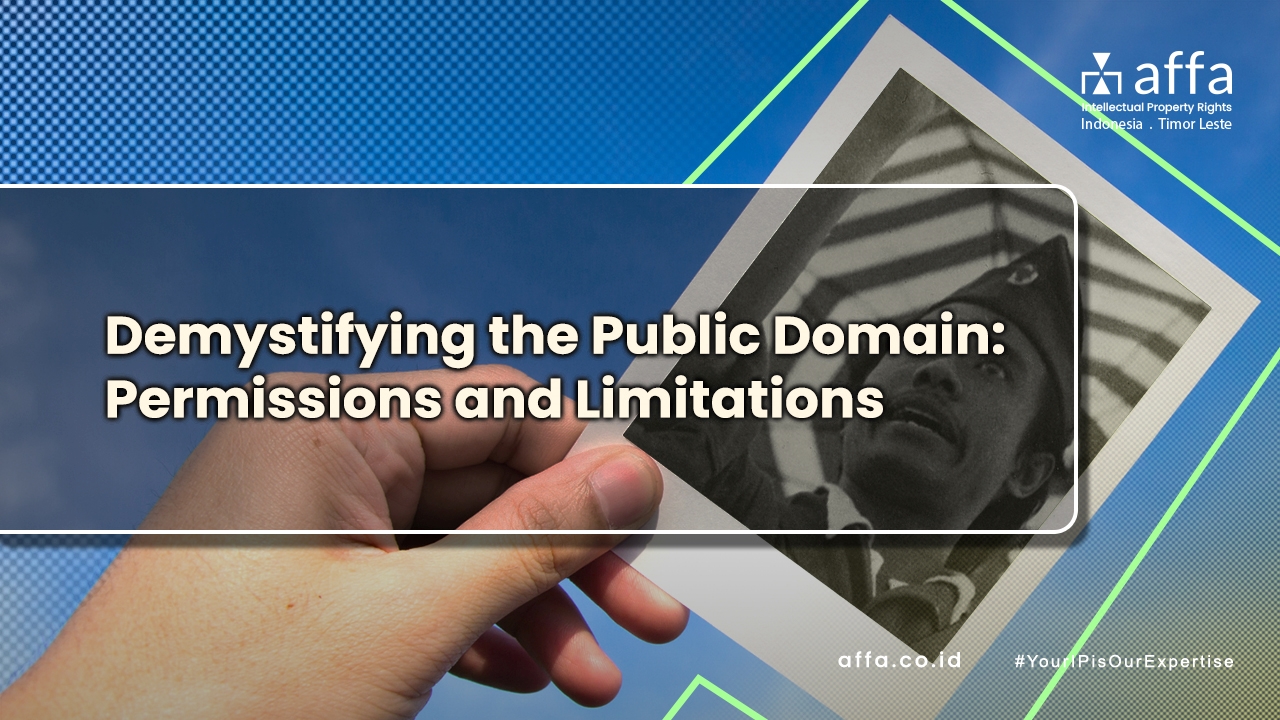
Demystifying the Public Domain: Permissions and Limitations
Demystifying the Public Domain: Permissions and Limitations We can almost always see this iconic portrait of Bung Tomo‘s enthusiastic speech every November 10th, as Indonesia celebrates National Heroes’ Day. In fact, according to Tempo Magazine‘s journalistic investigation, this photo was not taken on that date but later in 1947 by Frans Mendur, when Bung Tomo chaired a meeting in Malang, East Java. As a Work, this iconic portrait was first published in 1949, together with other historical photos of the Indonesian struggle, including photographs of the Proclamation, taken by Alex Mendur, Frans Mendur, and Abdoel Wahab Saleh, in a photo album “Revolutionary Paintings” courtesy of the Indonesia Press Photo Service (IPPHOS). The first two names are the brothers who founded IPPHOS. Because the portrait of Bung Tomo in Malang is more in line with the public’s imagination about the war spirit of November 10, rather than the actual conditions, where orations were only given in radio studios, this portrait is widely used to support Heroes’ Day. However, a portrait is still a Work that has copyright protection. Articles 1 and 9 of the Indonesian Copyright Law specifically state that a portrait is a photographic Work with human objects, and only the Creator has Economic Rights to publish, reproduce in all forms, adapt, transform, and distribute a Work. If another party wants to use it, they must obtain permission from the Creator or Copyright Holder. What if the Creator or Copyright Holder no longer exists? The Copyright Law regulates the validity period of Economic Rights, a reference for whether we still have to obtain permission from the Creator or Copyright Holder for a Work. If the validity period has passed, the Work has entered the Public Domain, and the public can use it freely without asking anyone for permission. The Copyright Law in Indonesia divides the validity period of Economic Rights over Work into three different periods: 1. 25 years since the first publication; Applies to Works of Applied Art in the form of fine art created by using art to a product so that it has an aesthetic impression to meet practical needs, including images, motifs, or ornaments on a product. 2. 25 years since the first publication; This applies to the following three categories: Photographic works; portrait; cinematographic; video games; computer program; the appearance of written work; translations, interpretations, adaptations, anthologies, databases, adaptations, arrangements, modifications, and other works resulting from transformation; translation, adaption, arrangement, transformation or modification of traditional cultural expressions; compilation of works or data, either in a format that computer programs or other media can read; and the compilation of traditional cultural expressions as long as the compilation is an original work. Works Made for Hire; Anonymous Works and Pseudonymous Works. 3. During the life of the creator and 70 years after the creator’s death; Books, pamphlets, and all other written works; lectures, lectures, speeches, and other similar works; demonstration materials created for educational and scientific purposes; songs or music with or without text; drama, musical drama, dance, choreography, puppetry, and pantomime; works of fine art in all forms such as paintings, drawings, carvings, calligraphy, sculpture, statues or collages; architectural works; map; and batik artwork or other motif art. 4. Limitless Time Applies to held Traditional Cultural Expressions by government, which includes the following six categories: a. textual verbal, both spoken and written, in the form of prose or poetry, in various themes and message content, which can be in the form of literary works or informative narratives; b. music, including, among other things, vocal, instrumental, or a combination thereof; c. movement, including, among other things, dance; d. theater, including, among other things, puppet shows and folk plays; e. fine arts, both in two-dimensional and three-dimensional form, made from various materials such as leather, wood, bamboo, metal, stone, ceramics, paper, textiles, etc., or a combination thereof; and f. traditional ceremonies. From the four categories above, it can be concluded that all works, if not included in Traditional Cultural Expressions, will ultimately fall into the Public Domain. Therefore, the portrait of Bung Tomo, first published in 1949, has been in the Public Domain since 1999. In addition, there are regulations in Article 43 (e) of the Copyright Law regarding Copyright Restrictions, which states that duplication, announcement, and/or distribution of portraits of the President, Vice President, Former President, Former Vice President, National Heroes, heads of state institutions, leaders ministries/non-ministerial government agencies, and/or regional authorities with due regard for dignity and fairness by the provisions of laws and regulations are not considered a Copyright Infringement. Since 2008, Bung Tomo has been designated as a National Hero, so the public’s use of this iconic portrait is not Copyright infringement. However, it would be best to remember that the legal basis governing Copyright varies in each country. So, the rules that apply in Indonesia may be different from other countries. Comparison of Public Domains Abroad Duration of Copyright in the United States The Copyright Law in the United States divides the duration of Copyright as follows: 1. During the life of the creator and 70 years after the creator’s death; The creator’s identity is known for all works created after January 1, 1978. 2. 95 years from the year of its first publication, or a term of 120 years from the year of its creation, whichever expires first; For Anonymous Works, Pseudonymous Works, and Works Made for Hire 3. 45 years after the creation; Works created before January 1, 1978, but expired before December 31, 2002; and, if the work is published on or before December 31, 2002 4. 28 years after the publication. Any Posthumous Work or of any periodical, cyclopedic, or other composite work upon which the copyright was originally secured by the proprietor thereof, or any Work copyrighted by a corporate body (otherwise than as assignee or licensee of the individual author) or by an employer for whom
The Minimum Requirements for Industrial Design Registration in Indonesia
The Minimum Requirements for Industrial Design Registration in Indonesia Having your Industrial Design registered and protected means you are ready to advance your product to the next stage. Because the exemplary Industrial Design plays a vital role in targeting specific market segments, creating new market niches, and strengthening the company’s branding and positioning. Industrial Design in Indonesia: A Brief Overview Industrial Design refers to an article’s ornamental or aesthetic aspect, encompassing its visual appearance and features. It is not concerned with the technical or functional aspects of the product. In Indonesia, Industrial Design protection is governed by Law No. 31 of 2000 concerning Industrial Designs. This legal framework provides creators with the means to protect their original designs from unauthorized use or reproduction. In previous articles, we have explained the importance of novelty in Industrial Design. This time, the comprehensive guide continues with the minimum requirements, including what must be prepared to apply for Industrial Design Registration. Minimum Application Requirements 1. Fill out the Application Form Independently or Through a Registered Intellectual Property Consultant You can submit this filling process online on the Directorate General of Intellectual Property (DGIP) portal or through a reliable, experienced Intellectual Property Consultant. Using a Consultant will give you professional advice early on the chances of your registration application being accepted. This way, the application fee you pay will not be in vain. In addition to that, you don’t need to worry about completing the required documents. To fill out the Application Form, you must include the following data: Types of Industrial Design: When applying, you must determine what Industrial Design you wish to register among the following 4 (four) options: 1. One Design What is meant by One Design is the overall product design, for example, a chair design or a food packaging design. 2. Set Design This category is selected if your design includes several products at once—for example, a set of tables and chairs or speakers and subwoofer. 3. Divisional/Partial Design This category is chosen if your design is only part of a pre-existing product. For example, the sole part of the shoes you have previously registered or the frame part that surrounds the glass of a pair of glasses. 4. Divisional/Partial Set Design As the name suggests, this category is selected if the design you are registering is only part of several products—for example, just the outer appearance of the speaker tubes of a set of loudspeakers. Applicant Information Contains the full name, nationality, detailed address consisting of country, province, city/district, sub-district, postal code, email, and telephone number of the Applicant. Designer Information If the data is not the same as the Applicant, then the Designer data must be filled in with full name, nationality, and country. Designer Data can also contain more than one Designer. Consultant Information If you use a Consultant, the data required is the Consultant’s full name and address, as well as email and telephone number. Desain Information This data must include the following information: 1. Title of Industrial Design The general name of the product in Indonesian, without including the brand or type of item. For example, for bottle products, just write “bottle,” without adding “- 30 cm plastic”. 2. Description This section is the place to explain the product’s uses, product characteristics, and product features that you want to protect. 3. Claim In this section, you can choose the registered design, which is the complete product shape (for example, a car or shoes), configuration (for example, a car dashboard), line composition (for example, a pattern installed on a car seat), color composition (for example a colored batik design), or a combination thereof. 4. Locarno CLassification Locarno here refers to the “Locarno Agreement,” an international agreement in the field of Industrial Design that determines international classification based on a list of class and sub-class indications, as well as explanatory notes intended solely for administrative purposes of Industrial Design registration. Locarno consists of 32 class titles arranged sequentially, and class numbers are assigned according to the type, nature, or function of the goods indicated according to the relevant class title. You can choose the category according to your product type. Priority Data This data must be filled in if the applicant comes from outside Indonesia. The information required is country of origin, priority number, priority date, and additional notes (if any). 2. Providing Figures and Descriptions The figures can be in a form of Technical Drawing, Computer Rendered Image, or Photo with the following appearance: Views: Perspective View Top view Bottom View Front look Back view Left Side View Right-side view Application Documents (administrative): Power of Attorney (if using a Consultant) Industrial Design Ownership Letter Assignment Document of Industrial Design Rights from Designer to Applicant A required letter if the Designer is not the same as the Applicant. Therefore, this letter must contain the following information: Assignor = Designer; Assignee = Industrial Design Owner/Applicant; Designers are individuals, one or more than one; The owner is an individual or a legal entity; Legal entities are represented by parties who are responsible for representing them, as evidenced by a position decree or similar. Priority Document along with its translation into Indonesian (must be sworn translated) 3. Pay the Application Fee Once all the documents are complete, you will receive detailed fees, and if payment has been made, it will continue with the Formality Examination, Publication, and Substantive Examination. All of these documents will be provided to you by us later on. Furthermore, if no problems are found with the application or no existing design is found, DGIP will issue an Industrial Design Rights Certificate as proof of ownership of Industrial Design Rights. This protection certificate is valid for 10 (ten) years and cannot be extended, valid from the date the application was received, not from the time the certificate was issued. Should you have other questions about the Industrial

The Impact of Intellectual Property on the Quality of Life for People with Disabilities
The Impact of Intellectual Property on the Quality of Life for People with Disabilities The 2022* Asian Para Games, which ended yesterday in Hangzhou, China, showcased human civilization’s sportsmanship, high fighting spirit, and demonstrated the impact of Intellectual Property (IP) on the quality of life of people with disabilities in many ways. For example, the Games featured a wide range of patented assistive technologies used by athletes with disabilities to compete at the highest level. These patented assistive technologies included: Running Prosthetics: Losing a leg (or both) is not an obstacle for paralympic athletes to run; they no longer use prosthetic legs in the form of legs but unique legs in the form of carbon fiber plates, which are lighter and enable them to run like Olympic athletes. One of the Running Prosthetic manufacturers whose products are widely used is Ottobock, which currently has more than 1,800 patents. Racing Wheelchairs: There are three sports where wheelchair use is permitted at the 2022 Asian Para Games: basketball, fencing, and tennis. Of course, they don’t compete with ordinary wheelchairs, but wheelchairs with innovative technology that makes them lighter but more robust, which allows them to act more quickly and safely. Swim Fins: Swimming athletes who don’t have legs can use artificial fins made from silicon worn on their hands to swim faster and more efficiently. Blindfolds: Because not all Paralympic athletes are entirely blind, for the competition to be fair, they are required to use unique cloth coverings, for example, when competing in athletics. These blindfolds are also made with an innovative design to be worn comfortably throughout the competition. At the 2022 Asian Para Games, Indonesia achieved the highest achievement by reaching 6th place, under China, the Islamic Republic of Iran, Japan, the Republic of Korea, and India. The economic benefits obtained certainly do not only come to people with disabilities. The sporting event, which took place from October 22nd to 28th, 2023, generated billions of dollars in economic activity and created thousands of jobs from its implementation and innovative products protected by Intellectual Property. Intellectual Property continues to play an essential role in improving the quality of life of people with disabilities in various ways, including: Encourage innovation in assistive technologies to help people with disabilities live more independent and fulfilling lives. For example, IP rights have been instrumental in developing technologies such as screen readers, speech-to-text software, and prosthetic limbs. Make assistive technologies more affordable and accessible to people with disabilities. For example, IP rights can establish licensing agreements allowing manufacturers to produce and sell assistive technologies at lower prices. Promote the inclusion of people with disabilities in the workplace and society. For example, IP rights can be used to protect the intellectual property of businesses that employ people with disabilities. This can help to create jobs for people with disabilities and reduce the stigma associated with disability. Overall, the 2022 Asian Para Games were a powerful reminder of the positive impact that IP can have on the quality of life for people with disabilities. IP-protected assistive technologies can help people with disabilities live more independent and fulfilling lives, participate in the workplace and society, and achieve their full potential. If you need more information about IP protection in Indonesia or abroad, please feel free to contact us via email at [email protected] Source: WIPO Magazines 2022 Asian Para Games *) Dated 2022, as it originally marked the event scheduled for 2022, which was subsequently rescheduled to 2023 due to the COVID-19 Pandemic.
在印度尼西亚修改专利权利要求
在印度尼西亚修改专利权利要求 《印度尼西亚专利法》允许在知识产权总局(DGIP)下属的印度尼西亚专利局发出授权通知后3个月内,分阶段对专利权利要求进行修改。我们在此对在印度尼西亚允许进行权利要求修改的情况进行了总结。 法律依据 《专利法》(2016年第13号法律)(以下简称“《专利法》”)规范印度尼西亚专利保护的所有方面,包括在专利生命周期各阶段的权利要求修改。《专利法》第39条规范了各种性质的修改。涉及权利要求修改时,通常要确保不会扩大最初申请的保护范围。此外,只要专利申请尚未得到DGIP批准,即可随时对权利要求进行修改。 《专利法》第67条和第69条规定可通过专利上诉委员会进行授权后修改。一旦专利申请获得批准,修改范围可能仅限于对说明书、权利要求书和/或附图的修正。 我们在此对专利生命周期各阶段的权利要求修改可行性进行了总结,以供参考: 发表前的修改 支持对权利要求进行修改,前提是保护范围不超过最初提出的权利要求。 发表后的修改 支持对权利要求进行修改,前提是保护范围不超过最初提出的权利要求。 在实质审查申请期间提交的修改 支持对权利要求进行修改,前提是保护范围不超过最初提出的权利要求。 审查结果发布后的修改 在主管审查员发布审查结果后,仍可申请修改权利要求。为明确起见,审查员也可不时建议作出修改。请注意,这是授权前修改的最后一步,修改应在审查员发出授权通知/驳回通知之前提交。与前面的步骤类似,只要保护范围不超过最初提出的权利要求,即可对权利要求进行修改。 授权后权利要求修改 授权后权利要求修改须在自专利上诉委员会收到授权通知之日起3个月内提交。此类修改仅限于几个问题,如对说明书、权利要求和/或附图的修正(修正原因可能是在授权通知发布后发现翻译错误)、对权利要求范围的限制以及对模糊的说明书内容的澄清。 专利上诉委员会应当自开始审查之日起6个月内作出裁决。 如果您对各种性质的专利修改有任何疑问,请通过[email protected]与我们联系。

인도네시아에서의 특허 청구항 수정
인도네시아에서의 특허 청구항 수정 인도네시아 특허법(Indonesian Patent Law)은 지식재산권총국(Directorate General of Intellectual Property, DGIP) 산하 인도네시아 특허청(Indonesian Patent Office)에서 승인통지서를 발행한 후 최대 3개월 이내에 출원부터 여러 단계에 걸쳐 특허 청구항 수정을 허용하고 있습니다.인도네시아에서 청구항 수정이 허용되는 경우를 요약하여 알려드리겠습니다. 법적 근거 특허에 관한 인도네시아 공화국 법률 2016년 제13호(이하 ‘특허법’이라 함)는 특허 수명주기의 다양한 단계에서의 청구항 수정을 포함하여 인도네시아 특허 보호의 모든 측면을 규정하고 있으며,특허법 제39조는 다양한 특질의 수정에 관해 규정하고 있습니다.수정에 관한 경험칙은 최초 출원 보호 범위가 확대되지 않도록 하는 것이며,또 다른 경험칙은 DGIP가 출원을 승인하지 않았다면 언제든지 수정이 가능하다는 것입니다. 특허법 제67조 및 제69조에 따라 특허항소위원회(Patent Board of Appeal)를 통해 승인 후 수정이 가능해졌습니다.다만, 출원이 승인된 후에는 설명, 청구항 및/또는 수치에 대한 수정으로 범위가 제한될 수 있습니다. 이에 다음과 같이 특허 수명 주기의 다양한 단계에서 청구항 수정이 가능한 경우를 요약하여 알려드리오니 참고하시기 바랍니다: 발행 전 수정 당초 청구된 출원 범위보다 보호 범위가 넓지 않다면 청구항 수정이 가능합니다. 발행 후 수정 당초 청구된 출원 범위보다 보호 범위가 넓지 않다면 청구항 수정이 가능합니다. 실질심사요청 중 제출된 수정안 당초 청구된 출원 범위보다 보호 범위가 넓지 않다면 청구항 수정이 가능합니다. 심사 결과 발행 후 수정 담당 심사관이 심사 결과를 발행한 후에도 수정안을 제출할 수 있습니다.때로는 심사관이 명확히 하기 위해 수정안을 제안하기도 합니다.이는 승인 전 수정이 가능한 최종단계이므로 심사관이 승인통지서/거부통지서를 발행하기 전에 수정안을 제출해야 한다는 점에 유의하시기 바랍니다. 이전 단계와 유사하게, 당초 청구된 출원 범위보다 보호 범위가 넓지 않다면 수정안이 허용될 수 있습니다. 승인 후 청구항 수정 승인 후 수정안은 승인 통지일로부터 늦어도 3개월 이내에 특허항소위원회에 제출해야 합니다.수정안은 설명, 청구항 및/또는 수치의 수정(승인통지서 발행 이후에 발견된 번역 오류로 인한 것일 수 있음), 청구 범위의 제한, 특질에 대한 모호한 설명 내용의 명확화 등 일부 사안에 국한됩니다. 특허항소위원회는 심사를 개시한 날로부터 6개월 이내에 결정해야 합니다. 다양한 특질의 특허 수정에 대해 궁금한 점이 있으시면 [email protected]로 문의하시기 바랍니다.