特许人在印度尼西亚开展业务前应满足的7个条件-affa

特许人在印度尼西亚开展业务前应满足的7个条件

知识产权在特许经营业务中发挥着重要作用,在印度尼西亚,特许经营称为 “Waralaba”。“该特许经营商标注册了吗?”这个问题对授予特许者(特许人)非常重要,它是检验商标有效性的首要问题。   从投资者(加盟商)的角度来看,在印尼经营特许经营业务似乎很有前景。因为我们得到了快速投资回报率的“自动经营” 业务的承诺!   只需投入一些资金,收入就会源源不断,这归功于我们获得的特许经营权。 特许经营的提议如雨后春笋般涌现,在各种特许经营展览会上,很容易就能找到诱人的商业提案,包括由知名艺术家支持的新公司的提案。   但要考虑的是,我们所关注的公司所提供的业务值得称为特许经营吗?   假冒特许经营商会有什么法律后果吗?   特许经营的定义 根据《印度尼西亚共和国政府条例》(2007 年第 42 号,关于特许经营)第 1 条和《印度尼西亚共和国贸易部长条例》(2019 年第 71 号,关于实施特许经营)第 1 条,特许经营是指个人或企业实体对具有商业特征的商业系统所拥有的特殊权利,目的是销售成功的商品和/或服务,其他各方可根据特许经营协议利用和/或使用这些商品和/或服务。   特许经营必须满足的 7 项标准 《政府条例》第 3 条 2017年底42号关于特许经营以及《贸易部长条例》第 10 条 2019年第71号关于实施特许经营规定了具有特许经营概念的企业必须满足的明确标准,具体如下:   1.      具有商业特色 鲜明特点的企业,是指与其他同类企业相比,具有不易被模仿的优势或差异,并使消费者青睐这些特点的企业。例如,特许经营人(特许人)特有的管理系统、销售和服务方法,或结构或分销方法。 2.      盈利证明 该证明指特许人在经营过程中积累大约 5 年的经验,并掌握了克服困难的经营诀窍,从而实现继续生存和发展,并实现盈利。   3.      以书面形式制定所提供商品和/或服务的服务标准 这项规定要求特许经营公司制定 SOP(Standard Operational Procedure标准操作程序),以便加盟商在统一框架内开展业务。 因此,若不具备 SOP,就不能称之为特许经营。   4.      易于教学和应用 特许经营业务的好处在于,没有类似业务经验或知识的加盟商可以根据特许人提供的持续经营和管理指导很好地开展业务   5.      持续支持 此外,特许人不应袖手旁观,因为它有义务不断向加盟商提供经营指导、培训和宣传。   6.      已注册的知识产权 确保您审查的特许经营公司已注册与业务相关的知识产权,如商标、版权、专利和商业秘密,并提供证书所有权证明,或正在授权机构进行注册,具体指印度尼西亚共和国法律和人权部知识产权总局(DJKI)。   7.      拥有STPW(特许经营注册证书) 《贸易部长条例》第 10 条第 71号2019年要求特许人机加盟商拥有 STPW。 要获得本STPW,特许人必须有特许经营招股说明书,否则特许人加盟商之间不得签订特许经营协议。 注意,若将来特许人的知识产权(IPR)注册未获批准或过期,STPW 将失效。   因此,鉴于知识产权在特许经营业务中的重要性,必须一开始就提出“您的企业是否已在知识产权总局(DJKI)注册商标?”的问题。   在辨别假冒特许经营权时,注意以下一些重要事项:   真正的特许经营不会承诺自动经营 印度尼西亚特许经营协会(AFI)主席阿南–苏坎达尔(Anang Sukandar)在组织国际特许经营展览会时警告说:“我们不应被敷衍了事的方法所迷惑。在生意场上,不会自动经营。自动驾驶只存在于航空领域,在商业领域不存在。” 因此,千万不要以为特许经营企业就像投资黄金一样,不按照经营流程就能持续上涨。 因为你可能被当作猎物,这样特许人就可以在将来亏损时逃脱惩罚。 例如,说明你所处的位置并不有利。   印度尼西亚特许经营支持国内生产 不要被以销售进口原材料为主要吸引力的特许经营店所诱惑。 因为《特许经营条例》第 9 条规定,只要符合特许人书面规定的商品和/或服务质量标准,特许人和加盟商应优先使用国产商品和/或服务。                                                                                                     通过更好地了解特许经营业务的复杂性,在选择特许经营业务时就会更多选项。 看似非常诱人的商业提议可能只是合伙提议,并不符合印度尼西亚共和国政府的《特许经营条例》。   注意,使用不符合上述标准的 “特许经营 “可能会受到行政处罚,应根据法律法规的规定,推荐发证官员吊销营业执照和/或经营/商业执照。 换句话说,您付出的巨额投资最终可能会亏损,不是因为缺少买家,而是因为忽略了对特许经营强制要求的检测。   如需更多有关印度尼西亚或全球特许经营的信息和帮助,请通过以下方式联系我们[email protected]. 来源: 政府条例 2007 年第 42 号关于特许经营 贸易部长条例 2019年第71号关于实施特许经营

7-Things-That-A-Real-Franchise-Should-Have-in-Indonesia-affa

7 Things That A Real Franchise Should Have in Indonesia

Intellectual Property Rights have an essential role in the Franchise business in Indonesia. The question “Does your Franchise already register your Trademark?” becomes very relevant to test its legitimacy as an initial question to the Franchisor.   Running a Franchise business in Indonesia, from an investor’s point of view or as a Franchisee, at first glance, looks promising because we are promised an “auto-pilot” business with a quick return on investment!   Without a million-dollar investment, you will have continuous cash flow in returns with the help of the big name of the Franchise that we take. Franchise offers are increasing, including at various Franchise exhibitions. We can easily find lucrative business proposals from new companies with well-known artists behind them.   However, we need to pay attention to whether the business offered by the companies we aim for is worthy of being called a Franchise.   Are there any legal consequences for fake Franchise businesses?   Definition of Franchise in Indonesia According to Article 1 of the Government Regulation of the Republic of Indonesia Number 42 of 2007 concerning Franchising and Regulation of the Minister of Trade of the Republic of Indonesia Number 71 of 2019 concerning the Implementation of Franchising, what is meant by Franchising is a Special Right owned by an individual or business entity towards a business system with business characteristics, to market goods and/or services that HAVE PROVEN SUCCESS and can be utilized and/or used by other parties based on the Franchise Agreement.   7 Criteria that Franchisees Must Fulfill Article 3 Government Regulation No. 42 of 2007 concerning Franchising and Article 10 of the Minister of Trade Regulation No. 71 of 2019 concerning the Implementation of Franchises provides clear criteria regarding things that must be fulfilled by businesses that use the Franchise concept, as follows:   1.      Has Distinctive Business Characteristics Businesses with distinctive characteristics have advantages or differences that are not easily imitated compared to similar companies, making consumers always look for those characteristics. For example, the Franchisor’s unique characteristics are management systems, sales and service methods, or arrangement or distribution methods.   2.      Proven to Provide Benefits This evidence refers to the experience of the Franchisor, who has been running for approximately 5 (five) years. It already has business tips for overcoming problems in its business so that it can continue to survive, grow, and be profitable. 3.      Has Service Standards for the Goods and/or Services Offered which are Made in Writing This rule requires a Franchise to have a certain Standard Operational Procedure (SOP) so that the Franchisee can carry out business within a clear and the same framework. Therefore, it is only a Franchise if it is equipped with SOP. 4.      Easy to Teach and Apply The pleasant thing about the Franchise business is that Franchisees who do not have experience or knowledge of similar businesses can carry it out well through the Franchisor’s continuous operational and management guidance. 5.      Provide Continuous Support Apart from point number four, the Franchisor must be very helpful because it must continuously provide operational guidance, training, and promotions to the Franchisee. 6.      Registered Intellectual Property Rights Make sure that the Franchise you are seeking has registered Intellectual Property Rights (IPR) related to the business, such as Trademarks, Copyrights, Patents, or Trade Secrets, with proof of certificate ownership or is in the process of registering with the authorized agency in this case, the Directorate General of Intellectual Property (DGIP), Ministry of Law and Human Rights of the Republic of Indonesia. 7.      Has an STPW (Franchise Registration Certificate) Article 10 Regulation of the Minister of Trade of the Republic of Indonesia No. 71 of 2019 requires Franchisors and Franchisees to have STPW. To obtain this STPW, the Franchisor must have a Franchise Offer Prospectus, because without it a Franchise Agreement cannot be made between the Franchisor and the Franchisee.   It should also be noted that the STPW is declared invalid if in the future the registration of IPR (eg. Trademark) by the Franchisor is not approved or the validity period of the IPR expires.   Therefore, given the importance of Intellectual Property in a Franchise business, the question “Does your Franchise already register your Trademark?” must be asked from the start.   Furthermore, some essential things that you should also pay attention to when sorting out fake Franchises are:   True Franchises Don’t Promise Auto-Pilot At the recent international Franchise exhibitions, Chairman of the Indonesian Franchise Association (AFI) Anang Sukandar warned, “We should not be lulled into instant ways. In business, you can’t have auto-pilot business. Auto-pilot only exists in the world of aviation, not in business.” So don’t ever think that a Franchise business is like investing in gold, which can continue to rise without following the business process. If your Franchisor is offered that way, perhaps you are being used as prey, and the Franchisor can be irresponsible when you lose money in the future, for example, by giving reasons that your location is not in a profitable area.   Indonesian Franchise Supports Domestic Production Take your time to be tempted by Franchises that sell imported raw materials as their main attraction. Article 9 of the Government Regulation concerning Franchising states that the Franchisor and the Franchisee prioritize using domestically produced goods and/or services as long as they meet the quality standards of goods and/or services stipulated in writing by the Franchisor.   By better understanding the ins and outs, you can be more selective in choosing a Franchise business. The business offer that looks very tempting could be just a partnership offer that does not follow the Republic of Indonesia Government Regulations on Franchising.   So that you know, the use of the term Franchise that does not meet the above criteria may be subject to administrative sanctions in the form of recommendations for revocation of business permits and/or operational/commercial permits to issuing officials according to the…

Bogey-Business-The-Rough-Ride-of-Counterfeit-Clubs-and-Apparels-in-Indonesia-affa

Bogey Business: The Rough Ride of Counterfeit Clubs and Apparels in Indonesia

Indonesia, renowned for its breathtaking landscapes and intricate cultural tapestry, has recently seen an unwelcome trend infiltrating its golfing community: the proliferation of counterfeit golf clubs and apparel. As the sport’s popularity continues to surge in the archipelago, the market for cheaper alternatives has thrived. But this search for affordability might come at a greater cost, not only affecting the game’s quality but also influencing social perceptions within the golfing circle.   Unfortunately, counterfeit clubs and apparel are widely found both online and offline. Several Instagram pages in Indonesia have been educating consumers about the differences between the original products and the counterfeit ones.     1. Game Integrity at Risk Counterfeit golf clubs, often made of subpar materials and lacking in technological advancements, don’t perform at the same level as their genuine counterparts. Clubs are specifically engineered for precise weight distribution, flexibility, and balance. When one uses a counterfeit, they’re risking unpredictable ball trajectories, reduced shot distances, and less forgiving mishits.   This makes it extremely difficult for players to refine their skills and achieve consistency. Such inconsistencies not only frustrate players but can also lead to a lack of confidence in their abilities. For those unaware they are using counterfeit equipment, it may seem like their skills are at fault rather than the club.   2. Social Judgments on the Fairway In golf, much like other sports, there’s an unspoken code of conduct, respect, and a shared pursuit of authenticity. Using genuine equipment signifies a commitment to the game and its traditions. Therefore, when someone knowingly or unknowingly sports counterfeit gear, it can be met with skepticism and judgment from peers.   This judgment can manifest in various ways: silent side glances, hushed conversations at the clubhouse, or even outright confrontations on the course. Counterfeit apparel and clubs may unwittingly label a player as inauthentic or as someone who doesn’t value the true essence of the game.   3. Impact on Authentic Brands and Local Economy The spread of counterfeit products doesn’t only impact players and their social standing; it also affects genuine brands that invest heavily in research and development. These brands rely on sales to fund their innovation, and counterfeit sales undermine this. Furthermore, local retailers selling genuine products are undercut by these cheaper alternatives, leading to potential business closures and loss of employment.   4. Way Forward Addressing the issue requires a multi-faceted approach. First, awareness campaigns can educate players about the downsides of counterfeit equipment. Golf clubs and associations can also play a pivotal role by organizing equipment verification days or partnering with brands for authentic equipment promotions.   Moreover, stricter regulations and better enforcement can curb the import and sale of counterfeit golf products. Collaborative efforts between the government, industry stakeholders, and the golfing community can create a robust defense against this rising challenge.   In conclusion, while the allure of affordable golf clubs and apparel might seem tempting, the repercussions go beyond just an individual’s game. A collective effort is needed to preserve the integrity of the sport and maintain the respect and camaraderie that golfers share in Indonesia and around the world.   Should you require further information and assistance regarding IP infringements related to golf clubs and apparel in Indonesia, please get in touch with us at [email protected], [email protected], and [email protected]. Source: Instagram GOLFELLAS

Exploring-the-Intellectual-Property-Game-in-Basketball-affa

Exploring the Intellectual Property Game in Basketball

When we think of basketball, the first things that come to mind are slam dunks, crossovers, and buzzer-beating shots. But did you know that the world of basketball also involves its fair share of Intellectual Property? From iconic logos to innovative technologies, the game has its own unique IP game. Let’s take a jump shot into basketball and some of its Intellectual Property.        1. Trademark for Team Logos: Just like the game itself, team logos are integral to the identity of basketball teams. The LA Lakers’ iconic logo or the Chicago Bulls’ fierce emblem aren’t just symbols; they’re also protected Trademarks, ensuring their uniqueness and preventing unauthorized use.        2. Patents for Innovative Footwear: Basketball shoe technology has come a long way. From Air Jordan’s game-changing cushioning to Adidas’ Boost technology, Patents often protect these advancements. These Patents encourage innovation and safeguard the hard work of creating performance-enhancing gear.        3. Copyright for Broadcasts and Analytics Software: The exhilarating dunks and clutch plays would be the same with the broadcasters who capture the moment. These broadcasts are subject to Copyright, ensuring that the creative work involved in producing them is acknowledged and protected. The modern game is heavily influenced by data analytics and software. The algorithms and software tools used to analyze player performance and strategy are valuable Intellectual Property assets.   As we cheer for our favorite teams and players, remember the ‘behind-the-scenes game’ of Intellectual Property that contributes to the excitement on the court. From Trademarks to Patents and Copyrights, basketball is more than just a sport; it’s a field where innovation and creativity are valued and protected.   Should you require further information and assistance regarding Intellectual Property in sports, please get in touch with us at [email protected]. Source: World Intellectual Property Organization FIBA Basketball

ASEAN-Launches-IP-Register-to-Boost-Intellectual-Property-Protection-affa-global

ASEAN Launches “IP Register” to Boost Intellectual Property Protection

The Association of Southeast Asian Nations (ASEAN) and the World Intellectual Property Organization (WIPO) launched the ASEAN Intellectual Property (IP) Register on August 20, 2023, in Semarang, Indonesia. The IP Register is a one-stop technology developed by the ASEAN Intellectual Property Office to facilitate the exchange of data on Patents, Trademarks, Industrial Designs, and others that have already been registered.   The launch of the IP Register is part of a Memorandum of Understanding (MoU) signed by ASEAN and WIPO in 2022. The MoU aims to expand cooperation between ASEAN and WIPO in specific areas through a future-focused and impact-driven approach. It also seeks to complement the ongoing partnership under the ASEAN Intellectual Property Rights Action Plan (AIPRAP) 2025.   The specific areas referred to in the MoU aim to meet the new and emerging needs of underrepresented stakeholders from the business and creative communities, such as small and medium enterprises (SMEs), startups, creators, and other IP-related parties.   The IP Register is expected to boost intellectual property protection in ASEAN by providing a single portal for stakeholders to conduct seamless Patent, Trademark, and Industrial Design searches. It will also help to facilitate the registration of IP Rights in ASEAN, which can help businesses and creators to protect their innovations and creations.   The launch of the IP Register is a significant milestone in ASEAN’s efforts to build a more conducive environment for innovation and creativity. It is also a testament to the strong partnership between ASEAN and WIPO in promoting Intellectual Property protection in the region.   Here are some of the benefits of the IP Register: Provides a single portal for stakeholders to conduct seamless Patent, Trademark, and Industrial Design searches. Helps to facilitate the registration of IP Rights in ASEAN. Help businesses and creators to protect their innovations and creations. Boost Intellectual Property Protection in ASEAN. Create a more conducive environment for innovation and creativity in the region.   The IP Register is a valuable tool for businesses, creators, and other stakeholders in ASEAN. It is expected to play a significant role in boosting Intellectual Property protection in the region and promoting innovation and creativity.   Should you require further information and assistance regarding IP Protection in Indonesia or abroad, please contact us at [email protected]. Sources: ASEAN.org Directorate General Intellectual Property

Similar-But-Not-The-Same-The-Difference-Between-Franchising-and-Licensing-in-Indonesia-affa-global

Similar But Not The Same – The Difference Between Franchising and Licensing in Indonesia

Franchising and Licensing are two popular business models that allow businesses to expand their reach and grow their profits without investing heavily in new infrastructure or resources. However, there are some critical differences between the two models, both in terms of how they work and how they are regulated by Indonesian law.   In a Franchise arrangement, the Franchisor grants the Franchisee the right to use its Brand, Trademarks, Intellectual Property, and Business Model in return for a fee. The Franchisee is then responsible for operating the business by the Franchisor’s standards. In a Licensing arrangement, the Licensor grants the Licensee the right to use its Intellectual Property (e.g., Trademarks, Patents, Industrial Designs, and Copyrights) in exchange for a fee and for a certain period. The Licensee is then responsible for developing and marketing its own business using the licensed Intellectual Property.   The Indonesian government regulates franchises through the Government Regulation No. 42 of 2007. This regulation sets out the requirements for Franchisors and Franchisees, including registering the franchise with the Ministry of Trade. The law also establishes restrictions on franchise arrangements, such as the requirement for franchisors to provide franchisees with specific information about the franchise business.   The legal basis governing franchising and licensing also differs. Franchise activities are regulated through Government Regulation No. 42 of 2007, strengthened by the Minister of Trade Regulation No. 71 of 2019. This regulation regulates the requirements for Franchisors and Franchisees, including regulations governing the registration of franchises with the Ministry of Trade, as well as specific information about the franchise business that must be provided from the Franchisor to the Franchisee.   In addition to the two legal bases above, other legal grounds related to franchising arrangements are Law No. 5 of 1999, concerning the Prohibition of Monopolistic Practices and Unfair Business Competition; Law No. 40 of 2007, concerning Limited Liability Companies and Franchise Agreements that bind the party.   Meanwhile, licenses more closely related to Intellectual Property are governed by Government Regulation No. 36 of 2018 concerning the Recordation of Intellectual Property License Agreements, which are derivatives of Article 41 paragraph (1) of Law Number 20 of 2016 concerning Trademark and Geographical Indications.    Now let’s dive into the terms of Franchising and Licensing:   FRANCHISE REQUIREMENTS By law, to conduct a franchise business in Indonesia the Franchisor will need to obtain the Franchisor’s STPW (permit registration) and Commitment Registration to the Ministry of Trade by registering the Franchise proposal documents and agreement draft. The Franchisee will need to do the same thing to obtain Franchisee’s STPW permit and Commitment Registration.   Required documents for Registration of Prospectus (Franchisor’s permits) of the Offered Franchise (to be filed by the Franchisor, notarized, and attested by the Indonesian Embassy) are as follows: Power of Attorney  Application Letter (STPW) Details of Franchisor Identity Copy of the ID card of the Directors/Owners of the Franchisor Copy of Business License of the Franchisor History of Business of the Franchisor Organisation Structure of the Franchisor (from Board of Commissionaires, Shareholders, Directors, up to its operational level) Audited Financial Statements for the last 2 years Number of outlets owned by the Franchisor List of current Franchisee Rights and Obligations of the Franchisor and Franchisee List of Composition and numbers of franchised goods used by the Franchisee List of Composition of required manpower Trademark registration certificates in Indonesia or filing receipt of the Trademark application in Indonesia. Copy of Franchise Agreement.   After the prospectus (Franchisor’s permits) has been registered in the Ministry, the franchisor can begin the franchisee’s agreement. The franchisee must also register the signed agreement.   Required Documents for Registration of Franchise Agreement (to be filed by the Franchisee): Power of Attorney (by the Franchisee) Application letter made by  Franchisee on the Franchisee’s company letterhead. Copy of the Prospectus of the offered Franchise; Copy of Article of Association of Franchisee’s company Copy of the Business Licenses of the Franchisee; Copy of the ID card of the Directors/owners of the Franchisee Copy of the Franchise Agreement and its Indonesian translation; Copy of Certificate of trademark registration. Composition and numbers of the employees (foreign and local staff) Composition and numbers of franchised goods used by the Franchisee   The documents above must be translated into the Indonesian language.   LICENSE AGREEMENT RECORDATION REQUIREMENTS Required documents for recordal of Trademark license agreement: Executed License Agreement duly notarized by Notary Public in the relevant country Copy of the trademark registration certificate Power of Attorney (simply signed) Identity of the signors Deed of Incorporation of the parties (if any)   The followings have to be included in the license agreement: Place & Date of the letter signing Details of the parties including the address Object of trademark license (trademark registration no.) Terms of use (exclusive, non-exclusive, sub-licensable, or not) Duration Territory   For more information about IP License Agreement in Indonesia, you can read our previous articles here: Indonesia’s IP Odyssey: Unraveling the Ins and Outs of IP License Agreement Recordal   From the description above, if you already have a business with a proven and duplicable business model for at least two years, you can try running a franchise business as a Franchisor. On the other hand, if you want to start running a company from a proven business, you can become a Franchisee.   However, you can run a Licensing business if you are an IP owner who can provide freedom in IP management, including marketing strategies, as a Licensor. On the other hand, for those of you who have a lot of creative ideas to run a business from an IP you don’t own, you can apply for a license from the IP owner, and act as a Licensee. Should you require further information and assistance regarding Franchise & IP Licensing in Indonesia, please contact us at [email protected].   Source: Government Regulation No. 42 of 2007 concerning Franchising Minister of Trade Regulation No. 71 of 2019 concerning The Implementation of Franchise Law No. 20 of…

Brushstrokes-Trademarks-Indonesias-Copyright-Quirk-affa

Brushstrokes & Trademarks Indonesia’s Copyright Quirk

Article 65 of the Indonesian Copyright Law crafts a vibrant patchwork in the legal tapestry of intellectual property rights. It explicitly prohibits the registration of a work of art, specifically a painting, as a copyright when it is used as a logo or distinguishing mark for a trade of goods or services or represents a symbol for an organization, business entity, or legal entity. This law paints a clear boundary line in the diverse field of intellectual property rights, where copyrights and trademarks often play tug-of-war.   However, an intriguing paradox has emerged in practice. Many parties try to draw double protection by registering the exact artistic representation as both a Trademark and Copyright – in other words, trying to overdo it by “double kill.” This practice takes advantage of a perceived grey area between the two distinct protections, aiming to arm the creator with an extra layer of legal armor. By doing so, they attempt to circumvent the spirit of Article 65, setting up a fascinating legal conundrum and an escalating tug-of-war between the copyright and trademark protection regimes in Indonesia.   In the past, there have been some warnings by the Indonesian Copyright Office to unilaterally withdraw the recorded copyrights if they are found to have breached Article 65 of the Copyright Law. A solution to this discrepancy lies in tightening the enforcement by the Indonesian IP Office, ensuring that the lines dividing trademarks and copyrights remain as sharp and clear as the brushstrokes of a master artist. Thus, Article 65 of the Indonesian Copyright Law continues to challenge the art and business words, forcing them to think outside the frame without doubling down on the protection for the same object illegally.   Should you have any questions about Copyright Recordation in Indonesia or abroad, please get in touch with us via [email protected].

Indonesias-IP-Odyssey-Tackling-Counterfeiters-on-Indonesian-E-Commerce-Sites-affa-global

Indonesia’s IP Odyssey: Tackling Counterfeiters on Indonesian E-Commerce Sites

According to the Priority Watch List (PWL) 2023 report, the United States Trade Representative (USTR) still places Indonesia, Argentina, Chile, India, Russia, China, and Venezuela on an investment blocklist because it is prone to piracy practices. In particular, the Notorious Markets for Counterfeiting and Piracy 2022 report, also released by USTR, listed various Indonesian sites on the watch list.   Even though in October 2021, Indonesia’s five largest e-commerce companies, namely Tokopedia, Shopee, Lazada, Bukalapak, and Blibli, signed a law enforcement cooperation agreement in the field of Intellectual Property (IP) together with the Directorate General Intellectual Property, Criminal Investigation Agency, and the Directorate General of Customs and Excise. Their target then was clear: Indonesia was released from PWL 2022.   In fact, since 2018, Indonesia is still on this list. Specifically, USTR stated that U.S. rights holders continue to face challenges in Indonesia concerning adequate and effective IP protection and enforcement. There continues to be widespread piracy and counterfeiting, and concerns regarding IP enforcement remain, including lack of enforcement against counterfeit goods, and the lack of deterrent-level penalties for IP infringement in physical markets and online.   Furthermore, USTR provides lays out the current challenges faced by and improvements made by Indonesian e-commerce that are on the watch list.   Challenges In general, right holders note a high volume of counterfeit products, with some openly labeled “replicas” of branded products. Several e-commerce sites have established notice and takedown processes and have made several improvements to their anti-counterfeiting systems, but right holders continue to push for the sites to invest more significant resources into developing proactive anti-counterfeiting protocols, as well as into increasing the speed of takedowns and transparency of takedown procedures.  Right holders have also expressed frustration with several e-commerce sites’ “repeat infringer” policy, which states that sellers with more than three infringement reports submitted by the same brand are “eligible” to be taken down, instead of “will be” taken down. Right holders state that both the site’s “repeat infringer” policy and “major infringer” policy require brands to expend significant effort and resources to report infringement, and they urge the sites to instead use proactive measures like keyword filtering to allow for automated removal of counterfeit listings.   Progresses Made by E-Commerce Sites in Indonesia Despite the challenges, the aforementioned sites have ramped up their efforts in battling against the counterfeits. In 2022, Shopee launched a pilot program for its new brand protection portal and, with a newly hired global brand protection director, increased its engagement with right holders. Whereas Tokopedia launched its new  Intellectual Property portal to increase the ease and efficiency of submitting notices of infringement and tracking the progress of the resolution of the notices.  Additionally, right holders have noted that Tokopedia has invested resources in a seller education campaign and has implemented some new technologies to increase proactive monitoring of product postings, that could detect and remove counterfeit listings before they are shown to users. Tokopedia also introduced the “penalty points” system and repeat offender system to counter the evergrowing counterfeit demands and markets.     Reporting counterfeit goods helps to protect consumers and businesses from being harmed by these illegal products. It also helps to ensure that the e-commerce platforms are fair and safe for everyone to use. But as seen from the screenshot above, for us to report counterfeit products, there is already a limit that only the owner or their authorized representatives can report. In other words, complaints for listing takedown or removal of goods from e-commerce, from ordinary users who have nothing to do with the owner of the Trademark or Copyright cannot be continued. On the other hand, this policy prevents false reporting from disturbing users.   Then if you are indeed the right holders or official representative, what documents are needed for reporting and requesting the removal of goods from e-commerce?   Documents Required for Trademark Infringement Report Proof of Trademark ownership in the form of a Trademark; Certificate that has been registered and issued by the Ministry of Law and Human Rights of the Republic of Indonesia, or similar documents; Recommended Retail Price (RRP) from Trademark Owner; This document is one of the economic evidence tools that can help e-commerce determine whether the listing to be taken down violates the Trademark. If the price of the goods sold in the listing is far below the RRP, then there is an indication that the product is counterfeit or that the seller is practicing price dumping. Proof of your legal identity; and Power of attorney from the Trademark holder/owner in accordance with the document proof of Trademark ownership that you have attached (if you are not the owner of the Trademark but are the beneficiary of the power of attorney from the Trademark owner to make a report). Documents Required for Copyright Infringement Report Proof of Copyright ownership in the form of a Copyright Recordation that has been registered and issued by the Ministry of Law and Human Rights of the Republic of Indonesia, or similar documents; Proof of your legal identity; and Power of attorney from the Copyright holder/owner in accordance with the document proof of Copyright ownership that you have attached (if you are not the owner of the Copyright but are the beneficiary of the power of attorney from the Copyright owner to make a report).   According to our experience, the average takedown listing request that we submit is accommodated by e-commerce within 2-3 weeks.   If you need further assistance in the process of reporting counterfeit products or listing takedown in e-commerce sites in Indonesia, don’t hesitate to contact us via [email protected]. Sources: 2022 Review of Notorious Markets for Counterfeiting and Piracy Priority Watch List 2023 Tokopedia IP Report Directorate General Intellectual Property

How-to-Upcycle-Without-Violating-Trademark-Law

How to Upcycle Without Violating Trademark Law

Upcycling is the process of transforming waste materials into new products of higher quality or value. This trend has been growing in popularity in recent years, and it is now estimated that resale could account for 20% of a luxury company’s revenue by 2030.   According to Vogue magazine, upcycling was the biggest fashion trend of spring/summer 2021. As of June 2023, the hashtag #upcycle has over 6.2 million posts on Instagram alone.   For brand and trademark owners, upcycling can raise legal concerns. For example, if a company uses a trademarked brand name on an upcycled product without the permission of the trademark owner, this could be considered Trademark Infringement.     However, there are some exceptions to this rule. For example, in the United States, trademark owners cannot prevent the use of their trademarks on upcycled products if the use is “noncommercial and non-confusing.” This means that the use of the trademark cannot be used to sell the product or to imply that the product is endorsed by the trademark owner.   In addition, trademark owners may be able to prevent the use of their trademarks on upcycled products if the use is likely to dilute the trademark. Dilution occurs when the use of a trademark weakens the distinctiveness or reputation of the trademark.   Overall, the legal implications of upcycling for brand and trademark owners are complex. However, by understanding the law, trademark owners can protect their brands and trademarks while still supporting the upcycling movement.   Should you have any questions about Trademark Infringement in Indonesia, please contact us at [email protected]. Source ipwatchdog.com

Toei-Strategy-Using-IP-to-Increase-Global-Sales-affa-global

TOEI Strategy: Using IP to Increase Global Sales

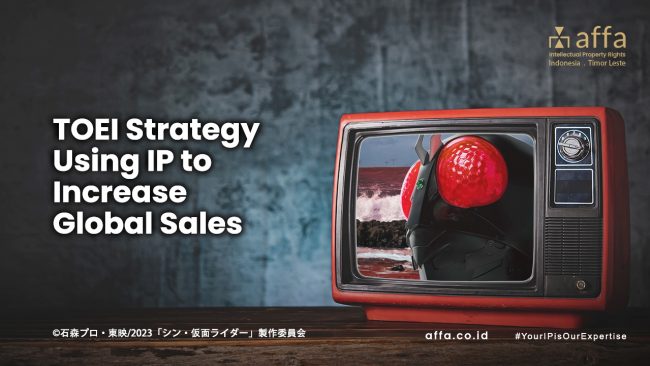
The IP (Intellectual Property) business in the entertainment industry is up-and-coming. We can see how the Walt Disney Company became a giant by producing its own animated series and feature films and continuing to buy well-known IPs such as Marvel Heroes, Star Wars, and many more. The valuation of the company founded by Walter Elias Disney 100 years ago has reached USD 171.49 billion and is ranked 63rd company with the largest market capitalization in the world.   Meanwhile, from Japan, Toei Company, Co. Ltd., or simply Toei, is known as a producer of popular films and animations such as Dragon Ball, Saint Seiya, One Piece, Digimon, Sailor Moon, Super Sentai, and Kamen Rider. Classic series such as Gaban (Uchu Keiji Gavan), Voltus (Chodenji Machine Voltes V), and Goggle Five, which were popular in the 80s, were also produced by Toei.   However, unlike Disney, like most other Japanese companies, especially in the entertainment industry, they prioritize the local market and only make the global market a secondary target. According to Nora Mediana, Managing Director of Moxienotion, who has several times been entrusted with distributing Japanese-produced films to Indonesia, this policy applies the principle of embracing enthusiasts and succeeding in the local market before advancing in the global market.   “You have to speak to your local audience, and be relevant to them first before reaching out to a wider audience,” she explained.   This strategy of strengthening IP foundations in the country has to deal with a population growth crisis that is difficult to overcome. The continued reduction in the number of children and adolescents, the main target of this IP business, has reduced the income in the local market.   Even though Toei has produced more than 4,400 feature films and 38,000 TV series, income from licenses for using trademarks and copyrights of their works will decrease unless they make the global market their primary target. Efforts to get out of this crisis were marked by the launch of a long-term vision called “Toei New Wave 2033”, which targets to increase global sales by 170%, or from the composition of the local to the global market, which was 70:30 to 50:50 in 2033.   So what strategy is done by Toei? The first, as has been and is commonly done by IP practitioners in the entertainment industry, is to extend the life of the IP itself, namely by recycling an IP so that it can continue to be known and loved from generation to generation.   One of the IPs that Toei relies on to carry out this mission is Kamen Rider, known in Indonesia as Ksatria Baja Hitam. In Japan, Kamen Rider, which first aired in 1971, has become a popular series that continues to be updated yearly. There are always new Kamen Riders with new transformation tools (called Henshin Belt), new bikes, new enemies, and other new uniqueness that are sold. Not only in the form of a TV series that airs in many countries but also in the form of a wide-screen film adaptation, besides the various toys and merchandise that fans are always hunting for.   The growing development of digital platforms also opens vast opportunities for this series to have more touch points to a broader market. If previously it was only available on TV screens, now it can be watched on cross-country streaming channels. Whether it was published via Toei’s official YouTube channel or the license was taken by a paid streaming platform that can be accessed worldwide. Of course, guarding the legality of granting cross-country licenses is a challenge. Because the protection of Intellectual Property is territorial, a limited license agreement must be paid close attention to so that it does not leak or fall into the hands of pirates.   Two Kamen Rider movies have screening dates in Indonesian cinemas in the last two months. The first is “Kamen Rider Geats × Revice: Movie Battle Royale”, screened on 31 May 2023, then “Shin Kamen Rider”, which will be screened in the last week of June 2023. These two films have regional licenses held by Neofilms Southeast Asia, and Moxienotion, aka PT Mitra Media Layar Lebar, hold the right in Indonesia.   IP Kamen Rider fans also enthusiastically welcomed the screening of these two films, especially since the screening of Shin Kamen Rider in Indonesia will be one of the earlier than neighboring countries. Shin Kamen Rider itself is a 121-minute remake of the first Kamen Rider series (1971) and was directed by Hideaki Anno, the director, and animator who gave birth to the IP Neon Genesis Evangelion, which became a phenomenon in the mid-90s.   Hopefully, this fan support will be converted into satisfactory ticket sales so that a mutually beneficial relationship between producers, distributors and fans can be maintained for other films in the future. Distributors are happy, fans are satisfied, and producers can meet their global sales targets.   In addition to intensifying the sale of its works globally, Toei is also opening itself up to foreign production houses to adapt its IP to suit the tastes of its audience. The latest project currently airing is “Voltes V: Legacy”, an entirely CGI robot series produced by GMA Entertainment for audiences in the Philippines. Voltes V was originally a robot animation series produced by Toei in 1977-1978, which was very popular in the Philippines because the story inspired the people to overthrow the Marcos regime in 1986. Because the popularity of this series is still immense, the fans who used to be children are now established, and current skills are also trying to bring back the Voltes robot with more sophisticated visual technology.   Toei’s support for the production house from the Philippines is a strategy to increase the value of IP through a cycle: “Creation – Export – Reboot – Reimportation.” From the same IP, the value can continue to grow because the license is purchased by outsiders, becoming new works that can be resold to the…