
Legal Obstacles to Trademarking Indonesia's National Emblem - AFFA IPR

Legal Obstacles to Trademarking Indonesia’s National Emblem

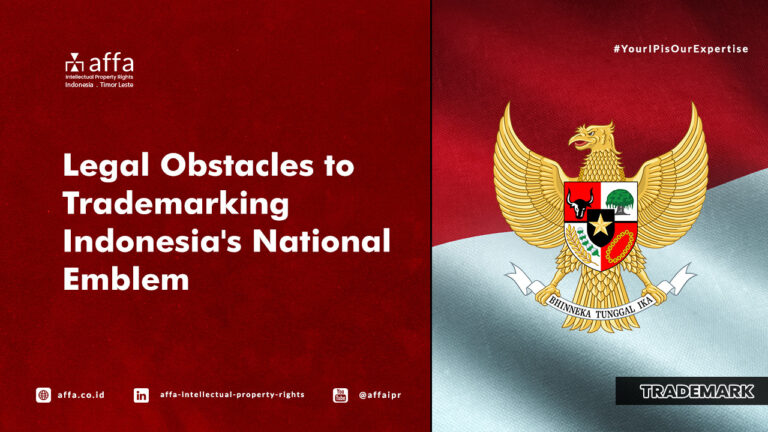
The Garuda Pancasila, the National Emblem of the Republic of Indonesia, is indeed iconic. The figure of this giant bird that is said to be able to cover the sunlight has been known since the 5th century and has become a symbol of many Hindu kingdoms in the archipelago. So, since it was established and used in various national activities, its presence has always inspired people from each generation to display it in a better and better form.   But is that allowed? Modifying and/or using the Garuda Pancasila as a Trademark in Indonesia? Here is the answer from the perspective of Intellectual Property law.   This large and strong figure, containing the date of the Proclamation of Independence of the Republic of Indonesia on its feathers (17-8-1945), was already in the minds of the nation’s founders when they determined the Garuda Pancasila as the National Emblem. In early 1950, the government of the Republic of Indonesia United (RIS) created a technical committee called the National Emblem Committee under the coordination of Minister Zonder Porto Folio Sultan Hamid II, with the Chairman of the Committee, Muhammad Yamin, and Ki Hajar Dewantara, M.A. Pellaupessy, Mohammad Natsir, and R.M. Ng. Purbatjaraka as its members. President Soekarno then inaugurated it at the RIS Cabinet Meeting on February 11, 1950. Its use was then regulated in Government Regulation No. 43 of 1958 and amended by the enactment of Law of the Republic of Indonesia Number 24 of 2009 concerning the Flag, Language, National Emblem, and National Anthem to implement Article 36A of the 1945 Constitution (UUD 1945) which reads, “The National Emblem is the Garuda Pancasila with the motto Bhineka Tunggal Ika.” For those of you who need clarification as to why the 1945 Constitution already contains the Garuda Pancasila even though the draft was only made in 1950, it is because Article 36A resulted from the Second Amendment in 2000. Previously, only Article 36 contained the following: “The National Language is Indonesian.” However, after the amendment, Article 36A (national emblem), 36B (national anthem), and 36C (further provisions related to the flag, language, national emblem, and national anthem are regulated by law) were presented.   Then specifically, Article 57 of Law Number 24 of 2009 contains the following prohibitions related to the National Emblem: It is prohibited to cross out, write, draw, or damage the National Emblem with the intention of tarnishing, insulting, or degrading the honor of the National Emblem; It is prohibited to use the National Emblem that is damaged and does not match the shape, color, and size comparison; It is prohibited to create a symbol for an individual, political party, association, organization, and/or company that is the same as or resembles the national emblem; and It is prohibited to use the National Emblem for purposes other than those regulated by the Law.   A person who violates the prohibition can be punished with a maximum imprisonment of one year or a maximum fine of IDR 100 million.   Although later, the Constitutional Court, through Constitutional Court Decision Number 4/PUU-X/2012, stated the provisions of Article 57 letter d jo. Article 69 letter c of Law 24/2009 concerning the prohibition of the use of the National Emblem for other purposes and its criminal sanctions are contrary to the 1945 Constitution of the Republic of Indonesia and do not have binding legal force, which means that since then the National Emblem can be used freely to a certain extent to support the spirit of nationalism, but does not apply if it is related to Trademark registration.   So even if you can use the Garuda Pancasila in a design for a t-shirt, cap, pin, or other merchandise that is traded, you still cannot register it as a Trademark. As regulated in Article 21 Paragraph (2)b of the Trademark Law, which reads, “An application is rejected if the Trademark is an imitation or resembles the name or abbreviation of a name, flag, insignia, symbol or emblem of a country, or national or international institution, except with the written approval of the authorized party.”   Legal Problems on the Use of National Emblem in Sports Jerseys   A few months ago, there was a debate regarding the use of the National Emblem on the jersey of the Indonesian Football Team. It is common and natural for a national jersey to change its design every season or every year. When the jersey’s vendor changes, the design and logo containing the National Emblem also changes. During the last change, the latest logo was registered with the name of the owner of the jersey’s manufacturer, and this invited controversy because the public began to understand the existence of Article 21 Paragraph (2) b of the Trademark Law.   However, the public forgets the sentence “written approval from the authorized party.” This controversy ended in June 2024 when the Indonesia Football Association (PSSI), the official parent organization of football in Indonesia, took over all logos applied to the Directorate General of Intellectual Property (DGIP). So, if we open the DGIP database today, both old and new logos have listed PSSI as the Trademark owner.   Thus, PSSI has the Exclusive Right to use the logo, and anyone who wants to use it must have permission from PSSI.   Old (DID2024030570) & New (DID2024006041) Logo of PSSI   It is a bit unfortunate that the logo does not contain the initials of PSSI, so it will cause polemics if other sports organizations want to register a logo that also contains the National Emblem. This means that other parties must file and register it with a different logo, but it still has similarities in principle to the logo filed by the PSSI. Should you need further information regarding Trademark protection or registration in Indonesia and worldwide, please do not hesitate to email us at [email protected].

FAQs: Trademark Enforcement in Indonesia - AFFA IPR

Frequently Asked Questions about Trademark Enforcement in Indonesia

Trademark Enforcement Proceedings Q: What types of legal or administrative proceedings are available to enforce the rights of a Trademark Owner against an alleged infringer or dilutive use of a mark, apart from previously discussed opposition and cancellation actions? Are there specialised courts or other tribunals? Is there any provision in the criminal law regarding Trademark Infringement or an equivalent offence?   A: There are several approaches that need to be considered when commencing the Trademark enforcement proceedings. It is always a prudent course of action to start with sending a cease and desist letter against the infringer to immediately cease the infringing action. Should the infringer does not comply with the requests that have been addressed in the cease and desist letter, then the Trademark Owner has the option to file a criminal action against the infringer to the civil investigator at the Directorate General of Intellectual Property (DGIP) or to the Indonesian Police.   All Intellectual Property disputes are the domain of the Court of Commerce. Apart from invalidations and cancellations of registered marks, any party with legal rights can also seek civil actions through the Court of Commerce, namely to request preliminary injunction and to seek for damages or remedies.   The penalties for infringements are covered by the Trademark Law, namely the following articles:   CHAPTER XVIII  CRIMINAL PROVISIONS Article 100 (1) Every person unlawfully uses any Mark which is identical to registered Mark of other parties for similarly produced, and/or traded goods and/or services, shall be sentenced to imprisonment of up to 5 (five) years and/or fines up to Rp2,000,000,000.00 (two billion rupiahs).   (2) Every person unlawfully uses any Mark which is substantially similar to registered Mark of another party for similarly produced and/or traded goods and/or services, shall be sentenced to imprisonment for up to 4 (four) years and/or fines up to Rp2,000,000,000.00 (two billion rupiahs).   (3) Every person violating the provisions as referred to in section (1) and section (2), whose goods cause health impairment, environment distortion, and/or human deceases, shall be sentenced to an imprisonment up to (10) ten years and/or fines up to Rp5.000.000.000,00 (five billion rupiahs).   Article 101 (1) Every person unlawfully uses any signs which are identical to Geographical Indications of other parties for similar goods and/or products or identical to registered goods and/or products, shall be sentenced to imprisonment up to 4 (four) years and/or up to Rp2.000.000.000,00 (two billion rupiahs).   (2) Every Person unlawfully uses any sign which is substantially similar to Geographical Indications of another party for similar goods and/or products or identical with registered goods and/or products, shall be sentenced with imprisonment up to 4 (four) years and/or :nes up to Rp2.000.000.000,00 (two billion rupiahs).   Article 102 Every Person who trades goods and/or services and/or product which is known or allegedly know that the goods and/or services and/or product constitute criminal acts as referred to in Article 100 and Article 101 shall be sentenced with imprisonment up to 1 (one) year or fines up to Rp200.000.000,00 (two hundred million rupiahs).   Article 103 The criminal acts as referred to in article 100 to article 102 constitute complaint delict.   Procedural Format and Timing Q: What is the format of the infringement proceeding?   A: Civil proceedings in Indonesia are conducted in writing and oral arguments. The judges will listen to the oral arguments of each party one at a time, and they rely heavily on documentary evidence. Witnesses of fact can also provide oral evidence before the court. However, a witness statement or affidavit alone will not be sufficient since it is considered merely supplementary documentary evidence. In general, the procedure of the trial is as follows: attendance at the first hearing after the court summons both plaintiff and defendant; attendance at the second hearing, when the defendant files its response to the plaintiff’s cancellation suit; preparation of the plaintiff’s reply to the defendant’s response to the suit; attendance at the third hearing to file the plaintiff’s reply; attendance at the fourth hearing when the defendant files its response to the plaintiff’s reply; preparation of the plaintiff’s evidence to be submitted to the court; attendance at the fifth hearing to submit the plaintiff’s evidence and review the defendant’s evidence; preparation and filing of the conclusion of the case based on documents and evidence filed with the court by both plaintiff and defendant; attendance at the sixth hearing on the filing of the conclusion of the case;  attendance at the seventh hearing to hear the judge’s decision; and issuance of the court’s decision.   For civil procedure, in theory a decision shall be issued within three months. However, in practice, it may take slightly longer due to the extensions requested by any of the parties involved.   Burden of Proof Q: What is the burden of proof to establish infringement or dilution?   A: In Indonesian civil procedure, the burden of proof regarding the facts on which a claim is based lies with the plaintiff. Article 1865 of the Indonesian Civil Code states that anyone who claims to have a certain right or who refers to a fact to support such a right, or who obzects to another party’s right, must prove the existence of that right or that fact. Evidence may comprise written evidence, evidence presented by witnesses, or through inference, confession or oath. In our experience, it is prudent to collect as much diverse evidential material as possible, such as purchases made by mystery shoppers, marketing materials found online and offline, and expert witnesses that may provide substantive statements pertaining to the alleged infringement. Furthermore, written evidence must be presented in the Indonesian language – translated by a sworn translator if necessary.   Standing Q: Who may seek a remedy for an alleged Trademark violation and under what conditions? Who has standing to bring a criminal complaint?   A: In accordance with article 83 of the Trademark Law, the registered mark owner and/or its licensee may file a…

FAQs Licensing and Assignment of Trademark in Indonesia - AFFA IPR

Frequently Asked Questions about Licensing & Assignment of Trademark in Indonesia

Licenses Q: May a licence be recorded against a Mark in Indonesia? How? Are there any benefits to doing so or detriments to not doing so? What provisions are typically included in a licensing agreement?   A: A registered Mark can be licensed out to other parties in Indonesia. For the agreement to have binding legal effect against any third party, it will have to be recorded at the Directorate General of Intellectual Property (DGIP). In general, a licence agreement should cover the details of the licensor and the licensee, the nature of licensing (exclusive or non-exclusive), the ability to sub-license (or not), term of the licence agreement, rights and responsibilities of the parties, and the object or Trademark to be licensed.   The licensing agreement must not contain provisions that either directly or indirectly damage the Indonesian economy or limitation obstructing Indonesian capacity to acquire and develop technology.   Assignment Q: What can be assigned? Does the Trademark have to be registered first?   A: A Trademark application or registration can be assigned to another party, provided that the deed of assignment, which has been notarised, is recorded at the DGIP to be fully binding. The assignment shall cover all goods or services covered by the assigned mark. The other business assets are not generally required to be assigned to make the Trademark assignment valid, except if both parties agree otherwise.   Assignment Documentation Q: What documents are required for assignment and what form must they take? What procedures apply?   A: Both parties shall sign a deed of assignment that later will be notarised and submitted to the DGIP. A power of attorney will also need to be provided.   Validity Assignment Q: Must the assignment be recorded for purposes of its validity?   A: A signed deed of agreement must be recorded before the DGIP to be valid.   Security Interests Q: Are security interests recognised and what form must they take? Must the security interest be recorded for purposes of its validity or enforceability?   A: In theory, all kinds of IP rights can be used as security interests. But in practice, the recordal of security interests is not possible for the time being. Should you need more information regarding the Licensing & Assignment of Trademark in Indonesia, please do not hesitate to contact us via [email protected].

Patent-x-Trademark-x-Industrial-Design-x-Copyright-affa-global

Patent, Trademark, Industrial Design, Copyright: Sorting Out Your Intellectual Property

Intellectual Property (IP) is a term used to describe a variety of intangible assets or creations of the mind that are given legal protection. The three main objects of Intellectual Property are Patents, Trademarks, and Copyrights. Here’s a brief explanation of each: 1. Patents Patents are legal protections for inventions. A patent gives the owner the exclusive right to make, use, and sell the invention for a certain period of time, typically 20 years from the date of filing the patent application. 2. Trademarks Trademarks are distinctive signs that are used to identify and distinguish the goods or services of one business from those of another. Trademarks can be in the form of words, logos, symbols, or a combination of these, and they are used to build brand recognition and goodwill. In general, a trademark registration provides protection for 10 years. However, trademark protection can be renewed indefinitely as long as the trademark owner continues to use the mark and pays the necessary renewal fees. 3. Industrial Design Industrial Design is a creation of shape, configuration, or composition of lines or colors, or lines and colors, or a combination thereof in a three-dimensional or two-dimensional form which gives an aesthetic impression and can be realized in a three-dimensional or two-dimensional pattern and can be used to produce products, goods, industrial commodities or handicrafts. 4. Copyrights Copyrights protect original works of authorship, such as books, music, art, and software. Copyright gives the owner the exclusive right to reproduce, distribute, and display the work for a certain period of time, typically the life of the creator plus 70 years.   In addition to these three main objects, there are also other forms of Intellectual Property, such as Trade Secrets and Industrial Designs, which provide protection for confidential information and the aesthetic design of products, respectively. Understanding the different categories of Intellectual Property can be crucial for protecting your intangible assets and creations of the mind. Patents provide protection for inventions or discoveries, Trademarks protect distinctive signs that identify and distinguish goods or services, and Copyrights safeguard original works of authorship. By understanding and utilizing these legal protections, individuals and businesses can ensure that their intellectual property is protected and secure. If you need more advice for protecting your IPs in Indonesia and other countries, please do not hesitate to contact us at [email protected]. Sources: Law No. 13 of 2016 on Patents (Patent Law); Law No. 20 of 2016 on Trademarks and Geographical Indications (Trademark Law) Law No. 28 of 2014 on Copyrights (Copyright Law);

Patent-Granted-2021-affa-global

China Dominates Patent Grants, Beating USA & Japan

Patent grants involve a comprehensive examination and review by the relevant government authority to ensure that the invention satisfies specific legal requirements such as novelty, non-obviousness, and industrial applicability.  The patent office conducts a search to determine if the invention has already been patented or disclosed by others and may request additional information or amendment of the application. The high volume of patent applications can also cause delays in the processing of the application. These measures are in place to ensure that only truly innovative and practical inventions are granted patent protection. That’s why it takes more than a year to be granted. The following chart was created based on Patent application data in 2021 that have been granted as of February 2023, where China dominates with 607,758 patents or about 38% of the total. In addition, China dominates in 29 categories: 1. Computer & Technology 2. Electrical, Machinery, Apparatus, & Energy 3. Digital Communication 4. Measurement 5. Transport 6. Civil Engineering 7. Other Special Machines 8. Audio Visual Technology 9. Machine Tools 10. Chemical Engineering 11. Handling 12. Pharmaceuticals 13. Materials & Metallurgy 14. Control 15. Mechanical Elements 16. Telecommunications 17. Basic Materials Chemistry 18. Biotechnology 19. Organic Fine Chemistry 20. IT Methods for Management 21. Macromolecular Chemistry & Polymers 22. Other Consumer Goods 23. Environmental Technology 24. Thermal Processes & Apparatus 25. Surface Technology Coating 26. Textile & Paper Machines 27. Food Chemistry 28. Analysis of Biological Material 29. Micro Structural & Nano Technology 30.  31. 32.  33.    Meanwhile, the United States only obtained 286,206 patents granted, only 18% or less than half of China’s total. The United States only dominates in the categories of Medical Technology, Engine Pumps & Turbines, Basic Communication Processes, and Other Unknown Inventions. Next, there is Japan with 256,890 patents granted, or about 16% of the composition. Japan leads in the categories of Semiconductors, Optics, as well as Furnitures & Games.     What about Indonesia? Data from WIPO (World Intellectual Property Organization) which can be accessed through www3.wipo.int/ipstats/ shows that Indonesia only had 756 patents granted in 2021. This number is lower than Singapore with 4,034 and Malaysia with 1,583. These Indonesian patents are dominated by inventions originating from state universities, such as Andalas University, Brawijaya University, Gadjah Mada University, Diponegoro University, and Bandung Institute of Technology. If you need further information about patent registration in Indonesia and other countries, please do not hesitate to contact us at [email protected]. Sources: OBIS: omnibisolutions.com WIPO IP Stats