Critical for Indonesia Importers: SNI Must Be Registered by the Trademark Owner and the Licensing Agreement Mus Be Recorded to DGIP - AFFA IPR

Critical for Indonesian Importers: SNI Must Be Registered by the Trademark Owner and the Licensing Agreement Must Be Recorded to DGIP

One of the primary requirements for obtaining a Certificate of Indonesian National Standard (SNI) is the ownership of a valid and registered Trademark with the Directorate General of Intellectual Property (DGIP), whether by a domestic industrial company or a foreign producer. Products intended to be marketed in Indonesia must meet specific standards, including quality and safety requirements, as enforced through the SNI certification.   Thus, having a registered Trademark is no longer optional but necessary for conducting business in Indonesia. A Trademark is a product’s identity and a critical legal protection tool, especially in a highly competitive market. Securing a registered Trademark is a vital initial step for local and international business operators.   Furthermore, business operators who fail to obtain an SNI Certificate for products that are required to have one may face severe penalties, including administrative sanctions such as product distribution bans and product recalls, as well as criminal sanctions such as fines and the revocation of previously issued SNI certifications.   Requirements for Obtaining SNI To obtain an SNI Certificate, business operators must meet several requirements, including: Ownership of a registered Trademark in the appropriate class (e.g., Class 11 for gas stoves). A quality management system that complies with ISO 9001:2015. Adequate production facilities. Product testing at an accredited laboratory.    Registration Process and Eligible Parties for SNI Registration   Domestic Industrial Companies: Local producers holding a valid business license in Indonesia. Can directly apply for an SNI Certificate via SIINas (National Industrial Information System).  Foreign Producers: Must appoint an Authorized Representative in Indonesia to handle certification processes. Applications must be submitted by the Authorized Representative in Indonesia who holds the Trademark License for the product. Additional documents are required, such as a License Agreement and proof of license recordation with the DGIP.   If you are a distributor or importer, please ensure that the products you import have their Trademark registered in Indonesia by the foreign producer and that you have a License Agreement that has been recorded with the DGIP.   To simplify the process and ensure all documents comply with applicable laws in Indonesia, you can utilize the services of a trusted Trademark Consultant to handle all the necessary steps, including:   Registering the Trademark with the DGIP on behalf of the client (foreign producer). Drafting a License Agreement that adheres to Indonesian regulations. Recording the License Agreement with the DGIP to ensure the license has legal enforceability. Assisting clients in managing the documents required for the SNI Certificate, including consultations related to compliance with SNI standards. Should you need further information regarding Trademark registration as a requirement for obtaining an SNI Certificate, feel free to contact us via email at [email protected].
Trademark Filing and Renewal Fees in the US Rise Starting January 2025: What You Need to Know - AFFA IPR

Trademark Filing & Renewal Fees in the U.S. Rise Starting January 2025: What You Need to Know

The United States Patent and Trademark Office (USPTO) has announced fee adjustments for Trademark filing and renewal, which will take effect on January 18, 2025. These changes include increases in fees for various Trademark-related services, ranging from USD 50 to 150.   If you own a registered Trademark in the United States or plan to file a Trademark there, here are the details of the fee changes:   Application Fees Current New TEAS Standard* USD 350 n/a TEAS Plus** USD 250 n/a Base application (sections 1 and 44), per class n/a USD 350 Application fee filed with WIPO (section 66(a)), per class USD 500 USD 600 Subsequent designation fee filed with WIPO (section 66(a)), per class                                USD 500 USD 600   Surcharge Fees Current New Insufficient information (sections 1 and 44), per class n/a USD 100 Using the free-form text box instead of the Trademark ID Manual within the Trademark Center to identify goods and services (sections 1 and 44), per class n/a USD 200 Each additional group of 1,000 characters in the free-form text box beyond the first 1,000 (sections 1 and 44), per affected class n/a USD 200   Post-Registration Maintenance Fees Current New Section 9 registration renewal application, per class                                                            USD 300 USD 325 Section 8 declaration, per class USD 225 USD 325 Section 15 declaration, per class USD 200 USD 250 Section 71 declaration, per class USD 225 USD 325 Renewal fee filed at WIPO USD 300 USD 325   Petitions and Letters of Protest Fees Current New Petition to the Director USD 250 USD 400 Petition to revive an application                                                                                           USD 150 USD 250 Letter of protest USD 50 USD 150   Intent-to-Use Fees Current New Amendment to allege use (AAU), per class                                                                            USD 100 USD 150 Statement of use (SOU), per class USD 100 USD 150   If possible, you can file a new Trademark application before January 2025 and take advantage of the services of an experienced Trademark Consultant to calculate all potential costs that may arise afterward. By understanding these costs, you can better prepare in advance, ensuring a smooth trademark protection process in the United States.   Make sure not to miss business opportunities and always secure Trademark protection in the United States by registering your Trademark there.   Should you need more information regarding Trademark registration and protection in the United States, please contact us via email: [email protected].   *) Trademark Electronic Application System Standard: A registration scheme with higher fees, suitable for unique goods and/or services with specific descriptions if they are not available in the existing list provided by the USPTO. **) Trademark Electronic Application System Plus: A standard registration scheme that requires applicants to use the list of goods/services already provided by the USPTO.

Unraveling the Global Complexity of IP Crime: Money Laundering and More! AFFA IPR

Unraveling the Global Complexity of IP Crime: Money Laundering and More!

Intellectual Property (IP) Crime negatively impacts the economy and consumer safety and has become structurally more complex, posing a worldwide threat to economic and social security.   According to the recently released report “Uncovering the Ecosystem of Intellectual Property Crime,” published this October by the European Union Agency for Law Enforcement Cooperation (Europol) and the European Union Intellectual Property Office (EUIPO), it is revealed that 6% of imported products entering the European Union are counterfeit, with a value exceeding 2 billion euros) annually. This figure represents only the seized products, mainly packaging materials, toys, cigarettes, and CDs/DVDs. Imagine if we could account for the undetected counterfeit goods distributed worldwide.   So, why is tackling IP crime so challenging? The report highlights that this form of crime is highly networked and involves corrupt officials, money laundering, and even tax officers. EUIPO labels these facilitators as IP Crime Enablers!   How significant is their role, and how do they perpetuate Intellectual Property crime? Here are the details.   Intellectual Property Crime – The Definition   In the document, “IP Crime” refers to illegal activities involving the theft, infringement, or unauthorized use of Intellectual Property (IP) rights, which include Copyrights, Industrial Designs, Trademarks, Patents, Geographical Indications, and Trade Secrets. The document categorizes IP crime primarily as:   Counterfeiting Manufacturing, importing, distributing, storing, or selling goods that bear the Trademark of a genuine brand without permission. Examples: Counterfeit Pharmaceuticals: Production and distribution of fake pharmaceutical products that can pose severe health risks to consumers. For instance, counterfeit Semaglutide injection pens falsely labeled as containing the active ingredient were found to contain other substances, leading to serious health incidents​. Counterfeit Automotive Parts: The production and distribution of fake automotive parts, like brake pads and wheel rims, infringe Trademarks and pose serious safety risks. Piracy Unauthorized copying, use, reproduction, and distribution of materials protected by IP rights, such as digital media, software, and entertainment. Example: Digital Piracy: Illicit streaming services that distribute copyrighted content (like movies and sports events) without authorization. In one case, a streaming service was operating across multiple countries, generating significant revenue through illegal broadcasts​.   The Mechanics of IP Crime   IP criminals exploit weaknesses in the global supply chain, legal loopholes, and infrastructure to operate with resilience and evade law enforcement efforts. This structured approach allows them to profit significantly while remaining difficult to prosecute due to their operations’ multi-jurisdictional and often hidden nature. The structured process criminal networks use to conduct IP crimes ranges from obtaining infringing items to laundering the proceeds. Here are the key phases:   Infringing IP Rights (Acquisition Phase) This is the initial stage where IP rights are intentionally violated. Criminals produce counterfeit goods by replicating brand logos, labels, or pirated content. This phase may involve either manufacturing counterfeit products directly or diverting legitimate products from the supply chain. Common sources for counterfeit goods include China, Hong Kong, and Türkiye. Transportation and Distribution Phase After acquiring the counterfeit items, networks transport them globally, often abusing the legal logistical and shipping sectors to move goods across borders. Criminals use sophisticated smuggling techniques, including splitting shipments and hiding counterfeit items within legitimate products to avoid detection. Marketing and Retail Phase Criminals use both online and offline methods to market and sell counterfeit products. Online marketplaces, social media platforms, and even the dark web provide anonymity and access to large audiences. Offline, counterfeit goods may also be sold through physical retail outlets or open markets. Dealing with Profits and Risks (Money-Laundering Phase) The final stage involves managing the profits from these illegal sales. Criminal networks employ money laundering techniques to disguise the origins of their profits. This includes investing in legal businesses, conducting physical cash transfers, or using complex digital financial systems to reintegrate funds into the economy.   Parties Also Involved in Intellectual Property Crimes In addition to the 4 (four) phases of crime above, Europol and EUIPO mapped the parties involved in IP crimes, making these crimes complex and challenging to eradicate.   Criminal Enablers These are illegal activities or crimes that help facilitate IP crime: Corruption: Bribery or manipulation within organizations to ease illegal processes. Forced Labour: Exploitation of labor, often under inhumane conditions, to produce counterfeit goods. Cybercrime: Digital crimes that support IP crime, such as phishing, malware, or data theft. Money Laundering: Concealing the profits from IP crime by converting illegal earnings into legitimate assets. Document Fraud: Creating fake documents to disguise the origin or legitimacy of counterfeit goods. Environmental Crime (Envicrime): Illegal activities that harm the environment, often associated with the improper disposal of waste from counterfeit production. Non-Criminal Enablers These are lawful activities or structures that criminals misuse to facilitate IP crime: Professional Expertise: Use of skills from professionals (e.g., lawyers, technicians) to support illegal IP activities. Use of Legal Business Structures (LBS): Legal businesses that provide a front for illegal IP activities, such as follows: Trading Companies or Factories These legitimate businesses can be set up or inserted into the supply chain to disguise the production or distribution of counterfeit goods. Factories or production sites can be used to produce counterfeit goods under the guise of legitimate products. Warehouses or Logistics Service Providers Legitimate warehouses or logistics companies can be used to store or transport counterfeit goods without raising suspicion. For example, counterfeit goods can be hidden among legitimate products in international shipments. Physical Retail Stores Appearing legitimate stores can be used to sell counterfeit goods to consumers without their knowledge. Counterfeit goods can be sold alongside legitimate products, making it difficult for consumers to tell the difference. Online Stores or Marketplace Platforms Many IP criminals use e-commerce websites or accounts on platforms like Amazon, eBay, or social media to sell counterfeit products. These platforms often give the impression of a legitimate business, making it easier for criminals to reach consumers at a wide range. Front or Shell Companies These companies are technically legitimate but serve only as a front for illegal activity. They are often used to launder money…

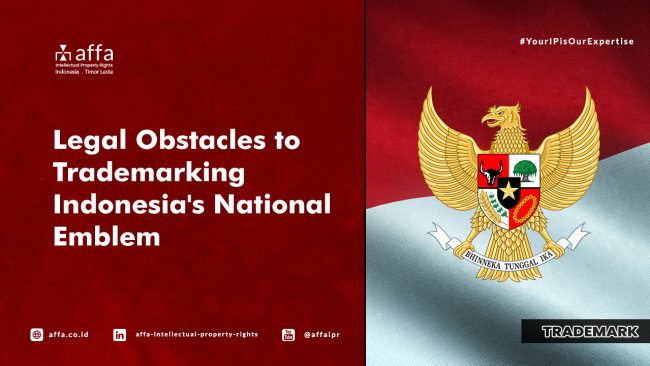
Legal Obstacles to Trademarking Indonesia's National Emblem - AFFA IPR

Legal Obstacles to Trademarking Indonesia’s National Emblem

The Garuda Pancasila, the National Emblem of the Republic of Indonesia, is indeed iconic. The figure of this giant bird that is said to be able to cover the sunlight has been known since the 5th century and has become a symbol of many Hindu kingdoms in the archipelago. So, since it was established and used in various national activities, its presence has always inspired people from each generation to display it in a better and better form.   But is that allowed? Modifying and/or using the Garuda Pancasila as a Trademark in Indonesia? Here is the answer from the perspective of Intellectual Property law.   This large and strong figure, containing the date of the Proclamation of Independence of the Republic of Indonesia on its feathers (17-8-1945), was already in the minds of the nation’s founders when they determined the Garuda Pancasila as the National Emblem. In early 1950, the government of the Republic of Indonesia United (RIS) created a technical committee called the National Emblem Committee under the coordination of Minister Zonder Porto Folio Sultan Hamid II, with the Chairman of the Committee, Muhammad Yamin, and Ki Hajar Dewantara, M.A. Pellaupessy, Mohammad Natsir, and R.M. Ng. Purbatjaraka as its members. President Soekarno then inaugurated it at the RIS Cabinet Meeting on February 11, 1950. Its use was then regulated in Government Regulation No. 43 of 1958 and amended by the enactment of Law of the Republic of Indonesia Number 24 of 2009 concerning the Flag, Language, National Emblem, and National Anthem to implement Article 36A of the 1945 Constitution (UUD 1945) which reads, “The National Emblem is the Garuda Pancasila with the motto Bhineka Tunggal Ika.” For those of you who need clarification as to why the 1945 Constitution already contains the Garuda Pancasila even though the draft was only made in 1950, it is because Article 36A resulted from the Second Amendment in 2000. Previously, only Article 36 contained the following: “The National Language is Indonesian.” However, after the amendment, Article 36A (national emblem), 36B (national anthem), and 36C (further provisions related to the flag, language, national emblem, and national anthem are regulated by law) were presented.   Then specifically, Article 57 of Law Number 24 of 2009 contains the following prohibitions related to the National Emblem: It is prohibited to cross out, write, draw, or damage the National Emblem with the intention of tarnishing, insulting, or degrading the honor of the National Emblem; It is prohibited to use the National Emblem that is damaged and does not match the shape, color, and size comparison; It is prohibited to create a symbol for an individual, political party, association, organization, and/or company that is the same as or resembles the national emblem; and It is prohibited to use the National Emblem for purposes other than those regulated by the Law.   A person who violates the prohibition can be punished with a maximum imprisonment of one year or a maximum fine of IDR 100 million.   Although later, the Constitutional Court, through Constitutional Court Decision Number 4/PUU-X/2012, stated the provisions of Article 57 letter d jo. Article 69 letter c of Law 24/2009 concerning the prohibition of the use of the National Emblem for other purposes and its criminal sanctions are contrary to the 1945 Constitution of the Republic of Indonesia and do not have binding legal force, which means that since then the National Emblem can be used freely to a certain extent to support the spirit of nationalism, but does not apply if it is related to Trademark registration.   So even if you can use the Garuda Pancasila in a design for a t-shirt, cap, pin, or other merchandise that is traded, you still cannot register it as a Trademark. As regulated in Article 21 Paragraph (2)b of the Trademark Law, which reads, “An application is rejected if the Trademark is an imitation or resembles the name or abbreviation of a name, flag, insignia, symbol or emblem of a country, or national or international institution, except with the written approval of the authorized party.”   Legal Problems on the Use of National Emblem in Sports Jerseys   A few months ago, there was a debate regarding the use of the National Emblem on the jersey of the Indonesian Football Team. It is common and natural for a national jersey to change its design every season or every year. When the jersey’s vendor changes, the design and logo containing the National Emblem also changes. During the last change, the latest logo was registered with the name of the owner of the jersey’s manufacturer, and this invited controversy because the public began to understand the existence of Article 21 Paragraph (2) b of the Trademark Law.   However, the public forgets the sentence “written approval from the authorized party.” This controversy ended in June 2024 when the Indonesia Football Association (PSSI), the official parent organization of football in Indonesia, took over all logos applied to the Directorate General of Intellectual Property (DGIP). So, if we open the DGIP database today, both old and new logos have listed PSSI as the Trademark owner.   Thus, PSSI has the Exclusive Right to use the logo, and anyone who wants to use it must have permission from PSSI.   Old (DID2024030570) & New (DID2024006041) Logo of PSSI   It is a bit unfortunate that the logo does not contain the initials of PSSI, so it will cause polemics if other sports organizations want to register a logo that also contains the National Emblem. This means that other parties must file and register it with a different logo, but it still has similarities in principle to the logo filed by the PSSI. Should you need further information regarding Trademark protection or registration in Indonesia and worldwide, please do not hesitate to email us at [email protected].

FAQs: Trademark Enforcement in Indonesia - AFFA IPR

Frequently Asked Questions about Trademark Enforcement in Indonesia

Trademark Enforcement Proceedings Q: What types of legal or administrative proceedings are available to enforce the rights of a Trademark Owner against an alleged infringer or dilutive use of a mark, apart from previously discussed opposition and cancellation actions? Are there specialised courts or other tribunals? Is there any provision in the criminal law regarding Trademark Infringement or an equivalent offence?   A: There are several approaches that need to be considered when commencing the Trademark enforcement proceedings. It is always a prudent course of action to start with sending a cease and desist letter against the infringer to immediately cease the infringing action. Should the infringer does not comply with the requests that have been addressed in the cease and desist letter, then the Trademark Owner has the option to file a criminal action against the infringer to the civil investigator at the Directorate General of Intellectual Property (DGIP) or to the Indonesian Police.   All Intellectual Property disputes are the domain of the Court of Commerce. Apart from invalidations and cancellations of registered marks, any party with legal rights can also seek civil actions through the Court of Commerce, namely to request preliminary injunction and to seek for damages or remedies.   The penalties for infringements are covered by the Trademark Law, namely the following articles:   CHAPTER XVIII  CRIMINAL PROVISIONS Article 100 (1) Every person unlawfully uses any Mark which is identical to registered Mark of other parties for similarly produced, and/or traded goods and/or services, shall be sentenced to imprisonment of up to 5 (five) years and/or fines up to Rp2,000,000,000.00 (two billion rupiahs).   (2) Every person unlawfully uses any Mark which is substantially similar to registered Mark of another party for similarly produced and/or traded goods and/or services, shall be sentenced to imprisonment for up to 4 (four) years and/or fines up to Rp2,000,000,000.00 (two billion rupiahs).   (3) Every person violating the provisions as referred to in section (1) and section (2), whose goods cause health impairment, environment distortion, and/or human deceases, shall be sentenced to an imprisonment up to (10) ten years and/or fines up to Rp5.000.000.000,00 (five billion rupiahs).   Article 101 (1) Every person unlawfully uses any signs which are identical to Geographical Indications of other parties for similar goods and/or products or identical to registered goods and/or products, shall be sentenced to imprisonment up to 4 (four) years and/or up to Rp2.000.000.000,00 (two billion rupiahs).   (2) Every Person unlawfully uses any sign which is substantially similar to Geographical Indications of another party for similar goods and/or products or identical with registered goods and/or products, shall be sentenced with imprisonment up to 4 (four) years and/or :nes up to Rp2.000.000.000,00 (two billion rupiahs).   Article 102 Every Person who trades goods and/or services and/or product which is known or allegedly know that the goods and/or services and/or product constitute criminal acts as referred to in Article 100 and Article 101 shall be sentenced with imprisonment up to 1 (one) year or fines up to Rp200.000.000,00 (two hundred million rupiahs).   Article 103 The criminal acts as referred to in article 100 to article 102 constitute complaint delict.   Procedural Format and Timing Q: What is the format of the infringement proceeding?   A: Civil proceedings in Indonesia are conducted in writing and oral arguments. The judges will listen to the oral arguments of each party one at a time, and they rely heavily on documentary evidence. Witnesses of fact can also provide oral evidence before the court. However, a witness statement or affidavit alone will not be sufficient since it is considered merely supplementary documentary evidence. In general, the procedure of the trial is as follows: attendance at the first hearing after the court summons both plaintiff and defendant; attendance at the second hearing, when the defendant files its response to the plaintiff’s cancellation suit; preparation of the plaintiff’s reply to the defendant’s response to the suit; attendance at the third hearing to file the plaintiff’s reply; attendance at the fourth hearing when the defendant files its response to the plaintiff’s reply; preparation of the plaintiff’s evidence to be submitted to the court; attendance at the fifth hearing to submit the plaintiff’s evidence and review the defendant’s evidence; preparation and filing of the conclusion of the case based on documents and evidence filed with the court by both plaintiff and defendant; attendance at the sixth hearing on the filing of the conclusion of the case;  attendance at the seventh hearing to hear the judge’s decision; and issuance of the court’s decision.   For civil procedure, in theory a decision shall be issued within three months. However, in practice, it may take slightly longer due to the extensions requested by any of the parties involved.   Burden of Proof Q: What is the burden of proof to establish infringement or dilution?   A: In Indonesian civil procedure, the burden of proof regarding the facts on which a claim is based lies with the plaintiff. Article 1865 of the Indonesian Civil Code states that anyone who claims to have a certain right or who refers to a fact to support such a right, or who obzects to another party’s right, must prove the existence of that right or that fact. Evidence may comprise written evidence, evidence presented by witnesses, or through inference, confession or oath. In our experience, it is prudent to collect as much diverse evidential material as possible, such as purchases made by mystery shoppers, marketing materials found online and offline, and expert witnesses that may provide substantive statements pertaining to the alleged infringement. Furthermore, written evidence must be presented in the Indonesian language – translated by a sworn translator if necessary.   Standing Q: Who may seek a remedy for an alleged Trademark violation and under what conditions? Who has standing to bring a criminal complaint?   A: In accordance with article 83 of the Trademark Law, the registered mark owner and/or its licensee may file a…

FAQs Licensing and Assignment of Trademark in Indonesia - AFFA IPR

Frequently Asked Questions about Licensing & Assignment of Trademark in Indonesia

Licenses Q: May a licence be recorded against a Mark in Indonesia? How? Are there any benefits to doing so or detriments to not doing so? What provisions are typically included in a licensing agreement?   A: A registered Mark can be licensed out to other parties in Indonesia. For the agreement to have binding legal effect against any third party, it will have to be recorded at the Directorate General of Intellectual Property (DGIP). In general, a licence agreement should cover the details of the licensor and the licensee, the nature of licensing (exclusive or non-exclusive), the ability to sub-license (or not), term of the licence agreement, rights and responsibilities of the parties, and the object or Trademark to be licensed.   The licensing agreement must not contain provisions that either directly or indirectly damage the Indonesian economy or limitation obstructing Indonesian capacity to acquire and develop technology.   Assignment Q: What can be assigned? Does the Trademark have to be registered first?   A: A Trademark application or registration can be assigned to another party, provided that the deed of assignment, which has been notarised, is recorded at the DGIP to be fully binding. The assignment shall cover all goods or services covered by the assigned mark. The other business assets are not generally required to be assigned to make the Trademark assignment valid, except if both parties agree otherwise.   Assignment Documentation Q: What documents are required for assignment and what form must they take? What procedures apply?   A: Both parties shall sign a deed of assignment that later will be notarised and submitted to the DGIP. A power of attorney will also need to be provided.   Validity Assignment Q: Must the assignment be recorded for purposes of its validity?   A: A signed deed of agreement must be recorded before the DGIP to be valid.   Security Interests Q: Are security interests recognised and what form must they take? Must the security interest be recorded for purposes of its validity or enforceability?   A: In theory, all kinds of IP rights can be used as security interests. But in practice, the recordal of security interests is not possible for the time being. Should you need more information regarding the Licensing & Assignment of Trademark in Indonesia, please do not hesitate to contact us via [email protected].

Indonesia Extends the Trademark Non-Use Period from 3 to 5 Consecutive Years - AFFA IPR

Indonesia Extends the Trademark Non-Use Period from 3 to 5 Consecutive Years

On March 31, 2020, Indonesia officially entered the COVID-19 pandemic period with the enactment of Government Regulation Number 21 of 2020 concerning Large-Scale Social Restrictions in the Framework of Accelerating the Handling of Corona Virus Disease 2019 (Covid-I9). After facing various challenges, both for the community, the business world, and the government, the pandemic status in Indonesia was officially lifted on June 21, 2023, and changed to endemic based on the Presidential Decree of the Republic of Indonesia Number 17 of 2023 concerning the Determination of the End of the Corona Virus Disease 2019 (COVID-19) Pandemic Status in Indonesia. In post-pandemic recovery efforts, the government prioritizes economic recovery by paying attention to the needs of Small, and Medium Enterprises (SMEs).  Taking into account the specific conditions of the Indonesian economy, which hugely relies on SMEs that have limited capital and can change at any time and force majeure, through Decision Number 144/PUU-XXI/2023, which was read out at the Constitutional Court (MK) on Tuesday, July 30, 2024, an adjustment was made to the time limit for Trademark non-use period from three to five consecutive years. This case began when Ricky Thio faced a Cancellation Action for his Trademark based on Article 74 of Law Number 20 of 2016 concerning Trademarks and Geographical Indications (Trademark Law) at the Commercial Court at the Central Jakarta District Court with case number 28/Pdt.Sus HKI/Merek/2023/PN Niaga Jkt.Pst from Zhejiang Dahua Technology Co., Ltd. wanted the cancellation of the Trademark “” with registration number IDM000553432 because it was considered not to have been used for three consecutive years. According to Ricky Thio, this situation raises uncertainty in the Trademark protection provided by the government, which has the potential to make SMEs hesitate to register their Trademarks.   Timeframe for Filing a New Trademark Cancellation Action In Decision Number 144/PUU-XXI/2023, the Constitutional Court saw the importance of adjusting the non-use time limit to 5 (five) consecutive years. This is closely related to the time limit for filing a Trademark Invalidation, which is 5 (five) years from the date of Trademark registration, as stated in Article 77 paragraph (1) of the Trademark Law. Although cancellation and invalidation are different things, the regulation is placed in the Chapter “Cancellation and Invalidation of Trademarks” in the Trademark Law.   Thus, without intending to ignore the tendency of countries that adhere to the civil law system, the adjustment of the time limit for non-use of registered Trademarks to 5 (five) years is to provide justice for all registered Trademark owners so that it does not conflict with the Principle of National Treatment and is in line with the provisions contained in Trademark Invalidation. Based on all the legal considerations above, the Applicant’s argument questioning the unconstitutionality of Article 74 paragraph (1) of the Trademark Law, especially the phrase “3 (three) years” is legally justified. In Decision Number 144/PUU-XXI/2023, the Court partially granted Ricky Thio’s request so that the changes to the article related to the deletion of the Trademark due to the Decision are as follows: Before the Constitutional Court Decision After the Constitutional Court Decision Article 74 paragraph (1) Trademark Law The cancellation of a registered Mark may also be submitted by a third party who has an interest in the form of a lawsuit to the Commercial Court based on the ground that the Mark has not been used for 3 (three) consecutive years in the trade of goods and/or services from the registration date or the last use. Article 74 paragraph (1) Trademark Law The cancellation of a registered Mark may also be submitted by a third party who has an interest in the form of a lawsuit to the Commercial Court based on the ground that the Mark has not been used for 5 (five) consecutive years in the trade of goods and/or services from the registration date or the last use. Article 74 paragraph (2) Trademark Law The reasons for an non-used Mark as referred to in paragraph (1) are invalid in the event of: a. import ban; b. temporary prohibition that is related to the permit for the distribution of goods that use the relevant Mark or a decision from an authorized party; or c. other similar prohibitions that are established with Regulation of the Government. Article 74 paragraph (2) Trademark Law The reasons for an non-used Mark as referred to in paragraph (1) are invalid in the event of: a. import ban; b. temporary prohibition that is related to the permit for the distribution of goods that use the relevant Mark or a decision from an authorized party; or c. other similar prohibitions, including in conditions of force majeure that are established with Regulation of the Government.   Force Majeure can be Used for Exceptions Force Majeure can be a legitimate reason for Trademark owners who cannot use their registered Trademark or cannot run their business normally. The Constitutional Court (MK), in Decision Number 144/PUU-XXI/2023, emphasized the importance of this exception. Force Majeure generally refers to events or effects that cannot be predicted or controlled, such as natural disasters (floods, hurricanes, earthquakes) or human actions (riots, strikes, war) that prevent someone from fulfilling their obligations. In this decision, pandemic conditions such as COVID-19 are considered Force Majeure, which justifies an exception for Trademark owners who experience difficulties using and producing their Trademarks.  The consequence of Decision Number 144/PUU-XXI/2023 is that the provisions of the Trademark Law must be adjusted to the decision. This is, of course, in line with the explanation of Article 10, paragraph (1) of Law. No. 07 of 2020 Third Amendment to Law Number 24 of 2003 concerning the Constitutional Court in conjunction with the Stipulation of Government Regulation instead of Law Number 1 of 2013 concerning the Second Amendment to Law Number 24 of 2003 concerning the Constitutional Court to Become a Law in conjunction with Law No. 8 of 2011 concerning Amendments to Law Number 24 of 2003 concerning the Constitutional Court in conjunction with Law Number 24 of…

FAQs: The Registration and Use of Trademark in Indonesia - AFFA IPR

Frequently Asked Questions About the Registration and Use of Trademark in Indonesia

Ownership of Marks Q: Who may apply for registration?   A: Since the Indonesian Trademark Law adopts the first to file principle, in general any individual, organisation or company can file for a Trademark Registration. However, the Trademark Law also regulates Trademark Registrations that are filed in bad faith. Article 21 paragraph (3) of the Trademark Law stipulates that an application is refused if it is submitted by an applicant in bad faith. While the implementation of this article during substantive examination holds true for some applications that have similarities with the already established and Well-known Marks, in practice it is quite challenging to determine whether an application is filed in bad faith or not. A bad-faith application that later matured to registration can always be invalidated at the Court of Commerce as regulated under article 77 paragraph (2) of the Trademark Law, which stipulates the following:   “The lawsuit for invalidation may be in unlimited time if there is bad faith and/or the relevant Mark contravenes the State ideology, laws and regulations, morality, religions, decency, and public order.”   Scope of Trademark Q: What may and may not be protected and registered as a Trademark?   A: By definition of article 1 of the Trademark Law, a Mark is any sign capable of being represented graphically in the form of drawings, logos, names, words, letters, numerals, colour arrangement, in two and;or three-dimensional shape, sounds, holograms or combination of two or more of those elements to distinguish goods or services produced by a person or legal entity in trading goods or services.   Given the definition above, then the Law acknowledges two types of trademarks, namely traditional and non-traditional marks.   Unregistered Trademarks Q: Can Trademark Rights be established without registration?   A: Indonesia is a jurisdiction that adopts the first to file principle. Hence, a prior use itself is not sufficient to establish rights in the country.   Famous Foreign Trademarks Q: Is a famous foreign Trademark afforded protection even if not used domestically? If so, must the foreign Trademark be famous domestically? What proof is required? What protection is provided?   A: A Trademark can only be protected if it is registered in Indonesia, regardless of its fame. However, the Indonesian Trademark Law has a mechanism to somewhat protect a famous foreign Trademark from bad faith registrations by other parties. Should another party try to file a malicious Trademark application that is identical or similar to a famous foreign Trademark, such application will be rejected on the basis of article 21 paragraph (1) b and c, which stipulates the following:   “An Application is refused if the Mark is substantively similar to or identical with a well-known Mark of other parties for similar goods and/or services OR a well-known Mark of other parties for different goods and/or services complying with certain requirements.”   The issue is then shifted to what constitutes as a famous Trademark. Article 18 of the Ministry of Law and Human Rights of the Republic of Indonesia Regulation No. 67 2016 concerning Trademark Registration Decree of the Directorate General of Intellectual Property in the Field of Trademarks has set out the criteria of what makes a Trademark famous, such as: the level of knowledge or public recognition against the Mark in the business field that concerned as a well-known mark; the volume of sales of goods and/or services and benefits derived from using the Mark by the owner; the market share controlled by the Mark in relation to the circulation of goods and/or services in the community; the area of use of the Mark; the period of use of the Mark; the intensity and promotion of the Mark, including value of investment used for the promotion; the number of Trademark applications and registration around the world; the success rate of law enforcement, in particular regarding the recognition of the Mark as a well-known Mark by an authorised institution; or the valuation of the Mark because of the reputation and quality assurance of goods and/or services protected by the Mark.   However, a well-known mark that is famous abroad does not always necessarily have the same level of fame in Indonesia. This raises the issue as to whether the Trademark owner should also establish its fame in Indonesia before taking any action against other parties.   The Benefits of Registration Q: What are the benefits of registration?   A: Pursuant to the Trademark Law, the right on a Mark means the Exclusive Right granted by the state to a registered Mark Owner for a definite period to use his or her mark or authorise others to do otherwise. Hence, by registering a Trademark in Indonesia, the owner can establish its legal right should there is an infringement by another party. This includes, but is not limited to, requesting an e-commerce listing takedown notice, sending a cease and desist letter, filing a police report for the criminal aspect of the infringement, seeking damages at the Court of Commerce, issuing licensing rights, filing injunctions and conducting a Customs Recordal before Indonesian Customs.   Filing Procedure and Documentation Q: What documentation is needed to file a Trademark Application? What rules govern the representation of the Mark in the application? Is electronic filing available? Are trademark searches available or required before filing? If so, what procedures and fees apply?   A: A Trademark search is strongly suggested for anyone who wishes to file a Trademark Application in Indonesia. The search report will identify potential hazards and tumbling blocks to an otherwise successful registration process. Assuming the search report gives the all-clear for continuing the application process, the applicant shall prepare the following: name of the applicant; address; list of goods and services; and the representation of the Mark to be filed, which can be in a form of wordmark, logo or non-traditional Marks.   Once the above information has been provided, then we will prepare the following documents to be signed by the client: power of attorney; and statement…

AFFA Represented Guangzhou Sanwich Biology Technology, Co., Ltd. in a Succesful Trademark Invalidation Action in Indonesia - AFFA IPR

AFFA Represented Guangzhou Sanwich Biology Technology, Co., Ltd. in a Succesful Trademark Invalidation Action in Indonesia

On June 11, 2024, the Commercial Court at the Central Jakarta District Court granted AFFA IPR’s lawsuit, in this case representing Guangzhou Sanwich Biology Technology, Co., Ltd., to invalidate the SEVICH Mark with Registration Number IDM000917666, which gave a decision that the mark had similarities in essence and registered in bad faith. So, how does the “first-to-file” concept apply if there is a case like the one above? The SEVICH Trademark was first registered in China on March 21, 2016, by our client, Guangzhou Sanwich Biology Technology, Co., Ltd., in Class 3, which includes “Cleaning preparations; Abrasives; Essential oils; Toothpastes (pieces).” This Trademark has also been registered in the United States, Mexico, the United Kingdom, and the European Union. This business has expanded in Asia, and this year, SEVICH plans to be sold and distributed in Indonesia. However, before it could be applied for in Indonesia, it was discovered that the SEVICH Mark had been registered since November 2021 by another party. The Mark has the same writing, pronunciation, and logo and is registered in the same class. As a result, our client could not obtain registration in Indonesia, even though it should have had exclusive rights to use the Mark in trade. Therefore, our client filed a lawsuit for invalidation of the Trademark. The lawsuit was filed in March 2024 against Jong, Sylvia (hereinafter referred to as the Defendant), owner of the SEVICH Trademark in Indonesia with number 25/Pdt.Sus-HKI/Merek/2024/PN.Niaga.Jkt.Pst. The Defendant certainly does not easily give up the registered Mark. One of the points in their answer stated that they were the first registrants, so they are the party who has the Exclusive Right to use the SEVICH Mark in Indonesia, according to Article 1 Number 5 of Law Number 20 of 2016 concerning Marks and Geographical Indications (Trademark Law): “Right on Mark means the exclusive right granted by the State to a registered Mark owner for a definite period to use his/her Mark or authorize others to do otherwise.” Applicant in Bad Faith One of the rulings in the Decision 25/Pdt.Sus-HKI/Merek/2024/PN.Niaga.Jkt.Pst. stated that the defendant was a registrant with bad faith in registering the SEVICH mark with Registration Number IDM000917666. Applicants who have bad intentions based on the explanation of Article 21 paragraph (3) of Law Number 20 of 2016 concerning Trademarks and Geographical Indications are applicants who are reasonably suspected that in registering their Mark, they have the intention to imitate, plagiarize, or follow another party’s Mark for the benefit of their business, causing conditions unfair business competition, deceiving or misleading consumers. For example, a Trademark application takes the form of writing, a painting, a logo, or the same color arrangement as a Trademark belonging to another party or a Trademark that has been generally known to the public for many years, imitated in such a way that it has similarities in essence or its entirety to the already known Trademark. From this example, there has been bad faith on the part of the Applicant because at least it should be known that there was an element of intentionality in imitating a well-known Mark. The concept in this article is undoubtedly in line with the Permanent Decree of the Supreme Court of the Republic of Indonesia No. 39K/Pdt/1989 dated 24 November 1990 which reads, “That every act of using a Mark which is confusing and deceptive and confuses the opinion and visuals of the general public is qualified as containing elements of bad faith and unfair competition,” and Permanent Decision of the Supreme Court of the Republic of Indonesia No. 220 K/Pdt/1986 which states, “Local entrepreneurs are obliged to use marks with national identity, not plagiarize foreign names or marks, because this can mislead consumers about the origin of a good or service.” Until finally the deliberative meeting of the Commercial Court Panel of Judges at the Central Jakarta District Court ordered the Directorate General of Intellectual Property (DGIP) to invalidate the SEVICH Mark registered No. IDM000917666 on behalf of the defendant by registering the invalidation of the Mark from the General Register of Marks and announcing it in the Official Mark Gazette. Never Risk Registering Other Party’s Trademark to Begin With In a Trademark Invalidation lawsuit, if the trademark being sued is similar in essence or its entirety, and there are indications that another party registered the trademark in bad faith towards the actual owner of the trademark, and this can be proven in court, then the first to file principle can be overridden. The actual rights of the Mark owner can be restored through a court decision in Indonesia, and the Mark owner can attach proof of the decision to the Trademark Office, in this case, the DGIP, during the examination process of the Mark registration application at a later date. Should you have further questions regarding Trademark registration and protection in Indonesia and/or abroad, do not hesitate to email us at [email protected].