OC-AND-WIPO-JOIN-FORCES-TO-PROMOTE-IP-USE-AND-MANAGEMENT-IN-SPORT-affa-global

IOC & WIPO Join Forces to Promote IP Use & Management in Sport

IP rights are increasingly important in the sports industry, as they protect brands, logos, and other intellectual property assets, while the global sports industry is worth an estimated $624 billion. To ensure that IP is used responsibly and sustainably and that it benefits all stakeholders in the sports ecosystem, the International Olympic Committee (IOC) and the World Intellectual Property Organisation (WIPO) have signed a Framework Cooperation Agreement to promote the use and management of intellectual property (IP) in sports.    The agreement, which was signed on June 13, 2023, at the Olympic House in Lausanne, Switzerland, establishes a legal framework for the collaboration between the two organizations. The IOC and WIPO are both committed to the development and promotion of innovation, creativity, and the responsible management of IP in sports. By working together, they aim to foster common goals within their missions, including: Protecting the IP rights of athletes, sports organizations, and other stakeholders in the sports industry; Promoting the use of IP to drive innovation and creativity in sports; Ensuring that IP is used responsibly and sustainably.   The agreement between the IOC and WIPO will cover a wide range of activities, including: Sharing information and best practices on IP management; Collaborating on research and development projects; Organizing joint training and education programs; Providing technical assistance to sports organizations.   The IOC and WIPO believe that this agreement will help to strengthen the global sports ecosystem and ensure that IP is used to its full potential to benefit athletes, sports organizations, and fans around the world. If you need further information regarding the registration and protection of Intellectual Property in Indonesia and abroad, don’t hesitate to contact us via [email protected]. Sources: The Olympics  

Indonesias-IP-Odyssey-Unraveling-the-Ins-and-Outs-of-IP-License-Agreement-Recordal-affa-global

Indonesia’s IP Odyssey: Unraveling the Ins and Outs of IP License Agreement Recordal

In Indonesia, it is a legal obligation to record all intellectual property (IP) license agreements under laws relating to trademarks, patents, designs, and copyrights to ensure they are legally enforceable and binding to all relevant third parties. By law, any IP license agreements that are not recorded will not have any legal effect against all relevant third parties. Nevertheless, the agreements will still only be binding between the contracting parties. In recent times, there have been increasing demands by IP owners to record IP license agreements, because such recorded license agreements are often requested by SNI (the Indonesian National Standardisation Body) and BPOM (Indonesian Food and Drugs Administration) to issue certain yet separate licenses.   The Directorate General of Intellectual Property (DGIP) under the Ministry of Law and Human Rights (MOLHR) is in charge of receiving the recordal applications for the license agreements. The DGIP is empowered by Government Regulation No. 36 Year 2018 on the Recordation of Intellectual Property License Agreement (Government Regulation No. 36/2018) to carry on this function. While the practice of recording IP licensing agreements has actually been done for many years before the enactment of Government Regulation No. 36/2018, we noted that the DGIP only started issuing the notifications of the recordal of license agreements after 2018 for the recordals that were filed many years before that. Until then, many who had recorded them simply held on to the “recordal filing receipts” as an evidence of recordal.   In general, Government Regulation 36/2018 regulates various requirements and procedures for recording intellectual property license agreements and specifies the following matters: License agreements Recordation procedures Recordation excerpts Changes and revocations   As a general rule of thumb, the IP holder (“Licensor”) is authorized to grant a license to another party (“Licensee”) who wishes to use the Licensor’s exclusive rights. Such a license can only be granted based on an agreement made in writing in Indonesian – hence the agreements signed in English or other languages must be sworn translated into Bahasa Indonesia. In addition, the license agreement must stipulate the following points: Place & Date of the letter signing Details of the parties including the address Object of trademark license (trademark/patent/copyright/industrial design registration number) Terms of use (exclusive, non-exclusive, sub-licensable, or not) Duration of the agreement Territory For patents, the agreement shall stipulate the party tasked with the responsibility of paying the annuity.   However, be mindful that the term of the agreement shall not be longer than the protection period of the licensed IP. The license agreement must not entertain any stipulations that might inflict harm upon Indonesia’s economic vitality or the nation’s strategic interests. Moreover, it must not cultivate an environment for unjust business competition, nor should it stand in contradiction to the existing legislative framework in Indonesia. It is equally critical that such an agreement does not breach the bounds of religious adherence, ethical conduct, or public order.   Recordation Procedure A submission of a Recordation Request must be formally made to the Minister written in the Indonesian language, accompanied by the following documents: A copy of the license agreement which has been notarized by a Notary Public in the relevant country where the parties reside; Official excerpts from the intellectual property certificate; A power of attorney letter (if applied for by proxy). It is noteworthy that the use of a proxy is mandatory if the Licensor and Licensee are foreigners or reside outside Indonesia;  Copy of the identity card/passports of the signatories; Deed of Incorporation of the parties bound to the agreement; and Proof of payment of the official fees, which will be paid by the proxy.   According to Government Regulation No. 36/2018, the submitted request will be reviewed within five business days following the receipt of a fully completed application. The applicant will be informed if the application is incomplete, and they will be given a period of 30 business days from the date of notification to perfect it. However, thanks to DGIP’s innovation – POP Merek (POP Trademark), most of the IP license agreement recordal notifications are issued within a day.    Amendment and Revocation A recorded IP license agreement can be amended and revoked. When it comes to amendments, they are limited to the name of the Licensor and/or Licensee or the subject of the license agreement, and other information (such as the address of the related parties, provisions related to the exclusivity of the license, and so forth).    A recorded IP license agreement can only be revoked under the following conditions: The agreement between the Licensor and the Licensee; The resolution of a court proceeding; or Additional elements, in accordance with Ministerial Regulation No. 8 of the year 2016 on the Procedure for Registering Conditions and Methods for the Application of Recording Intellectual Property Licensing Agreements.   Should you require further information and assistance regarding IP license agreement recordal in Indonesia, please contact us at [email protected]; [email protected]; or [email protected].

5-Richest-People-Who-Live-From-Selling-Fonts-affa-global

5 Richest People Who Live From Selling Fonts

Fonts are Intellectual Property that can be sold outright or licensed. You can sell them directly from your own website or through a font foundry. The amount of income you make depends on the popularity of your fonts, the licensing terms you offer, and the sales channels you use. But before considering selling the fonts you make, you should record your fonts as Copyrights to Copyright Office, or in Indonesia called DGIP (Directorate General Intellectual Property).   If you create a successful font, you can potentially earn a significant amount of money. Here are some additional ways to get income from fonts: Create Custom Fonts for Businesses or Individuals This can be an excellent way to earn a steady stream of income, as businesses and individuals are always looking for unique fonts to use for their branding or marketing materials. Use Fonts on Social Media Being active on social media with lots of followers has many advantages. One way is to display and use your own fonts through additional applications to become the default font of your posts that many people can see. Create Fonts for Games or Apps This can be a good way to reach a specific audience and earn a commission on each sale.   If you’re interested in creating fonts as a way to make money, there are a few things you can do to increase your chances of success: Learn About the Font Industry This includes understanding the different types of fonts, the licensing terms that are available, and the marketing channels that are most effective. Create High-Quality Fonts This means paying attention to the details, such as the kerning, the hinting, and the overall appearance of the fonts. Promote Your Fonts This includes creating a website or blog for your fonts, as well as using social media and other channels to reach potential buyers.   Creating fonts can be a challenging but rewarding way to make money. If you have the skills and the dedication, you can create fonts that are both beautiful and profitable, just like these five people: Steve Matteson – Net Worth: $10 million Matteson is an American type designer and fontographer. He is best known for creating the popular fonts “Lucida Grande” and “Lucida Sans”. Matteson has also created fonts for Apple, Microsoft, and Adobe. Matthew Carter – Net Worth: $8 million Carter is an English type designer. He is best known for creating the fonts “Gill Sans” and “Times New Roman”. Carter has also created fonts for the New York Times, the BBC, and the U.S. Government. Erik Spiekermann – Net Worth: $7 million Spiekermann is a German type designer and typographer. He is best known for creating the fonts “Frutiger” and “Optima”. Spiekermann has also founded the type foundry FontShop International. Jonathan Hoefler – Net Worth: $6 million Hoefler is an American type designer and typographer. He is best known for creating the fonts “Hoefler Text” and “Gotham”. Hoefler has also founded the type foundry Hoefler & Co. Mike Abbink – Net Worth: $5 million Abbink is a Dutch type designer and typographer. He is best known for creating the fonts “Avenir” and “Univers”. Abbink has also founded the type foundry Font Bureau.   It is important to note that these estimates are based on publicly available information and may not be entirely accurate. However, they give a general idea of the wealth of some of the most successful font creators in the world. If you need further information about Copyright Recordation for fonts in Indonesia and abroad, please contact us via [email protected]. Sources: Commarts.com: Cold Cash for Hot Fonts Jonathan Hoefler: Typeface Design (2019) You are a what? Font Designer

Bootleg-Toys-v-Third-Party-Which-One-is-Illegal-affa-global

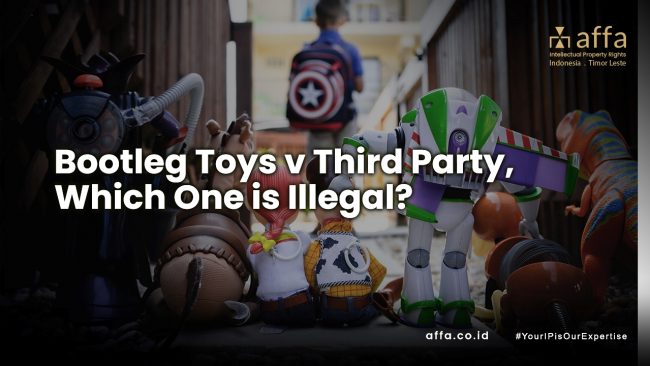
Bootleg Toys v Third Party, Which One is Illegal?

The toy industry is one of the most promising businesses for IP businesses. Of the total circulation of money, which has reached USD 107.4 billion in 2022 alone, more than 80% is Intellectual Property (IP) based toys. The best sellers were toys from IP Barbie, Disney Princess, Marvel, Star Wars, Pokemon, Minecraft, and Harry Potter.   Because basically, the buyers of these toys are not only children but also adults who collect various action figures (toy characters that can be posed because they have multiple points of articulation) and statues (toy characters that are large without articulation but have super accurate details), worth hundreds of dollar.   The large community of toy fans and collectors, with different purchasing power from a popular character, overwhelms toy manufacturers in presenting various toys that are in demand. This potential is then filled by other toy manufacturers, ranging from cheaper versions of toys to those with different designs that are not officially licensed.   Bootleg Toys Because they have official partnerships with IP owners, big toy manufacturers such as Hasbro, Bandai, Mattel, and LEGO must maintain quality by presenting products that match the original characters’ appearance— from the suitability of the color to the packaging with the official logo. With maintained quality, the selling price of these original toys is costly. But on the other hand, we can also find toys with low prices, of course with a low level of accuracy, messy paint, no official logo, and the name of the company that made it needs to be clarified.   That criterion is what is referred to as a bootleg or pirated toy. Because it is clear that its presence does not go through an official collaboration process, paying for a license, nor is there a Quality Control (QC) process that should be present to maintain the quality of an IP. Unfortunately, there is also a high interest in pirated toys, especially from low-budget collectors or collectors who deliberately buy toys to modify, repaint, or use some of the parts to replace the original toys.   Third-Party Toys As previously explained, each popular IP character has huge fans with high purchasing power. The characters Batman, Spider-Man, Iron Man, Darth Vader, Optimus Prime, and Kamen Rider are examples of popular characters whose fans always buy a new version of the toys. Seeing their enormous purchasing power, a third category of toy manufacturers emerged: toy manufacturers who make toys based on a character but with a different design, never before made by other toy companies but still attractive to the fans. These are what fans classify as “third-party” toys.   While true fans can feel guilty when they buy pirated toys, that’s not the case when they buy “third-party” toys. Because they think buying toys with new variants which have never been produced before by design is acceptable. These “third-party” toy manufacturers also do not pay royalties to IP owners. This is indicated by the absence of official logos and character names on the packaging of “third-party” toys.   Industrial Design Rights on Toys Several types of Intellectual Property are attached to a toy, namely Industrial Designs, Trademarks, and Copyrights. If the Copyright protects the packaging design, while the Mark protects the IP name and its characters, then the Industrial Design protects the core product.   According to Law Number 31 of 2000 concerning Industrial Design in Indonesia, the definition of Industrial Design is a creation of the shape, configuration, or composition of lines or colors, or lines and colors, or a combination thereof in a three-dimensional or two-dimensional form which gives an aesthetic impression and can be embodied in three-dimensional or two-dimensional patterns and can be used to produce a product, goods, industrial commodities or handicrafts.   In producing a toy, these toy manufacturers usually buy a license for a character from the IP owner, then make an attractive design and register it as an Industrial Design. However, this Industrial Design only has a protection period of 10 (ten) years from the application date and cannot be extended. This is what makes toy manufacturers have to keep creating and keep making new variants so they can continue to get the maximum benefit from the characters that have been licensed before losing the exclusive rights to the designs they made ten years later.   Penalties for Industrial Design Violators From the explanation above, it can be concluded that pirated toy manufacturers who make similar toys with the same design but lower quality have violated Industrial Design. Because according to Article 9 of the Industrial Design Law in Indonesia, “Holders of Industrial Design Rights have the exclusive right to exercise their Industrial Design Rights and to prohibit other people without their consent from making, using, selling, importing, exporting, and/or distributing goods that are given Industrial Design Rights.”   Then Article 54 of the Industrial Design Law provides for a maximum imprisonment of 4 (four) years and/or a maximum fine of Rp 300,000,000.00 (three hundred million rupiahs) for violations of Article 9 above.   Then what about “third-party” toy manufacturers? Do they not commit any violations?   Because Industrial Designs are specific according to the designs registered, “third-party” toy manufacturers may be able to escape the legal snares stipulated in the Industrial Design Law. Still, they cannot run the Copyright Law and/or Trademark Law because it is not impossible that the toy manufacturer still uses a similar name on the packaging and character design which still has similarities in principle to the character whose copyright has been recorded at the Intellectual Property Office.   Therefore, if we are true fans who support the development of our favorite IPs, we must start leaving the habit of buying toys from manufacturers who do not pay royalties because there are still forms of violation there. On the other hand, if you are interested in getting into the toy industry, it is better to start by establishing official partnerships with IP owners.   If you need further information about Industrial…

Structure-of-Intellectual-Property-Trial-in-Indonesia-affa-global

Structure of Intellectual Property Trial in Indonesia

As the world becomes increasingly interconnected, the exchange of ideas, innovation, and creativity has become an essential engine of global economic growth. Intellectual Property Rights serve as the cornerstone of this new economy, safeguarding the interests of inventors and fostering an environment conducive to creative endeavor.    Within this context, Indonesia, home to a thriving marketplace of ideas, has seen a dramatic increase in the importance of Intellectual Property Rights. This article aims to demystify the unique and complex structure of the intellectual property trial process in Indonesia. From understanding the roles of various stakeholders and procedural intricacies to the legal framework that governs these trials, we’ll provide a comprehensive guide to navigating this essential, yet often confusing, aspect of Indonesia’s legal landscape.   Civil proceedings in Indonesia are conducted in writing and oral arguments. The judges will listen to the oral arguments of each party one at a time, and they rely heavily on the documentary evidence. Witnesses of fact can also provide oral evidence before the court. However, a witness statement or affidavit alone will not be sufficient since it is considered merely supplementary documentary evidence. In general, the procedure of the trial is as follows: attendance at the first hearing after the court summons both plaintiff and defendant; attendance at the second hearing, when the defendant files its response to the plaintiff’s cancellation suit; preparation of the plaintiff’s reply to the defendant’s response to the suit; attendance at the third hearing to file the plaintiff’s reply; attendance at the fourth hearing when the defendant files its response to the plaintiff’s reply; preparation of the plaintiff’s evidence to be submitted to the court; attendance at the fifth hearing to submit the plaintiff’s evidence and review the defendant’s evidence; preparation and filing of the conclusion of the case based on documents and evidence filed with the court by both plaintiff and defendant; attendance at the sixth hearing on the filing of the conclusion of the case; attendance at the seventh hearing to hear the judges’ decision; and issuance of the court’s decision.   For patent disputes, pursuant to Article 145(4) of the Patent Law, the trial can be conducted in a private manner if both parties make a request to the Court of Commerce for the trial to be private. This is to protect the secrecy of processes that would be easily manipulated or improved by a person knowledgeable in the relevant field.     For further questions regarding Intellectual Property disputes in Indonesia and the world, contact us via [email protected].  

Nine-Types-of-Conduct-that-Constitute-Patent-Infringement-affa-global

Nine Types of Conduct that Constitute Patent Infringement

Patent Infringement is a serious violation that can result in legal consequences for those who violate it. Various actions carried out intentionally and without rights can be categorized as Patent Infringements. The essence of these violations is the misuse of other people’s atents for commercial interests or purposes.   Actions considered Patent Infringements are regulated in Article 160 of Law Number 13 of 2016 concerning Patents (Patent Law). As for the activities that are considered Patent Infringements, we summarize them as follows: Manufacturing products/processes without the permission of the Patent Holder. Using products/processes without the permission of the Patent Holder. Selling products/processes without the permission of the Patent Holder. Importing products without the permission of the Patent Holder. Leasing products/processes without the permission of the Patent Holder. Transferring products/processes without the permission of the Patent Holder. Providing for sale products/processes without the permission of the Patent Holder. Providing for lease products/processes without the permission of the Patent Holder. Providing for transfer products/processes without the permission of the Patent Holder.   By understanding the various types of patent infringement, you can at least avoid the legal consequences that can arise as a result of Patent Infringement. There are also very serious legal consequences. For example, Article 161 of the Patent Law states that anyone who deliberately and without rights commits an act as referred to in Article 160, shall be subject to imprisonment for a maximum of 4 (four) years and/or a fine of up to Rp. 1,000,000,000 (one billion rupiah). Meanwhile, criminal sanctions as stipulated in Article 162 of the Patent Law for violations of Simple Patents are imprisonment for a maximum of 2 (two) years and/or a fine of up to Rp. 500,000,000 (five hundred million rupiah).   If you need further information about Patent Protection and Patent Registration in Indonesia or abroad, please get in touch with us via [email protected]. Source: Articla 160, Law No. 13 of 2016 on Patents (Patent Law)

7758-COVID-19-Patents-Registered-in-3-Years

7,758 COVID-19 Patents Registered in 3 Years

The WHO (World Health Organization) revoked the Public Health Emergency of International Concern or PHEIC status for COVID-19 on May 5, 2023. Indonesia will also revoke this emergency status shortly, marked by the loosening of the rules for using masks in public places. COVID-19 has become a human tragedy in the last three years, in which 15 million people died, and vaccines and physical distancing are the leading solutions.   Vaccines that must be produced quickly are the main focus of medical companies in innovating. Technologies and innovations made by researchers and medical companies can be classified in the Intellectual Property category of Patents. Throughout 2020-2022, the WIPO (World Intellectual Property Organization) received 7,758 applications for patent registration, with 1,298 related to vaccine technology, 4,787 for therapeutic (antibodies/immunity), and the remainder for other innovations associated with COVID-19.     Domination of China & the United States Furthermore, WIPO also describes the countries with the highest patent filings, where China and the United States dominate, both in the Vaccine and Therapeutics categories. For the vaccine category, China filed 573 registrations, the United States 356 registrations, and Germany and the Republic of Korea with 57 and 56 registrations, respectively. As for the Therapeutics category, China & the US-dominated, followed by the Republic of Korea and India with 229 and 195 registrations.     Then, when viewed by the sector that submitted it, WIPO explained that companies submitted half of the vaccine and therapeutic patents related to COVID-19. After that, it was followed by Research Organizations, around 40% for both categories, Independent Inventors for vaccines, around 6%, and therapeutics, around 13%.   Given the sudden and rapid spread of the COVID-19 disaster, it is unsurprising that almost ¼ of these patent applications are registered by the collaboration of several parties at once. Awareness of the importance of collaborating between medical companies, universities, and research organizations is reflected in the WIPO report on patents produced related to COVID-19.   Indonesian Contribution Of the many patent applications related to vaccines, Indonesia has also involved two of its scientists, Carina Citra Dewi Joe and Indra Rudiansyah. In 2020, they joined the Jenner Institute, Oxford University, led by Sarah Gilbert, in developing the AstraZeneca vaccine.   If you need further information about patent registration and protection in Indonesia and abroad, please get in touch with us via [email protected]. Sources: World Intellectual Property Organization Detik.com Liputan6.com  

Toei-Strategy-Using-IP-to-Increase-Global-Sales-affa-global

TOEI Strategy: Using IP to Increase Global Sales

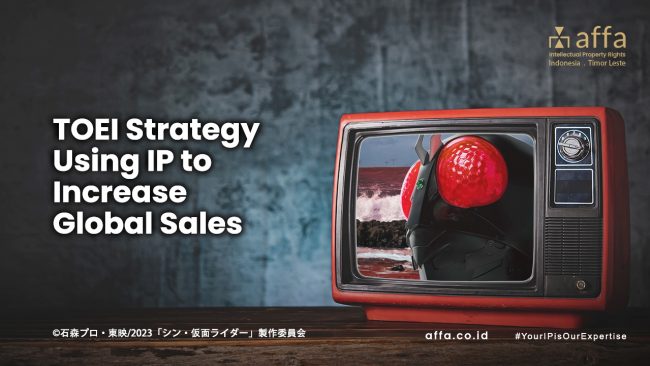
The IP (Intellectual Property) business in the entertainment industry is up-and-coming. We can see how the Walt Disney Company became a giant by producing its own animated series and feature films and continuing to buy well-known IPs such as Marvel Heroes, Star Wars, and many more. The valuation of the company founded by Walter Elias Disney 100 years ago has reached USD 171.49 billion and is ranked 63rd company with the largest market capitalization in the world.   Meanwhile, from Japan, Toei Company, Co. Ltd., or simply Toei, is known as a producer of popular films and animations such as Dragon Ball, Saint Seiya, One Piece, Digimon, Sailor Moon, Super Sentai, and Kamen Rider. Classic series such as Gaban (Uchu Keiji Gavan), Voltus (Chodenji Machine Voltes V), and Goggle Five, which were popular in the 80s, were also produced by Toei.   However, unlike Disney, like most other Japanese companies, especially in the entertainment industry, they prioritize the local market and only make the global market a secondary target. According to Nora Mediana, Managing Director of Moxienotion, who has several times been entrusted with distributing Japanese-produced films to Indonesia, this policy applies the principle of embracing enthusiasts and succeeding in the local market before advancing in the global market.   “You have to speak to your local audience, and be relevant to them first before reaching out to a wider audience,” she explained.   This strategy of strengthening IP foundations in the country has to deal with a population growth crisis that is difficult to overcome. The continued reduction in the number of children and adolescents, the main target of this IP business, has reduced the income in the local market.   Even though Toei has produced more than 4,400 feature films and 38,000 TV series, income from licenses for using trademarks and copyrights of their works will decrease unless they make the global market their primary target. Efforts to get out of this crisis were marked by the launch of a long-term vision called “Toei New Wave 2033”, which targets to increase global sales by 170%, or from the composition of the local to the global market, which was 70:30 to 50:50 in 2033.   So what strategy is done by Toei? The first, as has been and is commonly done by IP practitioners in the entertainment industry, is to extend the life of the IP itself, namely by recycling an IP so that it can continue to be known and loved from generation to generation.   One of the IPs that Toei relies on to carry out this mission is Kamen Rider, known in Indonesia as Ksatria Baja Hitam. In Japan, Kamen Rider, which first aired in 1971, has become a popular series that continues to be updated yearly. There are always new Kamen Riders with new transformation tools (called Henshin Belt), new bikes, new enemies, and other new uniqueness that are sold. Not only in the form of a TV series that airs in many countries but also in the form of a wide-screen film adaptation, besides the various toys and merchandise that fans are always hunting for.   The growing development of digital platforms also opens vast opportunities for this series to have more touch points to a broader market. If previously it was only available on TV screens, now it can be watched on cross-country streaming channels. Whether it was published via Toei’s official YouTube channel or the license was taken by a paid streaming platform that can be accessed worldwide. Of course, guarding the legality of granting cross-country licenses is a challenge. Because the protection of Intellectual Property is territorial, a limited license agreement must be paid close attention to so that it does not leak or fall into the hands of pirates.   Two Kamen Rider movies have screening dates in Indonesian cinemas in the last two months. The first is “Kamen Rider Geats × Revice: Movie Battle Royale”, screened on 31 May 2023, then “Shin Kamen Rider”, which will be screened in the last week of June 2023. These two films have regional licenses held by Neofilms Southeast Asia, and Moxienotion, aka PT Mitra Media Layar Lebar, hold the right in Indonesia.   IP Kamen Rider fans also enthusiastically welcomed the screening of these two films, especially since the screening of Shin Kamen Rider in Indonesia will be one of the earlier than neighboring countries. Shin Kamen Rider itself is a 121-minute remake of the first Kamen Rider series (1971) and was directed by Hideaki Anno, the director, and animator who gave birth to the IP Neon Genesis Evangelion, which became a phenomenon in the mid-90s.   Hopefully, this fan support will be converted into satisfactory ticket sales so that a mutually beneficial relationship between producers, distributors and fans can be maintained for other films in the future. Distributors are happy, fans are satisfied, and producers can meet their global sales targets.   In addition to intensifying the sale of its works globally, Toei is also opening itself up to foreign production houses to adapt its IP to suit the tastes of its audience. The latest project currently airing is “Voltes V: Legacy”, an entirely CGI robot series produced by GMA Entertainment for audiences in the Philippines. Voltes V was originally a robot animation series produced by Toei in 1977-1978, which was very popular in the Philippines because the story inspired the people to overthrow the Marcos regime in 1986. Because the popularity of this series is still immense, the fans who used to be children are now established, and current skills are also trying to bring back the Voltes robot with more sophisticated visual technology.   Toei’s support for the production house from the Philippines is a strategy to increase the value of IP through a cycle: “Creation – Export – Reboot – Reimportation.” From the same IP, the value can continue to grow because the license is purchased by outsiders, becoming new works that can be resold to the…

Patented-Trademark-Registering-Copyright-What-are-the-correct-terms

Patented Trademark? Registering Copyright? What are the correct terms?

Patents are only one of the Intellectual Property objects recognized by the state as stated in Law Number 13 of 2016 concerning Patents. However, according to the Indonesian Dictionary, Patent has a general definition as “a right granted by the government to someone for an invention for their own use and to protect it from imitation (piracy),” then misperception has spread widely, including to the media and some officials.   So that the terms “patented a trademark” or “patented [fill in the name of any food here]” are what we usually hear in Indonesia.   In fact, according to Patent Law, a Patent is an inventor’s exclusive right to an invention in the field of technology for a certain period of time to implement it himself or to give approval to another party to carry out his invention. So the emphasis should be on innovation in the field of technology. An invention itself is an inventor’s idea that is translated into a specific problem-solving activity in the field of technology, which can be in the form of a product or process or improvement and development of a product or process.   Furthermore, Patents are granted for inventions that are new, contain an inventive step, and are industrially applicable. While Simple Patents are granted for any new invention, development of an existing product or process, and can be applied in industry. Simple Patents are granted for inventions in the form of products that not only differ in technical characteristics, but must have functions/uses that are more practical than previous inventions due to their shape, configuration, construction, or components which include tools, goods, machines, compositions, formulas, compounds or system. Simple Patents are also granted for inventions in the form of new processes or methods.   Therefore, a Trademark which is a sign that distinguishes one good or service from another, as well as food, is not appropriate to be “patented,” because it does not meet the criteria of the Patent itself.   Trademark is an object in itself in Intellectual Property which is regulated in Law Number 20 of 2016 concerning Trademarks and Geographical Indications. While food does not contain technological inventions in it. It is almost certain that in the process of making food, nothing will intersect with technological inventions that contain elements of novelty, are unpredictable, and can be applied in industry.   Another reason food is not right to be patented is the element of secrecy in the manufacturing process, which is of course the uniqueness of the food we make. Because if registered as a Patent, the recipe must be published. This means everyone can use the recipe after the expiration of the Patent protection, 10-20 years later. In other words, we have limitations in obtaining exclusivity for innovation from the food we have.   However, that does not mean that food cannot be protected by Intellectual Property. Food can still be protected by Trademarks and or Trade Secrets. The way to protect it is by registering the food Trademark to the DGIP (Directorate General of Intellectual Property), as stipulated in Article 1 of the Trademark Law, using pictures, names, words, letters, numbers, color arrangements, or a combination of these elements. elements that have discriminatory power.   If we already have a registered Trademark, then we have a strong basis to prevent other people from using the same or substantially the same Trademark in circulation for similar goods/services.   Then there are Trade Secrets which are also the right solution for protecting the food recipes that we have. As defined in Article 1 paragraph (1) of the Trade Secret Law, Trade Secrets are information that is not known by the public in the field of technology and/or business, has economic value because it is useful in business activities, and is kept confidential by the owner of the Trade Secret. The scope of protection for Trade Secrets includes production methods, processing methods, sales methods, or other information in the field of technology and/or business that has economic value and is not known by the general public, including food/beverage recipes, formulas, production processes, client lists or marketing plans.   The unique thing is, to get protection for Trade Secrets, we don’t need to register them to DGIP, but by doing a number of activities must be done and must also be avoided in order to avoid losing this protection. You can read more about Trade Secret protection in our previous article: “Protecting Your Food Recipes: A Step-by-Step Guide.“   Meanwhile, Copyright is an Intellectual Property object that has the broadest scope of protection, because it includes science, art and literature, which also includes computer programs. What’s unique is that the exclusive right to a creation arises automatically based on the declarative principle after a creation is declared or manifested in a tangible form. Therefore, Copyright does not need to be registered to get its protection. However, in order for our creation to have stronger legal protection, where we have legal proof of ownership when a dispute occurs, we need to record them in the DGIP database. The recordation process, which is much simpler than the patent and trademark registration process, can provide copyright owners with a sense of security.   By understanding the different types of Intellectual Property objects, we can differentiate their treatment, as a first step towards obtaining proper protection. So that we no longer use the terms “patented trademark”, “patent of a copyright,” or “registering copyright”. If you need further information regarding Patent registration, Trademark registration, Copyright recordation, or further consultation regarding the drafting of Trade Secret agreements in Indonesia and abroad, please do not hesitate to contact us via [email protected].

亚太区商标法一览:印度尼西亚

亚太区商标法一览:印度尼西亚

2016年第20号《商标和地理标志法》(又称《商标法》)是印度尼西亚的主要商标法。此外,印度尼西亚还就具体事项颁布了多项细则,包括: 2019年第28号《关于适用于法律和人权部的非税国家收入的类型和收费标准的政府条例》,规定了印度尼西亚法律和人权部下属知识产权总局(DGIP)各种备案事项的官方收费标准; 2018年第22号《关于根据商标国际注册马德里协定相关议定书办理商标国际注册的政府条例》,规定了在印度尼西亚办理国际注册或者来自印度尼西亚的商标办理国际注册的各方面事项;; 2019年第90号《关于商标上诉委员会的上诉申请、审查与和解程序的政府条例(该委员会于1995年8月29日成立); 法律和人权部2016年第67号《知识产权总局局长商标注册令条例》,规定了注册要求、商品和服务类别以及已颁发证书和记录的更正等事宜。   商标范围 根据《商标法》第一条的规定,商标是指能够以图形、标志、名称、文字、字母、数字、颜色组合、二维和(或)三维形状、声音、全息图或上述两种要素以上的组合等图形形式表现出来、用以区分个人或法人在商品和(或)服务交易中生产的商品和(或)服务的任何标志。 根据这一定义,法律承认两种类型的商标:传统商标和非传统商标。   申请注册 印度尼西亚《商标法》采用先申请先注册原则,一般来说,任何个人、组织或公司都可以申请商标注册。然而,法律也对恶意注册商标的行为作出了规定。《商标法》第21条规定,申请人恶意提出申请的,应当予以驳回。 在实质审查过程中,如出现与知名商标相似的商标申请,适用本条规定,但在实践中,认定是否属于恶意申请难度很大。 根据《商标法》第77条,恶意商标申请获注册的,可由商事法庭宣告无效,该条规定如下:“商标属恶意申请的,以及(或)违反国家意识形态、法律法规、道德、宗教、风俗和公共秩序的,可以无限期提起无效宣告诉讼。”   提交申请和准备材料 在印度尼西亚提交商标注册申请之前,一定要进行商标查询。查询报告可以确定潜在的危险和障碍,帮助申请人成功完成注册流程。 如果查询报告没有发现任何问题,表明可以继续进行申请程序,申请人要准备好提供以下材料: 申请人姓名或名称 地址 商品和服务清单 拟申请注册的商标图样,可以以文字、标识或非传统标识的形式呈现 必要信息提交完成后,还需由专利律师准备两份供客户签署的文件:委托书和商标所有权声明。 自2019年起,商标注册申请全部转到线上申请。   办理时长 假如未遭到任何异议和临时驳回,那么从提交商标注册申请到获得注册号可能只需要10到13个月。这一时间比过去快得多,过去,即使是简单的注册也耗时两到三年。   异议和无效宣告 商标申请的公告期只有两个月。在公告期内,任何利益相关方都可以提出异议,公告部门将在实质审查阶段对异议予以审查。 公告期满后,不得再提出异议,也不得提出延期申请。 异议成功的关键前提是异议人提出有效的法律原由,即商标已在印度尼西亚提交申请注册或已获注册。否则,审查员很可能以先申请先注册原则为由驳回异议。 商标一旦获注册,第三方只能向商事法庭提起商标无效或商标注销诉讼。   外国著名商标 无论是否为著名商标,只有在印度尼西亚注册的商标才可受到保护。但是,《商标法》有一个机制,可以在一定程度上保护外国著名商标免受其他当事人的恶意注册。 另一方当事人恶意申请注册与外国著名商标相同或相似的商标的,可依《商标法》第21条的规定予以驳回,具体规定如下: “如果商标实质上与其他当事人在类似商品和(或)服务上使用的知名商标相似或相同,或者,在符合一定要求的前提下,与其他当事人在不同商品和(或)服务上使用的知名商标相似或相同,则申请将被驳回。” 于是,接下来的问题便是,什么是知名商标?法律和人权部2016年第67号《知识产权总局局长商标注册令条例》第18条规定了知名商标的认定标准: 该商标作为知名商标在相关业务领域的公众了解或认可程度; 使用该商标的商品和(或)服务的销售量,以及商标所有人使用该商标所获得的收益; 带有该商标的商品和(或)服务在社会流通中所占的市场份额; 该商标的使用地域; 该商标的使用期; 该商标的推广力度,包括为推广商标所投资的金额; 该商标在全球范围的商标申请和注册次数; 商标执法的成功率,尤其是主管部门认可该商标为知名商标的成功率;以及 使用该商标的商品和(或)服务获得的声誉和品质保证赋予商标的价值。 然而,外国著名商标在印度尼西亚并不一定享有同样的知名度。这就产生了一个问题,即商标所有人在对其他人提起诉讼前是否应先在印度尼西尼建立起商标的知名度。   使用要求 由于印度尼西亚采用先申请先注册原则,因此在进行商标注册前无需具有在先使用行为。申请人无需提交使用证据。 如果申请人在其他国家在先提交了另一份申请,申请人可在自优先权日起算的6个月内要求在印度尼西亚享有优先权。 关于不使用注销的规定,依照法律规定,注册商标自注册之日起或自最后一次使用之日起连续三年未使用的,可以向商事法庭申请注销商标。然而,法律并未规定最低使用门槛,因此,不使用注销的实现难度很大。   商标许可 在印度尼西亚,注册商标可以许可给他人使用。许可协议在DGIP备案后方具有法律约束力。 一般来说,许可协议应包含以下内容:许可方和被许可方的详细资料、许可的性质(独家或非独家)、是否可以进行再许可、许可协议条款、各方权利和责任以及被许可的对象或商标。 许可协议不得包含直接或间接损害印度尼西亚经济的条款,亦不得包含阻碍印度尼西亚获得和开发技术的限制性条款。   AFFA Intellectual Property Rights 15/F Graha Pratama Building Jl. MT. Haryono Kav. 15 Jakarta – 12810, Indonesia 电话: +62 21 8379 3812 电子邮件:[email protected] www.affa.co.id