
Can You Protect Checkered Sarong Designs Under Indonesian IP Law? - AFFA IPR

Can You Protect Checkered Sarong Designs Under Indonesian IP Law?

Sarong fabrics featuring checkered patterns and distinctive color combinations often serve as a unique identity of a particular region or brand. Due to their visual appeal and strong market demand, these designs are frequently commercialized. This raises an important question: can such patterns be protected as exclusive rights in Indonesia, and if so, under which type of Intellectual Property protection?   Available Forms of Protection in Indonesia   Checkered patterns and color combinations on sarongs can be protected under Indonesian Intellectual Property law, depending on how they are created and used. The two most relevant forms of protection are Copyright and Industrial Design.   Protection as Copyright   Under Law No. 28 of 2014 on Copyright, protection is granted to artistic works, including motifs or designs with artistic value.   A sarong pattern may qualify for Copyright protection if it: Is created as an original artistic work; Demonstrates creativity and uniqueness; and Is not merely a common or repetitive pattern widely available in the market.   Examples include: A sarong motif specifically designed by a designer; A pattern with a distinctive composition of lines and colors that reflects strong artistic character.   In this case, the protection applies to the artistic motif itself, not the sarong product.   Protection as Industrial Design   If the pattern is applied to sarongs that are mass-produced and sold commercially, serving as part of the product’s visual appearance and market appeal, then Industrial Design protection is more appropriate.   Under Law No. 31 of 2000 on Industrial Design, the aesthetic appearance of a product—such as compositions of lines and color combinations—can be protected as an Industrial Design.   In this context, the protection covers the appearance of the sarong as a commercial product.   Which Protection Is More Appropriate? Both forms of protection are available, and the choice depends on the intended strategy: Aspect Copyright Industrial Design Object Artistic Work (Motif) Product Appearance Protection Automatic (registration optional but recommended) Must be Registered Requirement Originality Novelty Term Life of the author + 70 years 10 years Business Value More Abstract More Specific & Practical   Can Both Protections Be Used?   Yes. A combined strategy is often the most effective. For example: The original motif created by a designer can be protected under Copyright; Once applied to sarongs and commercialized, the design can also be registered as an Industrial Design.   This approach ensures long-term protection of the artistic work, while also securing strong commercial protection for the product.   However, it is important to ensure that the design is actively used in business, so that the investment in registration or recordation provides real value.   Do you have a unique motif you want to protect? Contact us through the following channels and get a FREE 15-minute consultation:   📩 E-Mail : [email protected] 📞 Book a Call : +62 21 83793812 💬 WhatsApp : +62 812 87000 889   About AFFA:  Established in 1999, AFFA Intellectual Property Rights is an Indonesia-based boutique IP law firm serving international brands and innovators, offering full-service support—from prosecution and licensing to enforcement and commercialization—in Indonesia’s dynamic IP landscape. Our firm is widely recognized for its excellence, with accolades including “Best Boutique Law Firm in Indonesia” and “IP Enforcement Firm” at the Indonesia Law Firm Awards 2025 by Asia Business Law Journal, as well as being listed as a “Recommended Firm 2024 — Indonesia” by WTR 1000: The World’s Leading Trademark Professionals. For more information, please visit: www.affa.co.id.
Indonesia and China Forge Strategic Copyright Alliance to Strengthen Global IP Protection - AFFA IPR

Indonesia and China Forge Strategic Copyright Alliance to Strengthen Global IP Protection

In a major step toward deeper international IP collaboration, the Government of Indonesia and the People’s Republic of China have signed a Memorandum of Understanding (MoU) to enhance cooperation in the field of Copyright and related rights. The agreement was formalized during the sidelines of the World Intellectual Property Organization (WIPO) General Assembly in Geneva, Switzerland, on July 8, 2025.   This landmark MoU, signed between Indonesia’s Ministry of Law and Human Rights and China’s National Copyright Administration, marks a pivotal moment in the bilateral IP relationship between two of Asia’s largest creative economies.   Responding to the Challenges of a Digital World   “This MoU represents a new chapter in our countries’ commitment to protect creativity in an increasingly borderless digital era,” said Minister of Law Supratman Andi Agtas. “It is more than an agreement—it’s a framework for resilience, cooperation, and innovation.”   At its core, the agreement focuses on strengthening Copyright enforcement, building institutional capacity, and fostering mutual promotion of the creative and cultural industries. Both countries have recognized the need for joint responses to transnational Copyright infringement, especially amid the rise of digital piracy and the development of generative AI.   Key Areas of Cooperation   Under the MoU, Indonesia and China will collaborate in the following areas: Exchange of legal and technical information on Copyright and related rights. Joint training programs for staff and professionals. Promotion of cross-border creative and cultural exchange. Facilitation of relations between Collective Management Organizations (CMOs). Public awareness campaigns to elevate IP education   Crucially, both parties agreed to develop annual work plans, appoint official contact points, and organize practical engagements—ranging from seminars and workshops to policy dialogues on emerging Copyright issues.   A Strategic – Soft Power Approach   While the MoU is non-binding, its strategic impact is significant. It reinforces Indonesia’s broader vision of positioning Intellectual Property as a tool of cultural diplomacy, especially within the fast-evolving global IP landscape.   The MoU will remain in effect for five years, with an option to renew for another term. Both countries may revise the agreement through mutual written consent, ensuring flexibility in addressing future challenges and opportunities.   As global stakeholders watch with growing interest, this Indonesia-China partnership sends a clear message: International Copyright cooperation is no longer optional—it is essential!   At AFFA Intellectual Property Rights, we support stronger international IP cooperation like the Indonesia–China partnership. Whether you’re expanding into Indonesia or managing IP across Asia, our consultants are ready to guide you.   Need help protecting your Copyright in Indonesia? Book a free 15-minute call with our professional consultant:   ? E-Mail : [email protected] ? Book a Call : +62 21 83793812 ? WhatsApp : +62 812 87000 889   Source: Directorate General of Intellectual Property

Indonesia Fosters a Thriving IP Ecosystem: Domestic and International Filings Soar Over the Past Decade - AFFA IPR

Indonesia Fosters a Thriving IP Ecosystem: Domestic and International Filings Soar Over the Past Decade

Indonesia’s Directorate General of Intellectual Property (DGIP) has achieved a remarkable milestone over the past decade. According to a report delivered by the Director General of Intellectual Property, Razilu, a total of 1,738,573 Intellectual Property (IP) applications were filed between 2015 and 2024. “This is a monumental figure that reflects the extraordinary enthusiasm of the Indonesian public in protecting their intellectual creations,” Razilu stated during the “Ten-Year Performance Exposé and IP Appreciation” event, held in celebration of World Intellectual Property Day 2025 at Graha Pengayoman, Jakarta, on Wednesday, June 4, 2025. The data show that IP filings have grown at an average annual rate of 18.5%. According to Razilu, this growth is more than just numbers — it reflects increasing awareness of the importance of IP as a national economic and cultural asset. Razilu emphasized that this performance exposé is not merely an evaluation, but also a strategic platform to shape future IP policies. The goal is to ensure that every innovation and creative work by Indonesians is not only protected by law but also fully empowered. Of the total filings, approximately 86.76% originated from within the country. Domestic applicants contributed nearly 99.8% of Copyright filings, 85.2% of Trademark filings, and 68.76% of Industrial Design filings. However, domestic contributions to Patent filings remain relatively low, standing at just 32.05%, highlighting an area for improvement. “These figures demonstrate the strong dominance of local IP filings across all categories. It’s a testament to the thriving innovation and creativity among individuals, entrepreneurs, and inventors across Indonesia,” Razilu added. Over the same period, micro, small, and medium enterprises (MSMEs) were significant contributors to Trademark filings. The most registered classes included: Culinary products (Classes 30 and 29) Fashion (Class 25) Hospitality services (Class 43) Cosmetics and personal care (Class 3) In the Industrial Design category, top applications were concentrated in: Other printed matter (Class 19-08) Chairs (Class 06-01) Garments (Class 02-02) Travel bags, handbags, key holders (Class 03-01) Bags, containers, tubes, capsules (Class 09-05)  Meanwhile, the most recorded Copyright works were books, written articles, computer programs, video recordings, and posters. For Geographical Indications, the top five products over the past decade were coffee, woven textiles, rice, batik, and traditional salt. In the domestic Patent category, top filings involved food chemistry, pharmaceuticals, chemical engineering, special machinery, and basic chemistry. On the other hand, foreign Patent applications were dominated by sectors such as pharmaceuticals, digital communications, transportation, basic chemistry, and metallurgy. At AFFA Intellectual Property Rights, we welcome this growing momentum in Indonesia’s IP landscape. Our team of experienced IP consultants stands ready to support businesses, creators, and innovators—not only in Indonesia but also around the world—in securing and maximizing the value of their Intellectual Property. Let us help you navigate your IP journey with confidence.   Need help filing your IP in Indonesia? Book a free 15-minute call with a registered IP consultant and ensure your IP meets all local requirements:   ? E-Mail : [email protected] ? Book a Call : +62 21 83793812 ? WhatsApp : +62 812 87000 889   Source: Directorate General of Intellectual Property

Discover 6 Intellectual Property Potentials in Padel - AFFA IPR

Discover 6 Intellectual Property Potentials in Padel

Padel is experiencing rapid growth in Indonesia. Over the past few years, it has captured the attention of various groups — from sports communities and entrepreneurs to celebrities. Its popularity is reflected in its inclusion in PON XXI 2024 (National Sports Week) held in Aceh – North Sumatra, as well as in several tournaments held in Indonesia, including the Asia Pacific Padel Cup 2024 and Padel Pro Open 2025.   Padel was first created in 1969 in Acapulco, Mexico, by Enrique Corcuera. He modified a squash court at his home by adding walls and elements from tennis, creating a new game called “Paddle Corcuera.” This new game quickly attracted the attention of his friends, including Alfonso de Hohenlohe, who later introduced padel to Marbella, Spain in 1974 and built two courts there. From Spain, padel spread to Argentina (1975) and continued to grow in popularity across Europe and Latin America. In 1991, the Federation International de Padel (FIP) was established in Madrid, Spain, to regulate and promote the sport globally.   As the padel ecosystem continues to grow in Indonesia, various elements — such as tournament names, logos, racket designs, court technology, training strategies, and merchandise — are becoming strong identity markers with commercial value. All of these should and can be protected through various forms of Intellectual Property (IP) rights, so that all parties involved can benefit while supporting a more sustainable padel ecosystem.   Here are several relevant and potential IP categories in the world of padel:   Trademark Names of padel clubs, logos, slogans, tournaments, courts, training academies, apparel, padel balls, rackets, or other equipment should be protected to avoid the use of identical or confusingly similar names. These should be registered as Trademarks, which offer protection for 10 years and can be renewed indefinitely. Industrial Design The visual designs of rackets, special padel shoes, and uniquely styled tournament uniforms can be protected as Industrial Designs, with a protection period of up to 10 years. Patent This category includes technological innovations in racket materials or structure, automated digital scoring systems, training sensors, and unique portable padel court construction features. Such innovations can evolve continuously and offer local manufacturers or innovators a competitive edge. Copyright Promotional content such as tournament highlight videos, music, event posters, digital graphics, and training modules or documented game strategies is automatically protected under Copyright. However, formal recordation is recommended to strengthen legal proof of ownership. Trade Secret This category includes exclusive training techniques used by padel coaches, business strategies or community management models, and even recipes or formulas for sports nutrition products used by a club. Trade Secrets do not require registration but must be kept confidential to remain protected. Licensing & Franchising Business models such as court rentals, expansion of padel club branches, licensing tournament names for use in other cities, or even launching padel-themed café franchises can be governed through licensing or franchise agreements, and can be officially recorded to secure legal protection and expand commercial benefits.   Ultimately, padel is a fun sport and a gateway to economic opportunities through Intellectual Property assets. Business actors and padel communities must understand that the innovation, creativity, and identity they build today can become sustainable business value — if properly managed and protected. Should you need further information about registering and protecting Intellectual Property in the padel sport, feel free to contact us at [email protected].

5 Steps to Avoid Copyright Issues for Your Product Illustrations - AFFA IPR

5 Steps to Avoid Copyright Issues for Your Product Illustrations

Being inspired by, imitating, modifying, or even duplicating someone else’s work without permission—whether it’s well-known or not—can lead to serious legal consequences, including up to 4 years in prison or a fine of 1 billion Rupiah!   This is because Copyright Law grants Exclusive Rights only to the Original Creator, ensuring that they alone can claim economic benefits from their work.   In other words, if you profit from someone else’s creation without permission, the rightful owner can file an objection, send a legal notice (cease-and-desist), or take further legal action against you.   However, exceptions exist if your use of the work is non-commercial, educational, for criticism, or news reporting, provided it is done fairly and does not harm the creator.   But what if you genuinely didn’t know that a design submitted by your designer or illustrator infringed on someone else’s work?   Here are 5 essential steps you can take to review and evaluate whether a work violates copyright or not.   Does the Work Resemble a Popular Character?  A popular character isn’t just limited to animated movie figures or superheroes like Batman, Superman, or Ultraman. Even public figures or athletes with recognizable faces and signature poses cannot be used without permission.  To avoid issues, ask your designer about the initial sketches and the creative process behind the work. Use Reverse Image Search  Utilize tools like Google Reverse Image Search, TinEye, or Yandex Image Search to check if similar images already exist online.  If you find the design in stock image websites, art platforms, or other media, ensure that your illustrator didn’t just copy or slightly edit the image without significant modification. Avoid Copying the Style of Famous Illustrators  Some illustrators have highly distinctive and well-known styles, such as Loish, Kim Jung Gi, Greg Rutkowski, Hajime Sorayama, and others whose works frequently appear on book covers, games, or movies.  If the submitted artwork strongly resembles their style without permission, it could be considered Copyright Infringement or a Trade Dress violation (protection against copying distinctive design elements). Ensure All Design Elements Have Proper Licenses  Certain fonts or typefaces require a paid license. If your designer uses a premium font without a valid license, you could face legal action.Similarly, elements like brushes, textures, or patterns may also have specific usage rights. Always verify that all components in the design are legally licensed. Create a Written Agreement with Your Illustrator  Draft a contract stating that the work is 100% original and not derived or modified from another source without permission.This ensures that the illustrator is legally accountable if copyright infringement issues arise due to their work.   Remember, a work is automatically protected by copyright the moment it is published. You cannot claim that your use is valid simply because the work was never officially registered or originates from a different country with a separate market.   If you must or want to use an existing work for commercial purposes, the only legal solution is to contact the original creator and negotiate a licensing agreement.   This agreement would require you to pay royalties to the rightful owner. By obtaining proper licensing, you can legally collaborate with the original creator and promote the work openly—without fear of legal consequences.   You might also want to read: Indonesia’s Copyright Dilemma: When Good Intentions Pave the Way to (Unintended) Infringement Should you need more information regarding Copyright protection both domestically and internationally, you can contact us directly via email at [email protected].

The Billion-Stream Christmas Song: Mariah Carey's Seasonal Success - AFFA IPR

The Billion-Stream Christmas Song: Mariah Carey’s Seasonal Success

As December begins and the holiday season approaches, Mariah Carey’s iconic song, “All I Want for Christmas Is You,” can be heard almost everywhere. The festive atmosphere, from radios, cafes, hotels, offices, and shopping malls, seems incomplete without this song. If you’re a musician, songwriter, or singer, you might wonder how much royalty Mariah Carey earns annually from this song. But is it as massive as we imagine?   “All I Want for Christmas Is You” was first released in 1994 as part of Mariah Carey’s Christmas album, Merry Christmas. The song was co-written by Mariah and Walter Afanasieff, a seasoned musician, songwriter, and producer who collaborated with top artists of the era, such as Celine Dion, Boyz II Men, and Natalie Cole. However, the song initially only peaked at number twelve on the Billboard US Hot 100 Airplay chart.   The Journey to Becoming a $100 Million Royalty Song   Although it didn’t perform exceptionally well in the United States, the song skyrocketed in popularity in Europe, Japan, Singapore, Australia, and New Zealand, becoming the most-played holiday song annually. In 2001, Mariah released a remix of her Greatest Hits album. From then on, the demand for the song surged, with the original version consistently topping the charts every December from 2005 to 2008, 2019, and beyond.   According to the Associated Press, since 1994, the song has generated an estimated $100 million in royalties. This is primarily thanks to the surge in plays from streaming platforms like Spotify and YouTube, making it more accessible to listeners worldwide.   Passive Income of Up to $3 Million Per Year   As the songwriter and singer, it’s no surprise that Mariah is one of the biggest royalty earners from this song. However, she’s not the only one receiving royalties. The song has sold over 3.6 million digital copies in the United States since its release. It’s the most popular Christmas song in Europe, mainly the UK, with over 1.2 million downloads and 100 million streams. In Asia, the song ranks top on karaoke platforms and remains one of the most frequently sung Western songs.   Radio airplay and physical record sales also continue to generate royalties for the parties involved with the song. They include:   Songwriters Walter Afanasieff, the song’s co-writer, is entitled to a share of the songwriting royalties.  Record Label The song is under Columbia Records, part of Sony Music Entertainment. As the company that produces, markets, and protects the master recording, the label receives royalties from distribution and licensing agreements.  Music Producers In addition to Mariah Carey, Walter Afanasieff also acted as the song’s producer, earning royalties for the master recording.  Related Rights Supporting musicians like Dan Shea and backing vocalists (Kelly Price, Melonie Daniels, and Shanrae Price) who contributed to the recording are also entitled to royalties, as stipulated in their recording contracts.     “All I Want for Christmas Is You,” celebrating its 30th anniversary this year, shows how a single song can provide extraordinary long-term income for singers, songwriters, and other musicians. However, such income sources would not be well-managed without proper licensing agreements that regulate royalty distribution.   Thus, ensure that all your creations are appropriately documented and managed with solid licensing agreements to maximize their benefits—not just now but for decades to come. Should you need more information on Copyright recordation and licensing agreements domestically and internationally, please contact us at [email protected].

Unraveling the Global Complexity of IP Crime: Money Laundering and More! AFFA IPR

Unraveling the Global Complexity of IP Crime: Money Laundering and More!

Intellectual Property (IP) Crime negatively impacts the economy and consumer safety and has become structurally more complex, posing a worldwide threat to economic and social security.   According to the recently released report “Uncovering the Ecosystem of Intellectual Property Crime,” published this October by the European Union Agency for Law Enforcement Cooperation (Europol) and the European Union Intellectual Property Office (EUIPO), it is revealed that 6% of imported products entering the European Union are counterfeit, with a value exceeding 2 billion euros) annually. This figure represents only the seized products, mainly packaging materials, toys, cigarettes, and CDs/DVDs. Imagine if we could account for the undetected counterfeit goods distributed worldwide.   So, why is tackling IP crime so challenging? The report highlights that this form of crime is highly networked and involves corrupt officials, money laundering, and even tax officers. EUIPO labels these facilitators as IP Crime Enablers!   How significant is their role, and how do they perpetuate Intellectual Property crime? Here are the details.   Intellectual Property Crime – The Definition   In the document, “IP Crime” refers to illegal activities involving the theft, infringement, or unauthorized use of Intellectual Property (IP) rights, which include Copyrights, Industrial Designs, Trademarks, Patents, Geographical Indications, and Trade Secrets. The document categorizes IP crime primarily as:   Counterfeiting Manufacturing, importing, distributing, storing, or selling goods that bear the Trademark of a genuine brand without permission. Examples: Counterfeit Pharmaceuticals: Production and distribution of fake pharmaceutical products that can pose severe health risks to consumers. For instance, counterfeit Semaglutide injection pens falsely labeled as containing the active ingredient were found to contain other substances, leading to serious health incidents​. Counterfeit Automotive Parts: The production and distribution of fake automotive parts, like brake pads and wheel rims, infringe Trademarks and pose serious safety risks. Piracy Unauthorized copying, use, reproduction, and distribution of materials protected by IP rights, such as digital media, software, and entertainment. Example: Digital Piracy: Illicit streaming services that distribute copyrighted content (like movies and sports events) without authorization. In one case, a streaming service was operating across multiple countries, generating significant revenue through illegal broadcasts​.   The Mechanics of IP Crime   IP criminals exploit weaknesses in the global supply chain, legal loopholes, and infrastructure to operate with resilience and evade law enforcement efforts. This structured approach allows them to profit significantly while remaining difficult to prosecute due to their operations’ multi-jurisdictional and often hidden nature. The structured process criminal networks use to conduct IP crimes ranges from obtaining infringing items to laundering the proceeds. Here are the key phases:   Infringing IP Rights (Acquisition Phase) This is the initial stage where IP rights are intentionally violated. Criminals produce counterfeit goods by replicating brand logos, labels, or pirated content. This phase may involve either manufacturing counterfeit products directly or diverting legitimate products from the supply chain. Common sources for counterfeit goods include China, Hong Kong, and Türkiye. Transportation and Distribution Phase After acquiring the counterfeit items, networks transport them globally, often abusing the legal logistical and shipping sectors to move goods across borders. Criminals use sophisticated smuggling techniques, including splitting shipments and hiding counterfeit items within legitimate products to avoid detection. Marketing and Retail Phase Criminals use both online and offline methods to market and sell counterfeit products. Online marketplaces, social media platforms, and even the dark web provide anonymity and access to large audiences. Offline, counterfeit goods may also be sold through physical retail outlets or open markets. Dealing with Profits and Risks (Money-Laundering Phase) The final stage involves managing the profits from these illegal sales. Criminal networks employ money laundering techniques to disguise the origins of their profits. This includes investing in legal businesses, conducting physical cash transfers, or using complex digital financial systems to reintegrate funds into the economy.   Parties Also Involved in Intellectual Property Crimes In addition to the 4 (four) phases of crime above, Europol and EUIPO mapped the parties involved in IP crimes, making these crimes complex and challenging to eradicate.   Criminal Enablers These are illegal activities or crimes that help facilitate IP crime: Corruption: Bribery or manipulation within organizations to ease illegal processes. Forced Labour: Exploitation of labor, often under inhumane conditions, to produce counterfeit goods. Cybercrime: Digital crimes that support IP crime, such as phishing, malware, or data theft. Money Laundering: Concealing the profits from IP crime by converting illegal earnings into legitimate assets. Document Fraud: Creating fake documents to disguise the origin or legitimacy of counterfeit goods. Environmental Crime (Envicrime): Illegal activities that harm the environment, often associated with the improper disposal of waste from counterfeit production. Non-Criminal Enablers These are lawful activities or structures that criminals misuse to facilitate IP crime: Professional Expertise: Use of skills from professionals (e.g., lawyers, technicians) to support illegal IP activities. Use of Legal Business Structures (LBS): Legal businesses that provide a front for illegal IP activities, such as follows: Trading Companies or Factories These legitimate businesses can be set up or inserted into the supply chain to disguise the production or distribution of counterfeit goods. Factories or production sites can be used to produce counterfeit goods under the guise of legitimate products. Warehouses or Logistics Service Providers Legitimate warehouses or logistics companies can be used to store or transport counterfeit goods without raising suspicion. For example, counterfeit goods can be hidden among legitimate products in international shipments. Physical Retail Stores Appearing legitimate stores can be used to sell counterfeit goods to consumers without their knowledge. Counterfeit goods can be sold alongside legitimate products, making it difficult for consumers to tell the difference. Online Stores or Marketplace Platforms Many IP criminals use e-commerce websites or accounts on platforms like Amazon, eBay, or social media to sell counterfeit products. These platforms often give the impression of a legitimate business, making it easier for criminals to reach consumers at a wide range. Front or Shell Companies These companies are technically legitimate but serve only as a front for illegal activity. They are often used to launder money…

Trademark Freeriding Legal Risks and Solutions in Indonesia - AFFA IPR

Trademark Freeriding: Legal Risks & Solutions in Indonesia

According to the Indonesian Dictionary (KBBI), hitchhiking is participating (eating, riding in a vehicle, etc.) without paying. This word is used in colloquial language and is often associated with someone taking advantage of an opportunity without any contribution or cost.   Freeriding Trademarks are also often carried out to take advantage of the popularity of an existing Trademark or even a Well-known Mark to increase exposure and make it easier to sell. For example, opening a ramen shop with a logo that resembles and displays the Ultraman character, opening an amusement park called Squid Game, or opening a car rental business and naming it Gulfstream.   Is this practice justified? What are the legal consequences for the hitchhiker and the actual owner?   A Trademark is the Exclusive Right of the Trademark Holder   Exclusive Trademark Rights are rights granted to Trademark Holders who have been officially registered to use the Trademark in the trade of goods or services. These Exclusive Rights allow the holder to prohibit other parties from using the same or similar Trademark for goods and/or services in the same class without permission.   In Indonesia, Trademarks as Exclusive Rights are regulated in Article 1 of Law Number 20 of 2016 concerning Trademarks and Geographical Indications (Trademark Law), where registered Trademark Holders have Exclusive Rights for a certain period by using the Trademark themselves or granting permission to other parties to use it. Thus, Trademark Holders can prohibit other parties who, without permission, use the same Trademark on the same goods and/or services, Trademarks that are the same as their registered Trademark on the same goods and/or services, or Trademarks that are the same or basically the same as their registered trademark for similar goods and/or services.   Thus, if another party without permission utilizes the existence of a registered Trademark, it can be considered a Trademark violation.   Sanctions for Trademark Violators   For the use of a Trademark without permission, Article 100 of the Trademark Law regulates criminal sanctions of imprisonment and/or fines as follows:   Using the same Trademark: A maximum of 5 years in prison and/or a maximum fine of IDR 2 billion. Using a similar Trademark: A maximum of 4 years in prison and/or a maximum fine of IDR 2 billion.   Legal Ways to Freeriding on Registered Trademarks   Several steps can be taken to use a Registered Trademark in Indonesia legally. These steps are as follows:   Trademark License: The most common step is to obtain a license from the registered Trademark owner. This license is an agreement between the Trademark Owner (Licensor) and the Other Party (Licensee), which grants the Licensee the right to use the Trademark according to the agreed terms. To obtain it, you must contact the Trademark Owner and negotiate and sign a License Agreement determining the scope of use, duration, territorial coverage, and exclusivity. Franchise Agreement: If the registered Trademark is part of a Franchise, you can join it through the available Franchise Agreement. Through this agreement, the franchisor will grant you (the franchisee) the right to use the Trademark and its business system. Usually, a Franchise also involves transferring business knowledge, training, and operational support.You might also want to read: Similar But Not The Same – The Difference Between Franchising and Licensing in Indonesia   Co-Own of a Trademark: Sometimes, two or more parties may agree to use a Trademark together. This requires a detailed agreement and ensures that all parties understand their rights and obligations, including how the Trademark will be managed. If this joint use results in a change of ownership, you must submit the change to the Directorate General of Intellectual Property (DGIP) or through a reliable Trademark Consultant. Trademark Transfer: Another alternative is to purchase the rights to the Trademark from the current owner, the provisions of which are regulated in the Trademark Transfer. Uniquely, the Trademark can be transferred while still in the application process status, provided that the deed of transfer that the notary has legalized is recorded at the DGIP to be fully binding. The transfer must cover all classes of goods and/or services of the transferred Trademark. File a Trademark Cancelation Action: If you believe the previous owner has not used the Trademark you will use for 5 (five) consecutive years, then you can appoint an experienced Trademark Consultant to file a Trademark Cancelation Action with the Commercial Court. The Panel of Judges will then order DGIP to delete the Trademark you wish to use. However, you have also submitted a registration application for the Trademark you want to use.   You might also want to read: A Win for the “WIN” – AFFA Represents Hongyunhonghe Tobacco (Group) Co. Ltd. for a Successful Trademark Non-Use Cancellation in Indonesia Should you need more information about Trademark protection or registration in Indonesia and/or abroad, do not hesitate to contact us through email: [email protected].

The Legal Risks of Selling (Unauthorized) T-Shirts with Popular Character Images - AFFA IPR

The Legal Risks of Selling (Unauthorized) T-Shirts with Popular Character Images

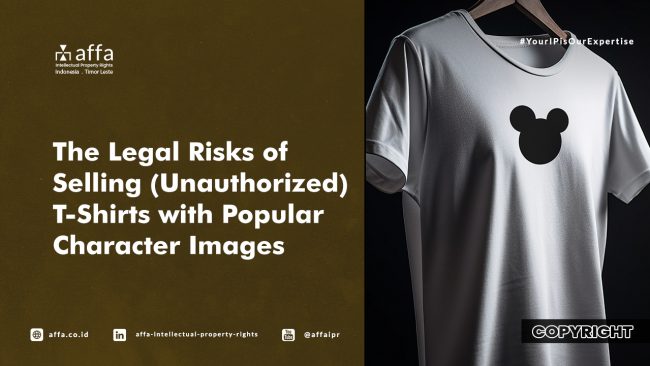
We can still easily find t-shirts with popular character images in small stores, shopping centers, exhibitions, and e-commerce in Indonesia. For those of you who are fans of popular culture from within and outside the country, the presence of t-shirts with characters that you like, sometimes with attractive designs, and also at low prices, is very tempting to buy.   But what if these t-shirts are not licensed or use the images without permission? Are there any legal consequences for the buyer? Here is the discussion from the Intellectual Property law perspective that applies in Indonesia.   Legal Standing   Article 40 of Law Number 28 of 2014 (Copyright Law) has recognized that works of fine art in all forms, such as paintings, drawings, carvings, calligraphy, sculptures, statues, or collages, photographic works, to cinematographic works that are closely related to popular culture, are protected creations. Therefore, the state guarantees that Exclusive Rights consisting of Moral Rights and Economic Rights are given only to the Work’s Creator, Copyright Holder, and/or Related Rights Owner.   This Copyright Law also covers all works or Creations and/or Related Rights products and users of Creations and/or Related Rights products from Indonesian Citizens and non-Indonesian citizens, non-Indonesian residents, or those who are not Indonesian legal entities, with the following provisions: Their country has a bilateral agreement with the Republic of Indonesia regarding the protection of Copyright and Related Rights; or Their country and the Republic of Indonesia are parties or participants in the same multilateral agreement regarding Copyright and Related Rights protection.   The point is that it is inevitable that all works born from popular culture originating from abroad will be recognized as copyrighted in Indonesia. Therefore, all activities of utilization, duplication, distribution, and commercialization must have the permission of the Creator, Copyright Holder, and/or Related Rights Owner. Otherwise, it will be categorized as piracy!   This piracy is regulated explicitly in Article 1 of the Copyright Law, where it is clear that what is meant by Piracy is the unauthorized duplication of Creations and/or Related Rights products and the widespread distribution of the resulting duplication goods to obtain economic benefits.   Penalties for Piracy   Article 113 Paragraph (4) of the Copyright Law states explicitly that “Any person who fulfills the elements as referred to in paragraph (3), which is carried out in the form of piracy, shall be punished with imprisonment for a maximum of 10 (ten) years and/or a maximum fine of Rp. 4,000,000,000.00 (four billion rupiah).”   Terrible sanctions, right? Unfortunately, this criminal threat has not been appropriately socialized because many still do not understand the term piracy. There is even a glorification for successful SMEs by commercializing the use of characters protected by copyright without permission. Finally, this Piracy activity continues rampant without understanding its negative impacts. In fact, Copyright is important to protect.   You might also want to read: Media Missteps: 5 Intellectual Property Blunders to Avoid   5 Reasons Why Copyright is Important Copyright protection is an important part of the legal system that supports economic justice and innovation, with the following details:   Respecting Creators: Protecting copyright ensures that creators of works receive proper recognition and compensation for their work. This provides an incentive to continue innovating and creating. Encouraging Creativity: With copyright protection, individuals and companies are more likely to invest time and resources in creating new works because they can expect a return. Regulating the Use of Works: Copyright gives owners control over how their work is used, shared, or modified, helping to prevent misuse or unauthorized use. Economic Growth: Copyright supports the creative industry, significantly contributing to economic growth through job creation and tax revenue. Consumer Protection: It helps ensure that consumers get original, high-quality products, not imitations or pirated goods.   Therefore, if piracy occurs, all of the above points will be disrupted, from a low appreciation for creators, stagnant creativity, weak distribution supervision, and low product quality to worsening Indonesia’s ranking in the International Intellectual Property Index.   Your Contribution is Needed   If you have already bought a pirated t-shirt, you don’t need to worry about legal sanctions. Because in Indonesia, criminal sanctions are mainly aimed at those who produce, distribute, or sell pirated goods, not at buyers. The Indonesian Copyright Law focuses on parties who actively violate Copyright by reproducing, producing, or distributing works without the permission of the Copyright Holder.   However, although buyers of pirated goods are generally not faced with criminal sanctions, buying pirated goods is unethical because it supports an illegal industry that harms the original Creators and the creative industry. Buying pirated goods can also harm consumers because the goods often do not meet quality and safety standards.   You must realize that choosing legitimate and licensed products is the best way to support Creators and ensure that the products received are safe and of good quality. In addition, buying original products contributes to healthy economic growth and innovation for society.   You might also want to read: Intellectual Property Infringements in Indonesia: A Closer Look at Online Hypocrisy Should you need further information regarding Copyright protection in Indonesia, you can contact us via email: [email protected].

The Indonesian Constitutional Court Ruled Article 10 of the Copyright Law Unconstitutional - AFFA IPR

The Indonesian Constitutional Court Ruled Article 10 of the Copyright Law Unconstitutional

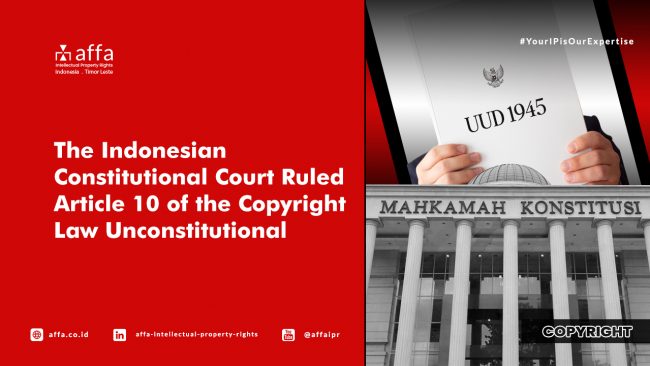
On February 29, 2024, the Constitutional Court of the Republic of Indonesia (MKRI) decided case Number 84/PUU-XXI/2023 concerning Material Review of Law Number 28 of 2014 concerning Copyright (Copyright Law) and declared Article 10 of the Copyright Law to be contrary to the 1945 State Constitution of the Republic of Indonesia (Constitution of Indonesia). How is this possible?   This case began when PT Aquarius Pustaka Musik, PT Aquarius Musikindo, and songwriter Melly Goeslaw (hereinafter referred to as the Petitioner) discovered that songs created and/or owned Copyright were being used by a User Generated Content (UGC)-based digital service platform. In early 2020, the Petitioner even filed a civil lawsuit against Bigo Technology Ltd. as the digital service platform ‘Likee’ manager to the Central Jakarta District Court’s Commercial Court for using songs whose Copyright is under his auspices without permission. Unfortunately, the panel of judges rejected the lawsuit because the videos shown were UCG-based, i.e., originated, created, and uploaded by application users, not by Bigo. Thus, Bigo cannot be held responsible.   The Indonesian Copyright Law Does Not Yet Regulate UGC   The rejected lawsuit to Bigo and Likee could occur because there is a vacuum in the Copyright law used for UGC-based platforms. Hence, the platform manager ignores and deliberately hides behind the Circular Letter of the Ministry of Communications and Informatics Number 5 of 2016, Chapter V-C Provisions Number 2(b), which states that the UGC Platform is not responsible for goods and/or services containing content that violates Intellectual Property Rights if it can be proven that there was an error and/or negligence on the part of the merchant or Platform user.   In fact, in Article 28-C and 28-D paragraph (1) of the Constitution of Indonesia, the state guarantees its citizens to benefit from science and technology and the arts to improve the quality of life and for the welfare of humanity, as well as to obtain fair legal certainty. Thus, the Human Rights of the Petitioners must be protected, promoted, upheld, and fulfilled by the State, in this case, the government as mandated in Article 28-I paragraph (4) which explicitly states that “Protection, promotion, enforcement and fulfillment of rights Human rights are the responsibility of the state, especially the government.”   One of the methods that the state must take in protecting and upholding the fundamental rights of the Petitioners is by establishing laws and regulations that can substantively and procedurally guarantee and ensure the implementation of these rights by the instructions of Article 28-I paragraph (5) the Constitution of Indonesia. Therefore, on the one hand, the State must create a legal norm or rule with a precise, firm formulation, without multiple interpretations, and includes or encompasses matters aimed at realizing these fundamental rights. On the other hand, the Petitioners are entitled to the certainty of the quo regulations. This is inevitable for its continuity in a rule-of-law state as required in Article 1 paragraph (3) of the Constitution of Indonesia, which states, “The state of Indonesia is a state of law.”   As stated in Indonesian Copyright Law:   Article 10 Managers of business premises are prohibited from allowing the sale and/or reproduction of goods resulted from Copyrights and/or Related Rights infringements in the location under their management.  Article 114 Every Person managing business premises in all its forms who deliberately and knowingly allows the sale and/or duplication of goods resulting from infringement of Copyright and/or Related Rights in the premises that they manage as referred to in Article 10 shall be sentenced with a maximum fine of Rp100,000,000.00 (one hundred million rupiahs). Because Articles 10 and 114 of the Copyright Law are deemed not to include protection for UGC and the state is obliged to provide legal certainty, the Petitioner also submitted a Material Review of the Copyright Law to the Constitutional Court on July 30, 2023, based on the Petitioner’s Petition Submission Deed Number 83/PUU/PAN.MK/AP3/07/2023 was recorded in the Constitutional Case Registration Book on August 3, 2023, with Number 84/PUUXXI/2023, corrected and accepted by the Registrar of the Court on September 8, 2023.   Final Verdict in Favor of the Creator Until then, the Constitutional Court’s decision stated that it had granted the Petitioners’ petition in its entirety and stated that Article 10 of the Copyright Law was contrary to the Constitution of Indonesia and did not have conditionally binding legal force as long as it was not interpreted as “Manager of trading places and/or Digital Service Platforms based on User Generated Content (UGC) is prohibited from allowing the sale, display and/or duplication of goods resulting from violations of Copyright and/or Related Rights on trading venues and/or digital services that it manages.”   In particular, the Constitutional Court stated that the Petitioners’ human rights, as outlined in the Constitution of Indonesia, were impaired due to the enactment of Article 10 and Article 114 of the Copyright Law, considering that the content of the two articles being reviewed did not or did not protect fair legal certainty, because the content was inadequate and too narrow so that it cannot reach/keep up with new phenomena that have emerged as a logical consequence of technological growth and development, where one of the consequences of technological progress, especially in the information sector, has been the violation of the constitutional rights of the Petitioners. Still, the perpetrators will easily avoid legal responsibility because the formulation of the article cannot be used as a basis for prosecuting perpetrators who violate the law.   Furthermore, the Constitutional Court stated that the material content of Article 10 and Article 114 of the Copyright Law is normatively very limited and narrow because it only emphasizes the Management of Trading Places, which are a venue for selling and/or duplicating goods resulting from violations of Copyright and/or Related Rights, despite their speed and sophistication. Information technology has created an extensive space for interaction or mass communication (between people or society) through the provision of digital service platforms, namely in the form of sharing-app, short-video creation…