
Athlete and Inventor at Once - Why Not? - AFFA IPR

Athlete and Inventor at Once – Why Not?

Professional athletes often understand what needs to be done to improve their performance, whether modifying existing equipment or creating something new. So, their position is not just to use the latest technology created by sponsors but to create their own technology according to their needs. This is also useful for athletes and other sportsmen, including fans who want to experience the sensation.   In the history of sports technology development, dozens of athletes have been involved in the innovation process and registered as inventors in various countries. The following five names could be an inspiration for you: Tony Finau This 6 PGA Tour winner has a unique habit when using his putter. He often uses the back of the club to hit the ball from close range. He even provides an arrow with a certain tilt angle on his Ping PLD Anser 2D putter, making his aim more accurate. Seeing this inappropriate use certainly made the Ping producer feel the need to “talk” with Tony to get feedback. The results led to the creation of a putter prototype that provides the sensation of being hit from behind but still has an attractive design that does not violate the rules.   “Compact Putter Head” (U.S. #11.911.670 B2) Finally, since February 2024, Tony Finau’s name was officially included as the inventor of the Patent Utility for Ping’s “Compact Putter Head” (U.S. #11,911,670 B2), along with Tony Serrano (Ping Design Engineer) and John A. Solheim (Ping President). George Grant A century and a half ago, the sport of golf did not yet know the term “golf tee” or a tool for placing the ball at the starting point of the shot. Uneven sand or grass conditions were harsh and interfered with hitting accuracy until the first African-American avid golfer from Harvard registered the first “Golf-Tee” (U.S. #638,920 A) in America in 1899. “Golf-Tee” (U.S. #638.920 A) Unfortunately, Grant’s wooden tee is not commercialized, so only a few people know about it and use it. Until decades later, William Lowell, who also worked as a dentist, appeared, collaborating with Spalding to produce and promote the “Reddy Tee,” a wooden tee like Grant’s but painted red. Stanley Honey As a Sailing sports navigator since 1992, he has mastered various classes, from Yacht to Catamaran, complete with several fastest finish records, including winning the Newport Bermuda Race in 2022. Stanley, who has a Master of Science in Electrical Engineering from Stanford University, uses the knowledge gained on campus to maximize his sporting activities. Since 2003, he has had a Patent for “Locating an Object Using GPS with Additional Data” (U.S. #657,584 B2). “Electromagnetic Transmitting Hockey Puck” (U.S. #5.564.698 A) He also became acquainted with officials from this sport from leading technology and media companies, including Atari, News Corp, and Fox Corporation. Until 1998, Stanley was trusted to lead Sportvision, a technology company tasked with improving the audience’s experience watching various sports broadcasts on News Corp and Fox. “Electromagnetic Transmitting Hockey Puck” (U.S. #5,564,698 A), which allows TV viewers at home to see more clearly the hockey puck in play, “System for Determining Information about a Golf Club and/or a Golf Ball” (U.S. #6,456 .232 B1) which can show the speed of the ball on the viewer’s screen, and the “System for Enhancing the Television Presentation of an Object at a Sporting Event” (U.S. 5,912,700 A) which allows the viewer to receive real-time information from changes in the sequence of vehicles on racing. Of his total of 30 Patents, eight are related to navigation design systems, while the rest are related to improving the experience of watching sporting events. Charles Smith After retiring, the former National Basketball Association (NBA) player from 1988-1988 was active in the National Basketball Players Association (NBPA) Foundation, advising retired basketball players who wanted to change professions to other fields. In 1998, Smith founded New Media Technology Corp., the first company to develop and patent a customizable video ingest application. “System and Method for Computer-Assisted Manual and Automatic Logging of Time-Based Media” (U.S. #8.060.515 B2) This invention, called “System and Method for Computer-Assisted Manual and Automatic Logging of Time-Based Media” (U.S. #8,060,515 B2), makes it easier to provide virtual consultations to everyone who needs them, with limited bandwidth. Smith said that his experience as a player and coach is beneficial in giving these virtual consultations, especially in the post-pandemic era, when people trust the input of a “coach” more than their boss. Van Phillips Phillips lost both legs at the age of 21 in a 1976 water skiing accident. However, he became even more enthusiastic about completing his studies as a Biomedical Design Engineer at the Utah University, United States, and founded his own company, Flex-Foot Incorporated, in 1984. “Prosthetic Energy Storing and Releasing Apparatus and Methods” (U.S. #20.210.259.857 A1) From there, several vital inventions were born, one of which was a light and flexible artificial leg made from carbon fiber, which foreign athletes widely used to excel in the prestigious Summer Paralympics. This Patent, called “Attachment Construction for Prosthesis” (WO #9,318,723 A1), was then developed to give birth to dozens of other Patent derivatives that brought him royalty income.   Whatever job you are in now, you may find a better way to make it easier. If it turns out to be unique, has never existed before, and can also be helpful for many people, immediately register it as a Patent to get more protection and benefits!   Should you need further information about Patent registration in Indonesia and abroad, don’t hesitate to email us at [email protected].
Kylian Mbappe has Trademarked His Iconic Goal Celebration - Why is it Possible? - AFFA IPR

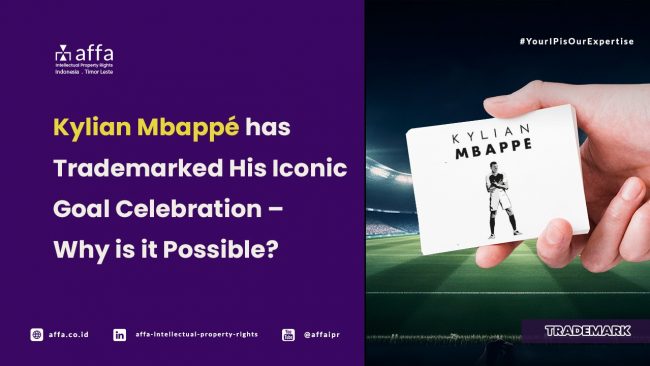
Kylian Mbappé has Trademarked His Iconic Goal Celebration – Why is it Possible?

Since 2017, Kylian Mbappé has contributed 170+ goals for the Paris Saint-Germain football club. Since then, Mbappé has introduced a celebration pose with crossed arms clamped in his armpits after he scores. Apparently, the pose was registered as a Trademark in the same year and will be protected at least until August 2027.   In theory, since 2008, the World Intellectual Property Organization (WIPO) has recognized the existence of ‘New Types of Marks,’ which divides Trademarks into two types, namely Visible and Non-Visible. For Visible Marks, apart from the various commonly recognized Marks such as names, logos, and holograms, Motion or Multimedia Signs, Position Marks, and Gesture Marks are also recognized. Therefore, this celebratory pose, which includes gestures, can indeed be registered as a Trademark. Source: World Intellectual Property Organization (WIPO)   As a logo, there is a classification system that regulates it to make applications more accessible, as well as providing ample opportunity for each person or company logo to be registered in various appropriate class categories, thereby minimizing monopolistic practices. The classification system is the Vienna Class, which divides logos into 29 categories, 144 divisions, 775 main sections, and 1,112 auxiliary sections. Mbappé’s celebration pose is included in Vienna Class 2.1.8 which includes logos for “Acrobats, athletes, dancers, jugglers, nude men, men practising sports (except those already included in Vienna Classes 2.1.2, 2.1.12, 2.1.14, 2.1.20 and 2.1.21).”   It should be noted that the Indonesian Trademark Office (DGIP) has not adopted the Vienna Class for Figurative Mark, but this does not mean that the Mark cannot be registered in Indonesia. Please take a look at the explanation at the end of this article.   Why Does It Need to be Trademarked?   From the start, Mbappé understood that his unique pose could be registered as a Trademark. Dozens of years earlier, David Beckham, the legendary wing midfielder from Manchester United, had registered his cross-passing pose as a Trademark. The difference is that the logo registered by Beckham is a figure that resembles a human (Vienna Class 4.5.5), not a black-and-white photo of himself as registered by Mbappé. Source: World Intellectual Property Organization (WIPO)   However, just like Beckham, Mbappé also hopes that this Trademark can be used commercially for various goods and/or services of his own. With global achievements and 113 million Instagram followers from all over the world, it is not difficult to imagine that whatever Mbappé sells, especially those with his unique celebration logo, will make a profit. Of course, this profit does not only come to Mbappé but also to manufacturers of clothes, textiles, toys, video games, umbrellas, bags, jewelry, perfume, cosmetics, and even toothbrushes who are interested in getting the license.   Negative Impact on the Athlete’s Image?   If a Trademark is already registered, commercial use of the mark becomes the exclusive right of the mark owner or another party who has officially obtained permission. So, suppose another party uses it without permission. In that case, a civil lawsuit can be filed in Indonesia, or criminal liability can be demanded, with a maximum fine of 2 (two) billion Rupiah or a maximum imprisonment of 5 (five) years.   From the perspective of the fan community, the size of this fine can be scary because a logo that was previously very proud, used as wallpaper on a cellphone, laptop, sticker on a vehicle, or poster in the work space could become incriminating evidence. Will Mbappé’s lawyers or legal team sue and imprison the Fans?   The answer is, of course, no. Because they will mainly pursue pirates who produce, distribute, or sell counterfeit products without permission, this effort is undoubtedly very positive for fans who are truly present to provide support to their athletes. Because the money spent will actually be income for the athletes, not put into the pockets of the pirates, it’s more expensive but legal, you get quality goods, and you’re prouder.   Other Athletes Who Have Done It, Too.   The practice of commercializing athletes’ profiles as Trademarks has been going on for a long time; for example, basketball player Michael Jordan, golfer Jack Nicklaus, and sprinter Usain Bolt are still loved by their fans. With the ownership of this celebration logo, Mbappé is recorded as having 7 registered Trademark variants at the European Union Intellectual Property Office (EUIPO), of which 1 is a Trademark bearing his name, 2 Trademarks contain his favorite slogan, 2 are his logo, and 2 more are a combination of logo and Mbappé’s name.   Lionel Messi (6 Marks) and Cristiano Ronaldo (5 Marks) are other footballers with many active registered Trademarks. However, when David Beckham was still active, he had more Trademarks. Namely, he had 8 registered Trademarks for the logo, name, and several variants of his name with a combination of his back numbers for various products and foundations that he owns. Unfortunately, currently, only one Trademark is still active: BECKHAM.   Can this Trademark be Registered in Indonesia? Referring to Article 1 point 1 of Law Number 20 of 2016 on Trademarks and Geographical Indications (the Trademark Law), a Trademark is a sign that can be displayed graphically in the form of an image, logo, name, word, letter, number, color arrangement, in the form of 2 (two) dimensions and/or 3 (three) dimensions, sound, hologram, or a combination of 2 (two) or more of these elements to differentiate goods and/or services produced by individuals or legal entities in goods and/or services trading activities.   Referring to the Trademark definition, the Trademark submitted by Kylian Mbappé can also be registered in Indonesia as long as no identical or similar Mark has been previously submitted by another party, as regulated in Article 21 of the Trademark Law. Are you interested in registering your name or favorite pose as a Trademark in Indonesia or abroad? Contact us directly via email: [email protected].

[Important Update] Japan Adopts Letter of Consent for Trademark Registration - AFFA IPR

[Important Update] Japan Adopts Letter of Consent for Trademark Registration

The revised Japan Trademark Law will come into effect on April 1, 2024, introducing the “Letter of Consent” to overcome conflicts with earlier Trademark registrations.   However, the Japan Patent Office (JPO) recently announced that evidence must be provided in addition to a consent letter obtained from the earlier registrant when applying Article 4(4) of the Japan Trademark Law. This evidence must convince the JPO examiner that there is no likelihood of confusion between earlier and junior marks, not only at present but also in the future.   Article 4(4) of the Japan Trademark Law, which is newly introduced in April, states:   Trademark applications will not be rejected under Article 4(1)(xi) as long as the applicant obtains consent from the owner of the cited mark and it is unlikely to cause confusion with the cited owner or its exclusive or non-exclusive licensee when used on goods or services designated under the application.   Trademark Examination Guidelines for Article 4(4) Provides:   The requirement of being ‘unlikely to cause confusion’ must be satisfied at the time of the JPO examiner’s decision and in the future. To satisfy the requirement, the following factors will be assessed: Similarity between marks Recognition of mark Uniqueness of mark Significance of mark (House mark or product brand) Possibility of business expansion Relatedness of goods and service Consumers Trade practices involving actual use of mark Where both marks are identical and used on same goods and service, the examiner will find “likely to cause confusion” in principle. Applicant must provide evidence to demonstrate the unlikelihood of confusion based on the actual use of both marks. For example: Different color, font or combination between literal element and figurative element of respective mark Different position to place the mark or to accompany with other distinctive mark Difference in speific purpose or price of respective goods Different sales channel Different seasons to use the mark Different territory to use the mark Mutual covenants to take necessary actions if confusion is likely to occur between the marks An agreement between the parties to keep the present use or configuration of both marks in the future will be required to strengthen the unlikelihood of confusion in the future.   It is important to note that “Letter of Consent” is not available to Trademark applications filed with the JPO before April 1, 2024, even if they are pending examination.   Similarly, international registrations registered at the World Intellectual Property Organization (WIPO) or subsequently designated to Japan before April 1, 2024, can’t use the consent. Should you need further information regarding Trademark registration in Japan or other countries, please email us at [email protected].

[重要] 向印度尼西亚进口纺织品、箱包和鞋类需提供商标证书 - AFFA IPR

[重要] 向印度尼西亚进口纺织品、箱包和鞋类需提供商标证书

2024 年 3 月 10 日生效,旨在加强对商标的保护并控制市场上的产品质量,印度尼西亚共和国工业部 (Kemenperin) 开始实施对纺织品、箱包和鞋类产品进口有重大影响的新法规。2024 年第 5 号工业部长条例修正案第 23 (3) 条规定了这些产品进口的技术审查签发程序。   重大变化在于增加了进口商申请进口商识别号(API-U)时必须附加的以下文件:   印尼法律和人权部知识产权总局颁发的商标证书; 商标所有人向授权代表出具的许可协议、再许可和/或委任书的记录证明;以及 商标所有者或授权代表的进口委任书。   受影响产品 –   纺织品:纤维、长丝纱线和片状织物; –   纺织产品:地毯或其他纺织地板覆盖物、服装、服装配件和其他纺织成品; –   箱包:行李箱、钱包、书包、运动包、手提包和其他包袋; –   鞋类:鞋履、凉鞋和软皮鞋。   一般进口许可程序仍适用,贸易型进口企业需要获得一般进口商识别号(API-U)。申请程序包括一般进口商核查(VIU),随后由工业部进行技术审议(Pertek)。要获得 API-U,需要向贸易部提交 VIU 报告和 Pertek 结果。   对进口商的影响 对于尚未在印尼注册商标的进口商,这项新要求是重要提醒。 鉴于商标注册过程耗时较长(约 1-2 年),需要尽快与商标所有人沟通,以获得必要的证书,避免在获得进口许可证方面出现延误。   如需有关该法规的更多信息,包括如何在印尼注册商标,请随时通过电子邮件[email protected]与我们联系。

A Complete Guide to Trademark Registration in Papua New Guinea - AFFA IPR

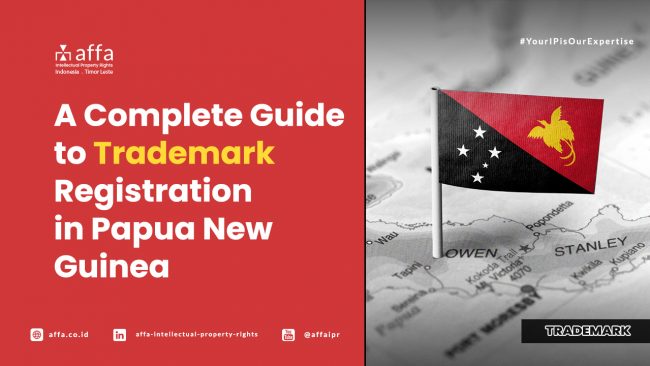
A Complete Guide to Trademark Registration in Papua New Guinea

Papua New Guinea (PNG) and Indonesia are close neighbors but far away. You only need to travel by land to reach it, but after flying for more than five hours from Jakarta to Jayapura, Papua. However, just like the province of Papua, which borders it, PNG is a country with more inland areas than urban areas. Of the approximately 9 million population, less than 2 million live in urban areas. The rest are in remote areas dominated by coffee, chocolate, and palm oil plantations.   However, in 2022, recorded trade transactions between Indonesia and PNG will be among the highest in history, reaching USD 307 million or the equivalent of IDR 4.6 trillion. Indonesia has contributed a lot to road construction and student scholarships. PNG has a lot of potential, starting from its natural beauty, which is the source of many adventure tourism and eco-tourism destinations, to various renewable energy projects, ranging from hydro and solar power to geothermal energy, which, of course, requires a lot of supporting raw materials from extensive industry coverage.   If you see the immense business potential of developing PNG, you can immediately market your products and/or services there. But of course, remember to register your Trademark to get Trademark protection there.   Legal Basis for Trademark Protection in PNG   In PNG, the legal protection of Trademarks is regulated in the “Trade Marks Act, 1980 (Ch.385)” where the administration of registration and legislation is managed by the Intellectual Property Office of Papua New Guinea (IPOPNG), which is under the auspices of the Papua New Guinea Investment and Promotion Authority (IPA). However, IPOPNG has been part of the World Intellectual Property Organization (WIPO) since 1996, the World Trade Organization (WTO), and the Paris Convention since 1999, so you don’t need to worry about the legal standards used.   Registering your Trademark in PNG will protect it, especially if it conflicts with an identical or similar Trademark. The registered status also gives you exclusive rights to the goods and/or services you own, so your Trademark is protected from other parties who use it without permission and from prosecution if violations occur.   Types of Trademark That Can be Registered The definition of a Trademark in PNG is a sign used or proposed to be used in relation to goods or services to differentiate these  goods or services of one entity/ business from those of other entities in the course of trade.   Generally, a sign can be anything from a visible distinctive word or words, letter (s), numeral (number), drawing, picture, shape, color, logotype, label or a combination of one or all of these things. While Trademarks that cannot be registered are marks contrary to moral standards or public order, generic terms non-distinctive marks, surnames, geographic location names, marks that are contrary to law, and marks that may deceive the public or cause confusion.   Trademark Registration Application Process in PNG   The average time frame for the registration approval is 10 months, if no objections or oppositions arise. However, because PNG has not yet joined the Madrid Agreement, you cannot make PNG the destination country for international Trademark registration via the Madrid Protocol. So, if you want to apply there, you must appoint an experienced Trademark Consultant who can be trusted to submit the application to IPOPNG.   However, just like Trademark registration in any country, the first step that is highly recommended is carrying out the search process. This process is essential to check whether the Trademark you want to register is already registered or is being applied for by another party. For this reason, you can visit the WIPO site sorted into the IPOPNG database or the IPOPNG search page for this search process.   After going through the search process and getting an idea of how successful your Trademark registration is, you can continue by paying the application fee to IPOPNG through the Trademark Consultant you have appointed. The following process for Trademark registration in PNG can be seen in the following flowchart: Validity Period for Trademark Protection in PNG   Once your Trademark is registered in PNG, the protection period is ten years from the date of application, and it can be extended for a further ten years by paying a renewal fee. If you want to extend your Trademark, you can apply 1 (one) year before the protection period ends. However, if, for one reason or another, you are late in renewing, you still have a maximum of 1 (one) year after the protection period ends to pay the renewal fee, plus a late payment.   You need to pay attention to the fact that every Trademark registered in PNG must be used. If it is not used for 3 (three) consecutive years, other parties can apply to cancel your Mark. However, if you really don’t want to continue using it, you can request cancellation or transfer ownership to another party.   Should you need further information regarding Trademark registration in Papua New Guinea or other countries, please email us at [email protected]. Source: – Intellectual Property Office of Papua New Guinea

[Important Update] Trademark Certificate Required for Textile, Bag, & Footwear Imports in Indonesia - AFFA IPR

[Important Update] Trademark Certificate Required for Textile, Bag, & Footwear Imports in Indonesia

Effective March 10, 2024, in order to increase Trademark protection and control product quality on the market, Indonesian Ministry of Industry (MOI) has implemented a new regulation significantly impacting importers of textiles, textile products, bags, and footwear. This revision to MOI Regulation No. 5 of 2024 Article 23(3) concerns the procedures for issuing technical considerations for these imports.   Significant changes have occurred, including the addition of the following documents, which are mandatory when an importer submits a General Import Permit for Consumption (API-U).   Trademark Certificates issued by DGIP under the Ministry of Law and Human Rights of the Republic of Indonesia; Proof of recordation the License Agreement, Sublicense, and/or Letter of Appointment from the Trademark Owner to the Authorized Representative; and Letter of Appointment to Import from the Trademark Owner or Authorized Representative.   Affected Products Textiles: Fibers, threads, and fabrics; Textile Products: Carpets, other textile floor coverings, clothing, ready-made clothing accessories, and other finished textile goods; Bags: Suitcases, wallets, school bags, sports bags, handbags, and other bags; Footwear: Shoes, sandals, and moccasins.   The general import permit process remains in place, where the General Import Permit for Consumption (API-U) applies to businesses importing for trading purposes. The application process involves a General Importer Verification (VIU) followed by the MOI’s Technical Consideration (Pertek). Obtaining the API-U permit requires submitting the VIU report and Pertek results to the MOT.   Impact on Importers This new requirement poses a challenge for importers who haven’t secured Trademark registration in Indonesia. The lengthy Trademark registration process, typically taking 1-2 years, necessitates immediate discussions with Trademark owners to obtain the necessary certificates and avoid delays in obtaining import permits. Should you need further information regarding this regulation, including how to register a trademark in Indonesia, please contact us via email [email protected].

Looking forward to meeting you at the 2024 INTA Annual Meeting - AFFA IPR

See You At The Upcoming INTA 2024 Annual Meeting In Atlanta, May 18-22 | 2024

AFFA Intellectual Property Rights—Indonesia & Timor Leste are delighted to announce that our Managing Partner, Emirsyah Dinar, will attend the highly anticipated International Trademark Association (INTA)’s 146th Annual Meeting in Atlanta, USA, this May. As a leading global association of Trademark owners and professionals, INTA’s annual meeting is a must-attend event for IP practitioners worldwide. We look forward to meeting you during the course of the Annual Meeting. For meeting inquiries, please email [email protected].

7 Reasons to Not Use Pirated Software - the Indonesian Context - AFFA IPR

7 Reasons to Not Use Pirated Software – the Indonesian Context

Knowing that the original price of “Windows 11 Home” on the Microsoft website is sold for IDR 2,999,999, but on the well-known e-commerce in Indonesia, it can be found for only IDR 20,000, complete with the promise of an activation key that is valid forever. What’s even crazier is that this high price disparity opens up opportunities for other fraudsters to sell pirated software at various prices, from hundreds of thousands of rupiah to millions, which, of course, can deceive buyers who intend to buy genuine products but are constrained by a limited budget.   However, if you are used to buying original or branded products with a large price difference from the original, you will understand that something is wrong. Yes, of course, it can be suspected that the product being sold cheaper is not genuine, used, or even stolen.   Just like using pirated or stolen products, there are several big risks if we continue to use pirated software. Want to know more?   Here are 7 disadvantages of using pirated software:   Fostering Illegal Activities Software piracy is a violation of Copyright Law and can lead to hefty fines or even jail time, primarily if you use it for commercial purposes without permission or reproduce and distribute it unlawfully. There have been many instances where software companies go after those who use the software illegally for commercial purposes. Security Risks Pirated software often comes from untrusted sources and may contain malware or viruses that can harm your computer and steal your data. Lack of Updates You won’t receive security updates or bug fixes for pirated software, leaving your system vulnerable to attacks. No Technical Support If you encounter problems with pirated software, you won’t have access to customer support from the software developer. Harms Software Development Software piracy reduces software developers’ revenue, making investing harder in research and development of new and improved software. This condition will undoubtedly worsen the growth of innovation in our country. Damaging Your Image Imagine if you are in the middle of an important presentation and, while sharing the screen, a notification appears that your laptop’s operating system needs to be revised. Of course, this would create a wrong impression for you and your company. Clients would also judge that you do not uphold Intellectual Property. Inhibiting Foreign Investment It is common knowledge that Indonesia is still on the list of world countries with serious Intellectual Property violations (along with Argentina, Chile, China, India, Indonesia, Russia, and Venezuela), as released by the United States Trade Representative (USTR) in the 2023 Priority Watch List Special 301 Report.   Overall, the bads of software piracy far outweigh the goods. There are many affordable and legal software options available, and the risks associated with piracy are simply not worth it. If you require further information regarding the software protection, Copyright recordation or Patent registration in Indonesia and abroad, please do not hesitate to contact us via email at [email protected].

Are You Breaking the Law? The Truth About Region Lock - AFFA IPR

Are You Breaking the Law? The Truth About Region Lock

Region lock is a Digital Rights Management (DRM) restriction placed on content or devices. It restricts their use to a specific geographical region. You might know that Netflix Japan has a different movie catalog than Netflix Indonesia. That’s the basic idea, but why?   Before we delve into discussion about the “why,” let’s first learn about the two types of region locking: Content Locking This restricts access to digital content, like movies, games, or even streaming services, based on your location. For instance, a movie available on a streaming service in the US might be blocked for viewers in Indonesia due to licensing agreements. Device Locking This restricts the functionality of a physical device, like a phone or game console, depending on the region it’s purchased in. For example, a phone bought from abroad might not be able to be used in Indonesia.   There are 5 (five) reasons why region locking exists: Content Regulation Copyright laws and regulations that rule contents can vary worldwide. Region locking allows companies to control what content is available in each region, comply with local laws, and avoid any issues.A simple example is that content considered normal in one country will be sensitive if seen in another. Plus, the age limit of 13+ in one country may be 18+ in another. Therefore, creators tend to apply region lock to their work to limit responsibility to the public outside their jurisdiction. Licensing Agreements Sometimes, companies sell the rights to distribute their products (like movies or games) to different companies in different regions. Region locking ensures that people use the product only in the region it’s licensed for.Because Licensing Agreements are a form of IP utilization, a leak from the distribution channel will cause losses for both parties. The licensor will lose potential buyers from other countries/regions, while the licensee will lose exclusivity in their region. Price Discrimination This is another big problem. Because not all countries have the same purchasing power and Licensees are given the authority to determine prices according to the market, differences in selling prices are very likely to occur. For example, an iPhone might be much cheaper in one country compared to another. Region locking stops people from buying the cheaper version and using it or even selling it in the more expensive region. Staged Releases Sometimes, companies might want to release a product in one region before another. Region locking can help them control when and where the product is available.This strategy is usually taken to determine the response from a specific market in a region so any improvements can be made before being released to the wider market. If there is a leak in this stagging release, the research data received will be biased, and the product may be disappointing when it is actually released to the wider market. Technical Reasons In some cases, region locking might be used for technical reasons, like ensuring compatibility with local infrastructure or preventing lag in online games.A clear example is if an application requires a very fast connection, it will not be possible to release it in a country where the internet connection is far below average. If it is forced to be released or accessed outside the region, it will not give a good impression; it will actually bring a lot of complaints, which will make the product look bad in the eyes of the public.   That’s why the region locking can be frustrating for consumers, but it does serve some purposes for companies. So it would be best if you did not force yourself to break it because you might suffer losses such as the following: For You Warranty Voiding Tampering with region locks might be considered a violation of the device’s warranty terms, potentially voiding your warranty and leaving you without coverage for repairs. Technical Issues Bypassing region locks often involves unofficial methods or software. These can be unstable and lead to unexpected glitches or malfunctions with your device or content. Legal Issues Region locking often hinges on copyright or licensing agreements. Breaking these locks might be illegal depending on your location and the specific content or device. For Your Device/Content Limited Functionality Bypassing a lock might disable certain features intended for the original region. For example, a console game might lack online functionality if the region lock is broken. Content Incompatibility Region locking can sometimes be tied to format or encoding differences. Bypassing the lock might lead to compatibility issues, such as the content not playing properly on your device. Other Factors Safety and Security Using unofficial methods to break region locks such as using a Virtual Private Network (VPN) can introduce security risks. Malicious software might be bundled with these tools, putting your device and data at risk.   In the end, it’s important to weigh the potential benefits against the risks before attempting to bypass region locking. Sometimes, waiting for a regional release from the official licensee in the region or considering alternatives like region-free versions might be a safer option.   If you require further information regarding the region lock issue, licensing problem, or want to protect your Intellectual Property in a broader market, please do not hesitate to contact us via email at [email protected].

ASEAN IP 2024: Addressing Intellectual Property Issues by AI by Maximizing the Use of AI - AFFA IPR

ASEAN IPA 2024: Addressing Intellectual Property Issues by AI by Maximizing the Use of AI

This article is a continuation of the previous article, which discussed the Challenges of Intellectual Property Protection in the Digital Era for countries in Southeast Asia, as presented at the 2024 ASEAN Intellectual Property Association (IPA) Annual General Meeting & Conference, which took place on March 1-2 ago in Jakarta, Indonesia. As previously explained, the Digital Economy presents challenges in protecting Intellectual Property (IP) in the ASEAN region. However, what has not been revealed in the article is the contribution of Artificial Intelligence (AI) to the growth of the digital economy and its impact on IP law enforcement, even though AI’s contribution to regional GDP in 2030 will reach USD 1 trillion.   The growth of the Digital Economy in the ASEAN region cannot be denied, generated by many start-up companies in various fields, such as Techinasia in the media sector, Grab in the transportation sector, and Traveloka in the tourism sector. Of the USD 100 billion growth in the region in 2023, around 13% will be supported by investment in the AI sectors, with 6 (six) main uses as follows:   Computer Vision This market focuses on technology that helps computers make sense of digital images and videos. Machine Learning Algorithms teach computer systems to learn from data. Natural Language Processing Deals with technology enabling computers to understand and generate human language. AI Robotics Combining AI, machine learning, and engineering, to create intelligent machines capable of independent tasks. Autonomous & Sensor Technology Machines and systems equipped with sensors and AI operate independently, responding to changes in their environment. Generative AI Involving the creation of models that produce new content like images and text, often indistinguishable from human-created content.   With those various implementations, IP stakeholders must anticipate AI developments because they impact administration, practice, protection, and law enforcement. In particular, AI will confuse IP owners, consultants, and government officials if the laws on Copyright, Trade Secrets, Industrial Designs, Patents, and Trademarks are not changed.   Because AI, on the one hand, is very promising but also dangerous, depending on who uses it. In the UK and the US, there have been more than 10 cases of lawsuits against Generative AI-based companies. For example, OpenAI, the company that created ChatGPT, was deemed to have violated Copyright because it used many well-known works and media news as learning material for its AI system without permission.   Utilization of AI for IP Violations   If ChatGPT argues that the use of the work is for learning and can be settled with royalty payments, in practice, many other uses of AI can be categorized as legal violations, namely: Fabricate, forge, falsify images, certificates, documents, and create deepfakes videos; Create/manufacture realistic counterfeit labels and packaging; Clean up language, grammar, misspellings, and awkward phrasing on labels, packaging, advertising, websites; spam/phishing emails, which were often dead giveaways of counterfeit goods made in a foreign country; and Allow hackers to break into networks through emails that trick recipients into sharing personal info or accessing them illegally.   Benefits of AI in the IP Landscape However, AI is of great benefit to IP law enforcement. Starting from maximizing IP Consultants’ work and the border enforcement process to law enforcement officers.   Maximizing the Work of IP Consultants: Conducting searches and analysis of prior art and IP registration databases more efficiently and accurately; Streamlining contract analysis by extracting and categorizing relevant information, saving time and allowing attorneys to focus on negotiating and drafting contracts; Enabling faster identification of potential conflicts, enhancing due diligence, assisting in determining protection or infringement issues; and application drafting to improve productivity/reduce costs.   Benefits of AI for IP Law Enforcement: Monitor online platforms, websites, and social media for unauthorized use of IP, enabling proactive enforcement by owners; Identify instances of infringement on digital platforms by comparing content or marks against databases of brands, designs, or works; and Assist IP research and litigation by analyzing legal texts, court decisions and precedents, case strategy development, and outcome predictions from historical data. AI is being integrated into the criminal justice process, from crime prevention to evidence analysis. It can assist courts in making sentencing decisions and assess the likelihood of future criminal behavior, thereby informing parole, probation, or release decisions. It can enhance efficiency, accuracy and fairness, but bias, transparency, and ethics concerns have been raised and will continue to be raised as AI technologies become more pervasive and invasive. Benefits of AI for Border Enforcement: Drawing insights and patterns from customs databases, market reports, trade statistics, and IP owner-provided product identification materials; Automatically identifying objects in streaming video and imagery; and Providing real-time alerts to operators when an anomaly is detected, enhances the ability to stop illicit and illegal goods from entering the country.   In the end, new regulations are needed to adapt to AI developments. These regulations should start with rules related to ownership of rights involving AI, rules governing coordination between stakeholders, competition, and privacy, and rules governing resolution and legal enforcement of any disputes that may occur. Only with clear rules can conducive growth be created before the next technological wave finally emerges.   If you require further information regarding the impact of AI on Intellectual Property, please do not hesitate to contact us via email at [email protected].