
Your food recipes are a valuable asset. They represent your creativity, hard work, and passion. That’s why it’s important to protect them as a trade secret from being stolen or plagiarized. Here are some tips on how to protect your food recipes: Document Your Recipe. This means writing down the ingredients, measurements, and steps involved in making the recipe. Be as specific and detailed as possible. Keep Your Recipe Secret. Don’t share it with anyone, not even friends, family, or colleagues. If you do share it with someone, make sure they sign a non-disclosure agreement (NDA). Also, consider the following steps: a) Use a password-protected computer or file-sharing service to store your recipes. b) Don’t post your recipes on social media or other public forums. c) If you are considering selling your recipes, be sure to consult with an attorney to discuss your options. d) If the recipe is not documented in a digital document, please ensure to keep it in a restricted place (i.e. safe deposit box). Keep Your Recipe Documentation Updated As you continue to refine and improve your recipe, be sure to keep your documentation up to date. This will ensure that you always have an accurate and complete record of your recipe, which can be useful in the event of a legal dispute. By following these tips, you can help protect your food recipes and trade secret from being stolen or plagiarized. So, go ahead and share your culinary creations with the world, knowing that you have taken steps to protect your trade secret. If you need more advice for protecting your trade secret in Indonesia and other countries, please do not hesitate to contact us at [email protected]. Sources: Nolo.com LegalVision.com
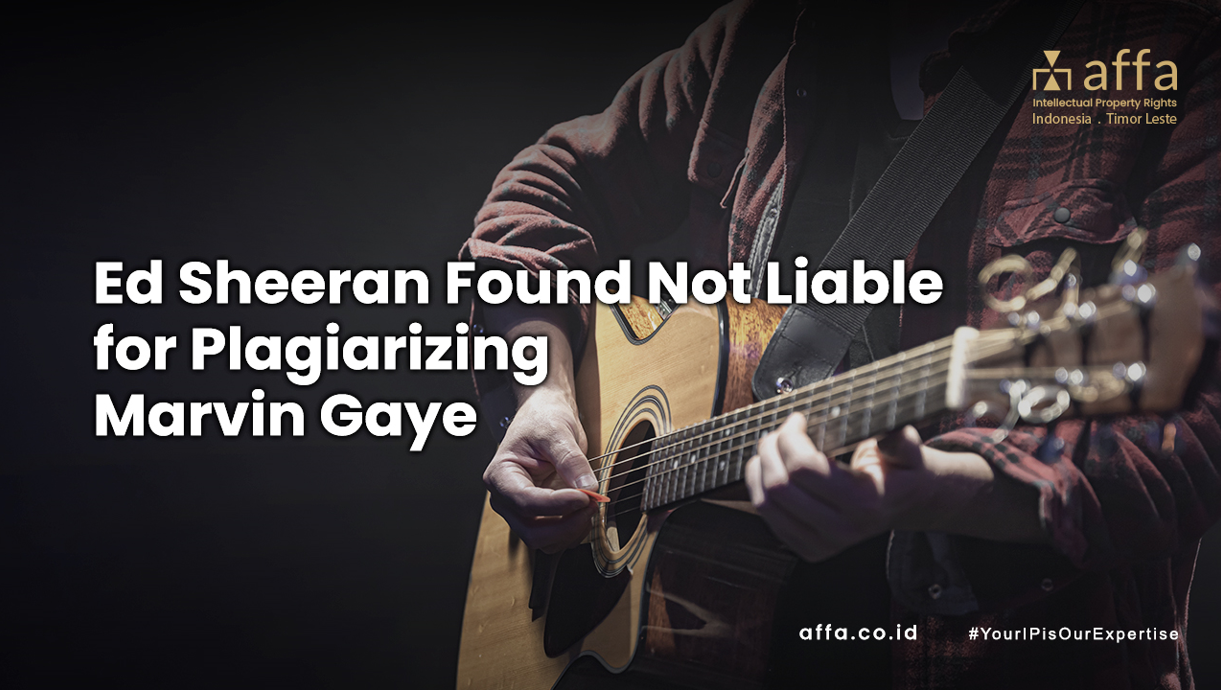
Ed Sheeran Found Not Liable for Plagiarizing Marvin Gaye
A federal jury in New York City found on Thursday that Ed Sheeran did not copy Marvin Gaye’s classic “Let’s Get It On” for his own 2014 hit “Thinking Out Loud.” The verdict came after a two-week trial in which Sheeran and his co-writers testified that they came up with the song independently. The lawsuit was filed by the heirs of Ed Townsend, who co-wrote “Let’s Get It On.” They argued that “Thinking Out Loud” copied the structure, melody, and rhythm of their song. However, the jury found that the similarities between the two songs were not substantial enough to constitute copyright infringement. The verdict is a victory for Sheeran, who has been one of the most successful pop stars in the world in recent years. It is also a setback for the heirs of Townsend, who had hoped to win a large settlement from Sheeran. The case was closely watched by the music industry, as it could have set a precedent for future copyright infringement cases. The verdict suggests that courts will be reluctant to find copyright infringement when there are only superficial similarities between two songs. This is not the first time that Sheeran has been accused of plagiarism. In 2017, he settled a lawsuit with the songwriters of the song “Amazing” by Matt Cardle. The songwriters alleged that Sheeran had copied the melody of their song for his own song “Photograph.” Sheeran has denied all allegations of plagiarism. He has said that he writes his songs from scratch and that he does not intentionally copy other artists’ work. The verdict in the Marvin Gaye case is a relief for Sheeran and his fans. It is also a victory for the music industry, as it sends a message that courts will not be quick to find copyright infringement in cases where there are only superficial similarities between two songs. If you need further information about copyright recordation in Indonesia and other countries, please do not hesitate to contact us at [email protected]. Source: The Guardian
Battle of Trademark: Katy Perry v Katie Perry Unfortunately, the singer lost in Australia.
In a trademark dispute, having a big name sometimes guarantees a win, but only sometimes. When Katy Perry, the owner of five Billboard Music Awards and a judge on American Idol with 108 million followers on Twitter, held concerts in Australia in 2014 and 2018, she sold a lot of fashion products through retail and social media using the trademark “Katy Perry,” which is owned by her company, Killer Queen, LLC. However, it turned out that there was already a similar trademark in Australia with a similar pronunciation, namely “Katie Perry” (with ie), which had been registered by a designer named Katie Taylor in the fashion category (Nice Class 25) since 2008. In 2009, Katy Perry’s lawyers actually tried to cancel Katie’s trademark and sent a “Cease and Desist Order” letter so she wouldn’t use the trademark again, but this effort was not pursued. After Katy Perry’s 2018 concert, which once again sold fashion products, Katie decided to strike back by reporting “Katy Perry” for ignoring the existence of “Katie Perry,” which has homophonous and had already been officially registered in IP Australia Finally, on Thursday, April 27, 2023, Australian Federal Court Judge Brigitte Markovic ruled that Killer Queen, LLC. had been proven to have infringed on some of Katie Taylor’s trademarks and ordered them to compensate for the damages with a certain amount that will be decided later. In response to this victory, Katie Taylor made a statement on her website, “Not only have I fought [for] myself, but I fought for small businesses in this country, many of them started by women, who can find themselves up against overseas entities who have much more financial power than we do. This victory could not have been achieved if Katie had not registered her trademark first. By registering a trademark, the owner obtains their rights, and the state provides legal protection so that the trademark’s economic rights are not violated. In Indonesia, a trademark can only be protected if an application for registration is filed first, and prior use of the trademark cannot be used as a basis for protection. This is because the ‘First to File’ approach is adopted by Law No. 20 of 2016 concerning Trademarks and Geographical Indications. If you need further information about trademark registration in Indonesia and other countries, please do not hesitate to contact us at [email protected]. Sources: Reuters.com Nine.com.au WIPO Global Brand Database
Patent, Trademark, Industrial Design, Copyright: Sorting Out Your Intellectual Property
Intellectual Property (IP) is a term used to describe a variety of intangible assets or creations of the mind that are given legal protection. The three main objects of Intellectual Property are Patents, Trademarks, and Copyrights. Here’s a brief explanation of each: 1. Patents Patents are legal protections for inventions. A patent gives the owner the exclusive right to make, use, and sell the invention for a certain period of time, typically 20 years from the date of filing the patent application. 2. Trademarks Trademarks are distinctive signs that are used to identify and distinguish the goods or services of one business from those of another. Trademarks can be in the form of words, logos, symbols, or a combination of these, and they are used to build brand recognition and goodwill. In general, a trademark registration provides protection for 10 years. However, trademark protection can be renewed indefinitely as long as the trademark owner continues to use the mark and pays the necessary renewal fees. 3. Industrial Design Industrial Design is a creation of shape, configuration, or composition of lines or colors, or lines and colors, or a combination thereof in a three-dimensional or two-dimensional form which gives an aesthetic impression and can be realized in a three-dimensional or two-dimensional pattern and can be used to produce products, goods, industrial commodities or handicrafts. 4. Copyrights Copyrights protect original works of authorship, such as books, music, art, and software. Copyright gives the owner the exclusive right to reproduce, distribute, and display the work for a certain period of time, typically the life of the creator plus 70 years. In addition to these three main objects, there are also other forms of Intellectual Property, such as Trade Secrets and Industrial Designs, which provide protection for confidential information and the aesthetic design of products, respectively. Understanding the different categories of Intellectual Property can be crucial for protecting your intangible assets and creations of the mind. Patents provide protection for inventions or discoveries, Trademarks protect distinctive signs that identify and distinguish goods or services, and Copyrights safeguard original works of authorship. By understanding and utilizing these legal protections, individuals and businesses can ensure that their intellectual property is protected and secure. If you need more advice for protecting your IPs in Indonesia and other countries, please do not hesitate to contact us at [email protected]. Sources: Law No. 13 of 2016 on Patents (Patent Law); Law No. 20 of 2016 on Trademarks and Geographical Indications (Trademark Law) Law No. 28 of 2014 on Copyrights (Copyright Law);
China Dominates Patent Grants, Beating USA & Japan
Patent grants involve a comprehensive examination and review by the relevant government authority to ensure that the invention satisfies specific legal requirements such as novelty, non-obviousness, and industrial applicability. The patent office conducts a search to determine if the invention has already been patented or disclosed by others and may request additional information or amendment of the application. The high volume of patent applications can also cause delays in the processing of the application. These measures are in place to ensure that only truly innovative and practical inventions are granted patent protection. That’s why it takes more than a year to be granted. The following chart was created based on Patent application data in 2021 that have been granted as of February 2023, where China dominates with 607,758 patents or about 38% of the total. In addition, China dominates in 29 categories: 1. Computer & Technology 2. Electrical, Machinery, Apparatus, & Energy 3. Digital Communication 4. Measurement 5. Transport 6. Civil Engineering 7. Other Special Machines 8. Audio Visual Technology 9. Machine Tools 10. Chemical Engineering 11. Handling 12. Pharmaceuticals 13. Materials & Metallurgy 14. Control 15. Mechanical Elements 16. Telecommunications 17. Basic Materials Chemistry 18. Biotechnology 19. Organic Fine Chemistry 20. IT Methods for Management 21. Macromolecular Chemistry & Polymers 22. Other Consumer Goods 23. Environmental Technology 24. Thermal Processes & Apparatus 25. Surface Technology Coating 26. Textile & Paper Machines 27. Food Chemistry 28. Analysis of Biological Material 29. Micro Structural & Nano Technology 30. 31. 32. 33. Meanwhile, the United States only obtained 286,206 patents granted, only 18% or less than half of China’s total. The United States only dominates in the categories of Medical Technology, Engine Pumps & Turbines, Basic Communication Processes, and Other Unknown Inventions. Next, there is Japan with 256,890 patents granted, or about 16% of the composition. Japan leads in the categories of Semiconductors, Optics, as well as Furnitures & Games. What about Indonesia? Data from WIPO (World Intellectual Property Organization) which can be accessed through www3.wipo.int/ipstats/ shows that Indonesia only had 756 patents granted in 2021. This number is lower than Singapore with 4,034 and Malaysia with 1,583. These Indonesian patents are dominated by inventions originating from state universities, such as Andalas University, Brawijaya University, Gadjah Mada University, Diponegoro University, and Bandung Institute of Technology. If you need further information about patent registration in Indonesia and other countries, please do not hesitate to contact us at [email protected]. Sources: OBIS: omnibisolutions.com WIPO IP Stats

See you at the upcoming INTA 2023 Annual Meeting in Singapore, May 16-20 | 2023
AFFA Intellectual Property Rights – Indonesia & Timor Leste are delighted to announce that our team members, Emirsyah Dinar (Managing Partner), Fariz Syah Alam (Partner – Trademark), and Amelia Zafin (Associate – Trademark), will be attending the highly anticipated International Trademark Association (INTA)’s 145th Annual Meeting in Singapore this May. As a leading global association of trademark owners and professionals, INTA’s annual meeting is a must-attend event for IP practitioners around the world. Our team members’ attendance provides a unique opportunity to network with other professionals in the industry, gain insights into the latest trends and best practices, and showcase our firm’s expertise. We look forward to meeting you during the course of the Annual Meeting.