The Management of Royalties for Secondary Use Licenses for the Copyright of Books and/or other Written Works in Indonesia - A Closer Look at the Minister of Law and Human Rights Regulation Number 15 of 2024 - AFFA IPR

The Management of Royalties for Secondary Use Licenses for the Copyright of Books and/or other Written Works in Indonesia – A Closer Look at the Minister of Law and Human Rights Regulation Number 15 of 2024

The Minister of Law and Human Rights of the Republic of Indonesia, Yasonna Laoly, has officially ratified the Minister of Law and Human Rights Regulation (Permenkumham) Number 15 of 2024 concerning Management of Royalties for Secondary Use Licenses for the Copyright of Books and/or Other Written Works.   What is meant by Secondary Use for Book Copyright and/or other Written Works are all activities as follows: printing; photocopy; scanning; screenshot; internet downloading; emailing; posting/uploading; storing; sharing; read aloud in a form of video and/or audio; live performing; or web scraping.   This regulation, published on June 12, 2024, is expected to increase income for book creators and publishers in Indonesia. It also regulates who receives, pays, and distributes royalties for books and other written works.   More specifically, this Regulation describes the following provisions: Royalty Recipient Creator of books and/or other written works who has become a member of the Collective Management Organization (LMK) in the field of books and/or other written works. Royalty Payer Secondary Users include: education units; colleges; educational institutions; research institutions; ministries/institutions/regional governments; private businesses that carry out document duplication activities; photocopying service business; electronic system administrator; broadcasting institutions; artificial intelligence (AI) developer; other Secondary Users in accordance with statutory provisions. Imposition of Royalties The amount of Royalty for Secondary Use of Book Creations and/or Other Written Works is determined by LMK in the field of Books and/or Other Written Works, the amount of which is stated in a mutual agreement stipulated in a written agreement between LMK and Secondary Users, and ratified by the Minister.   Secondary Use rates for educational units, universities, educational institutions, and micro and small businesses can be adjusted by submitting an application letter to LMK with supporting evidence. Royalty Distribution Royalties that LMK has withdrawn will be collected and distributed only to Creators of books and/or other written works who have become members of the LMK, and this is done at least 1 (one) time in 1 (one) year. The Indonesian Publishers Association (IKAPI) acts as LMK Currently, IKAPI has been designated as the first LMK in this field, and a supervisory team formed by the Minister of Law and Human Rights will monitor its performance and finances. Requirements to Become an LMK The Ministry of Law and Human Rights is still accepting applications for operational permits as LMK in the field of Books and/or other Written Works with the following requirements: in the form of a non-profit Indonesian legal entity; obtain authority from the Creator and/or Copyright Holder to collect, gather, and distribute Royalties; have authorized persons as members of at least 200 (two hundred) people who represent the interests of the Creator and/or Copyright Holder; aims to collect, gather, and distribute Royalties; able to collect, gather, and distribute Royalties to Creators and/or Copyright Holders; member of the LMK federation organization in the field of books and/or other written works of international reproduction; And have bilateral/reciprocal agreements with LMK in the field of Books and/or other similar written works in at least 5 (five) countries, government of a country’s particular administrative region and/or certain entities.   With the existence of Minister of Law and Human Rights Regulation Number 15 of 2024, it is hoped that the welfare of authors of books and/or other written works can increase, as well as encouraging the spirit of creativity and the creation of quality works in Indonesia.   Should you have further questions regarding Royalty Management for Secondary Use Licenses for Book Copyrights and/or Other Written Works in Indonesia, please do not hesitate to email us at [email protected].   Source: Directorate General Intellectual Property
Indonesia's Copyright Dilemma: When Good Intentions Pave the Way to (Unintended) Infringement - AFFA IPR

Indonesia’s Copyright Dilemma: When Good Intentions Pave the Way to (Unintended) Infringement

Viral on Social Media about how the family of the late proclaimer of the Republic of Indonesia, Bung Hatta, objected to his speeches, which had been released in book form, being digitized and distributed free to the public by a public official for educational reasons and not for commercial purposes. Why might the family raise objections? Were any laws violated?   Suppose you have several classic books published before 1960, which contain a collection of speeches by Bung Hatta (who died on March 14, 1980), and you have done research that the publisher is no longer there. Then, it doesn’t mean you can transform the creation; in this case, make a digital version and share it for free without permission from the heirs.   Article 40 of the Copyright Law recognizes a book and a lecture/speech as protected works. Most of these books contain Bung Hatta’s speeches, not as the first Vice President of the Republic of Indonesia but as a person who gave speeches on various occasions. So, the assumption that the speech is not protected by Copyright falls.   Specifically, the Copyright Law regulates Moral and Economic Rights, which are creators’ Exclusive Rights. In this case, Bung Hatta gets Moral Rights without time limits and Economic Rights for up to 70 years after his death. If we calculate that Bung Hatta died in 1980, his Economic Rights will still be valid for 70 years starting January 1 of the following year (1981) and will only end in December 2050.   Sanctions for Transformation & Distribution of Works Without Permission   Transforming activities are considered a different Copyright violation than the distribution of works. So parties who create a digital version of a book and share the link without permission can be subject to two articles at once, namely the Copyright Law Article 113 Paragraphs (2) and (3): a maximum imprisonment of 3 (three) years and/or a maximum fine of IDR 500,000,000.00 (five hundred million rupiah) for transforming without permission; And a maximum prison sentence of 4 (four) years and/or a maximum fine of IDR 1,000,000,000.00 (one billion rupiah) for distribution without permission.   But what if you argue that you’re doing it for free?   For educational reasons and not charging fees by distributing it for free, you could say that this activity does not harm the reasonable interests of the Creator, known as the term “Fair Use.” However, it would be best to remember that Fair Use does not look at elements of commercialization. As long as the Copyright holder objects, you can be considered violating Copyright.   The basis is stated in the Explanation of Article 44 paragraph (1) letter a of the Copyright Law, which states “Reasonable Interests of the Creator or Copyright Holder” are interests based on balance in enjoying the economic benefits of a Creation, and it is proven that Bung Hatta’s family has submitted object.   Reasons for Bung Hatta’s Family to Object   In their statement via social media X (Twitter) on June 9, 2024, the family of Halida Hatta, Bung Hatta’s youngest daughter, expressed disappointment from Bung Hatta’s heirs over the piracy of Bung Hatta’s writing, which was shared on social media X. In another statement, the heir reminded us that even though the post was taken down, it can still be prosecuted legally.   The heirs stated that since 1988, Meutia Farida Hatta, the first daughter of Bung Hatta, together with the publisher LP3ES, have collected his works, up to 9 (nine) volumes, so that his writings do not disappear and can be accessed by the public, both by purchasing the physical book in a bookstore or online, or accessing it for free at the National Library.   In their follow-up statement, the heir stated that Bung Hatta’s family had followed the Copyright Memoir, which were published in 1978 by the publisher Tinta Mas before being republished by the publisher Gramedia and then collected and republished by LP3ES. The family does not intend to share or publish it themselves because they are paying respect to the Economic Rights of each publisher. And for now, all of Bung Hatta’s works can be purchased officially at the LP3ES Book Gallery.   Therefore, if you have good intentions to share educational information from a book, especially if you want to share the entire contents of the book for free, the most important thing you have to do is contact the heirs of the Creator. This is because you will get legal information about a work. For example, who is also the Copyright holder for the work, whether it can still be obtained legally, or when the Copyright protection period ends?   So don’t assume that non-commercial actions you carry out without permission will not have legal consequences. The Copyright Law guarantees that Moral and Economic rights are the Exclusive Rights of the Creator and his heirs until the work falls into the Public Domain.   You might also want to read: Demystifying the Public Domain: Permissions and Limitations Should you need further information regarding Copyright and Intellectual Property protection in Indonesia or abroad, do not hesitate to contact us via email: [email protected].

Steps to Consider if Your Copyright is Infringed in Indonesia - AFFA IPR

Steps to Consider if Your Copyright is Infringed in Indonesia

To date, Indonesia is still considered as a “hot bed” for Copyright infringements. Many infringements vary from petty ones to the heavily industrialised ones. Copyrights are protected under the Law No. 28 Year 2014 on Copyrights and by definition, a (Copyright) Creation is any creative work in the fields of science, art, and literature that is produced based on inspiration, ability, thought, imagination, dexterity, skill or expertise expressed in tangible form. A Creator is a person or several people who produce a Creation. Meanwhile, the Copyright Holder is the Creator or other party, including a company that is also given the right by the Creator to obtain Exclusive Rights and economic benefits from a Creation.   Therefore, if another party benefits from a work without permission from the Copyright Holder, it can be categorized as a Copyright infringement. In particular, piracy activities also have the meaning clearly stated in Article 1 of the Copyright Law, namely the illegal duplication of works and/or related rights products and the widespread distribution of goods resulting from such duplication to obtain economic benefits.   Because economic benefits are the Copyright Holder’s exclusive right and infringement is still widespread in the modern era, if you are a Creator or Copyright Holder, you need to understand your rights and know what you can do when your work is pirated in Indonesia.   Record Your Creation before the Copyright Office under the DIrectorate General of Intellectual Property (DGIP)   Copyright protection is granted automatically from the time the copyrighted work is produced. This is different from other Intellectual Property, such as Trademarks and Patents, which must be registered first to obtain protection. Therefore, the term used to register copyright with the Directorate General of Intellectual Property (DGIP)—Ministry of Law and Human Rights (Kemenkumham) is “recordation.”   Hence, no recordation is required to prosecute or file a lawsuit against a party deemed to have violated Copyright. However, suppose there is a dispute regarding Copyright ownership of a work. In that case, a work recordation letter issued by the Minister, in this case the DGIP, and recorded in the General Register of Works is initial proof of ownership of a work and is substantial evidence in court.   Prioritize Mediation, Amicable Settlements, Before Pursuing Criminal Charges   Article 95 Paragraph (4) of the Copyright Law stipulates that Copyright violations, including piracy, must take mediation before making criminal charges.   So if you find that your work has been pirated, you can give an informal warning first, followed by a warning letter, if you don’t get a response.   Contents of the Warning Letter: In general, there are no standard rules governing the contents of a warning letter, but it must clearly describe the following 5 (five) things: Intended party; The problem being addressed; The demands of the sender, which the recipient must implement; Legal basis and legal standing of the sender; and The period for demands must be met.   Violations in Social Media/E-Commerce   Piracy is rampant on various social media and e-commerce platforms in the internet era. Technically, each platform also provides a complaint service if pirated goods are found. If you find Trademarks or Copyrights being bought and sold there without permission, you can start from the self-report system or go to the particular page provided.   In general, you need to prepare the following 3 (three) things if your report is to be followed up: Proof of ownership of the work in the form of a work recordation letter issued by the Ministry of Law and Human Rights, a statement of work ownership signed by you, or a similar document; Proof of your identity (ID card, driving license, passport, or similar); and Power of attorney from the Copyright Holder by the document proving ownership of the work you attached (if you are not the owner of the Copyright but are the recipient of the power of attorney from the Copyright owner to make a report).   You might also want to read: Tackling Counterfeiters on Indonesian E-Commerce Sites   Suppose pirates or platforms ignore your warning. In that case, you need to engage an experienced Intellectual Property Consultant who can provide further advice so that piracy activities from other parties can be stopped immediately or proceed with criminal prosecution at the Commercial Court.   Violations By Fellow Creators   A problem that also often occurs in Copyright disputes is disputes between Creators who claim they have the right to get more than others. For example, a comic was created jointly by an illustrator, a colorist, and a writer. If, in the future, the writer feels that his share is smaller, he might claim his rights. There was also a case that went viral in which a band was subpoenaed and prohibited from performing songs by writers who had left the band.   That is where the critical role of copyright recording with DGIP is to avoid disputes that may arise in the future between creators. In the Copyright Recordation, which is then included in the DGIP General Register of Creations, you can consist of all existing Creators. But again, mediation is still the most recommended route before trial.   Furthermore, you can also register a License Agreement for the work you own because it is possible for you, as the Creator of a character, to need vendors or other parties interested in getting economic benefits from your creation. For example, suppose a t-shirt or toy manufacturer is interested in commercializing your work in massive quantities and distributing it throughout Indonesia. In that case, you need to make a clear License Agreement that details how much royalties or profit sharing scheme you will get and register the agreement with DGIP as a firm grip in case of default or dispute in the future.   You might also want to read: Unveiling Copyright Ownership in the Film Industry: Legal Perspectives Should you need more information about Copyright protection in Indonesia, don’t hesitate to contact us at…

7 Reasons to Not Use Pirated Software - the Indonesian Context - AFFA IPR

7 Reasons to Not Use Pirated Software – the Indonesian Context

Knowing that the original price of “Windows 11 Home” on the Microsoft website is sold for IDR 2,999,999, but on the well-known e-commerce in Indonesia, it can be found for only IDR 20,000, complete with the promise of an activation key that is valid forever. What’s even crazier is that this high price disparity opens up opportunities for other fraudsters to sell pirated software at various prices, from hundreds of thousands of rupiah to millions, which, of course, can deceive buyers who intend to buy genuine products but are constrained by a limited budget.   However, if you are used to buying original or branded products with a large price difference from the original, you will understand that something is wrong. Yes, of course, it can be suspected that the product being sold cheaper is not genuine, used, or even stolen.   Just like using pirated or stolen products, there are several big risks if we continue to use pirated software. Want to know more?   Here are 7 disadvantages of using pirated software:   Fostering Illegal Activities Software piracy is a violation of Copyright Law and can lead to hefty fines or even jail time, primarily if you use it for commercial purposes without permission or reproduce and distribute it unlawfully. There have been many instances where software companies go after those who use the software illegally for commercial purposes. Security Risks Pirated software often comes from untrusted sources and may contain malware or viruses that can harm your computer and steal your data. Lack of Updates You won’t receive security updates or bug fixes for pirated software, leaving your system vulnerable to attacks. No Technical Support If you encounter problems with pirated software, you won’t have access to customer support from the software developer. Harms Software Development Software piracy reduces software developers’ revenue, making investing harder in research and development of new and improved software. This condition will undoubtedly worsen the growth of innovation in our country. Damaging Your Image Imagine if you are in the middle of an important presentation and, while sharing the screen, a notification appears that your laptop’s operating system needs to be revised. Of course, this would create a wrong impression for you and your company. Clients would also judge that you do not uphold Intellectual Property. Inhibiting Foreign Investment It is common knowledge that Indonesia is still on the list of world countries with serious Intellectual Property violations (along with Argentina, Chile, China, India, Indonesia, Russia, and Venezuela), as released by the United States Trade Representative (USTR) in the 2023 Priority Watch List Special 301 Report.   Overall, the bads of software piracy far outweigh the goods. There are many affordable and legal software options available, and the risks associated with piracy are simply not worth it. If you require further information regarding the software protection, Copyright recordation or Patent registration in Indonesia and abroad, please do not hesitate to contact us via email at [email protected].

The Benefits of IP Customs Recordation for Your IPs in Indonesia - AFFA IPR

The Benefits of IP Customs Recordation for Your IPs in Indonesia

Recently, the Directorate General of Customs and Excise of the Republic of Indonesia (DGCE) has taken widespread action against tons of illegal food to protect consumers and the Indonesian food industry. Because the ingredients of food imported illegally are unknown, it can endanger residents and disrupt the distribution of local food producers. But did you know that Customs and Excise can also deter illegal goods that violate Intellectual Property abroad or within the country? Because DGCE is part of the Task Force together with the Criminal Investigation Agency of the Republic of Indonesia Police (Bareskrim Polri), the Indonesian Food and Drug Authority (BPOM), and the Directorate General of Informatics Applications (Ditjen Aptika), which supports the performance of the Directorate General of Intellectual Property (DGIP) in enforcing Intellectual Property Law in Indonesia. Enforcing this law is a collective homework because Indonesia is still on the list of world countries with serious Intellectual Property violations (along with Argentina, Chile, China, India, Indonesia, Russia, and Venezuela), as released by the United States Trade Representative (USTR) in the 2023 Priority Watch List Special 301 Report. A few weeks ago, DGCE conducted outreach to the public so that the wider community, especially Intellectual Property (IP) owners, could take advantage of this service. So, if illegal products are found crossing state borders, IP owners, especially copyright and trademark owners, will be assisted in the deterrence process. But before that, you must first carry out the recordation process on the DGCE website. For those of you who are still unfamiliar with the term “deterrence”, this word has 2 (two) meanings, namely: Delaying the release, loading, or transportation of excisable goods and/or other goods related to excisable goods; Prevent the departure of means of transport.   The Benefits of IP Customs Recordation in DGCE The recordation process is an activity to enter your IP information into the DGCE customs database, with the following benefits: Action at Ports or Borders; Especially if the quantity of goods smuggled is very significant. Effective and efficient deterring before goods that violate IPR are distributed to the domestic market. Protecting IP Owners’ Business Processes; Products are protected from counterfeiting or infringement attempts. Maintain consumer confidence in products on the market. Maintaining brand reputation from low-quality counterfeit products. Macro Aspects; Increasing investor confidence, both domestic and foreign. The government can restore international trust in the seriousness of eradicating counterfeit products in Indonesia.   The Authority of DGCE DGCE has two schemes for the enforcement of Intellectual Property Law: Judicial Scheme that applies to all IP regimes: DGCE may impose a temporary suspension until a physical examination. However, DGCE’s position here is passive because it must wait for a temporary suspension order from the Commercial Court, where the Rights owner must carry out the initiative without any prior obligation to record it on the DGCE site. Ex-Officio Scheme for Trademarks and Copyrights: After the rights owner carries out the recordation process with the DGCE, the process of deterrence, temporary suspension, and physical examination can be carried out proactively by the DGCE.   Conditions for IP Customs Recordation at DGCE As the owner or right holder, you must submit a written application accompanied by the required documents by Minister of Finance Regulation (MFR) Number 40/pmk.04/2018 concerning Recording, Deterrence, Guarantee, Temporary Suspension, Monitoring and Evaluation in the Context of Controlling the Import or Export of Suspected Goods Constituting or Originating from the results of Violations of Intellectual Property Rights, to the Director of Action and Investigation at the DGCE Head Office and submitted electronically via the CEISA IPR application which can be accessed on the user portal.   Then you are required to prepare the following documents as attachments: Copy of Company Deed of Establishment and Latest Amendments Copy of Taxpayer Identification Number (NPWP) Copy of Trading Business License (SIUP) or Company Registration Certificate (TDP) Copy of Domicile Letter Copy of Trademark Certificate/ Registration or Copyright Recordation Letter issued by DGIP Information regarding product authenticity characteristics (mark, product appearance, packaging, distribution route, etc.) Statement letter as regulated in Appendix B – MFR No. 40/PMK.04/2018 Proof of transfer of rights (if rights are transferred) Information on parties granted the right to import/export Other information(s) required by DGCE   Involve Internal or External Examinator Apart from that, you must appoint one or more examiners who are experts on the product, who can come from within or outside the company, and who understand the Trademark or Copyright of the item to be recorded. If the goods recorded are related to the Trademark, the appointed Examiner(s) must understand the characteristics of product authenticity, such as the mark, goods, logo, product appearance, packaging, distribution, and marketing routes, as well as the number of products marketed in that area. However, suppose the item being recorded is related to Copyright. In that case, the examiner must understand the characteristics or specifications of the copyrighted work in the fields of science, art, literature, or related rights being created.   DGCE Research Procedure Approximately 30 Days All requirements will then undergo formal and material research by DGCE, including validating the data with DGIP. If this recordation is approved, it will be valid for 1 (one) year and can be extended. The entire recordation process is free of charge and only takes approximately 30 days. However, if you are a Trademark Owner or Copyright Holder who is a foreign company and domiciled abroad, you must have a business entity domiciled in Indonesia. DGCE has successfully disposed of more than one million pens, three million razors, 72 thousand more cosmetics, up to 160 rolls, and 890 cartons of sandpaper in the last four years. This number is not much because not many Trademark Owners and Copyright Holders take advantage of this feature. Therefore, if you own a product with a high cross-border risk, we recommend immediately recording it at DGCE.   If you still have questions or need further information regarding Intellectual Property Customs Recordation at the Directorate General of Customs and Excise, do not hesitate to…

AFFA IPR Si Juki Team Up to Raise IP Awareness in Indonesia

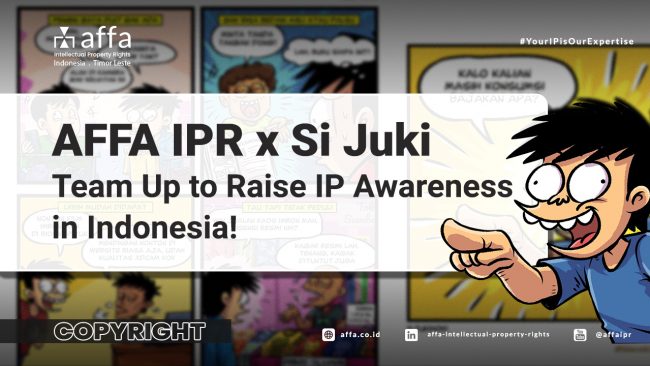
AFFA IPR x Si Juki Team Up to Raise IP Awareness in Indonesia!

Check out AFFA IPR’s first collaboration with Indonesia’s iconic Si Juki character in a comic raising awareness about IP. With more than 771K followers on Instagram, Si Juki is the work of Faza Meonk, one of Indonesia’s most influential IP creators, who has collaborated several times with various international IPs, such as Garfield and SpongeBob SquarePants. Not only in comic form, Si Juki has also appeared in big-screen animated films. Stay tuned for more exciting collaborations from AFFA IPR!

Indonesia-Issues-Publisher-Rights-Google-and-Social-Media-Must-Collaborate-with-Local-Media-affa-global

Indonesia Issues Publisher Rights: Google and Social Media Must Collaborate with Local Media

Indonesia Issues Publisher Rights: Google and Social Media Must Collaborate with Local Media The President of the Republic of Indonesia, Joko Widodo, on February 20, 2024, signed the Presidential Regulation Number 32 of 2024 concerning the Responsibility of Digital Platform Companies to Support Quality Journalism. One of the provisions in that regulation, which President Joko calls the Publisher Rights Regulation, requires digital platforms such as Google, Facebook, and X (Twitter) to collaborate with local media companies.   The Presidential Regulation on Publisher Rights consists of 6 (six) chapters and 19 articles, with a summary as follows:   Chapter I: General Provisions This chapter regulates the responsibilities of digital platform companies, such as Google, Facebook, or X (Twitter), to maintain a healthy news business ecosystem and support quality journalism.   Chapter II: Digital Platform Companies Digital platform companies are determined based on service presence in Indonesia. They are obliged to support quality journalism by: Not facilitating the dissemination and/or commercialization of news content that is not by the law regarding the press after receiving reports through reporting facilities provided by digital platform companies; Provide best efforts to prioritize the facilitation and commercialization of news produced by press companies; Provide fair treatment to all press companies in offering services; Carrying out training and programs aimed at supporting quality and responsible journalism; Providing the best effort in designing news distribution algorithms that support the realization of quality journalism by democratic values, diversity, and statutory regulations; Collaborate with press companies that the Press Council has verified in four ways, namely: Paid license Profit sharing Sharing aggregate data of news users Other agreed forms   Chapter III: Cooperation and Dispute Resolution Apart from regulating the forms of cooperation as mentioned above, this chapter discusses how to resolve disputes between digital platform companies and the press, namely: The parties, individually or collectively, can submit legal remedies outside the general court through arbitration or alternative dispute resolution. Dispute resolution is carried out independently by statutory provisions.   Chapter IV: Committee The committee was formed and determined by the Press Council. Duties and functions are as follows: Ensuring the fulfillment of digital platform company obligations. Supervise and facilitate the fulfillment of company obligations related to digital platforms. Provide recommendations to the Minister regarding the results of supervision. Facilitate arbitration or alternative dispute resolution between digital platform companies and the press.   Matters relating to the committee are: Every committee decision-making is carried out in a collegial collective manner and is accountable to the public. If a consensus deliberation agreement is not reached, the majority vote decides. Each committee agreement must: Through a consideration process that considers input in the form of opinions and thoughts that develop in society. Guarantee transparency, guarantee independence, and fulfill a sense of justice. The committee must regularly report to the public on implementing its duties and functions at least once a year. This report is uploaded to the Press Council information system and must be easily accessible to the public. The committee consists of representatives from: The Press Council does not represent press companies. Ministry. Experts in Digital Platform Services who are not affiliated with digital platform companies or the press. The committee members have an odd number of at most 11 people, consisting of: Representatives from elements of the Press Council, a maximum of five people; Representatives from elements of the Ministry are one person; Representatives from expert elements, as a maximum of five people, and appointed by the minister who coordinates government affairs in politics, law, and security. The composition of the committee membership consists of: One committee chairman is also a committee member. One deputy chairman of the committee is also a member of the committee. Committee members can be appointed for a term of three years and can be re-elected for another term. The Committee is assisted by a secretariat, held ex officio by the Secretary of the Press Council.   Chapter V: Funding Sourced from press organizations and companies, assistance from the state and/or others by statutory provisions.   Chapter VI: Conclusion Regulates the implementation of the Presidential Regulation on Publisher Rights, namely six months from the date of promulgation or August 20, 2024.   With this Publisher Rights Regulation, the government of the Republic of Indonesia is trying to organize the ecosystem of digital platform companies with press companies to support quality journalism to realize a democratic life as a nation, state, and society.   If you need more information about the Presidential Regulation on Publisher Rights and its implementation in Indonesia, please contact us via [email protected]. Source: Presidential Regulation Number 32 of 2024 concerning the Responsibility of Digital Platform Companies to Support Quality Journalism

Remixed-Music-from-the-Indonesian-Intellectual-Property-Perspective-AFFA-Copyright

Remixed Music from the Indonesian Intellectual Property Perspective

Remixed Music from the Indonesian Intellectual Property Perspective The weekend is just around the corner. Which club will you go to to spend the night? The club with the most comfortable atmosphere? In the middle of the city? On the beach? Club with makes the best drink? Or the one with the most popular live music?   Live music has become a form of entertainment that is inseparable from nightlife. With the mix of popular and new songs sung, we can be hypnotized for a moment and forget all our problems. But for those of you who are on the side of event organizers, venue managers, or artists who perform this music/song, don’t let yourself get into trouble.   Because music/songs with or without text (lyrics), in Article 40 of the Law of the Republic of Indonesia Number 28 of 2014 concerning Copyright, is stated as a form of protected work. For these creations, there are Exclusive Rights (moral and economic) holders entitled to royalties from every music/song performed. If done without paying royalties, performing music/songs without permission for commercial purposes can be categorized as a Copyright violation.   However, Who Should Pay the Royalties? In Article 3 of the Republic of Indonesia Government Regulation Number 56 of 2021 concerning the Management of Song and/or Music Copyright Royalties, it is regulated that every person can make commercial use of songs and/or music in the form of commercial public services by paying royalties to the Creator, Copyright Holders, and/or Related Rights Owners through the National Collective Management Organization (LMKN).   Commercial public services include commercial seminars and conferences; restaurants, cafes, pubs, bars, lounges, nightclubs, and discotheques; music concerts; airplanes, buses, trains, and ships; exhibitions and fairs; cinema; telephone waiting tone; banks and offices; shops; recreation center; television broadcasting institutions; radio broadcasting institutions; hotels, hotel rooms, and hotel facilities; and karaoke business.   Regarding Music Mix performed in restaurants, cafes, pubs, bars, discotheques, or nightclubs, Article 3 GR No. 56 of 2021 concerning the Management of Song and/or Music Copyright Royalties has specifically regulated the rates as follows:   Restaurants and Cafes Royalties are determined per seat per year, with the provisions of the Creator royalty being IDR 60,000 per seat per year and the Related Rights royalty being IDR 60,000 per seat per year.  Pubs, Bars, and Lounges Royalties are determined per square meter per year. The royalty rate for the Author’s Rights is IDR 180,000 per square meter per year, and the royalty rate for Related Rights is IDR 180,000 per square meter per year.  Discotheques and Nightclubs Royalties are determined per square meter per year. The royalty rate for the Author’s Rights is IDR 250,000 per square meter per year, and the royalty rate for Related Rights is IDR 180,000 per square meter per year.   Note: Author’s Rights are royalties given to the Creator, while Related Rights are royalties given to musicians, original singers (performers), and producers of the song/music.   Because Creators or recipients of Related Rights do not always know when and where their songs are performed, the government has given authority to LMKN to collect royalties and distribute them to Creators and recipients of Related Rights. Therefore, if you are a restaurant and cafe, pub, bar and lounge, discotheque, and nightclub manager, you will be the one who will be charged royalties for the songs/music held inside your business, not the artist or performer who performs the music.   Before LMKN inspects your business, it would be a good idea for you first to carry out the following procedures: Submit a license application to the Copyright holder or Related Rights owner through LMKN; The license agreement is recorded by the Minister of Law and Human Rights by statutory provisions; Provide reports on the use of songs and/or music to LMKN via the Song and/or Music Information System (“SILM” Platform); Pay royalties to Creators, Copyright holders, and/or Related Rights owners through LMKN;   Based on the rules above, royalty payments are not explicitly charged per song but are based on the number of seats or the size of your commercial area. But you must know what song and/or music is being performed so that you can accurately report it through SILM, and the creator and/or recipient of related rights can obtain their rights properly. You can then hold proof of royalty payments to LMKN if, in the future, there is a lawsuit from the creator who objects to the use of their work in your place.   What if the Music Mix is commercialized? Sometimes, DJs also record and distribute their favorite remixes, even selling them on a limited basis to their fans. Is this an unlawful act?   Returning to the rules regarding the Exclusive Rights of a music/song, where Article 9 of the Copyright Law states that only the Copyright Holder has the Economic Rights to adapt, arrange, and transform the work, as well as copy and use commercially, so to be able to do this, these DJs must obtain permission by submitting a license application to the Copyright holder or Related Rights owner. Otherwise, as regulated in Article 113 concerning Criminal Provisions for Copyright Infringement, “Every person who fulfills the elements as stated in as intended in paragraph (3), which is committed in the form of piracy, shall be punished with imprisonment for a maximum of 10 (ten) years and/or a fine of a maximum of IDR 4,000,000,000.00 (four billion rupiah).”   After understanding the risks, if you are a DJ or musician and a live music organizer, you have to be more aware of implementing your business by applicable regulations. If you have further questions regarding commercial use of music/songs, Copyright, or other Intellectual Property, don’t hesitate to contact us via [email protected].

Writer-Forbids-Singers-from-Performing-Their-Songs-Is-It-Possible-affa-global

Writer Forbids Singers from Performing Their Songs – Is It Possible?

Writer Forbids Singers from Performing Their Songs – Is It Possible? A few weeks ago, the Indonesian music industry was enlivened by the case of a 35 billion Rupiah lawsuit from Ndhank Surahman Hartono, former guitarist and composer of the song “Mungkinkah” (in English: “Is it possible?”), against the band Stinky, where he used to belong. Apart from prohibiting Stinky from performing the song he wrote, Ndhank also prohibited Stinky’s former vocalist, Andre Taulany, later known as a comedian, from performing the song at any opportunity.   However, two weeks later, Ndhank withdrew his lawsuit after Andre and his colleagues took a family approach. Ndhank even broke off cooperation with the lawyer who had previously directed him to file a lawsuit. Stinky revealed that the song was not created by Ndhank alone but was created with Irwan Batara, a bass player who is still active with Stinky and can be proven by a recordation certificate at the Directorate General of Intellectual Property (DGIP), complete with royalties that have been given regularly through the Collective Management Organization (LMK), namely Yayasan Karya Cipta Indonesia (YKCI) and Wahana Musik Indonesia (WAMI).   That demand arose because Ndhank was experiencing economic difficulties, even though he saw that his song was still popular and often performed. He then demanded to renegotiate the distribution of royalties for the song to 90:10 because Irwan Batara’s portion was only the lyrics at the end of the song. So, from an Intellectual Property perspective, does a songwriter have the right to prohibit other parties from performing their songs?   The Copyright Holder of A Song Article 1 of Law of the Republic of Indonesia Number 28 of 2014 concerning Copyright states that a Creator is a person or several people who individually or together produce a Creation that is unique and personal in nature, and Article 40 states, “Songs and/or music with or without text” is a form of protected work.   Uniquely, in a song, the holder of Exclusive Rights (Moral and Economic) is not only the Creator as the Copyright Holder but also musicians, original singers as performers, and song producers who are also considered recipients of Related Rights. So, if a song generates royalties, those entitled to receive them are the creator and all parties listed as recipients of Related Rights. Then, Article 70 of the Copyright Law, which explains Article 40, states that a song is a complete creative work. So it will be difficult for the Creator to claim a 90% share of royalties from a song, as in Ndhank’s demands, without mutual agreement from the other Creator, in this case, Irwan Batara, as well as the recipients of Related Rights, including Andre, the vocalist who popularized the song.   Legal Basis for the Creator to Prohibition Because the original singer who first popularized a song is the recipient of the Related Rights, Article 13 of the Copyright Law also states that if the singer performs in a public performance, it is not considered a violation of Copyright. Unless otherwise indicated or approved by the Performer or the holder of the rights to the performance before or during the performance. So, in the case of the song “Mungkinkah,” what Andre did was not a copyright violation. However, the case is different if the person banned is not the original singer, as was done by Ahmad Dhani, the creator of the DEWA band’s songs, to Once Mekel, the former vocalist of the DEWA. Due to Once’s position as not being the original singer of all of DEWA’s songs, he is not the recipient of the Related Rights of all of DEWA’s songs. Hence, as Creator, Ahmad Dhani has the right to prohibit Once from performing his songs, including not including Once’s name as a royalty recipient.   Ideal Royalty Distribution In particular, no legal regulations regulate what percentage must be received by a creator (songwriter), what percentage is for performers (singers), and what percentage is for music producers because it goes back to their agreement at the beginning. This is where the source of the problem usually arises. In many cases, we can see that the singer then earns a lot of income from the various performances he performs, both alone and with his band. Meanwhile, the part that the songwriter received is only known by himself and the record producer.   Suppose we refer to Spotify, a music platform with 8.8 million users in Indonesia. In that case, the distribution of royalties is wholly handed over to the record producer/label owner and then distributed to the Creator and all recipients of Related Rights. However, what needs to be remembered here is that royalties are obtained from performances delivered by singers or playback of their songs via the application and from commercial playback of songs by other parties, for example, in shopping centers, hotels, cafes, and karaoke rooms.   This is where Collective Management Organization (LMKN) plays a role; as regulated by Government Regulation Number 56 of 2021, LMKN is a government auxiliary institution tasked with collecting and distributing royalties as well as managing the interests of the Economic Rights of Creators and Owners of Related Rights in the field of songs and/or music. If LMKN had functioned optimally in carrying out its duties, popular songwriters would have been able to have a better economy, and cases like this would not need to happen.   Should you need further information about Royalty and Copyright or other Intellectual Property Management, please do not hesitate to contact us via [email protected].

AI-A-Threat-to-Our-Intellectual-Property

AI: A Threat to Our Intellectual Property?

AI: A Threat to Our Intellectual Property? AI is a branch of computer science that deals with creating intelligent agents, which are systems that can reason, learn, and act autonomously. AI research has been highly successful in developing effective techniques for solving a wide range of problems, from self-driving cars, medical diagnosis, product recommendations, creating articles or songs based on voice collections, and processing very realistic images.   The sophistication of AI also makes the operation of an application no longer need to be done manually. For example, not by carrying out a series of actions or commands via menu clicks but simply by writing down the command, the AI will carry out the operation automatically. However, this sophistication is open to controversy because the basis of AI’s capabilities comes from a collection of data taken without permission from what is already available on the internet. This is undoubtedly dangerous for Intellectual Property.   In general, AI can harm Intellectual Property in the following 3 (three) ways:   1. AI Can Copy Your Work AI can be trained on a massive dataset of text, images, and code. This means that it can learn to reproduce your work, even if you have taken steps to protect it, such as copyrighting it.   2. AI Can Create Derivative Works AI can be used to create new works based on your original work. For example, an AI could be used to create a new painting based on your existing painting.   3. AI Can Use Your Work Without Attribution AI can be used to create new works that do not give you credit for your original work. This can happen if the AI is not properly trained or if the person using the AI does not understand the importance of attribution.   Recognizing the potential for Intellectual Property infringement that AI-based applications can carry, several countries have taken steps to prevent further disputes. Some of these countries are Japan and the European Union.   AI Copyright Protection for Japanese Artists Agency for Cultural Affairs Government of Japan) on May 30th, the statement “Regarding the relationship between AI and copyright” divides AI use into two stages: First Stage AI can be used for research and education purposes without requiring Copyright permission, but this has limitations if it exceeds recognized necessary limits or harms the Copyright holder’s interests.  Second Stage If AI-generated works are published or sold as reproductions and infringe Copyright laws, the Copyright holder has the right to take legal action, potentially leading to criminal penalties.   The document emphasizes strict penalties for Copyright Infringement through AI-generated works that are almost identical or clearly dependent on existing copyrighted works. Japan plans to raise awareness about these issues through seminars and collaborate with legal experts to proactively regulate commercial AI and protect the copyrighted works of Japanese artists and creators.   This approach signifies Japan’s commitment to shield copyrighted creative work, data, and materials from commercial AI use, potentially impacting AI developers and users aiming to exploit stolen art and creative works for profit. The move marks a potential turning point in the fight against Copyright Infringement by AI, providing more vital protection for artists’ Intellectual Property.   In the next article, we will discuss The Artificial Intelligence Act (AIA) the European Union’s draft for AI regulation related to the protection of Intellectual Property.   If you need further information regarding the registration and protection of Intellectual Property in Indonesia and abroad, don’t hesitate to contact us via [email protected]. Sources: IBM PC Watch