Indonesian IP Office Declares 2025 the Year of Copyright and Industrial Design - What Are the Benefits? - AFFA IPR

Indonesian IP Office Declares 2025 the Year of Copyright and Industrial Design – What Are the Benefits?

The Indonesian IP Office (DGIP) has reaffirmed its commitment to supporting the protection and development of Intellectual Property (IP) in Indonesia. 2025 has been declared the Year of Copyright and Industrial Design, marking a new strategic initiative to strengthen Indonesia’s IP ecosystem. This policy not only aims to raise awareness of the importance of Copyrights and Industrial Designs but also to create a more conducive environment for businesses and investors, both domestic and international.   This declaration is based on several initiatives and policies implemented by DGIP over recent years. After the 2024 Year of Geographical Indications, DGIP recorded a significant increase in IP applications, demonstrating heightened public awareness of the importance of IP protection. With the declaration of the Year of Copyright and Industrial Design, DGIP aims to continue this positive trend, particularly by increasing the registration of Copyrights and Industrial Designs.   DGIP has set ambitious targets, with the Director General of Intellectual Property aiming for increased Non-Tax State Revenue (PNBP) for 2026: IDR 28,156,750,000 from Copyrights, IDR 354,753,680,000 from Trademarks, and IDR 529,167,083,000 from Patents and Trade Secrets.   DGIP’s Achievements in 2024 As a foundation for 2025, DGIP achieved several milestones during 2024:   Increase in Intellectual Property Applications DGIP recorded a significant increase in IP applications, including Copyrights, Industrial Designs, and Geographical Indications. In 2024, more than 15,000 Copyright applications were recorded, a 20% increase compared to the previous year. DGIP also received approximately 5,000 Industrial Design applications, reflecting a 15% growth. Furthermore, 50 new Geographical Indication applications were filed, indicating rising public awareness of protecting local wealth-based products. Launch of the 2025-2029 National Geographical Indications Roadmap This strategy aims to strengthen the management and preservation of Geographical Indication-based products, providing direct economic benefits to local communities. Enhanced Services and Transparency Through various initiatives, including the 2024 IP Program Financial Coordination Meeting, DGIP improved service efficiency, especially by expediting IP registration processes to enhance user experience. International Collaboration DGIP successfully established partnerships with international organizations to strengthen IP protection in Indonesia. These collaborations included training, capacity-building for human resources, and promoting Indonesian IP products in global markets. Key IP-Based Regional Programs This initiative encourages the development of IP-based regions to support sustainable economies, enhancing the competitiveness of local products in international markets. These programs range from the Development of Geographical Indications-Based Local Products, Creative Economy Zones Based on IP, to IP-Based SME Assistance.   Strategic Policies Supporting the Year of Copyright and Industrial Design To ensure the success of this initiative, DGIP has formulated several strategic policies and measures:   Updating the 2024-2029 Strategic Plan During the Strategic Plan Update meeting in Bogor in December 2024, DGIP designed data-driven programs to anticipate future needs and challenges. This step ensures that policies related to Copyrights and Industrial Designs align with global dynamics. Strengthening Services and Financial Management Through the 2024 IP Program Financial Coordination Meeting, DGIP focused on improving services and the potential for Non-Tax State Revenue (PNBP). Efficient financial management has become a priority to support optimal operations, particularly in expediting the registration and protection of Copyrights and Industrial Designs. IP-Based Regional Programs DGIP launched flagship programs that utilize IP-based regions to support sustainable economies. This approach aims to enhance the competitiveness of local products with IP value in global markets, providing direct economic benefits to communities and businesses. 2025-2029 National Geographical Indications Roadmap While focusing on Geographical Indications, this roadmap serves as an example of how DGIP designs comprehensive strategies for IP management. Similar approaches are expected to be applied to Copyrights and Industrial Designs, emphasizing preservation and innovation.   Positive Impacts for Businesses and Investors Through these policies, DGIP not only strengthens Indonesia’s IP ecosystem but also sends positive signals to international businesses and investors. These conducive conditions include:   Faster Services: Improved speed and transparency in IP recordation, registration, and protection processes.   Legal Certainty: Structured policies provide better protection for rights holders.   Global Competitiveness: Strengthened IP-based regions allow local products to compete more effectively in international markets.   You might also want to read: Fighting IP Crimes: Indonesia’s IP Office Task Force Destroys IDR 5.35 Billion Worth of Counterfeit Goods!   Despite the many initiatives launched, challenges remain, such as low public awareness of the importance of IP protection and the need for adequate infrastructure. However, with DGIP’s commitment, 2025 is expected to be a monumental year for strengthening Copyright and Industrial Design protection in Indonesia.   The declaration of the 2025 Year of Copyright and Industrial Design is DGIP’s tangible step in solidifying Indonesia’s position as a country that supports Intellectual Property protection. This policy aims to raise awareness of the importance of Copyrights and Industrial Designs and create a more conducive environment for businesses and investors, both domestic and international. Should you need more information on Copyright and Industrial Design protection in Indonesia, please contact us at [email protected].
IP Licensing for Restaurants & Theme Parks: An Investment or a Burden? - AFFA IPR

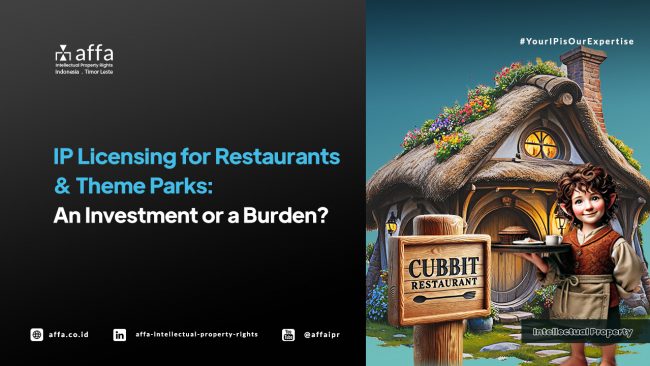
IP Licensing for Restaurants & Theme Parks: An Investment or a Burden?

Indonesian laws regulate the granting of Exclusive Rights over Trademarks, Industrial Designs, or Copyrights, where only the owner and/or creator have the right to derive economic benefits from the Intellectual Property (IP). Therefore, it can be concluded that any restaurant, venue, or theme park wishing to utilize such IP must obtain permission. But how does it work in practice?   However, it is still common to find restaurants and venues utilizing well-known IP elements such as characters from popular animations, superheroes, or movie themes without official permission from the owner. For example, themed restaurants inspired by popular movies or series that use their names and menu concepts, or amusement parks displaying statues of characters without a license. While these may appear attractive and draw visitors, such actions violate the Exclusive Rights of IP owners and may lead to legal lawsuits.   The Importance of Licensing IP Usage   Such violations harm IP owners and create an unhealthy business environment. Entrepreneurs who disregard Intellectual Property Rights neglect the significant investments made by IP owners in creating their works, from the creative process to marketing efforts.   So, what’s the solution? It’s as simple as contacting the IP owner and obtaining usage rights formalized in a Licensing Agreement. This ensures legal usage of the IP and helps determine if another party in Indonesia has already been granted a license, potentially allowing further collaboration for authorization.   You might also want to read: Indonesia’s IP Odyssey: Unraveling the Ins and Outs of IP License Agreement Recordal   By obtaining a license, you can get the following three key benefits:   Avoiding Legal Risks Licensing protects businesses from lawsuits that may result in hefty fines or even closure. Enhancing Credibility Official licensing demonstrates a commitment to ethical business practices and respect for others’ rights. Building Long-Term Partnerships IP owners often support the marketing of licensed businesses, providing strategic advantages for expanding into international markets. You could even become the trusted partner for operating this business in Indonesia.   The Public’s Role in Respecting IP   Besides business operators, the public also plays a crucial role in safeguarding Intellectual Property Rights. As consumers, we should be more critical when choosing places to visit. If you encounter a restaurant, venue, or theme park using a well-known IP without authorization, consider the following:   Avoid Visiting Supporting businesses that violate IP rights only worsens the problem. Report Violations You can report violations to the relevant authorities or directly to the IP owner to initiate legal action.   The easiest way to verify whether a venue has a formal collaboration with the IP owner is by checking for the © “IP Owner’s Name” label on its publication. Because obtaining such authorization often involves significant effort and cost, businesses are likely to display this label. Not only does it reflect official usage, but it also serves as a badge of pride that their business has earned the trust of a major IP name. Licensed businesses also freely promote such partnerships without fear of secrecy.   Criminal Sanctions for Unauthorized IP Usage   Running a business that uses IP without permission in Indonesia may result in criminal penalties, depending on the type of violation:   Trademark Infringement Anyone who unlawfully uses a trademark identical to a registered one belonging to another party for similar goods and/or services may be subject to: Imprisonment: Up to 5 years. Fine: Up to IDR 2 billion. Copyright Infringement Anyone who unlawfully and/or without permission from the creator or copyright holder distributes a work or its copies for commercial purposes may be subject to: Imprisonment: Up to 4 years. Fine: Up to IDR 1 billion.   For more severe violations, such as piracy, penalties may include imprisonment of up to 10 years and/or fines of up to IDR 4 billion. Furthermore, should you need help obtaining a license for well-known IPs, including drafting proper licensing agreements, feel free to contact us via email at [email protected].

The Billion-Stream Christmas Song: Mariah Carey's Seasonal Success - AFFA IPR

The Billion-Stream Christmas Song: Mariah Carey’s Seasonal Success

As December begins and the holiday season approaches, Mariah Carey’s iconic song, “All I Want for Christmas Is You,” can be heard almost everywhere. The festive atmosphere, from radios, cafes, hotels, offices, and shopping malls, seems incomplete without this song. If you’re a musician, songwriter, or singer, you might wonder how much royalty Mariah Carey earns annually from this song. But is it as massive as we imagine?   “All I Want for Christmas Is You” was first released in 1994 as part of Mariah Carey’s Christmas album, Merry Christmas. The song was co-written by Mariah and Walter Afanasieff, a seasoned musician, songwriter, and producer who collaborated with top artists of the era, such as Celine Dion, Boyz II Men, and Natalie Cole. However, the song initially only peaked at number twelve on the Billboard US Hot 100 Airplay chart.   The Journey to Becoming a $100 Million Royalty Song   Although it didn’t perform exceptionally well in the United States, the song skyrocketed in popularity in Europe, Japan, Singapore, Australia, and New Zealand, becoming the most-played holiday song annually. In 2001, Mariah released a remix of her Greatest Hits album. From then on, the demand for the song surged, with the original version consistently topping the charts every December from 2005 to 2008, 2019, and beyond.   According to the Associated Press, since 1994, the song has generated an estimated $100 million in royalties. This is primarily thanks to the surge in plays from streaming platforms like Spotify and YouTube, making it more accessible to listeners worldwide.   Passive Income of Up to $3 Million Per Year   As the songwriter and singer, it’s no surprise that Mariah is one of the biggest royalty earners from this song. However, she’s not the only one receiving royalties. The song has sold over 3.6 million digital copies in the United States since its release. It’s the most popular Christmas song in Europe, mainly the UK, with over 1.2 million downloads and 100 million streams. In Asia, the song ranks top on karaoke platforms and remains one of the most frequently sung Western songs.   Radio airplay and physical record sales also continue to generate royalties for the parties involved with the song. They include:   Songwriters Walter Afanasieff, the song’s co-writer, is entitled to a share of the songwriting royalties.  Record Label The song is under Columbia Records, part of Sony Music Entertainment. As the company that produces, markets, and protects the master recording, the label receives royalties from distribution and licensing agreements.  Music Producers In addition to Mariah Carey, Walter Afanasieff also acted as the song’s producer, earning royalties for the master recording.  Related Rights Supporting musicians like Dan Shea and backing vocalists (Kelly Price, Melonie Daniels, and Shanrae Price) who contributed to the recording are also entitled to royalties, as stipulated in their recording contracts.     “All I Want for Christmas Is You,” celebrating its 30th anniversary this year, shows how a single song can provide extraordinary long-term income for singers, songwriters, and other musicians. However, such income sources would not be well-managed without proper licensing agreements that regulate royalty distribution.   Thus, ensure that all your creations are appropriately documented and managed with solid licensing agreements to maximize their benefits—not just now but for decades to come. Should you need more information on Copyright recordation and licensing agreements domestically and internationally, please contact us at [email protected].

Fighting IP Crimes: Indonesia's IP Office Task Force Destroys IDR 5.35 Billion Worth of Counterfeit Goods! - AFFA IPR

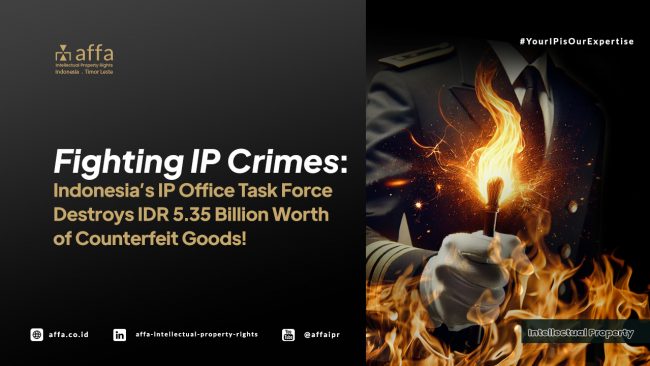
Fighting IP Crimes: Indonesia’s IP Office Task Force Destroys IDR 5.35 Billion Worth of Counterfeit Goods!

The Indonesian Intellectual Property (IP) Task Force, a cross-ministerial special task force of the Republic of Indonesia, consists of the Directorate General of Intellectual Property (DGIP), the Directorate General of Customs and Excise (DGCE), the National Agency of Drug and Food Control (BPOM), the Ministry of Communication and Digital (Komdigi), the Criminal Investigation Department (Bareskrim) of the National Police, and the National Cyber and Crypto Agency (BSSN). On December 12, 2024, the task force symbolically destroyed a number of products associated with violations of 12 Trademarks and Industrial Designs.   During a press conference, the Director General of Intellectual Property, Razilu, stated: “This destruction serves as a strong message from the DGIP that there is no room for Intellectual Property violations in Indonesia.”   At least three key messages were conveyed through the destruction of these products: Deterrence: To provide a deterrent effect on offenders, ensuring they refrain from committing further violations. Both civil and criminal legal actions can be enforced against them. Creator and Owner Protection: To assure creators and IP owners that their works are protected, fostering an environment where they can continue innovating. Public Awareness: To urge the public never to buy counterfeit or fake goods at low prices, as these products can adversely affect health, employment, and the environment.   The destroyed products, valued at IDR 5.35 billion, included the following: LEGO (toys): Worth over IDR 1 billion, from 110 items. Comotomo (baby bottles): Worth over IDR 500 million, from 888 items. Mimi White (hand and body lotion): 216 items. MT NG Shan (drill bits): 2,000 pieces. Louis Vuitton (women’s bags, wallets, and belts): 10 items. Christian Louboutin (women’s shoes): 2 pairs. Tokai (lighters): 5 boxes. Orion Choco Pie (snack/biscuits): 50 boxes. Honda (spare parts): 30 boxes. Honda (generators): 30 units. Harley Davidson (apparel accessories, umbrellas, and wallets): 600 items. Food Packaging (Industrial Design): 30 boxes.   It is important to note that the products classified as IP violations are not limited to counterfeit goods but also include goods illegally entering the Indonesian market. Under the law, smuggled goods that bypass official channels, fail to adhere to applicable import procedures, and are subject to objections by the official license holders of the relevant trademarks are subject to enforcement actions.   Given the complex and extensive scope of IP  violations, cross-sector enforcement is required. The specific roles of the involved institutions are as follows: DGIP: Monitoring, supervision, preventive measures, mitigation strategies, and enforcement of IP laws. DGCE: Addressing the importation of goods suspected of infringing IP rights. BPOM: Managing the distribution of food and pharmaceutical products that are suspected of infringing IP rights and endangering public health and the environment. Komdigi: Handling complaints and requests for blocking websites related to goods and/or services deemed to violate IP rights. Bareskrim Polri: Coordinating communication and collaboration for law enforcement from the central office to its units across Indonesia. BSSN: Monitoring IP violations in cyberspace and assisting in handling IP infringements that occur in the digital realm.   You might also want to read: Unraveling the Global Complexity of IP Crime: Money Laundering and More!   Each year, the average number of reports on IP violations is around 50 cases, with the majority involving Trademark, Industrial Design, and Copyright infringements. The active role of Komdigi has also significantly contributed to blocking 414 websites infringing Copyrights based on 16 requests. However, considering that the IDR 5 billion in damages mentioned earlier came from only 12 cases, this can be seen as just the beginning or the tip of the iceberg in the enforcement of IP laws in Indonesia.   Therefore, the participation of the five key components of the nation—Government, Academics, Private Sector, Society, and Media—is expected to continue supporting efforts to create a better Intellectual Property climate in Indonesia.   With increasing public awareness of the importance of Intellectual Property, there will also be positive impacts on the national economy and Indonesia’s investment climate in the global arena.   Should you need more information regarding Trademark protection and other Intellectual Property matters in Indonesia and abroad, feel free to contact us via email at [email protected].

IP Character Collaborations with Airlines - Which One is Your Favorite? AFFA IPR

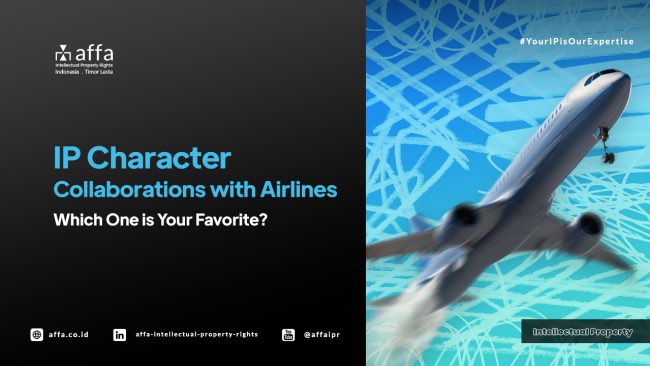
IP Character Collaborations with Airlines – Which One is Your Favorite?

Collaborations involving Intellectual Property (IP) or well-known characters aren’t limited to clothing or merchandise; they extend to restaurants, theme parks, and even airlines. Thanks to the immense popularity of these characters, fans are willing to travel, buy tickets, and spend more to enjoy a unique experience connected to their favorite icons. As the holiday season approaches, traveling with a trusted airline featuring your favorite IP characters can be an exciting option for you and your family. These collaborations often offer in-flight branding, including themed headrests, paper cups, meal boxes, in-flight entertainment, and exclusive merchandise to take home. Does your favorite character make the list? Etihad Airways x Warner Bros Boeing 787-10 Dreamliner  Since: July 2024 Characters: Batman, Superman, Wonder Woman, Looney Tunes, etc. Routes: Abu Dhabi, London, Dublin, Amsterdam, Vienna, Bangkok, and Manila AirAsia x Sonic the Hedgehog Airbus A330 Since: October 2024 Characters: Sonic, Tails, & Shadow Routes: Kuala Lumpur – Bangkok All Nippon Airways (ANA) x Demon Slayer: Kimetsu no Yaiba Bombardier DHC 8-400 Since: July 2023 Characters: Tanjiro, Nezuko, Zenitsu, Inosuke, Kyojuro, etc. Routes: Osaka – Fukuoka Southwest Airlines x Walt Disney World Boeing 737-700 Since: September 2021 Characters: Mickey, Minnie, etc. Routes: United States Domestic Garuda Indonesia x Pokemon Boeing B737-800 NG (Pikachu Jet GA-1), since February 2024 Airbus A330-300 (Pikachu Jet GA-2), from March 2025 Characters: Pikachu, Squirtle, Aipom, Oddish, etc. Routes: Jakarta, Denpasar, Jogja, Lombok, Batam, Surabaya, Malang, Semarang, Makassar, Tokyo, Sydney, Melbourne, Hong Kong, China, Jeddah, Bangkok, etc. With this collaboration, Garuda Indonesia has joined the elites of the “Pikachu Jets” fleet, alongside other airlines that collaborated earlier, such as ANA and Skymark Airlines (Japan), China Airlines, Scoot (Singapore), and T’way Air (South Korea). For Garuda Indonesia, IP collaborations are not new, as the airline previously partnered with Star Wars and Marvel Studios from The Walt Disney Company in 2022.   Should you need further information about IP collaborations, licensing agreements, or the protection of Trademarks and other IPs domestically or internationally, contact us at [email protected].
Patent Translation Submission Requirement in Indonesia - AFFA IPR

Patent Translation Submission Requirement in Indonesia

In accordance with the latest amendment of the Indonesian Patent Law, all foreign applicants who wish to file patent applications in Indonesia have to provide the Indonesian IP Office (DGIP) with the following:   ⁠If the description is written in foreign languages other than English, the description shall be complemented with the English and Indonesian translations; or If the description is written in English, it shall be complemented by an Indonesian translation.   This new policy is aimed to enable the examiners to examine the applications more thoroughly, since in the past some applicants from non-English speaking countries only provided the description, claims, and figures in their languages and then in Indonesia.    Please be mindful of the deadline to submit the above within 30 working days from the filing date. Should you require any assistance for patent translation in Indonesia, please do not hesitate to contact us at [email protected].
TKDN-Related Sales Restrictions: How Can IP Play a Role in Enhancing its Composition - AFFA IPR

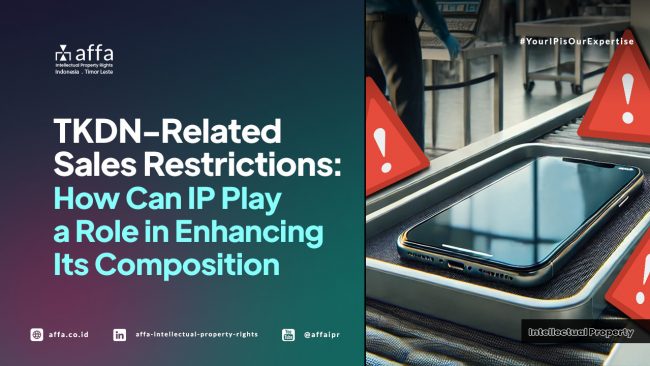
TKDN-Related Sales Restrictions: How Can IP Play a Role in Enhancing Its Composition

The Indonesian government recently banned the distribution of the iPhone 16 due to its failure to meet the required Domestic Component Level (TKDN) threshold of 35%. This policy serves as a stern reminder to all local and international manufacturers of the importance of contributing to the development of domestic industries.   However, the iPhone 16 is not the only TKDN-related issue in the spotlight. Previously, the tactical vehicle Maung Pindad, used by “RI 1” (the President), became a success story in fulfilling TKDN requirements. According to Chief of Presidential Staff Anto Mukti Putranto, while 30% of Maung’s components were sourced from Korean and German manufacturers, namely SsangYong and Mercedes-Benz, the remainder was developed locally.   So, who is obligated to comply with TKDN regulations? How can Intellectual Property (IP) certificates help meet these requirements? Let’s dive into the details.   Legal Basis of TKDN   TKDN refers to the percentage of goods or services derived from domestic components in a product, service, or combination of both. This policy is governed by Minister of Industry Regulation No. 16 of 2011, which outlines the rules and methods for calculating TKDN. At least three parties are required to comply with TKDN regulations:   Electronics and Telecommunications Manufacturers: Products like smartphones with 4G/5G technology must have a minimum TKDN value of 35%, as stated in Minister of Industry Regulation No. 22 of 2020 on Electronics and Telematics TKDN Calculation Guidelines. Goods/Services Providers for Government Projects: Under Presidential Regulation No. 16 of 2018 on Government Procurement, all government-procured goods/services must prioritize products with high TKDN values. Strategic Industries: For example, battery electric vehicles (BEVs) are regulated under Minister of Industry Regulation No. 6 of 2022, which specifies development roadmaps, specifications, and TKDN calculation requirements.   Intellectual Property & TKDN Calculation Framework   Factors influencing a product’s TKDN value include:   Type of Product and/or Service: Different products have unique parameters and calculation weights, such as manufactured goods, technology, or services. Local Components Used: The greater the proportion of raw materials or services sourced domestically, the higher the TKDN value.  Contribution of Certification and Local Innovation: Intellectual Property certificates, SNI (Indonesian National Standard), and Halal certification can increase the domestic component value.   It can be concluded that owning IP Certificates, such as Patents, Trademarks, and Industrial Designs, allows businesses to count these as part of the Domestic Component (KDN).   The varying needs of industries and technical specifications result in differing TKDN standards. For instance, electronic products like smartphones require a minimum TKDN value of 35%, whereas strategic industrial products like electric vehicles involve more complex parameters, including design and testing.    Specifically for the iPhone, Apple previously held a TKDN certificate, but its validity period has expired. To renew it, the government still deems the latest investment made in educational facilities insufficient. Apple would need to establish larger manufacturing plants and research development centers to meet the requirement.   Requirements for Meeting TKDN Standards   To obtain TKDN certification, businesses must fulfill the following requirements: Company Legal Documents: Articles of incorporation and business licenses. Intellectual Property Certificates: Relevant patents, trademarks, or industrial designs. Quality Management System: Certification such as ISO 9001:2015. Proof of Local Components: Cooperation contracts with local suppliers or invoices for locally sourced raw materials. Verification Body Appointment Letter: Only independent bodies designated by the Ministry of Industry can conduct TKDN verification.   TKDN as a Strategic National Policy   From its requirements and objectives, TKDN is not just a regulation but a strategic national policy to strengthen domestic industries. Similar policies exist in other countries, such as: Buy American Act in the United States; Industrial and Regional Benefits in Canada; Local Content Policy in Brazil; Local Content Requirement in the European Union; Make in India in India; and China’s Indigenous Innovation Policy in China.   This long-term policy to enhance Indonesian products’ competitiveness in local and global markets deserves our full support.   Does your product meet the required TKDN standards? Don’t hesitate to consult us about registering your Intellectual Property as part of TKDN compliance. Contact us via email at [email protected].

Protecting a Giant: Why Godzilla Needs Both 3D Mark and Industrial Design Status

This November, one of Japan’s oldest Intellectual Property (IP) assets celebrates its 70th anniversary. First introduced as a movie in 1954, Godzilla has since starred in over 40 films and animated series, and its Trademark is protected in more than 30 countries worldwide.   As a giant mutant lizard with many variations, its likeness has also been immortalized in various toys and merchandise, often registered as Industrial Designs to protect them from counterfeiting. However, since Industrial Design protection has a limited duration, Toho, the owner of Godzilla’s IP, has also registered it as a 3D Mark.   What’s the difference? What are the advantages compared to Industrial Designs? Here’s the answer…   Aesthetic Value vs. Distinctiveness   Based on its definition, Industrial Design protects the aesthetic aspects or appearance of a product, such as its shape, pattern, or configuration, which give it a distinctive impression. The focus is on visually appealing elements rather than brand identity. Therefore, Industrial Designs protect the unique design of vehicles, household appliances, and, of course, toys.   On the other hand, a 3D Mark is a mark that protects the three-dimensional shape of a product used to distinguish the goods or services of one party from another. Examples include the Coca-Cola bottle, Lego bricks, Ferrari’s prancing horse, and the PS5 console.   The differences, as well as the advantages and disadvantages of Industrial Designs and 3D Marks, can be summarized in the following table:   Industrial Design 3D Mark Focus of Protection Protects the aesthetics or visual appeal of a product. Protects the identity and function of a Trademark in commerce. Duration of Protection Limited duration, typically 10-15 years, depending on the regulations in a given country. Unlimited duration as long as it is renewed periodically every 10 years. Registration Process & Criteria Must be new and unique in its design. Requires evidence that the shape has a distinctive character and is recognized by consumers as a Trademark. A 3D Mark cannot be registered if the shape has functional value. Advantages The registration process is relatively simpler and quicker. Protection can last indefinitely with periodic renewals. Disadvantages Protection is limited to aesthetic aspects, and the duration cannot be extended. The registration process is more complex and requires significant evidence of use to demonstrate distinctiveness in the market.   Godzilla Needs Longer Protection   From the table above, we can understand why IP assets as old as Godzilla still seek longer protection. Especially considering the increasing hype surrounding Godzilla after winning the 2024 Academy Award/Oscar for Best Visual Effects. This success could lead to an increase in counterfeit products and toys by irresponsible parties.   According to Yahoo Japan and a decision by the Japanese court, Toho’s attempt to register one of Godzilla’s variants, Shin Godzilla, as a 3D Trademark began as early as October 2019. However, after a lengthy process, the Japan Patent Office (JPO) issued a final rejection in March 2024, stating that the registered Godzilla shape was too generic and lacked sufficient distinctiveness.   Toho subsequently filed an appeal in May, emphasizing that the Shin Godzilla design has a strong distinctive character and is widely recognized by the public. This was followed by a review of submitted evidence, including the popularity of Shin Godzilla as a character, its use in various products, and public recognition of the shape as a unique identity, by the court.   3D Mark Shin Godzilla – Application No.: 2020-120003   Finally, on October 30, 2024, the court overturned the JPO’s decision and declared that the 3D shape of Shin Godzilla possesses sufficient distinctiveness and is eligible to be registered as a 3D Mark. The court emphasized that the popularity and widespread recognition of the Shin Godzilla character added significant value to the assessment of its distinctiveness.   As a result, Shin Godzilla has successfully secured the opportunity to get unlimited protection.   This ruling sets an important precedent for 3D Mark protection in Japan, particularly for the entertainment industry and consumer products that rely on unique characters or designs as their brand identity. Previously, iconic characters were typically protected through copyright for creative works, and their names or logos as Trademarks. Now, these characters can also be protected as 3D Marks if proven to have distinctiveness and public recognition as a source identifier.   This strengthens Intellectual Property protection for iconic characters through a layered and complementary approach, depending on the context of their use. Should you need further information regarding trademark registration and protection in Indonesia or worldwide, please contact us via email: [email protected].

Critical for Indonesia Importers: SNI Must Be Registered by the Trademark Owner and the Licensing Agreement Mus Be Recorded to DGIP - AFFA IPR

Critical for Indonesian Importers: SNI Must Be Registered by the Trademark Owner and the Licensing Agreement Must Be Recorded to DGIP

One of the primary requirements for obtaining a Certificate of Indonesian National Standard (SNI) is the ownership of a valid and registered Trademark with the Directorate General of Intellectual Property (DGIP), whether by a domestic industrial company or a foreign producer. Products intended to be marketed in Indonesia must meet specific standards, including quality and safety requirements, as enforced through the SNI certification.   Thus, having a registered Trademark is no longer optional but necessary for conducting business in Indonesia. A Trademark is a product’s identity and a critical legal protection tool, especially in a highly competitive market. Securing a registered Trademark is a vital initial step for local and international business operators.   Furthermore, business operators who fail to obtain an SNI Certificate for products that are required to have one may face severe penalties, including administrative sanctions such as product distribution bans and product recalls, as well as criminal sanctions such as fines and the revocation of previously issued SNI certifications.   Requirements for Obtaining SNI To obtain an SNI Certificate, business operators must meet several requirements, including: Ownership of a registered Trademark in the appropriate class (e.g., Class 11 for gas stoves). A quality management system that complies with ISO 9001:2015. Adequate production facilities. Product testing at an accredited laboratory.    Registration Process and Eligible Parties for SNI Registration   Domestic Industrial Companies: Local producers holding a valid business license in Indonesia. Can directly apply for an SNI Certificate via SIINas (National Industrial Information System).  Foreign Producers: Must appoint an Authorized Representative in Indonesia to handle certification processes. Applications must be submitted by the Authorized Representative in Indonesia who holds the Trademark License for the product. Additional documents are required, such as a License Agreement and proof of license recordation with the DGIP.   If you are a distributor or importer, please ensure that the products you import have their Trademark registered in Indonesia by the foreign producer and that you have a License Agreement that has been recorded with the DGIP.   To simplify the process and ensure all documents comply with applicable laws in Indonesia, you can utilize the services of a trusted Trademark Consultant to handle all the necessary steps, including:   Registering the Trademark with the DGIP on behalf of the client (foreign producer). Drafting a License Agreement that adheres to Indonesian regulations. Recording the License Agreement with the DGIP to ensure the license has legal enforceability. Assisting clients in managing the documents required for the SNI Certificate, including consultations related to compliance with SNI standards. Should you need further information regarding Trademark registration as a requirement for obtaining an SNI Certificate, feel free to contact us via email at [email protected].

Trademark Filing and Renewal Fees in the US Rise Starting January 2025: What You Need to Know - AFFA IPR

Trademark Filing & Renewal Fees in the U.S. Rise Starting January 2025: What You Need to Know

The United States Patent and Trademark Office (USPTO) has announced fee adjustments for Trademark filing and renewal, which will take effect on January 18, 2025. These changes include increases in fees for various Trademark-related services, ranging from USD 50 to 150.   If you own a registered Trademark in the United States or plan to file a Trademark there, here are the details of the fee changes:   Application Fees Current New TEAS Standard* USD 350 n/a TEAS Plus** USD 250 n/a Base application (sections 1 and 44), per class n/a USD 350 Application fee filed with WIPO (section 66(a)), per class USD 500 USD 600 Subsequent designation fee filed with WIPO (section 66(a)), per class                                USD 500 USD 600   Surcharge Fees Current New Insufficient information (sections 1 and 44), per class n/a USD 100 Using the free-form text box instead of the Trademark ID Manual within the Trademark Center to identify goods and services (sections 1 and 44), per class n/a USD 200 Each additional group of 1,000 characters in the free-form text box beyond the first 1,000 (sections 1 and 44), per affected class n/a USD 200   Post-Registration Maintenance Fees Current New Section 9 registration renewal application, per class                                                            USD 300 USD 325 Section 8 declaration, per class USD 225 USD 325 Section 15 declaration, per class USD 200 USD 250 Section 71 declaration, per class USD 225 USD 325 Renewal fee filed at WIPO USD 300 USD 325   Petitions and Letters of Protest Fees Current New Petition to the Director USD 250 USD 400 Petition to revive an application                                                                                           USD 150 USD 250 Letter of protest USD 50 USD 150   Intent-to-Use Fees Current New Amendment to allege use (AAU), per class                                                                            USD 100 USD 150 Statement of use (SOU), per class USD 100 USD 150   If possible, you can file a new Trademark application before January 2025 and take advantage of the services of an experienced Trademark Consultant to calculate all potential costs that may arise afterward. By understanding these costs, you can better prepare in advance, ensuring a smooth trademark protection process in the United States.   Make sure not to miss business opportunities and always secure Trademark protection in the United States by registering your Trademark there.   Should you need more information regarding Trademark registration and protection in the United States, please contact us via email: [email protected].   *) Trademark Electronic Application System Standard: A registration scheme with higher fees, suitable for unique goods and/or services with specific descriptions if they are not available in the existing list provided by the USPTO. **) Trademark Electronic Application System Plus: A standard registration scheme that requires applicants to use the list of goods/services already provided by the USPTO.