Top Ways to Accelerate Your Patent Application

3 Top Ways to Accelerate Your Patent Application in Indonesia

The Directorate General of Intellectual Property of the Republic of Indonesia under the Ministry of Law and Human Rights of the Republic of Indonesia (hereinafter referred to as “DGIP”) has established various procedures under which the examination of a patent application may be accelerated. Under these procedures, DGIP will advance an application out of turn for faster examination if the applicant files the following special requests through the ASPEC program, Indonesia-Japan PPH program, or simply by providing the examiner in charge the granted corresponding claims from other Patent Offices, such as the USPTO, JPO, EPO, and others. We herewith summarize the options that may suit your need, depending on where you file your patent applications in other jurisdictions: 1. ASPEC The ASEAN Patent Examination Co-operation ( hereinafter referred to as “ASPEC”) was launched on 15 June 2009 and it is the first regional patent work-sharing program which involves nine participating ASEAN Member States (AMS) IP Offices of Brunei Darussalam, Cambodia, Indonesia, Lao PDR, Malaysia, the Philippines, Singapore, Thailand, and Viet Nam. The program aims to accelerate the patent examination process by encouraging each of the participating Patent Offices to share search and examination results to allow applicants in the participating countries to obtain corresponding patents faster and more efficiently. Since ASPEC aims to reduce duplication on the search and examination work done, it is hoped that the search and examination work done on a corresponding application can be used as a useful reference in producing high-quality examination reports. Hence, if you can obtain the examination result from other countries in the participating Patent Offices, then the examination results or reports can be used as the basis of examination acceleration, as long as the corresponding claims are the same. When requesting ASPEC, the patent applicant is required to submit an ASPEC Request Form in the second Patent Office. The ASPEC Request Form shall be accompanied by the following documents: 1. a copy of the Search and Examination (S&E) report or the Examination report (“minimum documents”) of a corresponding application from the first IP Office; and 2. a copy of the claims referred to in the minimum documents submitted, with at least one claim determined by the first IP Office to be allowable/patentable. For PCT ASPEC request, the patent applicant is required to indicate that the request is for PCT ASPEC in the ASPEC form. The completed ASPEC request form shall be submitted together with the following documents: 1. a copy of the written opinion/international preliminary examination report (“WO/ISA, WO/IPEA or IPER”) established by an ASEAN International Searching Authority/International Preliminary Examining Authority (ASEAN ISA/IPEA) (“minimum documents”) relating to a corresponding application from the first IP Office; and 2. a copy of the claims referred to in the minimum documents submitted, with at least one claim determined by the first IP Office to be allowable/patentable. Please be mindful that the request to utilize ASPEC can only be done after the application has finished the publication stage. Based on our experience, the time it takes from filing the ASPEC request until the issuance of the decision to grant will not be more than 12 months – a great improvement in lead or pendency times compared to the processing time for non-ASPEC (or PPH) patent applications in Indonesia.   2. Japan-Indonesia Patent Prosecution Highway (Indonesia-Japan PPH) The Japan Patent Office (hereinafter referred to as the “JPO”) and the DGIP have initiated a Patent Prosecution Highway Program (hereinafter referred to as the “PPH”) back on June 1, 2013, and since then, the PPH has been chosen by many applicants who have previously filed their base applications in Japan as the method of accelerating the patent applications in Indonesia. The PPH request can be filed at any time as long as it is before the deadline to request the substantive examination stage. Please also be mindful that there will be an official fee of Rp 5.000.000,00 incurred for requesting the PPH acceleration program. When it comes to the requirements, the DGIP will require the applicant to provide the following documents in order to start the accelerate examination process: All formality documents required to file the application have been submitted and the DGIP will issue the notice of formality documents completion, which should also be provided by the applicant; Proof of payment to file a substantive examination request; The application should have passed the Publication of Period of 6 months; PPH Form (filled in); Corresponding claims which should be equivalent or less compared to the claims granted by the JPO; OEE ad OLE examination results; and OEE/OLE in English and/or in Bahasa Indonesia. Based on our experience, the time it takes from filing the ASPEC request until the issuance of the decision to grant will not be more than 7 to 12 months – a great improvement in lead or pendency times compared to the processing time for non-ASPEC (or PPH) patent applications in Indonesia.   3. Providing Corresponding Registered Claims In case none of the options above apply to you, you mal also provide the examiners at the DGIP with the corresponding granted claims from other well-established Patent Offices, such as the USPTO, UKIP, EP, AUIPO, SIPO, JPO, etc. The provision of the corresponding granted claims from the aforementioned Patent Offices will make it easier for the examiners at the DGIP to expedite the examination. Please note that the documents should be provided with the equivalent English translation. For any questions related to patent application in Indonesia, please do not hesitate to contact us at [email protected].
affa-protokol-madrid

Pendaftaran Merek Internasional Lebih Murah dan Mudah Menggunakan Sistem Protokol Madrid

Pendaftaran Merek Internasional Lebih Murah dan Mudah Menggunakan Sistem Protokol Madrid Sistem Madrid adalah solusi satu atap bagi para pemilik Merek untuk mendapatkan perlindungan Merek di 129 negara Anggota dengan biaya yang lebih kompetitif. Sistem ini dapat membantu Anda untuk mengelola pendaftaran Merek di banyak negara dengan lebih efisien dan terorganisir.  Keuntungan menggunakan Sistem Madrid diantaranya: 1. Nyaman dan Mudah Kami dapat membantu Anda untuk mengajukan satu aplikasi dalam satu bahasa, dan membayar satu set biaya untuk mengajukan perlindungan Merek Anda di berbagai negara. Kami dapat mengelola portofolio Merek Anda melalui sistem terpusat, dan dengan mudah memperluas perlindungan ke negara baru yang penting bagi ekspor produk dan/atau jasa Anda.   2. Lebih Hemat Sistem Madrid menawarkan system pendaftaran Merek yang lebih hemat waktu dan uang dengan mengajukan satu aplikasi, daripada sekumpulan aplikasi nasional. Anda tidak perlu membayar untuk jasa pengacara di negara masing-masing, kecuali apabila Merek Anda ditolak.   3. Prosedur Pasca Pendaftaran Disederhanakan dan Terpusat Prosedur pasca-pendaftaran, seperti perubahan nama dan alamat pemilik merek, pengalihan dan perpanjangan Merek dapat diselesaikan secara ekstensif melalui Sistem Madrid. Di bawah Sistem Madrid, pengusaha dan pebisnis tidak perlu melakukan masing-masing prosedur ini secara individual di setiap negara yang ditunjuk. Selain itu, biaya prosedur tersebut dibayar sekali dalam satu biaya, bukan ke masing-masing negara yang ditunjuk. Sehingga, biaya pasca-pendaftaran diharapkan lebih rendah. Sistem Madrid menguntungkan pengusaha dan pebisnis dalam hal kemudahan mengelola portofolio, peningkatan efisiensi, dan penurunan biaya untuk prosedur pasca-pendaftaran.   4. Kepastian Waktu untuk Menentukan Diterima atau Terdaftarnya Merek di Negara yang DItunjuk Sistem Madrid menjamin bahwa aplikasi Merek akan diproses dalam jangka waktu 12 atau 18 bulan, tergantung pada kantor Merek dari negara yang ditunjuk. Periode waktu yang tetap dan terbatas untuk menentukan validitas pendaftaran merek dagang pemohon merupakan keuntungan bagi pengusaha dan pebisnis karena pengajuan di negara-negara tertentu yang ditunjuk dapat memakan waktu hingga periode waktu lebih dari 18 bulan untuk validasi merek dagang. Selanjutnya, Sistem Madrid memastikan bahwa merek dagang akan dilindungi secara otomatis dalam keadaan tidak adanya keberatan setelah 12 atau 18 bulan.   Untuk informasi lebih lanjut tentang permohonan Pendaftaran Merek Internasional, silakan menghubungi kami di [email protected] atau WA di +6281287000889.

Timor Leste's Parliament Passed The Copyright Law

Timor Leste’s Parliament Passed The Copyright Law

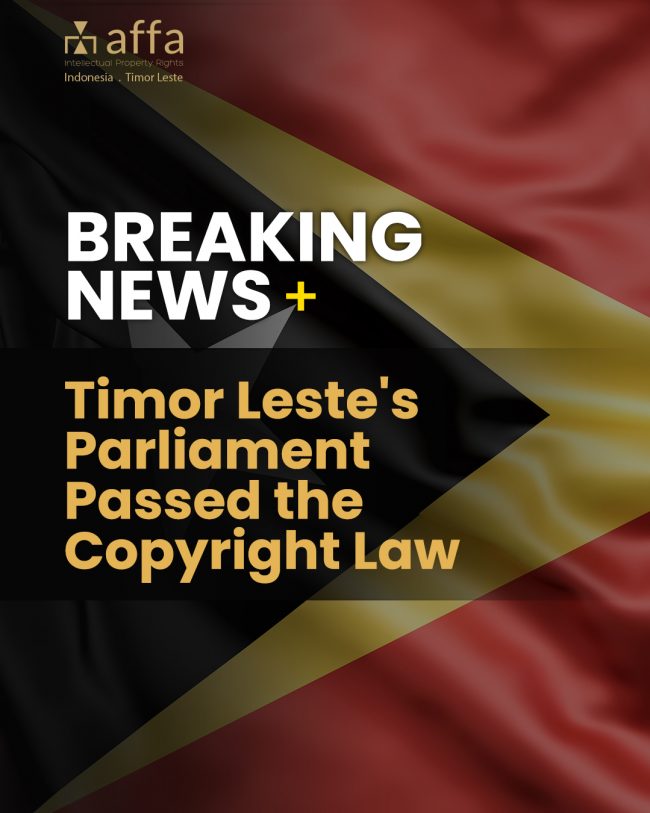
The most awaited update from Timor Leste is finally here – the Copyright Law was passed by the Parliament with 48 votes in favor, zero against, and one abstention. However, the Law may still be amended/corrected further before it is presented to the President of Timor Leste before its promulgation. The Copyright Law consists of 224 Articles which may still be subject to further correction.

AFFA-IPR-INDONESIA

AFFA Recognized in the Asia Business Law Journal: Indonesia Law Firm Awards 2022

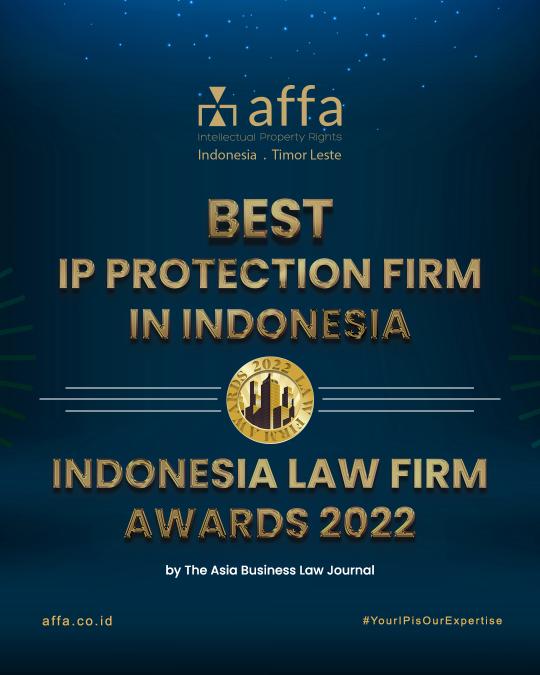
Our firm has received an award by the Asia Business Law Journal, the definitive guide to Asia’s leading law firms and lawyers, as the winning firm in the IP Protection category in Indonesia for 2 years in a row. This is a testament to our desire to keep improving and to give the best solutions to our clients around the world. The full list can be viewed at https://law.asia/top-indonesian-law-firms/. For further information when it comes to IP protection in Indonesia, please do not hesitate to contact us at [email protected]; [email protected]

Intellectual Property Protection in Indonesia

  I    FORMS OF INTELLECTUAL PROPERTY PROTECTION Intellectual property protection and enforcement in Indonesia have already existed in Indonesia since the Dutch Colonial Government era, where it enacted the Auteurswet Stb. No. 600 Year 1912 (Copyright), Ooctroi Wet No. 313 Year 1910 (Patent), and Reglement Industriele Eigendom No. 545 Year 1912 (Trademark). Even after the independence of Indonesia in 1945, these laws were still relevant and in force until 1961, where the government of the Republic of Indonesia enacted the Law No. 21 Year 1961 on Marks, Law No. 6 Year 1982 on Copyrights, and Law No. 6 Year 1989 on Patents. As time went by, Indonesia further ratified various international agreements concerning Intellectual Property Rights. Now, Indonesia is a party to the Trade-Related Aspects of Intellectual Property Rights (TRIPS), Madrid Protocol, Beijing Treaty on Audiovisual Performances, Berne Convention, Paris Convention, Patent Cooperation Treaty, and WIPO Copyright Treaty. Furthermore, Indonesia is also a party to several bilateral and/or regional agreements/treaties, such as the ASEAN Patent Examination Cooperation (ASPEC) and the Japan-Indonesia Patent Prosecution Highway (PPH). Currently, the grouping of Intellectual Property Rights in Indonesia is as under:   Intellectual Property Protection Grouping in Indonesia Copyrights Industrial Rights Copyrights Related rights Trademarks and Geographical Indications Industrial Designs Patents – covers conventional patents and utility models/simple patents Plant Varieties Trade Secrets Integrated Circuit Layout Designs Whereas the legal basis of the protection of the above are as under: The Law No. 29 Year 2000 on Plant Varieties The Law No. 30 Year 2000 on Trade Secrets The Law No. 31 Year 2000 on Industrial Designs The Law No. 32 Year 2000 on Integrated Circuit Layout Designs The Law No. 28 Year 2014 on Copyrights The Law No. 13 Year 2016 on Patents The Law No. 20 Year 2016 on Trademarks and Geographical Indications The Law No. 11 Year 2020 on Job Creation (the Omnibus Law) i.   Simple Patents/Utility Models Simple patents/utility models are governed by the Law No. 13 Year 2016 on Patents (the Patent Law) and the Law No. 11 Year 2020 on Job Creation (the Omnibus Law). Subject to registration, simple patents allow for obtaining exclusive rights if they can fulfil the following criteria: Novelty Development of known products or processes Possess practical uses Applicable commercially¹ The development of the above cover simple products, simple processes, or simple methods. Once registered, simple patents/utility models are valid for 10 years from the filing date. ii.   Patents Unlike simple patents/utility models, conventional patents are not affected by the Omnibus Law and the Patent Law is the only law which governs the protection of conventional patents. Subject to registration, simple patents allow for obtaining exclusive rights if they can fulfil the following criteria: Novelty Inventive steps Applicable commercially. Conventional patents can cover both product and process patents. Once registered, conventional patents are valid for 20 years from the filing date. It is also worth mentioning that there are inventions that cannot be filed, such as aesthetical creations, schemes, business methods, computer programs per se, presentation of information, and discoveries that are considered as new uses for known products and/or new forms of existing compounds that do not result in significant increase in efficacy and there are differences in related chemical structures that have been known from the compounds.² iii.   Trademarks Trademarks (as well as Geographical Indications) are regulated under the Law No. 20 Year 2016 on Marks and Geographical Indications (the Trademark Law). The basis of registration adopts the “first to file” approach and registered Trademarks are valid for 10 years – effective from the filing date. While no prior use requirement is essential for the purpose of application and registration, it is always advised to use the registered Trademarks to avoid non-use cancellation action filed by any third parties. Furthermore, Indonesia adopts strict classification system on its e-filing platform. Any goods or services that do not exist in the system may not be filed – hence prior checking is advised. iv.   Copyrights Copyrights are governed under the Law No. 28 Year 2014 on Copyrights (the Copyright Law). The Copyright protests various in the realms of art, science, and literature. The protection period starts from the first date of publication and depending on the nature of the protectable work. For instance, Softwares and other computer programs are protected for 50 years form the first publication date. Whereas songs and books are protected up to 70 years from the passing of the creator(s).   II    RECENT DEVELOPMENTS The Omnibus Law adjusted several provisions in both Patent and Trademark Laws in 2020. The changes focused on several aspects of patents and simple patents. The most significant change is the obligation to use or perform registered patents in Indonesia, otherwise they are prone to be invalidated or subject to compulsory licensing. This marked the end of the prior practice where it was feasible to postpone the use of registered patents by submitting written requests to the Indonesian Patent Office. The compulsory licensing can be requested if a registered patent has not been used or performed in Indonesia within 36 months. Furthermore, during COVID-19 Indonesia has pushed for the use of registered patents that deemed necessary to mitigate the virus. For instance, the President issued the Presidential Regulation No. 100 Year 2021 on Patent Use by the Government for Remdesivir. Under the regulation, the government may appoint a pharmaceutical industry to perform the patent if the nature of the use remains non-commercial. Furthermore, the patent holder will receive 1% from the nett sales of Remdesivir. Furthermore, the President also issued Presidential Regulation No. 101 Year 2021 on Patent Use by the Government for Favipiravir. The content of the regulation is identical to Presidential Regulation No. 100 Year 2021 on Patent Use by the Government for Remdesivir. These regulations show how the President finally used the provisions which would allow the emergency use of essential medications in the event of health emergency in Indonesia.

Disney Akan Kehilangan Hak Eksklusif Atas Karakter Asli Mickey Mouse – Kok Bisa?

Mickey Mouse merupakan karakter ikonik yang yang pertama kali muncul di publik pada tahun 1920-an. Karakter fiksi berbentuk seekor tikus ini merupakan salah satu karakter yang paling terkenal dari the Walt Disney Company  yang pada akhirnya menjadi maskot bagi perusahaan tersebut. Namnun, tahukah Anda bahwa karakter Mickey Mouse akan menjadi public domain pada tahun 2024. Hal ini dikarenakan oleh Undang-Undang Hak Cipta Amerika Serikat yang mengatur masa berlaku suatu ciptaan selama 95 tahun setelah publikasi pertama kalinya. Mickey Mouse sendiri pertama kali dipublikasikan pada 1 Oktober 1928. Namun, menurut Daniel Mayeda yang merupakan Associate Director dari the Documentary Film Legal Clinic di UCLA School of Law, publik dapat menggunakan karakter Mickey Mouse, namun masih ada kemungkinan pengguna tersebut melanggar hak lainnya dari Mickey Mouse, misalnya hak Merek atas nama Mickey Mouse tersebut.  Namun, dengan berakhirnya masa perlindungan Hak Cipta karakter asli Mickey Mouse bukan berarti publik dapat menggunakan variasi-variasi dari karakter tersebut yang terbit setelahnya, lho! Variasi-variasi tersebut akan mendapatkan perlindungan Hak Cipta yang dimulai dari tanggal publikasi pertama kalinya. Dengan demikian, Disney sejatinya tidak akan benar-benar kehilangan Hak Eksklusif atas karakter ikonik tersebut.   Image source: theguardian.com/film/2022/jul/03/mickey-mouse-disney-copyright-expiry 

Perlindungan Merek di Metaverse – apakah mungkin?

Beberapa hari yang lalu, Hermès mengajukan gugatan pelanggaran Merek melawan pencipta MetaBirkins NFT di New York Federal Court. Hermès mengklaim bahwa Mason Rotschild (pencipta MetaBirkins NFT) mendompleng ketenaran Mereknya dengan cara menyalah gunakan Merek BIRKIN untuk menjadi “kaya mendadak” dengan membuat, memasarkan, menjual, dan memfasilitasi pertukaran asset digital/NFT. NFT ini dijual melalui OpenSea dan menurut Hermès hal tersebut merupakan pelanggaran Merek yang sangat brutal. Dari sudut pandang hukum Merek, rasanya ini memang cukup jelas pelanggarannya – meskipun “produknya” bersifat “digital”. Pelanggaran Merek (dan kadang-kadang Hak Cipta) melalui NFT adalah satu hal – namun bagaimana dengan pelanggaran Merek di METAVERSE? Tidak dipungkiri bahwa Metaverse adalah masa depan – Anda bisa menggunakan headset yang akan membawa Anda ke mana pun Anda ingin pergi. Dan the best thing about Metaverse adalah Anda dapat melakukannya kapan pun – sesuka Anda. Anda juga dapat “pergi” ke mana pun! Ingin berada di Mars? Ingin balapan di F1? Tidak masalah; Anda akan berpikir bahwa Anda benar-benar ada di sana – dan semua teman Anda juga bisa berada di sana, semua dari kenyamanan rumah Anda. Banyak masalah hukum yang muncul (atau akan muncul) sehubungan dengan Metaverse yang dan masalah kekayaan intelektual yang sebenarnya tidak unik untuk Metaverse. Namun kita harus selalu ingat bahwa produk hukum akan selalu tertinggal dari praktik dunia usaha yang “kecepatannya” akan selalu sulit untuk diimbangi. Dari sudut pandang hukum Merek, sejatinya Undang-Undang Nomor 20 Tahun 2016 tentang Merek dan Indikasi Geografis memberikan hak bagi pemengang hak Merek untuk menggunakan sendiri Merek tersebut atau memberikan izin kepada pihak lain untuk menggunakannya.Yang tidak diatur di sini adalah apakah Undang-Undang Nomor 20 Tahun 2016 tentang Merek dan Indikasi Geografis ini dapat mencakup dunia digital paralel yaitu Metaverse. Bagaimana apabila Anda dapat membeli tas digital BIRKIN di Metaverse namun pada faktanya penjualnya itu bukanlah Hermès? Bahkan jika kita menggunakan pendekatan safe-harbour provision dalam Undang-Undang Merek di Amerika Serikat maupun dalam DMCA (Digital Millennium Copyright Act), kedua produk hukum tersebut tidak mengatur pelanggaran Merek dalam Metaverse! Namun jika kita menggunakan analogi yang sama dengan dunia nyata, semua pemegang hak Merek Sudha sepatutnya dilindungi dari pelanggaran Merek yang cenderung keji di dunia virtual – setidaknya dapat melakukan “content takedown” yang dapat difasilitasi oleh Metaverse. Ke depannya, pasti akan banyak sekali gugatan atas pelanggaran Merek di Metaverse. Namun saat ini, sepertinya belum ada contoh kasus yang dapat dijadikan contoh atau acuan di Indonesia. Mungkin dalam waktu dekat ini akan ada dan akan menjadi berita yang sangat besar.