
Fighting IP Crimes: Indonesia's IP Office Task Force Destroys IDR 5.35 Billion Worth of Counterfeit Goods! - AFFA IPR

Fighting IP Crimes: Indonesia’s IP Office Task Force Destroys IDR 5.35 Billion Worth of Counterfeit Goods!

The Indonesian Intellectual Property (IP) Task Force, a cross-ministerial special task force of the Republic of Indonesia, consists of the Directorate General of Intellectual Property (DGIP), the Directorate General of Customs and Excise (DGCE), the National Agency of Drug and Food Control (BPOM), the Ministry of Communication and Digital (Komdigi), the Criminal Investigation Department (Bareskrim) of the National Police, and the National Cyber and Crypto Agency (BSSN). On December 12, 2024, the task force symbolically destroyed a number of products associated with violations of 12 Trademarks and Industrial Designs.   During a press conference, the Director General of Intellectual Property, Razilu, stated: “This destruction serves as a strong message from the DGIP that there is no room for Intellectual Property violations in Indonesia.”   At least three key messages were conveyed through the destruction of these products: Deterrence: To provide a deterrent effect on offenders, ensuring they refrain from committing further violations. Both civil and criminal legal actions can be enforced against them. Creator and Owner Protection: To assure creators and IP owners that their works are protected, fostering an environment where they can continue innovating. Public Awareness: To urge the public never to buy counterfeit or fake goods at low prices, as these products can adversely affect health, employment, and the environment.   The destroyed products, valued at IDR 5.35 billion, included the following: LEGO (toys): Worth over IDR 1 billion, from 110 items. Comotomo (baby bottles): Worth over IDR 500 million, from 888 items. Mimi White (hand and body lotion): 216 items. MT NG Shan (drill bits): 2,000 pieces. Louis Vuitton (women’s bags, wallets, and belts): 10 items. Christian Louboutin (women’s shoes): 2 pairs. Tokai (lighters): 5 boxes. Orion Choco Pie (snack/biscuits): 50 boxes. Honda (spare parts): 30 boxes. Honda (generators): 30 units. Harley Davidson (apparel accessories, umbrellas, and wallets): 600 items. Food Packaging (Industrial Design): 30 boxes.   It is important to note that the products classified as IP violations are not limited to counterfeit goods but also include goods illegally entering the Indonesian market. Under the law, smuggled goods that bypass official channels, fail to adhere to applicable import procedures, and are subject to objections by the official license holders of the relevant trademarks are subject to enforcement actions.   Given the complex and extensive scope of IP  violations, cross-sector enforcement is required. The specific roles of the involved institutions are as follows: DGIP: Monitoring, supervision, preventive measures, mitigation strategies, and enforcement of IP laws. DGCE: Addressing the importation of goods suspected of infringing IP rights. BPOM: Managing the distribution of food and pharmaceutical products that are suspected of infringing IP rights and endangering public health and the environment. Komdigi: Handling complaints and requests for blocking websites related to goods and/or services deemed to violate IP rights. Bareskrim Polri: Coordinating communication and collaboration for law enforcement from the central office to its units across Indonesia. BSSN: Monitoring IP violations in cyberspace and assisting in handling IP infringements that occur in the digital realm.   You might also want to read: Unraveling the Global Complexity of IP Crime: Money Laundering and More!   Each year, the average number of reports on IP violations is around 50 cases, with the majority involving Trademark, Industrial Design, and Copyright infringements. The active role of Komdigi has also significantly contributed to blocking 414 websites infringing Copyrights based on 16 requests. However, considering that the IDR 5 billion in damages mentioned earlier came from only 12 cases, this can be seen as just the beginning or the tip of the iceberg in the enforcement of IP laws in Indonesia.   Therefore, the participation of the five key components of the nation—Government, Academics, Private Sector, Society, and Media—is expected to continue supporting efforts to create a better Intellectual Property climate in Indonesia.   With increasing public awareness of the importance of Intellectual Property, there will also be positive impacts on the national economy and Indonesia’s investment climate in the global arena.   Should you need more information regarding Trademark protection and other Intellectual Property matters in Indonesia and abroad, feel free to contact us via email at [email protected].

Critical for Indonesia Importers: SNI Must Be Registered by the Trademark Owner and the Licensing Agreement Mus Be Recorded to DGIP - AFFA IPR

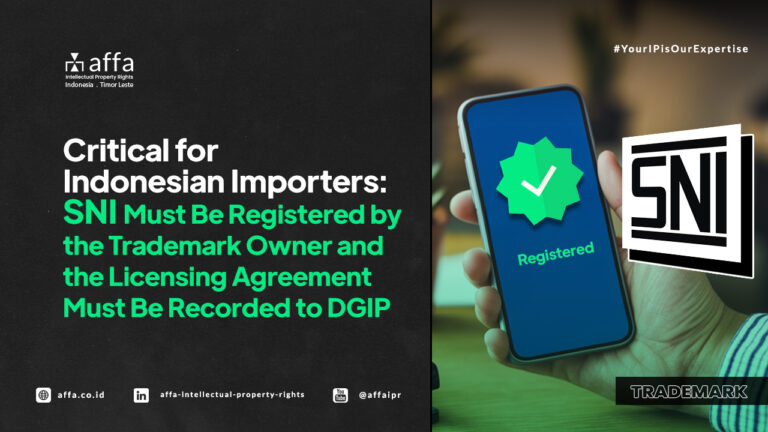
Critical for Indonesian Importers: SNI Must Be Registered by the Trademark Owner and the Licensing Agreement Must Be Recorded to DGIP

One of the primary requirements for obtaining a Certificate of Indonesian National Standard (SNI) is the ownership of a valid and registered Trademark with the Directorate General of Intellectual Property (DGIP), whether by a domestic industrial company or a foreign producer. Products intended to be marketed in Indonesia must meet specific standards, including quality and safety requirements, as enforced through the SNI certification.   Thus, having a registered Trademark is no longer optional but necessary for conducting business in Indonesia. A Trademark is a product’s identity and a critical legal protection tool, especially in a highly competitive market. Securing a registered Trademark is a vital initial step for local and international business operators.   Furthermore, business operators who fail to obtain an SNI Certificate for products that are required to have one may face severe penalties, including administrative sanctions such as product distribution bans and product recalls, as well as criminal sanctions such as fines and the revocation of previously issued SNI certifications.   Requirements for Obtaining SNI To obtain an SNI Certificate, business operators must meet several requirements, including: Ownership of a registered Trademark in the appropriate class (e.g., Class 11 for gas stoves). A quality management system that complies with ISO 9001:2015. Adequate production facilities. Product testing at an accredited laboratory.    Registration Process and Eligible Parties for SNI Registration   Domestic Industrial Companies: Local producers holding a valid business license in Indonesia. Can directly apply for an SNI Certificate via SIINas (National Industrial Information System).  Foreign Producers: Must appoint an Authorized Representative in Indonesia to handle certification processes. Applications must be submitted by the Authorized Representative in Indonesia who holds the Trademark License for the product. Additional documents are required, such as a License Agreement and proof of license recordation with the DGIP.   If you are a distributor or importer, please ensure that the products you import have their Trademark registered in Indonesia by the foreign producer and that you have a License Agreement that has been recorded with the DGIP.   To simplify the process and ensure all documents comply with applicable laws in Indonesia, you can utilize the services of a trusted Trademark Consultant to handle all the necessary steps, including:   Registering the Trademark with the DGIP on behalf of the client (foreign producer). Drafting a License Agreement that adheres to Indonesian regulations. Recording the License Agreement with the DGIP to ensure the license has legal enforceability. Assisting clients in managing the documents required for the SNI Certificate, including consultations related to compliance with SNI standards. Should you need further information regarding Trademark registration as a requirement for obtaining an SNI Certificate, feel free to contact us via email at [email protected].