Discover 6 Intellectual Property Potentials in Padel - AFFA IPR

Discover 6 Intellectual Property Potentials in Padel

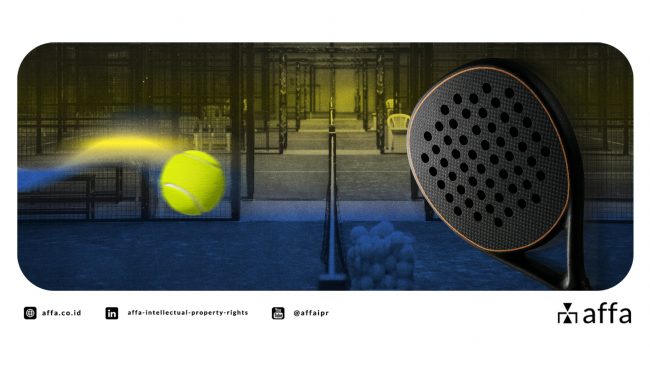
Padel is experiencing rapid growth in Indonesia. Over the past few years, it has captured the attention of various groups — from sports communities and entrepreneurs to celebrities. Its popularity is reflected in its inclusion in PON XXI 2024 (National Sports Week) held in Aceh – North Sumatra, as well as in several tournaments held in Indonesia, including the Asia Pacific Padel Cup 2024 and Padel Pro Open 2025.   Padel was first created in 1969 in Acapulco, Mexico, by Enrique Corcuera. He modified a squash court at his home by adding walls and elements from tennis, creating a new game called “Paddle Corcuera.” This new game quickly attracted the attention of his friends, including Alfonso de Hohenlohe, who later introduced padel to Marbella, Spain in 1974 and built two courts there. From Spain, padel spread to Argentina (1975) and continued to grow in popularity across Europe and Latin America. In 1991, the Federation International de Padel (FIP) was established in Madrid, Spain, to regulate and promote the sport globally.   As the padel ecosystem continues to grow in Indonesia, various elements — such as tournament names, logos, racket designs, court technology, training strategies, and merchandise — are becoming strong identity markers with commercial value. All of these should and can be protected through various forms of Intellectual Property (IP) rights, so that all parties involved can benefit while supporting a more sustainable padel ecosystem.   Here are several relevant and potential IP categories in the world of padel:   Trademark Names of padel clubs, logos, slogans, tournaments, courts, training academies, apparel, padel balls, rackets, or other equipment should be protected to avoid the use of identical or confusingly similar names. These should be registered as Trademarks, which offer protection for 10 years and can be renewed indefinitely. Industrial Design The visual designs of rackets, special padel shoes, and uniquely styled tournament uniforms can be protected as Industrial Designs, with a protection period of up to 10 years. Patent This category includes technological innovations in racket materials or structure, automated digital scoring systems, training sensors, and unique portable padel court construction features. Such innovations can evolve continuously and offer local manufacturers or innovators a competitive edge. Copyright Promotional content such as tournament highlight videos, music, event posters, digital graphics, and training modules or documented game strategies is automatically protected under Copyright. However, formal recordation is recommended to strengthen legal proof of ownership. Trade Secret This category includes exclusive training techniques used by padel coaches, business strategies or community management models, and even recipes or formulas for sports nutrition products used by a club. Trade Secrets do not require registration but must be kept confidential to remain protected. Licensing & Franchising Business models such as court rentals, expansion of padel club branches, licensing tournament names for use in other cities, or even launching padel-themed café franchises can be governed through licensing or franchise agreements, and can be officially recorded to secure legal protection and expand commercial benefits.   Ultimately, padel is a fun sport and a gateway to economic opportunities through Intellectual Property assets. Business actors and padel communities must understand that the innovation, creativity, and identity they build today can become sustainable business value — if properly managed and protected. Should you need further information about registering and protecting Intellectual Property in the padel sport, feel free to contact us at [email protected].

The Billion-Stream Christmas Song: Mariah Carey's Seasonal Success - AFFA IPR

The Billion-Stream Christmas Song: Mariah Carey’s Seasonal Success

As December begins and the holiday season approaches, Mariah Carey’s iconic song, “All I Want for Christmas Is You,” can be heard almost everywhere. The festive atmosphere, from radios, cafes, hotels, offices, and shopping malls, seems incomplete without this song. If you’re a musician, songwriter, or singer, you might wonder how much royalty Mariah Carey earns annually from this song. But is it as massive as we imagine?   “All I Want for Christmas Is You” was first released in 1994 as part of Mariah Carey’s Christmas album, Merry Christmas. The song was co-written by Mariah and Walter Afanasieff, a seasoned musician, songwriter, and producer who collaborated with top artists of the era, such as Celine Dion, Boyz II Men, and Natalie Cole. However, the song initially only peaked at number twelve on the Billboard US Hot 100 Airplay chart.   The Journey to Becoming a $100 Million Royalty Song   Although it didn’t perform exceptionally well in the United States, the song skyrocketed in popularity in Europe, Japan, Singapore, Australia, and New Zealand, becoming the most-played holiday song annually. In 2001, Mariah released a remix of her Greatest Hits album. From then on, the demand for the song surged, with the original version consistently topping the charts every December from 2005 to 2008, 2019, and beyond.   According to the Associated Press, since 1994, the song has generated an estimated $100 million in royalties. This is primarily thanks to the surge in plays from streaming platforms like Spotify and YouTube, making it more accessible to listeners worldwide.   Passive Income of Up to $3 Million Per Year   As the songwriter and singer, it’s no surprise that Mariah is one of the biggest royalty earners from this song. However, she’s not the only one receiving royalties. The song has sold over 3.6 million digital copies in the United States since its release. It’s the most popular Christmas song in Europe, mainly the UK, with over 1.2 million downloads and 100 million streams. In Asia, the song ranks top on karaoke platforms and remains one of the most frequently sung Western songs.   Radio airplay and physical record sales also continue to generate royalties for the parties involved with the song. They include:   Songwriters Walter Afanasieff, the song’s co-writer, is entitled to a share of the songwriting royalties.  Record Label The song is under Columbia Records, part of Sony Music Entertainment. As the company that produces, markets, and protects the master recording, the label receives royalties from distribution and licensing agreements.  Music Producers In addition to Mariah Carey, Walter Afanasieff also acted as the song’s producer, earning royalties for the master recording.  Related Rights Supporting musicians like Dan Shea and backing vocalists (Kelly Price, Melonie Daniels, and Shanrae Price) who contributed to the recording are also entitled to royalties, as stipulated in their recording contracts.     “All I Want for Christmas Is You,” celebrating its 30th anniversary this year, shows how a single song can provide extraordinary long-term income for singers, songwriters, and other musicians. However, such income sources would not be well-managed without proper licensing agreements that regulate royalty distribution.   Thus, ensure that all your creations are appropriately documented and managed with solid licensing agreements to maximize their benefits—not just now but for decades to come. Should you need more information on Copyright recordation and licensing agreements domestically and internationally, please contact us at [email protected].

FAQs Licensing and Assignment of Trademark in Indonesia - AFFA IPR

Frequently Asked Questions about Licensing & Assignment of Trademark in Indonesia

Licenses Q: May a licence be recorded against a Mark in Indonesia? How? Are there any benefits to doing so or detriments to not doing so? What provisions are typically included in a licensing agreement?   A: A registered Mark can be licensed out to other parties in Indonesia. For the agreement to have binding legal effect against any third party, it will have to be recorded at the Directorate General of Intellectual Property (DGIP). In general, a licence agreement should cover the details of the licensor and the licensee, the nature of licensing (exclusive or non-exclusive), the ability to sub-license (or not), term of the licence agreement, rights and responsibilities of the parties, and the object or Trademark to be licensed.   The licensing agreement must not contain provisions that either directly or indirectly damage the Indonesian economy or limitation obstructing Indonesian capacity to acquire and develop technology.   Assignment Q: What can be assigned? Does the Trademark have to be registered first?   A: A Trademark application or registration can be assigned to another party, provided that the deed of assignment, which has been notarised, is recorded at the DGIP to be fully binding. The assignment shall cover all goods or services covered by the assigned mark. The other business assets are not generally required to be assigned to make the Trademark assignment valid, except if both parties agree otherwise.   Assignment Documentation Q: What documents are required for assignment and what form must they take? What procedures apply?   A: Both parties shall sign a deed of assignment that later will be notarised and submitted to the DGIP. A power of attorney will also need to be provided.   Validity Assignment Q: Must the assignment be recorded for purposes of its validity?   A: A signed deed of agreement must be recorded before the DGIP to be valid.   Security Interests Q: Are security interests recognised and what form must they take? Must the security interest be recorded for purposes of its validity or enforceability?   A: In theory, all kinds of IP rights can be used as security interests. But in practice, the recordal of security interests is not possible for the time being. Should you need more information regarding the Licensing & Assignment of Trademark in Indonesia, please do not hesitate to contact us via [email protected].

FAQs: Patent Licensing in Indonesia - AFFA IPR

Frequently Asked Questions about Patent Licensing in Indonesia

Voluntary Licensing Q: Are they any restrictions on the contractual terms by which a Patent Owner may license a Patent?   A: Several minimum requirements should be met. A licence agreement should contain: the date, month, year and place where the licence agreement was signed; name and address of the licensor and the licensee; the object of the licence agreement; provisions regarding the exclusivity or non-exclusivity of the licence, including sub-licensing; the term of the licence agreement; the area where the license agreement applies; and the party responsible for paying annual fees for the Patent (see Government Regulation No. 36 Year 2018 on Intellectual Property License Agreement Recordal). If either the licensor or licensee resides outside of Indonesia or are foreign nationals, the application for recording the licence agreement must be submitted through a registered IP consultant.   The licence agreement should be recorded before the Patent Office in order to have a binding legal effect to any third party.   Compulsory licences Q: Are any mechanisms available to obtain a compulsory licence to a patent? How are the terms of such a licence determined?   A: Compulsory licences can be requested if a Registered Patent has not been used or worked in Indonesia within 36 months (three years) of registration. Other conditions that allow compulsory licensing include the implementation of a Registered Patent would be in the public interest, and it is not possible to obtain a licence to implement a Patent.   Note that there are previous steps that need to be shown to obtain a compulsory licence. The applicants must show evidence that they intend to use the Patent based on their capability, and that attempts were made to contact the patent holder to obtain a licence for a maximum of 12 months but a favourable response was not received. The Ministry should also be in agreement that the patent can be performed in Indonesia on an economically feasible scale and provide benefits to society.    See Regulation of the Minister of Law and Human Rights No. 30 of 2019 on Procedures for the Granting of Compulsory Patent Licensing, which later has been replaced by the Regulation of the Minister of Law and Human Rights No. 14 Year 2021 on the Amendment to the Minister of Law and Human Rights No. 30 of 2019 on Procedures for the Granting of Compulsory Patent Licensing. Should you need more information regarding Patent Licensing in Indonesia, please do not hesitate to contact us via [email protected].