Unraveling the Global Complexity of IP Crime: Money Laundering and More! AFFA IPR

Unraveling the Global Complexity of IP Crime: Money Laundering and More!

Intellectual Property (IP) Crime negatively impacts the economy and consumer safety and has become structurally more complex, posing a worldwide threat to economic and social security.   According to the recently released report “Uncovering the Ecosystem of Intellectual Property Crime,” published this October by the European Union Agency for Law Enforcement Cooperation (Europol) and the European Union Intellectual Property Office (EUIPO), it is revealed that 6% of imported products entering the European Union are counterfeit, with a value exceeding 2 billion euros) annually. This figure represents only the seized products, mainly packaging materials, toys, cigarettes, and CDs/DVDs. Imagine if we could account for the undetected counterfeit goods distributed worldwide.   So, why is tackling IP crime so challenging? The report highlights that this form of crime is highly networked and involves corrupt officials, money laundering, and even tax officers. EUIPO labels these facilitators as IP Crime Enablers!   How significant is their role, and how do they perpetuate Intellectual Property crime? Here are the details.   Intellectual Property Crime – The Definition   In the document, “IP Crime” refers to illegal activities involving the theft, infringement, or unauthorized use of Intellectual Property (IP) rights, which include Copyrights, Industrial Designs, Trademarks, Patents, Geographical Indications, and Trade Secrets. The document categorizes IP crime primarily as:   Counterfeiting Manufacturing, importing, distributing, storing, or selling goods that bear the Trademark of a genuine brand without permission. Examples: Counterfeit Pharmaceuticals: Production and distribution of fake pharmaceutical products that can pose severe health risks to consumers. For instance, counterfeit Semaglutide injection pens falsely labeled as containing the active ingredient were found to contain other substances, leading to serious health incidents​. Counterfeit Automotive Parts: The production and distribution of fake automotive parts, like brake pads and wheel rims, infringe Trademarks and pose serious safety risks. Piracy Unauthorized copying, use, reproduction, and distribution of materials protected by IP rights, such as digital media, software, and entertainment. Example: Digital Piracy: Illicit streaming services that distribute copyrighted content (like movies and sports events) without authorization. In one case, a streaming service was operating across multiple countries, generating significant revenue through illegal broadcasts​.   The Mechanics of IP Crime   IP criminals exploit weaknesses in the global supply chain, legal loopholes, and infrastructure to operate with resilience and evade law enforcement efforts. This structured approach allows them to profit significantly while remaining difficult to prosecute due to their operations’ multi-jurisdictional and often hidden nature. The structured process criminal networks use to conduct IP crimes ranges from obtaining infringing items to laundering the proceeds. Here are the key phases:   Infringing IP Rights (Acquisition Phase) This is the initial stage where IP rights are intentionally violated. Criminals produce counterfeit goods by replicating brand logos, labels, or pirated content. This phase may involve either manufacturing counterfeit products directly or diverting legitimate products from the supply chain. Common sources for counterfeit goods include China, Hong Kong, and Türkiye. Transportation and Distribution Phase After acquiring the counterfeit items, networks transport them globally, often abusing the legal logistical and shipping sectors to move goods across borders. Criminals use sophisticated smuggling techniques, including splitting shipments and hiding counterfeit items within legitimate products to avoid detection. Marketing and Retail Phase Criminals use both online and offline methods to market and sell counterfeit products. Online marketplaces, social media platforms, and even the dark web provide anonymity and access to large audiences. Offline, counterfeit goods may also be sold through physical retail outlets or open markets. Dealing with Profits and Risks (Money-Laundering Phase) The final stage involves managing the profits from these illegal sales. Criminal networks employ money laundering techniques to disguise the origins of their profits. This includes investing in legal businesses, conducting physical cash transfers, or using complex digital financial systems to reintegrate funds into the economy.   Parties Also Involved in Intellectual Property Crimes In addition to the 4 (four) phases of crime above, Europol and EUIPO mapped the parties involved in IP crimes, making these crimes complex and challenging to eradicate.   Criminal Enablers These are illegal activities or crimes that help facilitate IP crime: Corruption: Bribery or manipulation within organizations to ease illegal processes. Forced Labour: Exploitation of labor, often under inhumane conditions, to produce counterfeit goods. Cybercrime: Digital crimes that support IP crime, such as phishing, malware, or data theft. Money Laundering: Concealing the profits from IP crime by converting illegal earnings into legitimate assets. Document Fraud: Creating fake documents to disguise the origin or legitimacy of counterfeit goods. Environmental Crime (Envicrime): Illegal activities that harm the environment, often associated with the improper disposal of waste from counterfeit production. Non-Criminal Enablers These are lawful activities or structures that criminals misuse to facilitate IP crime: Professional Expertise: Use of skills from professionals (e.g., lawyers, technicians) to support illegal IP activities. Use of Legal Business Structures (LBS): Legal businesses that provide a front for illegal IP activities, such as follows: Trading Companies or Factories These legitimate businesses can be set up or inserted into the supply chain to disguise the production or distribution of counterfeit goods. Factories or production sites can be used to produce counterfeit goods under the guise of legitimate products. Warehouses or Logistics Service Providers Legitimate warehouses or logistics companies can be used to store or transport counterfeit goods without raising suspicion. For example, counterfeit goods can be hidden among legitimate products in international shipments. Physical Retail Stores Appearing legitimate stores can be used to sell counterfeit goods to consumers without their knowledge. Counterfeit goods can be sold alongside legitimate products, making it difficult for consumers to tell the difference. Online Stores or Marketplace Platforms Many IP criminals use e-commerce websites or accounts on platforms like Amazon, eBay, or social media to sell counterfeit products. These platforms often give the impression of a legitimate business, making it easier for criminals to reach consumers at a wide range. Front or Shell Companies These companies are technically legitimate but serve only as a front for illegal activity. They are often used to launder money…
Indonesia Climbs 7 Spots in Global Innovation Index 2024: What's Fueling the Rise? - AFFA IPR

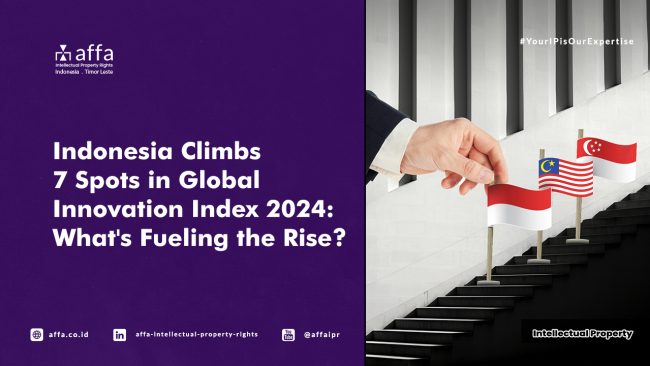
Indonesia Climbs 7 Spots in Global Innovation Index 2024: What’s Fueling the Rise?

The Global Innovation Index (GII) is an annual report published by the World Intellectual Property Organization (WIPO), in collaboration with Cornell University, USA, and the Institut Européen d’Administration des Affaires (INSEAD), France. This index ranks countries based on innovation capacity and performance, using more than 80 indicators covering innovation inputs (such as institutions, human resources, and infrastructure) and outputs (such as research outcomes, technology, and creative products). This index is a crucial benchmark, as innovation is a primary driver of economic development, especially in knowledge-based economies. Intellectual Property (IP) is a critical component of this innovation ecosystem.   With effective IP protection and management, countries can create new technologies, enhance competitiveness in global markets, and provide incentives for inventors and creators to continue innovating. IP ensures that innovation results are protected from easy duplication or misuse while offering economic benefits to innovators through Copyright, Patents, Trademarks, and Industrial Designs.   Rising from Rank 61 to 54  This year (2024), Indonesia has experienced a significant improvement, climbing from rank 61 in 2023 to rank 54, closely trailing the Philippines at 53. Several key factors drove this rise:   Policy Stability for Doing Business Measures how the government ensures a stable policy environment for business activities. This indicator is based on perceptions of policy stability measured through surveys. Entrepreneurship Policies and Culture Assesses policies that support entrepreneurship and a culture that encourages domestic entrepreneurial activity. This indicator reflects support for the establishment and growth of new ventures. Finance for Startups and Scaleups Measures the availability of financial capital for startups and business development, including access to venture capital and other financial instruments that support startup growth and business expansion. Domestic Market Scale Measures the domestic market size based on Gross Domestic Product (GDP) and National Income. This indicator highlights the domestic market’s potential for innovative products and services. University-Industry R&D Collaboration Assesses the level of research and development collaboration between universities and industries, reflecting the integration of academic and industrial sectors in generating innovation. State of Cluster Development Measures the level of development of industrial and technology clusters, including coordination between companies and institutions within clusters to enhance innovation and growth. Software Spending Measures total corporate spending on software, indicating investments in IT solutions that support operations and innovation.   However, Indonesia still lags in several indicators, including: Expenditure on Education Reflects government spending on education per student, indicating the priority of education in the national budget allocation. Government Funding per Pupil Measures government funds allocated per student, reflecting the nation’s investment in human capital development through education. Tertiary Inbound Mobility Measures the number of international students enrolled in domestic higher education institutions, indicating the global attractiveness of the nation’s universities. Firms Offering Formal Training Reflects the percentage of companies providing formal employee training, indicating corporate investment in employee skill development. Scientific and Technical Articles Measures the number of scientific and technical publications, reflecting a country’s research output and innovation capacity.   These factors still place Indonesia behind other ASEAN countries like Singapore (rank 4), Malaysia (33), Thailand (41), Vietnam (44), and the Philippines (53).   A significant difference between Indonesia and the Philippines lies in the strength of innovation output. The Philippines excels in High-Tech Manufacturing, Production and Export Complexity, High-Tech Exports, ICT Services Exports, and Creative Goods Exports. Compared to Malaysia, they outperform Indonesia in the number of Graduates in Science and Engineering, University Rankings, and Domestic Credit to the Private Sector.   Indonesia still needs to work on competing with these nations, mainly when its weaknesses lie in fundamental categories such as government spending and educational budgets, particularly at the primary level. However, Indonesia’s improved investment climate, marked by the growth of startups and solid indicators for stable government policies, reflects its commitment to creating a better business environment. Should you need further information related to innovation, Patents, or other Intellectual Property protection in Indonesia, feel free to contact us via email: [email protected].

Legal Obstacles to Trademarking Indonesia's National Emblem - AFFA IPR

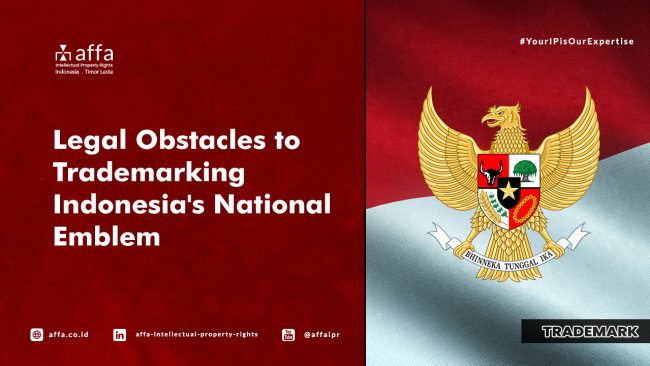
Legal Obstacles to Trademarking Indonesia’s National Emblem

The Garuda Pancasila, the National Emblem of the Republic of Indonesia, is indeed iconic. The figure of this giant bird that is said to be able to cover the sunlight has been known since the 5th century and has become a symbol of many Hindu kingdoms in the archipelago. So, since it was established and used in various national activities, its presence has always inspired people from each generation to display it in a better and better form.   But is that allowed? Modifying and/or using the Garuda Pancasila as a Trademark in Indonesia? Here is the answer from the perspective of Intellectual Property law.   This large and strong figure, containing the date of the Proclamation of Independence of the Republic of Indonesia on its feathers (17-8-1945), was already in the minds of the nation’s founders when they determined the Garuda Pancasila as the National Emblem. In early 1950, the government of the Republic of Indonesia United (RIS) created a technical committee called the National Emblem Committee under the coordination of Minister Zonder Porto Folio Sultan Hamid II, with the Chairman of the Committee, Muhammad Yamin, and Ki Hajar Dewantara, M.A. Pellaupessy, Mohammad Natsir, and R.M. Ng. Purbatjaraka as its members. President Soekarno then inaugurated it at the RIS Cabinet Meeting on February 11, 1950. Its use was then regulated in Government Regulation No. 43 of 1958 and amended by the enactment of Law of the Republic of Indonesia Number 24 of 2009 concerning the Flag, Language, National Emblem, and National Anthem to implement Article 36A of the 1945 Constitution (UUD 1945) which reads, “The National Emblem is the Garuda Pancasila with the motto Bhineka Tunggal Ika.” For those of you who need clarification as to why the 1945 Constitution already contains the Garuda Pancasila even though the draft was only made in 1950, it is because Article 36A resulted from the Second Amendment in 2000. Previously, only Article 36 contained the following: “The National Language is Indonesian.” However, after the amendment, Article 36A (national emblem), 36B (national anthem), and 36C (further provisions related to the flag, language, national emblem, and national anthem are regulated by law) were presented.   Then specifically, Article 57 of Law Number 24 of 2009 contains the following prohibitions related to the National Emblem: It is prohibited to cross out, write, draw, or damage the National Emblem with the intention of tarnishing, insulting, or degrading the honor of the National Emblem; It is prohibited to use the National Emblem that is damaged and does not match the shape, color, and size comparison; It is prohibited to create a symbol for an individual, political party, association, organization, and/or company that is the same as or resembles the national emblem; and It is prohibited to use the National Emblem for purposes other than those regulated by the Law.   A person who violates the prohibition can be punished with a maximum imprisonment of one year or a maximum fine of IDR 100 million.   Although later, the Constitutional Court, through Constitutional Court Decision Number 4/PUU-X/2012, stated the provisions of Article 57 letter d jo. Article 69 letter c of Law 24/2009 concerning the prohibition of the use of the National Emblem for other purposes and its criminal sanctions are contrary to the 1945 Constitution of the Republic of Indonesia and do not have binding legal force, which means that since then the National Emblem can be used freely to a certain extent to support the spirit of nationalism, but does not apply if it is related to Trademark registration.   So even if you can use the Garuda Pancasila in a design for a t-shirt, cap, pin, or other merchandise that is traded, you still cannot register it as a Trademark. As regulated in Article 21 Paragraph (2)b of the Trademark Law, which reads, “An application is rejected if the Trademark is an imitation or resembles the name or abbreviation of a name, flag, insignia, symbol or emblem of a country, or national or international institution, except with the written approval of the authorized party.”   Legal Problems on the Use of National Emblem in Sports Jerseys   A few months ago, there was a debate regarding the use of the National Emblem on the jersey of the Indonesian Football Team. It is common and natural for a national jersey to change its design every season or every year. When the jersey’s vendor changes, the design and logo containing the National Emblem also changes. During the last change, the latest logo was registered with the name of the owner of the jersey’s manufacturer, and this invited controversy because the public began to understand the existence of Article 21 Paragraph (2) b of the Trademark Law.   However, the public forgets the sentence “written approval from the authorized party.” This controversy ended in June 2024 when the Indonesia Football Association (PSSI), the official parent organization of football in Indonesia, took over all logos applied to the Directorate General of Intellectual Property (DGIP). So, if we open the DGIP database today, both old and new logos have listed PSSI as the Trademark owner.   Thus, PSSI has the Exclusive Right to use the logo, and anyone who wants to use it must have permission from PSSI.   Old (DID2024030570) & New (DID2024006041) Logo of PSSI   It is a bit unfortunate that the logo does not contain the initials of PSSI, so it will cause polemics if other sports organizations want to register a logo that also contains the National Emblem. This means that other parties must file and register it with a different logo, but it still has similarities in principle to the logo filed by the PSSI. Should you need further information regarding Trademark protection or registration in Indonesia and worldwide, please do not hesitate to email us at [email protected].

FAQs: The Registration and Use of Trademark in Indonesia - AFFA IPR

Frequently Asked Questions About the Registration and Use of Trademark in Indonesia

Ownership of Marks Q: Who may apply for registration?   A: Since the Indonesian Trademark Law adopts the first to file principle, in general any individual, organisation or company can file for a Trademark Registration. However, the Trademark Law also regulates Trademark Registrations that are filed in bad faith. Article 21 paragraph (3) of the Trademark Law stipulates that an application is refused if it is submitted by an applicant in bad faith. While the implementation of this article during substantive examination holds true for some applications that have similarities with the already established and Well-known Marks, in practice it is quite challenging to determine whether an application is filed in bad faith or not. A bad-faith application that later matured to registration can always be invalidated at the Court of Commerce as regulated under article 77 paragraph (2) of the Trademark Law, which stipulates the following:   “The lawsuit for invalidation may be in unlimited time if there is bad faith and/or the relevant Mark contravenes the State ideology, laws and regulations, morality, religions, decency, and public order.”   Scope of Trademark Q: What may and may not be protected and registered as a Trademark?   A: By definition of article 1 of the Trademark Law, a Mark is any sign capable of being represented graphically in the form of drawings, logos, names, words, letters, numerals, colour arrangement, in two and;or three-dimensional shape, sounds, holograms or combination of two or more of those elements to distinguish goods or services produced by a person or legal entity in trading goods or services.   Given the definition above, then the Law acknowledges two types of trademarks, namely traditional and non-traditional marks.   Unregistered Trademarks Q: Can Trademark Rights be established without registration?   A: Indonesia is a jurisdiction that adopts the first to file principle. Hence, a prior use itself is not sufficient to establish rights in the country.   Famous Foreign Trademarks Q: Is a famous foreign Trademark afforded protection even if not used domestically? If so, must the foreign Trademark be famous domestically? What proof is required? What protection is provided?   A: A Trademark can only be protected if it is registered in Indonesia, regardless of its fame. However, the Indonesian Trademark Law has a mechanism to somewhat protect a famous foreign Trademark from bad faith registrations by other parties. Should another party try to file a malicious Trademark application that is identical or similar to a famous foreign Trademark, such application will be rejected on the basis of article 21 paragraph (1) b and c, which stipulates the following:   “An Application is refused if the Mark is substantively similar to or identical with a well-known Mark of other parties for similar goods and/or services OR a well-known Mark of other parties for different goods and/or services complying with certain requirements.”   The issue is then shifted to what constitutes as a famous Trademark. Article 18 of the Ministry of Law and Human Rights of the Republic of Indonesia Regulation No. 67 2016 concerning Trademark Registration Decree of the Directorate General of Intellectual Property in the Field of Trademarks has set out the criteria of what makes a Trademark famous, such as: the level of knowledge or public recognition against the Mark in the business field that concerned as a well-known mark; the volume of sales of goods and/or services and benefits derived from using the Mark by the owner; the market share controlled by the Mark in relation to the circulation of goods and/or services in the community; the area of use of the Mark; the period of use of the Mark; the intensity and promotion of the Mark, including value of investment used for the promotion; the number of Trademark applications and registration around the world; the success rate of law enforcement, in particular regarding the recognition of the Mark as a well-known Mark by an authorised institution; or the valuation of the Mark because of the reputation and quality assurance of goods and/or services protected by the Mark.   However, a well-known mark that is famous abroad does not always necessarily have the same level of fame in Indonesia. This raises the issue as to whether the Trademark owner should also establish its fame in Indonesia before taking any action against other parties.   The Benefits of Registration Q: What are the benefits of registration?   A: Pursuant to the Trademark Law, the right on a Mark means the Exclusive Right granted by the state to a registered Mark Owner for a definite period to use his or her mark or authorise others to do otherwise. Hence, by registering a Trademark in Indonesia, the owner can establish its legal right should there is an infringement by another party. This includes, but is not limited to, requesting an e-commerce listing takedown notice, sending a cease and desist letter, filing a police report for the criminal aspect of the infringement, seeking damages at the Court of Commerce, issuing licensing rights, filing injunctions and conducting a Customs Recordal before Indonesian Customs.   Filing Procedure and Documentation Q: What documentation is needed to file a Trademark Application? What rules govern the representation of the Mark in the application? Is electronic filing available? Are trademark searches available or required before filing? If so, what procedures and fees apply?   A: A Trademark search is strongly suggested for anyone who wishes to file a Trademark Application in Indonesia. The search report will identify potential hazards and tumbling blocks to an otherwise successful registration process. Assuming the search report gives the all-clear for continuing the application process, the applicant shall prepare the following: name of the applicant; address; list of goods and services; and the representation of the Mark to be filed, which can be in a form of wordmark, logo or non-traditional Marks.   Once the above information has been provided, then we will prepare the following documents to be signed by the client: power of attorney; and statement…

Recommended Representation of FIgures for Industrial Deisgn Applications in Indonesia - AFFA IPR

Recommended Representation of Figures for Industrial Design Applications in Indonesia

Indonesian awareness of the importance of protecting Industrial Design has continued to increase in the last five years. This can be seen from the significantly increasing number of Industrial Design registrations. From 2,319 applications in 2017, it grew to 2,835 in 2019, jumped again to 2,957 in 2021, and peaked in 2022 with 3,533 applications.   The Directorate General of Intellectual Property (DGIP), the Industrial Design Office in Indonesia, has also proposed changes to the Industrial Design Law to remain relevant to the latest creations and innovations. However, when submitting an Industrial Design application, at least 8 (eight) recommended representations of figures for Industrial stay the same, and you must follow them. Those recommendations are:   Do not combine different features or colors in the same design. The design must be represented on a neutral background. Do not include extra elements that are not part of the design. Each image must have only one view of the design, namely front, back, top, bottom, left, right and perspective view. Magnified views must be uploaded as separate images. To exclude unregistered elements, disclaim them identically in all views. Disassembled product views require a corresponding assembled view. To protect a 2D ornament/pattern, submit it alone, not on a product. Should you have further questions about registering for Industrial Design in Indonesia or abroad, do not hesitate to email us at [email protected].

IP Infringement Risks - Is Building Replicas of Classic Cars One of Them? AFFA IPR

IP Infringement Risks – Is Building Replicas of Classic Cars One of Them?

Owning a rare classic car, even at a high price, can be a source of pride. What’s unique is that several classic cars, such as the Porsche 911, Shelby Cobra 427, and Ford Mustang GT500, which are widely used by Indonesian celebrities, are local manufacturers, aka custom or modified results from different cars. How is this practice viewed from an Intellectual Property law perspective?   In the production of vehicles, or in this case specifically four-wheeled cars, there are at least three categories of Intellectual Property (IP) related to it, namely Trademarks, Industrial Designs, and Patents. Let’s describe the details one by one.   Car Name & Logo are the Exclusive Rights of the Trademark Owner   According to the Trademark Law, a Trademark is a sign in the form of an image, name, word, letters, numbers, color arrangement, or a combination of these elements, which has distinguishing power and is used in trading activities for goods or services. The names and logos of well-known cars such as Porche, Shelby Cobra, and Ford Mustang are the property of Porche AG, Carroll Hall Shelby Trust, and Ford Motor Company, respectively. These Trademarks have been registered and recognized as well-known marks and are protected in many countries, including Indonesia.   The trademark’s ownership and protection are valid for ten years and can be extended. Therefore, there is very little chance for you to own or commercialize this Trademark in Indonesia without establishing official cooperation with the Trademark owner or its official distributor in Indonesia.   Regarding the use of Trademarks without permission, Article 100, paragraphs (1) and (2) of the Trademark Law clearly states, “Every person who without right uses a Trademark which is completely the same as a registered Trademark belonging to another party for similar goods and/or services which produced and/or traded, shall be punished with imprisonment for a maximum of 5 years and/or a fine of a maximum of IDR 2 billion.”   Industrial Design – Aesthetic External Appearance Protection   Another IP that is closely related to cars is Industrial Design. According to its definition, Industrial Design is the creation of a form of configuration, or composition of lines or colors, or lines and colors, or a combination thereof in a three-dimensional or two-dimensional form which gives an aesthetic impression and can be realized in three-dimensional or two-dimensional patterns and can be used to produce a product, industrial commodity, or handicraft.   Industrial Design protects the appearance of the car’s external design, whether as a whole or just in part, such as the design of the front bumper, rear bumper, rim shape, or even the threads of the tires. Industrial design can also protect the appearance of the dashboard, steering wheel, chair shape, and even the design of the pedal brake clutch, as well as the gear shift lever. Several Industrial Designs registered by Porche AG Source: Word Intellectual Property Office (WIPO)   As an Intellectual Property, Industrial Designs have a protection period of 10 years and cannot be extended. So, legally, you can use an expired design without getting approval from the owner. However, suppose you use a design that is still protected. In that case, Article 54 of the Industrial Design Law states that a maximum prison sentence of four years and/or a maximum fine of IDR 300,000,000.00 (three hundred million rupiah) awaits you.   Patent & Cars Innovations   Patents are another category of IP that can be contained in a car. If Industrial Design concerns an aesthetic external appearance, then a Patent only covers certain parts that include innovations in the field of technology. For example, braking sensor systems, light automation, or airbag systems are all protected Patents, and anyone who wants to use them must pay royalties to the Patent owner.   And if there is a violation or use of a Patent without permission, Article 161 of the Patent Law states that each person can be punished with imprisonment for a maximum of four years and/or a fine of a maximum of IDR 1,000,000,000 (one billion rupiah). Meanwhile, criminal sanctions, as regulated in Article 162 of the Patent Law for violations of Simple Patents, are imprisonment for a maximum of 2 (two) years and/or a fine of a maximum of IDR 500,000,000 (five hundred million rupiah).   If we are talking about modified cars, most of the technology contained in the original car will not be available. Firstly, because it is technically incapable of adopting the technology; secondly, it does not obtain a license for the Patent. That’s where modified cars become technically unsafe products because of a technological imbalance in their manufacture.   Legal Solution: Original Car Modification   Although since 25 September 2023, the Minister of Transportation of the Republic of Indonesia has promulgated Ministerial Regulation Number PM-45 of 2023 concerning Vehicles Customization, this regulation only regulates technical requirements regarding how modifications can and cannot be carried out so that the car is roadworthy, and provides a sense of security to users, as well as the requirements for a modification workshop to apply for a certificate, without touching on the Intellectual Property side.   Article 1 of Ministerial Regulation No. PM-45 of 2023 clearly states that modification or customization of motorized vehicles includes changes to the axle distance, construction, and/or materials, as well as changing the engine brand and engine type of a motorized vehicle for one’s benefit or individual.   However, it should be noted that customization by order by a custom workshop for one’s own or individual interests, if there is an Intellectual Property violation in it, is still at risk of receiving a complaint from the owner of the Trademark, Industrial Design and/or Patent, and may be subject to criminal sanctions as stated in each article of Intellectual Property law applicable in Indonesia.   For this reason, several legal practices widely implemented worldwide focus on making their own modified cars. An example of this is done by Mitsuoka Motor, a Japanese modification company that changes Japanese-manufactured…