6 Key Principles of Patent Protection in Indonesia - AFFA IPR

6 Key Principles of Patent Protection in Indonesia

Through Law Number 65 of 2024 on Patents, the Indonesian Government has revised the definition of “invention” to mean an inventor’s idea manifested in solving a specific problem in the field of technology, which can take the form of a product or process, or the improvement and development of an existing product or process.   Meanwhile, a Patent is an exclusive right granted by the state to an inventor for an invention that meets the criteria of patentability, namely novelty (new), inventive step, and industrial applicability. For Utility Models, the requirements include at least novelty, incremental improvements to existing products or processes, practical utility, and industrial applicability.   If you are an inventor, a Patent will protect your invention by granting you legal rights, enabling you to enjoy the economic benefits of your invention.   However, six key principles form the foundation of Patent protection and are crucial for safeguarding technological innovations and inventions. These principles are:   First-to-File: This principle states that the first party to file a Patent application is granted Patent rights, not the first to invent or use it. Therefore, Patent owners must file their applications as soon as possible. Patent Information: Every Patent application must include complete information about the invention, such as descriptions, claims, and drawings illustrating how the invention works. This information will be published once the application is approved, allowing the public to refer to it and encouraging further technological advancements. Protection Is Granted Only by Application: Patents are only granted if the inventor or an authorized party submits an official application. Without an application, Patent rights will not be awarded, even if the invention meets patentability requirements. Obligation to Pay Annual Fees: After a Patent is granted, the Patent holder must pay annual fees to maintain the Patent rights. Failure to pay these fees can result in the cancellation of the Patent, making the invention part of the public domain. Universal Substantive Examination: Every Patent application undergoes a substantive examination to ensure the invention meets the requirements of novelty, inventive step, and industrial applicability. This process ensures that only truly innovative inventions are granted Patent protection. Territorial Protection: Patent rights are territorial, meaning protection is only valid in the country or region where the Patent is registered and approved. To secure protection in other countries, the inventor must file separate Patent applications in those countries.   By understanding these six principles, innovators and industry players can take the necessary steps to legally protect their inventions and maximize their economic potential.   You might also want to read: Indonesia’s Patent Law Amendment: Excluded Inventions and Change in Novelty Grace Period Should you need more information about Patent protection in Indonesia or globally, feel free to contact us at [email protected].

The Walmart Wirkin VS Hermes Birkin Controversy: A Case Study in Intellectual Property Awareness - AFFA IPR

The Walmart Wirkin VS Hermès Birkin Controversy: A Case Study in Intellectual Property Awareness

The viral phenomenon surrounding Walmart’s “Wirkin” bag, which bears a striking resemblance to the iconic Hermès Birkin, has captivated social media and sparked discussions on fashion ethics, consumer behavior, and, of course, Intellectual Property. This controversy highlights the complexities of balancing accessible fashion with protecting luxury brand exclusivity. Here’s everything you need to know.   In December 2024, a USD 78 handbag sold on Walmart’s marketplace became an overnight sensation on platforms like TikTok. Dubbed the “Wirkin” by users, the bag mimics the design of the legendary Hermès Birkin, which starts at around USD 10,000. The Wirkin’s affordability and resemblance to a luxury product spurred millions of views in unboxing videos and drew widespread attention.   Ethical and Legal Implications   Supporters argue that the Wirkin democratizes luxury, making high-end aesthetics attainable for everyday consumers. Critics counter that such “dupes” undermine the craftsmanship, exclusivity, and Intellectual Property of brands like Hermès.   From a legal perspective, Hermès could potentially claim a Trademark, specifically Trade Dress infringement, as Wirkin’s design closely imitates the recognizable elements of the Birkin. Trade Dress protects the visual appearance of a product that signifies its source to consumers. However, Walmart might defend the Wirkin by emphasizing its lack of Hermès branding and the significant price gap, arguing that consumer confusion is unlikely.   Walmart’s Response   Amid mounting scrutiny, in mid-January 2025, Walmart removed the Wirkin from its marketplace and issued a generic statement: “In some instances, products may no longer be available. We invite customers to continue exploring our expansive selection and uncover new alternatives.” This move was likely intended to minimize legal risks and preserve brand relationships.   Key Differences Between the Wirkin and Birkin   The table below highlights the critical differences between the two bags, helping consumers distinguish between them:   Feature “Wirkin” Birkin Price ~USD 78 Starts at ~USD 10,000 Logo No branding “Hermès Paris” logo under the flap Material Synthetic or imitation leather High-quality genuine leather or exotic skins Size Options Standard, typically smaller Multiple sizes (25cm, 30cm, 35cm, 40cm) Craftsmanship Mass-produced stitching Handcrafted using saddle stitching Packaging No luxury packaging Comes with Hermès orange box and dust bag Sales Platform Walmart’s e-commerce platform Exclusive to Hermès boutiques Distribution Mass-market availability Strictly controlled, often with a waitlist   From the Wirkin-Birkin case, we gain yet another insight that pricing remains a recurring source of Intellectual Property infringement. Affordable versions of well-known, especially luxury, products continue to attract significant market interest, often without regard for authenticity. However, if you are a Trademark owner, there is no need to worry, as having a registered Trademark establishes you as the rightful owner and grants you the legal authority to take action against counterfeit products. If necessary, you can further strengthen your position by registering your product design as an Industrial Design, ensuring that the aesthetic aspects of your product are also protected.   Moreover, if you are a retailer, it is crucial to understand the intricacies of Trademark law to safeguard your business reputation and avoid misleading virality, which could ultimately jeopardize your business’s sustainability. Should you need more information about Trademark protection in Indonesia or globally, feel free to contact us via email at [email protected].

Indonesia’s Patent Law Amendment: Excluded Inventions and Change in Novelty Grace Period - AFFA IPR

Indonesia’s Patent Law Amendment: Excluded Inventions and Change in Novelty Grace Period

On October 28, 2024, Indonesia introduced significant updates to its Patent System through Law No. 65 Year 2024, amending Law No. 13 Year 2016 on Patents. These changes aim to align Indonesia’s Patent System with global technological advancements while strongly emphasizing national interests. For international stakeholders and Patent applicants, this article highlights the crucial changes related to what does not constitute an invention and the updated novelty grace period.   What Is Not Included as an Invention According to Article 4 of the Patent Law, inventions do not include the following: Aesthetical creations; Schemes; Methods to conduct: – Mental activities; – Games: and – Businesses: Computer programs, except for the inventions that are implemented using computers; Presentations of information; and Theories and methods in the field of science and mathematics.    Previously, discoveries in the form of new use of existing and/or known product; and/or new forms from existing compound that do not generate significantly enhanced efficacy and contain different relevant known chemical structures to the compound, did not constitute inventions. The removal of this provision is intended to accommodate developments related to new uses for existing and/or known products that are still considered Inventions and can be granted a Patent. The Patent for such new use does not prevent the public from producing the product as long as they do not mention or indicate the patented use. Examples: Dapagliflozin: The first-use patent for diabetes has expired and has entered the public domain, so the public can use Dapagliflozin with the indication for diabetes without infringing the second-use patent. The second-use patent, which is for kidney disease, is still under patent protection. Snakehead Fish Extract: The first-use patent for cancer has expired and has entered the public domain, allowing the public to use Snakehead Fish Extract for cancer without infringing the second-use patent. The second-use patent, which is for COVID-19, is still under patent protection.   Furthermore, the term “computer program” refers to a computer program that only contains a program without technical characteristics, technical effects, or problem-solving capabilities. Problem-solving that involves a computer program, which in its implementation uses a computer, computer network, or other programmable equipment, can be considered an Invention, hereafter referred to as a computer-implemented Invention.   Examples of problem-solving involving a computer program that can be considered an Invention are: a computer program used for navigation based on the global positioning system (GPS) in motor vehicles; a computer program used to maintain a safe distance from the vehicle in front by automatically adjusting the vehicle’s speed; and a computer program used to control the electrical connectivity of household equipment.   Extended Novelty Grace Period One of the most notable updates is the extension of the novelty grace period. Previously, an invention disclosed within six months before the filing date under specific conditions would not lose its novelty. The amendment extends this period to 12 months, providing greater flexibility for inventors to publicly showcase their work without risking Patent eligibility.   Key Conditions for Grace Period: Exhibition Disclosure: Public display at recognized exhibitions in Indonesia or abroad. Experimental Use: Research and development purposes in Indonesia or abroad. Scientific Disclosure: Presentations during scientific sessions, such as thesis defenses or research discussions. Confidentiality Breaches: Unauthorized disclosure by third parties.   This extension demonstrates Indonesia’s commitment to fostering innovation by allowing inventors more time to refine and file their applications, encouraging global and domestic filings. For a deeper dive into the broader implications of the revised Patent Law, read our comprehensive guide: The Ultimate Guide to the Amendment of the Indonesian Patent Law. Should you need to know how this new definition impacts your business or invention, feel free to contact us at [email protected].

Indonesia in BRICS: A Golden Opportunity for Further Trademark Protection - AFFA IPR

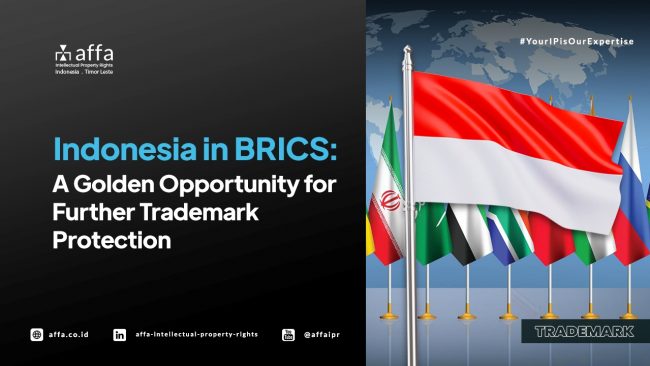
Indonesia in BRICS: A Golden Opportunity for Further Trademark Protection

As of January 2025, Indonesia has officially joined BRICS as a full member, marking a significant milestone in its economic journey. This move is expected to enhance trade and investment among member nations, creating exciting opportunities for businesses looking to expand into the region.   BRICS, initially spearheaded by Russia, now includes Brazil, India, China, South Africa, Egypt, Ethiopia, Iran, and the United Arab Emirates. Together, these nations represent a powerful economic bloc, accounting for a substantial portion of global GDP and population. BRICS aims to strengthen the economies of its members, increase their global influence, and provide a counterbalance to Western-dominated economic institutions.   Indonesia’s entry into BRICS comes with a strong foundation. It already has robust trade relations with its fellow BRICS members, offering a dynamic market ripe for exploration. With its strategic location, abundant resources, and growing consumer market, Indonesia is poised to become a hub for international businesses.   This is the perfect time for foreign investors to tap into Indonesia’s vast potential. By registering your Trademark and establishing your business presence in Indonesia, you can gain a competitive edge in one of Southeast Asia’s most promising markets, now further amplified by its BRICS membership.   Indonesia’s Economic Potential in BRICS Countries Russia:  Main Exports to Indonesia: Wheat, fertilizers, and iron & steel products. Number of Registered Trademarks in Indonesia: 47 Most Class Category: 41 – Education; providing of training; entertainment; sporting and cultural activities. (7) 5 – Pharmaceutical and veterinary preparations; sanitary preparations for medical purposes; dietetic substances adapted for medical use, food for babies; plasters, materials for dressings; material for stopping teeth, dental wax; disinfectants; preparations for destroying vermin; fungicides, herbicides. (5) 35 – Advertising; business management; business administration; office functions. (5) 44 – Medical services; veterinary services; hygienic and beauty care for human beings or animals; agriculture, horticulture and forestry services. (5) Brazil Main Exports to Indonesia: Raw sugar, soybeans, and beef. Number of Registered Trademarks in Indonesia: 55 Most Class Category: 1 – Chemicals used in industry, science and photography, as well as in agriculture, horticulture and forestry; unprocessed artificial resins, unprocessed plastics; manures; fire extinguishing compositions; tempering and soldering preparations; chemical substances for preserving foodstuffs; tanning substances; adhesives used in industry. (16) 35 – Advertising; business management; business administration; office functions. (14) 29 – Meat, fish, poultry and game; meat extracts; preserved, frozen, dried and cooked fruits and vegetables; jellies, jams, compotes; eggs, milk and milk products; edible oils and fats. (13) India Main Exports to Indonesia: Organic chemicals, pharmaceutical products, and cotton. Number of Registered Trademarks in Indonesia: 2,308 Most Class Category: 5 – Pharmaceutical and veterinary preparations; sanitary preparations for medical purposes; dietetic substances adapted for medical use, food for babies; plasters, materials for dressings; material for stopping teeth, dental wax; disinfectants; preparations for destroying vermin; fungicides, herbicides. (404) 12 – Vehicles; apparatus for locomotion by land, air or water. (317) 9 – Scientific, nautical, surveying, photographic, cinematographic, optical, weighing, measuring, signalling, checking (supervision), life-saving and teaching apparatus and instruments; apparatus and instruments for conducting, switching, transforming, accumulating, regulating or controlling electricity; apparatus for recording, transmission or reproduction of sound or images; magnetic data carriers, recording discs; automatic vending machines and mechanisms for coin-operated apparatus; cash registers, calculating machines, data processing equipment and computers; fire-extinguishing apparatus. (229) 35 – Advertising; business management; business administration; office functions. (205) China Main Exports to Indonesia: Electronics, machinery, and textiles. Number of Registered Trademarks in Indonesia: 44,992 Most Class Category: 9 – Scientific, nautical, surveying, photographic, cinematographic, optical, weighing, measuring, signalling, checking (supervision), life-saving and teaching apparatus and instruments; apparatus and instruments for conducting, switching, transforming, accumulating, regulating or controlling electricity; apparatus for recording, transmission or reproduction of sound or images; magnetic data carriers, recording discs; automatic vending machines and mechanisms for coin-operated apparatus; cash registers, calculating machines, data processing equipment and computers; fire-extinguishing apparatus. (8,044) 7 – Machines and machine tools; motors and engines (except for land vehicles); machine coupling and transmission components (except for land vehicles); agricultural implements other than hand-operated; incubators for eggs. (3,439) 35 – Advertising; business management; business administration; office functions. (3,060) South Africa Main Exports to Indonesia: Coal, iron, and steel. Number of Registered Trademarks in Indonesia: 227 Most Class Category: 13 – Firearms; ammunition and projectiles; explosives; fireworks. (58) 9 – Scientific, nautical, surveying, photographic, cinematographic, optical, weighing, measuring, signalling, checking (supervision), life-saving and teaching apparatus and instruments; apparatus and instruments for conducting, switching, transforming, accumulating, regulating or controlling electricity; apparatus for recording, transmission or reproduction of sound or images; magnetic data carriers, recording discs; automatic vending machines and mechanisms for coin-operated apparatus; cash registers, calculating machines, data processing equipment and computers; fire-extinguishing apparatus. (50) 42 – Scientific and technological services and research and design relating thereto; industrial analysis and research services; design and development of computer hardware and software. (31) Egypt Main Exports to Indonesia: Cotton, dates, and other agricultural products. Number of Registered Trademarks in Indonesia: 80 Most Class Category: 35 – Advertising; business management; business administration; office functions. (21) 34 – Tobacco; smokers’ articles; matches. (20) 30 – Coffee, tea, cocoa, sugar, rice, tapioca, sago, artificial coffee; flour and preparations made from cereals, bread, pastry and confectionery, ices; honey, treacle; yeast, baking-powder; salt, mustard; vinegar, sauces (condiments); spices; ice. (14) 41 – Education; providing of training; entertainment; sporting and cultural activities. (14) 42 – Scientific and technological services and research and design relating thereto; industrial analysis and research services; design and development of computer hardware and software. (13) Ethiopia Main Exports to Indonesia: Coffee, oilseeds, and raw hides. Number of Registered Trademarks in Indonesia: N/A Most Class Category: N/A Iran Main Exports to Indonesia: Crude oil, petrochemical products, and nuts. Number of Registered Trademarks in Indonesia: 135 Most Class Category:  30 – Coffee, tea, cocoa, sugar, rice, tapioca, sago, artificial coffee; flour and preparations made from cereals, bread, pastry and confectionery, ices; honey, treacle; yeast, baking-powder; salt, mustard; vinegar, sauces (condiments); spices; ice. (36) 29 – Meat, fish, poultry and game; meat…

Amended Definition of Patent under the Revised Indonesian Patent Law - AFFA IPR

Amended Definition of Patent under the Revised Indonesian Patent Law

The landscape of Intellectual Property in Indonesia continues to evolve, reflecting the dynamic nature of technology and innovation. One of the most significant updates in Law No. 65 of 2024, which is the third amendment to Law No. 13 of 2016 on Patents, lies in the revised definition of “Invention.”   The Old Definition Under Law No. 13 of 2016, Article 1(2) defined an invention as: “An idea of an inventor embodied into a specific problem-solving activity in the field of technology in the form of product or process, or refining and developing product or process.”   While this definition provided a foundation for Patent protection, it was deemed limited in addressing the broader advancements in technology and innovation across various industries.   The New Definition With the enactment of Law No. 65 of 2024, Article 1(2) now defines an invention as: “An idea of an inventor embodied into a specific problem-solving activity in the field of technology in the form of product and/or process, refinement, and/or development of a product and/or process, as well as systems, methods, and uses.”   Key Changes and Implications   Broader Scope: The inclusion of “systems, methods, and uses” significantly broadens the scope of what can be patented. This change acknowledges the importance of protecting technological advancements that may not fit neatly into the previous categories of “product or process.” Clarity and Flexibility: By adding “and/or” between product, process, refinement, and development, the law ensures greater flexibility in interpretation, making it more inclusive for different types of innovations. Alignment with Global Standards: The new definition aligns more closely with international Patent laws, making Indonesia a more attractive jurisdiction for inventors and businesses seeking to protect their Intellectual Property globally.   Why the Change Matters   This amendment reflects Indonesia’s commitment to adapting its Intellectual Property framework to keep pace with the rapid evolution of technology. From AI-driven systems to innovative methods in healthcare, the revised definition ensures that inventors in Indonesia have a robust legal foundation to protect and commercialize their ideas.   The revision is not only a response to domestic technological advancements but also a move to foster innovation and competitiveness in the international market. By expanding the definition, Indonesia signals its readiness to embrace emerging industries and future innovations.   For a deeper dive into the broader implications of the revised Patent Law, read our comprehensive guide: The Ultimate Guide to the Amendment of the Indonesian Patent Law. Should you need to know how this new definition impacts your business or invention, feel free to contact us at [email protected].

2025 Resolution: Wealth Through IP - Make It Happen! - AFFA IPR

2025 Resolution: Wealth through IP – Make It Happen!

As we enter a new year, many of us aim for ambitious resolutions, including achieving financial success. One often-overlooked but highly effective way to achieve this is through Intellectual Property (IP) ownership—be it Trademarks, Patents, Industrial Designs, or Copyrights. Hard to imagine? Let’s look at some inspiring examples of how IP has made others wealthy.   Trademarks: David Beckham Earned USD 36 Million in 2024  By licensing his name to major companies like Adidas, Nespresso, and Stella Artois, the English football icon significantly boosted his income from the previous year, which was “just” USD 16.2 million. This is remarkable, considering he retired more than a decade ago.  Moreover, the entire Beckham family, from his wife Victoria to his children Brooklyn, Romeo, Cruz, and Harper, have also registered their names as Trademarks with the UK Intellectual Property Office (UKIPO). So, if you have a unique name with notable achievements, don’t hesitate to register it and use it as your business identity.   Patents: Dyson’s Innovations Generated GBP 1.4 Billion in 2023  Founded by Sir James Dyson in 1991, Dyson started with the revolutionary bagless vacuum cleaner. Today, its innovations extend to other technologies used in household appliances such as hand dryers, bladeless fans, air purifiers, and hair styling tools.  Although the company invests heavily in R&D for AI, robotics, and cutting-edge battery technologies, its tens of thousands of registered patents have been licensed to numerous companies worldwide, providing additional revenue beyond the sales of finished products. In 2023, Dyson’s total revenue reached GBP 7.1 billion!   Copyrights: Mariah Carey’s Royalties Reach USD 3 Million Annually  In the entertainment world, Copyright is an invaluable asset. For instance, Mariah Carey’s timeless hit, “All I Want for Christmas Is You,” has generated annual royalties of around IDR 48 billion despite being released in 1994. These royalties come from frequent airplay on radio, streaming platforms, and usage in films and commercials every holiday season.  If you create a song or movie with a holiday theme, its popularity and playback could grow yearly, allowing you to earn passive income through royalties.   Industrial Designs: Bandai’s 20 Billion Yen Annual Revenue from “Henshin Belt”  It’s no secret that the Kamen Rider series serves as a year-long advertisement for toys. Each year, a new Kamen Rider series is introduced, complete with a new Henshin Belt—more sophisticated and unique, following current trends.In the story, the Henshin Belt is a high-tech device enabling the protagonist to transform into a superhero. To captivate children, the toy version incorporates engaging “gimmicks.” For example, in the latest series, Kamen Rider GAVV, the gimmick involves inserting small monster-shaped collectibles into the belt to unlock various powers. Bandai registers the Industrial Design for the belt and its collectible monsters to ensure exclusivity and economic rights. With this protection, no other party can legally use the unique design without permission. The result? Annual toy sales of approximately USD 134 million!   These examples show that Intellectual Property isn’t just a foreign concept—it’s also applicable in Indonesia or everywhere. You can use your name as a Trademark for a restaurant franchise or create a unique product design registered as an Industrial Design. As long as your IP is protected, it will continue to generate opportunities to build wealth in the future. If you’re an innovator, business owner, athlete, musician, or creator from any background, IP-based business opportunities can be a promising source of future income. To learn more about securing legal protection for your Intellectual Property, reach out to us at [email protected].