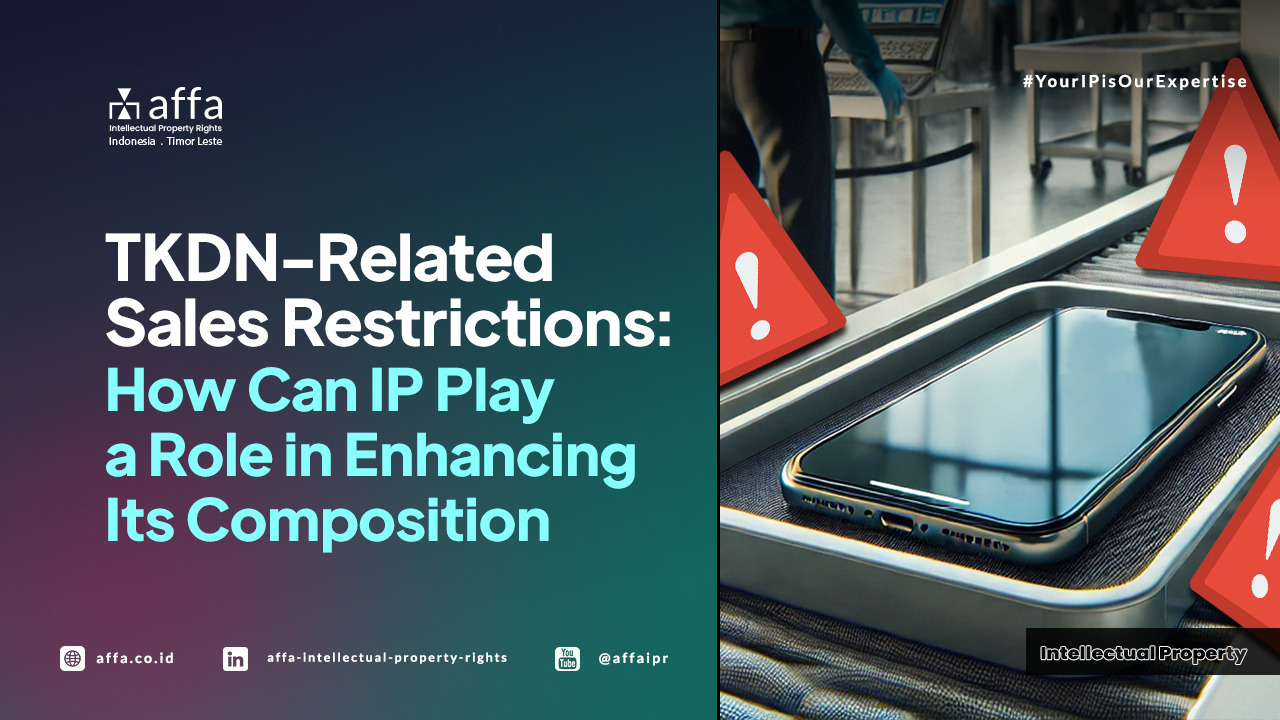
The Indonesian government recently banned the distribution of the iPhone 16 due to its failure to meet the required Domestic Component Level (TKDN) threshold of 35%. This policy serves as a stern reminder to all local and international manufacturers of the importance of contributing to the development of domestic industries. However, the iPhone 16 is not the only TKDN-related issue in the spotlight. Previously, the tactical vehicle Maung Pindad, used by “RI 1” (the President), became a success story in fulfilling TKDN requirements. According to Chief of Presidential Staff Anto Mukti Putranto, while 30% of Maung’s components were sourced from Korean and German manufacturers, namely SsangYong and Mercedes-Benz, the remainder was developed locally. So, who is obligated to comply with TKDN regulations? How can Intellectual Property (IP) certificates help meet these requirements? Let’s dive into the details. Legal Basis of TKDN TKDN refers to the percentage of goods or services derived from domestic components in a product, service, or combination of both. This policy is governed by Minister of Industry Regulation No. 16 of 2011, which outlines the rules and methods for calculating TKDN. At least three parties are required to comply with TKDN regulations: Electronics and Telecommunications Manufacturers: Products like smartphones with 4G/5G technology must have a minimum TKDN value of 35%, as stated in Minister of Industry Regulation No. 22 of 2020 on Electronics and Telematics TKDN Calculation Guidelines. Goods/Services Providers for Government Projects: Under Presidential Regulation No. 16 of 2018 on Government Procurement, all government-procured goods/services must prioritize products with high TKDN values. Strategic Industries: For example, battery electric vehicles (BEVs) are regulated under Minister of Industry Regulation No. 6 of 2022, which specifies development roadmaps, specifications, and TKDN calculation requirements. Intellectual Property & TKDN Calculation Framework Factors influencing a product’s TKDN value include: Type of Product and/or Service: Different products have unique parameters and calculation weights, such as manufactured goods, technology, or services. Local Components Used: The greater the proportion of raw materials or services sourced domestically, the higher the TKDN value. Contribution of Certification and Local Innovation: Intellectual Property certificates, SNI (Indonesian National Standard), and Halal certification can increase the domestic component value. It can be concluded that owning IP Certificates, such as Patents, Trademarks, and Industrial Designs, allows businesses to count these as part of the Domestic Component (KDN). The varying needs of industries and technical specifications result in differing TKDN standards. For instance, electronic products like smartphones require a minimum TKDN value of 35%, whereas strategic industrial products like electric vehicles involve more complex parameters, including design and testing. Specifically for the iPhone, Apple previously held a TKDN certificate, but its validity period has expired. To renew it, the government still deems the latest investment made in educational facilities insufficient. Apple would need to establish larger manufacturing plants and research development centers to meet the requirement. Requirements for Meeting TKDN Standards To obtain TKDN certification, businesses must fulfill the following requirements: Company Legal Documents: Articles of incorporation and business licenses. Intellectual Property Certificates: Relevant patents, trademarks, or industrial designs. Quality Management System: Certification such as ISO 9001:2015. Proof of Local Components: Cooperation contracts with local suppliers or invoices for locally sourced raw materials. Verification Body Appointment Letter: Only independent bodies designated by the Ministry of Industry can conduct TKDN verification. TKDN as a Strategic National Policy From its requirements and objectives, TKDN is not just a regulation but a strategic national policy to strengthen domestic industries. Similar policies exist in other countries, such as: Buy American Act in the United States; Industrial and Regional Benefits in Canada; Local Content Policy in Brazil; Local Content Requirement in the European Union; Make in India in India; and China’s Indigenous Innovation Policy in China. This long-term policy to enhance Indonesian products’ competitiveness in local and global markets deserves our full support. Does your product meet the required TKDN standards? Don’t hesitate to consult us about registering your Intellectual Property as part of TKDN compliance. Contact us via email at [email protected].
Protecting a Giant: Why Godzilla Needs Both 3D Mark and Industrial Design Status
This November, one of Japan’s oldest Intellectual Property (IP) assets celebrates its 70th anniversary. First introduced as a movie in 1954, Godzilla has since starred in over 40 films and animated series, and its Trademark is protected in more than 30 countries worldwide. As a giant mutant lizard with many variations, its likeness has also been immortalized in various toys and merchandise, often registered as Industrial Designs to protect them from counterfeiting. However, since Industrial Design protection has a limited duration, Toho, the owner of Godzilla’s IP, has also registered it as a 3D Mark. What’s the difference? What are the advantages compared to Industrial Designs? Here’s the answer… Aesthetic Value vs. Distinctiveness Based on its definition, Industrial Design protects the aesthetic aspects or appearance of a product, such as its shape, pattern, or configuration, which give it a distinctive impression. The focus is on visually appealing elements rather than brand identity. Therefore, Industrial Designs protect the unique design of vehicles, household appliances, and, of course, toys. On the other hand, a 3D Mark is a mark that protects the three-dimensional shape of a product used to distinguish the goods or services of one party from another. Examples include the Coca-Cola bottle, Lego bricks, Ferrari’s prancing horse, and the PS5 console. The differences, as well as the advantages and disadvantages of Industrial Designs and 3D Marks, can be summarized in the following table: Industrial Design 3D Mark Focus of Protection Protects the aesthetics or visual appeal of a product. Protects the identity and function of a Trademark in commerce. Duration of Protection Limited duration, typically 10-15 years, depending on the regulations in a given country. Unlimited duration as long as it is renewed periodically every 10 years. Registration Process & Criteria Must be new and unique in its design. Requires evidence that the shape has a distinctive character and is recognized by consumers as a Trademark. A 3D Mark cannot be registered if the shape has functional value. Advantages The registration process is relatively simpler and quicker. Protection can last indefinitely with periodic renewals. Disadvantages Protection is limited to aesthetic aspects, and the duration cannot be extended. The registration process is more complex and requires significant evidence of use to demonstrate distinctiveness in the market. Godzilla Needs Longer Protection From the table above, we can understand why IP assets as old as Godzilla still seek longer protection. Especially considering the increasing hype surrounding Godzilla after winning the 2024 Academy Award/Oscar for Best Visual Effects. This success could lead to an increase in counterfeit products and toys by irresponsible parties. According to Yahoo Japan and a decision by the Japanese court, Toho’s attempt to register one of Godzilla’s variants, Shin Godzilla, as a 3D Trademark began as early as October 2019. However, after a lengthy process, the Japan Patent Office (JPO) issued a final rejection in March 2024, stating that the registered Godzilla shape was too generic and lacked sufficient distinctiveness. Toho subsequently filed an appeal in May, emphasizing that the Shin Godzilla design has a strong distinctive character and is widely recognized by the public. This was followed by a review of submitted evidence, including the popularity of Shin Godzilla as a character, its use in various products, and public recognition of the shape as a unique identity, by the court. 3D Mark Shin Godzilla – Application No.: 2020-120003 Finally, on October 30, 2024, the court overturned the JPO’s decision and declared that the 3D shape of Shin Godzilla possesses sufficient distinctiveness and is eligible to be registered as a 3D Mark. The court emphasized that the popularity and widespread recognition of the Shin Godzilla character added significant value to the assessment of its distinctiveness. As a result, Shin Godzilla has successfully secured the opportunity to get unlimited protection. This ruling sets an important precedent for 3D Mark protection in Japan, particularly for the entertainment industry and consumer products that rely on unique characters or designs as their brand identity. Previously, iconic characters were typically protected through copyright for creative works, and their names or logos as Trademarks. Now, these characters can also be protected as 3D Marks if proven to have distinctiveness and public recognition as a source identifier. This strengthens Intellectual Property protection for iconic characters through a layered and complementary approach, depending on the context of their use. Should you need further information regarding trademark registration and protection in Indonesia or worldwide, please contact us via email: [email protected].
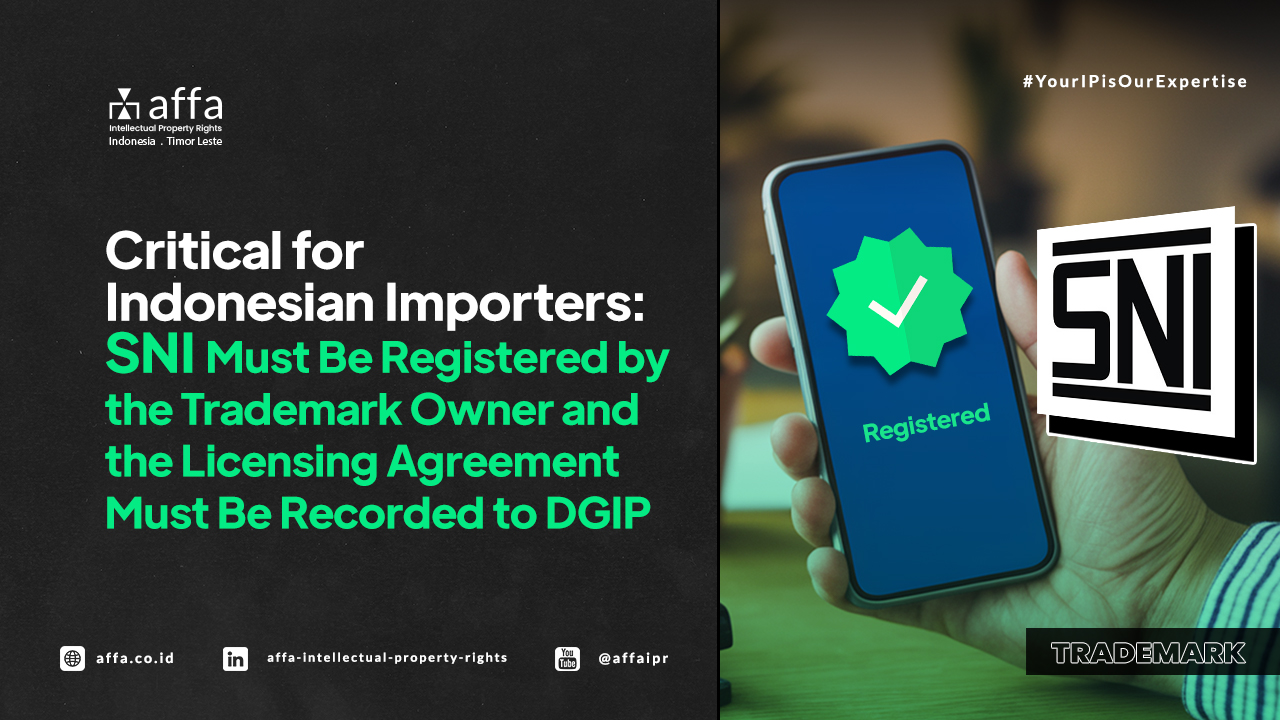
Critical for Indonesian Importers: SNI Must Be Registered by the Trademark Owner and the Licensing Agreement Must Be Recorded to DGIP
One of the primary requirements for obtaining a Certificate of Indonesian National Standard (SNI) is the ownership of a valid and registered Trademark with the Directorate General of Intellectual Property (DGIP), whether by a domestic industrial company or a foreign producer. Products intended to be marketed in Indonesia must meet specific standards, including quality and safety requirements, as enforced through the SNI certification. Thus, having a registered Trademark is no longer optional but necessary for conducting business in Indonesia. A Trademark is a product’s identity and a critical legal protection tool, especially in a highly competitive market. Securing a registered Trademark is a vital initial step for local and international business operators. Furthermore, business operators who fail to obtain an SNI Certificate for products that are required to have one may face severe penalties, including administrative sanctions such as product distribution bans and product recalls, as well as criminal sanctions such as fines and the revocation of previously issued SNI certifications. Requirements for Obtaining SNI To obtain an SNI Certificate, business operators must meet several requirements, including: Ownership of a registered Trademark in the appropriate class (e.g., Class 11 for gas stoves). A quality management system that complies with ISO 9001:2015. Adequate production facilities. Product testing at an accredited laboratory. Registration Process and Eligible Parties for SNI Registration Domestic Industrial Companies: Local producers holding a valid business license in Indonesia. Can directly apply for an SNI Certificate via SIINas (National Industrial Information System). Foreign Producers: Must appoint an Authorized Representative in Indonesia to handle certification processes. Applications must be submitted by the Authorized Representative in Indonesia who holds the Trademark License for the product. Additional documents are required, such as a License Agreement and proof of license recordation with the DGIP. If you are a distributor or importer, please ensure that the products you import have their Trademark registered in Indonesia by the foreign producer and that you have a License Agreement that has been recorded with the DGIP. To simplify the process and ensure all documents comply with applicable laws in Indonesia, you can utilize the services of a trusted Trademark Consultant to handle all the necessary steps, including: Registering the Trademark with the DGIP on behalf of the client (foreign producer). Drafting a License Agreement that adheres to Indonesian regulations. Recording the License Agreement with the DGIP to ensure the license has legal enforceability. Assisting clients in managing the documents required for the SNI Certificate, including consultations related to compliance with SNI standards. Should you need further information regarding Trademark registration as a requirement for obtaining an SNI Certificate, feel free to contact us via email at [email protected].
Trademark Filing & Renewal Fees in the U.S. Rise Starting January 2025: What You Need to Know
The United States Patent and Trademark Office (USPTO) has announced fee adjustments for Trademark filing and renewal, which will take effect on January 18, 2025. These changes include increases in fees for various Trademark-related services, ranging from USD 50 to 150. If you own a registered Trademark in the United States or plan to file a Trademark there, here are the details of the fee changes: Application Fees Current New TEAS Standard* USD 350 n/a TEAS Plus** USD 250 n/a Base application (sections 1 and 44), per class n/a USD 350 Application fee filed with WIPO (section 66(a)), per class USD 500 USD 600 Subsequent designation fee filed with WIPO (section 66(a)), per class USD 500 USD 600 Surcharge Fees Current New Insufficient information (sections 1 and 44), per class n/a USD 100 Using the free-form text box instead of the Trademark ID Manual within the Trademark Center to identify goods and services (sections 1 and 44), per class n/a USD 200 Each additional group of 1,000 characters in the free-form text box beyond the first 1,000 (sections 1 and 44), per affected class n/a USD 200 Post-Registration Maintenance Fees Current New Section 9 registration renewal application, per class USD 300 USD 325 Section 8 declaration, per class USD 225 USD 325 Section 15 declaration, per class USD 200 USD 250 Section 71 declaration, per class USD 225 USD 325 Renewal fee filed at WIPO USD 300 USD 325 Petitions and Letters of Protest Fees Current New Petition to the Director USD 250 USD 400 Petition to revive an application USD 150 USD 250 Letter of protest USD 50 USD 150 Intent-to-Use Fees Current New Amendment to allege use (AAU), per class USD 100 USD 150 Statement of use (SOU), per class USD 100 USD 150 If possible, you can file a new Trademark application before January 2025 and take advantage of the services of an experienced Trademark Consultant to calculate all potential costs that may arise afterward. By understanding these costs, you can better prepare in advance, ensuring a smooth trademark protection process in the United States. Make sure not to miss business opportunities and always secure Trademark protection in the United States by registering your Trademark there. Should you need more information regarding Trademark registration and protection in the United States, please contact us via email: [email protected]. *) Trademark Electronic Application System Standard: A registration scheme with higher fees, suitable for unique goods and/or services with specific descriptions if they are not available in the existing list provided by the USPTO. **) Trademark Electronic Application System Plus: A standard registration scheme that requires applicants to use the list of goods/services already provided by the USPTO.
WIPO’s 2024 Report: Indonesia Ranks Among Global Leaders in Trademarks and Design Growth
The World Intellectual Property Organization (WIPO) recently released the World Intellectual Property Indicators 2024 (WIPI) report, highlighting the growth performance of Intellectual Property (IP) in 2023. This report provides a comprehensive overview of global trends in IP, covering Patents, Trademarks, Geographical Indications, Industrial Designs, and Plant Variety Protection. It is a vital reference for governments, entrepreneurs, and innovators to understand their country’s position in the global IP landscape. China, India, Russia, and Indonesia showcased remarkable growth in this report. China leads with 1.64 million Patent applications, accounting for 46% of all Patent applications worldwide. Regarding Trademark and industrial design applications, China also dominated with 7.4 million Trademark applications (approximately 49% of the total global market) and 58% of global industrial design filings. Similarly, China commanded a 54% share in plant variety protection applications. How Did Indonesia Perform? While the global average for Trademark applications declined by 2%, Indonesia bucked the trend with a 10% increase in 2023, trailing only Russia (30%) and Mexico (11%). For industrial designs, Indonesia recorded the highest global growth at 37.3%, far surpassing the global average of 2.8%. In absolute numbers, Trademark applications in Indonesia rose from 122,458 to 152,447, and industrial design filings increased from 4,795 to 6,326. These achievements place Indonesia as a Southeast Asian leader, far ahead of Singapore, Malaysia, and Thailand. Global Rankings: Where Does Indonesia Stand? Trademark Applications Indonesia ranks 15th globally, behind: China (7,184,831) United States (739,395) Russia (546,455) India (520,862) EUIPO (436,720) Brazil (427,327) Turkey (398,763) United Kingdom (345,205) Japan (328,559) Iran (327,384) South Korea (314,284) France (263,550) Germany (229,793) Mexico (205,867) Industrial Design Applications Indonesia ranks 19th globally, trailing: China (826,086) EUIPO (116,884) United Kingdom (81,543) United States (60,022) South Korea (59,454) Turkey (58,084) Italy (37,099) Japan (32,061) France (30,023) Germany (29,663) India (28,168) Spain (14,776) Switzerland (11,391) Russia (10,472) Canada (9,037) Australia (8,798) Iran (7,841) Brazil (7,679) Creative Industries Drive Growth According to the WIPI 2024 report, Indonesia’s growth in Trademarks is largely fueled by MSMEs and the creative economy, while the textile, fashion, and handicraft sectors primarily drive the surge in industrial design filings The data further indicates that the primary purpose of registering Trademarks and industrial designs in Indonesia is to facilitate exports. Future Potential and Opportunities As public awareness of IP registration continues to grow, Indonesia holds immense potential to become a hub for innovation and intellectual property in the ASEAN region. Strengthening regulations, increasing public education, and fostering collaboration with the private sector can help capitalize on this momentum. Should you need more information about the registration and protection of Patents, Trademarks, or Industrial Designs, both domestically and internationally, please contact us via email: [email protected].
Indonesia – Adjustment to the Intellectual Property Services Official Fees Under the Government Regulation No. 45 Year 2024
The Government of the Republic of Indonesia has issued the latest update on the Non-Tax State Revenue for the Ministry of Law and Human Rights under the Government Regulation No. 45 Year 2024. The adjustments cover IP services pertaining Trademark, Geographical Indication Patent, Industrial Design, and Copyright. We herewith provide you the summary of the changes for your perusal and please bear in mind that anything not listed here is not affected. Trademark and Geographical Indication The items that have been adjusted are as follows: Type of Action Old Fees New Fees International Registration designating Indonesia CHF 144 CHF 125 International Registration renewal in Indonesia CHF 180 CHF 156 International Registration renewal in Indonesia (within 6-month grace period) CHF 360 CHF 313 Requesting substantive examination for a Geographical Indication application N/A IDR 1,000,000.00 Patent The items that have been adjusted are as follows: Type of Action Old Fees New Fees Accelerated publication IDR 400,000.00 IDR 500,000.00 Patent substantive examination request IDR 3,000,000.00 IDR 3,500,000.00 Simple patent substantive examination request IDR 500,000.00 iDR 750,000.00 Priority rights document request IDR 300,000.00 IDR 500,000.00 Patent decision appeal request IDR 3,000,000.00 IDR 4,000,000.00 Post-grant correction of description, claim, and/or figures after the patent is granted IDR 3,000,000.00 IDR 4,000,000.00 Post-grant appeal against the decision to grant a patent IDR 3,000,000.00 IDR 4,000,000.00 Patent Board of Appeal decision request N/A IDR 20,000.00 per page Industrial Design No changes or adjustments were introduced for Industrial Design matters. Copyright The items that have been adjusted are as follows: Type of Action Old Fees New Fees Application IDR 400,000.00 OR IDR 600,000.00 (if software) per creation IDR 200,000.00 Should you have any further questions and queries about the adjustment of official fees, please do not hesitate to contact us at [email protected].
The Ultimate Guide to the Amendment of the Indonesian Patent Law
The Indonesian IP world has just gotten more exciting after the enactment of the Law No. 65 Year 2024 on the Third Amendment to the Law No. 13 Year 2016 on Patents on 28 October 2024. The amendment is designed to be in line with the current technological practices around the world, while at the same time putting a special emphasis on the national interest. It also aims to make Indonesia’s Patent System more adaptable and responsive to contemporary needs. Please note that as the result of this amendment, several official fees have increased as well. The actions that are subject to the increase include the acceleration of publication, substantive examination request for both invention patent and simple patent, and the appeal before the patent board of appeal/appeal commission. Whereas for recordals (data amendment, assignment and license), certificate correction, filing and annuity fees remain the same. The key theme of the amendment is divided into 28 parts below. Please note that the amendment has the following conditions: Patent applications that have been submitted and processed but are not yet completed will continue to be processed based on the provisions of patent legislation prior to the enactment of this Law. The protection period for simple patent applications submitted under Law No. 14 of 2001 on Patents and Law No. 13 of 2016 on Patents, as amended by Law No. 6 of 2023 on the Establishment of Government Regulation in Lieu of Law No. 2 of 2022 on Job Creation as Law, is calculated from the Filing Date. Patents granted under Law No. 14 of 2001 on Patents shall remain valid until the end of their protection period. Should you need more information regarding the proposed amendment of Patent Law in Indonesia, please do not hesitate to contact us via [email protected].