Understanding Trade Secret Laws in Indonesia: Scope and Consequences - AFFA IPR

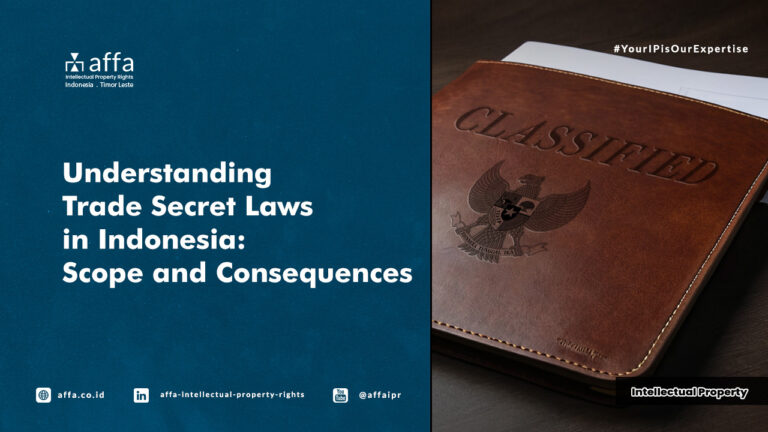
Understanding Trade Secret Laws in Indonesia: Scope and Consequences

Trade Secrets are the recipe for business success in various fields, such as culinary, IT, pharmaceuticals, and biotechnology.   The public often seeks ways to discover or exploit these “secrets to success” through various means, including claiming and exposing these secrets on social media.   So, what exactly are the scope and consequences for disclosing Trade Secrets? We’ve summarized it for you.   Trade Secrets are governed by Law No. 30 of 2000 concerning Trade Secrets (Trade Secret Law). The definition of Trade Secrets, as outlined in Article 1, point 1, of the Trade Secret Law, is information that is not generally known to the public in the field of technology and/or business and has economic value because it is helpful in business activities, and is kept confidential by the owner of the Trade Secret.   So, what does a Trade Secret encompass?   Article 2 of the Trade Secret Law describes the scope of Trade Secret protection as follows:   Production Methods Various steps and technologies are used to convert raw materials into finished goods. Processing Methods Methods focusing on the steps necessary to alter or modify the properties of raw materials. Sales Methods Various strategies or methods to sell products or services to consumers, considering variables like target market, product type, and sales objectives. Other Information in Technology or Business This category includes product development research, customer data, agreements with third parties, and future business strategies. Economic Value Have other secrets that provide a competitive market advantage and financial potential. Not Known to the General Public The information is not a “public secret,” meaning it is known only to certain parties and not widely known by the general public.   A common dilemma for business owners is whether to file a Patent for their Trade Secret or keep it confidential indefinitely.   However, you should know that there is a criminal penalty of up to 2 (two) years imprisonment and/or a fine of up to IDR 300,000,000 (three hundred million rupiah) for parties without permission, using the Trade Secret.   To protect your Trade Secret, here are a few options to consider:   Document all methods and/or other information as thoroughly as possible. Keep the information confidential by drafting a Non-Disclosure Agreement (NDA) signed by all parties involved. Update the documentation whenever there are updates to the methods and/or other information related to the Trade Secret.   Additionally, you can implement access restrictions or encrypted technology to secure confidential documents, preventing unauthorized access.   However, you want to license your Trade Secret to a third party. In that case, you must record it with the Directorate General of Intellectual Property (DGIP) to obtain legal protection from unauthorized third-party violations. Should you need more information on Trade Secret protection in Indonesia, you can contact us via email: [email protected].

Anti-Counterfeiting Methods: Choose the Right Strategy to Get Additional Protection for Your Intellectual Property - AFFA IPR

Anti-Counterfeiting Methods: Choose the Right Strategy to Get Additional Protection for Your Intellectual Property

Counterfeiting is a pervasive issue that threatens the integrity of Intellectual Property (IP) across various industries. From luxury goods to pharmaceuticals, counterfeit products not only harm brand reputation but can also endanger consumers. In this article, we will explore the most effective anti-counterfeiting methods available and guide you in choosing the right strategy based on the type of IP you seek to protect.   Before diving into anti-counterfeiting methods, it is crucial to understand what counterfeiting is and its broad impact. Counterfeiting involves the unauthorized production of goods that imitate genuine products, leading to financial losses, reputational damage, and potential legal liabilities. And that’s something you want to avoid.   Anti-Counterfeiting Methods Overview   In addition to registering and/or recording your Intellectual Property with the Directorate General of Intellectual Property (DGIP) of the Ministry of Law and Human Rights (Kemenkumham) or IP Customs Recordation, several other methods are available to strengthen the protection of your IP. But each comes with strengths and weaknesses. These methods can be categorized into physical and digital solutions, as well as legal and technological approaches.   Physical Anti-Counterfeiting Methods Holograms and Security Labels Holograms and security labels are widely used to authenticate products. These features are difficult to replicate, making them an effective deterrent against counterfeiters. This method appropriate for Trademarks, Patents, and Copyright-protected products such as luxury goods, pharmaceuticals, electronics, and official documents. Watermarks Watermarks are subtle marks embedded into materials like paper or textiles. They are invisible under normal conditions but can be seen when held against light. This method appropriate for Copyright-protected works, Industrial Designs, and legal document for Trade Secrets. Unique Serial Numbers and Barcodes Unique identifiers such as serial numbers and barcodes are used to track products throughout the supply chain. This method appropriate for Patented products, Trademarks, or hi-regulated products such as electronics, pharmaceuticals, and automotive parts.   Digital Anti-Counterfeiting Methods   RFID Tags and QR Codes Radio-frequency identification (RFID) tags and QR codes store product information that can be scanned to verify authenticity. This method appropriate for Trademarks, Patents, or products that require real-time tracking, like fashion items, electronics, and pharmaceuticals. Blockchain Technology Blockchain provides a decentralized ledger that records every transaction associated with a product. This method offers a transparent and tamper-proof way to verify product authenticity. This method appropriate for Patented products, Trademarks, or products with high levels of security, such as luxury goods, fine art, and collectibles. Digital Watermarking Digital watermarking embeds information directly into digital media, such as images, videos, or audio files, which can then be used to verify authenticity. This method appropriate for Copyright-protected digital content like music, videos, images, and software.   Selecting the Right Anti-Counterfeiting Method The best anti-counterfeiting strategy depends on the type of IP you are protecting and the specific threats you face. Here’s a brief guide:   Trademarks Consider using physical security features like holograms and security labels, along with digital solutions such as RFID tags or blockchain for high-value items.   Patents Employ unique serial numbers, barcodes, and blockchain to ensure product integrity and traceability.   Copyrights Use digital watermarking for digital media and watermarks for physical documents or packaging. In this digital era you can choose invisible watermark by using steganography.   Trade Secrets Focus on strong legal protections and technological solutions like encryption to prevent unauthorized access and copying.   Counterfeiting remains a significant challenge for IP owners, but by employing the right combination of anti-counterfeiting methods, you can effectively protect your intellectual property. Assess your specific needs, the nature of your IP, and the risks you face to determine the most appropriate strategy. Should you need more information about additional protection for your Intellectual Property, dont hesitate to contact us via email: [email protected].

Various Intellectual Properties in Football - AFFA IPR

Various Intellectual Properties in Football

At the beginning of May 2024, the United Nations (UN) General Assembly declared May 25 as the World Football Day. This date was chosen to commemorate the 100th anniversary of the first football competition at the 1924 Olympics held in Paris, France. The UN hopes this day will always be celebrated as a day of world unity, which can unite cultural differences and socio-economic barriers.   As the most widely played sport, Football also involves a lot of Intellectual Property, with a turnover of up to trillions of dollars. This includes Trademarks, Patents, Industrial Designs, Copyrights, Trade Secrets, Domain Names, and License Agreements. Below, we describe some of the Intellectual Property we most often encounter in Football.   Trademark   Every competition and tournament certainly has a name. We know the FIFA World Cup, UEFA Champions League, English Premier League (EPL), and Asian Football Confederation (AFC). These names are synonymous with quality and entertaining games. Most importantly, they are all registered Trademarks that unauthorized parties cannot use arbitrarily. You cannot just produce and sell t-shirts with the UEFA Champions League logo without permission from the Union des Associations Européennes de Football.    Trademarks in football are not only related to competition; several names of top players have also been registered as Trademarks. For example, “CR7” belongs to Cristiano Ronaldo, “Leo Messi” belongs to Lionel Messi, and even Mbappe’s celebration pose. You might also want to read: Kylian Mbappé Has Trademarked His Iconic Goal Celebration – Why Is It Possible?   Patent An innovation that cannot be separated from modern football is the Video Assistant Referee (VAR). With this technology, referee decisions on the field can be more accurate, not controversial. VAR, whose patent is owned by Hawk-Eye Innovations (part of Sony), was first used at the 2018 FIFA World Cup in Russia. With VAR, the referee can quickly check whether a goal is legal, a player is caught offside, or cameras from many sides cover other violations.   As a Patent, FIFA pays royalties to Hawk-Eye Innovations for its use. Hawk-Eye also maximizes its income by marketing this technology to 90 countries worldwide. However, with a cost per season of around USD 6.2 million, not all leagues worldwide can afford to use it.   The Patent for football also includes the ball itself. In almost every World Cup event, the ball is presented with more sophisticated technology than before, which is expected to increase the accuracy of the players’ shots.   Industrial Design   Like the ball in football, the shoes players use may contain patent-protected innovations. But if not, the shoes and all the clothes we see are registered as Industrial Design.   Football jerseys or costumes are one of a football club or team’s biggest sources of income. For diehard fans, wearing a jersey when watching a match or even going to the mall is a matter of pride and proof of their support for their favorite team.   However, jerseys are also among the Intellectual Property most often pirated. As true fans, of course, we can choose to only buy the original because only then is the money we spend commensurate with the quality we get, and most importantly, the income will go to the club we support.   Copyright   League and match materials, images, promotions, or other content related to football broadcasts fall into the Copyright category. Each match is owned by a different owner, who also sells broadcast rights to TV stations in each region.   These Copyright holders even opened a bidding scheme to give the highest buyers the opportunity to obtain the Broadcasting Rights. Because it costs a lot of money to get the rights, it is understandable that the Broadcasting Rights holders are very protective of the material they own. They don’t let other parties broadcast it in the regions they already cover, or prosecution will be carried out.   Trade Secret   Playing strategies, including technical details of formations and other confidential information, can be categorized as Trade Secrets. These secrets give each team a competitive advantage by not revealing certain important information to the public or rival teams. All team members, including the technical and health trainers, are bound by a Non-Disclosure Agreement (NDA).   Domain Name   The Domain Name associated with each league and competition is very important in maintaining its online presence and marketing. Fifa.com, uefa.com, and the-afc.com have been registered to prevent cybersquatting and Trademark misuse. The fifa.com domain, for example, is available in various languages to make it easier to access and search for the latest information and to disseminate official information to all media and football fans throughout the world.   License Agreement   Licensing Agreements may include Trademark Licenses to produce and sell merchandise, mobile phone applications, video games, and more. Game developers who want to present a team with the appropriate club name or accurate appearance of the players have to pay significant royalties to FIFA.   Finally, in organizing football, we must be aware of and involve all related Intellectual Properties (IPs). In fact, IP is the financial generator in every activity. Therefore, don’t forget to involve IPs in every tournament you run and reap the benefits. Should you need further information regarding Licensing Agreements, Trademark registration, Patents, Industrial Designs, Copyrights, or other Intellectual Property, please do not hesitate to contact us at [email protected].

International IP Index 2024: Indonesia to catch up on IP Commercialization - AFFA IPR

International IP Index 2024: Indonesia to Catch Up on IP Commercialization

Every year, the United States Chamber of Commerce releases the “International Intellectual Property Index,” which ranks countries worldwide based on their growth in Intellectual Property, commercialization of Intellectual Property assets, law enforcement, system efficiency, and membership and ratification of international treaties. This year, Indonesia is ranked 49th out of 55 countries, or 7th from the bottom. What caused it?   The International Intellectual Property (IP) Index is a comprehensive assessment of the intellectual property framework of countries worldwide. It indirectly shows a country’s policies in encouraging innovation, creativity, economic growth, and wider investment opportunities.   Intellectual Property Becomes an Important Decision for Investment   Intellectual Property as an asset must be recognized. Today’s large companies are at the forefront thanks to their Intellectual Property assets. Technology companies such as Tesla, Apple, Microsoft, and even Walt Disney became rich thanks to the Copyrights, Patents, Trademarks, Industrial Designs, and Trade Secrets they owned. Therefore, when a country cannot provide a climate conducive to protecting Intellectual Property (IP), it is considered to have failed to protect the wealth of its citizens and its business ecosystem. If this is the case, it makes sense that investment in the lowest-rank countries will be smaller than in the upper-rank countries.   The International IP Index published by the United States Chamber of Commerce was first published in 2012. At that time, it only described the performance of 11 countries: the United States, Australia, Brazil, Chile, China, India, England, Canada, Malaysia, Mexico, and Russia. The 12th edition, released in February 2024, has experienced an increase from the previous year, covering 53 countries. This year’s 55 countries have covered over 90% of the world economy’s Gross Domestic Product (GDP), so it is hoped to represent the condition of world IP.   From Southeast Asian countries, the IP Index maps the performance of Singapore, Malaysia, the Philippines, Brunei, Vietnam, Thailand, and Indonesia as samples. Unfortunately, Indonesia is indeed the lowest in Southeast Asia.   The following is the overall ranking of the 2024 International IP Index:   1 United States 95,48% 29 Peru 49,82% 2 United Kingdom 94,12% 30 Chile 49,72% 3 France 93,12% 31 Colombia 48,84% 4 Germany 92,46% 32 Saudi Arabia 48,42% 5 Sweden 92,12% 33 Brazil 46,52% 6 Japan 91,26% 34 United Arab Emirates 46,00% 7 The Netherlands 91,24% 35 Jordan 44,70%  8 Ireland 89,38% 36 Honduras 42,16% 9 Spainl 86,44% 37 Philippines 41,58%  10 Switzerland 85,98% 38 Brunei 41,08%  11 South Korea 84,94% 39 Ghana 40,88%  12 Singapore 84,92%  40 Vietnam 40,76% 13 Italy 83,90% 41 Ukraine 40,30%  14 Australia 80,70% 42 India 38,64% 15 Hungary 76,90% 43 Thailand 38,28%  16 Canada 76,22% 44 Kenya 37,88% 17 Israel 72,74% 45 South Africa 37,28%  18 Greece 71,42% 46 Argentina 37,00% 19 Poland 70,74% 47 Nigeria 36,34%  20 New Zealand 69,36% 48 Egypt 33,86% 21 Taiwan 67,34% 49 Indonesia 30,40% 22 Morocco 62,76% 50 Ecuador 29,58% 23 Mexico 59,98% 51 Kuwait 28,42% 24 China 57,86% 52 Pakistan 27,42% 25 Dominican Republic 55,30% 53 Algeria 26,36% 26 Costa Rika 55,04% 54 Russia 25,00% 27 Malaysia 53,44% 55 Venezuela 14,10% 28 Turkiye 51,04%   Why is Indonesia’s Ranking Low?   Indonesia’s performance in the index fell 0.02% from the previous year but remained at the same rank.   Indonesia’s Performance based on Indicators Source: 2024 International IP Index – U.S. Chamber of Commerce   From the graph above, it can be seen that the number of Patents owned by Indonesia still needs to be stronger, unable to keep up with the growth of Copyrights, Trademarks, and Industrial Designs. Among all the IPs used as indicators, only Copyright is closest to the Asian average performance.   For other indicators, Indonesia is quite good regarding system efficiency but very low in IP asset commercialization. It is the country with the lowest score for this indicator, recorded at only 4.17%. It is below Ecuador, Venezuela, Ghana, Kenya, Russia, and even Vietnam.   Indonesia’s ranking based on the Commercialization of IP Asset Indicator Source: 2024 International IP Index – U.S. Chamber of Commerce   The commercialization of IP Assets is an indicator that measures the presence of barriers and incentives for the commercialization and licensing of IP assets. In more detail, this indicator includes barriers to technology transfer, registration and disclosure requirements of licensing agreements, direct government intervention in setting licensing terms, and the existence of tax incentives for the creation and commercialization of IP assets.   In particular, the United States Chamber of Commerce assesses that Presidential Regulation of the Republic of Indonesia Number 77 of 2020 concerning Procedures for Implementing Patents by the Government has gone far beyond the stated goals and circumstances for the issuing of compulsory licenses under the Trade-Related Aspects of Intellectual Property Rights (TRIPS) Agreement, minimum standards for the regulation by national governments of different forms of IP as applied to nationals of other World Trade Organization (WTO) member nations. This presidential regulation is considered to hinder the transfer of technology on Patents, and Biopharmaceutical patentability standards are outside international norms.   However, Indonesia is generally at the bottom of the ranking because its commercialization foundation still needs to be stronger. Public awareness of IP still needs to improve; the knowledge of IP as an asset is minimal. There are still many people who do not appreciate IPs, not because they cannot afford to buy, but because the tendency to enjoy the IPs without paying still exists. Copyright growth is high, but the market hopes these works can be enjoyed for free. As a result, creators scream, and their productivity decreases. This also causes the innovation climate in Indonesia is not good. Because the public still needs to consider innovation to be something that can be commercialized, the growth of Patents from Indonesia is low. dapat dikomersialisasikan, pertumbuhan Paten dari Indonesia pun rendah. To change this mentality, more than education is needed; concrete steps from the government and private sectors are needed to give the highest appreciation to every existing IPs from within and outside the…

The-Coffee-Business-and-Intellectual-Property-A-Perfect-Blend-affa-global

The Coffee Business and Intellectual Property: A Perfect Blend

The Coffee Business and Intellectual Property: A Perfect Blend The world of coffee is a flavorful fusion of tradition and innovation. From unique blends to cutting-edge brewing methods, the coffee industry is rich with Intellectual Property opportunities. In this article, we’ll explore the various aspects of Intellectual Property, from Trademarks to Patents, Copyrights, and more, and how they’re intertwined with the coffee business. Whether you’re a coffee connoisseur or a seasoned roaster, here’s a breakdown of the fundamental Intellectual Properties related to the coffee industry:   Trademarks Coffee Brand Names Trademarks protect the unique names and logos of coffee brands. Think of iconic brands like “Starbucks” or “Kapal Api.” Coffee Shop Names Trademarks also apply to coffee shop names, creating brand recognition for businesses like “The Coffee Bean & Tea Leaf” or “Kenangan Coffee.”   Patents Coffee Brewing Technology Patents protect innovative coffee brewing methods and machines—for instance, the invention of the espresso machine in 1884 by an Italian inventor, Angelo Moriondo. Coffee Roasting Equipment Patents can cover advancements in coffee roasting technology, ensuring that unique processes are protected.   Copyrights Coffee Art and Labels Coffee packaging often includes artistic designs and labels. Copyrights safeguard these creative elements. Coffee Literature Copyrights can apply to books, articles, or marketing materials related to coffee, including coffee history, brewing guides, and more.   Trade Secrets Coffee Blends Coffee companies may have closely guarded trade secrets related to their unique coffee blends and recipes. Roasting Profiles The specific roasting profiles for different coffee beans can also be considered Trade Secrets.   Geographical Indications Origin-Based Labels Some coffee regions, like Arabica Gayo coffee or Jamaican Blue Mountain coffee, are known for their distinct flavors. Geographical Indications protect these regional characteristics.   Industrial Designs Coffee Machine Aesthetics The design of coffee machines, from espresso makers to grinders, can be protected by Industrial Design rights. Unique Packaging The distinctive packaging of coffee products, making them easily recognizable on store shelves, can also be registered as Industrial Design.   Plant Variety Protection Unique Coffee Varieties: Specific coffee plant varieties may sometimes be protected to ensure that only authorized growers can cultivate them. For example, Gayo Arabica coffee has several varieties registered as Plant Variety Protection in Indonesia.   Licensing & Franchising Agreements Distribution Rights To distribute a specific brand of coffee, you must obtain official approval from the owner, stating several details, such as distribution scope, licensing validity period, and how much royalties can be given. Franchising Coffee businesses with networked shops usually have a franchise agreement, where the franchisee has obtained permission from the franchisor with a registered Trademark to open a coffee shop based on a predetermined business model.   From a coffee business, there are many additional opportunities to increase income from various existing Intellectual Property, and it would be a shame if they were not maximized. If you need further information about Trademark registration, Patent protection, or anything related to Intellectual Property, please do not hesitate to contact us via [email protected].

Protecting-Your-Food-Recipes-affa-global

Protecting Your Food Recipes: A Step-by-Step Guide

Your food recipes are a valuable asset. They represent your creativity, hard work, and passion. That’s why it’s important to protect them as a trade secret from being stolen or plagiarized. Here are some tips on how to protect your food recipes: Document Your Recipe. This means writing down the ingredients, measurements, and steps involved in making the recipe. Be as specific and detailed as possible. Keep Your Recipe Secret. Don’t share it with anyone, not even friends, family, or colleagues. If you do share it with someone, make sure they sign a non-disclosure agreement (NDA). Also, consider the following steps: a) Use a password-protected computer or file-sharing service to store your recipes. b) Don’t post your recipes on social media or other public forums. c) If you are considering selling your recipes, be sure to consult with an attorney to discuss your options. d) If the recipe is not documented in a digital document, please ensure to keep it in a restricted place (i.e. safe deposit box). Keep Your Recipe Documentation Updated As you continue to refine and improve your recipe, be sure to keep your documentation up to date. This will ensure that you always have an accurate and complete record of your recipe, which can be useful in the event of a legal dispute. By following these tips, you can help protect your food recipes and trade secret from being stolen or plagiarized. So, go ahead and share your culinary creations with the world, knowing that you have taken steps to protect your trade secret.   If you need more advice for protecting your trade secret in Indonesia and other countries, please do not hesitate to contact us at [email protected]. Sources: Nolo.com LegalVision.com