
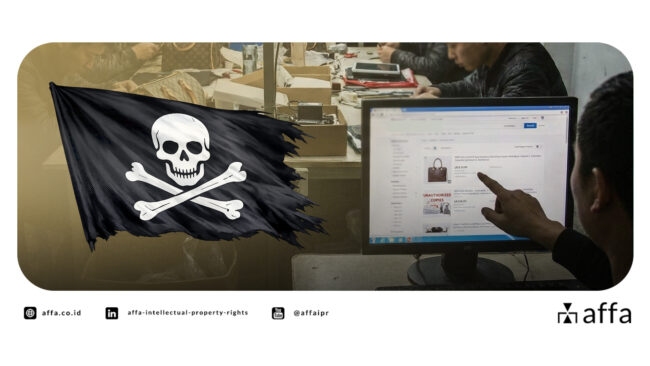
IP Infringed Online? Now You Can Request Official Takedowns in Indonesia
Trademark and Copyright infringement on marketplaces, social media, and websites is not a minor issue in Indonesia. Despite frequent warnings, illegal content distribution, counterfeit product sales, and unauthorized use remain easy to find. Often, enforcement struggles to keep pace with the growth of infringements—take one down, and many more appear in its place. The good news is that the Indonesian IP Office – Directorate General of Intellectual Property (DGIP) now provides an official mechanism to request the takedown of infringing content, listings, accounts, and even entire websites. This mechanism is expressly regulated under Minister of Law Regulation No. 47 of 2025 on the Handling of Reports of Intellectual Property Infringements in Electronic Systems. This means that Trademark owners, Copyright holders, and other Intellectual Property (IP) rightsholders no longer have to remain passive in the face of digital infringements. What Is the New Solution Under This Regulation? Under this regulation, IP owners or rightsholders may submit an official report to DJKI for suspected IP infringements occurring on: Marketplaces/e-commerce platforms Websites Digital media operating through electronic systems Including live streaming content If the report is deemed to meet the elements of infringement, DGIP may recommend access termination, which may include: Removal of content (takedown of listings); Account suspension; or Partial or full blocking of a website. This is an official administrative pathway provided by the state, not merely an internal platform mechanism that may be unavailable or inadequately implemented. Types of Intellectual Property Protected This regulation applies broadly and covers all IP rights protectable in Indonesia, including: Trademarks Copyright and Related Rights Patents Industrial Designs Trade Secrets Layout Designs of Integrated Circuits Geographical Indications Communal Intellectual Property As long as the rights are registered or recorded with DGIP, this mechanism may be used. Who Is Entitled to Submit a Report? Please note that reports may only be submitted by: Registered/recorded IP rightsholders with DGIP; or IP licensees whose license agreements have been recorded with DGIP. Reports may be submitted directly or through an authorized representative, such as a trusted and reliable IP Consultant. How to Submit a Takedown Request Prepare the Report Containing the Following Information Identity of the reporter; Type of IP infringement; Website address, platform name, account, or content link being reported; Brief description of the alleged infringement; and Additional information related to the infringing goods/services. Attach Mandatory Supporting Documents Proof of IP ownership (e.g., Trademark certificate, Copyright recordation, etc.); or Proof of recordation of the IP license with DGIP.Without these documents, the report cannot be processed. Administrative Examination by DGIP After the report is received, DJKI will conduct an administrative examination: If the submission is incomplete, the reporter will be given up to 14 business days to complete it. If the deficiencies are not remedied within this period, the report will be deemed withdrawn. Substantive Verification by the DGIP Verification Team If the report passes the administrative stage, DGIP will form a cross-sector Verification Team (involving DGIP, relevant ministries, associations, and/or experts). The team will examine the substance of the alleged infringement and may request information from: Electronic System Operators (ESOs); and/or The reported party.Verification timeline: a maximum of 3 business days from the date the report is recorded. Recommendation for Access Termination If the infringement is confirmed, DGIP will: Issue a recommendation for partial or full site closure or access termination; and Submit the recommendation to the relevant digital authority or directly to the ESO.The recommendation must be delivered within 1 x 24 hours of being signed. Special Provision for Live Streaming Infringements For infringements occurring via live streaming, the verification and recommendation process is expedited to a maximum of 1 x 24 hours. Can Access Be Restored After a Takedown? Yes, subject to certain conditions, including: Authorization or cooperation from the IP owner/rightsholder; or A settlement agreement resulting from mediation with the reporter. A request for restoration must be submitted to DGIP and will undergo a further review process. With this newly regulated mechanism, trademark owners, creators, and other IP rightsholders now have an additional, effective option for enforcement, beyond court proceedings and internal marketplace complaints. Importantly, the regulation also provides clear timelines, strengthening the position of rightsholders by offering multiple pathways to stop infringements. That said, document completeness and reporting strategy are critical to achieving a successful outcome. Should you need further information on protecting and enforcing intellectual property in the digital space, including marketplaces and websites, please contact us through the following channels and receive a FREE 15-minute consultation. 📩 E-Mail : [email protected] 📞 Book a Call : +62 21 83793812 💬 WhatsApp : +62 812 87000 889 About AFFA: Established in 1999, AFFA Intellectual Property Rights is an Indonesia-based boutique IP law firm serving international brands and innovators, offering full-service support—from prosecution and licensing to enforcement and commercialization—in Indonesia’s dynamic IP landscape. Our firm is widely recognized for its excellence, with accolades including “Best Boutique Law Firm in Indonesia” and “IP Enforcement Firm” at the Indonesia Law Firm Awards 2025 by Asia Business Law Journal, as well as being listed as a “Recommended Firm 2024 — Indonesia” by WTR 1000: The World’s Leading Trademark Professionals. For more information, please visit: www.affa.co.id.