
The Walmart Wirkin VS Hermes Birkin Controversy: A Case Study in Intellectual Property Awareness - AFFA IPR

The Walmart Wirkin VS Hermès Birkin Controversy: A Case Study in Intellectual Property Awareness

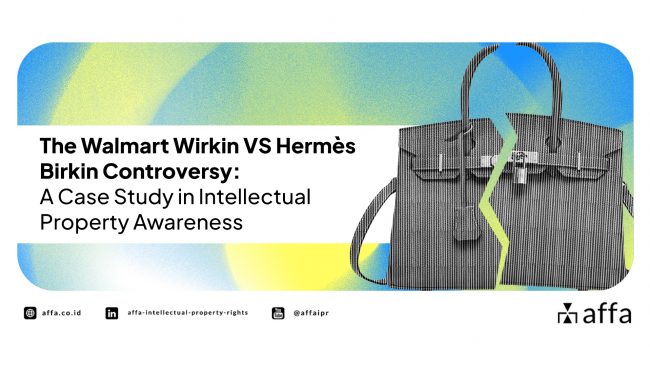
The viral phenomenon surrounding Walmart’s “Wirkin” bag, which bears a striking resemblance to the iconic Hermès Birkin, has captivated social media and sparked discussions on fashion ethics, consumer behavior, and, of course, Intellectual Property. This controversy highlights the complexities of balancing accessible fashion with protecting luxury brand exclusivity. Here’s everything you need to know.   In December 2024, a USD 78 handbag sold on Walmart’s marketplace became an overnight sensation on platforms like TikTok. Dubbed the “Wirkin” by users, the bag mimics the design of the legendary Hermès Birkin, which starts at around USD 10,000. The Wirkin’s affordability and resemblance to a luxury product spurred millions of views in unboxing videos and drew widespread attention.   Ethical and Legal Implications   Supporters argue that the Wirkin democratizes luxury, making high-end aesthetics attainable for everyday consumers. Critics counter that such “dupes” undermine the craftsmanship, exclusivity, and Intellectual Property of brands like Hermès.   From a legal perspective, Hermès could potentially claim a Trademark, specifically Trade Dress infringement, as Wirkin’s design closely imitates the recognizable elements of the Birkin. Trade Dress protects the visual appearance of a product that signifies its source to consumers. However, Walmart might defend the Wirkin by emphasizing its lack of Hermès branding and the significant price gap, arguing that consumer confusion is unlikely.   Walmart’s Response   Amid mounting scrutiny, in mid-January 2025, Walmart removed the Wirkin from its marketplace and issued a generic statement: “In some instances, products may no longer be available. We invite customers to continue exploring our expansive selection and uncover new alternatives.” This move was likely intended to minimize legal risks and preserve brand relationships.   Key Differences Between the Wirkin and Birkin   The table below highlights the critical differences between the two bags, helping consumers distinguish between them:   Feature “Wirkin” Birkin Price ~USD 78 Starts at ~USD 10,000 Logo No branding “Hermès Paris” logo under the flap Material Synthetic or imitation leather High-quality genuine leather or exotic skins Size Options Standard, typically smaller Multiple sizes (25cm, 30cm, 35cm, 40cm) Craftsmanship Mass-produced stitching Handcrafted using saddle stitching Packaging No luxury packaging Comes with Hermès orange box and dust bag Sales Platform Walmart’s e-commerce platform Exclusive to Hermès boutiques Distribution Mass-market availability Strictly controlled, often with a waitlist   From the Wirkin-Birkin case, we gain yet another insight that pricing remains a recurring source of Intellectual Property infringement. Affordable versions of well-known, especially luxury, products continue to attract significant market interest, often without regard for authenticity. However, if you are a Trademark owner, there is no need to worry, as having a registered Trademark establishes you as the rightful owner and grants you the legal authority to take action against counterfeit products. If necessary, you can further strengthen your position by registering your product design as an Industrial Design, ensuring that the aesthetic aspects of your product are also protected.   Moreover, if you are a retailer, it is crucial to understand the intricacies of Trademark law to safeguard your business reputation and avoid misleading virality, which could ultimately jeopardize your business’s sustainability. Should you need more information about Trademark protection in Indonesia or globally, feel free to contact us via email at [email protected].
AFFA Represents Inner Mongolia Kunming Cigarette Limited Liability Company for a Successful Bad-Faith Trademark Invalidation in Indonesia - AFFA IPR

AFFA Represents Inner Mongolia Kunming Cigarette Limited Liability Company for a Successful Bad-Faith Trademark Invalidation in Indonesia

On April 25 2024, the Panel of Judges at the Central Jakarta District Court issued a favourable decision for Inner Mongolia Kunming Cigarette Limited Liability Company to invalidate the “DONGCHONGXIACAO” Trademark under registration number IDM000791780 which had been registered in bad faith since May 2018 in Indonesia.   “DONGCHONGXIACAO” is a Trademark that has been registered and made famous by Inner Mongolia Kunming Cigarette Limited Liability Company (hereinafter referred to as the “company”) in China since 2017, as well as in several other countries including Pakistan, Brazil, Saudi Arabia, Qatar, and the United Kingdom. In 2021, the company decided to apply for Trademark registration with application number DID2021069519 in Indonesia. However, the application was rejected by Trademark Office (DGIP) in 2022 on the grounds that there were substantial similarities with the prior Trademark “DONGCHONGXIACAO” which was registered with number IDM000791780 in the same class, namely class 34.   In response to this rejection, Inner Mongolia Kunming Cigarette Limited Liability Company, which appointed AFFA Intellectual Property Rights, decided to file an act for invalidation of this Trademark. This is done considering that the company believed that the prior Mark “DONGCHONGXIACAO” with registration number IDM000791780 was applied for and registered by a party who did not have the rights to the Trademark nor any legitimate reason to own it, considering that the company has earlier registrations of the same Trademark in other countries which were  submitted before the date of the Trademark application of the prior Mark.   Apart from being registered and marketed in various countries around the world, the arguments in this action were based on the following 4 (four) points::   Similarities in visual elements   Notes Plaintiff’s Trademark Defendant’s Trademark Similarities in Words DONG CHONG XIA CAO DONGCHONGXIACAO Similarities in Writing Dong Chong Xia Cao DONGCHONGXIACAO Similarities in Word Order D-o-n-g-C-h-o-n-g-X-i-a-C-a-o D-O-N-G-C-H-O-N-G-X-I-A-C-A-O Conclusion The Defendant’s Trademark can create an impression that confuses the public, so the Trademark market can think that the Trademark is the Client’s Mark.   Similarities in pronunciation   Notes Plaintiff’s Trademark Defendant’s Trademark Similarities in essence in Trademark Pronunciation dong-chong-xia-cao dong-chong-xia-cao   Similarities in the goods covered in Class 34 They have similarities and close relationships, starting from the function, intended use, and origin of the goods, as well as similarities in marketing channels/target markets, so it is feared that they have the potential to confuse consumers.   Plaintiff’s Trademark Defendant’s Trademark DONGCHONGXIACAO Application Number DID2023116953 – Class 34 Registered Number IDM000791780 – Class 34 Type of Goods: “Tobacco powder; shredded tobacco; cigar; small cigars; cigarette; electronic cigarettes; cigarettes containing tobacco substitutes, not for medical purposes; tobacco; chewing tobacco; tobacco to snort.” Type of Goods: “Tobacco and processed tobacco products, including smoking tobacco, tobacco pipes, cigars and cigarettes, smokers’ goods, including smoking pipes and lighters, electronic cigarettes, non-metal cigarette ash containers, cigarette boxes, gas cylinders for cigar lighters, cigarillos (small cigars), tobacco for self-rolling cigarettes, chewing tobacco, snuff tobacco, kretek, betel tobacco, heated tobacco products, devices electronics and parts thereof for heating cigarettes or tobacco to release nicotine-containing aerosols for inhalation, liquid nicotine solutions for use in electronic cigarettes, cigarette paper, cigarette tubes, cigarette filters, tobacco containers, pouch equipment for rolling cigarettes.”   The trademark invalidation action that was officially filed was registered on December 18, 2024, at the Registrar’s Office of the Commercial Court at the Central Jakarta District Court, with the Trademark Office/Directorate General of Intellectual Property (DGIP) was also included as a co-defendant. Through a series of hearings,, the Panel of Judges at the Commercial Court at the Central Jakarta District Court finally issued a favourable decision for the plaintiff. The decision was based on the following considerations:   “The owner of an unregistered Trademark can file an action as intended in paragraph (1) after submitting an Application to the Minister,” as regulated in Article 76 paragraph (2) of Law Number 20 of 2016 concerning Marks and Geographical Indications (Trademark Law) and the Plaintiff has done this prior to the submission of the suit to the Court of Commerce. The Trademark Invalidation Action has been appropriately and properly filed through the Commercial Court at the Central Jakarta District Court, as regulated in Article 85 paragraph (2) of the Trademark Law; The Panel of Judges has carefully examined that the Defendant’s Trademark is substantially similar to the Client’s Trademark, which was previously registered in China on 28 August 2017. Both the sound of the speech, the arrangement of the letters, and the words used in the word DONGCHONGXIACAO Trademarks, according to the panel of judges, have very close similarities, so it is appropriate that the type of goods owned by the Plaintiff’s mark and the Defendant’s mark can be considered as a Trademark which is substantially similar in the type of goods applied for and also registered; Defendant should not use and/or apply for registration of a Trademark which is similar in essence to Plaintiff’s Trademark because there are many other words or arrangements of words that the Defendant can create and use as a Trademark without having to imitate and/or plagiarize the Plaintiff’s Trademark; The application for registration of the Trademark submitted by the Defendant is not an application that can be registered as intended in Article 21 paragraph 3 of the Trademark Law, or other words, the application for registration of the DONGCHONGXIACAO Trademark should be rejected by the Co-Defendant (DGIP) because the Trademark registered by the Defendant is the result of imitation and/or plagiarism of the Plaintiff’s Trademark which already existed and was previously registered in China; Defendant never appeared at the trial, even though they had been summoned legally and properly; this also proves that the Defendant did not refute the Plaintiff’s arguments, which were that the registered Trademark was substantially similar to the Plaintiff’s mark, which had previously existed and was registered earlier in China, and that the Defendant registered the Trademark in bad faith.   You might also want to read: A Win for the “WIN” – AFFA Represents Hongyunhonghe Tobacco (Group) Co. Ltd. for…