Switzerland Maintains Its Innovation Leadership in 2023; Indonesia Secures 61st Position
The World Intellectual Property Organization (WIPO) Global Innovation Index (GII) 2023 has been released, and it reveals that global innovation is on the rise, with the average GII score reaching an all-time high of 35.9. Switzerland leads with 67.6 points and Angola is in last place, 132nd, with only 10.3.
The GII ranks 132 countries based on their seven innovation performance categories, further divided into several criteria to generate these points. The details are as follows:
1. Institutions
a. Institutional Environment
i. Operational Stability for Businesses
ii. Government Effectiveness
b. Regulatory Environment
i. Regulatory Quality
ii. Rule of Law
iii. Cost of Redundancy Dismissal
c. Business Environment
i. Policies for Doing Business
ii. Entrepreneurship Policies and Culture
2. Human Capital & Research
a. Education
i. Expenditure on Education
ii. Government Funding per Student
iii. School Life Expectancy
iv. PISA Scales in Reading, Maths, and Science
v. Student-Teacher Ratio
b. Tertiary Education
i. Tertiary Environment
ii. Graduates in Science and Engineering
iii. Tertiary Inbound Mobility
c. Research and Development (R&D)
i. Researchers
ii. Gross Expenditure on R&D
iii. Global Corporate R&D Investors
iv. Quacquarelli Symonds (QS) University Ranking
3. Infrastructure
a. Information and Communication Technologies (ICTs)
i. ICT Access
ii. ICT Use
iii. Government Online Service
iv. E-Participation
b. General Infrastructure
i. Electricity Output
ii. Logistic Performance
iii. Gross Capital Information
c. Ecological Sustainability
i. GDP per Unit of Energy Use
ii. Environmental Performance
iii. ISO 14001 Environment
4. Market Sophistication
a. Credit
i. Finance for Startups and Scaleups
ii. Domestic Credit to Private Sector
iii. Loans from Microfinance Institutions
b. Investment
i. Market Capitalization
ii. Venture Capital (VC) Investors
iii. VC Recipients
iv. VC Received
c. Trade, Diversification, and Market Scale
i. Applied Tariff Rate
ii. Domestic Industry Diversification
iii. Domestic Market Scale
5. Business Sophistication
a. Knowledge Workers
i. Knowledge-Intensive Employment
ii. Firms Offering Formal Training
iii. GERD Performed by Business
iv. GERD Financed by Business
v. Females Employed with Advanced Degrees
b. Innovation Linkages
i. University-Industry R&D Collaboration
ii. State of Cluster Development
iii. GERD Financed by Abroad
iv. Joint Venture/ Strategic Alliance
v. Patent Families
c. Knowledge Absorption
i. Intellectual Property Payments
ii. High-Tech Imports
iii. ICT Services Imports
iv. FDI Net Inflows
v. Research Talent
6. Knowledge & Technology Outputs
a. Knowledge Creation
i. Patents by Origin
ii. PCT Patents by Origin
iii. Utility Models by Origin
iv. Scientist and Technical Articles
v. Citable Documents H-Index
b. Knowledge Impact
i. Labor Productivity Growth
ii. Unicorn Valuation
iii. Software Spending
iv. High-Tech Manufacturing
c. Knowledge Diffusion
i. Intellectual Property Receipts
ii. Production and Export Complexity
iii. High-Tech Exports
iv. ICT Services Exports
v. ISO 9001 Quality
7. Creative Outputs
a. Intangible Assets
i. Intangible Asset Intensity
ii. Trademarks by Origin
iii. Global Brand Value
iv. Industrial Design by Origin
b. Creative Goods and Services
i. Cultural and Creative Services Exports
ii. National Feature Films
iii. Entertainment and Media Market
iv. Creative Goods Exports
c. Online Creativity
i. Generic Top-Level Domains
ii. Country-Code Top-Level Domains
iii. GitHub Commits
iv. Mobile App Creation
Switzerland tops the GII rankings for the 13th year in a row, followed by Sweden, the United States, the United Kingdom, and Singapore. The top 10 economies are all high-income countries. Still, several middle-income countries are also performing well in innovation, such as Indonesia joining China, Türkiye, India, the Islamic Republic of Iran, and Vietnam as the most impressive innovation climbers of the last decade.
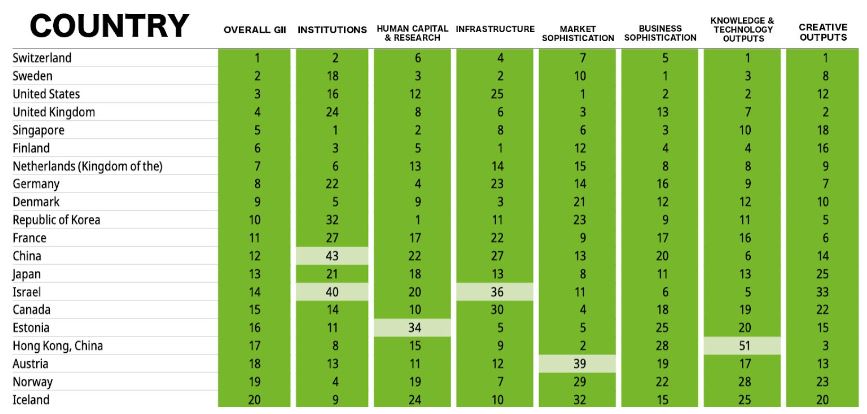
For the 13th consecutive year, Switzerland ranks first in the GII. It is the global leader in innovation outputs, ranking first in both Knowledge and technology outputs and Creative outputs. Sweden overtakes the United States (US) to climb to second position. Sweden leads in Business sophistication (1st), Infrastructure (2nd), and Human capital and research (3rd). It holds top positions for its Researchers (1st) and Knowledge-intensive employment (3rd). The United States continues to head the league table of scoring best in the world in 13 of the 80 GII 2023 innovation indicators. It is number one in the world in indicators that include Global corporate R&D investors, Venture capital received, the quality of its universities, the combined valuation of its unicorn companies (a new GII indicator), software spending, and the value of corporate Intangible asset intensity.
Singapore enters the top five leading in South East Asia, East Asia, and Oceania (SEAO) region economies. Finland (6th) gets closer to the top five, gaining three ranks this year. It comes top worldwide in Infrastructure (1st).
Denmark (9th) and the Republic of Korea (10th) remain in the top 10. France (11th) gets closer, improving one rank this year, while Japan remains strong as the 13th most innovative economy. Israel re-enters the top 15, reaching 14th place.
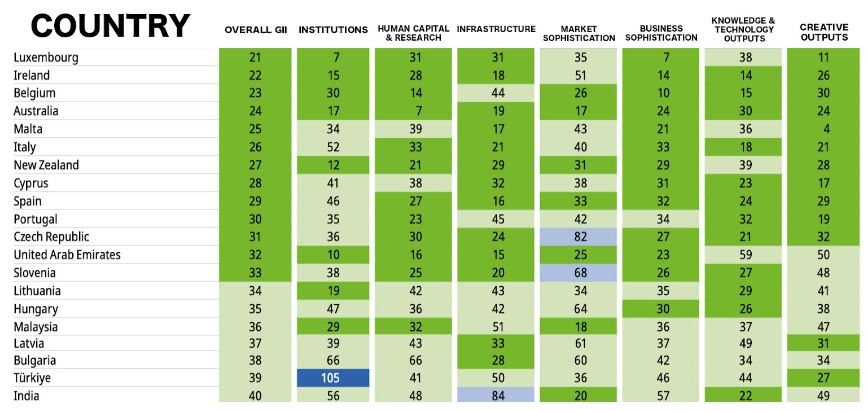
After a rapid ascent, gaining 23 positions over the last decade, China ranks 12th this year, dropping one rank relative to 2022. China remains the sole middle-income economy to secure a position among the top 30, retaining 3rd place in the SEAO region and top spot in the upper middle-income group. Apart from China, there are only four other middle-income economies among the top 40 economies, namely, Malaysia (36th), Bulgaria (38th), Türkiye (39th) and India (40th).
Standout Countries’ 4-year Innovation Surge, 2019–2023
In the last four years, and since the pandemic, Saudi Arabia (48th), Brazil (49th), Mauritius (57th), Indonesia (61st), and Pakistan (88th) ascended most in the GII, in order of their rank progression.
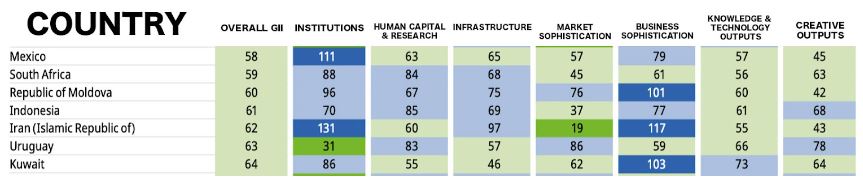
In 2019, Indonesia was ranked 85th with 29.7 points. In 2020, although the points decreased to 26.5, the ranking remained at number 85. The increase was only one point in the following years (2021-2022), but it was enough to increase the ranking to the top 75. Of course, The peak this year is 61st place with 31.3 points.
Indonesia makes marked improvements in innovation outputs, notably in Knowledge Creation and Online Creativity. It excels in ICT-related indicators and ranks among the top 10 globally for University–Industry R&D Collaboration (5th), State of Cluster Development (5th), Entrepreneurship Policies and Culture (5th), and Finance for Startups and Scaleups (8th). However, for Human Capital Research, Indonesia is still very low in the Education (113th) and Tertiary Education (95th) categories.
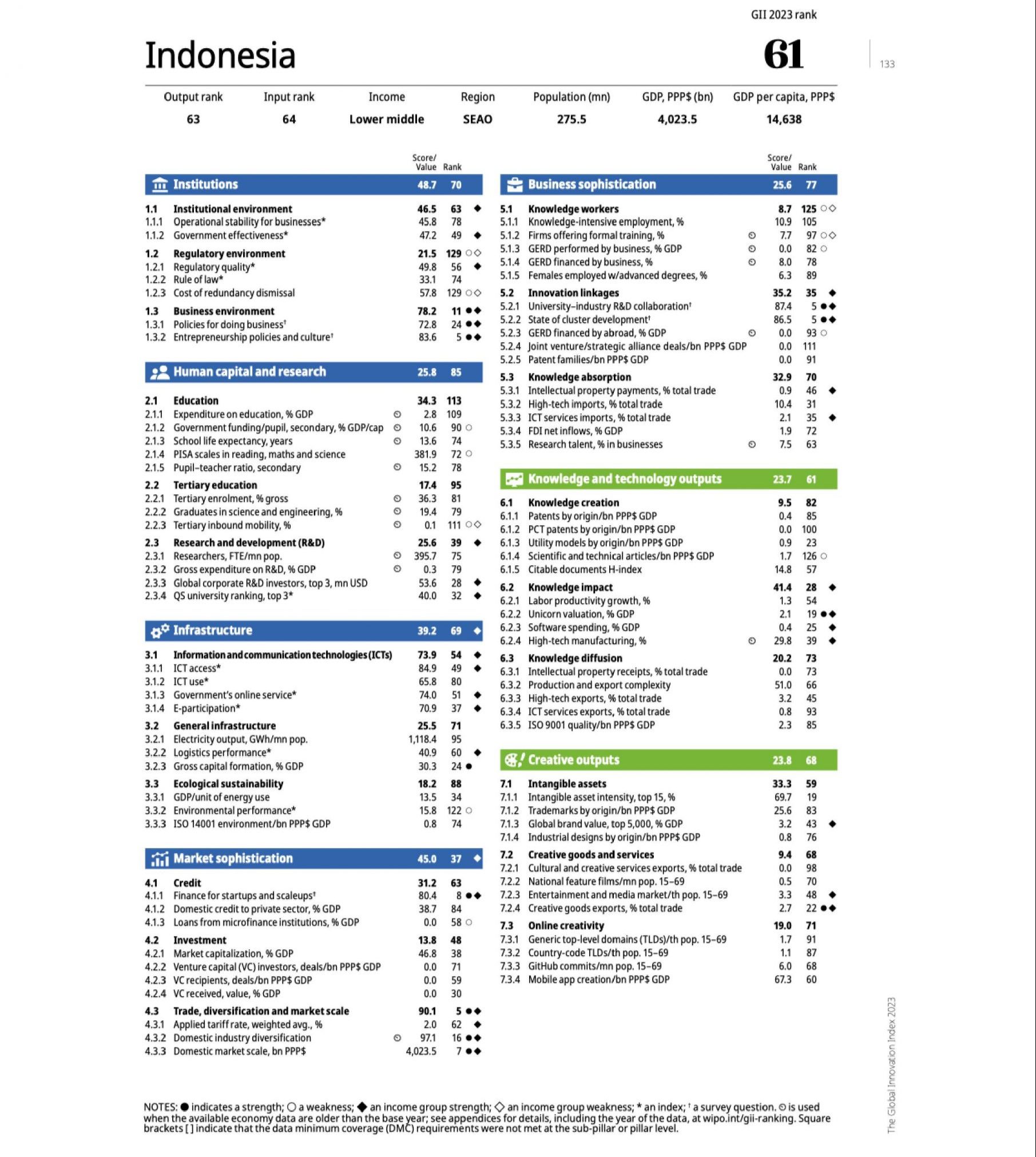
Of the 80 GII determining points, 12, or around 15%, are closely related to Intellectual Property. Therefore, every effort to increase education, protection, and law enforcement regarding IP must be supported to raise Indonesia’s ranking on the Global Innovation Index.
If you need further information regarding the protection and enforcement of laws related to Intellectual Property, do not hesitate to contact us via [email protected].
[dt_divider style=”thin” /]
Source: